flat tire AUDI S8 2010 Owners Manual
[x] Cancel search | Manufacturer: AUDI, Model Year: 2010, Model line: S8, Model: AUDI S8 2010Pages: 384, PDF Size: 90.95 MB
Page 178 of 384

IIIJIL_...!.A~d~a:!.!p~t!_;iv~e~A~ir~S~u~s~p~e:!n.!:s~io~n~ -----------------------------------------
Adaptive Air Suspension
Adaptive Air Suspension and
Damping
Description
Adaptive Air Suspension and damping can be regulated and they adapt automatically to a request from the
driver and the drivin g situati on at the time.
Adaptive Air Suspens ion is an e lectron ically controlled springing and
damping system. This chass is system makes it eas ie r on the d river by
adapting to the particular situation t hrough imperceptible contro l
processes.
T he
Adapt ive Air Su spen sion component regu lates ground clea rance
depending on vehicle speed, load condition and driver input. Acce le r·
a ting to a speed above a predetermined limi t will make the vehicle
lower itself. On the other hand, driving more slow ly results in the
vehicle raising aga in at spe cific speeds .
Th e
damping component provides individua l contro l of the damping
forces. For example, with damp ing characte rist ics set to provide
greater comfort, damp ing is set som ewhat harder for a br ief period
only as req uired, for example, whe n going around a curve or over
roug h road surfaces as we ll as when bra king.
Settings
Adaptive Air Suspension provides the drive r with the opportu nity to
set the chassis characte ristics also to the ir individual preference.
W ith the dr iv in g m odes
standard, automatic and dynamic the d river
has three chassis sett ings available, ranging from comfort to sporty.
In add it io n,
lift prov ides a fourth mode whi ch can be sele cti ng fo r
dr iving over poor stretches of road =:>
page 177, "Chass is Controls".
T he modes a re set in MM I
=:> page 179.
On veh icles equipped w ith the sport su spen sion Adaptive A ir Suspen
sion -Sport *, there is genera lly more emphasis on a sporty chassis
sett ing. Setti ngs ra nge from comfo rtable to fi rm=:>
page 178, "Spo rt
Chassis Cont rols" .
0 Note
• Whenever you park you r vehicle, always ma ke su re there is
adeq uate clea rance above and below t he ve hicle. The heig ht of the
parked veh icle ca n change as the res ult of temperature fluctuat ions,
c hanges in loa d cond ition and changes in the dr iv ing mode (ground
cleara nce) .
• M ount t he tie-down ch ains/ cables over the r unning s urfa ce
(circumfere nce) of the tires . Never secu re the vehicle by the axle, the
suspension st ruts or the front o r re ar tow line eye . For technical
reaso ns, the pressure in t he suspension struts may change dur ing the
transport and this will adverse ly affect vehicle handling.
• To prevent damage to the vehicle u nderbody, remembe r th at your
veh icle is no t an off- road vehicle, even in the lift mode. The ground
cleara nce is insufficient for this type of operation .
• If yo u are go ing to tow a tra il e r, you mus t act iv a te the trai le r oper
ation mode =:>
page 179 .
[I] Tips
Before you ca n ra ise your vehicle using the vehicle jack (fo r examp le ,
w hen changing a flat tire) you must activate the jacking mode
=:>
page 179 . •
Page 181 of 384

____________________________________________ A_ d_a_ p ,_ t_iv _ e_ A _ i_ r _ S_ u_s_, p __ e_n _ s_ i _o_ n __ _
Setting the Driving Modes
The driving modes are set in MMI.
Fig. 1 94 MMI d isplay:
Se tti ngs
The ignition must be switched on to set the driving modes.
- Press the [ CAR]function button. The main menu
Adaptive
Air Suspension
appears::::> fig. 194.
- Select the desired mode with the control knob .
Please note that not every driving mode can be selected in every
driving situation . For examp le, it is not possible to switch to lift mode
at speeds above 50 mph (80 km/h). This mode is shown
greyed out in
the MMI display.
For additiona l information on the driving modes=>
page 177,
"Chass is Controls" . •
Jacking Mode When Changing a Flat Tire
This mode must be activated before raising the vehicle
with a vehicle jack .
Switching jacking mod e on and off
- Select: Function button [CAR]> Adaptive Air Suspension
> function button [SETUP].
Controls and equip
ment Safety first
-
Turn the control knob to Veh icl e jac k mode and select on
or off as desired.
The vehicle jack mode must be act ivated before changing a whee l so
that the automatic control processes for the air suspension do not
make lifting with the vehicle jack more difficult.
In the veh icle jack mode the indicator light in the instrument cluster
w v illuminates.
& WARNING
The hei ght of the parked vehi cle ca n c hange due to te mp erature
fluc tu at ions or c ha ng es in l oad .
[I) Tips
The vehicle jack mode is switched off automatically at speeds above 9
mph (15 km/h). •
Towing a Trailer
Automatic lowering is not desirable when towing a
trailer.
If you are going to tow a trailer, you must activate the tra iler
towing mode .
Switching the trail er towing mode on and off
manually
- Select: Function buttont( CAR]> function button [SETUP].
- Select Trailer towing mode on or off as desired .
Level Adjustm ent when T ow ing a Trail er
The following applies to vehicles with Adaptive Air Suspension:
Vehicle care Technical data
Page 223 of 384

______________________________________________ ___:.A:::::.:.: ir:....: b~ a~g !....= s:ly '..:s~ t~ e~ m~ ---
& WARNING (co ntinued )
• Always make sure that the side airbag can inflate without
interference:
-Never install se at covers or replacement upholstery over the
front seatbacks that have not been specifically approved by
Audi .
- Never use additional seat cushions that cover the areas
where the side airbags inflate .
- Damage to the original seat covers or to the seam in the area
of the side airbag module must always be repaired immedi
ately by an authorized Audi dealer.
• The airbag sy stem can be activated only once. After an airbag
has inflated, it must be replaced by an authorized Audi dealer or
qualified technician who has the technical information , training
and special equipment necessary.
• The airbag sy stem can be deployed only onc e. After an airbag
has been deployed, it must be replaced w ith new replacement
parts de signed and approved es pecially for your Audi model
version . Replacement of complete airbag systems or airbag
components must be performed by qualified workshops only.
Make sure that any airbag service action is entered in your Audi
Warranty
& Maintenance booklet under AIRBAG REPLACEMENT
RECORD.
• For safety reasons in severe accidents, the alternator and
starter are separated from the vehicle battery with a pyrotechni c
circuit interrupter .
- Work on the pyrotechnic circu it interrupter must only be
performed by a qualified dealer -risk of an a ccident!
- If the vehicle or the circu it interrupter is scrapped, all appli
cable safety precautions must be followed .
Controls and equip ment Safety first Vehicle operation
<£' For the sake of the environment
U
ndeployed airbag modules and pretens io ners mig ht be classified as
Perch lorate Material -sp ec ial handling may a pply, see
www.d ts c. ca.gov/ha za rdouswaste/pe rchlorate . W he n t he vehicle or
parts of the restraint system including airbag modules and safety
bel ts wi th prete nsio ners are scra pped, all applica ble laws an d regula
tions m ust be observed. Your authorized Aud i dea ler is familiar with
t hese requireme nts and we recommend tha t you have you r dealer
perform this service for you. •
Other things that can affect Advanced
Airbag performance
Chang ing the ve hicle's suspension system can change the way that
t he Adv anced Airbag System pe rforms in a crash . For example, using
tire-r im combinations not approved by Aud i, lower ing t he veh icle,
c hang ing the st iffness o f the suspe nsio n, incl uding the s prings,
s u spension str uts, shoc k absorbe rs etc. can change the forces that
are meas ured by the airb ag sensors and sen t to the ele ctron ic con trol
uni t. Some suspension changes ca n, for examp le, increase the force
levels measu red by t he sensors and ma ke the airbag sys tem dep loy in
crashes in which it wou ld not deploy if the changes had not bee n
made . Other kin ds of c hanges may re duce the force levels meas ured
by the senso rs and p revent the airbag from dep loyi ng when it should .
The sensors in the safety belt buckle for the d river and front
p assenger se at tell the e le ct ro nic co ntro l mo dule if the sa fe ty belt is
latc hed or not . If the safety be lt is be ing used, the fron t airbag w ill
dep loy at a s ligh tly hig her ra te o f ve hicl e decelerat io n t han if the
safety belt is not be ing us ed. T he refo re, in a part icular collis io n, it is
poss ible that an a irbag wi ll not deploy at a seating posit ion where the
safety belt is being used but wi ll inflate at the posi tion whe re the
safety belt is not bei ng used. It is important that not hing interfere
w ith the s afe ty be lt bu ckles so t hat th e sensor s can sen d the correct
information about safety belt use to the electronic contro l unit. ..
Vehicle care Do-it-yourself service Technical data
Page 269 of 384

Operating instructions
Maximum trailer weight
A trailer for your vehicle is limited to a typical class 1 or class 2 trailer.
Trailer load distribution
Be sure the load in the trailer is held securely in place to prevent it
from shifting forward, backward or sideways.
Never allow a passenger to ride in a trailer=>
& in "Driving instruc
tions".
Engine cooling system
Towing a trailer makes the engine work harder. It is important that
the cooling system's performance is up to the additional load. Make
sure that the cooling system has enough fluid.
Tire pressure
When towing a trailer, inflate the tires of your vehicle to the cold tire
pressure listed under "Full load" on the label located either on the
driver's side B -pillar (visible when the door is open) or inside the fuel
filler flap. Inflate trailer tires to trailer and tire manufacturers' spec
ifications .
Lights
The headlight settings should be checked with the trailer attached
before driving off. Check to make sure both vehicle and trailer lights
are working properly.
Safety chains
Be sure trailer safety chains are properly connected from the trailer
to the hitch on the vehicle. Leave enough slack in the chains to permit
turning corners . When you install safety chains, make sure they will
not drag on the road when you are driving.
The chains should cross under the trailer tongue to prevent it from
dropping in case of separation from the hitch .
Controls and equip ment Safety first Vehicle operation
Trailer
towingL_,1!:::!:·~-
0 Note
If you are going to tow a trailer, you must activate the trailer opera
tion mode =>
page 179, "Towing a Trailer". •
Driving instructions
Driving with a trailer always requires extra care and
consideration .
To obtain the best possible handling of vehicle and trailer,
please note the following:
- Do not tow a loaded trailer when your car itself is not
loaded.
- Be especially careful when passing other vehicles.
- Observe speed limits.
- Do not drive at the maximum permissible speed.
- Always apply brakes early .
- Monitor the temperature gauge.
Weight distribution
Towing a loaded trailer with an empty car results in a highly unstable
distribution of weight. If this cannot be avoided, drive at very low
speeds only to avoid the risk of losing steering control.
A "balanced" rig is easier to operate and control. This means that the
tow vehicle should be loaded to the extent possible and permissible,
while keeping the trailer as light as possible under the circumstances.
Whenever possible, transfer some cargo to the luggage compart
ment of the tow vehicle while observing tongue load requirements
and vehicle loading considerations.
Vehicle care Do-it-yourself service Technical data
Page 308 of 384
-~_T_ i_ re _ s_ a_n _ d_ w_ h _e_ e_ ls _________________________________________________ _
Tires and wheels
Tires
General notes
Tires may be the least appreciated and most abused
parts of a motor vehicle.
T ir es may be the least apprec iated and most abused pa rts of a moto r
vehicle. Tires are, however, one of the most important parts of a
veh icle, parti cularly conside ring the comparative ly small patch of
rubber on eac h tire that assu res that all- important co ntact between
you , your ve hicle and the road .
Ma inta in ing t he correct t ire pressu re, making s ure that your veh icle
and i ts tires do not have to carry more weight than they can safely
hand le, avoid ing damage from road ha za rds and reg ula rly inspect ing
tires for damage incl ud ing c uts, s lashes irregular wea r and overall
condi tion are the mos t important th ings that you can do to help avoi d
sudden tire fa ilure includ ing t read separation and blowouts .
Avoiding damage
If you have to drive over a curb or sim ilar obstacle, drive very s lowly
and as close as poss ible at a right angle to the cu rb .
Always keep chemicals including grease, oil , gasoline and bra ke fl uid
o ff the t ires .
Inspect the ti res regularly for damage (cuts, crac ks o r bl ist ers, e tc .).
Remove any foreign bodies embed ded in the trea ds.
Storing tires
M ar k tires when yo u remove t hem to indica te the d irect ion of rota
tion . This ens ures yo u to be able to mo unt them co rrectly whe n you
re insta ll them.
Wh en r emoved, t he wheels or tires s hould be sto red in a c ool, dry and
preferably da rk p lace. Sto
re tires in a ver tica l pos it ion if they a re not mounted on rims, in a
hor izonta l position if they are mo unted on r ims.
New tires
N ew tires have to be bro ken in~ & .
Th e tread dep th of new tires may v ary, ac cor ding to t he type an d
make of t ire and the tread pattern.
Hidden damage
Dama ge to t ires and rims is often not readi ly visible . If yo u notice
unusu al v ib rat ion o r the veh icle pulls to one sid e, t his may i ndicate
that one of the tires has been damaged. The tires must be c hecke d
i m medi ately by an a uthor ized A udi deale r or quali fied w or ksh op .
Unidirectional tires
A u nidirectional tire can be identified by arrows on the sidewall, that
point in the d irect io n the tire is des igned to rotate. Yo u m ust follow
t he s peci fied dire ction of ro tation . T his is nece ssary so th at t hese
tires can develop the ir optimum c haracter istics regarding gr ip, road
noise, we ar and hy dropl aning res istance. For more informa tion
~page 341 .
& WARNING
New tires or tires that are old , worn or damaged cannot provide
maximum control and braking ability.
• New tires tend to be slippery and must be broken in. To reduce
the risk of losing control, a collision and serious personal injuries, drive with special care for the first 350 miles (560 km) .
• Driving with worn or damaged tires can lead to loss of control,
sudden tire failure , including a blowout and sudden deflation ,
crashes and serious personal injuries. Have worn or damaged tires
replaced immediately. .,_
Page 309 of 384

________________________________________________ T_i_re _ s_ a _ n_d_ w_ h_ e_ e_l_s __ l!'II
& WARNING (co ntinued )
• Tires age even if they are not be ing used and can fail suddenly ,
e specially at high speeds . Tires that are more than 6 year s old can
only be used in an emergency and then with special care and at low
s peed .
Glossary of tire and loading terminology
Accessory weight
means the combined weigh t (in excess of those sta ndard items wh ich
may be replaced) of automatic transmission, power steer ing, power
bra kes, powe r win dows, power sea ts, radio, and heate r, to the exte nt
that these items are available as factory-insta lled equipment
(whet her i ns ta lled or no t).
Aspect ratio
means the r atio of t he he ight to t he widt h of the t ire in percent.
N umbers of 55 or lower indicate a low sidewa ll for improved steer ing
res ponse and bet ter over all h andling on dry p avemen t.
Bead
means the part of the t ire that is made of stee l wi res, w rapped or
re in forced by ply cords and that is shaped to fit the rim.
Bead separation
means a brea kdown of the bond between components in the bead.
Cord
means the st rands forming the plies in the ti re.
Safety first
& W ARNING (co ntinued )
• Never mount u sed tires on your vehicle if you are not sure of
their "previous history ." Old u sed tires may have been damaged
eventhoughthedamagecannotbeseenthatcanleadtosudden
tire failure and loss of vehicle control.
• If you notice unusual vibr ation or if the vehicle pulls to one side
when driving, always stop as soon as it is safe to do so and check
the wheels and tires for damage. •
Cold tire inflation pressure
means the t ire pressu re recom mended by the vehicle manufa ctu rer
for a tire of a desig nate d size that has not been driven for more than
a couple of m iles ( kilomete rs) a t low speeds in the t hree hour per io d
before the tire pressu re is measured or adjusted.
Curb weight
means the weight of a moto r vehicle wit h standard equipment
incl uding the max imum ca pac it y of fue l, o il, and coo lan t, air condi
tioning and additiona l weig ht of optional eq uipment.
Extra load tire
means a tire design to operate at higher loads and at higher inflat ion
pressures than t he co rresponding sta ndard t ire. Extra load tires may
be identif ied as "XL", "xl", "EXTRA LOAD", or "RF" on the sidewa ll.
Gross Axle Weight Rating ( "GAWR ")
means the loa d-carrying capac ity of a sing le ax le system, measure d at
the t ire-grou nd interfaces.
Gross Vehicle Weight Rating ("GVWR")
mea ns the maximum tota l loaded we ig ht of the vehicle .
Vehicle care Technical data
Page 310 of 384

-~_T_ i_ re _ s_ a_n _ d_ w_ h _e_ e_ ls _________________________________________________ _
Groove
means the space between two adjacent tread ribs.
Load rating (code)
means the maximum load that a tire is rated to carry for a given infla
tion pressure. You may not find this information on all tires because
it is not required by law.
Maximum load rating
means the load rating fo r a tir e at the maximum permissible inflation
pressure for that tire.
Maximum loaded vehicle weight
means the sum of:
(a) Curb weight
(b) Accessory weight
(c) Vehicle capacity weight, and
(d) Production options weight
Maximum (permissible) inflation pressure
means the maximum cold inflation pressure to which a tire may be
inflated. Also called "maximum inflation pressure."
Normal occupant weight
means 150 lbs. (68 kilograms) times the number of occupants seated
in the vehicle up to the total seating capacity of your vehicle.
Occupant distribution
means distr ibution of occupants in a vehicle .
Outer diameter
means the overall diameter of an inflated new tire.
Overall width
means the linear distance between the exteriors of the sidewalls of
an inflated tire, including elevations due to labeling, decorations, or
protective bands or ribs.
Ply
means a layer of rubber -coated paralle l cords.
Production options weight
means the combined weight of those installed regular production
options weigh ing over 5 lbs. (2.3 kg) in excess of those standard
items which they replace, not previously considered in curb weight or
accessory weight, including heavy duty brakes, ride levelers, roof
rack, heavy duty battery, and special trim.
Radial ply tire
means a pneumatic tire in which the ply cords that extend to the
beads are laid at substantially 90 degrees to the centerline of the
tread .
Recommended inflation pressure
see=> page 307, "Cold tire inflation pressure".
Reinforced tire
means a tire design to operate at higher loads and at higher inflation
pressures than the corresponding standard tire. Reinforced t ires may
be identified as "XL ", "x l", "EXTRA LOAD", or "RF" on the sidewall.
Rim
means a metal support for a tire or a tire and tube assembly upon
wh ich the tire beads are seated .
Rim diameter
means nominal diameter of the bead seat . If you change your wheel
size, you w ill have to purchase new tires to match the new rim diam
eter .
Rim size designation
means rim diameter and width.
Rim width
means nom inal distance between rim flanges.
Page 311 of 384

________________________________________________ T_i_re _ s_ a _ n_d_ w_ h_ e_ e_l_s __ _
Sidewall
means that portion of a tire between the tread and bead.
Speed rating (letter code)
means the speed at which a tire is designed to be driven for extended
periods of time. The ratings range from 93 mph (150 km/h) to 186
mph (298 km/h)=>
page 320. You may not find this information on
all tires because it is not required by law .
The speed rating letter code, where applicable, is molded on the tire
sidewall and indicates the max imum permissible road speeds=>
& in
"Winter tires" on
page 323.
Tire pressure monitoring system*
means a system that detects when one or more of a vehicle's tires are
underinflated and illuminates a low tire pressure warning telltale.
Tread
means that portion of a tire that comes into contact with the road.
Tread separation
means pulling away of the tread from the tire carcass .
Treadwear indicators (TWI)
means the projections within the principal grooves designed to give a
visual indication of the degrees of wear of the tread. See=>
page 317,
"Tread Wear Ind icator (TWI)" for more information on measuring
tire wear.
Uniform Tire Quality Grading
is a tir e information system developed by the United States National
Highway Traffic Safety Administration (NHTSA) that is designed to
help buyers make relative comparisons among tires. The UTQG is not
a safety rating and not a guarantee that a tire will last for a prescribed
number of miles (kilometers) or perform in a certain way. It simp ly
gives tire buyers additional information to combine with other
considerations, such as price, brand loyalty and dealer recommenda
tions. Under UTQG, tires are graded by the tire manufacturers in three
Safety first
areas: treadwear, traction, and temperature resistance . The UTQG
information on the tires, molded into the sidewalls.
U.S. DOT Tire Identification Number (TIN)
This is the tire's "serial number" It begins with the letters "DO T" and
indicates that the tire meets all federal standards. The next two
numbers or letters indicate the plant where it was manufac tured, and
the last four numbers represent the week and year of manufacture.
For example,
DOT ... 2209 ...
means that the tire was produced in the 22nd week of 2009 . The
other numbers are ma rket ing codes that may or may not be used by
the tire manufacturer . Th is information is used to contact consumers
if a tire defect requires a recall.
Vehicle capacity weight
means the rated cargo and luggage load plus 150 lbs. (68 kilograms)
times the vehicle's total seating capacity as listed on the label located
either on the driver's side B-pillar or on the inside of the fu e l filler
flap.
Vehicle maximum load on the tire
means that load on an individual tire that is determined by distrib
ut ing to each axle its share of the maximum loaded vehicle weight
and dividing by two.
Vehicle normal load on the tire
means that load on an individual tire that is determined by distrib
uting to each axle its share of the curb weight, accessory weight, and
normal occupant weight (distributed in accordance with tab le below
=> page 310) and dividing by two. ._
Vehicle care Technical data
Page 312 of 384
___ T_ i_ r _e _s_ a_n_ d_ w_ h_ e_e_ l_ s _______________________________________________ _
Occ up ant loading and distribution for vehi cle normal load for various d esignated seating capacit ies
Designated seating capacity, num- Vehicle normal load , number of Occupant distribution in a nor
mally loaded vehicle
ber of occupants occupants
4
5
Cold tire inflation pressure
2
3
2 in front
2 in front, 1 in back seat
Tire pressure affects the overall handling, performance and safety of a vehicle.
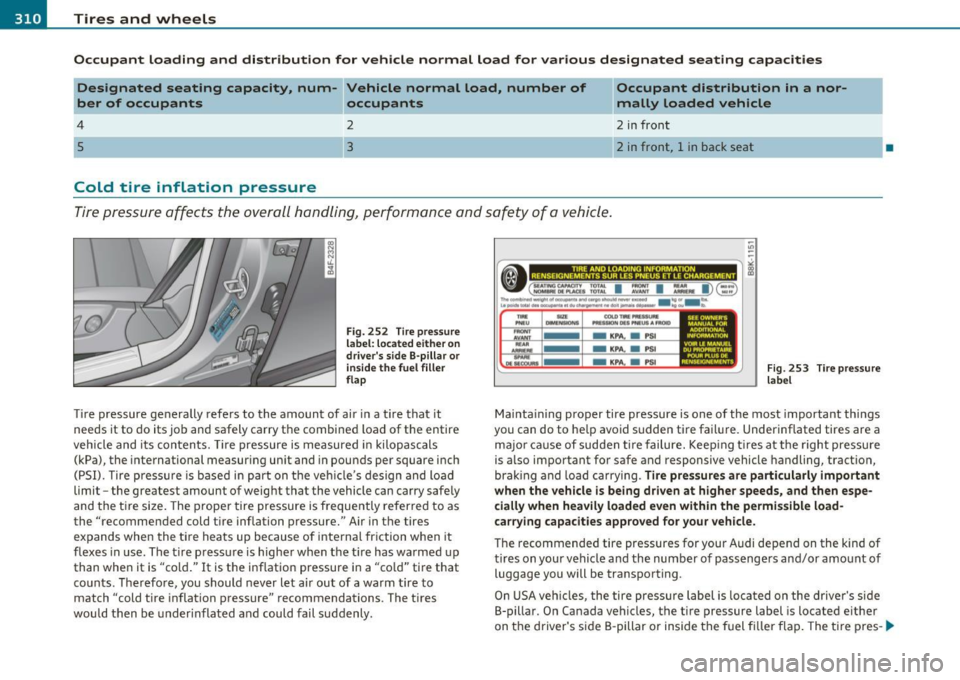
Fig. 252 Ti re pre ssure
l a bel : lo cate d eit he r o n
driver 's s ide B-pilla r or
in sid e t he fue l fill er
flap
TVIE' I IU COl.D 'nRI! MCUUM
PNIU DIMCNIIONII PMIIION Dtl "*lit A f:11101>
....
·-.. OIIICOUM
- KPA,. PSI
- KPA,. PSI
- KPA,. PSI
Fig. 2 53 Tire pre ssure
lab el
Ma inta in ing p roper tire pressure is one of the most important th ings
you can do to he lp avoid sudden tire fa ilure. Underinflated tires are a
ma jo r ca use of sudden t ire failure. Keep ing t ires a t the right pressu re
is a lso important for safe and responsive vehicle handling, tract ion,
bra king and loa d ca rry ing .
Tire pre ssures are particularly important
when the vehicle is be ing dr iven at higher speeds, and then espe
cially when he avily loaded even within the permi ssible load·
carr ying capacities approved for your veh icle.
Th e recommended tire pressures for your Audi depend on the kind of
tires on your vehicle and the number of passengers and/or amount of luggage you will be transporting.
O n USA veh icles, the tire pressure label is lo cated on the drive r's side
8-pillar. On Canada vehicles, the t ire pressure label is located either
•
T ir e pressure ge nera lly refers to the amount of air in a t ire that it
needs it to do its job and safely carry the combined load of the entire
veh icle and i ts conten ts. Tir e pressure is measured in kilopascals
(kPa), the international measur ing unit and in pounds per square inch
(PSI) . Tire press ure is based in part on the veh icle 's design and load
limit -the greatest amount of weight that the vehicle can carry safe ly
and the t ire size . The proper tire pressure is frequently referred to as
the "recommended cold t ire inflation pressure." Air in the tires
expands when the ti re hea ts up because of i nterna l fr iction when it
flexes in use. The ti re p ressu re is highe r when the t ire has wa rmed up
than when it is "cold ." It is the inflation pressure in a "co ld" tire that
co unts . Therefo re, you should never let air out of a warm tire to
match "cold tire inflation pressure" recommendations . The t ires
would then be under inflated and could fail suddenly.
on the driver's side 8-pillar o r inside the fuel f iller flap. The ti re pres- ...
Page 313 of 384

Tires and wheels Ill
----------------
sure label lists the recommended cold tire inflation pressures for the
vehicle at its maximum capacity weight and tires that were on your
vehicle at the time it was manufactured.
If you wish to improve comfort when operating the vehicle at
normal load (up to 3 occupants), you can adjust tire pressures to
those specified for normal vehicle load. Before operating the
vehicle at maximum load, you must increase the tire pressures to
those specified for maximum vehicle load~& .
Bear in mind that the tire pressure monitoring system* can only
mon itor the tire pressures you have stored . The system does not
recognize the load condition of your vehicle.
Th e effectiveness of the tire pressure monitoring system* will be
impaired if you store normal load pressures but then operate the
vehicle at its maximum load~.&, . See the
illustration
~ page 310, fig. 2 52 for the locat ion of the label
either on dr iver's side B-pillar or inside the fuel filler flap (color of the
actual label and exact location on the vehicle will vary slightly) .
Note that the following tab le is accurate at the time of going to press
and is subject to change. In the event of discrepancies , the tire pres
sure label (On USA vehicles, the tire pressure label is located on the
dr ive r's side B -pillar . On Canada veh icles, the tire pressure label is
located either on the dr iver's s ide B-pillar or inside the fue l f ill er flap)
always takes precedence.
The table below lists the recommended cold t ire inflation pressures
for the Audi model covered by your Owner's Literature at the vehicle's
capacity weight and the tire sizes insta lled on the respective models
as original equipment, or as a factory option .
Engine Tire designation Tire pressure front Tire pressure rear
(displace- normal load full load normal load
full load
ment in conditiona> condition conditiona> condition
liter)
PSI kPA PSI kPA
a -cylinder 255/45 Rla 99H All Season
33 230 36 250 30 210 35 240
4.2
255/40 Rl9 l0OV XL All Season 36 250 39 270 33 38 260
255/40 Rl9 l00Y XL High Performance 33 230 36 250 30 210 35 240
265/35 R20 99V XL High Performance 35 240 38 260 32 220 36 250
275/35 R20 102V XL High Performance 38 260 41 280 35 240 44 300
a-cylinder 255/45 Rla 99H All Season 33 230 36 30 210 35 240
4.2 L
255/40 Rl9 l00V XL All Season 36 250 39 270 33 230 38 260
255/40 R19 l00Y XL High Performance 33 230 36 250 30 35 240
275/35 R20 102V XL High Performance 38 260 41 280 35 240 44 300
Safety first Vehicle care Technical data