inflation pressure AUDI S8 2010 Owners Manual
[x] Cancel search | Manufacturer: AUDI, Model Year: 2010, Model line: S8, Model: AUDI S8 2010Pages: 384, PDF Size: 90.95 MB
Page 309 of 384

________________________________________________ T_i_re _ s_ a _ n_d_ w_ h_ e_ e_l_s __ l!'II
& WARNING (co ntinued )
• Tires age even if they are not be ing used and can fail suddenly ,
e specially at high speeds . Tires that are more than 6 year s old can
only be used in an emergency and then with special care and at low
s peed .
Glossary of tire and loading terminology
Accessory weight
means the combined weigh t (in excess of those sta ndard items wh ich
may be replaced) of automatic transmission, power steer ing, power
bra kes, powe r win dows, power sea ts, radio, and heate r, to the exte nt
that these items are available as factory-insta lled equipment
(whet her i ns ta lled or no t).
Aspect ratio
means the r atio of t he he ight to t he widt h of the t ire in percent.
N umbers of 55 or lower indicate a low sidewa ll for improved steer ing
res ponse and bet ter over all h andling on dry p avemen t.
Bead
means the part of the t ire that is made of stee l wi res, w rapped or
re in forced by ply cords and that is shaped to fit the rim.
Bead separation
means a brea kdown of the bond between components in the bead.
Cord
means the st rands forming the plies in the ti re.
Safety first
& W ARNING (co ntinued )
• Never mount u sed tires on your vehicle if you are not sure of
their "previous history ." Old u sed tires may have been damaged
eventhoughthedamagecannotbeseenthatcanleadtosudden
tire failure and loss of vehicle control.
• If you notice unusual vibr ation or if the vehicle pulls to one side
when driving, always stop as soon as it is safe to do so and check
the wheels and tires for damage. •
Cold tire inflation pressure
means the t ire pressu re recom mended by the vehicle manufa ctu rer
for a tire of a desig nate d size that has not been driven for more than
a couple of m iles ( kilomete rs) a t low speeds in the t hree hour per io d
before the tire pressu re is measured or adjusted.
Curb weight
means the weight of a moto r vehicle wit h standard equipment
incl uding the max imum ca pac it y of fue l, o il, and coo lan t, air condi
tioning and additiona l weig ht of optional eq uipment.
Extra load tire
means a tire design to operate at higher loads and at higher inflat ion
pressures than t he co rresponding sta ndard t ire. Extra load tires may
be identif ied as "XL", "xl", "EXTRA LOAD", or "RF" on the sidewa ll.
Gross Axle Weight Rating ( "GAWR ")
means the loa d-carrying capac ity of a sing le ax le system, measure d at
the t ire-grou nd interfaces.
Gross Vehicle Weight Rating ("GVWR")
mea ns the maximum tota l loaded we ig ht of the vehicle .
Vehicle care Technical data
Page 310 of 384

-~_T_ i_ re _ s_ a_n _ d_ w_ h _e_ e_ ls _________________________________________________ _
Groove
means the space between two adjacent tread ribs.
Load rating (code)
means the maximum load that a tire is rated to carry for a given infla
tion pressure. You may not find this information on all tires because
it is not required by law.
Maximum load rating
means the load rating fo r a tir e at the maximum permissible inflation
pressure for that tire.
Maximum loaded vehicle weight
means the sum of:
(a) Curb weight
(b) Accessory weight
(c) Vehicle capacity weight, and
(d) Production options weight
Maximum (permissible) inflation pressure
means the maximum cold inflation pressure to which a tire may be
inflated. Also called "maximum inflation pressure."
Normal occupant weight
means 150 lbs. (68 kilograms) times the number of occupants seated
in the vehicle up to the total seating capacity of your vehicle.
Occupant distribution
means distr ibution of occupants in a vehicle .
Outer diameter
means the overall diameter of an inflated new tire.
Overall width
means the linear distance between the exteriors of the sidewalls of
an inflated tire, including elevations due to labeling, decorations, or
protective bands or ribs.
Ply
means a layer of rubber -coated paralle l cords.
Production options weight
means the combined weight of those installed regular production
options weigh ing over 5 lbs. (2.3 kg) in excess of those standard
items which they replace, not previously considered in curb weight or
accessory weight, including heavy duty brakes, ride levelers, roof
rack, heavy duty battery, and special trim.
Radial ply tire
means a pneumatic tire in which the ply cords that extend to the
beads are laid at substantially 90 degrees to the centerline of the
tread .
Recommended inflation pressure
see=> page 307, "Cold tire inflation pressure".
Reinforced tire
means a tire design to operate at higher loads and at higher inflation
pressures than the corresponding standard tire. Reinforced t ires may
be identified as "XL ", "x l", "EXTRA LOAD", or "RF" on the sidewall.
Rim
means a metal support for a tire or a tire and tube assembly upon
wh ich the tire beads are seated .
Rim diameter
means nominal diameter of the bead seat . If you change your wheel
size, you w ill have to purchase new tires to match the new rim diam
eter .
Rim size designation
means rim diameter and width.
Rim width
means nom inal distance between rim flanges.
Page 312 of 384
___ T_ i_ r _e _s_ a_n_ d_ w_ h_ e_e_ l_ s _______________________________________________ _
Occ up ant loading and distribution for vehi cle normal load for various d esignated seating capacit ies
Designated seating capacity, num- Vehicle normal load , number of Occupant distribution in a nor
mally loaded vehicle
ber of occupants occupants
4
5
Cold tire inflation pressure
2
3
2 in front
2 in front, 1 in back seat
Tire pressure affects the overall handling, performance and safety of a vehicle.
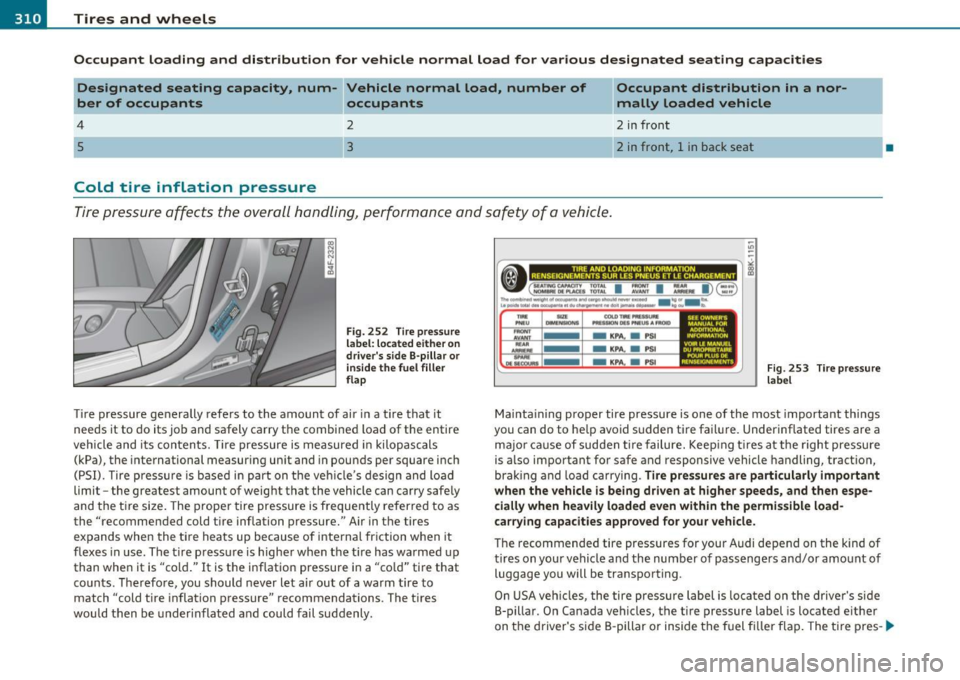
Fig. 252 Ti re pre ssure
l a bel : lo cate d eit he r o n
driver 's s ide B-pilla r or
in sid e t he fue l fill er
flap
TVIE' I IU COl.D 'nRI! MCUUM
PNIU DIMCNIIONII PMIIION Dtl "*lit A f:11101>
....
·-.. OIIICOUM
- KPA,. PSI
- KPA,. PSI
- KPA,. PSI
Fig. 2 53 Tire pre ssure
lab el
Ma inta in ing p roper tire pressure is one of the most important th ings
you can do to he lp avoid sudden tire fa ilure. Underinflated tires are a
ma jo r ca use of sudden t ire failure. Keep ing t ires a t the right pressu re
is a lso important for safe and responsive vehicle handling, tract ion,
bra king and loa d ca rry ing .
Tire pre ssures are particularly important
when the vehicle is be ing dr iven at higher speeds, and then espe
cially when he avily loaded even within the permi ssible load·
carr ying capacities approved for your veh icle.
Th e recommended tire pressures for your Audi depend on the kind of
tires on your vehicle and the number of passengers and/or amount of luggage you will be transporting.
O n USA veh icles, the tire pressure label is lo cated on the drive r's side
8-pillar. On Canada vehicles, the t ire pressure label is located either
•
T ir e pressure ge nera lly refers to the amount of air in a t ire that it
needs it to do its job and safely carry the combined load of the entire
veh icle and i ts conten ts. Tir e pressure is measured in kilopascals
(kPa), the international measur ing unit and in pounds per square inch
(PSI) . Tire press ure is based in part on the veh icle 's design and load
limit -the greatest amount of weight that the vehicle can carry safe ly
and the t ire size . The proper tire pressure is frequently referred to as
the "recommended cold t ire inflation pressure." Air in the tires
expands when the ti re hea ts up because of i nterna l fr iction when it
flexes in use. The ti re p ressu re is highe r when the t ire has wa rmed up
than when it is "cold ." It is the inflation pressure in a "co ld" tire that
co unts . Therefo re, you should never let air out of a warm tire to
match "cold tire inflation pressure" recommendations . The t ires
would then be under inflated and could fail suddenly.
on the driver's side 8-pillar o r inside the fuel f iller flap. The ti re pres- ...
Page 313 of 384

Tires and wheels Ill
----------------
sure label lists the recommended cold tire inflation pressures for the
vehicle at its maximum capacity weight and tires that were on your
vehicle at the time it was manufactured.
If you wish to improve comfort when operating the vehicle at
normal load (up to 3 occupants), you can adjust tire pressures to
those specified for normal vehicle load. Before operating the
vehicle at maximum load, you must increase the tire pressures to
those specified for maximum vehicle load~& .
Bear in mind that the tire pressure monitoring system* can only
mon itor the tire pressures you have stored . The system does not
recognize the load condition of your vehicle.
Th e effectiveness of the tire pressure monitoring system* will be
impaired if you store normal load pressures but then operate the
vehicle at its maximum load~.&, . See the
illustration
~ page 310, fig. 2 52 for the locat ion of the label
either on dr iver's side B-pillar or inside the fuel filler flap (color of the
actual label and exact location on the vehicle will vary slightly) .
Note that the following tab le is accurate at the time of going to press
and is subject to change. In the event of discrepancies , the tire pres
sure label (On USA vehicles, the tire pressure label is located on the
dr ive r's side B -pillar . On Canada veh icles, the tire pressure label is
located either on the dr iver's s ide B-pillar or inside the fue l f ill er flap)
always takes precedence.
The table below lists the recommended cold t ire inflation pressures
for the Audi model covered by your Owner's Literature at the vehicle's
capacity weight and the tire sizes insta lled on the respective models
as original equipment, or as a factory option .
Engine Tire designation Tire pressure front Tire pressure rear
(displace- normal load full load normal load
full load
ment in conditiona> condition conditiona> condition
liter)
PSI kPA PSI kPA
a -cylinder 255/45 Rla 99H All Season
33 230 36 250 30 210 35 240
4.2
255/40 Rl9 l0OV XL All Season 36 250 39 270 33 38 260
255/40 Rl9 l00Y XL High Performance 33 230 36 250 30 210 35 240
265/35 R20 99V XL High Performance 35 240 38 260 32 220 36 250
275/35 R20 102V XL High Performance 38 260 41 280 35 240 44 300
a-cylinder 255/45 Rla 99H All Season 33 230 36 30 210 35 240
4.2 L
255/40 Rl9 l00V XL All Season 36 250 39 270 33 230 38 260
255/40 R19 l00Y XL High Performance 33 230 36 250 30 35 240
275/35 R20 102V XL High Performance 38 260 41 280 35 240 44 300
Safety first Vehicle care Technical data
Page 315 of 384

Tires and wheels -________________ Effll
& WARNING
• Incorr ect tire pressures and /or underinflation can lead to a
s erious or fatal accident .
• Incor rect tire pressures and /or unde rinflation cause increased
tire wear and can aff ect the handling of the vehicle .
• Incorrect tire pressures and /or underinflation can also lead to
sudden tire failure , including a blowout and sudden deflation,
caus ing loss of vehicle cont rol. •
Checking tire pressure
The correct tire pressure for the tires orig in a lly installed
on your vehicle is listed on the tire pressure label located
either on driver 's sid e 8-pillar or inside the fuel filler flap.
The recommended tire pressures a re on the tire p ressure labe l and in
t he table => page 310, "Cold tire infla tion pressure ".This means that
the pressure must be chec ked and adjusted when the tire has not
bee n dr iven for more tha n a coup le of m iles (k ilomete rs) at low
speeds dur ing t he previous three ho urs . Air in t he tires expands when
t he tire hea ts up as a r esu lt of in te rna l fr ic tion as it flexes in use. The
tire pressure is higher when the tire has warmed up than when it is
" ld "
co .
It is the inflation pressu re in a "cold" ti re that counts. Therefore, yo u
sho uld never let air out of a warm tire to matc h "Cold tire inflation
pressure" recommendations=>
page 310. The t ires would then be
underinflated and co uld fail sudden ly.
Th e tire press ure label on your Audi lists the re comme nded cold t ire
inflation pressures at max imum capacity for t he new, origina l equip
ment tire s that were on yo ur vehi cle at t he time it was m anufactu red .
For the location of the label=>
page 310 , fig. 252.
M ost tires lose air nat urally
over time. They can also lose some air if
you d rive
over a potho le or hi t a curb while pa rking. It is usually not
Safety first
poss ible to see whether the radial t ires used today are underinflated
ju st by loo king at th em.
Th erefore, be sure to check t ire pressures a t least once a month and
always before going on a long trip. Make sure to take the n umber of
people a nd t he amount of luggage into account whe n ad justi ng tire
pressure for a tr ip -
even one that you would not consider to be
" long. " See =>
page 314, "Ti res and vehicle load limits" fo r more
important information.
Always use an acc urate t ire pressure ga uge when chec king and
adjust ing inf lation press ures. Check all of the tires and be sure not to
forget the spare tire . If the press ure in any tire is too hig h when the
t ir e is "cold," let air out of the t ire s lowly w it h the edge of the t ire
gauge and keep chec king the pressure u nti l yo u reach the pressure
t ha t is co rre ct for the load (passenge rs an d luggage) a nd kind of
dr iv ing you plan to do.
If the pressure in any ti re is too low, note t he difference betwee n th e
pressure in the co ld tire and the pressure you need and add the a ir
tha t you need to reach the correct p ressu re fo r th e ve hicle load
(passengers a nd luggage) fo r th e tires on yo ur vehicle as listed on the
on your vehicle and in this man ua l and the kind of driving you p lan to
do .
Never e xceed the max imum inflation pressure l isted on the tire
s idewall for any reason.
Remember that the vehicle manufacture r, not the t ire manufacturer,
de termines the correct tire press ure for the t ires on your vehicle.
It is i mport ant to che ck the t ire pressure when t he ti res a re cold.
• Read the required t ire pressure from the t ire pressure label. On
US A veh icles, the tire pressu re labe l is loca ted on the d river's si de B
pillar . On Canada vehicles, the tire pressure label is located either on
t he drive r's side B-pillar or inside the fuel fille r flap.
• Turn the
valve stem cap counter -clockw ise to remove it from the
tire
valve.
• Place the air press ure gauge on the valve. ..,.
Vehicle care Technical data
Page 316 of 384
-~_T_ ir_e_ s_ a_ n_ d_ w_ h_e_ e_ ls _______________________________________________ _
• The tire pr ess ure s sho uld o nly be c hecke d an d adjusted wh en the
t ire s ar e cold . Th e slightly rais ed pr ess ure s of war m tir es mu st not b e
r e d uced .
• Adjust th e tire p re ss ur e to t he load yo u a re ca rr yin g.
• Reinstall the valve stem cap on the valve.
When should I check the tire pressure?
The correct tire press ure is especia lly imp orta nt at high speeds . T he
pr essu re s hou ld t here fo re b e ch ec ked at least onc e a mo nth an d
always be fore sta rting a jo ur ney. Do not fo rget to check the tire pres
su re for th e s pare wheel~
page 33 4.
When should I adjust the tire pressures?
Adjus t the tire pr essur e to th e load yo u are carrying . A ft e r changi ng a
w heel
or replac ing w heels yo u have to adjust the ti re pressures on all
w heels. In addi tio n, yo u mu st then stor e the new tir e press ures in the
tire pressu re monitoring system*~
page 326.
& WARNING
Incorrect tire pressures and/or underinflation can lead sudden tire
failure, los s of control, collision, serious personal injury or even
death.
• When the warning symbol appears in the instrument
cluster , stop and inspect the tires.
• Incorrect tire pressure and/or underinflation can cause
increased tire wear and can affect the handling of the vehicle and
stopping ability.
• Incorrect tire pressures and/or underinflation can also lead to
sudden tire failure, including a blowout and sudden deflation,
causing loss of vehicle control.
• The dr iver is responsible for the correct tire pressures for all
tires on the vehicle. The applicable pressure values are located on
a sticker on the driver 's side 8-pillar or on the inside of the fuel
filler flap .
& WARNING (co ntinued )
• Only when all tires on the vehicle are filled to the correct pres
sure, the tire pressure monitoring* system can work correctly .
• The use of incorrect tire pressure values can lead to accidents or
other damage. Therefore it is essential that the driver observe the
specified tire pressure values for the tires and the correct pres
sures for the function of the tire pressure monitoring system*.
• Always inflate tires to the recommended and correct tire pres
sure before driving off .
• Driving with underinflated tires bend more , letting them get
too hot resulting in tread separation, sudden tire failure and loss
of control.
• Excessive speed and/overloading can cause heat build-up,
sudden tire failure and loss of control.
• If the tire pressure is too low or too high, the tires will wear
prematurely and the vehicle will not handle well.
• If the tire is not flat and you do not have to change a wheel
immediately, drive at reduced speed to the nearest service station
to check the tire pressure and add ai r as required.
0 Note
Dr iv ing witho ut valve stem caps can caus e damage to the tire valves.
T o preven t this, alw ays m ake s ure th at facto ry installe d valv e st em
caps o n all whee ls a re securely mo unted o n the valve.
Tires and vehicle load limits
T here a re lim its to the amount of load or we ight that any veh icle a nd
a ny t ire c an car ry. A veh icle th at is overloade d wi ll not ha n dle we ll an d ...
Page 321 of 384

________________________________________________ T_i_re _ s_ a _ n_d_ w_ h_ e_ e_l_s __ _
0
-
©
®
@
-
@
U.S . DOT tire identification number
Audi Original tire
Sever snow conditions
Tire ply composition and materials used
Treadwear, traction and temperature grades Ma ximum perm issible inflation pressure
The tires and rims are essential parts of the vehicle's design . The tires
and rims approved by Audi are specially matched to the characteris
tics of the vehicle and can make a major contribution to good road
holding and safe handling when in good condition and properly
inflated =>
&.
We recommend that all work on tires and wheels be performed by an
authorized Audi dealer. They are familiar with recommended proce
dures and have the necessary special tools and spare parts as well as
the proper facilities for disposing of the old tires.
Authorized Audi dealers have the necessary information about tech
nical requirements for installing or changing tires and rims.
Replacing tires and wheels
Tires should be replaced at least in pairs and not individually (for
example both front tires or both rear tires together).
Be sure to read and heed the information to the tire pressure moni
toring system* =>
page 320.
Always buy replacement radial tires that have the same specifications
as the tires approved for your vehicle by Audi. Replacement tires must
always have the same load rating specification as the original equip
ment or approved optional tires listed in the table=>
page 310.
Audi-approved specification tires are specially matched to your
vehicle and its load limits, and can contribute to the important road-
Safety first
holding, driving characteristics, and safety of the vehicle. The table
(=>
page 310) lists specifications of the tires approved for the Audi
models covered by your Owner's Literature.
The tire pressure label located either on driver's side B-pillar or inside
the fuel filler flap (=>
page 310, fig. 253) lists the specifications of
the original equipment tires installed on your vehicle at the time it
was manufactured.
Federal law requires tire manufacturers to place standardized infor
mation on the sidewall of all tires=>
page 318, fig. 256. This infor
mation identifies and describes the fundamental characteristics, the
quality grade of the tire and also provides a tire identification number
for safety standard certification and in case of a recall.
Tire specifications
Knowledge of tire specifications makes it easier to choose the correct
tires. Radial tires have the tire specifications marked on the sidewall,
for example:
255/45 R 18 99 H
This contains the following information:
P Indicates the tire is for passenger cars (where applicable)
255 Nominal tire width in mm of the tire from sidewall edge to side-
wall edge. In general, the larger the number, the wider the tire
45 Height/width ratio in percent (aspect ratio)
R Tire construction: Radial
18 Rim diameter code (in inches)
99 Load rating code
H Speed rating letter code
XL (or "xl", "EXTRA LOAD" or "RF") indicates that the tire is a "Rein
forced" or an "Extra Load" tire
M+S (or "M/5") Indicates that the tire has some mud and snow capa
bility
The tires could also have the information of direction of rotation
=>
page 306 .
Vehicle care Technical data
Page 322 of 384

-Tires and wheels
---------------------------------------------
Tire manufacturing date
The manu fac tu rin g date is also indica ted on the tire sidewa ll
(poss ibly only on the
inner s ide of the w heel):
"DOT . .. 2209 ... "means, fo r example, the t ire was prod uced in the
2 2n d week of 200 9.
Speed rating (letter code )
The speed rat ing lett er code on the w heels ind icates t he maxim um
permissible road speeds => & in "Winter t ires" on
page 323 .
P up to 93 mph (150 km/h)
Q up to 99 mph (158 km/h)
R up to 1 06 mph (1 70 km/h)
S up to 110 mp h (1 80 km /h)
T up to 118 mph ( 190 km/ h)
U up to 124 mp h (200 km/ h)
H up to 130 mph (210 km/h)
V up to 149 mph (240 km/h)
3>
Z over 149 mph ( 240 km/ h)3>
W up to 16 8 mph ( 270 km/h)3
)
Y up to 186 mp h (298 km/h)3>
Your vehicle is normally factory eq uipped with t ires, which possess
ex cellen t dr iv in g ch aract eri sti cs a nd give your Audi op timum driv ing
comfort. A n elect ronic spe ed limiter=>
page 26will normally prevent
your vehicle from goin g faste r tha n the t ire speed rating =>& .
U.S. DOT Tire Identification Number (TIN) and tire
manufacture date
Th is is the t ire's "ser ial nu mber" . It begi ns w ith t he letters "DOT" a nd
ind ic at es that t he tire mee ts all f ed eral stan dards. The nex t two
numbe rs or lette rs i ndicate the p lant where it was ma nufactu red, and
the last four numbers rep resent t he week an d year of manu fact ure.
For example, the numbers 2209 mean the tire was produced in t he
3l For t ire s w ith a m axim um spee d capability ove r 14 9 mph (240 km/h), t ire
man ufac turers somet imes use the l etters "ZR. "
22nd week of 2009 . The other numbers are market ing codes that
m ay o r m ay not be use d by the tire ma nufa cture r. T his inf orm ation is
used to contact cons umers if a ti re de fect requires a recall.
Audi original tire
T ires with t he ident ification "AO" or "RO" have been specially
mat ched w ith yo ur Audi. We recommend using o nly these t ires
b ecause t hey meet the hig hest standards regarding safety a nd
dr iv in g ch arac teris tic s when use d cor rec tly. Yo ur au thor ized Audi
dealer will g lad ly provide you with more info rmation .
Tire ply composition and materials used
The number of p lies indicates the number of layers of rubber-coated
f a b ric in the tire. In ge ne ral, the g rea ter the n umbe r of plies, the
more weight a t ire can support. Tire manufacture rs also must indi
c a te the mate rials in the t ire, w hich incl ude stee l, nylo n, polyester,
and others .
Maximum Load Rating
This number indicates the maximum load in kilograms and pounds
th at can be ca rr ied by the tire .
Tire quality grading for treadwear, traction, and
temperature resistance
Tread wear, traction and temperature grades=> page 322.
Maximum Permissible Inflation Pressure
Thi s number is the greatest amo unt o f air press ure t hat should eve r
be pu t in the tire unde r norm al driv in g cond iti ons.
Replacing tires or rims on vehicles equipped with
tire pressure monitoring system*
T he wheels on yo ur vehicle are eq uipped w ith a senso r which
con stantl y m onitor s the a ir pressure insid e the tire, an d th en tra ns
m its this info rmation to the tire press ure monito ring system *.
If you
a re goi ng to repl ace t he w heel rims on your ve hicle, m ake sur e the
new rims also have these sensors . The sensors m ust be compat ible
w ith the tire pressure mo nitoring sys te m* on you r ve hicl e. ..,_
Page 327 of 384

Tires and wheels -_______________________________ f!:f'II
[I) Tips
Where snow cha ins a re mandatory on certain roads, this no rmally
also applies to vehicles with All W heel Dr ive .•
Wheel bolts
Wheel b olts must al ways be tig hten ed to the correct
torque.
Th e design of whee l bo lts is matc hed to the facto ry installed rims. If
different r ims are fitted, the correct wheel bolts wi th t he r igh t lengt h
and correctly s haped bolt heads must be used . Thi s ensures that
w heels are fi tted secure ly and tha t the br ake system f unc tion s
correctly.
I n cert ain circumst ances, yo u may not us e wheel bolts from a
different veh icle -even if it is the same model=>
page 363.
& WARNING
Improperly tightened or maintained wheel bolts can become
loose causing lo ss of control, a collision and serious per sonal
injury .
• Always keep the wheel bolts and the thread s in the wheel hub s
clean so the wheel bolts can turn easily and be properly tightened .
• Never grease or oil the wheel bolts and the threads in the wheel
hubs. They can become loose while d riving if greased or oiled , even
if tightened to the specified torque.
• Only use wheel bolts that belong to the rim being installed.
• Never use different wheels bolts on your vehicle.
• Always maintain the correct tightening torque for the wheel
bolts to reduce the risk of a wheel loss. If the tightening torque of
the wheel bolts is too low , they can loo sen and come out when the
vehicle is moving. If the tightening torque is too high, th e wheel
Safety first
& WARNING (co ntinued )
bolts and threads can be damaged and the wheel can become
loose .
0 Note
The speci fied tor que f or th e wheel bolts is 90 ft lb (1 2 0 Nm) wi th a
tolerance of ± 7,4 ft lb( ± 10 Nm). Torque wheel bolts diagonally.
After ch anging a wheel, the to rque mu st be checked a s so on as
poss ible with a torque w rench -prefe rab ly by an authorized Aud i
dealer or qualified workshop. •
Low aspect ratio tires
Your Audi is fa cto ry -equ ip ped wi th low aspec t ratio tires. These tire s
have been thorough ly tested and been selected specifically for your
mode l for the ir supe rb perfo rmance, roa d fee l an d han dling un der a
var iety of driv ing cond it ions. Ask your author ized Audi dea ler for
more deta ils.
Th e low a spect rat io of these tires is indica ted by a nu meral of
55 or
less
in the tire's size designation. The numeral represents the ratio of
t he t ire's s idewall heigh t in relat io n t o its t re ad wi dth expressed in
percentage. Conventiona l tires have a height/width ratio of 60 or
more .
The performance of low -aspect -ratio tires is particularly sen sitive to
improper inflation pressure. It is therefore important that low
aspect ratio tires are inflated to the specified pressure and that the
inflation pressure is regularly checked and mainta ined. Tire pres
s ure s should be checked at lea st once a month and always before a
long trip =>
page 313, "Checking tire pressure".
What you can do to avoid tire and rim damage
Low aspect ratio ti res can be damaged more easi ly by impact w ith
potholes, curbs, gull ies or ridges on the road, p articular ly if the tire is
underinflated. .,_
Vehicle care Technical data
Page 328 of 384

-~_T_ ir_e_ s_ a_ n_ d_ w_ h_e_ e_ ls _______________________________________________ _
In order to minimize the occurrence of impact damage to the tires of
your vehicle, we recommend that you observe the following precau
tions:
• Always maintain recommended inflation pressures. Check your
tire pressure every 2,000 miles (3 ,000 km) and add air if necessary.
• Drive carefully on roads with potholes, deep gullies or ridges. The
impact from driving through or over such obstacles can damage your
tires. Impact with a curb may also cause damage to your tires.
• After any impact, immediately inspect your tires or have them
inspected by the nearest authorized Audi dealer. Replace a damaged
tire as soon as possible .
• Inspect your tires every 2,000 miles (3,000 km) for damage and
wear . Damage is not always easy to see . Damage can lead to loss of
air and underinflation, which could eventually cause tire failure. If
you believe that a tire may have been damaged, replace the tire as
soon as possible.
• These tires may wear more quickly than others .
• Please also remember that, while these tires deliver responsive
handling, they may ride less comfortably and make more noise than
other choices.
Reduced performance in winter/cold season
conditions
All tires are designed for certain purposes. The low aspect ratio, ultra high performance tires originally installed on your vehicle are
intended for maximum dry and wet road performance and handling.
They are not suitable for cold, snowy or icy weather conditions. If you
drive under those circumstances, you should equip your vehicle with
all-season or winter tires, which offer better traction under those
conditions . We suggest you use the recommended snow or all-season
tires specified for your vehicle, or their equivalent.
Refer to~
page 323 for more detailed information regarding winter
tires. •
Tire pressure monitoring system
Applies to veh icles : wit h Tire p ress ure m onitor ing sy ste m
General notes .. '
Each tire, including the spare (if provided) , should be checked
monthly when cold and inflated to the inflation pressure recom
mended by the vehicle manufacturer on the vehicle placard or tire
inflation pressure label. (If your vehicle has tires of a different size
than the size indicated on the vehicle placard or tire inflation pressure
label, you should determine the proper tire inflation pressure for
those tires.)
As an added safety feature, your vehicle has been equipped with a tire
pressure monitoring system (TPMS) that illuminates a low tire pres
sure telltale when one or more of your tires is significantly under
inflated . Accordingly, when the low tire pressure telltale illuminates,
you should stop and check your tires as soon as possible, and inflate
them to the proper pressure. Driving on a significantly under-inflated
tire causes the tire to overheat and can lead to tire failure . Under
inflation also reduces fuel efficiency and tire tread life, and may
affect the vehicle's handling and stopping ability.
Please note that the TPMS is not a substitute for proper tire mainte
nance, and it is the driver's responsibility to maintain correct tire
pressure, even if under-inflation has not reached the level to trigger
illumination of the TPMS low tire pressure telltale.
Your vehicle has also been equipped with a TPMS malfunction indi
cator to indicate when the system is not operating properly. The
TPMS malfunction indicator is combined with the low tire pressure
telltale. When the system detects a malfunction, the telltale will
flash for approximately one minute and then remain continuously illuminated. This sequence will continue upon subsequent vehicle
start-ups as long as the malfunction exists .
When the malfunction indicator is illuminated, the system may not
be able to detect or signal low tire pressure as intended. TPMS
malfunctions may occur for a variety of reasons, including the instal-..,_