brake pads AUDI S8 2010 Owners Manual
[x] Cancel search | Manufacturer: AUDI, Model Year: 2010, Model line: S8, Model: AUDI S8 2010Pages: 384, PDF Size: 90.95 MB
Page 34 of 384
Driver information displ ay
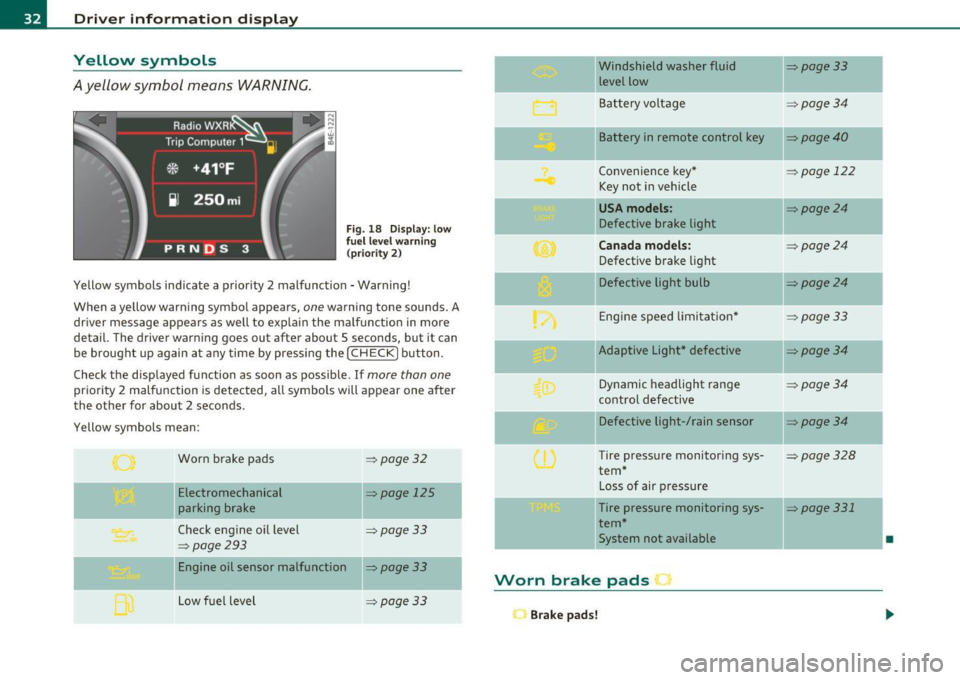
Yellow symbols
A yellow symbol means WARNING.
Fig . 18 Display: low
f ue l level warn ing
(priority 2)
Yellow symbols ind icate a prior ity 2 malfunction -Warning!
When a yellow warning symbo l appears,
one warning tone sounds. A
dr iver message appears as well to explain the ma lfunction in more
detail. The driver warning goes out after about 5 seconds, but it can
be brought up again at any time by pressing the
I CHECK] button .
Check the displayed function as soon as possible.
If more than one
priority 2 malfunction is detected, all symbols will appear one after
the other for about 2 seconds .
Yellow symbols mean:
Worn brake pads
=> page 32
Electromechanical => page 125
parking brake
Check engine oil level
=> page 33
=> page 293
Engine oil sensor malfunction => page 33
-
Low fuel level =>page33
Windshield washer fluid =>page33
level low ~
Bat tery voltage =>page34
-
II Battery in remote control key =>page40
Convenience key * =>page 122
Key not in veh icle
USA models: => page24
Defective brake light
Can ad a mod els : =>page24
Defect ive brake light
Defective light bulb
=>page24
E ng ine speed limitat ion* => page33
-
IIAdaptive Light* defective =>page34
Dynamic headlight range => page 34
contro l defective
Defective light-/rain sensor
=> page34
Tire pressure monitoring sys-=>page328
tern *
Loss of air p ressure
-Tire pressure monitoring sys-=> page331
tern*
11System not available •
Worn brake pads •
Brake pa ds!
Page 35 of 384
If the warning light illum inates, immediately contact your authorized
Audi dea ler or qu alified wor kshop to h ave all b rake pads insp ecte d.
On USA mode ls the warn ing light comes on together w it h the
warning light
BRAKE . Both sets of brake pads on an axle must a lways
be rep laced at the same time.
& WARNING
Driving w ith bad brakes can cause a collision and serious personal
injury .
• If the w arning light
ii and the warning light BRAKE1> with the
me ssage Brake pads! com es on in the in strument clu ster di splay,
immediately contact your author ized Aud i dealer or qualified
workshop t o have all brake pads che cked or replaced if
necessary. •
Checking the engine oil level ~
.... ,. Pleas e check oil level
W hen the symbol i lluminates, check the engine oi l level as soon as
poss ible=>
page 293. Add oil if necessary=> page 294. •
Engine oil sensor defective
~ Oil level ! sensor d efective
If the symbo l illuminates, contact your authorized Audi dealer and
have t he o il senso r in spec ted . U ntil yo u have this do ne, check the oil
level each time you refue l just to be on the safe side=>
page 293. •
ll BRAKE: USA mode ls on ly
Controls and equip
ment Safety first
Driver information display
A
pp lies to vehi cles : w ith engine s peed lim it a tion
Engine speed limitation
!.-• Engine speed maximum XXXX RPM
The symbol illuminates whe n there is an engine co ntrol malfunc
tion. The in dicator light in the instrument cluste r a lso i lluminates .
T he engi ne speed is limited to the speed d isp layed in the driver infor
mation system . Keep in mind that t he engine speed will not exceed
t he va lue disp layed in the d rive r in format ion sys tem, for example
when downshifting .
P lease go to an a uthor ized A udi deale r o r ot her qualifie d wo rk shop to
have the malfunction repa ired .•
Fuel supply too low w
A Please refuel
When the symbol illuminates, th is means there are about 2.4 ga llons
(9 litres) of fuel left in the fuel tank . Time to refuel.=>
page 284.
If
the symbol lig hts up, even when there is ample fue l in the tank, and
t he text
Tank sy stem m alfunction! Contact workshop appears in t he
display, there is a fa ult in the system. Con tact a qual ified workshop to
h ave the fault re ctified. •
Windshield washer fluid level too low ;>
Please top up washer fluid
If the symbo l illuminates, add windshield washe r fluid to the washer
system and a lso to the headlig ht washe r system =>
page 305. •
Vehicle care Technical data
Page 256 of 384

Intelligent technology
'-----------------------------------------------
until the car starts to move . The whee l less ab le to transfer power
spins .
Overheating of brakes
To prevent the disc b rake of the bra ked wheel from ove rhea ting if
subjected to excessive loads, the EDL cuts out temporarily . The
veh icle remains operat ional and beh aves in the same way as a vehicle
without EDL .
As soon as the brake has coo led down, EDL switches on again auto
matically .
& WARNING
• When a ccelerating on slippery surfaces, such as on ice or snow,
alw ay s be careful when depre ssing the a ccelerator pedal. E ven
with the EDL working, the drive wheel s can spin and reduce your
ability to control your car . Risk of crash !
• The in creased safety afforded by EDL does not mean that you
can take safety ri sks. Always adapt your driving st yle to the road
condition s and traffic situation .
fi Tips
If a fault occurs i n the ABS, the EDL is also no t fu nct ion ing . This is
indicated by the ABS warning light~
page 19. •
Anti-Slip Regulation System (ASR)
The Anti-Slip Regulati on System prevents the driven
wheels from spinning when the car is a ccel erating.
General notes
T he Anti-S lip Regulation System (ASR) is integrated in the electronic
stabilization program (ESP). When the veh icle starts up and acceler
ates , the wheels are p reve nted from sp inning by adjust ing the eng ine
powe r to match t he amo unt of grip avai lab le from the road s urface.
How the system works
ASR perfo rms au toma tica lly, i .e . witho ut the drive r's in tervent ion .
With the aid of the A BS sensors~
page 256, ASR monitors the speed
of the driven wheels . If the wheels start to spin, the engine powe r is
reduced automat ically u nti l the t ires find enough gr ip to lock onto
the road s urface. The system is active across the entire speed range.
Th e ASR wor ks in con ju nction with the A BS .
If a m alfu nction sho uld
occur in the ABS, the ASR w ill also be out of action.
& WARNING
The increased safety afforded by ASR does not mean that you can
take safety ri sks . Always adapt your driving style to the road
condit ions and traffic situation.
[ i ] Tips
To ensure that the ASR works prope rly, all four wheels must be fitted
w ith ident ic a l ti res Any differences in rollin g radius of the tires can
cause the system to reduce engine power when t his is not desired .
See also ~
page 318, "N ew t ires and replacing tires and whee ls" .•
Braking
General Information
What affects b raking efficiency ?
Operating cond itions and driving habits
Th e bra kes on t oday's automo biles are still subjec t to we ar,
depending large ly on operating conditions a nd driving habits~ &.
O n ve hicles tha t are eithe r driven mostly in stop- and-go city t raff ic or
are drive n hard, the brake pads should be checked by your author ized
Audi de aler more o ften than specified in the
Warranty & Mainte
nance booklet .
Failure to have your brake pads i nspected can result
in re duced brake pe rformance. .,
Page 257 of 384

________________________________________ __;I:..: n~ t -=-e .=.:.: ll:.:.;igent technology .__==-
On steep s lopes , you shou ld use the brak ing effect of t he e ngine. This
w ay, y ou p revent unne ce ss ary we ar o n t he bra ke sys te m . If you mus t
use your brakes , do not ho ld the brakes down conti nuously . Pump the
bra kes at intervals.
Moisture or road salt
Under cer ta in c on di tions, for ex ample, when drivin g thr ough w at er or
very heavy rain, or e ve n after was hing your veh icle, the braking effect
c an be re duced due to moi st ur e (o r in freezi ng condi tio ns ice) o n the
bra ke pads . A few care ful b rake app lica tions should dry off the bra ke
pads or
remove any ice coatings .
Th e effec tiveness of the bra ke s ca n be re d uced whe n the vehicle is
driven on a salt-covered road and the brakes are not used . He re too,
yo u sh ould clean off a ccumula ted sa lt c oat ing from brake disc s and
pads with a few caref ul app lications of the brake::::;,&.
Corrosion
The re may be a tendency fo r dirt to build up on the bra ke pads and
cor ro si on t o fo rm on the di scs if t he c ar is not driven re gularly or o nly
for short t rips w ith litt le use of the bra kes.
If the bra kes are not used fre quent ly, o r if corrosion ha s fo rme d on
t he d iscs, i t is advisable to clean off t he pads and d is cs by bra king
fi rm ly a few t imes from a mo derately high speed ::::;,& .
Faults in the brake system
If yo u shou ld no tice a sudden in cre ase in b rake ped al t ravel, t hen one
o f t he two brake circ uits may have failed::::;,&.
Low brake fluid level
Malfunctions can occ ur in the brake system if the brake fluid level is
t o o low. The bra ke f lui d level is mon itored e lectroni cally.
Brake lining wear status
Brak e lining we ar may be checked by v isual inspec tio n o f the condi
tion of the brake pads throug h the openings in the wheel. If neces
sa ry, t he wheel m ay be re m oved f or this in spection ::::;,
page 335,
"C hanging a w hee l" .
Controls and equip
ment Safety first Vehicle operation
& WARNING
•
You should perform braking maneuvers for the purpose of
cleaning the brake system only if road condition s permit. Other
road users must not be put at risk -you may cause an accident!
• Before descending a steep grade, reduce speed and shift trans
mission into a lower gear or lower driving range. Do not ride the
brakes or hold the pedal down too long or too often. This could
cause the brakes to get hot and diminish braking efficiency.
• Do not "ride the brakes " by resting your foot on the pedal when
you do not intend to brake. This may cause the brakes to overheat,
premature wear and increased stopping di stan ce.
• Under certain climatic and operating conditions such as
passing through water, driving in heavy rain or after washing the
vehicle, the effectiveness of the brakes can be reduced. In winter,
ice can accumulate on the brake pads , linings, discs and drums .
Carefully apply brakes for a test . Brakes will dry and ice coatings
will be cleaned off after a few careful brake applications.
• Driving for an extended period of time on salt-covered roads
without using your brakes can also affect braking efficiency. Clean
off accumulated salt coating from brake discs and pads with a few
careful brake applications.
• If you damage the front spoiler, or if you install a different
spoiler, be sure the air flow to the front brakes is not obstructed.
Otherwise the brake system could overheat reducing the effective
ness of the entire brake system .
• Failure of one brake circuit will impair the braking capability
resulting in an increased stopping di stance . Avoid driving the
vehicle and have it towed to the nearest Audi dealer or qualified
workshop .•
Vehicle care Do-it-yourself service Technical data
Page 264 of 384

Driving and environment
New brake pads
Remember that new brake pads do not have a f ull braki ng
e ff e ct during the first 250 miles (400 kilometers) after they
are i nsta lle d.
New bra ke pads have to be "burnished in" before they have opt ima l
grab=> &.
Dur ing the break -in period, you sho uld avoid putting severe loads on
the brakes. Severe loads incl ude, for example, sudden hard braki ng,
in particu lar at very high s peeds or, for examp le, on mountai n passes.
& WARNING
New brake pads don 't have the be st stopping power and must be
" broken -in " during the initial 100 to 150 miles (150 to 200 kilo
meters ) of normal cit y driving. You can compensate for thi s by
pressing th e brak e pedal more firmly. This also applies lat er wh en
new pad s are installed. n
Catalytic converter
It is very important that your emissio n contr ol system
(catalytic converter) is functioning prop erly to ensure
that your vehicle is running in an environmentally sound
manner.
- Always use lead-free gasoline==> page 283, "Fue l su pp ly" .
- Never ru n the tank down a ll th e way to empty .
- Never put too m uch motor oil in your engine==>
page 294,
"Adding engine o il
The catalytic converter is an efficient "clean- up" device bu ilt into the
exha ust syste m of the ve hicle. The cat alytic converte r burns many of
the polluta nts in the exhaust gas before they are released into the
atmosphe re.
Th e e xcl usive use of unleaded fuel is cr itic ally important for the life of
the catalytic converter and proper f unction ing of the engine.
& WARNING
• Do not park or operate the vehicle in areas whe re the hot
exhaust sy stem may come in contact with dry grass, brush, fuel
spill or other material which can cause a fire .
• Do not apply additional undercoating or ru stproofing on or
near the exhaust manifold , exhaust pipes, catalytic conve rter or
heat shield s. During driving, the substance used for undercoating
could overheat and cause a fire .
0 Note
• Be aware that just one tank filling wit h leaded fu el wi ll alrea dy
ser iou sly degrade the performan ce of the ca talyt ic co nve rter.
• Do not exceed the correct engine oil leve l=>
page 294 .
• Do not dr ive unti l the f uel tank becomes complete ly empty. The
eng ine could misfire . Unburned fuel could a lso get into the exha ust
system and th is could cause the catalytic converter to overheat.
• Do not t urn o ff the igni tion whi le the ve hicle is moving.
• Do not continue to operate your vehicle under these conditions, as
o therwi se fuel c an reach the cat alytic c onve rter. Th is cou ld resu lt in
over heating of t he converte r, requiring its rep lacement.
• T o ass ure eff ic ient operat ion of the Emi ssion Co ntro l System:
- Have your vehicle maintained properly and in accordance with
t h e se rvice recommenda tions in your Warranty
& M aintenance
booklet. •
Page 265 of 384

Driving and environment
------------------------------------------------'
- Lack of proper maintena nce as well as improper use of the
vehicle w ill imp air t he funct io n of t he emission con trol system and
could lead to damage.
<£> For the sake of the environment
Even when the Emiss ion Contro l System is operating properly, the
exhaust gas can have a sulfur-like exhaust gas sme ll under some
operat ing states. This depends on the s ulfur content of the fue l being
used. Using a differe nt brand of fuel may help, or filling the tank with
lead-free supe r grade gasoline. •
Avoid damaging the vehicle
When you are dr iving on poor roads, or ove r cur bs, steep r amps, etc.,
make certain that low-lying parts such as spoilers and exhaust system
p arts do not bo ttom ou t and ge t damage d.
Th is is espec ia lly true for vehicles with low-slung chass is (sports
chassis)* and fully loaded vehicles .•
Driving through water on roads
N ote the following to avoid vehicle damage w hen driving through
water, fo r examp le on flooded roads:
• The water must not be any higher than the bottom of the vehicle
b ody.
• Do not drive faster tha n walking speed.
& WARNING
After driving through water , mud, slush , etc. , the brakes may be
slow to take effect because of wet brake rotors and pads . Dry the
brakes first by braking carefully to restore the full braking effect.
Controls and equip ment Safety first Vehicle operation
0 Note
Vehicle
compone nts such as the engine, tra nsmiss ion, s uspension or
electrical system can be severely damaged by driv ing thro ugh water .
[ i ] Tips
• Check the depth of the water before d riving throug h it.
• Do not stop the vehicle, d rive in revers e or switch the e ngine off
when driving through wate r.
• Keep in m ind that oncoming vehicles may c reate waves t hat raise
the water leve l and make it too deep for yo ur vehicle to drive throug h
sa fely.
• Avoid driving through salt water because it can ca use corros io n.
Operate your vehicle economically
and minimize pollution
General
You r personal style of driving will determi ne the econom y
of your vehicle, as well as exhaust and noise l evels.
Fuel economy, environmenta l impact, and wea r on your eng ine,
brakes and tires largely depend on t hree factors:
• your persona l dr iving style
• operati ng conditions
• t echni cal lim itations
If you an ticipa te what you need to do next and drive economically,
you can easily cut your fuel consumption by 10-15 percent. This
s e ct io n w ill give you so me tip s on how you can he lp the e nvir onme nt
and your pocketbook.
~
Vehicle care Do-it-yourself service Technical data
Page 302 of 384
___ C_ h_e _c_ k_ i_ n ~ g~ a_ n _ d_ f_il _l _in _ g ____________________________________________ _
- Read the brake fluid level from the brake fluid reservoir
=> fig. 248 . T he brake fluid level mus t be between the
" M IN" and "MAX" markings.
The br ake fl uid re se rvoir is loc ated at the rear pa rt iti on of the engine
compartment on the left side~ page 290.
T he f lu id level may drop slightly after some time due to the auto
matic adjus tment of t he b rake pads. This is not caus e for alarm.
If the brake flu id leve l falls considerably below the "MIN" mark, t he
br ak e wa rning/ind ic ator lig ht ( U.S . model s:
BRAKE , Can adi an mod els:
«D> ) will come on~ page 20 and~ page 28. Do not continue to
operate the vehicle . The comple te brake system sho uld be thoro ughly
checked by an author ized A udi dealer or ot her qualified facility and
t he ca use correcte d. If the b rake fl uid leve l is too low, the bra ke
wa rning/in dicator light will illu mi nate . Con tact an au thorized Aud i
dealer
immediately .•
Changing brake fluid
H ave the brake flui d changed by an ex perienc ed techni
cian.
Brake flui d abso rbs mois ture from t he a ir . If t he wa ter con ten t in the
brake fl uid is too hig h, corros io n in the b rake system may res ult afte r
a period of time . The boiling po int o f the bra ke fl uid will also decrease
cons iderab ly and decrease brak ing perfo rmance.
The refore, the brake fl uid m ust be changed
every two years . Always
use new bra ke fluid w hich conforms to Fede ral Motor Veh icle St an
dard "FMVSS 116 DOT 4" .
Th e b rake fl uid reservoi r ca n be diffi cult to rea ch, there fore, we
recommend that you have the bra ke fluid c hanged by your author ized
Audi dealer. Your dea ler has the correct tools, the right b rake fl uid
and the know-how to do t his for you .
& WARNING
• Brake fluid is poisonous. It must be stored only in the closed
original container out of the reach of children!
• Brake failure can result from old or inappropriate brake flu id.
Observe these pre cautions:
- Use only brake fluid that meets SAE specification
J 1703 and
conforms to Federal Motor Vehicle Standard 116. Always che ck
with your authorized Audi dealer to make sure you are us ing
the correct brake fluid. The correct type of brake fluid i s also
indicated on the brake fluid reservoir .
- The brake fluid must be new. Heavy use of the brakes can
cause a vapor lock if the brake fluid is left in the system too
long . Thi s can seriously affect the efficiency of the brakes as
well as your safety . This could result in an accident.
0 Note
Brake fluid will damage the paint of your ve hicle .
~ For the sake of the environment
Because of the prob lem of proper disposal of brake fl uid as we ll as
the spec ia l too ls req uired and the necessary expe rtise, we recom
m en d that you have t he brake fl uid changed by your autho rized Audi
dea ler .•
Battery
General information
Under normal operat ing condit ions, the battery in your Aud i does not
nee d any m ain ten ance. Wi th high outs ide temper atures o r long d aily
dr ives we recommend that yo u have the elect rolyte level checked by .,_
Page 369 of 384

___________________________________________ A_ l::.. p _h _a_ b_ e_t _ic _a_ l_ in_ d _ e_x __ nn
We ight-sensing mat .... .. .. .. . ... 232
When must the system be inspected? 217
Aircraft Transporting your vehicle .......... 353
All Wheel Drive ............ .. ...... . 257
Alloy wheels . .... .. .. .. .. .. .. ... ... 275
All-wheel drive
Winter tires ....... .. ............ 323
Alternator See Generator .................... 16
Anti-freeze See Engine coolant ...... .. .. .. ... 296
Anti -lock brake system
How the ABS system works ......... 256
Warning/indicator lights ... .. ..... . 19
Anti-Sl ip Regulation System (ASR)
How the system works . .. .. .. .. .. . 254
Anti-theft systems Anti-theft alarm system ....... ... .. 52
Electronic immobilizer ............. 41
Ashtray Front .............. ...... ........ 96
Rear ........ .. .... .. ... . .. .... .. 96
ASR How the Anti-Slip Regulation System
works ..... .. ... .. ... ... ....... 254
Audi Service Repair Manuals and Literature
361
AUTO mode AC climate control ....... .... .. .. . 106
Auto Safety Hotline ... ... ... . .. ..... 195
Auto-Check Contro l .............. .... . 26 Automatic car wash
See Washing ............... ... .. 271
Automatic Shift Lock (ASL) ... .. .. .. ... 156
Automatic transmission 6-speed automatic transm iss ion .. .. 154
Automatic Sh ift Lock (ASL) ....... .. 156
Dr iv ing ................. ...... .. 154
Dynamic shift program ......... ... 157
Emergency release for selector lever . 159
Fail-safe mode ................ ... 159
lg nition key safety lock .... ..... ... 119
Kick-down . ............ .. ....... 157
Manual shift program .. .. .. .. .. .. . 158
Selector lever ............ ........ 155
Shift buttons ... ...... .. .. .. ..... 159
Steering wheel with tiptronic ...... . 159
Average speed ........... .. .......... 36
Avoid damaging the vehicle .. ....... .. 263
B
Background lighting ... . .. .. .......... 67
Battery . .. .. .. .. .... ............... 300
Battery location inside the luggage
compartment .................. 301
Charging ........................ 303
Important warnings when working on the battery ..... ........... ...... .. 301
low . .. .. .. .. .. ...... .. ......... 258
Rep lacing the battery . ... ......... 304
State of charge ..... .. ........... 258
Winter operation . .... ... ..... .... 300
Working on the battery .... ... .. .. . 301 Before driving
.. .. ... ... ... .... ... .. 187
Blended gasoline ................. .. 283
Body cavity sealing .............. . ... 276
Booster seats ......... ............ . 239
Brake fluid
Changing the brake fluid .......... . 300
Checking the brake fluid level ....... 299
What is the correct brake fluid level?. 299
What should I do if the brake fluid warning
light comes on? . .. .. .. .......... 299
Brake system Anti-lock brake system .. ........... 19
Brake assistant .. .. .. .. .. ...... .. 256
Brake booster ........... ... ..... 256
Brake fluid .. .. .. ................ 299
Brake fluid specificat ions for refill and
repla cemen t .................. . 300
Brake light defective . .... .. .. .. .. .. 24
Brake pads ..................... . 262
Electromechanical parking brake .... 123
Fluid reservoir . .......... ... .. ... 299
How does moisture or road salt affect the
brakes? ... .. ................ .. 254
Malfunction ...................... 28
Warning/indicator lights ... .... .. .. 20
Worn brake pads symbol ........... 32
Break-in period .... . .. .............. 261
Brake pads . ... ................ .. 262
Tires ..... .................... .. 261
Bulbs ............ .... .. .... .... .. . 346
Bumper cover Caution when parking near a parking barri-er or curb . ... ................ .. 124
Automatic belt retractor .......... .. . 201 Battery voltage .. ........... ........ . 34
Controls and equip
ment Safety first Vehicle operation
Vehicle care Do-it-yourself service Technical data