wheel bolts AUDI S8 2010 Owners Manual
[x] Cancel search | Manufacturer: AUDI, Model Year: 2010, Model line: S8, Model: AUDI S8 2010Pages: 384, PDF Size: 90.95 MB
Page 323 of 384

Tires and wheels Ill
----------------
If you install rims, which do not have the sensors, or have sensors
w hich are not compa tible, then the tire pressure moni toring sys tem *
w ill not wo rk p roperly. I n this case, t he tire pressure monitor ing
system * wo uld not be ab le to monitor the tire pressure or warn yo u if
it is necessary .
• The battery inside of the tire pressure sensor has a limited service
l ife.
• Always dr ive wit h the
valve stem caps securely mo unted. We
recommend using factory ins ta lled
valve stem caps. As k your autho
r ized Audi dea ler to rep lace lost
valve stem caps .
Th e insta llation of repl acement tir es w ith s teel co rd bo dy plies in the
t ire sidewa ll may ca use ma lfunctio n of the tire pressure mo nitoring
system *, and is not recommende d (cord material informat io n i n
molded on the ti re s idewall).
Always check your tire pressure monito ring system* indicator afte r
re plac ing one or mo re tires on your vehicle. If the tire press ure m oni
to ring system* indicator flashes, or is on, your system is not working
pro perl y. Yo ur repla ceme nt tire might be incomp atible with your t ire
pressure monitoring system*, or some component of the tire pres
sure mon itor ing system * may be damaged.
& WARNING
• Using incorrect or unmatched tires and / or wheels or improper
tire and wheel combinations can lead to loss of cont rol, collision
and seriou s per sonal injury .
• Always use tires, rims and wheel bolts that meet the specifica
tions of original fa ctory-in stalled tires or other combination s that
have been specifically appro ved by the vehicle manufacturer.
• Tires age even if they are not being used and can fail suddenly ,
especially at high speeds. Tires that are more than 6 years old can
only be u sed in an emergen cy and then with special care and at
lowe r speeds.
• Never mount used tires on your vehicle if you are not sure of
their "previous history." Old used tires may have been damaged
Safety first
& WARNING (co ntinued )
eventhoughthedamagecannotbeseenthatcanleadtosudden
tire failure and loss of vehicle control.
• All four wheels must be fitted with radial tires of the same
type, size (rolling circumference ) and the same tr ead pattern.
Driving with different t ires reduces vehicle handling and can lead
to a lo ss of control.
• If the spare ti re is not the same as the tires that are mounted
on the vehicle - for example with w inter tires - only use the spare
tire fo r a sho rt pe riod of t ime and drive with extra care. Refit the
normal road wheel as soon as safely possible.
• Never drive faster than the ma ximum speed for which the tires
on your vehicle are rated because tires that are driven faster than
their rated speed can fail suddenly .
• Overloading tire s cause heat build-up, sudden tire failure,
including a blowout and sudden deflation and loss of control.
• Temperature grades apply to tires that are properly inflated
and not over or underinflated.
• For technical reasons it is not always possible to use wheels
from other vehicles - in some c ases not even wheel s from the same
vehicle model.
• If you install wheel trim discs on the vehicle wheels , make sure
that the air flow to the brakes is not blocked. Reduced airflow to
the brakes can them to overheat , increasing stopping distance s
and causing a collision.
• Run flat tires may only be u sed on vehicles th at were equipped
with them at the factory. The vehicle must have a chassis designed
fo r run flat tires and a factor y-in stalled tire pres sure monitoring
system* that indicates a loss of tire pre ssure. Incorrect use of run
flat tires can lead to vehicle damage or accident s. Check with an
authorized Audi dealer or tire specialist to see if your vehicle can
be equipped with run flat tires . If run flat tires are used , they must
be installed on all four wheels. Mixing tire types is not permitted . ..,_
Vehicle care Technical data
Page 326 of 384
-~_T_ ir_e_ s_ a_ n_ d_ w_ h_e_ e_ ls _______________________________________________ _
& WARNING (conti nued)
personal injuries. Have worn or dam aged tires replaced immedi
ately .
• Winter tires have ma ximum speed rat ing that may be lower
than your vehicle' s maximum speed .
• Never drive faster than the speed for which the winter or other
tires installed on your vehicle are rated.
& WARNING
Always adjust your driving to the road and traffic condit ions.
Never let the good acceleration of the winter tires and all-wheel
drive tempt you into taking extra risks. Always remember:
• When braking, an all-wheel drive vehicle handles in the same
way as a front drive vehicle.
• Drive carefully and reduce your speed on icy and slippery road s,
even winter tires cannot help under black ice conditions.
<£> For the sake of the environment
Use s ummer tires when weather condit ions permit. They a re quieter,
do not we ar as qu ickly and redu ce fuel consum ptio n. •
Snow chains
Snow chains may be fitte d only to the fro nt w heels, and only to
certain tire sizes. Ask your authorized Audi dealer on which tire sizes
snow chains can be used.
If you a re goi ng to use snow c ha ins, then you must insta ll them on the
front wheels at least.
T he snow c hain s m ust have low -profile links and m ust not be thicker
than 0.53 inc h (13 .5 mm), including the lock. Remove wheel center covers a
nd trim d iscs before putting snow
c hains on you r veh icle =>
(D. For sa fe ty reaso ns cove r caps m ust the n
be fitted over the wheel bolts. These are available from a uth orized
Audi dealers.
& WARNING
Using the wrong snow chain s for your vehicle or installing them
incorrectly can increase the risk of loss of control leading to
serious personal injury.
• Snow chains are available in different sizes. Always make sure
to follow the instru ction s provided by the snow chain manufac
tur er.
• When driving with snow chains never drive fa ster than the
speed permitted for your specific snow chains .
• Always observe local regulations.
0 Note
• Remove snow chains before drivi ng on ro ads not covere d wit h
snow to avoid damag ing t ires and wear ing the snow chains down
unnecess aril y.
• Snow chains, which come into direct contact with the wheel rim,
c an scratch o r damage i t. T herefo re, make sure tha t t he s now chains
are suitably covered . Check the pos ition of the snow cha ins afte r
dr iv ing a few yar ds and correct if ne ccess ary. Fo llow the ins truct ion s
from t he snow chai n manufacturer when doing so.
• If the Ad aptive Air Suspe nsio n sho uld ma lf u nct ion, do n ot moun t
or use snow cha ins because the ve hicle wi ll be extremely low. If you
do drive w it h sn ow ch ain s on while the ve hicle i s at t his level , the
snow cha ins m ight severe ly damage the whee lhouse and other pa rts
of the vehi cle.
~
Page 327 of 384

Tires and wheels -_______________________________ f!:f'II
[I) Tips
Where snow cha ins a re mandatory on certain roads, this no rmally
also applies to vehicles with All W heel Dr ive .•
Wheel bolts
Wheel b olts must al ways be tig hten ed to the correct
torque.
Th e design of whee l bo lts is matc hed to the facto ry installed rims. If
different r ims are fitted, the correct wheel bolts wi th t he r igh t lengt h
and correctly s haped bolt heads must be used . Thi s ensures that
w heels are fi tted secure ly and tha t the br ake system f unc tion s
correctly.
I n cert ain circumst ances, yo u may not us e wheel bolts from a
different veh icle -even if it is the same model=>
page 363.
& WARNING
Improperly tightened or maintained wheel bolts can become
loose causing lo ss of control, a collision and serious per sonal
injury .
• Always keep the wheel bolts and the thread s in the wheel hub s
clean so the wheel bolts can turn easily and be properly tightened .
• Never grease or oil the wheel bolts and the threads in the wheel
hubs. They can become loose while d riving if greased or oiled , even
if tightened to the specified torque.
• Only use wheel bolts that belong to the rim being installed.
• Never use different wheels bolts on your vehicle.
• Always maintain the correct tightening torque for the wheel
bolts to reduce the risk of a wheel loss. If the tightening torque of
the wheel bolts is too low , they can loo sen and come out when the
vehicle is moving. If the tightening torque is too high, th e wheel
Safety first
& WARNING (co ntinued )
bolts and threads can be damaged and the wheel can become
loose .
0 Note
The speci fied tor que f or th e wheel bolts is 90 ft lb (1 2 0 Nm) wi th a
tolerance of ± 7,4 ft lb( ± 10 Nm). Torque wheel bolts diagonally.
After ch anging a wheel, the to rque mu st be checked a s so on as
poss ible with a torque w rench -prefe rab ly by an authorized Aud i
dealer or qualified workshop. •
Low aspect ratio tires
Your Audi is fa cto ry -equ ip ped wi th low aspec t ratio tires. These tire s
have been thorough ly tested and been selected specifically for your
mode l for the ir supe rb perfo rmance, roa d fee l an d han dling un der a
var iety of driv ing cond it ions. Ask your author ized Audi dea ler for
more deta ils.
Th e low a spect rat io of these tires is indica ted by a nu meral of
55 or
less
in the tire's size designation. The numeral represents the ratio of
t he t ire's s idewall heigh t in relat io n t o its t re ad wi dth expressed in
percentage. Conventiona l tires have a height/width ratio of 60 or
more .
The performance of low -aspect -ratio tires is particularly sen sitive to
improper inflation pressure. It is therefore important that low
aspect ratio tires are inflated to the specified pressure and that the
inflation pressure is regularly checked and mainta ined. Tire pres
s ure s should be checked at lea st once a month and always before a
long trip =>
page 313, "Checking tire pressure".
What you can do to avoid tire and rim damage
Low aspect ratio ti res can be damaged more easi ly by impact w ith
potholes, curbs, gull ies or ridges on the road, p articular ly if the tire is
underinflated. .,_
Vehicle care Technical data
Page 335 of 384
![AUDI S8 2010 Owners Manual What do I do now? -_______________ __.EWII
(]] Tips
If you no longer have your or iginal warn ing triangle and need to equip
your vehicle with a new one, contact your authori](/img/6/57617/w960_57617-334.png "AUDI S8 2010 Owners Manual What do I do now? -_______________ __.EWII
(]] Tips
If you no longer have your or iginal warn ing triangle and need to equip
your vehicle with a new one, contact your authori")
What do I do now? -_______________ __.EWII
(]] Tips
If you no longer have your or iginal warn ing triangle and need to equip
your vehicle with a new one, contact your authorized Aud i dealer for
a rep lacement. •
Jack, tools and spare wheel
Jack
The jack is stored underneath the floor panel in the
luggage compartment.
Fig. 26 5 Luggag e
c ompart ment vehicl e
jack
Be fore stori ng the jack, ma ke sure it is wound back down as far as it
w ill go .
& WARNING
Improper use of the vehicle jack can cause serious personal inju
ries.
• Never use the jack suppl ied with your Audi on another vehicle ,
particularly on a heavier one . The jack is only suitable for use on
the vehicle it came with .
Vehicle OP-eration
& WARNI NG (continued )
• Using a bumper jack to raise the veh icle will dam age the
bumper system . The ja ck may slip, causing injury .
• Never support your vehicle on cinder blocks , bricks or other
objects . These may not be able to support the load and could cause
injury when they fail.
• Never sta rt or run the engine while the vehicle is suppo rted by
the jack.
• If you must work under the vehicle , always use safety stands
specifically designed for this purpo se.
• Never use the he xagonal so cket in the handle of the screw
driver to loosen or tight en the wheel bolts .
• Always make sure the sp are tire and even a flat tire are secured
in pla ce and not loose, otherwis e they could fly forward, causing
personal injury to passengers in the vehicle in an accident or
sudden maneuver .
(]] Tips
Before you c an raise your vehi cle us ing t he jack, you mus t activate the
jack ing mode~
page 179 . •
Vehicle care Do-it-yourself service iTechnical data
Page 338 of 384

-What do I do now? ..._ __________________________________________ _
& WARNING (conti nued)
Tra nsmissi on i n " P" ( Park) wi ll not preve nt th e vehicle from
m ov ing.
• Befor e you chan ge a wh eel, be s ure th e grou nd i s lev el and
firm . If n ece ssa ry , us e a s turdy board under th e j ack .
• Afte r in stalling the sp are whee l, make su re that you r eplace
the flat tire /wh ee l i n it s storage are a properly and t ight en th e
knu rled ret ain in g sc rew s ecu rely .
[ i J Tips
Before changing the wheel, you must activate the jacking mode, so
that the automatic contro ls for the Adaptive A ir Suspension do not
make it more difficult to
lift the vehicle with the jack=> page 179. •
Changing a wheel
When you change a wheel, follow the sequence described
below step-by-step and in exactly that order.
1. Activate the vehicle jacking mode==> page 179.
2 . Remove the decorati ve wheel cover* . For more details see
also ==>
page 33 7, "Decorative wheel covers" or
==>
page 337, "Wheels with wheel bolt caps".
3 . Loosen the
wh eel bolts ==> page 338.
4. L ocate the proper mounting point for the jack and align
the jack below that point==>
page 338 .
5. Lift the car with the jack==> page 338.
6. Remove the wheel with the flat tire and then install the
spare ==>
page 340.
7. Tighten all wheel bolts lightly . 8
.
Lower the vehicle with the jack.
9. Use the wheel bolt wrench and
firmly tighten all wheel
bolts==>
page 338.
10. Replace the decorative wheel cov er*.
11. Deactivate the vehicle jacking mode==> page 179.
& WARNING
A lw ays rea d and f ollow all W ARNING S and inf ormation => & in
" Rai sing th e vehicl e" on
page 33 8 and => pag e 341. •
After changing a wheel
A wheel change is not complete without the doing the
following .
-Store and secure the whe el you rep laced in the spare
wheel well.
- Replace the tools and the jack in their proper location.
- Check the
tire pre ssure on the spare wheel immediately
after mounting it .
- As soon as possible, have the
tighten ing torques on all
wheel bolts checked with a torque wrench . The correct
tightening torque is 90 ft lb (120 Nm).
- Have the flat tire
re placed as soon as possible .
[ i J Tips
• If you notice that the wheel bolts are corroded and diff icult to turn
wh ile chang ing a tire, they shou ld be rep laced before you check the
tightening torque. .,_
Page 339 of 384
_____________________________________________ W __ h_a _ t_ d_o_ I_ d _ o_ n_o_ w_ ? _ ___.11111
• Drive at reduced speed until you have the tightening torques
checked. •
Applies to vehicles : with decorative wheel covers
Decorative wheel covers
The decorative wheel covers must be removed first to
access the wheel bolts.
R em ov ing
Fig. 269 Changing a
wheel: Removing the
wheel cover
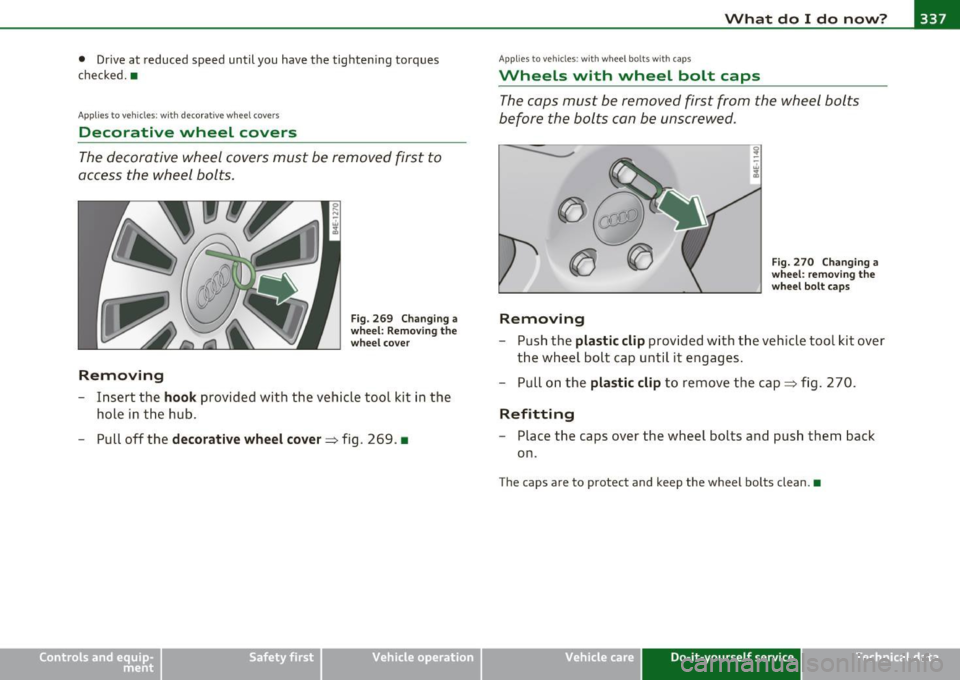
- Insert the hook provided with the vehicle tool kit in the
hole in the hub.
Pull off the
d ecora tive whe el cov er ~ fig . 269 . •
Vehicle OP-eration
Applies to vehicles : with wheel bolts with caps
Wheels with wheel bolt caps
The caps must be removed first from the wheel bolts
before the bolts can be unscrewed.
Removing
F ig. 2 70 Ch angi ng a
wheel: removing the
wheel bolt c aps
- Push the plastic clip provided with the veh icle tool kit over
the wheel bolt cap until it engages .
- Pull on the
plastic cli p to remove the cap~ fig . 270.
Refitting
- Place the caps over the wheel bolts and push them back
on.
The caps are to protect and keep the wheel bolts clean.•
Vehicle care Do-it-yourself service iTechnical data
Page 340 of 384
111...__W_ h_ a_t _ d_ o_ I_d_ o_ n_o _w_ ? ___________________________________________ _
Loosening and tightening the wheel bolts
The wheel bolts must be loosened before raising the
vehicle .
Loosening
Fig. 271 C hang in g a
w heel: loos eni ng t he
whe el b olt s
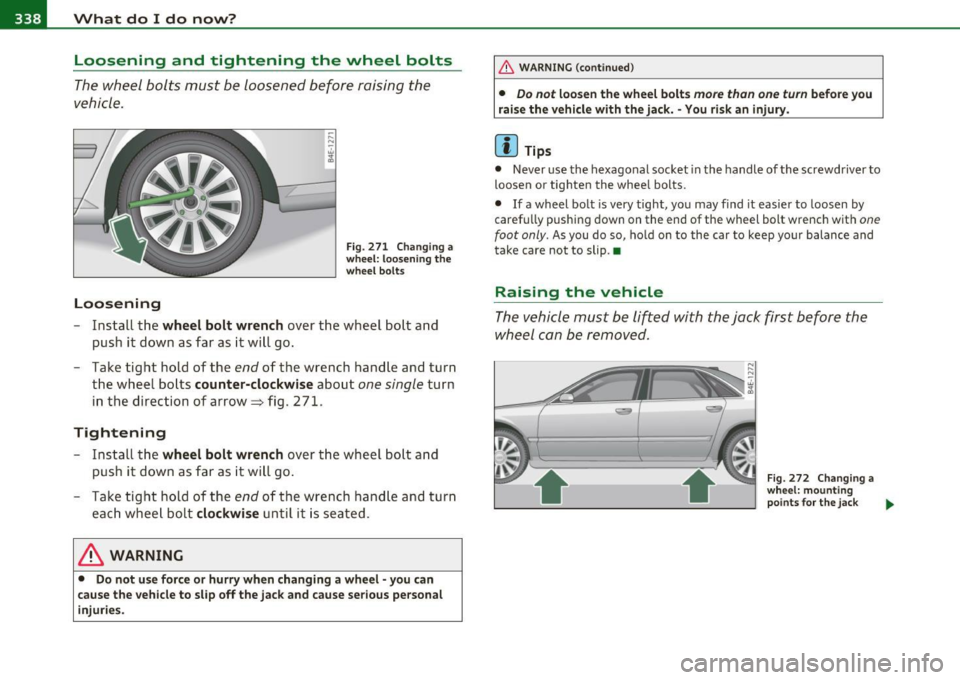
- Install the wheel bolt wrench over the wheel bolt and
push it down as far as it will go.
Ta ke tight hold of the
end of the wrench hand le and turn
the whee l bo lts
counter-clockwise ab out one single turn
in the direction of arrow:::::, fig. 271 .
Tightening
-Install the wheel bolt wrench over the w heel bo lt a nd
push i t down as far as it wi ll go .
- Tak e tight h old of the
end of the wr ench hand le and turn
eac h whee l bolt
clockwise u nti l it is seated.
& WARNING
• Do not use force or hurry when changing a wheel -you can
cause the vehicle to slip off the j ack and cause serious pe rsonal
injuries .
& WARNING (contin u ed )
• Do not loo sen the wheel bolt s more than one turn before you
raise the vehicle with the jack. -Y ou ri sk an injury.
(I] Tips
• N ever use the hexagonal socket in the handle of the screwdriver to
loosen or tighten the whee l bolts.
• If a wheel bo lt is very tight , yo u may find it easier to loosen by
carefu lly pushing down on the end of the wheel bolt wrench with
on e
foot only .
As you do so, ho ld on to the car to keep yo ur balance and
take care not to slip. •
Raising the vehicle
The vehicle must be lifted with the jack first bef ore the
w heel can be removed.
Fi g. 27 2 Chan ging a
wheel: m oun ting
poi nts fo r the jack ...
Page 342 of 384

.,.___W_ h_ a_t _ d _ o_ I_ d_ o_ n_o _w_ ? ___________________________________________ _
Taking the wheel off/installing the spare
Follow these instructions step-by-step for changing the
wheel
Fig. 274 Changing a
wheel: using the
screwdriver handle
(with the blade
removed ) to turn the
bolts
Fig . 275 Changing a
wheel: alignment pin
inside the top hole
After you have loosened all wheel bolts and raised the vehicle
off the ground, remove and replace the wheel as follows:
Removing the wheel
-Use the hexagonal socket in the screwdriver handle to
completely remove the topmost wheel bolt and set it
aside on a
clean surface => fig. 274 .
- Screw the threaded end of the
alignment pin from the
tool kit hand-tight into the empty bolt hole=> fig. 275 . -
Then remove the other wheel bolts as described above.
- Take off the wheel leaving the alignment pin in the bolt
hole.
Putting on the spare wheel
Lift the spare wheel and carefully slide it over the align
ment pin to guide it in place.
- Use the hexagonal socket in the screwdriver handle to
screw in and tighten all wheel bolts
slightly.
- Remove the alignment pin and insert and tighten the
remaining wheel bolt slightly like the rest.
- Turn the jack handle counter-clockwise to lower the
vehicle until the jack is fully released .
Use the wheel bolt wrench to tighten all wheel bolts firmly
=> page 338. Tighten them crosswise, from one bolt to
the (approximately) opposite one, to keep the wheel
centered .
(I) Tips
Never use the hexagonal socket in the handle of the screwdriver to
loosen or tighten the wheel bolts.
• Pull the reversible blade from the screwdriver before you use the
hexagonal socket in the handle to turn the wheel bolts .
• When mounting tires with
unidirectional tread design make sure
the tread pattern is pointed the right way~
page 341.
• The wheel bolts should be clean and easy to turn. Check for dirt
and corrosion on the mating surfaces of both the wheel and the hub.
Remove all dirt from these surfa ces before remounting the wheel. •
Page 343 of 384

_______________________________________________ W __ h_a _ t_ d_o_ I_ d_o_ n_ o_w _ ? __ _
Tires with unidirectional tread design
Tires with unidirectional tread design must be mounted
w ith their tread pattern pointed in the right direction .
Using a spare tire w ith a tread pattern intended for
u se in a specific direction
When using a spare tire w ith a tread pattern intended for use in a
spec ific direction, please note the fo llow ing:
• The d irect ion of rotation is marked by an arrow on the side of the
tire.
• If the spare tire has to be installed in the incorrect direct ion, use
t he spare t ire only temporar ily since the tire w ill no t be ab le to
achieve its optimum pe rformance character istics with rega rd to
aquap lan ing, no ise and wear.
• We recommend that you pay particular attent ion to t his fact
during wet wea ther and that you adjust you r speed to match road
conditions .
• Rep lace the flat tire w it h a new one and have it ins talled on your
vehicle as soon as poss ible to resto re the handling advantages of a
unidirectio na l tire .•
Notes on wheel changing
Please read the in forma tion => page 318, "New t ires and replacing
tires and wheels" if you are going to use a spare t ire which is different
from the tires on yo ur vehi cle.
After you change a t ire:
• Check the tire pressure on the spare immediately after installa
tion.
• Have the wheel bolt t ightening torque checked with a torque
wren ch as soon a s possible by your authorized Audi dealer or a qua l
i fied serv ice stat ion.
Safety first • With steel and alloy wheel rims
, the wheel bolts are correctly
tightened at a torque of 90
ft lb (120 Nm ).
• If you notice that the wheel bolts are corroded and difficult to
turn while changing a tire, they should be replac ed before you check
the tightening torque.
• R epla ce the flat tire with a new one and have it install ed on your
vehicle as soon as possible. Remount the wheel cover.
Until then, drive with extra care and at reduced speed s.
& WARNING
• If you are going to equip your vehicle with tires or rims which
differ from those which were factory installed, then be sure to
read the information =>
page 318, "New tires and replacing tire s
and whe els ".
• Always make sure the damaged whe el or ev en a flat tire and
the jack and tool kit are prope rly secured in the luggage compart ·
ment and are not loo se in the pa ssenger compartment.
• In an accident or sudden maneu ver they could fly forward ,
injuring anyone in the vehicle .
• Always store dam aged wheel , jack and tools secu rely in the
luggage compartment. Otherwi se, in an accident or sudden
maneuver they could fly fo rward , caus ing inju ry to passengers in
the vehicle .
• Do not u se commercially available tire sealants . Otherwi se, the
electrical component s of the tire pre ssure monitoring system * will
no longer work properly and the sensor for the t ire pressure moni ·
toring sy stem* will have to be replaced b y a qualified work shop .•
Vehicle care Do-it-yourself service Technical data
Page 379 of 384

___________________________________________ A_ l::.. p _h _a_ b_ e_t _ic _a_ l_ in_ d _ e_x __ __
T Storing tire pressures .. .. .. ... .... 330 Towing
Tires and wheels .................
320 Tow truck procedures ........ .. ... 350
Tachometer .................... .... . 11 Valves ................... .... ... 320 Towing hitch
Technical modifications .. .. ..........
364 Tire service life .. .............. ..... 317 Audi parking system ...... ..... ... 171
Temperature
Climate controls .......... .. .... .
106
Setting for the d river's and front passen-
ger's side .. ... .. .. .. .. .. .. .... .
106
Tether anchors ............. .... ... . 249
Tether strap .... ........... .. .... .. . 249
The first 1,000 mi les (1,500 km) and
afte rwards .... .... .. .. .. ... ... .
261
Tie-down eyelets .... ... .. ... . .. . 90, 195
T ips for the environment
Saving fue l ............. .... ... ...
94
Using the air conditioner only when
necessary ......... .. .. .. .. .... . 112
tiptronic ® ............ .. .. .. .. .... .
154
Automatic Shift Lock (ASL) ...... ... 156
Driving ......... ... ... ... .. ..... 154
Dynamic shift program ....... .. .. . 157
Fail-safe mode ..... .. .. .. .... .... 159
K ick-down ......... ..... ... .. .. . 157
Manual shift program .......... .. . 158
Selector leve r ......... .. .. .. .... . 155
Tire pressure . ..... ....... ... .. .. .. . 313
Tire pressure monitoring system . ...... 327
Displaying tire pressures ....... .... 329
Initialize wheels .. .. ........... ... 330
Learning process ........ ...... .. . 330
Loss of air pressure .. ......... 17,328
Malfunctions .......... ... .. ..... 331
Sensors ...... ........ .. .. .. .. .. . 320
Controls and equip
ment Safety first
Tir
es . .... ....................... .. 306 T owing loop ........... ...... .. .. .. . 351
Replacing .. .. .. .... ... . .... ..... 320 front . .. .. .. ................. .. . 351
Service life ....... .. .. .. .. .. ..... 317 rear .. .. ........... ...... .... .. . 352
speed rating letter ,code ........... 320 Trailer towing .. .. .................. 266
T ire manufacturing date ........... 320 Operating instructions .. .. .... .... 267
Tire specifications ................ 319 Technical requirements .. .. .. . 266,267
T read depth . ...... .............. 317 Tr ailer towing tips ......... .. .. .. . 268
Uniform tire quality grading . .. ..... 322 Train
Winter tires ................... ..
323 Transporting your vehicle ... ... . .. . 353
T ires and vehicle load Limits ........... 314 Transmission
Tires and wheels
See Automatic transmission ........ 154
Checking tire pressure .. .. .... .... . 313 T ransport Canada ..... ....... ...... . 195
Cold tire inflation pressure ....... .. 310
Dimens ions .. .... ............. ..
318
General notes ................... 306
Glossary of tire and loading terminology .
307
New tires and wheels .... ..... ... . 318
Replacing .. .. .. .... .. .. .... ..... 319
Snow chains .. ........... .... .. .. 324
Transporting your vehicle . .. .......... 353
Tr ead Wear Indicator ( TWI) . ..........
317
Trip computer
Fuel consumption .. ...............
36
Mileage ................. .. .. .. .. 36
Single-trip memory ........ ... ... .. 37
T otal-t rip memory ... ...... .... .. .. 37
Tir e pressure monitoring system .... 320
Tires and vehicle load limits ... .. ... 314
Wheel bolts .. ................ ... 325
Trip odometer .. .. .................. . 12
What does it mean when dEF appears in
the trip odometer display? . ... .. ...
12
Winter tires ..................... 323 Trunk
Tires/Wheels
See Rear lid . .. .. .. ............... 46
Low aspect rat io tires .. .... .. .. .. . 325 Trunk escape handle . ...... .... ...... 332
Tools .... ......................... 334 T urn s ignals ................ ... .. .. .. 64
Torn or frayed safety be lts ... ......... 200 Warning/indicator lights ... .. . ... .. 17
Touch-up paint .. .. .... .. .. .. ... .... 274
Vehicle operation Vehicle care Do-it-yourself service Technical data