catalytic converter AUDI S8 2010 Owners Manual
[x] Cancel search | Manufacturer: AUDI, Model Year: 2010, Model line: S8, Model: AUDI S8 2010Pages: 384, PDF Size: 90.95 MB
Page 5 of 384
Pedal area ... ........ ......... 192
S towing luggage .............. 193
Reporting Safety Defects ....... 195
Safety be lts ................... 197
General notes ................. 197
Why safety belts? . . . . . . . . . . . . . 198
Safety belts . . . . . . . . . . . . . . . . . . 201
Safe ty be lt pretensioners . . . . . . . 204
Airbag system ................ 206
Important th ings to know . . . . . . 206
F ront airbags ......... ........ 210
Mon ito ring the Advanced A irbag
Syst em ...................... 217
Knee airbags . . . . . . . . . . . . . . . . . . 2 22
Side airbags . . . . . . . . . . . . . . . . . . 225
Side curtain airbags . . . . . . . . . . . . 228
Child Safety ................... 231
Important things to know ...... 231
Child safety seats . . . . . . . . . . . . . 236
Ins ta lling a ch ild safety seat . . . . 24 1
LAT CH Lower anchorages and
t ethers for chi ldren . . . . . . . . . . . . 244
Add itiona l Informa tion 251
Vehicle operation ...... 252
Intelligent tec hno logy ........ 252
Notice about data recorded by
v e hicl e contro l modu les . . . . . . . . 252
Electronic Stab ili z ati on Program
(ESP) ........................ 252
Braking . . . . . . . . . . . . . . . . . . . . . . 254
Servotronic ® -advanced power
steer ing system ............ ... 257
Dr iving with your quattro® ...... 257
Energy management . . . . . . . . . . . 258
Controls and equip
ment Safety first
Driving and environment
..... 261
The first 1,000 miles (1,500 km)
and afterwards . . . . . . . . . . . . . . . 261
Catalytic converter . . . . . . . . . . . . 262
Avoid damaging the veh icle 263
Dr ivi ng th rough wat er on roads . 263
Operate your veh icle economica lly
and m inimi ze po llution . . . . . . . . 263
Trailer towing ................ 266
Dr iving wi th a traile r . . . . . . . . . . . 266
T railer tow ing tips . . . . . . . . . . . . . 268
Vehicle care .............. 270
Clea nin g and pro tect ion ...... 270
General information . . . . . . . . . . . 270
Care of exterior . . . . . . . . . . . . . . . 270
Care of interior . . . . . . . . . . . . . . . 277
Fuel supply and filling your fuel
tank .......................... 283
Gasol ine . . . . . . . . . . . . . . . . . . . . . 283
F u el tank . . . . . . . . . . . . . . . . . . . . . 284
Checking and filling . . . . . . . . . . . 288
Eng ine hood . . . . . . . . . . . . . . . . . . 288
Eng ine compartment . . . . . . . . . . 290
Engine oil ............... ..... 291
Engine cooling system . . . . . . . . . 296
Brake fluid . . . . . . . . . . . . . . . . . . . 299
Bat tery . . . . . . . . . . . . . . . . . . . . . . 300
W indshield/head light washer
containe r . . . . . . . . . . . . . . . . . . . . 305
Tires and wheels .............. 306
Ti res 306
T ir e pressure monitor ing system 326
Table of contents
Do-it-yourself service
What do I do now? .......... .
Trunk escape handle ......... .
Emergency wa rning tria ngle ... .
Jack, tools and spare wheel ... .
Changing a wheel ........... . .
Fuses and bulbs ............. .
Fuses ...................... .
Bulbs ...................... .
Emergency situations ....... .
General ..................... .
Starting by pushing or towing ..
S tarting with jumper cables ... .
Use of j umper cables ......... .
Emergency towing with
commercial tow truck ........ .
Lifting vehicle ............... .
Technical data
General information
Explanat ion of technical data .. .
Vehicle identification ......... .
We ig hts ... ....... ....... ... .
Dimensions ................. .
Data .......... ......... ...... .
350 hp, 8-cylind er engine, with all
whee l dr ive ................. .
Consumer Information ...... .
Warranty coverages .......... .
Ope rating your vehicle outs ide the
U.S.A. or Canada ............. .
Aud i Se rvice Repair Man uals and
Literature ................... . 332
332
332
332
333
335
342
342
346
348
348
348
3
4 8
349
350
353
356
356
356
356
357
357
360
360
361
361
361
361
Vehicle operation Vehicle care Do-it-yourself service Technical data
Page 15 of 384
There is still approximately 2.4 gallons (9 liters) of fuel left. This message is meant to remind you to
refuel.
(D Note
Never run the tank completely dry. An irregular supply of fuel can
cause engine misfiring and fuel could enter the exhaust system. The
catalytic converter could then overheat and be damaged. •
[CHECK) button
You can perform different functions with this button.
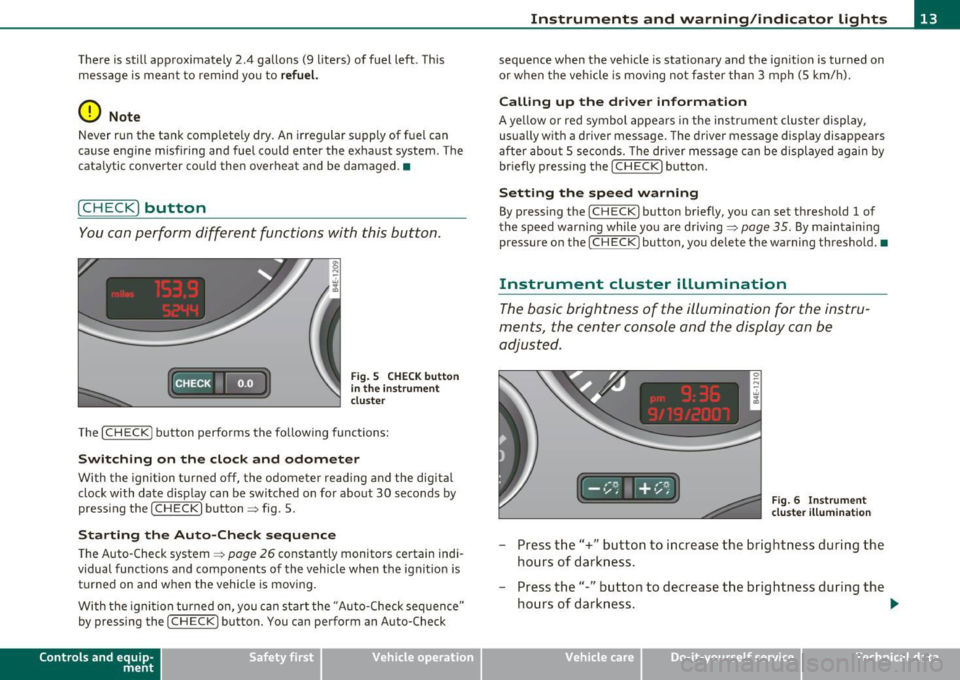
Fig. S CHECK button
in the instrument
cluster
The [ CHECK] button performs the following functions:
Switching on the clock and odometer
With the ignition turned off, the odometer reading and the digital
clock with date display can be switched on for about 30 seconds by
pressing the [
CHECK] button~ fig. 5.
Starting the Auto-Check sequence
The Auto-Check system~ page 26 constantly monitors certain indi
vidual functions and components of the vehicle when the ignition is turned on and when the vehicle is moving.
With the ignition turned on, you can start the "Auto-Check sequence"
by pressing the
(CHECK) button. You can perform an Auto-Check
Con tro ls a nd e quip
m en t Vehicle
OP-eration
Instruments and warning/indicator lights
sequence when the vehicle is stationary and the ignition is turned on
or when the vehicle is moving not faster than 3 mph (5 km/h).
Calling up the driver information
A yellow or red symbol appears in the instrument cluster display,
usually with a driver message. The driver message display disappears
after about 5 seconds. The driver message can be displayed again by
briefly pressing the [
CHECK) button.
Setting the speed warning
By pressing the [ CHECK] button briefly, you can set threshold 1 of
the speed warning while you are driving ~
page 35. By maintaining
pressure on the [
CHECK ) button, you delete the warning threshold.•
Instrument cluster illumination
The basic brightness of the illumination for the instru
ments, the center console and the display can be
adjusted.
Fig. 6 Instrument
cluster illumination
- Press the"+" button to increase the brightness during the
hours of darkness.
- Press the"-" button to decrease the brightness during the
hours of darkness. .,.
Vehicle care Do-it-yourselt service iTechnical data
Page 158 of 384
1111....__A_ u_ t_o _m_ a_ t_ic _ t_ r_ a_ n_s _m_ i _s_ s_ i_ o_ n ____________________________________________ _
Select R only when the vehicle is at a full stop and the engine is
running at id le speed =>
& in "Driving the automatic transmission"
on
page 154.
Before you move the selector lever to R , press both the button in the
hand le of the selector lever
and the brake pedal at the same time.
When the ignition is on, the backup lights illuminate when the
selector lever is moved into
R .
N -Neutral
The transmission is in neutral in this position. Shift to this position
for standing with the brakes applied =>
page 156.
When the vehicle is stationary or at speeds be low 3 mph (5 km/h),
you must always apply the footbrake before and while mov ing the
lever out of
N.
D -Normal position for driving forward
Posit ion Dis fo r normal city and highway driving . It ranges from zero
to top speed and all six gears shift automatically, depending on
engine load, driving speed and automat ica lly se lected shift
programs.
When the vehicle is stationary or at speeds below 3 mph (5 km/h),
you must always apply the foot bra ke before and while moving the
lever to
D out of N .
In certa in circumstances it may be advantageous to temporarily
switch to the manual sh ift program to manually select gear ratios to
match specific driving conditions =>
page 158.
S -Sport position
Select this position for sportie r performance. In this position, the
transmission will not upshift as soon, allowing the vehicle to use the
increased power available at higher engine speeds to achieve livelier
acceleration .
When the vehicle is stationary or at speeds be low 3 mph (5 km/h),
you must always apply the foot bra ke before and while moving the
lever to
S out of N .
& WARNING
Read and follow all WARNINGS=> & in "Driving the automatic
transmi ssion" on
page 154.
0 Note
Coasting downhill with the transmission in N and the engine not
running will result in damage to the automatic transmission and
possibly the catalytic converter. •
Automatic Shift Lock (ASL)
Automatic shift lock prevents you from accidentally
shifting into a forward gear or into reverse, thus causing
the vehicle to move unintentionally.
0
Fig . 170 Shift gate
se lector lever lock posi
tions and interlock
button highlighted
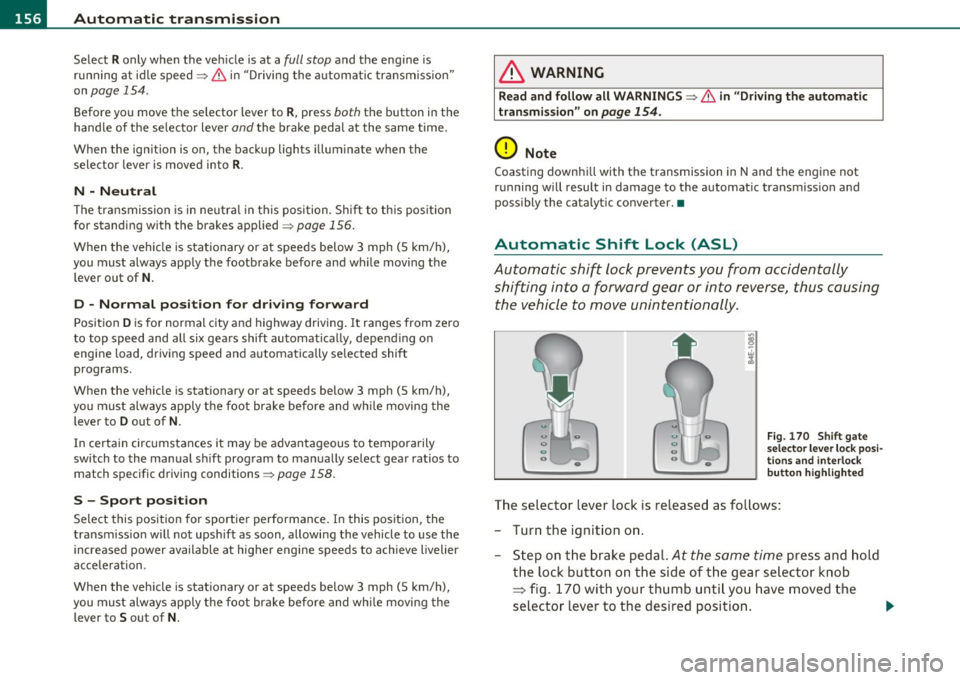
The selector lever lock is released as follows:
- Turn the ignition on .
- Step on the brake pedal.
At the same time press and hold
the lock button on the side of the gear selector knob
=:> fig. 170 with your thumb until you have moved the
selector lever to the desired position. .,_
Page 264 of 384

Driving and environment
New brake pads
Remember that new brake pads do not have a f ull braki ng
e ff e ct during the first 250 miles (400 kilometers) after they
are i nsta lle d.
New bra ke pads have to be "burnished in" before they have opt ima l
grab=> &.
Dur ing the break -in period, you sho uld avoid putting severe loads on
the brakes. Severe loads incl ude, for example, sudden hard braki ng,
in particu lar at very high s peeds or, for examp le, on mountai n passes.
& WARNING
New brake pads don 't have the be st stopping power and must be
" broken -in " during the initial 100 to 150 miles (150 to 200 kilo
meters ) of normal cit y driving. You can compensate for thi s by
pressing th e brak e pedal more firmly. This also applies lat er wh en
new pad s are installed. n
Catalytic converter
It is very important that your emissio n contr ol system
(catalytic converter) is functioning prop erly to ensure
that your vehicle is running in an environmentally sound
manner.
- Always use lead-free gasoline==> page 283, "Fue l su pp ly" .
- Never ru n the tank down a ll th e way to empty .
- Never put too m uch motor oil in your engine==>
page 294,
"Adding engine o il
The catalytic converter is an efficient "clean- up" device bu ilt into the
exha ust syste m of the ve hicle. The cat alytic converte r burns many of
the polluta nts in the exhaust gas before they are released into the
atmosphe re.
Th e e xcl usive use of unleaded fuel is cr itic ally important for the life of
the catalytic converter and proper f unction ing of the engine.
& WARNING
• Do not park or operate the vehicle in areas whe re the hot
exhaust sy stem may come in contact with dry grass, brush, fuel
spill or other material which can cause a fire .
• Do not apply additional undercoating or ru stproofing on or
near the exhaust manifold , exhaust pipes, catalytic conve rter or
heat shield s. During driving, the substance used for undercoating
could overheat and cause a fire .
0 Note
• Be aware that just one tank filling wit h leaded fu el wi ll alrea dy
ser iou sly degrade the performan ce of the ca talyt ic co nve rter.
• Do not exceed the correct engine oil leve l=>
page 294 .
• Do not dr ive unti l the f uel tank becomes complete ly empty. The
eng ine could misfire . Unburned fuel could a lso get into the exha ust
system and th is could cause the catalytic converter to overheat.
• Do not t urn o ff the igni tion whi le the ve hicle is moving.
• Do not continue to operate your vehicle under these conditions, as
o therwi se fuel c an reach the cat alytic c onve rter. Th is cou ld resu lt in
over heating of t he converte r, requiring its rep lacement.
• T o ass ure eff ic ient operat ion of the Emi ssion Co ntro l System:
- Have your vehicle maintained properly and in accordance with
t h e se rvice recommenda tions in your Warranty
& M aintenance
booklet. •
Page 267 of 384

Driving and environment
------------------------------------------------'
The amount of oil used is related to engine load and speed.
It is normal for the oil consumption of a new engine to reach its
lowest value after a certain mileage has been driven .
You must drive your vehicle about 3,000 miles (5,000 kilometers)
before you can properly assess oil consumption.
This also applies to fuel consumption and engine output .
0 Note
• Have your vehicle maintained properly and in accordance with the
service recommendations in your Warranty
& Maintenance booklet.
Lack of proper maintenance as well as improper use of the vehicle w ill
impair the function of the emission control system and cou ld lead to
damage.
• Do not alter or remove any component of the Emission Control
System un less approved by the manufacturer.
• Do not a lter or remove any device, such as heat shie lds, switches,
ignition wires, valves, which are designed to protect your vehicle's Emission Contro l System and other important vehicle components. •
Fewer short trips
Fuel consumption will always be relatively high on short
trips .
-Try to avoid driving short distances with a cold engine.
The eng ine and catalytic converter have to reach thei r optima l oper
ating temperature
to reduce fuel consumption and noxio us em is
sions effectively.
Just after starting, a cold engine in a mid -size car only achieves a fuel
economy of 6-8 miles per gallon (30-40 l/100 km) . After about a half
a mile, fuel economy climbs to 12 mpg (20 l/100 km). After about
2.5 miles (4 km), the engine is at its proper operating temperature
Controls and equip
ment Safety first Vehicle operation
and fuel economy has
reached a normal level. So you can see that you
should avoid short trips whenever possible.
The
outside temperature is also cr it ical in th is regard . Your car
consumes more fuel in the winter than in the summer. •
Vehicle care Do-it-yourself service Technical data
Page 278 of 384
-~_C_ le_ a_n_ i_ n_ g=- a_ n_d___. p_ ro_ t_e _c_ t_ i_o _n ___________________________________________ _
Use only special acid-free cleaners formulated for a lloy r ims . Sa fe
pro ducts are availabl e at your A udi de aler. Never leave t he cle aner on
the rims longe r tha n spec ified on the label. If not rinsed off promptly,
the ac id contained in some cleaners can attack the t hreads on the
w heel bolts.
Never use abrasive or metal po lish ing cleaning agents.
If the protec
t ive coa ting ha s been ch ipped, e.g. by k icked up road dirt, touch it up
as soon as possible.
& WARNING
• Moisture and ice on brakes may affect braking efficiency
=> page 254, "General information ". Test the brakes carefully
each time you wash the vehicle.
• Always read and heed all WARNINGS and other information
=:>page 270 . •
Body cavity sealing
The body cavity sealing does not need to be checked .
All body cavit ies which cou ld be affected by corrosion have been thor
oughly p rotected at the factory .
Th is sea ling does not require any inspection or additiona l treatment.
If any wax sho uld seep ou t of the cavi ty when the ambien t tempera
ture is h igh, it can be removed w it h a plastic scraper and a suitable
so lvent .
& WARNING
Solvents can be dangerous.
• Benzine is flammable and toxic. If you use benzine for
removing the wa x, keep sparks, flame and lighted cigarettes
away. Never dump benzine on the ground, into open st reams or
down sewag e drains.
& WARNING (co ntinued )
• Be su re to observe all safety and environmental regulations.
Follow all instructions on the container.
• Always read and heed all WARNINGS and other information
=:>page 270 . •
Chassis
Hav e the undercoa ting checked fo r damage f rom time to
ti me.
The lower body shell of your Audi is a lso thoroughly protected against
c orrosion .
Any damage to the u nde rcoat ing caused by road ha za rds sho uld be
repaire d promptly.
& WARNING
Too mu ch undercoating in the wrong places can caus e a fire.
• Do not apply additional undercoating or rustp roofing on or
near the exhau st manifold , exhaust pipes, catalytic converter or
heat shields. While dr iving, the substance used for undercoating
c ould overheat and cau se a fire.
• Always read and heed all WARNINGS and other info rmation
=> page 270 . •
E x haust tail pipes
Road s alt and ot her c orrosive mater ials w ill damage the m ate rial in
the exhaust ta il pipes if they a re not cleaned regularly. Do not clean
t he t ail pipes w ith w heel cleaner, p aint polish, chrome po lish or o ther
abrasive cleaners. C lean the tail pipes with car care products that are
sui table for sta inless s teel.
~
Page 287 of 384

In order to fill the tank properly while protecting the environment,
please follow this refueling procedure carefully.
& WARNING
Under normal operating conditions, never carry additional fuel
containers in your car. Gas canisters and other containers used to
transport fuel can be dangerous. Such containers, full or empty,
may leak and could cause a fire in a collision. If you must transport
fuel to use for your lawn mower, snow blower, etc., be very careful
and always observe local and state laws regarding the use, trans
portation and storage of such fuel containers. Make certain the
container meets industry standards (ANSI /ASTM F852 -86).
0 Note
Never drive your vehicle until the fuel tank is completely empty . The
irregular supply of fuel can cause misfiring. Gasoline could enter the
exhaust system and damage the catalytic converter. •
Refuelling
The fuel filler flap is unlocked from a button in the
driver's door.
Fig . 235 Driver's
door: Unlock ing fuel
filler flap
Vehicle OP-eration
Fuel supply and filling your fuel tank
Fig. 236 Fuel cap
hooked on the opened
f uel filler flap
When adding fuel , the ignition and any cellular phones in the
vehicle must be switched
off.
Taking the fuel cap off
- To open the fuel filler flap, press the button~ fig. 235.
- Unscrew fuel filler cap counter-clockwise and hang it on
the fuel filler flap~ fig . 236.
Refuelling procedure
- Insert the fue l nozzle from the gasoline pump into the
fuel filler neck as far as it will go.
- Select a medium refuelling rate so that the nozzle
switches off automatically when the tank is full.
Putting the fuel cap back on
- After filling your tank, twist the fuel filler cap clockwise
until you hear a definite click .
- Close the fuel filler flap.
To avo id fuel spi lling or evaporating from the fuel tank always close
fuel filler cap properly and completely . An improperly closed fuel
filler cap may also cause the MIL lamp~
page 25 to come on. ._.
Vehicle care Do-it-yourselt service iTechnical data
Page 346 of 384

lffll.,___F_ u_ s_e _ s_ a_n_ d_ b_u _ l_ b_ s _______________________________________________ _
No. IIEquipment
30 Vacant
31
32
33
34
35
36
37
38
39
4 0
41
42 Onboard power s
upply, light contro l (r ight
headlight)
Vacant L eft rea r footwell heate r
Vacant
Vaca nt
A udi si de assist
Coo ler
Onboard power supply, light control (left head
light)
Door control un it, dr iver's side
Power steerin g column adjustmen t
Door control unit, rear left
Access/start control module
4 3 Adaptive L ight, le ft
--44 Adap tive Light, righ t
Amps
30
25
5
15
30
7 .5
25
7 .5
25
10
10
•
Fuse Location, Instrument Panel right
Fig. 279 Fuse panel
la yout
Some of the equipment items listed are optiona l or only availab le on
certain mode l configurations .
Note that the following table is accurate at the time of going to
press and is subject to change. In the event of discrepancies , the
label on the in sid e of the cover alway s take s precedence .
The power window regu lators and the power seats are protected by
circuit breakers , which automatically reset after a few seconds after
the overload -for examp le if a window is frozen -has been remedied .
No. Equipment
1 Parking br ake
2 A ir cond ition ing
3 Shift gate
4 Vacan t
5
6
7
---· 8
Eng ine contro l
Oxygen sensor before the three-way
cat alytic converter
Oxygen sensor behind the three -way
catalytic converte r
E ngine control, auxiliary w ater pump
Amps
5
10
5
15
15
15
1 0
Page 372 of 384

__ _::_A:!: l~ p::_ h :....:..:: a:.:b::: e::..::. t:.:ic ::a::.: l:....:..: i n~ d:.:e ~ x::.._ ___________________________________________ _
Outside temperature display .... .... 23 Electronic speed limiter .. ...... .... ... 26 Malf u nction symbo l ....... ... . ... . 29
Sound system d isplay .............. 23
Electronic stabili zation prog ram ( ES P) Radiator fan
.................... 299
Dr iver Information System How the system works ...... .... .. 252 T
emperatu re gauge .......... ..... 10
Digita l speedometer .... ... ... .. ... 23 Wa rning/indicator l ights .. . .. .... .. 16 Engine data .. .. .. ...... ... .. .. .. .. 360
Dr ive r's seat .. .. .. .. .. .. .. ... ....... 77 Eme rgency braking . ............... . 12 5 Engine hood
Dr iver 's sea t memory ................. 84 Emergency closing Clos
ing ......................... 289
Act ivat ing remote control key ....... 85 Power su nroof ................. 58, 59 How to release the
hood ........ .. 288
Recalling a seat position ............ 84
Emergency flasher .. ..... ..... .. ... .. 63 Engine oil
.......... .......... ..... 291
Storing a seat position ... .. .. .. .... 84
Warning/indicator l ights .. . .. .... .. 17 Add
ing .... .... .... .. . .. .. .. .. .. 29 4
Dr iv ing messages .................... 27
Eme rgency locking ................. .. 46 Add
itives .... ....... ...... .... .. 294
Dr iv ing safely ... .. .. ............. .. 186
Driving through water . .......... ... . 263
Dr iv ing time . ... .. .. .. .. .. ..... ..... 36
Duplicate key ....................... 39
DVD playe r for navigat ion system ...... 102 Emergency
locking of doors ... .. ...... 46
Emergency st arting .... ..... ... .. .. . 3 48
Emergency towing .................. 350
E me rgency warning triang le ... .. .. .. . 332
E nergy managemen t .. ............. . 258 Cha
nging .... ....... .... .. .. .. .. 295
C hecking the engine oil leve l ... .. .. 293
I n dicat io ns and condi tions requiring ex tra
check ing . .. .. .. .. ............. 293
Oi l co nsumpt ion .. .. ... ... ..... .. 293
Oil grades ...................... 291
E
Battery power ................... 259
Dr ive r no tifica tion . .... ..... ... .. . 259 Oi
l level symbo l ................... 33
Pressu re malfunction .............. 30
Eas y entry feature
118 Engine
4.2 l, 8-cylinder (350 hp) ........ .. 290 Recommended oil check
inte rv a ls . .. 293
Sen sor defective .. .. .. .. .......... 33
Electrome chanical pa rking bra ke
Emergency br aki ng .. .. .. .. .... .. . 12 5
Ma lf u nct ion . .... .... ..... ... . .. . 12 5
Operation ... .. .. .. ... ... .... ... 1 23
Parking ... .. ..... ....... ... . ... 1 24
Releasing and app ly ing . .. .... ..... 123
Sta rting off w ith a trailer .. .. .. .... 125
Warning/ind icator lights . .......... 20
Electroni c dif feren tial loc k (EDL) 6
.0 l , 12-cylinde r (450 hp) ... ... .. . 291
Compa rtme nt .. .. .. .. .. .... . 2 9 0, 29 1
Coolan t ........................ 296
Hood .. ................. .. .. .. . 288
St art ing .. . .. .... .. .. .... .. . 1 18 , 119
Sta rting with jumpeir cab les ... .. .. . 3 48
Stopp ing . .. .. ... .. .. .... .. .. .. . 120
E ngine comp artment ................ 290
Safety ins truct ions .... .. .. .. .. ... 289 Spe
cifica tion and vis cosi ty .. ... .. .. 2 91
Engine speed lim itation ....... ... ... .. 33
Environment Break-in pe riod . ...... ......... .. 261
Catalytic converter .. .... ......... 262
Disposing of your veh icle battery .. .. 304
Dr iv ing at hig h speeds ............ 264
Dr iv ing to mi nimize pollution and noise ..
263
How the system wor ks ... ..... .... 253
Wa rning/indicator lights ... .. ... ... 19
Electron ic immobili ze r ... .. .... .. .. 12, 41 Wor
king the e ng ine compar tment .. 289
Engine coolant ... ... ... ...... .... .. 296
Add ing coolant .................. 298 Fuel
.... ...... ........... .... .. 285
Fuel economy .. .... ....... .... .. 263
Leaks under your vehicle . ......... 289
Electronic power contro l
Checking the engine coo la nt level ... 297
Letting the vehicle stand and warm up
(EPC) warning/ indicator light ........ 16
Expa nsio n tank .................. 297 264