light AUDI S8 2011 Owners Manual
[x] Cancel search | Manufacturer: AUDI, Model Year: 2011, Model line: S8, Model: AUDI S8 2011Pages: 302, PDF Size: 76.07 MB
Page 216 of 302
214 Cleaning and protection
leathe r, whi ch has a smooth surface and
comes in various co lors .
The intensity of the color determines the v is u
a l charac ter istics and appearance. If the sur
face of the leather has a typical natu ral look,
then the leather is a nappa leather that has been left in a relatively natural cond ition. This
leather offers particularly good comfort and
breathes well. F ine veins, closed grains, insect
b ites, skin folds , and subtle var iations in co lor
remain visible . These c haracteristics demon
strate that the mater ia l is natural.
Natural nappa leather is not covered by a col
or fi nish . It is therefore more sensitive to soil
i ng and wear, w hich is something you need to
consider if ch ild ren , an ima ls or othe r factors
might prove to be particular ly hard on the
l eathe r.
By contrast, leat her types that are covered by
a co lored finish layer a re mor e durable . This
has a posit ive effect o n the leather's resist
a nce to wear and soil ing in daily use. On the
o ther hand , the typical characteris tics of na tu
ra l leather a re barely or not apparent. Howev
e r, this does not mean that the leather itself
is of infer ior quality.
Care and handling
Because of the exclusive na ture of the types of
l eather that Audi uses and the ir unique prop
erties (such as sensitivity to oils, grease, soi l
ing, etc.), you will need to be somewhat care
fu l w ith these leathers, and a ce rtain type of
care is required. For examp le, dark clot hing
materials can d iscolor leather sea ts (especial
ly if such clot hing is damp and was not dyed
correctly) . Dust and d irt part icles in po res,
folds , and seams can have a n ab ras ive effect
and can damage the leathe r sur face as well as
weaken seams.
The leather should be cleaned regula rly as
needed. After havi ng been used for a re lative ly
l ong time, yo ur leather sea ts will acqui re a
ri ch aged finish. This is a charac ter istic of n at
u ra l lea ther and a sign o f true quality . In order to maintain the val
ue of this nat ural
product over the life of your vehicle, you
sho uld follow the recommendat ions be low :
(D Note
- To keep your leather from b leaching o ut,
do not allow it to be exposed to b right
sunlight for long periods of time . If you
have to leave the ve hicle parked outside
for long per iods, cover the leather to
protect it from direct exposure to sun
light .
- Sharp objects on cloth ing, such as zip
pers, rivets or sharp pieces on belts can
leave permane nt sc ratches or sc rape
ma rks on the su rface of the leather.
(0 Tips
- After each time you clean the leather and
at regular intervals, use a leathe r preser
vative c reme that contains UV-b locke rs
and tha t works into the leat he r. Thi s
c reme will nour ish a nd moistu rize the
leather, helping it to breathe and stay
supple. It a lso helps to build up a p rotec
tive coating on the surface.
- Clean the leat her every 2 -3 months,
and clean any a reas that get soi led .
- Remove fresh ma rks made by ballpo int
pe ns, ink, lipstick, shoe polish, etc. as
soon as poss ible.
- P reserve the color o f the leather as need
ed by using a specia l co lore d leathe r care
creme to touch up areas of uneven color .
Cleaning and caring for leather
upholstery and trim
Applies to vehicles: with natural leather
Natural lea ther requires special care and at
tention .
Normal cleaning
.. Clean soiled areas with a slightly moistened
cotton or woolen cloth . .,.
Page 217 of 302
More stubborn dirt
"' More stubborn dirt can be removed using a
cloth saturated with a mi ld soap so lution (2
tablespoons mi ld liquid soap).
"'N ever allow the soap so lution to saturate
the leather, and make certa in that no water
soaks into the seams .
"' Wipe
off the soap solution with a soft, dry
cloth .
Cleaning spots
"' Remove fresh water-based spots (such as
coffee, tea, juices, blood) w ith an absorbent
cloth or paper towel.
"' Remove fresh
grease or oil -based spots
(such as butter, mayonnaise, chocolate) with
an absorbent cloth or paper towel, or use
t h e cleane r from the leathe r care kit if the
spot has not yet penetrated into the surface
of the leather.
"'U se an oil/grease dissolving spray, if
oil/
grease spots have d ried on.
"' Remove spec ific kinds of spots (ballpoint
pen, felt marker, fingernail polish , water
based paint, shoe polish, etc.) with a spot
remover specifically formulated for leather .
Leather care
"'Every half year use an approved leather care
product (available from your Audi dealer) to
care for the leather.
"' Apply the product very sparingly.
"' Wipe it
off with a damp cloth .
If you have any questions abo ut cleaning and
caring for the leather in your vehicle, it is best
to contact your author ized Audi dealer, who
will be glad to help you and tell you about our
fu ll range of leather care products, suc h as:
- Leather cleaning and care k it
- Creams to care for colored leather
- Spot removers for ballpoint pens, shoe pol-
ish, etc.
- Oil/grease dissolving spray
- New and upcoming prod ucts.
Cleaning and protection 215
A WARNING
Always read and heed all WARNINGS and
other information
¢ page 206.
(D Note
-Never use chemica l so lvents (e.g. lighter
fluid, turpentine), waxes, shoe polish or
similar products on the leather surfaces
in your Audi.
- To avoid damage, have stubborn sta ins
removed by a commercial clean ing spe
cialist.
Cleaning Alcantara ® (synthetic suede)
App lies to veh icles: w it h Alca nta ra upho lstery
Removing dust and dirt
"' Moisten a cloth, squeeze out excess water
and wipe down the seat surfaces.
Removing stains
"' Moisten a cloth with lukewarm water or
w ith diluted
ethyl (rubbing) alcohol.
"' Dab at the stain . Start at the outside and
work inwards .
"' Once the stain is no longer visible, use a soft
d ry cloth or tissue to soak up the moisture .
Do not use leather cleaning products on A l
cantara .
You may use a suitable shampoo for remov ing
dust and dirt.
Dust and grit in the pores and seams can
scratch and damage the surface.
If the car is
left stand ing in the sun for long per iods, the
Alcantara covers should be protected aga inst
direct sunlight to prevent it from fad ing .
Slight color variations will develop in normal
use and are not an indication of mate rial dete
rioration .
(D Note
-Never use chemical so lvents (e .g. lighter
fluid, turpentine), waxes, shoe polish or
similar products on Alcantara ® surfaces. .,.. •
•
Page 218 of 302

216 Cleaning and protecti on
- To avoid damage, have stubborn stains
removed by a commercial cleaning spe
cialist.
- Do not use br ushes, stiff sponges or sim
ilarly abrasive cleaning aids.
Safety belts
Only well-maintained safety belts work relia
bly when needed .
> Keep belts clean.
> For cleaning, use a mild soap and wate r sol
ution . Let be lts dry thoroughly and away
from direct sunlight .
> Do not allow inertia reel safety be lts to re
tract before they are completely dry.
> Check the condition of your safety belts reg
ularly .
Heavily soiled safety belts may not retract
properly.
.&_ WARNING
Damaged safety belts can break in a crash.
- Anything that might damage your safety
belts could mean that you and your pas
sengers would not be adequately pro
tected in an acc ident.
- Safety belt performance depends on cor
rect installation. Never remove belts
from the vehicle to clean them.
- Do not use chemical cleani ng agents,
bleach or dyes. They have corrosive prop
ert ies which weaken the webbi ng.
- When cleani ng your safety belts, inspect
them for damage.
If you discove r dam
age, see you r A udi dealer.
- Always read and heed all WARNI NGS and
other information
c:> page 206.
Cooler
A ppl ies to vehicles: with cooler
A layer of ice or frost in the cooler interferes
with its cooling performance .
Clean ing
The refr igerator sho uld be cleaned reg ularly.
> Wash the coo ler with lukewarm wate r and a
mild cleaning solution, if necessary.
> Then wipe the cooler dry.
> Dust and d irt will accumulate near the venti
lation openings in the luggage compart
ment due to normal cooler usage. This
should be cleaned regularly.
D ef rosting
> Switch the coo ler off c:> page 72.
> Remove any food or beverages and allow the
coo ler to defrost with the door open.
> W ipe the inside of the cooler dry and clea n
the cooler, if necessary .
Defrost the cooler if you will not be us ing it
for extended periods of time .
(D Note
- Do not try to speed up the defrosting
process by apply ing heat.
- To reduce the risk of persona l injury or
damage to the refr igerator,
- do not use any abrasive cleaners, sol
vents, wax, agg ress ive clean ing solu
tions, solut io ns w it h strong frag rances,
etc.,
- d o no t clean the co oler w ith cleaning
tools su ch as s teel woo l.
Engine compartment
Be especially careful when cleaning the en
gine comportment.
Alway s switch off the ignit ion b efor e cle an
ing the engine
c:> ,&. .
Plenum panel
Remove leaves from the plenum panel in front
of the w indshield under the eng ine compart
ment . This prevents the wate r drain holes
from becom ing b locked, and it preve nts de
br is from entering the vehicle inte rior through
the heat ing and ven tilat ion duc ts.
Corrosion protection
The eng ine compartment and transmission
have been corrosion-protected at the factory .
ll-
Page 220 of 302
218 Fuel supply and filling your fuel tank
Fuel supply and filling
your fuel tank
Gasoline
Fuel supply
Using the righ t fuel helps keep the environ
ment clean and preven ts engine damage .
Fuel recommendation
The fuel recomme nded for you r vehicle is un
lead ed premium
g rade gasoline . See also
¢ pag e 282, Data . Audi recommends usi ng
T OP TIER D eterge nt Gaso line wi th a mini mum
octane r atin g of 9 1 AK I (95 RON). For more
info rmation on TO P TI ER De tergent Gaso line,
p lease go to t he officia l webs ite (www.toptier
gas.com).
T he re commended g asoline oct ane r ating for
your engine can a lso be fo und on a la bel locat
e d on the ins ide of the fue l filler flap . This rat
ing may be specif ied as A KI or RON.
Your veh icle m ay also be oper ated using un
l eaded regular gas oline with a min imum o c
tane rating of 87 AKI/91 R ON. However, using
87 AKI/91 RON octa ne f ue l w ill slightly re
d uce eng ine perfo rmance.
Use unleaded gasoline only. Unleaded g aso
line is available th rougho ut the USA, Ca nada ,
and in most E uropean countries . We recom
mend that you do not ta ke yo ur vehicle t o
areas or countries where unleaded gasoline
may not be avai lable.
F or mo re informat io n on refue ling your ve hi
cle, see
¢ page 219.
Octane rating
Octa ne r ating in dicates a g aso line's abili ty to
res ist engine damaging "knock" ca used by
p remature ign ition and detonation. Therefore,
buy ing the correct grade of gaso line is very
important to help prevent possible engine
damage and a loss of engine performance.
Gasoline most commonly used in the Unite d
States an d Canada has the following octane r
at ings t hat can usu a lly be found on the fi ller
pump:
- Pre mium Gra de: 91 -96 A KI
- Regular Grade : 87 -90 AKI
Explanation of the abbreviations:
AKI = Anti K nock Index= (R+M) /2 = (RO N
+ MON)/2
R ON= Resea rch Octane Numb er
MON = Motor Octane Number .
(D Note
-Do not use a ny f ue l w it h octane rat ings
lower tha n 87 A KI or 91 RO N othe rwise
expensive engine damage w ill occur.
- Do
not use leaded gasoline. The use of
leaded gasoline w ill severely damage
yo ur v ehicl e's catalytic co nve rter a nd its
ability to co ntrol exha ust em ission s.
Blended gasoline
U se of gasoline containing alcohol or
MTBE (methyl tertiary butyl ether)
You may use unleaded g asoline blende d with
alcohol o r MTBE (commonly referred to as
oxygenates) if the blende d mixture meets t he
f o llow ing criteria :
Blend of gasoline methanol (wood alcohol or
methyl alcohol)
-Anti -kno ck index mus t be 87 A KI or higher.
- Blend must contain no mor e than 3% me th-
anol.
- Blend must contain more than 2% co-sol-
ve nts .
Blend of gasoline and ethanol (grain alcohol
or ethyl alcohol)
- Anti -knoc k index must be 87 AKI or higher .
- Blend must not conta in mo re than 10%
ethanol.
Blend of ga soline and MTBE
- Anti-knoc k index must be 87 AKI or high er. ll-
Page 224 of 302
222 Checking and filling
Checking and filling Engine hood
Releasing the engine hood
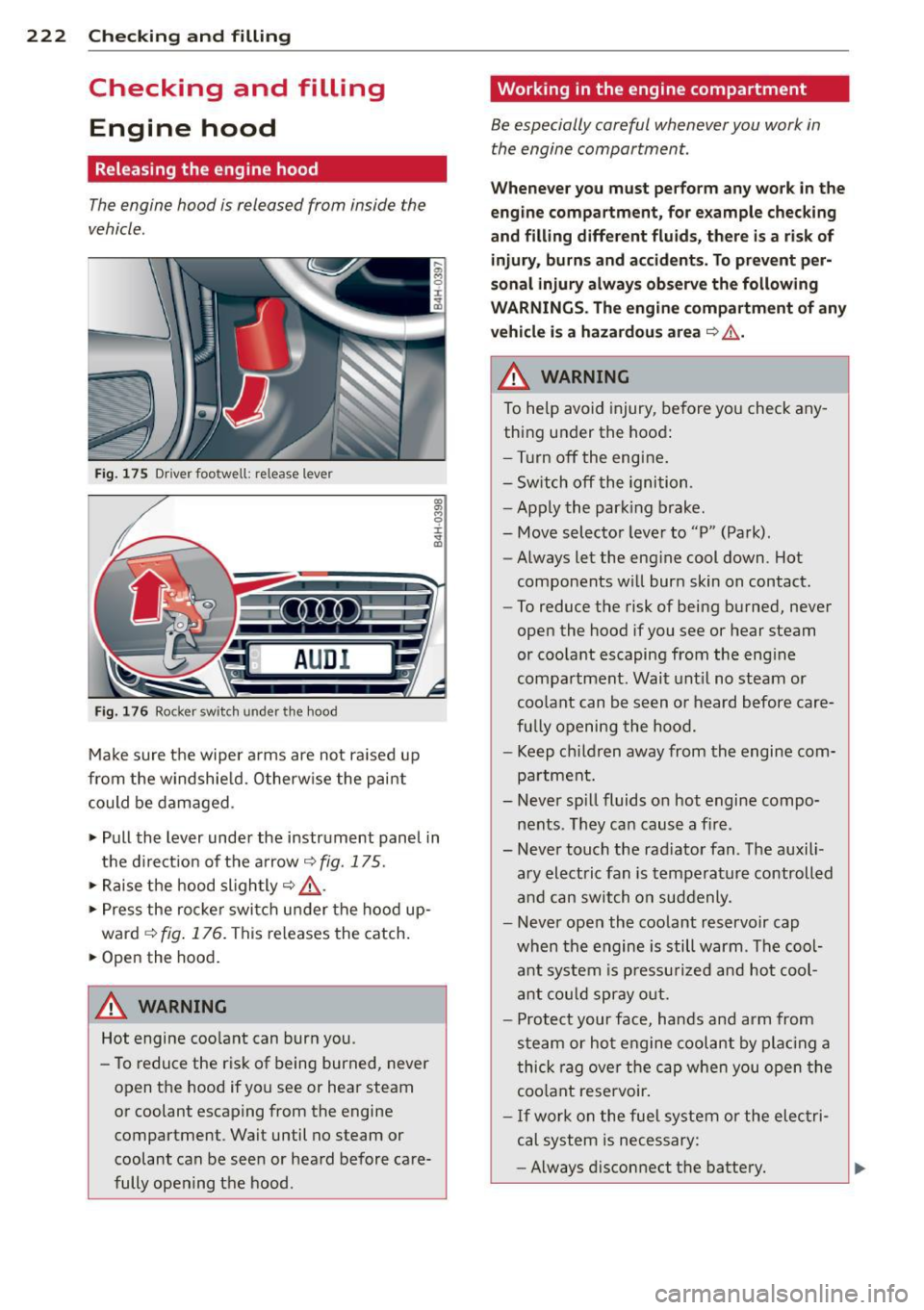
The engine hood is released from inside the
vehicle .
Fig. 175 Driver foo twell: release lever
AUD I
Fig. 176 Rocker switch un der the hood
Make sure the wiper arms are not raised up
from the windshield. Otherwise the paint
could be damaged.
.,. Pull the lever under the instrument panel in
the direction of the arrow
¢ fig. 175.
.,. Raise the hood slightly¢,&. .
... Press the rocker switch under the hood up
ward ~
fig. 176. This releases the catch.
... Open the hood.
&_ WARNING
Hot engine coolant can burn you.
- To reduce the risk of being burned, never
open the hood if you see or hear steam
or coolant escaping from the engine compartment . Wait until no steam or
coolant can be seen or heard before care
fully opening the hood .
' Working in the engine compartment
Be especially careful whenever you work in
the engine compartment.
Whenever you must perform any work in the
engine compartment, for example checking
and filling different fluids, there is a risk of injury, burns and accidents. To prevent per
sonal injury always observe the following
WARNINGS. The engine compartment of any
vehicle is a hazardous area
¢ ,&. .
/n.. WARNING
To help avoid injury, before you check any
thing under the hood:
- Turn off the engine.
- Switch off the ignition .
- Apply the parking brake.
- Move selector lever to "P" (Park) .
- Always let the engine cool down. Hot
components will burn skin on contact.
- To reduce the risk of being burned, never
open the hood if you see or hear steam
or coolant escaping from the engine
compartment. Wait until no steam or
coolant can be seen or heard before care
fully opening the hood.
- Keep children away from the engine com
partment.
- Never spill fluids on hot engine compo
nents . They can cause a fire .
- Never touch the radiator fan. The auxili
ary electric fan is temperature controlled
and can switch on suddenly .
- Never open the coolant reservoir cap
when the engine is still warm . The cool
ant system is pressurized and hot cool
ant could spray out.
- Protect your face, hands and arm from
steam or hot engine coolant by placing a
thick rag over the cap when you open the
coolant reservoir.
- If work on the fuel system or the electri
cal system is necessary:
- Always disconnect the battery.
Page 226 of 302
224 Checking and filling
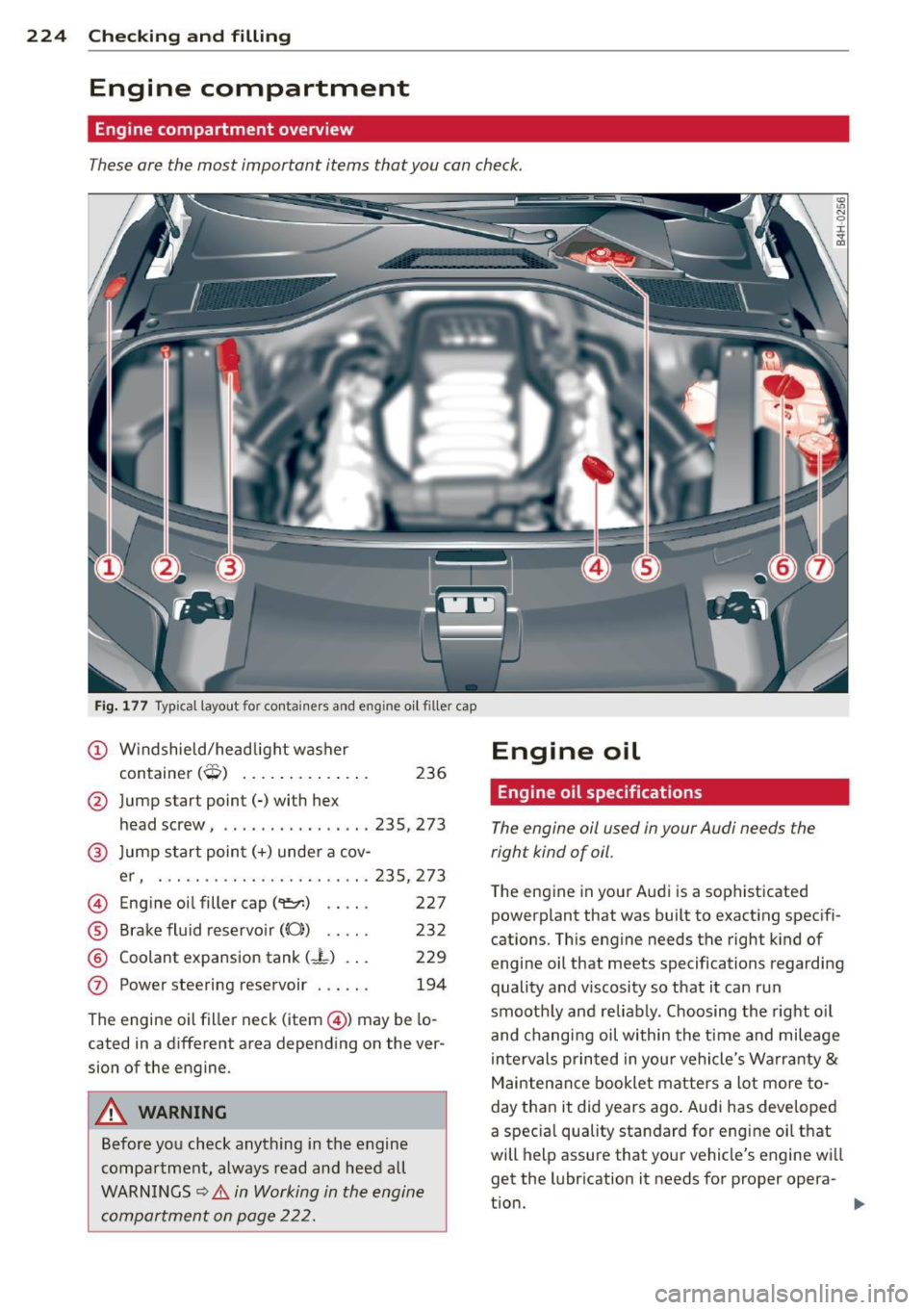
Engine compartment
Engine compartment overview
These are the most important items that you can check.
Fig . 177 Typ ical layout for conta iners a nd eng ine o il filler cap
(D W indshield/head light washer
t . (?::..) con
amer ~ .... ... . ... .. . 236
@ Jump start point(-) with hex
h ead screw, ................
235, 273
@ Jump start point(+) unde r a cov-
e r, . ...... .... ......... .. .
23 5, 273
© Eng ine oi l filler cap ('t::r.) . . . . . 227
® B rak e fluid reservo ir ((0)) . . . . . 232
® Coolant expansion tank (J-) . . . 229
0 Power steering reservoir . . . . . . 194
The engine oil filler neck (item@) may be lo
cated in a d ifferent area depending on the ver
sion of the engine .
A WARNING
Before you check anything in the engine
compartment, always read and heed all
WAR NINGS¢
A in Working in the engine
compartment on page 222.
Engine oil
Engine oil specifications
The engine oil used in your Audi needs the
right kind of oil.
T he eng ine in your Audi is a sophisticated
powerplant that was built to exacting specifi
cations . Th is engine needs the right k ind of
engine oil that meets specifications regarding
quality and v iscosity so that it can run
smoothly and reliab ly . Choosing th e right o il
and changi ng oil within the t ime and mileage
in tervals prin ted in you r vehicle's Warr anty
&
Maintenan ce booklet matte rs a lot more to
day tha n it did years ago . Audi has develope d
a spec ia l quality standard for engine oil that
will help assure that you r vehicle's engine w ill
get the lubr ication it needs for proper opera-
t ion. ..,.
Page 228 of 302
226 Check ing and filling
temperatures stay below freezing point for
long periods.
Detergent add it ives in the o il w il l make fresh
oil look dark after the eng ine has been run
ning for a short time . This is norma l and is not
a reason to change the oi l more often than
recommended.
Dam age or ma lf u ncti ons du e to lack of
m ainten ance
It
is essential that you change your oil at the
recommended in tervals using only engine o il
that complies with Audi oi l standard
VW 502 00. You r Limited New Vehicle War
ranty does not cover damage or malfunctions
due to fail ure to fo llow recommended mainte
nance and use requ irements as set forth in
the Audi Owner's Manual and Warranty&
Maintenance book let . Your dealer will have to
deny warranty coverage unless you present to
the dea ler proof in the form of Service or Re
pa ir Orders that all scheduled maintenance
was performed in a t imely manner.
Eng ine oil consumption
The engine in your vehicle depends on an ade
quate amount of oil to lubricate and cool all
of its moving parts.
In order to provide effective lubrication and
cool ing of internal engine components, a ll in
ternal comb ustion eng ines consume a certa in
amount of oil. O il consumption varies from
engine to engine and may change significantly
over the life of the engine. Typica lly, engines
with a specif ied break-in period (see
¢
page 197) consume more oil during the
break-in period than they consume after oil
consumption has stabilized.
Under norma l conditions, the rate of oil con
sumpt ion depends on the quality and viscosity
of the oil, the RPM (revolutions per m inute) at
which the engine is operated, the ambient
temperature and road condit ions . Further fac
tors are the amount of oil d ilution from water
condensat ion or fuel residue and the ox ida
tion level of the oi l. As any engine is subject to wear as mi
leage builds up, the oil consump
tion may increase over time until replacement
of worn components may become necessary.
With a ll these variab les coming into play, no
standard rate of oil consumption can be es
tablished or specified. There is no alternative
to regu lar and frequent check ing of the o il lev
el, see
Note .
If
the yellow engine oil leve l warning symbo l
in the instrument cluster
m lights up, yo u
shou ld check the oil leve l as soon as possib le
¢
page 22 7. Top off the oil at your earliest
convenience ¢
page 22 7.
A WARNING '"---
Before you check anything in the engine
compartment, always read and heed all
WARNINGS¢
A in Working in the engine
comportment on page 222.
(D Note
Driving w ith an insufficient o il level is like
ly to cause severe damage to the engine .
(D Tips
-The oil pressu re warn ing display. is
not an indicator of the oil le vel. Do not
r el y on it . In ste ad, ch eck the oil lev el in
y our engin e at regular inter vals , pref
erably ea ch time you r efu el, and alway s
before going on a long trip .
-If you have t he impression yo ur engine
cons umes ex cessive amoun ts of o il, we
recommend that you consu lt your Aud i
dea ler to have the cause of your concern
properly diagnosed. Keep in mind that
the accurate meas urement of oi l con
sumption requ ires great care and may
take some t ime. Your Audi dea ler has in
structions about how to measure oil con
sumption accurately.
-
Page 232 of 302

230 Check ing and filling
th e "min" and "max" markings. When the
engine is wa rm, the level may be slightly
above the "max" marking.
The location of the coolant expansion tank
can be seen in the engine compartment ill us
tration ¢
page 224 .
To obtain an accurate read ing , the engine
must be switched
off .
The expans io n tank in you r vehicle is equipped
with an e lectric coolant level se nsor.
When the coolant level is too low, the warning light in the A uto-Check System ¢
page 15 will
i llum inate u nti l you add coolant and the level
has been restored to normal. Even though
there is an electric coolant level sensor , we
still recommend you check the coolant leve l
from time to time.
Coolant loss
Coolant loss may indicate a leak in the cooling
system. In the event of coolan t loss, the cool
ing system should be inspected immedia tely
by your authorized Audi dealer. It is not
enough mere ly to add coolant.
I n a
se aled system, losses can occur only if
the boiling point of the coolant is exceeded as
a result of overheat ing.
A WARNING
T he cooling system is unde r pressure and
can get ve ry hot . Reduce the risk of sca ld
ing from hot coolant by following these
steps.
- Turn off the engine and allow it to cool
down.
- Protect yo ur face, hands and arms from
escaping fluid and steam by cove ring the
cap with a large, thick rag.
- Turn the cap slowly and very carefu lly in
a counter-clockwise direction wh ile ap
plying light, downward pressure on the
top of the cap .
- To avoid being b urned, do not spill ant i
freeze or coolant on the exhaust system or hot eng ine parts . Under ce rtai n condi -
'
tions, the ethylene glycol in engine coo l
ant can catch fire.
@ Note
Do not add any type o f radiato r leak sea l
ant to your vehicle's engine coolant. Add
i ng radiator repa ir fluid may adverse ly af
fect the funct ion and performance of your
cooling system and could result in damage not covered by your New Veh icle L imited
Warranty .
Adding coolant
Be very careful when adding engine coolant.
Before you check anyth ing in the engine com
partment,
always read and heed all WARN
INGS
c> .&. in Working in the engine compart
ment on page
222 .
• Turnoff the engine .
• Let the eng ine cool down.
• Place a thick rag over the coolant expansion
tank
c> page 22 9, fig . 180 and carefully
tw ist t he cap co unter-clockwise c> ,& .
• Add coo lant .
• Twist the cap o n again
tightly.
Replacement engine coo lant must conform to
exact spec ificat ions ¢
page 229, Coolant .
Even in a n emerge ncy, if coo la nt addi-
t ive G 12++ , G12+ or G12 is not ava ilable , do
not use a d iffe ren t addit ive. Use plain water
instead unt il you can get the cor rect add itive
and can restore the correct ratio . This sho uld
be don e as soon as possible.
If you have los t a consider able amount o f
coolant, then you sho uld add cold ant ifreeze
and cold wate r on ly when the engine is cold.
Always use
new engine coo lant when refilling.
Do not f ill coolant above the "MAX" mark. Ex
cess coola nt w ill be fo rced o ut through the
pressure relief valve in t he cap when the e n-
gine becomes ho t.
Ill>
Page 233 of 302

A WARNING
-=
-The cooling system is under pressure and
can get very hot . Reduce the risk of
scald ing from hot coolant by following
these steps .
- Turn
off the engine and a llow it to cool
down.
- Protect your face, hands and arms from
escaping fluid and steam by covering
the cap with a large, thick rag.
- Turn the cap slowly and very carefully in a counter-clockwise direction while
applying light, downward pressure on
the top of the cap.
- To avoid being burned, do not spi ll an
tifreeze or coolant on the exhaust sys
tem or hot engine parts. Under certa in
conditions, the ethylene glycol in en
g ine coolant can catch fire.
- Antifreeze is poisonous. Always store an
t ifreeze in its original container and well
out of the reach of children.
- If you drain the coolant, it must be
caught and safely stored in a proper con
tainer clearly marked "poison".
(D Note
- Coolant pollutes the env ironment and
could cause an engine fire. Excess cool
ant w ill be forced out through the pres
sure relief valve in the cap when the en
gine becomes hot.
- If, in an emergency, only water can be
added, the correct ratio between water
and antifreeze
Q page 229 must be re
stored as soon as possible.
@ For the sake of the environment
Drained coolant should not be reused. Al
ways dispose of used coolant while obse rv
ing all environmental regulations.
Checkin g and fillin g
Radiator fan
The radiator fan switches on automatically by
itself .
The rad iator fan is dr iven by the engine via the
V-belt. The viscous clutch regulates the speed
of the fan according to the temperature of the
coolant .
An auxiliary electric radiator fan* switches on
and
off depending on coolant temperature
and other vehicle operat ing cond it ions .
After you switch the engine
off, the aux iliary
fan can continue running for up to 10 minutes - even with the ignition
off. It can even switch
on again later by itself
Q &., if
- the temperature of the engine coo lant rises
due to the heat build-up from the engine in
the engine compartment, or
- the engine compartment heats up because the vehicle is parked in intense sunlight.
A WARNING
- To reduce the risk of personal in jury nev
er touch the radiator fan .
- The auxiliary electric fan is temperature
controlled and can switch on suddenly
even when the engine is not running.
- The auxiliary radiator fan sw itches on au
tomatically when the engine coolant reaches a certa in temperature and w ill
continue to ru n until the coolant temper
ature drops.
231
•
•
Page 234 of 302
232 Checking and filling
Brake fluid
Checking brake fluid level
The brake fluid level can be checked with a
quick glance .
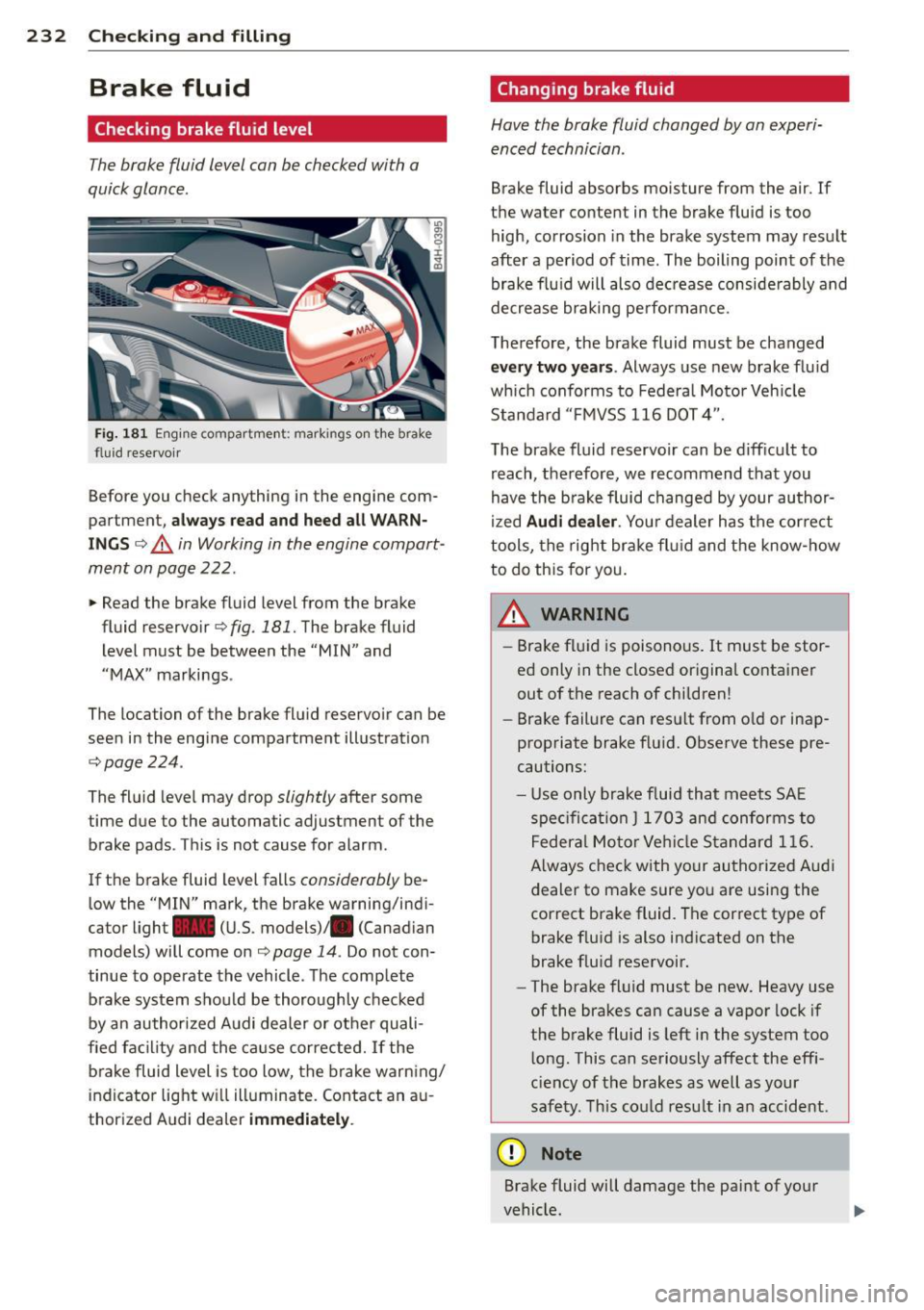
Fig. 181 Engine compartme nt: markings on the brake
flu id reservoir
Before you check anything in the engine com
partment,
always read and heed all WARN
INGS ¢ .&._ in Working in the engine compart
ment on page 222.
.. Read the brake fluid level from the brake
fluid reservoir ¢
fig. 181. The brake fluid
level must be between the "MIN" and
" MAX " markings .
The location of the brake fluid reservoir can be
seen in the engine compartment illustration
c:::,page224 .
The fluid level may drop slightly after some
time due to the automatic adjustment of the
brake pads . T hi s is not cause for alarm.
If the brake fluid level falls
considerably be
low the "MIN" mark, the brake warning/indi
cator light. (U.S. models)/ . (Canadian
models) will come on ¢
page 14. Do not con
tinue to operate the vehicle . The complete
brake system should be thoroughly checked
by an authorized Audi dealer or other quali
fied facility and the cause corrected.
If the
brake fluid level is too low, the brake warning/
indicator light will illuminate. Contact an au
thorized Audi dealer
immediately .
Changing brake fluid
Have the brake fluid changed by an experi
enced technician .
Brake fluid absorbs moisture from the air. If
t he water content in the brake fluid is too
high, corrosion in the brake system may result
after a period of time . The boiling point of the
brake fluid will also decrease considerably and
decrease braking performance.
Therefore, the brake fluid must be changed
every two years . Always use new brake fluid
which conforms to Federal Motor Vehicle
Standard "FMVSS 116 DOT 4".
The brake fluid reservoir can be difficult to reach, therefore, we recommend that you
have the brake fluid changed by your author
ized
Audi dealer. Your dealer has the correct
tools, the right brake fluid and the know-how
to do this for you .
A WARNING
-Brake fluid is poisonous. It must be stor
ed only in the closed original container
out of the reach of children!
- Brake failure can result from old or inap
propriate brake fluid. Observe these pre
cautions:
- Use only brake fluid that meets SAE
specification
J 1703 and conforms to
Federal Motor Vehicle Standard 116.
Always check with your authorized Audi
dealer to make sure you are using the
correct brake fluid. The correct type of brake fluid is also indicated on the
brake fluid reservoir.
- The brake fluid must be new. Heavy use
of the brakes can cause a vapor lock if
the brake fluid is left in the system too
long . This can seriously affect the effi
ciency of the brakes as well as your
safety. This could result in an accident.
(D Note
Brake fluid will damage the paint of your
vehicle.