ignition AUDI S8 2013 Repair Manual
[x] Cancel search | Manufacturer: AUDI, Model Year: 2013, Model line: S8, Model: AUDI S8 2013Pages: 318, PDF Size: 79.34 MB
Page 183 of 318
as possible before installing the child
restraint.
- Always make sure that nothing pre
vents the front passenger's seat from
be ing moved to the rearmost position
in its fore and aft adjustment range.
- Always make sure that the backrest is
in the upr ight position.
- Always buck le the child safety seat firmly
in place even if a child is not sitting in it.
A loose ch ild safety seat can fly around
dur ing a sudden stop or in a col lision .
- Always read and heed all WARNINGS
whenever using a child restrained in ave
hicle is being used
c::> page 144, Safety
belts,
c::> page 152, Airbag system and
c::> page 176, Child Safety.
A WARNING
T o reduce t he ris k of serious injury, make
sure that the
PASSENGER AIR BAG OFF
light comes on and stays on whenever a
child rest raint is installed on the front pas
senger seat and the ignition is switc hed
on.
- Take the child restraint off t he fro nt pas
senger seat and install it properly at one
of the rear seat positions if the
PASSEN ·
GER AIR BAG OFF
light does not stay on.
- Have the airbag system inspected by
your authorized Aud i dealer immediate
ly.
Secure unused safety belts on the rear
seat
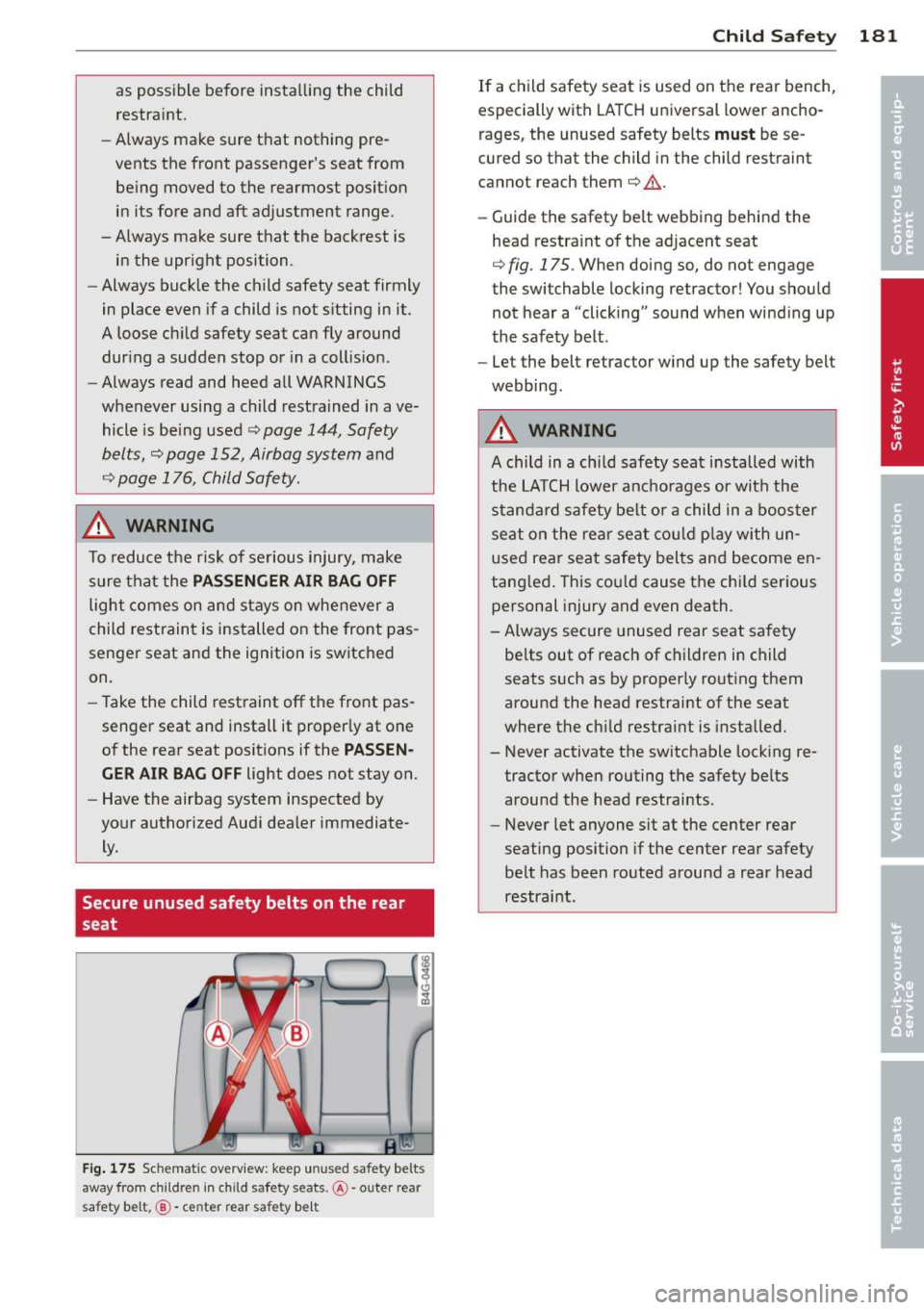
F ig. 175 Schematic overv iew : keep un used safety belts
away from children in child safety seats.@-oute r rear
safety belt,
@ -center rear safety belt
Child S afety 181
If a child safety seat is used on the rea r bench,
especially with LATCH universal lower ancho
rages, the unused safety belts
must be se
cured so that the child in the child restraint
cannot reach them
c::> &.
-Guide the safety belt webbing behind the
head restra int of the ad jacent seat
c::> fig. 175. When doing so, do not engage
the switchable locking retractor! You shou ld
not hear a "click ing" sound when wind ing up
the safety belt .
- Let the belt retractor wind up the safety belt
webbing.
A WARNING
A child in a chi ld safety seat installed with
the LA TCH lower anc horages or with the
standa rd safety be lt or a child in a booster
se at o n the rea r seat co uld play with un
used rear seat safety belts and become en
tang led . This cou ld cause the chi ld ser ious
personal injury and even death.
-A lways secure unused rear seat sa fe ty
be lts out of reach of children in child
seats such as by proper ly rout ing them
around the head restraint of the seat
where the ch ild restraint is installed.
- Never activate the switchable locking re
tracto r when routing the safety belts
around the head restraints.
- Never let anyone s it at the center rear
seating position if the center rear safety
be lt has been routed around a rear head
restra int .
Page 186 of 318
184 Child Safet y
to the backrest on the veh icle seat. Ad
just the rear seat head restraint if it is difficult to install the child seat w ith the
head restraint in place <=>
page 138. Driv
ing with head restraints that are not
properly ad justed increases the risk of
serious o r fa tal neck injury dramatically.
- Always read and heed all WARNINGS
whenever using a child restrained in ave
hicle is being use d
¢page 144, Safety
belts,
¢ page 152, Airbag system and
¢ page 176, Important things to know.
_& WARNING
If except ional circumstances requ ire the
use of a forward-facing child restraint on
the front passenger's seat, the ch ild's safe
ty and well -being require that the follow
ing special precautions be taken :
- Make sure the forward-facing seat has
been designed and certif ied by its manu
facturer for use on a front seat with a
passenger front and side a irbag.
- Always follow the manufacturer's in
struct ions provided with the child safety
seat or infant carrier .
- Always move the front passenger seat in
to the rearmost posit ion of the passen
ger seat's fore and aft adjustment range,
and as far away from the airbag as possi ble before installing the child restraint .
- Always make su re that noth ing prevents
the front passenger's seat from being
moved to the rearmost position in its
fore and aft adjustment range.
- Always make sure the backrest is in an
upr ight position .
- Make sure that the
PASSENGER AIR BAG
OFF
light comes on and stays on all the
t ime whenever the ignition is switc hed
on.
- If the light does no t stay on, pe rform the
chec ks
¢ page 163, Monitoring the Ad
vanced Airbag System.
- T ake the child restraint off the front pas
senger seat and install it properly at one
of the rear seat positions if the
PASSEN· GER AIR BA
G OF F
light does not stay on
whenever the ignit ion is switched on.
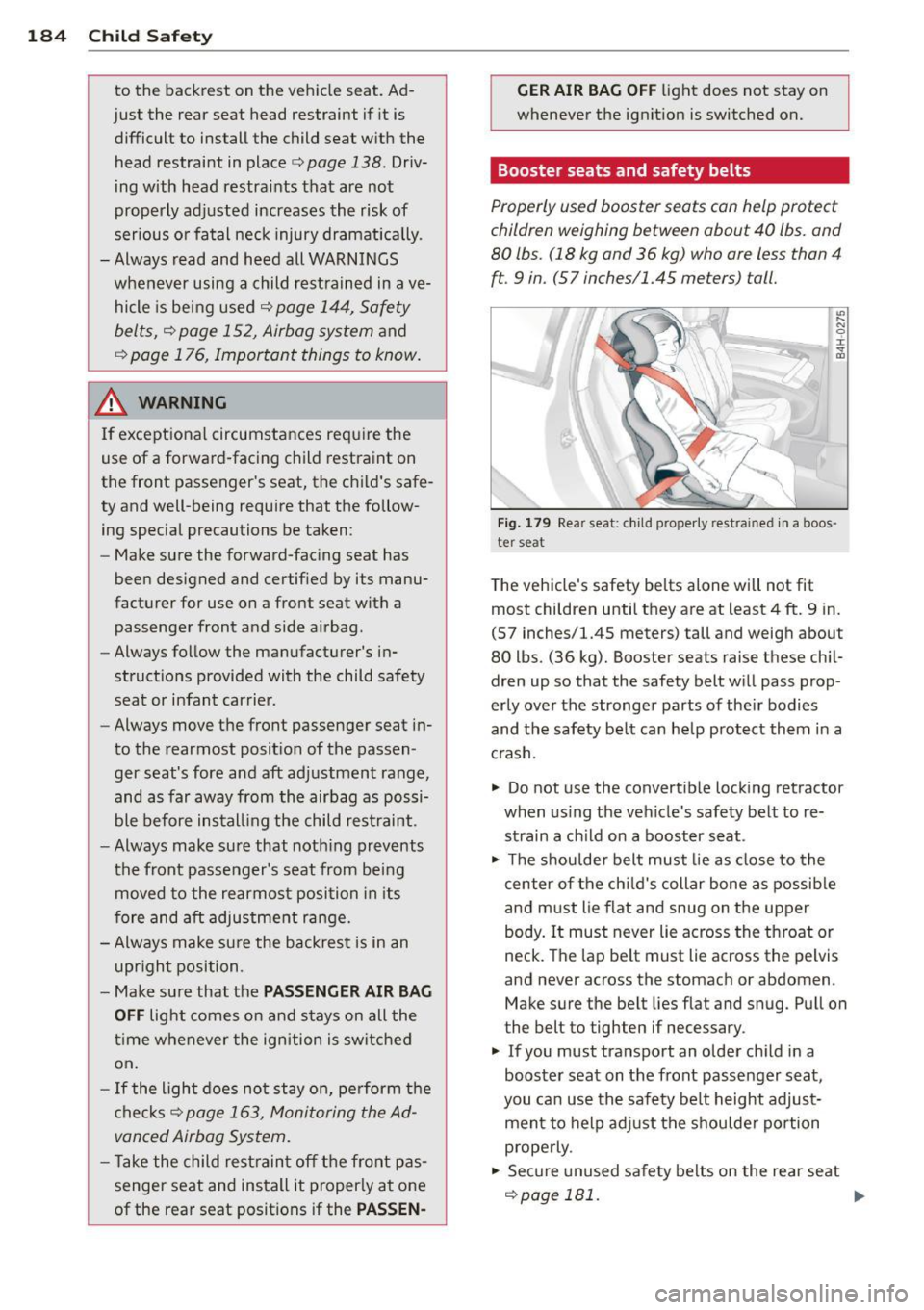
Booster seats and safety belts
Properly used booster seats can help protect
children weighing between about 40 lbs. and
80 lbs. (18 kg and 36 kg) who are less than 4
ft. 9 in . (57 in ches/1.45 meters) tall.
:e N 0 ±
i'il
F ig. 179 Rea r seat: c hild p roperly rest rai ned in a boos
ter se at
T he vehicle 's safety belts a lone will not fit
most children until they are at least 4 ft. 9 in.
(57 inches/1.45 meters) tall and weigh about
80 lbs. (36 kg). Booster seats raise these chil
dren up so that the safety belt will pass prop
erly over the stronger parts of the ir bodies
and the safety be lt can he lp protect them in a
c rash .
.,. Do not use the convertible lock ing retractor
when us ing the vehicle's safety belt to re
strain a ch ild on a booster seat .
.,. The shou lde r belt must lie as close to the
center of the ch ild's collar bone as possible
and must lie flat and snug on the upper
body. It must never lie across the throat or
neck. The lap be lt must lie across the pelvis
and never across the stomach or abdomen .
Make sure the belt lies flat and snug. Pull on
the belt to tighten if necessary .
.,. If you must transport an older child in a
booster seat on the front passenger seat,
you can use the safety be lt height adjust
ment to help adj ust the shou lder portion
properly .
.. Secure unused safety belts on the rear seat
¢page 181. ..,_
Page 188 of 318
186 Child Saf ety
- Never let a child ride in the cargo area of
your vehicle .
- Always remember that a chi ld leaning
forward, sitt ing s ideways or out of posi
t ion in any way during an acc ident can be
struck by a deploying airbag . This will re
sult in serious personal injury or death .
- If you must install a booster seat on the
front passenger seat because of excep
t ional circumstances the
PASSENGER
AIR BAG OFF
light must come on and
stay on, whenever the ignition is sw itch
ed on.
- If the PASSENGER AIR BAG OFF light
does not come on and s tay on, perform
the chec ks described
¢ page 163, Moni
toring the Advanced Airbag System.
- T ake the child rest raint off the front p as
senger seat and install it properly at one
of the rea r seat positions if the
PASS EN·
GER AIR BAG OFF
light does not stay on
whenever the ignition is switched on .
- Always read and heed all WARNINGS whenever using a child rest rained in ave
hicle is being used
¢ page 144, Safety
belts,¢ page 152 , Airbag system
and
¢ page 176, Important things to know.
Installing a child safety
seat
Securing a child safety seat using a
safety belt
Safety belts for the rear seats and the front
passenger can be locked with the convertible
locking re tractor to properly secure child
safety seats.
The safety belts emergency locking retractors
for the rear seats safety belts and for the
fro nt passenger's seat safety belt have a con
vertible locking retracto r for child restra ints .
The safety belt must be locke d so that belt
webbing can not unreel. The ret ractor ca n be
activ ated to lock the safety be lt and p revent
the safety belt webbing from loosening up
d ur ing normal driv ing . A child sa fe ty seat can
on ly be proper ly installed whe n the safety belt is loc
ked so that the chi ld and child sa fety
seat wi ll stay in place.
Alw ays remember: Even tho ugh yo ur vehicle is
equipped wi th an A dvan ced Airbag system, all
c hi ldren, especially those 1 2 years and young
er, sho uld always ride in the back seat prope r
l y restra ined fo r the ir age and size.
A WARNING
Improperly installed ch ild safety seats in
crease the risk of serious personal injury
and death in a co llision.
- Always make sure that the safety belt re
tractor is locked when insta lling a child
safety seat. A n un locked safety belt re
trac to r cannot hold the child safety seat
in place dur ing norma l driving o r in a
crash.
- Always buckle the child safety seat firmly
in place even if a ch ild is not si tt ing in it.
A loose child sa fe ty se at can fly aroun d
du ring a s udden stop or in a collision .
- Always make sure that the rear seat
backres t to wh ich the center rear safety
belt is attached is securely latched when
eve r the rea r center safety belt is being
used to secure a ch il d restra int .
- If the backrest is not securely la tc h ed,
the child and the child restraint will be
thrown forward together with the back
rest and will strike parts of the vehicle
interior. The child can be seriously in
jured or killed.
- Never install rear-facing child safety
seats or infant ca rr ie rs o n the front pas
senger seat . A child will be serious ly in
jured and can be killed when the passen
ge r airbag inflates.
- The infla ting airbag will h it the ch ild
safety seat or infant carrie r w ith gr eat
for ce and will smas h the child safe ty seat
a nd child ag ai nst t he back res t, cen ter
a rmrest, doo r or roof.
- Always inst all rear-fa cing ch ild safety
se ats or in fa nt c arrie rs on the re ar se at.
Page 189 of 318
-Forward-facing child safety seats or in
fant carriers installed on the front pas
senger's seat may interfere with the de ployment of the airbag and cause serious
injury to the child.
- It is safer to install a forward-facing
child safety seat on the rear seat .
- Always read and heed all WARNINGS
whenever using a child restrained in ave
hicle is being used
c:::;, page 176 . Special
precautions apply when installing a child
safety seat on the front passenger seat
c:::;, page 154, Child restraints on the front
seat -some important things to know.
A WARNING
-
Always take special precautions if you
must install a forward or rearward-facing
child restraint on the front passenger's
seat in exceptional situations:
- Whenever a forward or rearward-facing
child restraint is installed on the front
passenger seat, the
PASSENGER AIR
BAG OFF light must come on and stay on
whenever the ignition is switched on.
- If the
PASSENGER AIR BAG OFF light
does not come on and stay on, perform
the checks described
c> page 163, Moni
toring the Advanced Airbag System .
-Take the child restraint off the front pas
senger seat and install it properly at one
of the rear seat positions if the
PASSEN
GER AIR BAG OFF
light does not stay on
whenever the ignition is switched on.
- Improper installation of child restraints
can reduce their effectiveness or even
prevent them from providing any protec
tion.
- An improperly installed child restraint
can interfere with the airbag as it de
ploys and seriously injure or even kill the
child.
- Always carefully follow the manufactur
er's instructions provided with the child
safety seat or carrier.
- Never place additional items on the seat
that can increase the total weight regis-
Child Safety 187
tered by the weight-sensing mat and can
cause injury in a crash.
A WARNING
Forward-facing child restraints:
- Always make sure the forward-facing
seat has been designed and certified by
its manufacturer for use on a front seat
with a passenger front and side airbag.
- Never put the forward-facing child re
straint up, against or
very near the in
strument panel.
- Always
move the passenger seat into its
rearmost position in the seat 's fore and
aft adjustment range, as far away from
the airbag as possible before installing
the forward-facing child restraint . The
backrest must be adjusted to an upright
position.
- Make sure that the
PASSENGER AIR BAG
OFF
light comes on and stays on all the
time whenever the ignition is switched
on.
A WARNING ...==-
Rearward-facing child restraints:
-A child in a rearward-facing child safety
seat installed on the front passenger
seat will be seriously injured and can be
killed if the front airbag inflates -
even
with an Advanced Airbag System.
- The inflating airbag will hit the child
safety seat or infant carrier with great
force and will smash the child safety seat
and child against the backrest, center
armrest, door or roof .
- Always be especially careful if you must
install a rearward facing child safety seat
on the front passenger seat in exception
al circumstances .
- A tight tether strap on a rearward-facing
child restraint attached to the front pas
senger seat can put too much pressure
on the weight-mat in the seat and regis
ter a heavier weight in the Advanced Air
bag System. The heavier weight regis
tered can make the system work as •
•
Page 190 of 318
188 Child Safety
though an adult were on the seat and deploy the Advanced Airbag when it must
be suppressed causing serious or even
fatal injury to the child .
- Make sure that the
PASSENGER AIR BAG
OFF
light comes on and stays on all the
time whenever the ignition is switched
on.
- If the
PASSENGER AIR BAG OFF light
does not come on and stay on, immedi
ately install the rear-facing child safety
seat in a rear seating position and have
the airbag system inspected by your Audi dealer.
Activating the convertible locking retractor
Use the convertible locking retractor to se
cure a child restraint.
Always heed the child safety seat manufactur
er's instructions when installing a child re
straint in your vehicle. To activate the conver
tible locking retractor:
"" Place the child restraint on a seat, prefera
bly on the rear seat.
"" Slowly pull the belt
all the way out.
"" Route it around or through the child re
straint belt path¢&_ .
"" Push the child safety seat down with your
full weight to get the safety belt really tight.
"" Insert the belt tongue into the buckle for
that seating position.
"" Guide the safety belt back into the retractor
until the belt lies flat and snug on the child
safety seat.
"" You should hear a "clicking" noise as the
belt winds back into the inertia reel. Test the
convertible locking retractor by pulling on
the belt. You should no longer be able to
pull the belt out of the retractor. The con
vertible locking retractor is now activated.
"" Make sure that the red release button is fac
ing away from the child restraint so that it
can be unbuckled quickly .
"" Pull on the belt to make sure the safety belt
is properly tight and fastened so that the seat cannot move forward or sideways more
than one inch (2.5 cm).
A WARNING ....__ -
Using the wrong child restraint or an im
properly installed child restraint can cause
serious personal injury or death in a crash.
- Always make sure that the safety belt re- tractor is locked when installing a child
safety seat. An unlocked safety belt re
tractor cannot hold the child safety seat
in place during normal driving or in a
crash.
- Always buckle the child safety seat firmly
in place even if a child is not sitting in it.
A loose child safety seat can fly around
during a sudden stop or in a crash.
- Always make sure the seat backrest to
which the child restraint is installed is in
an upright position and securely latched
into place and cannot fold forward. Oth
erwise, the seatback with the child safety
seat attached to it could fly forward in
the event of an accident or other emer
gency situation.
- Always read and heed all WARNINGS whenever using a child restrained in ave
hicle is being used
¢ page 176. Special
precautions apply when installing a child
safety seat on the front passenger seat
¢ page 154, Child restraints on the front
seat -some important things to know.
Deactivating the convertible locking
retractor
The convertible locking retractor for child re
straints will be deactivated automatically when the belt is wound all the way back into
the retractor.
"" Press the red button on the safety belt
buckle. The belt tongue will pop out of the
buckle.
"" Guide the safety belt all the way back into
its stowed position .
Always let the safety belt retract completely
into its stowed position. The safety belt can
1J1-
Page 206 of 318
204 Intelligent technology
temperature. This determines the current
state of charge and the power of the battery .
Idling current management
Idling current management reduces energy
consumption while the vehicle is stand ing.
With the ignition switched off, it contro ls the
energy supply to the various e lectrica l compo
nents. Data from battery diagnosis is consid
ered.
Depending on the battery's state of charge,
individual consumers are gradually turned off
to prevent excessive discharge of the battery
and thus maintain starting capability.
Dynamic energy management
While the vehicle is being driven, dynamic en
e rgy management distributes the energy gen
erated according to the needs of the individu
al components. It regu lates consumption, so
that more electrical energy is not being used
than is being generated and ensures an opti
mal state of charge for the battery.
Q) Tips
- But even energy management cannot negate the limits of physics. Consider
that the power and life of a battery are
li mited.
- If starting ability is threatened, the indi
cator light[•) appears
Q page 16, D
Battery.
What you should know
The highest priority is given to maintaining
starting capability.
The battery is severely taxed in short-distance
driving, in city traffic and during the cold time
of year. Abundant electrical energy is re
qu ired, but only a little is generated.
It is also
cr itica l if the engine is not running and electri
cal components are turned on. In this in
stance energy is being consumed but none is
being generated .
It is in precise ly these situations that you will
notice energy management active ly regu lat
ing the d istribution of energy.
Vehicle stands for an extended period
If you do not drive your vehicle over a period
of seve ral days or weeks, e lectr ica l compo
nents are gradually cut back or switched off .
This reduces energy consumption and main
tains starting capability over a longer period .
Some of the convenience functions may not
operate, such as the interior lights or the
power seat adjustment . The convenience
funct ions will be available again when you
switch on the ignition and start the engine.
With the engine turned off
If you listen to the radio, for example, with
the engine turned off or use other MMI func
tions, the battery is being discharged .
If starting capab il it y is jeopardized due to en
ergy consumption, the following warning ap
pears in the MMI display:
Please start the engine soon or the system
will be turned off.
The warn ing ind icates that the system will be
turned off automatically after 3 minutes. If
you w ish to continue using the functions, you
have to sta rt the eng ine .
With the engine running
Although electrical energy is generated when
the vehicle is being driven, the battery can be
come discharged. This happens mostly when
little energy is being generated and a grea t
deal consumed and the battery's state of
charge is not optimal.
T o b ring the energy bala nce back into equili
brium, consumers which req uire espec ially
large amounts of energy are temporarily cut
back or switched off . Heating systems in par
ticular require a great deal of energy. If you
notice, for examp le, that the heated seats* or
the heated rear window are not heating, they
have been temporarily cut back or switched .,.
Page 220 of 318

218 Cleaning and protection
This also applies to cleaning headlights
and painted bumpers. Remember: the
closer the nozzle is to the surface of the
material, the greater the stress on the ma
terial.
Caring for vehicles with matte finish
paint
Ap plies to vehicles: with matte fi nish pa in t
Vehicles with matte finish paint require spe
cial care due to the characteristics of the
paint.
Washing by hand
To avoid damaging the paint when washing,
first remove dust and large particles from
your vehicle. Insects, grease spots and finger
prints are best removed with a
special cleaner
for matte finish paint.
Apply the product using a microfiber cloth . To
avoid damaging the paint surface, do not use
too much pressure .
Rinse the vehicle thoroughly with water . Clean
the vehicle starting at the top and working to
ward the bottom using a
neutral shampoo
and a soft microfiber cloth . Stop frequently to
rinse the cloth thoroughly .
Clean the wheels and sill panels last. Use a
clean
sponge on these areas.
Rinse the vehicle thoroughly again and let it
air dry. If there are any water spots, they can
be removed using a
leather cloth.
Clean again with the special cleaner for matte
finish paint
if necessary.
Removing stubborn dirt
Bird droppings or tree sap
are best removed
with plenty of water and a microfiber cloth.
You should rinse off
gasoline residue immedi
ately with plenty of water.
_& WARNING
- Wash your vehicle only when the ignition
is switched off to reduce the risk of a
crash. -
Always read and heed all WARNINGS and
other information ¢
page 215.
@ Note
-Do not treat vehicle parts painted with
matte finish paint using polishing mate
rials or hard wax. These products could
cause damage to the appearance or sur
face that cannot be repaired.
- Never use protective wax. It can destroy
the matte finish effect.
- Do not place any stickers or magnetic
signs on vehicle parts painted with
matte finish paint. The paint could be
damaged when the stickers or magnets
are removed .
- To prevent paint damage, do not wash
the vehicle in direct sunlight.
- To prevent damage to the paint surface,
do not use insect removal sponges,
rough kitchen sponges or similar items.
- You should remove debris (such as in
sects) from the headlight lenses on a
regular basis, for example when refuel
ing your vehicle . Only clean the head
lights using a wet cloth or sponge, never
a dry one. Cleaning with soapy water is
recommended.
(D Tips
For more information on special cleaning
products designed for matte finish paint,
seeyourAudidea~~
' Sensors and camera lenses
- Remove snow with a hand brush and remove
ice with a de-icing spray that does not con
tain solvents.
- Clean the sensors (adaptive cruise control*,
parking system*) with a cleaning solution
that does not contain solvents and a soft
cloth.
- Dampen the camera lens with a household alcohol-based glass cleaner, and then wipe
the lens clean with a dry cloth . The area in
front of the camera lens is normally cleaned
by the windshield wipers (lane assist*) or .,.
Page 229 of 318
-Before reaching into the front pane l, al
ways switch off the ignition. Otherwise,
the windsh ield wiper system could un in
tent ionally be switched on, possib ly
caus ing personal injury from the moving
wiper linkage .
- Never reach into the area around or
touch the radiator fan. The auxiliary fan is temperature controlled and can switch
on suddenly- even when the ign it ion is
off.
- Do not wash, wax or dry the engine w ith
the engine running. Moving or hot pa rts
cou ld inju re you .
- Do not clean the underside of the chas
sis, fenders, wheel cove rs, or other hard
to reach parts w ithout protecting your
hands and arms . You may cut yourse lf on
sharp-edged metal parts.
- Always read and heed all WARNI NGS and
other information ~page
215 .
Cleaning and protec tion 22 7
•
•
Page 232 of 318
230 Fuel supply and filling your fuel tank
transport fuel to use for your lawn mower,
snow blower, etc., be very careful and al
ways observe local and state laws regard
ing the use, transportat ion and storage of
such fuel containers. Make certain the con
tainer meets industry standards (ANSI/
AS TM F852 -86) .
(D Note
Never drive your vehicle until the fuel tank
is completely empty. The irregular supply
of fuel can cause misfiring. Gasoline could
enter the exhaust system and damage the
catalyt ic converter.
Refuelling
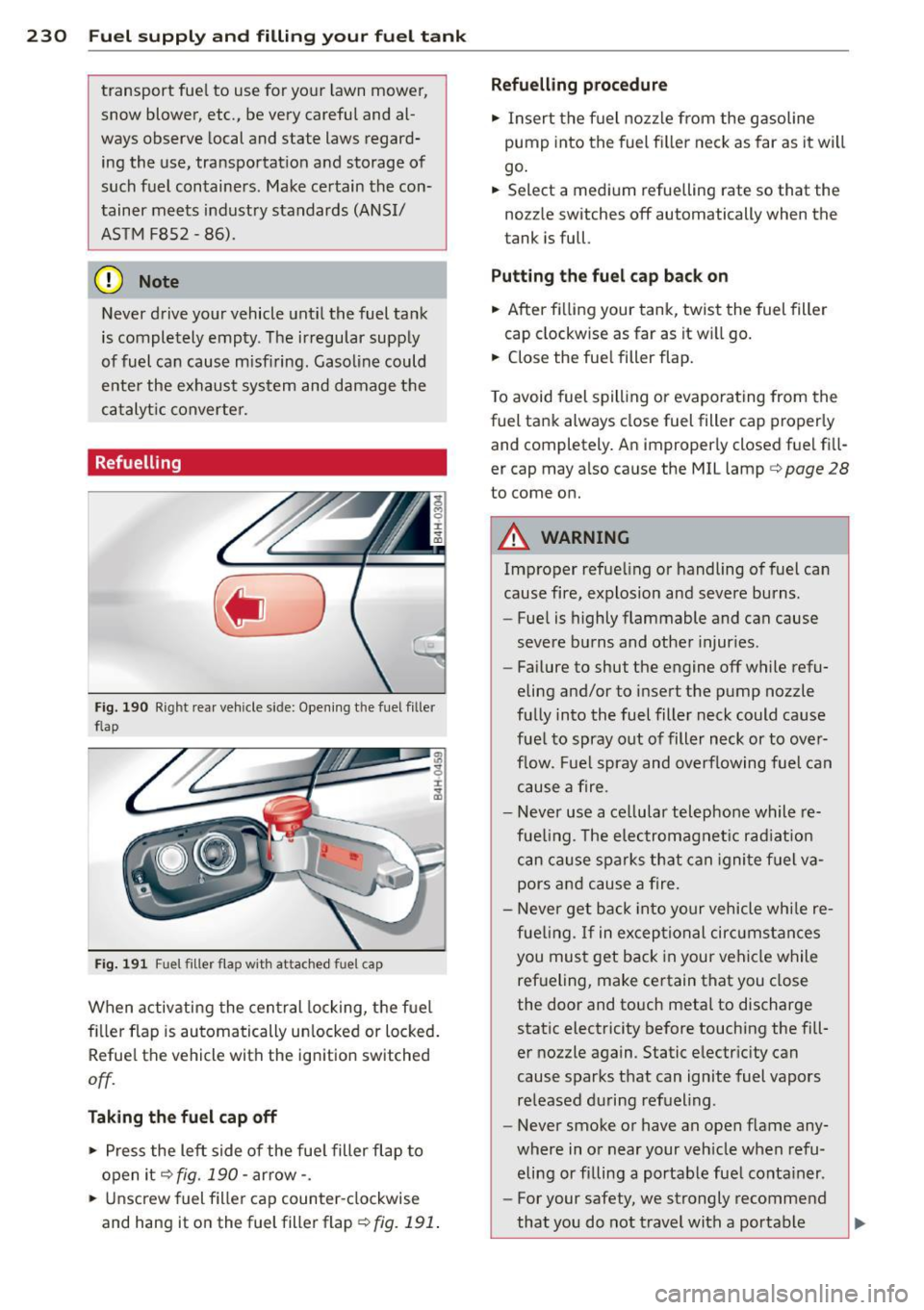
Fig. 190 Right rear vehicle side: Opening the fuel filler
flap
Fig . 191 Fuel filler flap with attached fuel cap
When activating the central locking, the fuel
fi ller flap is automatically un locked or locked.
Refuel the vehicle with the ignition switched
off.
Taking the fuel cap off
~ Press the left side of the fue l filler flap to
open it
q fig. 190 -arrow-.
~ Unscrew fuel filler cap counter-clockwise
and hang it on the fuel filler flap¢
fig. 191.
Refuelling procedure
~ Insert the fu el nozzle from the gasoline
pump into the fuel filler neck as far as it will
go .
~ Select a medium refuelling rate so that the
nozzle switches off automatically when the
tank is full.
Putting the fuel cap back on
~ After fi lling your tank, twist the fuel filter
cap clockwise as far as it w ill go.
~ Close the fue l filler flap.
T o avoid fuel spilling or evaporating from the
fuel tank always close fuel filler cap properly
and completely. An improperly closed fuel fill
er cap may also cause the MIL lamp¢
page 28
to come on.
A WARNING
Improper refue ling or handling of fuel can
cause fire, explosion and severe burns.
- Fuel is highly flammable and can cause
severe burns and other injur ies.
- Failure to shut the engine
off while refu
eling and/or to insert the pump nozzle
fully into the fuel filter neck could cause
fuel to spray out of filler neck or to over
flow. Fuel spray and overflowing fuel can
cause a fire.
- Never use a cellular telephone while re
fue ling. The electromagnet ic rad iat ion
can cause sparks that can ignite fuel va
pors and cause a fire.
- Never get back into your vehicle whi le re
fueling.
If in exceptional circumstances
you must get back in your vehicle while
refueling, make certain that you close
the door and touch metal to discharge
static electricity before touching the fill
er nozzle again. Static electricity can
cause sparks that can ignite fuel vapors
released during refueling.
- Never smoke or have an open flame any
where in or near your veh icle when refu
eling or filling a portable fuel container.
- For your safety, we strongly recommend
that you do not travel with a portable
Page 234 of 318
232 Checking and filling
Checking and filling Engine hood
Releasing the engine hood
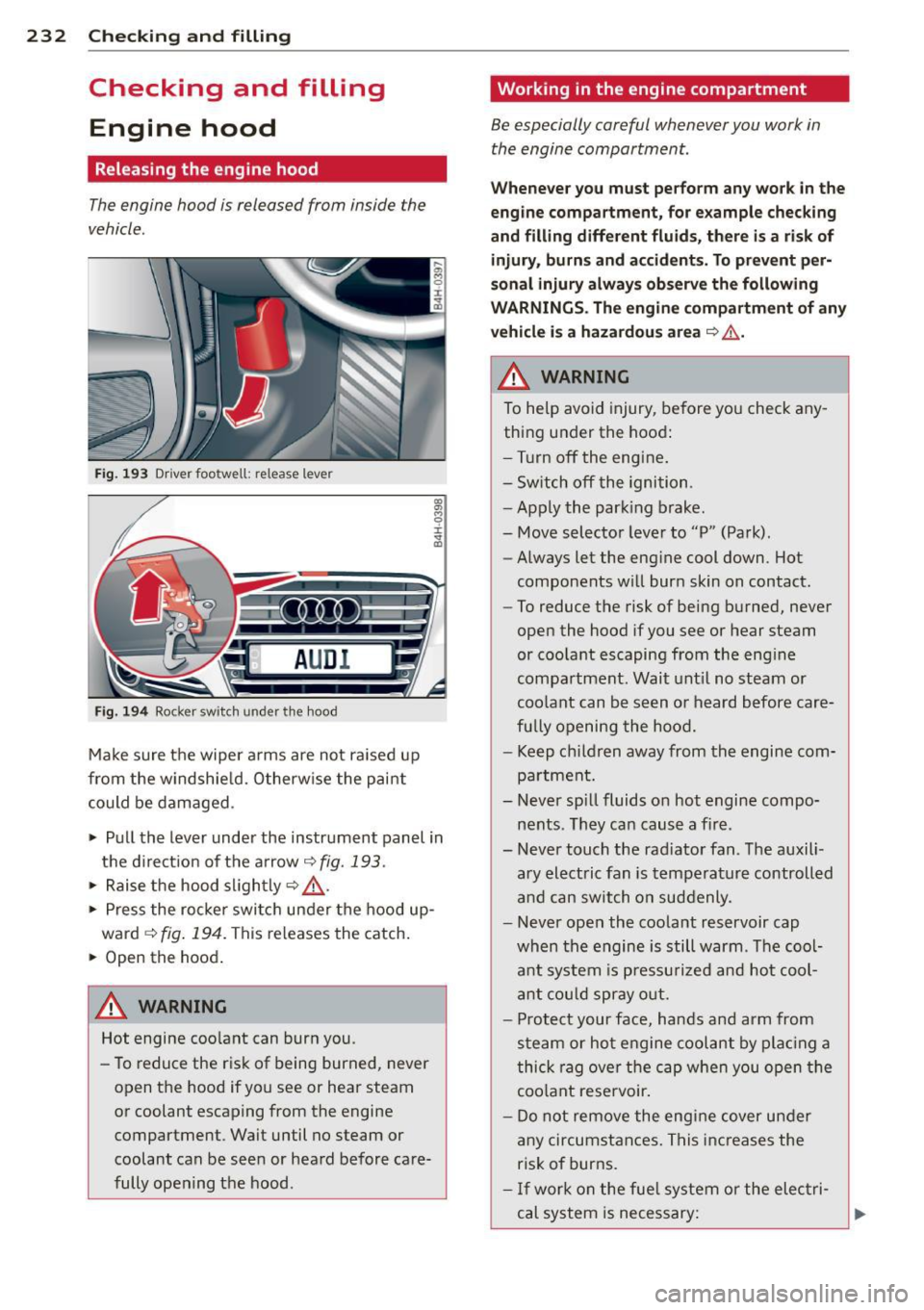
The engine hood is released from inside the
vehicle .
Fig. 193 Driver foo twell: release lever
AUD I
Fig. 194 Rocker switch un der the hood
Make sure the wiper arms are not raised up
from the windshield. Otherwise the paint
could be damaged .
.,. Pull the lever under the instrument panel in
the direction of the arrow
~ fig. 193.
.,. Raise the hood slightly~,&. .
... Press the rocker switch under the hood up
ward
~ fig. 194. This releases th e catch.
... Open the hood.
&_ WARNING
Hot engine coolant can burn you.
- To reduce the risk of being burned, never
open the hood if you see or hear steam
or coolant escaping from the engine compartment . Wait until no steam or
coolant can be seen or heard before care
fully opening the hood .
' Working in the engine compartment
Be especially careful whenever you work in
the engine compartment.
Whenever you must perform any work in the
engine compartment, for example checking
and filling different fluids, there is a risk of injury, burns and accidents. To prevent per
sonal injury always observe the following
WARNINGS. The engine compartment of any
vehicle is a hazardous area
~ ,&. .
A WARNING
To help avoid injury, before you check any
thing under the hood:
- Turn off the engine.
- Switch off the ignition .
- Apply the parking brake.
- Move selector lever to "P" (Park) .
- Always let the engine cool down. Hot
components will burn skin on contact.
- To reduce the risk of being burned, never
open the hood if you see or hear steam
or coolant escaping from the engine
compartment. Wait until no steam or
coolant can be seen or heard before care
fully opening the hood.
- Keep children away from the engine com
partment.
- Never spill fluids on hot engine compo
nents . They can cause a fire .
- Never touch the radiator fan. The auxili
ary electric fan is temperature controlled
and can switch on suddenly .
- Never open the coolant reservoir cap
when the engine is still warm . The cool
ant system is pressurized and hot cool
ant could spray out.
- Protect your face, hands and arm from
steam or hot engine coolant by placing a
thick rag over the cap when you open the
coolant reservoir.
- Do not remove the engine cover under
any circumstances. This increases the
risk of burns.
- If work on the fuel system or the electri
cal system is necessary: