height AUDI S8 2015 User Guide
[x] Cancel search | Manufacturer: AUDI, Model Year: 2015, Model line: S8, Model: AUDI S8 2015Pages: 312, PDF Size: 79.18 MB
Page 150 of 312
148 Safety belts
should always fit snugly¢ fig. 162. Pull
on the belt to tighten if necessary.
- A loose-fitting safety belt can cause seri
ous injuries by shifting its position on
your body from the strong bones to more
vulnerable, soft tissue and cause serious injury .
- Always read and heed all WARNINGS and
other important information
¢ page 146 .
Pregnant women must also be correctly
restrained
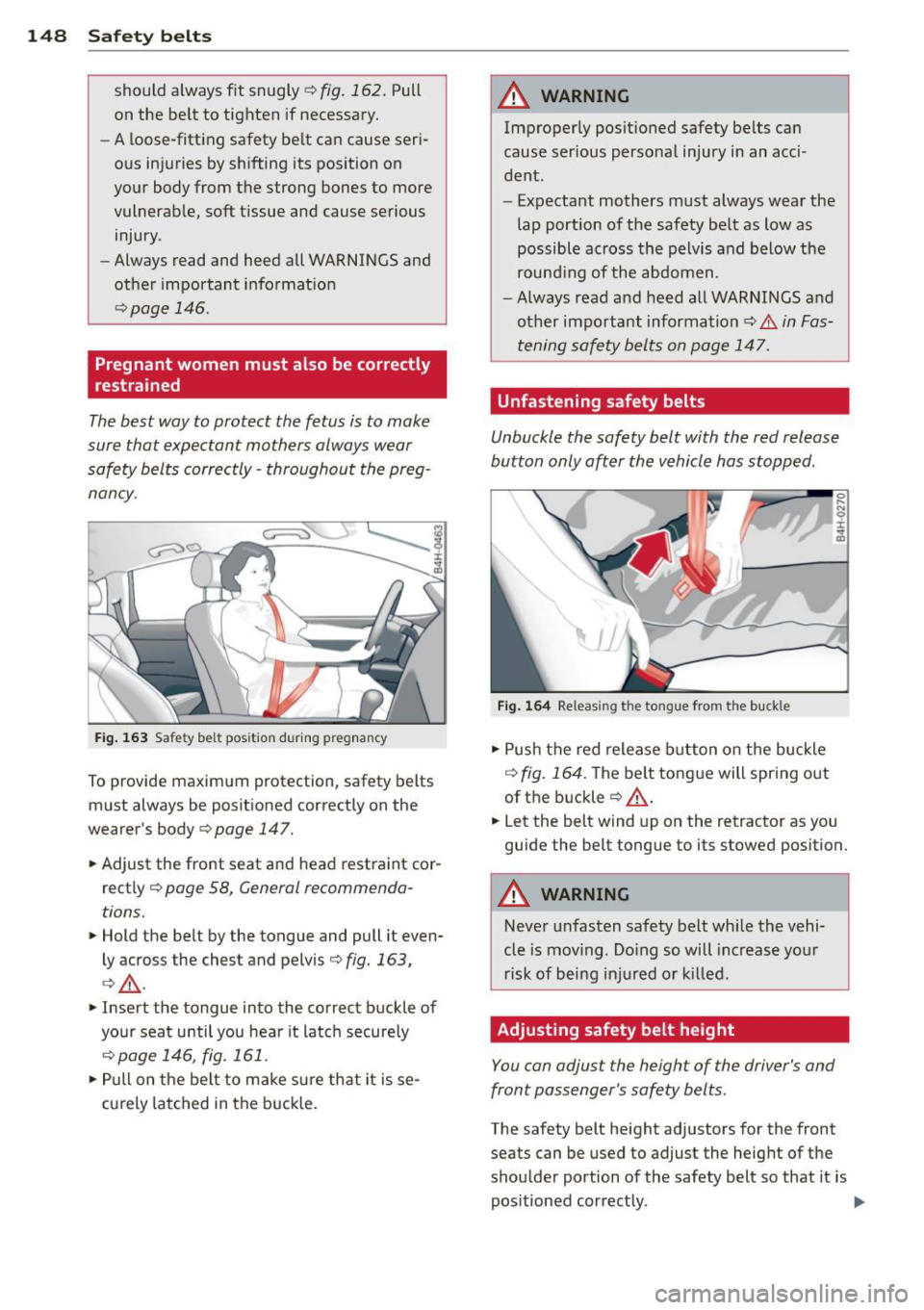
The best way to protect the fetus is to make
sure that expectant mothers always wear
safety belts correctly -throughout the preg
nancy.
Fig . 163 Safe ty be lt pos it io n durin g pregnancy
To provide maximum protection, safety belts
must always be positioned correctly on the
wearer's body ¢
page 147.
• Adjust the front seat and head restraint cor
rectly ¢
page 58, General recommenda
tions.
• Hold the belt by the tongue and pull it even
ly across the chest and pelvis
¢ fig. 163,
¢ Li). .
• Insert the tongue into the correct buckle of
your seat until you hear it latch securely
¢page 146, fig. 161.
•Pullon the belt to make sure that it is se
curely latched in the buckle .
A WARNING ,-
Improperly positioned safety belts can
cause serious personal injury in an acc i
dent.
- Expectant mothers must always wear the
lap portion of the safety belt as low as
possible across the pelvis and below the
rounding of the abdomen.
- Always read and heed all WARNINGS and
other important information¢
& in Fas
tening safety belts on page 147.
Unfastening safety belts
Unbuckle the safety belt with the red release
button only after the vehicle has stopped.
Fig. 164 Releas ing the ton gue from the buck le
• Push the red release button on the buckle
¢ fig. 164. The belt tongue will spring out
of the buckle
¢ _& .
0
" N 0 ±
~
• Let the belt wind up on the retractor as you
guide the belt tongue to its stowed position.
A WARNING
Never unfasten safety belt while the vehi
cle is moving . Doing so will increase your
risk of being injured or killed.
Adjusting safety belt height
You can adjust the height of the driver's and
front passenger's safety belts.
The safety belt height adjusters for the front
seats can be used to adjust the height of the
shoulder portion of the safety belt so that it is
positioned correctly .
1J>-
Page 151 of 312

,....,
N ,....,
N
0 J:
'SI: ,...., \!) 1.1"1 ,...., 1.1"1 ,....,
The shoulder belt should lie as close to the
center of the collar bone as possib le an d
should fit well on the body¢
A in Saf ety belt
position on page 147.
Power safety belt h eight adjustment*
You can ad just the height of the safety belts
using the mu lti function b utton on the driver
or fro nt passenge r seat ¢
page 60.
&_ WARNING
-Always read and heed all WARNINGS and
other important informat ion¢
page 146.
You can also a djust the height of the front
seats to change the position of the safety
be lts.
Improperly worn safety belts
Incorrectly positioned safety belts can cause
severe injuries.
Wear ing sa fe ty be lts imprope rly can cause se
rio us in jury or death. Safety be lts can only
wo rk when they are correct ly positioned on
the body. Improper seating positions reduce
the effect iveness of safety belts and w ill eve n
increase the r isk of injury and death by mov
in g the safety belt to cr itical a reas of the
body. Imprope r seat ing pos itions also in
crease the risk of serio us in jury and death
when an air bag deploys and strikes an occu
p a nt who is not in the cor re ct seating posi
tion. A driver is responsib le for the sa fe ty of
all vehicle occupants and especially for chi l
dren . Therefore:
""N ever permit anyone to ass ume an inco rrec t
s itting position in the veh icle w hile traveling
¢.&, .
&_ WARNING
Imprope rly worn safety belts increase the
r isk of se rious personal injury and death
whenever a veh icle is being used .
Safety belts 149
- Always ma ke s ure that all ve hicle occu
pants are co rrectly restrained and stay in
a co rrect seating position whenever the
veh icle is being used .
- Always read and heed all WARNI NGS and
o ther impo rtant inf ormation
¢page 146.
Safety belt preten
sioners
How safety belt pretensioners work
In front, side and rear-end collisions above a
particular severity and in a rollover, safety belts are tensioned automatically.
Reversible safety belt tensioners
T he s afety belts o n the fro nt seats ar e eq uip
ped with powe r reversi ble tensioners. The fo l
l ow ing functions a re ava ila bl e when the driv
er 's/fro nt passenge r's safety belts are fas
tened :
- Au tomatic tens ioners : at the star t of a drive,
the safety be lts automat ica lly adjust to the
passenger afte r a certain time period or ve
hicle speed. To switch the automatic ten
sioners off, select the following in t he M MI:
!CARI fu nction button > Car systems > Vehi
cle settings > Seats > Driver's seat or Pas
senger's seat > Automatic belt tensioner
>
Off .
-In ce rtain dr iv ing s ituations , the safety b elts
may tight en with a reve rs ible tens ion ing
fu nction
¢ page 194.
- The safety be lts m ay a lso tighten with th is
reve rsible te nsion ing functio n in m inor co ll i
s ion s.
Pyrotechnic safety belt pretensioners
The safety belts are equipped with safety be lt
pre tensioners . The system is act ivated by se n
so rs in front, s id e and r ear-end co llisions of
great seve rity and in a rollover. T his tig hte ns
t he be lt and t akes up belt slack ¢.&.
in Service
and disposal of s afe ty belt pretensioner on
page 150.
Tak in g up the s lack helps to reduce .,. •
•
Page 168 of 312

166 Airbag system
Other things that can affect Advanced
Airbag performance
Changing the vehicle's suspension system can
change the way that the Advanced Airbag Sys
tem performs in a crash. For example, using
tire-r im combinations not approved by Aud i,
lowering the vehicle, changing the stiffness of
the suspension, including the sp rings, suspen
sion struts, shock absorbe rs etc. can change
the forces that are measured by the a irbag
sensors a nd sent to the electron ic control
un it. Some suspension changes ca n, for exam
p le, increase the force levels measured by the
sensors and make the airbag system deploy in
crashes in which it would not dep loy if the
changes had not been made. Other kinds of
changes may reduce the force levels meas
ured by the sensors and prevent the airbag
from deploying when it should .
A WARNING
Changing the vehicle 's s uspension includ
ing use of unapproved tire-rim combina
tions can change Advan ced Airbag per
formance and increase the risk of serio us
personal injury in a crash.
- Never install suspens io n components
t hat do not have the same performance
characteristics as the components origi
nally installed on your vehicle .
- Never use tire-rim combinat ions that
have not been approved by A udi.
A WARNING
-
Items stored between the safety belt
buckle and the center console can cause
the sensors in the buckle to send the
wrong informat ion to the electronic con
trol modu le and prevent the Advanced A ir
bag System from work ing properly.
- Always make sure that nothing can inter-
fere w ith the safety belt buckles and that
they are not obstructed .
Knee airbags
Description of knee airbags
The knee airbag system can provide supple
mental protection to properly restrained
front seat occupants.
Fig . 169 Dr iver's knee airbag
T he driver knee airbag is in the ins trument
pane l underneath the steering wheel
¢fig. 169, the airbag for the passenger is at
about the same height in the instrument pan
el underneath the glove compartment.
T he knee airbag offers addi tional protection
to the driver 's and passenger's knees and up
per and lower thigh areas and supplements
the protection provided by the safety belts.
If the front airbags dep loy, the knee a irbags
also dep loy in frontal collisions w hen the de
ployment threshold stored in the control unit
is met
¢ page 160, More important things to
know about front airbags .
In addition to their normal safety f unction,
safety belts help keep the driver or front pas
senger in position in a fronta l collision so that
the a irbags can provide supplemental protec
t ion .
The airbag system is not a substitute for your safety belt . Rather, it is part of the overa ll oc
cupant restra int system in your vehicle. A l
ways remember that the a irbag system can
only he lp to protect you if you are wearing
you r safety belt and wearing it properly. This
is why you should always wear your safety
belt, no t jus t because the law requires you to
do so
¢page 143, General notes. .,.
Page 184 of 312

182 Child Safet y
to the backrest on the veh icle seat. Ad
just the rear seat head restraint if it is difficult to install the child seat w ith the
head restraint in place <=>
page 137. Driv
ing with head restraints that are not
properly ad justed increases the risk of
serious o r fa tal neck injury dramatically.
- Always read and heed all WARNINGS
whenev er using a child restrained in ave
hicle is being use d
¢page 143, Safety
belts, ¢ page 151, Airbag sys tem
and
¢ page 174, Importan t things to know.
_& WARNING
If exce ptional circumstances requ ire the
use of a forwa rd-facing child restraint on
the front passenger's seat, the ch ild's safe
ty and well-being require that the follow ing special precautions be taken :
- Make sure the forward-facing seat has
been designed and certif ied by its manu
facturer for use on a front seat with a
passenger front and side a irbag.
- Always follow the man ufacturer's in
struct io ns provided with the child safety
seat or infant car rier .
- Always move t he front passenger seat in
to the rearmost posit ion of the passen
ger seat's fore and aft ad justment range,
and as far away from th e airbag as possi
ble before ins tall ing the child res traint .
- Always make su re that noth ing prevents
the front passenger's seat from bei ng
moved to the rearmost posi tion in its
fore and aft adjus tme nt r an ge.
- Alw ay s make su re the backres t is in an
upr igh t position .
- Make su re that the
PASSENGER AIR BAG
OFF
light comes o n an d stays on all the
t ime whenever the ignition is switc hed
on.
- If the ligh t does no t st ay on, pe rform the
che cks¢
page 161, Monitoring the Ad
vanced Airbag System.
- Ta ke the child restrain t off t he fr ont p as
senger seat and install it properly at one
of the rear seat positions if the
PASSEN· GER AIR BAG OFF
light does not stay on
whenever the ignit ion is switched on.
Booster seats and safety belts
Properly used booster seats can help protect
children weighing between about 40 lbs . and
80 lbs. (18 kg and 36 kg) who are less than 4
ft. 9 in . (57 in ches/1.45 meters) tall.
:e N 0 ±
i'il
F ig. 179 Rea r seat: c hild p rope rly rest rai ned in a boos
ter se at
T he vehicle 's safety belts a lone will not fit
most children until t hey are at least 4 ft. 9 in .
(57 inches/1.45 meters) tall and weigh about
80 lbs. (36 kg). Booster seats raise these chi l
dren up so that the safety belt w ill pass prop
erly over the stronger parts of the ir bodies
and the safety be lt can he lp protect them in a
c rash .
.,. Do not use the convert ible lock ing retractor
when us ing the vehicle's safety belt to re
strain a ch ild on a booster seat .
.. The s hou lde r belt must lie as close to the
center of the ch ild's collar bone as possib le
and m ust lie flat and snug on the upper
body. It must never lie across the throat or neck. The lap be lt must lie across the pelvis
and never across the stomach or abdomen .
Make sure the belt lies flat and snug. Pull on
the belt to tighten if necessary .
.,. If you must transport an o lder child in a
booster seat on the front passenger seat,
you ca n use the safety be lt height adjust
ment to help adj ust the shou lde r portion
properly .
.,. Secure unused safety belts on the rear seat
¢ page 179. ...,.
Page 192 of 312

190 Child Safe ty
- Never mount more than one chi ld re
straint to a single tether or to a lower an
chorage point. Attaching two child re
straints to a single anchorage point can cause the anchorage to fail and cause se
rious personal inju ry in a crash.
(D Note
- Remove the guidance fixtures before
fold ing the rear seatback to prevent
damaging the seat cushion.
- To attach the child restraint secure ly, the
seat must be moved to the farthest rear pos ition, the seat height set to the low
est posit ion and the head restra int must
be adjusted to the verti cal position
¢page 61.
-If you leave the guidance fixtures instal
l ed for several days, they could leave a
mark on the upho lstery o n the sea t cush
i on and backrest in the a rea that the
guidance fixtures were insta lled . The up
ho lstery would also be permanently
stretched around the guidance fixtures.
This applies especially to leather seats.
Installing a child restraint with LATCH
lower anchorages
Whenever you install a child restraint always
follow the child restraint manufacturer's in
structions.
F ig. 1 85 Lower a nchorages: proper mounting
Mounting
"" Make su re the sea tback of the rear sea t
bench is in the upright position and sec urely
l atched in place. ""
Attach both hook -on connectors with the
spring catch release on the child safety seat
onto the LATCH lower anchorage so that the
connectors lock into place¢
fig. 185.
""Pull on the connector attachments to make
sure they are proper ly attached to the LATCH
lower anchorage .
"" Pull straps tight fo llow ing the child restraint
manufac turer's inst ruct ions .
Releasing
"" Loosen the tension on the straps following
the child restra int manufacturer's instruc
tions .
"" Dep ress the spring catches to release the
anchorage hooks from the lowe r anchorag
es.
Remember: Use tether straps to help keep the
ch ild restra int fi rm ly in place.
.&_ WARNING
I mp roper use of the LATCH system c an in
crease the risk of serious pe rsonal injury
and death in a n accident.
- These anchors were deve loped on ly for
child safety seats using the "LATCH" sys
tem .
- Never at tach other ch ild safety sea ts,
be lts or other objects to these anchors.
- Always make sure that you hear a click
when latch ing the seat in place . If you do
not hear a click the seat is not sec ure and
could fly forward and hit the interior of
the vehicle, or be ejected from the vehi
cle .
.&_ WARNING
-
Improper installat ion of child restra ints
will increase the r isk of injury i n an acci
dent.
- Always follow the child restraint system
manufacturer's instruct ions for proper
i n stallation of the ch ild restra int system
and p roper use of teth er straps as well as
the lower anchorages or safety bel ts in
-
your veh icle. Ii-
Page 193 of 312

-Always read and heed the important in
formation and WARNINGS about child
safety and the installation of child re
straint systems
c:> page 174, Child Safe
ty.
(D Note
On vehicles with power adjustable rear
seats* some criteria must be observed
when attaching the child restraint using the
LATCH system:
- To attach the child restraint securely, the
seat must be moved to the farthest rear
position, the seat height set to the low
est position and the head restraint must be adjusted to the vertical position
¢ page 61.
-If a child safety seat is attached to one of
the rear seats, this seat must not be ad
justed using the power controls under
any circumstances. The
Entry assistance
for this seat must also be deactivated in
the MMI ¢
page 64. The child safety seat
as well as the rear seat can be damaged by the adjustment process.
Tether anchors and tether straps
Fig. 186 Tether an cho rs: reces s fl ap s b ehin d th e re ar
seatbacks
The tether anchors for the two* /three rear
seating positions are located in recesses in the
rear window shelf ¢
fig. 186. Vehicles with
two rear seating positions* are equipped with two tether anchors .
A tether is a straight orV-shaped strap that
attaches the top part of a child restraint to
special anchorage points in the vehicle.
Child Safety 191
The purpose of the tether is to reduce the for
ward movement of the child restraint in a
crash, in order to help reduce the risk of head
injury that could be caused by striking the ve
hicle interior .
Forward facing child restra ints manufactured
after September 1, 1999, are required by U.S.
federal regulations to comply with new child
head movement performance requirements.
These new performance requirements make a
tether necessary on most new child safety
seats .
.&_ WARNING
Improper installation of child restraints
will increase the risk of injury and death in
a crash.
- Always follow the instructions provided
by the manufacturer of the child re
straint you intend to install in your Audi.
- Improper use of child restraint anchors
(including tether anchors) can lead to in
jury in a collision . The anchors are de
signed to withstand only those loads im
posed by correctly fitted child restraints .
- Never mount two child restraint systems
on one LATCH lower anchor point.
- Never attach two child restraint systems to one tether strap or tether anchorage.
- Never attach a tether strap to a tie-down
hook in the luggage compartment.
- Never use child restraint tether ancho
rages to secure safety belts or other
kinds of occupant restraints.
- Never secure or attach any luggage or
other items to the LATCH lower ancho rages or to the tether anchors .
- If a tether or other strap is used to at
tach a child restraint to the front passen ger seat, make sure that it is not so
tight, that it causes the weight -sensing
mat to measure more weight than is ac
tually on the seat .
- The heavier weight registered can make
the Advanced Airbag System work as
though an adult were on the seat and de -
ploy the Advanced Airbag when it must ..,
Page 213 of 312
.... N .... N
0 J:
'SI: .... \!) 1.1'1
.... 1.1'1 ,....,
Trailer load distribution Be sure the load in the trailer is held securely
in place to prevent it from shifting forward,
backward or sideways.
Never allow a passenger to ride in a trailer
¢ .&. in Driving instructions on page 212.
Engine cooling system
Towing a trailer makes the engine work hard
er . It is important that the cooling system's
performance is up to the additional load .
Make sure that the cooling system has enough
fluid.
Tire pressure
When towing a trailer, inflate the tires of your
vehicle to the cold tire pressure listed under
"Full load" on the label located on the driver's
side B-pillar (visible when the door is open).
Inflate trailer tires to trailer and tire manufac
turers' specifications.
Lights
Check to make sure both vehicle and trailer
lights are working properly.
Safety chains Be sure trailer safety chains are properly con
nected from the trailer to the hitch on the ve
hicle . Leave enough slack in the chains to per
mit turning corners . When you install safety
chains, make sure they will not drag on the
road when you are driving.
The chains should cross under the trailer
tongue to prevent it from dropping in case of
separation from the hitch .
Adjusting the Audi drive select Make sure the vehicle is on a level surface
be
fore
hitching up the trailer and before adjust
ing the tongue weight. The vehicle must be in
auto or comfort driving mode and not raised
¢page 108, ~CD .
Make sure that the vehicle is lowered. In Info
tainment, select:
ICARI function button> low
er control button .
Trailer towing 211
If you must drive under poor road conditions,
you can raise the vehicle
after coupling the
trailer or
after adjusting the tongue weight
¢ page 110.
@ Note
- Changes in temperature or load can af
fect the height of the vehicle.
- Always select auto or comfort mode.
Otherwise, the tongue load specified for
your vehicle will no longer be applicable.
Driving instructions
Driving with a trailer always requires extra
core and consideration.
To obtain the best possible handling of vehicle
and trailer, please note the following:
.,. Do not tow a loaded trailer when your car it
self is not loaded .
.,. Be especially careful when passing other
vehicles.
.,. Observe speed limits.
.,. Do not drive at the maximum permissible
speed .
.,. Always apply brakes early .
.,. Monitor the temperature gauge.
Weight distribution
Towing a loaded trailer with an empty car re
sults in a highly unstable distribution of
weight. If this cannot be avoided, drive at very
low speeds only to avoid the risk of losing
steering control.
A "balanced" rig is easier to operate and con
trol. This means that the tow vehicle should be loaded to the extent possible and permissi
ble, while keeping the trailer as light as possi
ble under the circumstances . Whenever possi
ble , transfer some cargo to the luggage com
partment of the tow vehicle while observing
tongue load requirements and vehicle loading
considerations .
Speed
The higher the speed, the more difficult it be
comes for the driver to control the rig. Do not .,.
•
•
Page 248 of 312
24 6 T ire s and whee ls
- Never mount used tires on yo ur vehicle if
you are not sure of their "previous histo
ry." Old used tires may have been dam
aged even though the damage cannot be
seen that can lead to sudden tire failure
and loss of vehicle control.
- If you notice unusual vibration or if the
vehicle pulls to one side when driving, al
ways stop as soon as it is safe to do so and check the wheels and tires for dam
age.
(D Note
- Please note that summer and winter
tires are designed for the cond itions that
a re typ ica l in those seasons. Aud i recom
mends using w inter t ires d uring the win-
Glossary of tire and loading terminology
Accessory weight
means t he comb ined weight (in excess of
those standard items which may be rep laced)
of automatic transmission, power steering,
power brakes, power windows, power seats,
radio, and heater, to the extent that these
items are available as factory-installed equip
ment (whether installed or not).
Aspect ratio
means t he ratio of the height to the width of
the tire in percent. Numbers of 55 or lower in
d icate a low sidewall for improved steer ing re
sponse and better overall handling on dry pavement .
Bead
means the pa rt of the tire t hat is made of
steel wires, wrapped or reinforced by ply cords
and that is shaped to fit the r im.
Bead separation
means a breakdown of the bond between
components in the bead.
Cord
means t he strands forming the plies in the
tire. ter months.
Low tempe ratu res signifi
cantly decrease the elasticity of summer
tires, which affects traction and braking ability. If summer tires are used in very
co ld temperatures, cracks can form on
the tread bars, resu lting in permanent
tire damage that can cause loud driving noise and unbalanced tires. Aud i is not
responsib le for this type of damage.
- Burn ished, polished or chromed rims
must not be used in winter weather. The
surface of the rims does not have suff i
c ien t corrosion protect io n for this and
cou ld be pe rmanently damaged by road
salt or simi lar substances. This damage
is not covered by war ranty.
Cold tire inflat ion pre ssure
means the t ire press ure recommended by the
vehicle manufacturer for a tire o f a des ignated
size that has not been driven for more than a
coup le of miles (ki lometers) at low speeds in
the three hour period before the tire press ure
is measured or adjusted.
Curb weight
means the weight of a motor vehicle w ith
standard equipment including the maximum
capacity of fuel, o il, and coolant, air cond i
tion ing and additional weight of optiona l
equipment.
E x tra load tire
means a tire design to operate at higher loads
and at higher inflation pressures than the cor
responding standard tire. Extra load tires may
be identified as "XL", "xl", "EXTRA LOAD", or
"RF" on the sidewall.
Gross A xle Weight Rating ("GAWR ")
means the load-carrying capacity of a single
axle system, measured at the tire-ground in -
terfaces.
IJ>,
Page 258 of 312

256 Tires and wheels
Incorrect wheel alignment
Incorrect wheel alignment can cause exces
sive tire wear, impairing the safety of the vehi
cle. If tires show excessive wear, have the
wheel alignment checked by an authorized
Audi dealer or qualified workshop.
All Wheel Drive
Vehicles with quattro must always have tires
of the same size, construction and tread type.
For details see Qpage 202 .
.&_ WARNING
Sudden tire failure can lead to loss of con
trol, a crash and serious personal injury!
- Never drive a vehicle when the tread on
any tire is worn down to the wear indica
tors.
- Worn tires are a safety hazard, they do
not grip well on wet roads and increase
your risk of"hydroplaning" and loss of
control.
- Always keep chemicals that can cause
tire damage, such as grease, oil, gasoline
and brake fluid away from tires.
- Tires age even if they are not being used
and can fail suddenly, especially at high
speeds. Tires that are more than 6 years
old can only be used in an emergency
and then with special care and at lower speeds.
- Never mount used tires on your vehicle if
you are not sure of their "previous histo
ry." Old used tires may have been dam
aged even though the damage cannot be
seen that can lead to sudden tire failure
and loss of vehicle control.
New tires and replacing tires and wheels
New tires and wheels have to be broken in .
Fig. 212 Tir e specificat ion codes on the s idewall of a
t ire
No. Description
® Ratio of height to width (aspect ratio)
© Radial
® Rim diameter code
® Load index and speed rating
(J) U.S . DOT tire identification number
® Audi Original tire
® Sever snow conditions
@ Tire ply composition and materials
used
@ Maximum load rating
@ Treadwear, traction and temperature
grades
@ Maximum permissible inflation pres-
sure
The tires and rims are essential parts of the
vehicle's design . The tires and rims approved
by Audi are specially matched to the charac
teristics of the vehicle and can make a major .,..
Page 259 of 312

,....,
N ,....,
N
0 J:
'SI: ,...., \!) 1.1'1 ,...., 1.1'1 ,....,
contribution to good road holding and safe
handling when in good condition and properly
inflated
¢ .&. .
We recommend that all work on t ires and
wheels be performed by an authorized A udi
dealer. They are familiar with recommended
procedures and have the necessary spec ial
too ls and spare parts as we ll as the proper fa
cilities for dispos ing of the old tires .
Authorized Audi dealers have the necessary information about techn ica l requ irements for
installing or changing tires and r ims.
R eplacing t ires and wheel s
Tires shou ld be rep laced at least in pairs and
not individua lly (for example both front tires
or both rear tires together).
Be s ure to read and heed the information to
the tire pressure monitoring system*
¢page 263.
Always buy rep lacement radial tires that have
the same specifications as the t ires approved
for your ve hicle by Audi. Replacement tires
must always have the same load rating speci
fication as the original equipment or approved
optional tires listed in the table¢
page 249.
Audi-approved specification tires are specially
matched to your vehicle and its load limits,
and can contribute to the important road hold
ing, driving character istics, and safety of the
veh icle. The table(¢
page 249) lists spec ifica
tions of the t ires approved for the Audi mod
e ls covered by your Owner's Literature .
The tire pressure labe l located on dr iver 's side
B-pillar
( ¢ page 249, fig. 209) lists the speci
fications of the orig inal equipment tires in
stalled on your veh icle at the time it was man
ufactured .
Federal law requires t ire manufacturers to
p lace standard ized information on the s ide
wall of all tires ¢
fig. 212 . This information
i dent ifies and desc ribes the fundamental
characterist ics, the quality grade of the tire
and a lso provides a tire ide ntificat io n number
Tire s an d wheel s 257
for sa fety standard certification and in case of
a reca ll.
Tire specifications
Knowledge of tire specifications makes it eas
ier to choose the co rrec t tires . Radial ti res
have the tire specifications marked on the
sidewa ll, for examp le:
255 /45 R 19 104 H
This co nta ins the following information :
P Indicates the tire is for passenger cars
(where app licab le)
255 Nom inal tire width i n mm of the tire
from sidewall edge to sidewall edge. In
general, the larger the number, the wider
the tire
45 Height/w idth ratio in percent (aspect ra -
t io)
R Tire construct ion: Radial
1 9 Rim diameter code (i n inches)
104 Load ra ting code
H Speed ra ting letter code
XL (or "xl", "EXTRA LOAD" or "RF") Indicates
t h at the t ire is a "Reinfo rced" or an " Ext ra
Load " tir e
M+S (or "M/S") Indicates that the ti re has
some mud and snow capab ility
The tires could also have the informat ion of
direction of rotat ion ¢
page 245 .
Tire manufacturing d ate
The manufact uring date is also indicated on
the tire sidewall (possibly only on the
inner
s ide of the wheel):
"DOT ... 2214 .. . " means, for example, the tire
was produced in the 22nd week of 2014.
Speed rating (letter code )
The speed rating le tter code on the whee ls in
dicates the maximum permiss ible road speeds
¢ .&. in Winter tires on page 261.
P up to 93 mp h (150 km/h)
Q up to 99 mph (158 km/h)
R up to 106 mph (170 km/h)
S up to 110 mph (180 km/h)
•
•