oil AUDI S8 2015 User Guide
[x] Cancel search | Manufacturer: AUDI, Model Year: 2015, Model line: S8, Model: AUDI S8 2015Pages: 312, PDF Size: 79.18 MB
Page 208 of 312

206 Driving and en vir onm ent
Catalytic converter
Appl ies to vehicles: with gasoline e ngin e
It is very important that your emission con
trol system (catalytic converter) is function
ing properly to ensure that your vehicle is run
ning in an environmentally sound manner .
.. Always use lead-free gasoline i=> page 220,
Fuel supply .
.. Never run the tank down all the way to emp-
ty .
.. Never put too much motor oil in your engine
¢ page 234, Adding engine oil
The catalytic converter is an eff ic ient "clean
up" device built into the exhaust system of
the vehicle. The catalyti c converter burns
many of the pollutants in the exhaust gas be
fore they are released into the atmosphere.
The exclus ive use of unleaded fuel is cr itically
important for the l ife of the cata lytic convert
e r and proper functioning of the engine.
A WARNING
T he temperature of the exhaust system is
high, both when driving and after stopping
the engine .
- Never touch the exhaust tail pipes once
they have become hot. This could result
in burns.
- Do not park or operate the vehicle in
areas where the hot exhaust system may
come in contact with dry grass, brush,
fuel spill or other material which can
cause a fire.
- Do not apply additional undercoating or
rustproofing on or near the exhaust
man ifold, exhaust p ipes, catalytic con
verter or heat shields . During driving, the
substance used for undercoating cou ld
overheat and cause a fire.
@) Note
- Be aware that just one tank f illing with
leaded fuel will al ready seriously de
grade the perfo rmance of the cata lytic
conve rter. -
Do not exceed the correct engine oil level
i=>page 234.
-Do not drive until the fue l tank becomes
completely empty . The engine co uld m is
fire . Unburned fuel could also get into
the exhaust system and this cou ld cause
the catalytic converter to overheat.
- Do not switch off the ignition while the
vehicle is mov ing .
- Do not continue to ope rate your vehicle
under these conditions, as otherwise fuel
can reach the catalyt ic converter. Th is
cou ld result in overheating of the con
verter, requir ing its replacement .
- To assure efficient operation of the Emis
sion Control System:
- Have you r vehicle maintained p roperly
and in accordance w ith the service rec
ommendations in your Warranty & Maintenance book let.
- Lack of prope r maintenance as we ll as
improper use of the vehicle wi ll impair
the function of the em ission contro l
system and could lead to damage.
@) For the sa ke of the en vironment
Even when the Emission Control System is
ope rat ing properly, the exhaust gas can
have a sulfur-like exhaust gas smell under
some operat ing states. This depends on
the sulfur content of the fuel being used .
Usi ng a different brand of fuel may help,
or f illing the tank with lead-free super
grade gasoline.
Diesel particulate filter
Applies to vehicles: with diese l eng ine
The diesel part icu late filter filters nearly all of
the soot pa rticles out of the exhaust . T he fil
te r cleans itself automat ica lly unde r no rma l
dr iv ing cond itions . If the filte r cannot clean it
self (for example, because you are on ly driving
short distances), the filter becomes clogged
with soot and the
Cl symbol for the diese l
particulate filter i lluminates
i=> page 21. ..,.
Page 209 of 312
,....,
N .... N
0 J:
'SI: .... \!) ..,.,
.... ..,., ....
A WARNING ,~
- Do not park your vehicle over flammable
materials such as grass or leaves because
the high temperature of the diesel par
t icu late filter cou ld start a fire .
- Do not apply an underbody protectant in the exhaust system area or a fire could start .
Shutting down vehicle
If you would like your veh icle to remain inop
erat ive for a longer period of time, contact an
Aud i or other specia lized dealer. They can ad
vise you on necessary precautions e.g . corro
sion prevention, ma intenance and storage.
Pay attention to additiona l information con
cerning the battery. Refer to~
page 240.
Avoid damaging the
vehicle
When you a re driving on poor roads, or over
curbs, steep ramps, etc., make certain that low-lying parts such as spoilers and exhaust
system parts do not bottom out and get dam
aged.
This is especially true for vehicles with low
slung chassis (sports chassis)* and fully load
ed vehicles.
Driving through water
on roads
Note the following to avoid vehicle damage
when driving through water, for example on
flooded roads :
- The water must not be any higher than the
bottom of the veh icle body.
- Do not drive faster than wa lking speed.
A WARNING
After driving through water, mud, slush,
etc., the brakes may be slow to take effect
because of wet brake rotors and pads. Dry
-
Drivin g and environment 207
the brakes first by braking carefully to re
store the full braking effect.
(D Note
- Vehicle components such as the engine,
transmission, suspension or electrical
system can be severely damaged by driv
ing through water.
- Always switch off the Start-Stop-System*
when driving through water
~ page 87.
(D Tips
-Check the depth of the water before driv
ing through it .
- Do not stop the vehicle, drive in reverse
or switch the engine off when driving
through water.
- Keep in mind that oncoming vehicles may create waves that raise the water
level and make it too deep for your vehi
cle to drive through safely .
- Avoid driving through salt water because
it can cause corrosion.
Operate your vehicle
economically and minimize pollution
General
Your personal style of driving will determine
t he economy of your vehicle , as well as ex
haus t and noise levels.
Fuel economy, environmental impact, and
wear on your engine, brakes and tires largely
depend on three factors:
- your personal driving style
- operating conditions
- technical limitations
If you ant icipate what you need to do next and
drive economically, you can easily cut your
fuel consumpt ion by 10-15 percent . This sec
tion w ill give you some tips on how you can
help the env ironment and your pocketbook. •
•
Page 210 of 312
208 Driving and en vir onm ent
The consumption estimates as published
by ENVIRONMENTAL PROTECTION AGENCY
(EPA) and Transport Canada may not corre
spond to your actual consumption on the
road, which will vary depending upon vehi
cle load and speed, road and weather con
ditions, tr ip length, etc .
Drive smoothly and keep a lookout
ahead
Vehicles use the most fuel when they are ac
celerating.
• Avoid unnecessary accelerating and braking.
Vehicles use the most fuel when they are ac
celerating . If you anticipate what is going to
happen next, you will need to brake less and,
thus , accelerate less. Let the vehicle coast
whenever poss ible -for example when you see
that the next traffic l ight is red.
Avoid full throttle
Driving at moderate speeds saves fuel and
improves your mileage.
• Try and keep well below your car's max imum
speed .
Accelerating gently reduces fuel consump
tion, engine wear, and does not disturb the
environment .
Fuel consumption, exhaust emissions and en
g ine noise increase d isproportionately at high
speeds. If you dr ive at approximately three
quarters of top speed, fue l consumption will
be reduced by one half. Neve r dr ive faste r
than the posted speed limit and wea ther con
d itions permit.
Reducing unnecessary idling
Even when your car is just idling it burns up
fuel.
• Shut the engine off when you are not dr iv ing
the vehicle. •
Do not warm up the vehicle by letting the
engine run at id le .
T he id ling phase is automatically red uced for
vehicles with the Start -Stop -System*. It is ef
ficient to switch off the engine in vehicles
without the Start -Stop-System when stopped
at rai lroad crossings and long red lights . Turn
ing the engine off for just 30-40 seconds
saves more fuel than is burned by starting the engine aga in .
It takes a long time for the engine to warm up
fully when it is running at idle. However, wear
and noxious emissions are espec ially high
when the eng ine is warm ing up . So you should
drive away as soon as you start the engine and
avo id running at high rpms while the engine is
still warming up.
W Note
Do not leave engine idling unattended af
ter start ing . If wa rning lights should come
on to indicate improper operation, they
wo uld go unheeded. Ex tended idling also
produces heat, wh ich could result in ove r
heating or other damage to the ve hicle or
other property .
Regular maintenance
A badly tuned engine unnecessarily wastes a
lot of fuel.
• Have your veh icle serviced at reg ular in ter -
vals .
By having your ve hicle regu la rly se rviced by an
Audi dealer he lps to ensu re that it runs p rop
erly and economically . The condition of your
vehicle not only affects its safety and ability to
ho ld its va lue, it also affects
fuel con sump
tion .
Ch eck your oil e ach time you
fill y our tank.
The amount of o il used is re lated to engine
load and speed.
It is normal for the oil consumption of a new
engine to reach its lowest value after a certa in
mileage has bee n driven . ..,.
Page 217 of 312

,....,
N ,....,
N
0 J:
'SI: ,...., \!) ..,.,
,...., ..,., ,....,
Vehicl e ca re a nd cl eanin g 215
Rinse the vehicle thoroughly with water. Then
clean using a neutral shampoo and a soft mi
crofiber cloth.
Rinse the vehicle tho roughly again and let it
air dry. Remove any water residue using a
shammy .
A WARNING
-Only wash the vehicle when the ignition
is off and follow the instructions from
the car wash operator to reduce the risk
of accidents .
- To reduce the risk of cuts, protect your
self from sharp metal components when
wash ing the underbody or the inside of
the wheel housings .
- After washing the vehicle, the braking ef
fect may be delayed due to mo isture on
the brake rotors or ice in the winter. The
brakes must be dried first with a few
careful brake applicat ions.
- If you wash the vehicle in an automatic car wash, you must fold the exterior m ir
rors in to reduce the r is k of damage to
the mirrors. Power folding exterior m ir- rors* must only be fo
lded in and out us
ing the power folding fu nction .
- T o prevent paint damage, do not wash
the vehicle in direct sunlight.
- T o reduce the r is k of damage to the sur
face, do not use insect removing spong
es, kitchen sponges or similar items.
- Matte finish painted vehicle compo
nents:
- To reduce the risk of damage to the
surface, do not use polishing agents or hard wax.
- Never use car wash cycles that apply
protective wax. It can destroy the
matte fin ish effect .
- Do not place any stickers or magnet ic
signs on vehicle parts painted w ith
matte fin ish paint. The paint cou ld be
damaged when the stickers o r magnets
a re removed.
@ For the sake of the environment
Only wash the vehicle in facilities spec ially
designed for that p urpose . This will red uce
the r is k of dirty wate r contam inated with
oil from entering the sewer system.
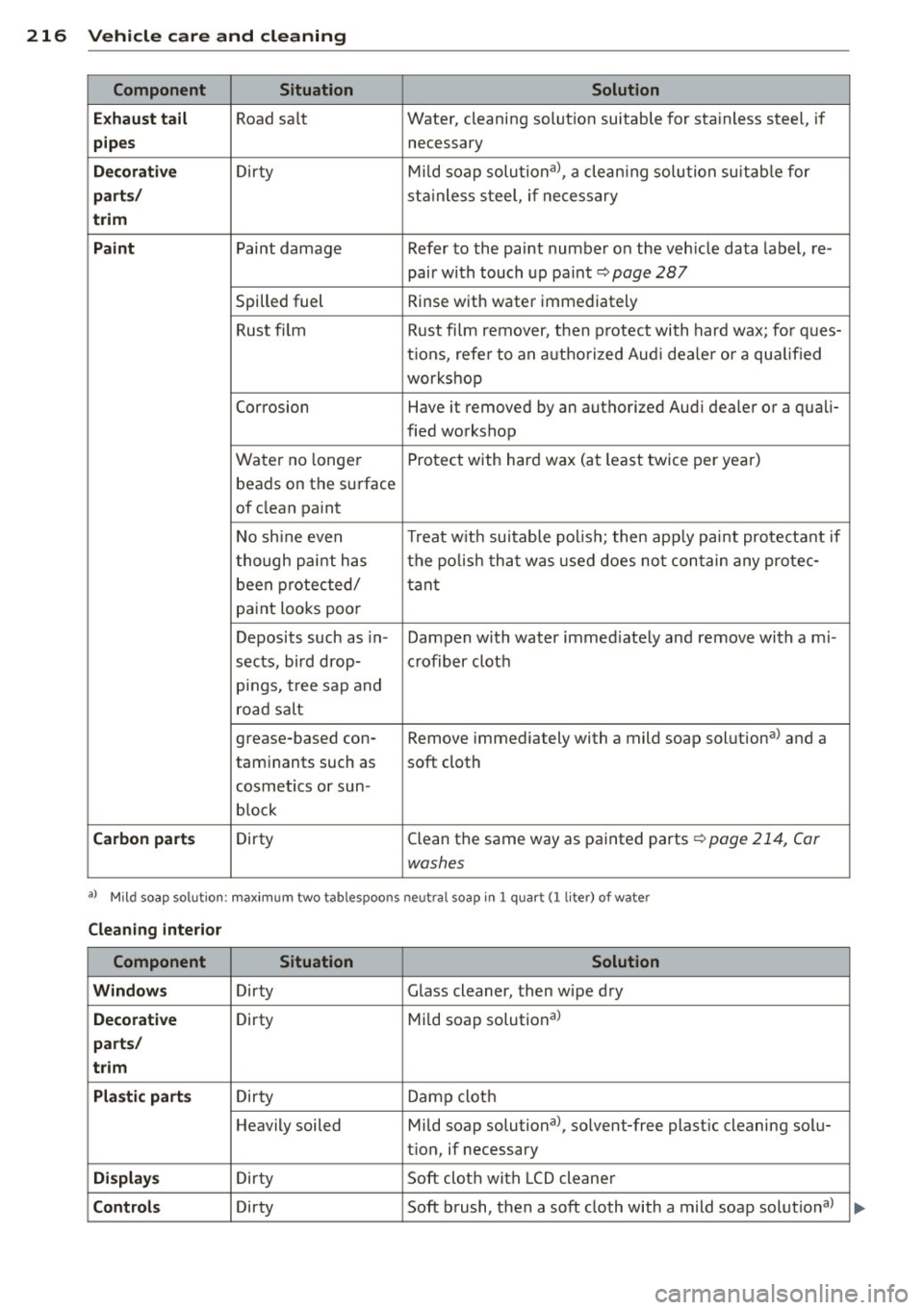
Cleaning and care information
When clea ning and caring for individual vehi
cle components, refer to the fo llow ing tab le.
The information contained there is simp ly rec
ommendations. For questions or for compo -nents that are not listed
, refer to a n author
ized Audi dea ler or a qualified workshop. Also
follow the information found in ¢ .&. .
Cle an ing exte rior
Component Situation Solution
Wipe r blades
Dirty ~ page 54, Cleaning windshield wiper blades
Headlight s/ Dirty Soft sponge with a mild soap solutiona>
tail ligh ts
S en sor s/
Dirty Sensors: soft cloth with a so lvent-free cleaning product
camera le nse s Camera lenses: soft cloth with an alcohol-free cleaning
so lution
Snow/ice Hand brush/so
lvent-free de-icing spray
Wheel s Road salt Water
Brake dust Acid-free special cleaning
solution
•
•
Page 218 of 312
216 Vehicl e c are and cle aning
Component Situ ation Solution
Ex haus t tail
Road salt Water,
cleaning solution suitable for stainless steel, if
pipes necessary
Deco rative Dirty Mi
ld soap solutiona), a cleaning solution su itab le for
pa rts/ sta inless steel, if necessary
trim
Paint
Paint damage Refer to the paint number on the veh icle data label, re -
pair with touch up paint ¢
page 287
Spilled fuel Rinse with
water immediately
Rust f ilm Rust film remover, then protect with hard wax; for ques-
t ions, refe r to an authorized Audi dea le r or a qua lified
workshop
Corrosion Have it removed by an authorized Audi dealer or a quali-
fied workshop
Water no longer Protect
with hard wax (at least twice per year)
beads on the surface
of clean paint
No sh ine even Treat with suitable polish; then apply pa int protectant if
though paint has the po lish that was used does not contain any protec-
been protected/ tant
paint looks poor
Deposits such as in - Dampen with water immediately and remove with a mi-
sects, bird drop- crofiber cloth
pings, tree sap and
road salt
grease-based con-Remove immediately with a mild soap solutiona) and a
tam inants such as soft cloth
cosmetics or sun-
block
Car bon p art s Dirty Clean tlhe same way as painted parts ¢ page 214, Car
washes
a) Mil d soap so lu tion: maximu m two tab les poon s neut ra l soa p in 1 q uar t (l lit e r) of water
Cle ani ng inte rio r
Component Situation Solution
Wind ows
Dirty Glass cleaner, then wipe dry
Deco ra tive Dirty Mild soap solutional
p arts/
t rim
Pla st ic p art s
Dirty Damp cloth
Heavily soiled Mild soap solutional, solvent-free plastic cleaning solu-
t ion, if necessary
Displ ays Dirty Soft cloth with LCD cleaner
C ont rols Dirty Soft brush, then a soft cloth with a mild soap solutiona l
Page 219 of 312

,....,
N ,....,
N
0 J:
'SI: ,...., \!) ..,.,
,...., ..,., ,....,
Vehicle care and cleaning 217
Component Situation Solution
Safety belts
Dirty Mild soap solutional, allow to dry before letting them re-
tract
Textiles, Stains adhering to Vacuum cleaner
Vinyl, the surface
Alcantara Water-based stains Absorbent cloth and mild soap solutiona>
such as coffee, tea,
blood, etc.
Oi l-based stains Apply a mild soap solutional, blot away the dissolved oil
such as oil, make- or dye, treat afterward with water, if necessary
up, etc .
Special stains such Special stain remover, blot with absorbent material,
as ballpoint pen, treat afterward with mild soap solutiona>, if necessary
nail polish, latex
paint, shoe polish,
etc.
Natural leather Fresh stains Cotton cloth with a mild soap solutiona >
Water-based stains Fresh stains: absorbent cloth
such as coffee, tea, Dried stains: stain remover suitable for leather
blood, etc.
Oil-based stains Fresh stains: absorbent cloth and stain remover suitable
such as oil, make- for leather
up, etc. dried stains: Oil cleaning spray
Special stains such Stain remover suitable for leather
as ballpoint pen ,
nail polish, latex
paint, shoe polish,
etc.
Care Regularly apply condit ion ing cream that protects from
light and penetrates into the material. Use specially-col-
ored conditioning cream, if necessary.
Cooler Dust and dirt Clean the ventilation openings in the luggage compart-
ment
Dirty Lukewarm
water, mild soap solutional if necessary, then
dry
Defrosting Empty the refrigerator, switch it off and let it thaw with
the door open, then dry
Carbon parts Dirty Clean the same way as p lastic parts
a) Mild soap so lu tion : maxim um two ta bl es poons neutr al soa p in 1 q uar t (l lit e r) of water
A WARNING
The windshield may not be treated with
water-repelling windshield coating agents.
Unfavorable conditions such as wetness,
darkness, or low sun can result in in- creased
glare. Wiper blade chatter is also
possible.
([) Note
-Headlights/tail lights
•
•
Page 231 of 312

,....,
N ,....,
N
0 J:
'SI: ,...., \!) 1.1'1 ,...., 1.1'1 ,....,
-Always disconnect the battery.
- Never smoke or work near heaters or open flames. Fluids in the engine com
partment could start a fire.
- Keep an approved fire extinguisher im
mediately available.
- To avoid electrical shock and personal in
jury while the engine is running or being
started, never touch :
- Ignition cables
- Other components of the high voltage
electronic ignition system.
- If you must perform a check or repair
with the engine running:
- First, fully apply the parking brake,
move selector lever to "P" (Park).
- Always use extreme caution to prevent
clothing, jewelry, or long hair from get
ting caught in the radiator fan, V-belts
or other moving parts, or from contact ing hot parts. Tie back hair before
starting, and do not wear clothing that
will hang or droop into the engine.
- Minimize exposure to emission and
chemical ha zards c:::> & .
A WARNING
California Proposition 65 Warning:
- Engine exhaust, some of its constituents,
and certain vehicle components contain
or emit chemicals known to the State of
California to cause cancer and birth de
fects and reproductive harm. In addition ,
certain fluids contained in vehicles and
certain products of component wear con
tain or emit chemicals known to the
State of California to cause cancer and
birth defects or other reproductive harm .
Checking and filling 229
-Battery posts, terminals and related ac
cessories contain lead and lead com
pounds, chemicals known to the State of
California to cause cancer and reproduc
tive harms. Wash hands after handling.
(D Note
When adding fluids, always make sure that
they are poured into the proper container
or filler opening, otherwise serious dam
age to vehicle systems will occur.
(® For the sake of the environment
To detect leaks in time, inspect the vehicle
floor pan from underneath regularly . If
you see spots from oil or other vehicle flu ids, have your vehicle inspected by an au
thorized Audi dealer.
Closing the engine hood
.,. Pull the hood down until the pressure from
the struts is reduced.
"'Let the hood
drop down and latch in place.
Do not try to push it shut; it may fail to en
gage
c:::> ,A .
A WARNING
-
A hood that is not completely latched
could fly up and block your view while driv
ing .
- When you close the engine hood, check it
to make sure the safety catch has proper ly engaged. The hood should be flush
with the surrounding vehicle body parts.
- If you notice while driving that the hood
is not secured properly , stop at once and
close it. •
•
Page 233 of 312

,....,
N ,....,
N
0 J:
'SI: ,...., \!) 1.1'1 ,...., 1.1'1 ,....,
(!) Windshield/headlight washer
t .
(~ ) con ainer ,..., .. .... ... .. .. . 244
@ Jump start point( -) with hex
h ead screw ............... .. 242, 281
® Jump start point( +) under a cov-
er . ..... .. ... .. ..... ... .. . 242, 281
@ Engine oil filler cap(~) . . . . . 234
® Brake fl uid reservo ir ((0)) . . . . . 239
® Coolant expansion tank (-L) . . . 237
0 O il dipstick . . . . . . . . . . . . . . . . . 234
The engine oil filler neck (item @) may be lo
cated in a different area depend ing on the ver
sion of the eng ine .
A WARNING
Before yo u check anything in the engine
compartment, always read and heed all
WARN INGS
Q .&. in Working in the engine
c ompartment on page 228.
Engine oil
Engine oil specifications
The engine oil used in your Audi needs the
right kind of oil .
-
The engine in your Audi is a sophisticated
powerp lant that was b uilt to exacting specifi
cations . This engine needs the right kind of
engine o il that meets specificat ions regarding
q ua lity and viscos ity so that it can run
smoothly and reliably . Choos ing the right oil
and changing oil within the time and mileage
in terva ls pr inted in your veh icle's War ranty
&
M aintenance book let matters a lot more to
day than i t did yea rs ago . Audi has developed
a special quality s tanda rd fo r engine oil th at
will he lp assure that your veh icle's eng ine will
get the lubrication it needs for prope r opera
tion .
M odern eng ine lubrica tion has taken a qu an
tum leap in the last few years . Many synthetic
oils ava ilable today provide better engine lu
brication that can outlast traditional petrole
um-based o ils, making them a smart choice
for use throughout the life of your A udi.
Checkin g and fillin g 231
Whether you use synthetic o r petro le um
based engine oil, the oil that you use m ust
conform to Aud i's oi l quality standard
VW 502 00 (vehicles with gasoline engine) or
VW 507 00 (vehicles w it h diesel eng ine) to
help keep your veh icle's engine ru nning
smoot hly and he lp prevent the format io n of
harmful deposits, sometimes ca lled "s ludge, "
t h at over time can lead to expensive repairs.
At the time of printing, engine oils ava ilab le i n
t h e U.S . and Canada that meet the exac ting
specifications of Audi oil standard VW 502 00
(ve hicl es w ith gasoline engine) o r VW 50 7 00
(ve hicl es w ith diese l engi ne) are synthet ic en
gine oi ls. Th is does not mean, howeve r, that
every synthetic engine oil will meet A udi oi l
standard VW 502 00 (vehicles with gasoline
engine) or VW 507 00 (vehicles with d iesel
engine). So always be sure that you use an ap
proved o il.
To he lp prevent the formation of harmfu l de
pos its use on ly oil with the following specifi
cations pr inted on the o il conta iner:
- Audi oil standard VW 502 00 (gasoline en
gine )
- Audi oil standard VW 507 00 (diesel en-
gine )
Oil containe r labels may car ry the spe cifica
tion sing ly or in combination wi th other desig
nations and oil quality s tanda rds .
Viscosity
Engine o ils are graded accord ing to their vis
cosity . The proper viscos ity grade oil fo r your
engine depends o n climactic or seasona l con
ditions where you d rive. You ca n use o il wit h a
vis cosity gr ade of SA E SW40 across all tem
pera ture ranges for norma l driv ing con ditions.
Howeve r, if engine oil v iscos ity grade SA E
SW40 is not available, you can a lso use v iscos
i ty grade SA E SW -30 or SA E OW -40 as long as
i t meets Aud i oil q ua lity standard VW 502 00
(ve hicles w ith gasoline engine) o r VW 5 07 00
(ve hicles w ith diese l engine) specifications.
Be cause eng ine o il that mee ts the Audi o il
standard may no t be availab le everywhere
•
•
Page 234 of 312
232 Check ing and filling
when you need it, we strongly recommend
that you always carry with you an extra quart (liter) of o il that expressly conforms to the
VW 502 00 (vehicles with gasoline engine) or
VW 507 00 (veh icles with diesel engine) spec
ification, in case you have to top off the oil
while o n the road .
Applies to veh icles w ith g asol ine eng ine on
l y:
Only if the level of the oil is at or below the
minimum mark on the oil dipstick - and no oil
that expressly conforms to Aud i oil standard
VW 502 00 specif ications is avai lab le - may
you top off with a high quality eng ine oil, pref
e rably synthetic -based, that meets ACEA A3
or AP I SM specifications, but even then, only
in viscosity grades SAE SW-40, SAE SW-30, or
SAE OW-40. However, during the entire time between oi l change interva ls, never top off
with more than a total of 0.5 qt/liter eng ine
oil that does not conform to Audi oil specifica
tion VW 502 00 .
Applies to veh icles with diesel engine onl y:
Only if the level of the oil is at or below the
minimum mark on the oil dipstick - and no oil
that expressly conforms to Aud i oil standard
VW 507 00 specifications is available - may
you top off with a high quality eng ine oil, that
meets AC EA C3 or A PI CF specifications, but
even then, only in v iscosity grades SAE
SW-40, SAE SW-30, or SAE OW-40 . However,
during the entire time between oil change in
tervals, never top off with more than a tota l
of 0.5 qt/ liter engine oil that does not con
form to Audi oil specif ication VW 507 00.
F or more information about engine oil that
has been approved for yo ur vehicle, please
contact either your authorized Audi dea ler or
Aud i Customer Relations at 1 (800) 822-2834
or visit our web site at www.audiusa.com or
www.audicanada.ca . Here you will a lso find a
current list of oils (manufacturers, b rand
names etc.) that conform to Audi o il standard
VW 502 00 (vehicles wi th gasoline engine) or
VW 507 00 (veh icles w ith diese l engine) .
Changing th e engine oil
The eng ine oi l and oil fi lter m ust be changed
according to the mileage (kilometers) and
t ime intervals specified in your veh icle's War
ranty
& Maintenance booklet. Do not exceed
these interva ls - harmful deposits from old
engine oil ca n reduce engine performance and
can lead to expensive e ngine repa irs.
Changi ng the oil at the recommended inter
vals is so very important because the lubricat
ing propert ies of oil decrease gradually during
normal veh icle use . If you are not sure when
you have your oil changed, ask your author ized Audi Serv ice Adv isor.
Under some circumstances the engine oil
should even be changed more frequent ly .
Change oil more often if you drive most ly
sho rt distances, operate the ve hicl e in dusty
areas o r most ly unde r stop-and-go traff ic con
ditions, or when you use your vehi cle where
temperatures stay be low freezing point for
long pe riods .
Detergent addi tives in the oil will make fresh
o il look dark after the engine has been run
ning for a short time. This is normal and is not
a reason to change the oil more often t han
recommended.
Damage or malfunction s du e to l ack of
maintenance
It is essentia l th at you c hange yo ur oil at the
recommended intervals using on ly eng ine oil
t h at complies with Audi oil standa rd
VW 502 00 (veh icles with gasoline engine) or
VW 507 00 (vehicles wit h diese l engine). Your
Limited New Veh icle Warranty does not cover
damage or malfunctions due to fail ure to fo l
low recommended maintenance and use re
quirements as set forth in the Audi Owner's
Manual and Warranty
& Mai ntenance booklet.
Your dealer w ill have to deny wa rranty cover
age unless you present to the dealer proof in
t h e form o f Service or Repair Orders that all
scheduled maintenance was performed in a
timely manner.
Page 235 of 312

,....,
N ,....,
N
0 J:
'SI: ,...., \!) 1.1'1 ,...., 1.1'1 ,....,
Engine oil consumption
The e ngine in your vehicle dep ends on an ade
quate amount of oil to lubricate and cool all
of its m oving parts .
In order to provide effective l ubrication and
cooling of internal engine components, all in
ternal combustion eng ines consume a certain
amo unt of o il. O il cons umption varies from
engine to eng ine and may c hange significant ly
over the li fe o f the eng ine . T yp ica lly, eng ines
with a specified break -in per io d (see
¢
page 205) cons ume more oi l during the
b reak-in period than they consume after oil
consumption has stabilized.
Unde r norma l conditions, the ra te of oil con
sumption depends on the quality and viscosity
of the oi l, the RPM (revo lutions per minute) at
which the eng ine is operated, the ambient
temperature and road condit ions. Further fac
tors are t he amount of oil d ilution from wate r
condensation or fuel residue and the ox ida
t ion level of the o il. As any engine is subject to
wear as mileage bu ilds up, the o il consump
tion may in crease over t ime un til re p la cement
of worn componen ts may become necessa ry.
W ith all these var iabl es com ing in to play, no
standa rd rate of o il cons umption can be es
t a blishe d or specifie d. T he re is no a lterna tive
t o regular and freq uen t ch ecking of the oi l lev
e l, see
Note .
If the ye llow eng ine o il level war ning symbol
in t he ins trumen t clus te r
II light s up, yo u
should che ck t he o il level as soon as possible
¢
page 233 or ¢ page 23 4. Top off t he oil at
your ea rliest convenience ¢
page 234.
A WARNING
Before yo u check anything in the engine
compartment, always read and heed all
WAR NINGS
¢ .&. in Working in the engine
compartment on page 228.
Dr iving with an insufficient oi l level is like
ly to ca use seve re damage to the eng ine.
-
Checkin g and fillin g
(D Tips
- The oil pressure warning display. is
not an indicator of the oil level. Do not
rely on it. Instead, check the oil level in
your engine at regular intervals, pref
erably each time you refuel, and always
before going on a long trip .
-If you have the impressi on yo ur engi ne
cons umes excess ive amounts of oil, we
recommend that you consult your Aud i
dea le r to have the cause of your concer n
properly diagno sed . K eep in mi nd th at
t he a ccu rate meas urement o f oil con
sumption requi res g reat care and may
take some t ime . Your Audi dea le r h as i n
struct io ns about how to measure oil con
sumption acc urate ly.
Checking the engine oil level
App lies to vehicles : wit h oil level indicator
Fig. 201 D isp lay: o il leve l indicator
.,. Par k yo ur vehicle o n a level su rface.
.,. Shu t the eng ine off when it is warm.
.,. Switch on ly the ignition back on.
.,. Wa it app roximately two minutes .
.,. Select:
!CAR ! functio n button > Car systems
cont ro l button > Servicing & checks > Oil
level.
.,. Check t he oil level i n the display ¢ fig. 201.
Add eng ine o il if the bar of the oil leve l ind i
cato r is nea r "m in"¢
page 234 .
Depending o n the way the vehicle is dr iven
and the ope rat ing cond it ions, o il cons umption
can be up to 1/2 quart per 600 miles (0 .5 liter
per 1,000 km). Consumption may b e hig he r
within the first 3, 000 miles (5 ,0 00 km). ..,,.
233
•
•