door lock AUDI S8 2016 Owner's Manual
[x] Cancel search | Manufacturer: AUDI, Model Year: 2016, Model line: S8, Model: AUDI S8 2016Pages: 302, PDF Size: 75.68 MB
Page 87 of 302
.... N
0 J:
'SI: ....
To prevent rolling back unintentionally on an in
cline, do the following:
11-Keep the sw itch<®) pulled and depress the ac
celerator. The parking brake stays applied and
prevents the vehicle from rolling backward .
11-You can release the switch© once you are su re
that you a re deve loping enough forwa rd mo
mentum at the whee ls as you depress the ac
celerator .
Depending on the weight of the rig (vehicle and
trailer) and the seve rity of the incline, you may
roll backwards as you start. You can prevent roll
ing backwards by holding the parking brake
switch C®> pulled out and accelerating -just as
you would when starting on a hill with a conven
tional hand brake.
Emergency braking
In the event that the conventional brake system
fails or locks.
11-In an emergency, pull the sw itch<®) and contin
ue to pull it to s low your vehicle down with the
parking brake.
11-As soon as you release the switch © or acceler-
ate, the brak ing process stops.
If you pull the switch<®> and hold it above a
speed of about 5 mph (8 km/h), the emergency
braking function is in itiated. The vehicle is braked
at all four wheels by activating the hydrau lic
brake system . The brake performance is sim ilar
to making an emergency stop¢,& .
In order not to activate the emergency brak ing by
mistake, an audib le warning tone (bu zzer)
sounds when the sw itch(®) is pu lled . As soon as
the switch(®) is released, or the accelerator pedal
i s depressed, emergency braking stops .
A WARNING
Emergency braking should only be used in an
emergency, when the normal foot brake has
fai led or the brake pedal is obstructed. Using
t he parking brake to perform emergency
braking will slow your vehicle down as if you
D riving
had made a full brake applicat ion . The laws of
physics cannot be suspended even with ESC
and its associated components (ABS, ASR,
EDL). In corners and when road or weather
conditions are bad, a full brake application
can cause the vehicle to skid or the rear end to
b reak away -risking an acc ident.
Start/Stop system
Description
Applies to: vehicles with Start-Stop-System
The Start-Stop -System can help increase fuel
economy and reduce CO2 emissions.
In the Start-Stop-mode, the engine shuts off au
tomatica lly when the vehicle is stopped, such as
at a traffic light . The ign ition remains switched
on during this stop phase. The eng ine will be au
tomat ically restarted when needed.
The last Start-Stop-System setting (on/off using
the b utton
10 -I) will be restored when the igni
t ion is turned on. The LED in the
10 ~1 button turns
on when the Start-Stop-System is switched off
manually .
Basic requirements for the Start-Stop mode
-The driver's door is closed.
- The driver' seat belt is latched .
- The hood is closed.
- The vehicle must have bee n driven faster than
2.5 mph (4 km/h) since the last stop.
- A trailer is not hitched to the vehicle .
A WARNING
-
-Never let the vehicle roll with the engine
switched off. You could lose contro l over the
veh icle. Th is can lead to a collision and seri
ous injuries .
- The brake booster and the steering support
do not work while the engine is switched
off . More force is required to stop and to
steer the vehicle.
- To reduce the risk of injur ies, ma ke sure that
the Sta rt-Stop-System is turned off when
working in the engine compartment
¢page 87.
85
Page 89 of 302
-The windshield is being defrosted~ page 79.
-The brake pedal is pressed sever al t imes in a
row .
- T he battery charge level becomes too low .
- High power cons umption .
Switching the ignition off automa tic ally
To prevent the battery from dra ining, the ignition
will sw itch off
auto mati call y when all of the fol
lowing cond itions have been met:
- The vehicle has already been driven.
- The eng ine has been turned
off by the Start-
Stop -System*.
- The driver's door is opened .
- The driver's seat bel t is removed.
- The brake pedal is not p ressed down.
- The veh icle is stationary.
In this case, the activated low beam will be re
p laced by the s ide marker lights. The side marker
lights will switch
off after appro ximately 30 mi
nutes or when you lock the veh icle.
If the Start-Stop System has
not turned off the
engine or if you have sw itched the Start-Stop sys
tem
off manually , the ignition will not be auto
mat ica lly switched
off and the engine w ill contin
ue to run~& .
& WARNING
Never allow the engine to r un in confi ned
spaces - da nger o f as phyxia tio n.
(D Tips
-
If you shift in to the D, Nor S posit ions after
shifti ng into reve rse, the veh icle must be driv
en faster th an 6 mph (10 km/h) in order for
t he eng ine to swi tc h
off aga in.
D rivi ng
Switching the Start-Stop-System on/off
manually
Applies to: vehicles with Start-Stop-System
If you do not wish to use th e system, you can
switch it off manually.
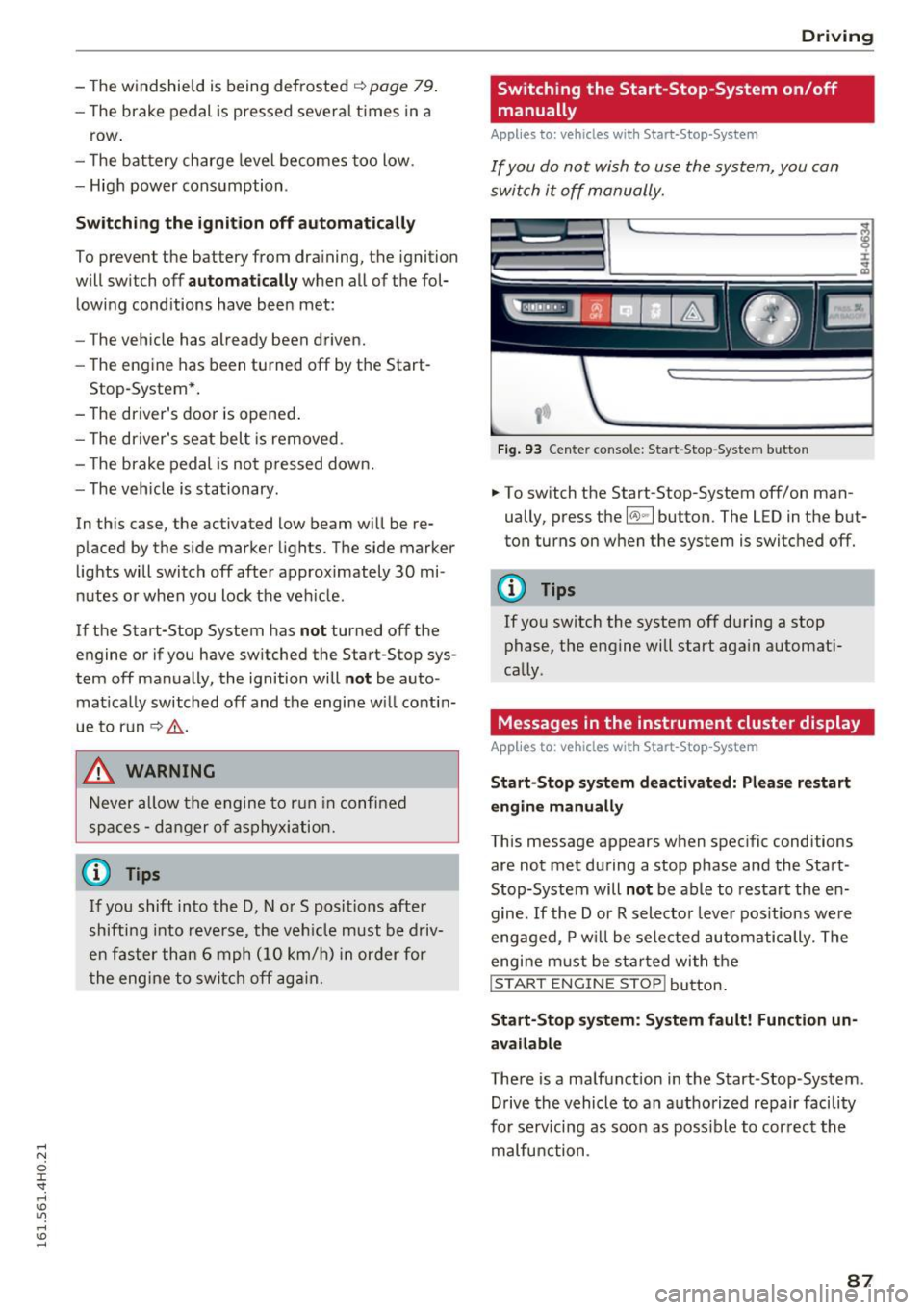
Fi g. 93 Center console: Start-Stop -System button
.. To switch the Start-Stop-System off/on man
ually, press the
l(A) ~ I button. The LED in the but
ton turns on when the system is switc hed
off.
(D Tips
If you sw itch the system off during a stop
phase, the engine will start aga in automati
cally .
Messages in the instrument cluster display
Applies to: vehicles with Start-Stop -System
Start-Stop system deactiv ated: Plea se restart
engin e manually
This message appears when spec ific conditions
are not met during a stop phase and the Start
Stop-System will
not be able to resta rt the en
gine.
If the Dor R selector leve r pos itions we re
engaged, P w ill be sele cted automatically. The
engi ne m ust be st arted wi th t he
I START ENGINE STOP! button .
Start-Stop s yst em : S y stem fault! Function un
available
There is a malfunction in the Start-Stop-System.
Drive the vehicle to an a uthorized repair facility
for serv icing as soo n as poss ible to cor rec t the
malfunction .
87
Page 116 of 302
Automatic transmissio n
-Power is sti ll transmitted to the w heels
w hen the eng ine is r unning at idle. To pre
vent the veh icle from "creeping", you must
keep your foot on the brake in all selector
lever positions except P and N when the en
gine is runn ing . Do not inadvertently press
t h e accelerator pedal when the vehicle is
s tationa ry. Otherwise the vehicle will start
to move immediately. This cou ld happen
even if the parking brake is activated.
- Before opening the hood, se lect the P sele c
tor leve r pos ition and se t the park ing bra ke .
This reduces the risk of a crash . Always read
and follow the applicab le warnings
<=> page 220.
- Never get out of the driver's seat when the
engine is running.
- If you must get out of the vehicle, move the
selector lever securely into the P position
and apply the parking brake.
(D Tips
- If you un intent ionally shift in to the N selec
tor lever position whi le driving, ta ke your
foot off the accelerator pedal and wait for
the engine to slow down unt il it is idling be
fore yo u shift into D or S.
Driving tips
Th e gears shi~ automatically .
Starting from a stop
.. Press and hold the brake pedal.
.. Start the engine<=>
page 81 .
.. Press the button on the selector lever and se
l ect the D, 5 or R selector lever position
<=> page 112.
.. Wait a moment unti l the transmission shifts.
You w ill not ice a slight moveme nt when the
gear engages .
"' Release the b rake pedal and press the acce lera
tor pedal <=>,&. .
Stopping temporarily
.. Press the b rake pedal to stop the vehicle, for
example at a traff ic light. Do not press the ac
celerator pedal when do ing th is.
114
.. To preven t the vehicle from ro lling when yo u
start driving, set t he parking brake when stop
ping on large inclines¢,&. .
.. The parking brake will release a utomat ica lly
and the vehicle will start moving once you press
the acce lerato r pedal.
Parking
If the se lector lever is not in the P position whe n
yo u open the drive r's door, the vehicle cou ld roll.
The message
Transmission: Car may roll! Shift
to park!
appears.
.. Press an d hold the b rake peda l
c::> ,&..
.. Set the park ing brake.
.. To engage the P selector lever position, press
the button on the selector lever and shift into
the P position
c::> page 112 .
Under certain conditions such as driving in the
mountains or when towing a trailer, it may be
helpful to switch to manua l mode temporar ily to
shift
manually to adapt to the driving conditions
c::> page 115.
On slopes, act ivate the park ing brake first and
then move the selector lever to the P position .
This prevents too muc h stress from be ing placed
on the locking mechanism .
A WARNING
Read and fo llow all WAR NING S c::> .&. in Se
le ct ing a selec tor lever posi tion on p age 113.
- The vehicle can also ro ll when the eng ine is
s t o pped .
- Do no t press the acce le ra t o r pedal when
chang ing t he selec to r lever posit io n while
t he vehicle is s tat ionary and the engine i s
r u nning. This co uld result in a crash.
- Never e ngage R or P while driving.
It co uld
cause a crash.
- P owe r is still transmitted to the wheels
when t he e ngine is runni ng at idle . To pre
vent the vehicle from "creeping", yo u m ust
keep your foot on the brake in a ll selector
lever positions except P and N when the en
gi ne is running. Do not inadvertent ly press
the acce le rator peda l when the veh icle is
stat ionary. Otherwise t he vehicle will start
-
Page 137 of 302
-Never place or install floor mats or other
floor coverings on top of already installed
floor mats. Additional floor mats and other
coverings will reduce the size of the pedal
area and interfere with the pedals .
- Always properly reinstall and secure floor
mats that have been taken out for cleaning.
- Always make sure that objects cannot fall
into the driver footwell while the vehicle is
moving . Objects can become trapped under
the brake pedal and accelerator pedal caus ing a loss of veh icle control.
Storing cargo correctly
Loading the luggage compartment
All luggage and other objects must be properly
stowed and secured in the luggage compart
ment.
L oose items in the luggage compartment can
shift suddenly, changing vehicle handling charac
teristics. Loose items can also increase the risk of
serious personal injury in a sudden vehicle ma
neuver or in a collision.
.. Distribute the load evenly in the luggage com
partment.
.. Always place and properly secure heavy items in
the luggage compartment as far forward as
possible.
.,. Secure luggage items using the tie-downs pro
vided
¢ page 68, Luggage compartment .
A WARNING
Improperly stored luggage or other items can
fly through the vehicle causing serious per
sonal injury in the event of hard braking or an
accident. To help reduce the risk of serious
personal injury:
- Always put objects, for example, luggage or
other heavy items in the luggage compart
ment.
- Always secure objects in the luggage com
partment using the tie-down hooks and
suitable straps .
Driving safety
A WARNING
Heavy loads will influence the way your vehi
cle handles. To help reduce the risk of a loss
of control lead ing to serious personal injury:
- Always keep in m ind when transporting
heavy objects, that a change in the center of
gravity can also cause changes in vehicle handling:
- Always distribute the load as evenly as
possible .
- Place heavy objects as far forward in the
luggage compartment as possible.
- Never exceed the Gross Axle Weight Rating
or the Gross Vehicle Weight Rating specified
on the safety compliance sticker on the left
door jamb. Exceeding permissible weight
standards can cause the vehicle to slide and handle differently.
- Please observe information on safe driving
¢page 129.
A WARNING
To help prevent poisonous exhaust gas from
being drawn into the vehicle, always keep the
rear lid closed while driving .
- Never transport objects larger than those
f itting completely into the luggage area be
cause the rear lid cannot be fully closed.
- If you absolutely must drive with the rear lid open, observe the following notes to reduce
the risk of poisoning:
- Close all windows,
- Close the power roof,
- Open all air outlets in the instrument pan-
el,
- Switch off the air recirculation
,
- Set the fresh air fan to the highest speed .
A WARNING
Always make sure that the doors, all win
dows, the power roof and the rear lid are se
curely closed and locked to reduce the r isk of
in jury when the vehicle is not being used.
- After closing the rear lid, always make sure
that it is properly closed and locked.
-
135
Page 176 of 302
Child safety
The airbag on the passenger side makes the front
seat a potentially dangerous p lace for a child to
ride. The front seat is not the safest place for a
child in a forward-facing child seat. It is a very
dangerous place for an infant or a larger child in
a rearward-fac ing seat.
A WARNING
Not using a ch ild safety seat, using the wrong
child safety seat or improperly installing a
child restra int increases the r isk of serious
personal inju ry and death in a crash.
- Never install rear-facing chi ld safety seats
or infant carriers on the front passenger
seat -even with an Advanced Airbag System.
A chi ld will be seriously injured and can be
killed when the inflating airbag hits the
child safety seat or infant carrier with great
force and smashes the child safety seat and
child against the backrest, center armrest,
door or roof
c::, page 147, Child restraints on
the front seat -some important things to
know.
- Always install rear-facing child safety seats
or infant carr iers on the rear seat.
- Never install a rear-facing child restra int in
the forward-facing direct ion. Such restraints
are designed for the spec ial needs of infants
and very sma ll children and cannot protect
them properly if the seat is forward-fa cing.
- If you must install a rearward fac ing ch ild
safe ty seat on the front passenger seat be
ca use of exceptiona l circumsta nces and the
PASSENGER AIR BAG OFF light does not
come on and stay on, immed iate ly install
the rear-facing chi ld safety seat in a rear
seat ing position and have the airbag system
inspected by your Audi dealer.
-Always read and heed all WARNINGS when
ever using a child restrained in a vehicle is
being used
c:> page 138, Safety belts,
c::, page 146, Airbag system and
c:> page 168, Important information.
174
Convertible child safety seats
Properly used convertible child safety seats can
help protect toddlers and children over age one
who weigh between 20 and 40 lbs. (9 and 18 kg)
in a crash.
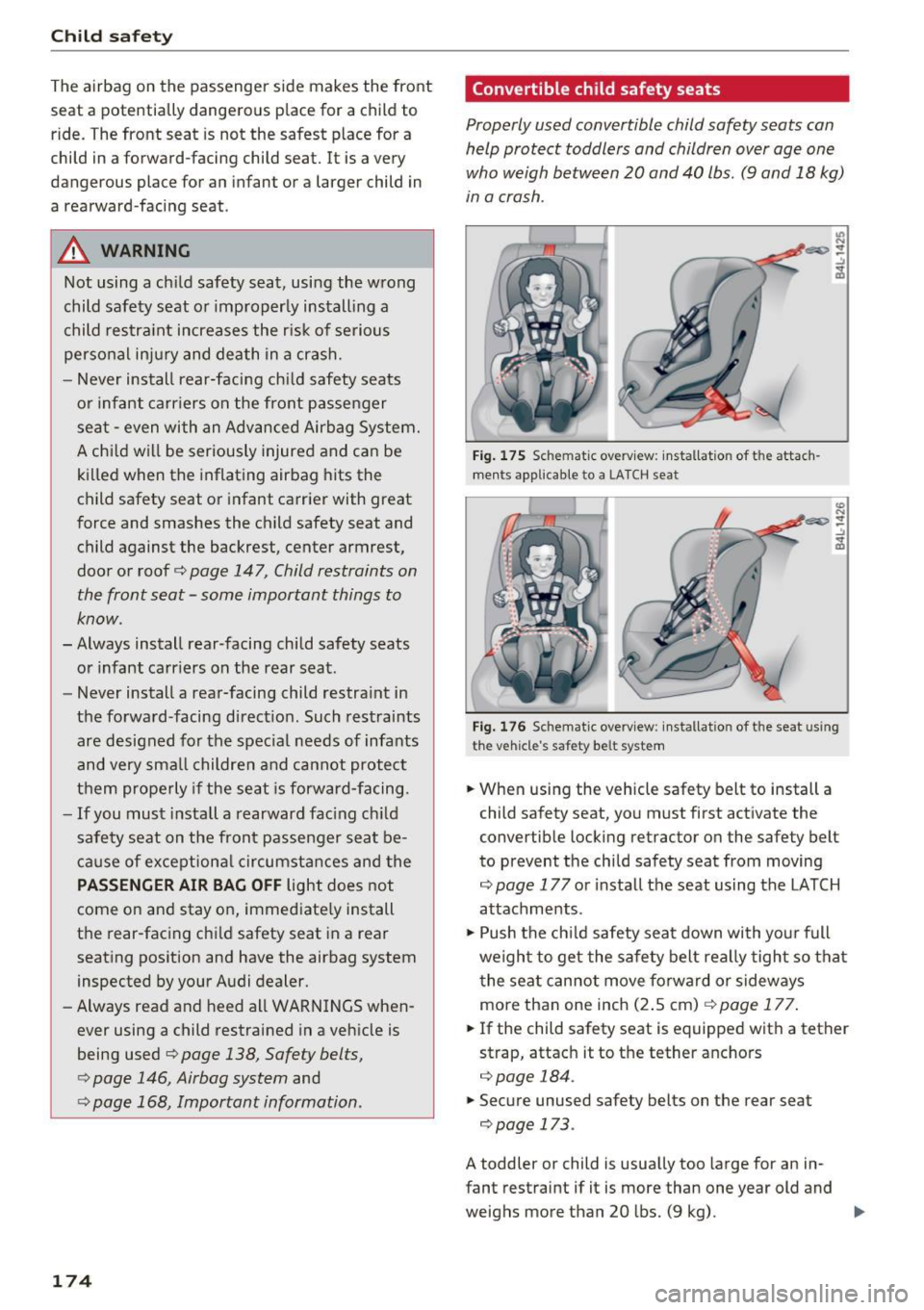
Fig . 1 7 5 Schemat ic overv iew : installat ion of the attach
ments applicable to a LA TCH seat
Fig. 176 Schemat ic overv iew: i nstallat ion of the seat using
the vehicle's safety belt system
.. When using the vehicle safety belt to install a
child safety seat, you must first activate the
convertib le locking retractor on the safety belt
to prevent the child safety seat from moving
c:> page 177 or install the seat using the LATCH
attachments .
.. Push the chi ld safety seat down wi th your full
we igh t to get the safe ty belt really tight so that
the seat cannot move forward or sideways
more than one inch (2 .5 cm)
c:>page 177.
.. If the child safety seat is equipped with a tether
strap, attach it to the tether anchors
c:>page 184.
.. Secure unused safety belts on the rear seat
c:>page 173.
A toddler or child is usually too large for an in
fant restraint if it is more than one year old and
weighs more than 20 lbs. (9 kg). ..,.
Page 180 of 302
Child safety
-Always make sure that the safety belt re
tractor is locked when installing a child
safety seat. An unlocked safety belt retrac
tor cannot hold the child safety seat in place during normal driving or in a crash.
- Always buckle the child safety seat firmly in
place even if a child is not sitting in it . A
loose child safety seat can fly around during
a sudden stop or in a collision.
- Always make sure that the rear seat back
rest to which the center rear safety belt is
attached is securely latched whenever the
rear center safety belt is being used to se
cure a child restraint .
- If the backrest is not securely latched, the
child and the child restraint will be thrown
forward together with the backrest and will
strike parts of the vehicle interior. The child
can be seriously injured or killed.
- Never install rear-facing child safety seats or infant carriers on the front passenger
seat. A child will be seriously injured and can be killed when the passenger airbag in
flates.
- The inflating airbag will hit the child safety
seat or infant carrier with great force and
will smash the child safety seat and child
against the backrest, center armrest, door
or roof .
- Always install rear-facing child safety seats
or infant carriers on the rear seat .
- Forward-facing child safety seats or infant
carriers installed on the front passenger's
seat may interfere with the deployment of
the airbag and cause serious injury to the
child.
- It is safer to install a forward-facing child
safety seat on the rear seat.
-Always read and heed all WARNINGS when
ever using a child restrained in a vehicle is
being used ¢
page 168. Special precautions
apply when installing a child safety seat on
the front passenger seat¢
page 147, Child
restraints on the front seat- some impor
tant things to know.
178
A WARNING , .
Always take special precautions if you must
install a forward or rearward-facing child re
straint on the front passenger's seat in excep
tional situations:
- Whenever a forward or rearward-facing child restraint is installed on the front pas
senger seat, the
PASSENGER AIR BAG OFF
light must come on and stay on whenever
the ignition is switched on.
- If the PASSENGER AIR BAG OFF light does
not come on and stay on, perform the
checks described¢
page 156, Monitoring
the Advanced Airbag System.
- Take the child restraint off the front passen
ger seat and install it properly at one of the
rear seat positions if the
PASSENGER AIR
BAG OFF
light does not stay on whenever
the ignition is switched on.
- Improper installation of child restraints can
reduce their effectiveness or even prevent
them from providing any protection.
- An improperly installed child restraint can
interfere with the airbag as it deploys and
seriously injure or even kill the child.
- Always carefully follow the manufacturer's
instructions provided with the child safety
seat or carrier .
- Never place additional items on the seat
that can increase the total weight registered
by the weight-sensing mat and can cause in
jury in a crash.
A WARNING
Forward-facing child restraints:
- Always make sure the forward-facing seat
has been designed and certified by its man
ufacturer for use on a front seat with a pas
senger front and side airbag .
- Never put the forward-facing child restraint up, against or very near the instrument pan
el.
- Always move the passenger seat into its
rearmost position in the seat's fore and aft
-
Page 181 of 302
adjustment range, as far away from the air
bag as possible before installing the for
ward-facing child restraint. The backrest must be adjusted to an upright posit ion .
- Make sure that the
PAS SEN GER AIR BAG
OFF
light comes on and stays on all the time
whenever the ignition is switched on .
A WARNING
Rearward-facing child restraints:
- A child in a rearward-facing child safety seat
installed on the front passenger seat will be
seriously injured and can be killed if the
front airbag inflates -even with an Ad
vanced Airbag System.
- The inflating a irbag w ill hit the child safety
seat or infant carrier with great force and
will smash the ch ild safety seat and chi ld
against the backrest, center armrest, door
or roof.
- Always be especially careful if you must in
stall a rearward facing child safety seat on
the front passenger seat in exceptional cir
cumstances.
- A tight tether strap on a rearward-facing
child restraint attached to the front passen
ger seat can put too much pressure on the
weight-mat in the seat and register a heavi
er weight in the Advanced Airbag System .
The heavier weight registered can make the system work as though an adult were on the
seat and deploy the Advanced Airbag when
it must be suppressed causing serious or
even fatal injury to the child.
- Make sure that the
PASSENGER AIR B AG
OFF
light comes on and stays on all the time
whenever the ignition is switched on.
- If the
PASSENGER AIR BAG OFF light does
not come on and stay on, immediately in
sta ll the rear-fac ing ch ild safety sea t in a
rear seating position and have the airbag
system inspected by your Audi dealer.
Ch ild safety
Activating the convertible locking retractor
Use the convertible locking retractor to secure a
child restraint .
Always heed the child sa fety seat manuf actu rer 's
ins truc tions when ins talling a child restraint in
your vehicle . To activate the convertible locking
retractor:
.. Place the child rest raint on a seat, prefe rably
on the rear sea t.
.. Slowly pull the belt
all the w ay out .
.. Route it around or through the child restra int
be lt path ¢,&. .
.. Push the ch ild safety seat down with you r full
weight to get the safety belt really tight.
.. Insert the belt tongue into the buckle for that
seating position.
.. Guide the safety belt back into th e retractor un
til the belt lies flat and snug on the child safety
seat .
.. You should hear a ''cl icking" noise as the belt
w inds back into the inertia reel. Test the con
vert ible lock ing retractor by pulling on the belt .
You shou ld no longer be able to pull the belt
out of the retractor. The convertib le locking re
t ractor is now activated.
.. Make sure that the red release button is facing
away from the child restraint so that it can be
unbuckled quickly .
.. Pull on the belt to make sure the safety belt is
properly tight and fastened so that the seat
cannot move forward or sideways more than
one inch (2 .5 cm) .
A WARNING
Using the wrong ch ild rest raint or an improp
e rly installed child restra int can cause se rious
personal injury or death in a crash .
- Always make sure that the safety be lt re
tr actor is locked when installing a child
safety seat . An un locked safety be lt retrac
tor cannot hold the chi ld safety seat in p lace
during normal driving or in a crash.
- Always buckle the child safety seat firm ly in
p lace even if a child is not sitting in it. A
loose child safety seat can fly around during
a sudden stop or in a crash. .,.
179
Page 217 of 302
Putting the fuel c ap back on
"' After filling your tank , tw ist the f uel fi ller cap
clockwise as far as it wi ll go .
"' Close the fuel filler flap.
To avoid fuel spill ing o r evaporating from the f uel
tank always close fuel filler cap properly and
comp let ely. An improperly closed fue l filler cap
may a lso caus e the MIL lamp ¢
page 28 to come
on (only vehicles with gasoline engine).
A WARNING
Improper refueling or handling of fuel can
cause fire, explosion and severe burns .
- Fuel is highly f lammable and can cause se
vere burns and other injur ies.
-
- Failure to shut the engine off wh ile refuel
ing and/or to insert the pump no zzle fully
into the fuel filler neck could cause fuel to
spray out of filler neck or to overflow . Fuel
spray and overflowing fue l can cause a fire .
- Never use a cellular telephone wh ile refuel
ing . The electromagnetic radiation can
cause spa rks that can ignite fuel vapors and
cause a fire.
- Never get back into your vehicle while refu
eling .
If in except io na l circumstances you
must get back in you r vehicle while refue l
ing, make certain tha t you close the door
and touch meta l to discharge static electric
ity before touchi ng the filler nozz le again.
Static electricity can ca use spa rks that can
ignite fuel vapors released during refueling .
- Never smoke o r have an open flame any
where in or near your vehicle when refueling or filling a portable f uel container.
- For yo ur safety , we strongly recommend
that you do not travel with a portable fue l
conta iner in your vehicle. The conta iner, full
or empty may leak and could cause a fire,
especially in a crash .
-If, under exceptional c ircumstances, you
must transport a portable fuel container,
please observe the follow ing :
- Neve r fi ll a portable fuel containe r wh ile i t
is anywhere in or on the vehicle (for exam
p le, in the luggage compartment, or on
the trunk) . Static e lectr icity can build up
Fuel and R efueling
whi le filling and can ignite fuel vapors
caus ing a fire .
- Always place a portab le fue l container on
the ground before f illing.
- Always keep the fi ller nozzle comp lete ly
inside the po rtable container before and
during f illing.
- If filling a portable container made of
metal, the filler nozz le m ust always be in
contact with the container. This will he lp
prevent stat ic electricity from discharging
and cause a fire .
- Never spill fue l inside the vehicle or lug
gage compartment. F uel vapors are highly
flammable .
- Always observe local and state/prov incial
laws regarding the use, storage and trans
po rtation of fuel co nta iners.
- Make ce rtain t he f uel container meets in
dust ry standards (ANSI/ ASTM F852-86) .
(0 Note
If any fuel has sp illed onto the car, it should
be removed immed iately to p revent damage
to the pa int.
@ For the sake of the environment
As soon as the correctly operated noz zle
switches off automatically for the first time,
the tank is fu ll. Do not try to add more fuel
because f uel may sp ill out . In add it ion, the
expans ion space in the fuel tank will be fi lled -
causing the fue l to overflow when it becomes
warm and po llute the environment.
(D Tips
- Runn ing your engine while refuelling may
cause vapors to escape or even ca use fue l to
spill out of the tank. This wo uld then shut
off the f uel no zzle befo re t he t ank is f ull.
- Do not ref ue l your veh icle with the ignition
switched on . The fuel gauge m ay o therwise
no t indicate the co rrect fuel leve l after refu
elling.
- Diesel vehicles* are equ ipped wi th a die sel
m isf ueli ng pro tector . It a llows the vehi cle
to be fuele d only with a d iesel fue l pump .,.
215
Page 218 of 302
Fuel and Refueling
nozzle. A worn or damaged nozzle or a noz
zle that is too small may not be ab le to open
the diesel m isfueling protector. If th is is the
case, try turning the nozzle before inserting
i t in the fuel f iller neck, use a different fuel
pump or see your authorized Audi dealer or
authorized repair facility for ass istance.
- The fuel filler flap of your vehicle is not
locked when you lock the veh icle from the
i nside .
Fuel filler flap emergency release
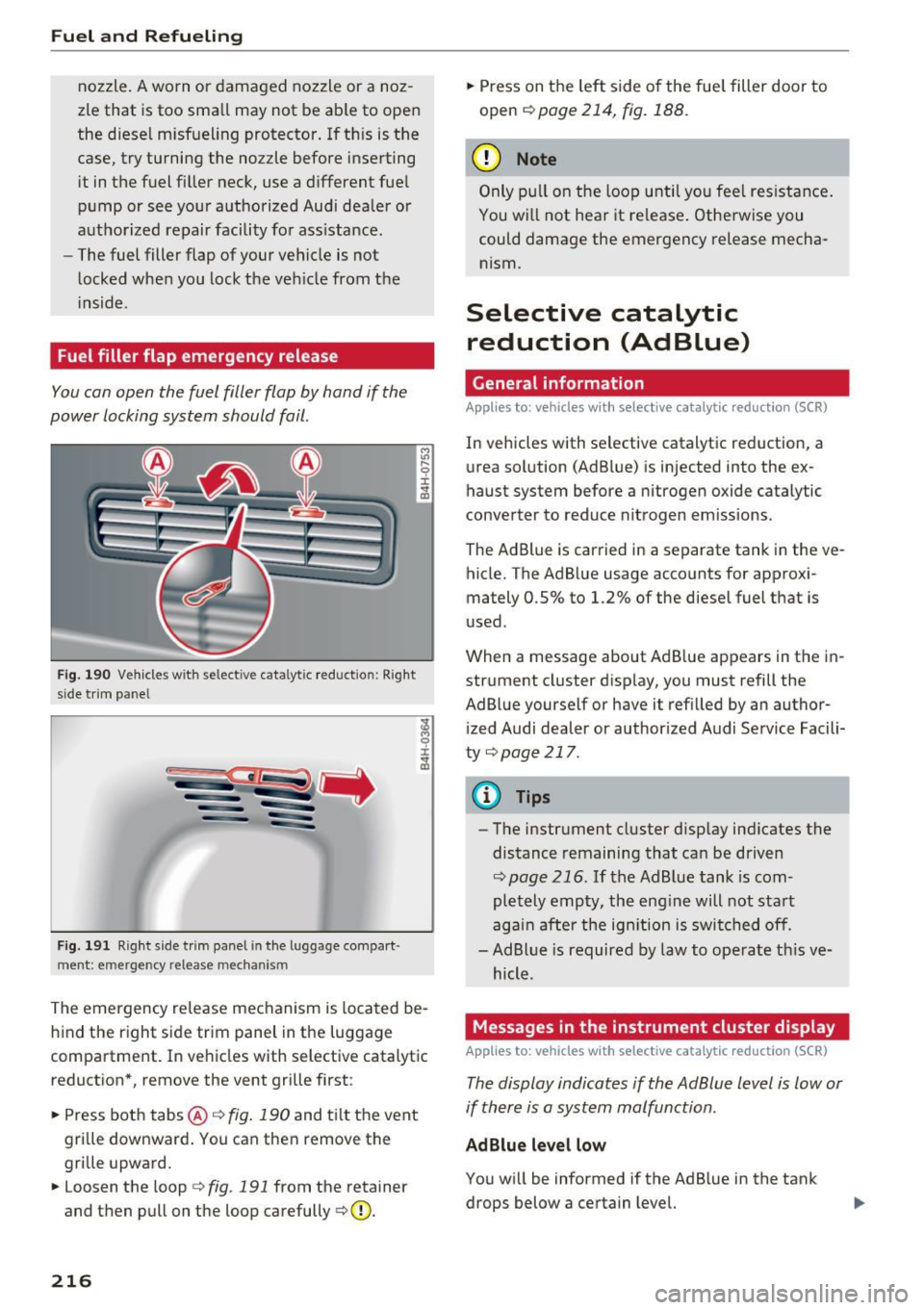
You can open the fuel filler flap by hand if the
power locking system should fail.
F ig . 190 Vehicles w ith se lect ive cata lytic reductio n: Right
side tr im pane l
Fig. 191 Right side trim panel in the lu ggage compart ·
ment: e mergency release mechan is m
...,
"' 9 ::i: ... (D
The emergency release mechanism is located be
hind the right side trim panel in the luggage
compartment. In vehicles with selective catalytic
reduction*, remove the vent grille first :
.. Press both tabs@¢
fig. 190 and tilt the vent
gri lle downward. You can then remove the
grille upward.
.. Loosen the loop¢
fig. 191 from the retainer
and then pull on the loop carefully ¢(D.
216
.. Press on the left side of the fuel filler door to
open
¢ page 214, fig. 188.
(D Note
Only pull on the loop until you feel resistance .
You wi ll not hea r it re lease . Otherwise you
could damage the emergency release mecha nism.
Selective catalytic reduction (Ad Blue)
General information
Applies to: vehicles with selective catalytic reduction (SCR)
In vehicles with selective catalytic reduction, a
urea solution (AdBlue) is injected into the ex
haust system before a nitrogen oxide catalytic
converter to reduce nitrogen emissions .
The Ad Blue is carried in a separate tank in the ve
hicle. The AdBlue usage accounts for approxi
mately 0.5% to 1.2% of the diesel fuel that is
used.
When a message about Ad Blue appears in the in
strument cluster display, you must refill the
Ad Blue yourself or have it refilled by an author ized Audi dealer or author ized Audi Service Facili
ty
¢ page 217.
@ Tips
-The instrument cluster display indicates the
distance remaining that can be driven
¢page 216. If the AdBlue tank is com
pletely empty , the eng ine will not start
again after the ign ition is switched off.
- Ad Blue is required by law to operate th is ve
hicle.
Messages in the instrument cluster display
Applies to: vehicles with selective catalytic reduction (SCR)
The display indicates if the Ad Blue level is Low or
if there is a system malfunction .
AdBlue level low
You will be informed if the AdBlue in the tank
drops below a certain level.
Page 221 of 302
-A permitted refill canister contains approxi
mately 1.3 gallons (5 liters) of Ad B lue .
Completing AdBlue refill
Applies to: veh icles with selective catalyt ic reduction (SCR)
Cl os ing the fill er ne ck
~ Turn the Ad Blue cap to the r ight on the fill er
tube unti l the cap clicks into place ¢
A in Fill
ing Ad Blue on page 217,
¢ CD in Filling Ad Blue
on page 217 .
~ Then press on the left side of the tank door un -
t il you hear it lock.
After filling
T he vehicle must be driven so that the system
recogni zes th at the Ad Blue was refilled. Th is
process can take several minutes.
~ If there was no Ad Blue left in the tank and a
range of
O m i (0 km ) was shown in the display,
switch the ign ition on for about 30 seconds be
fore starting the engine.
Ad Blue can freeze at very low temperatures. If th is happens, the system will not detect
that the Ad Blue was refilled and it wi ll contin
ue to inform yo u of the low Ad Blue level. The
message turns off as soon as the tank thaws
out again .
Fuel and R efueling
219