fuel AUDI S8 2016 Owner's Manual
[x] Cancel search | Manufacturer: AUDI, Model Year: 2016, Model line: S8, Model: AUDI S8 2016Pages: 302, PDF Size: 75.68 MB
Page 203 of 302
Fewer short trips
Fuel consumption will always be relatively high
on short trips.
11-Try to avoid driving short distances with a cold
engine.
The engine and catalyt ic converter have to reach
their optimal
op erating tempe ratur e to reduce
fuel consumption and noxious emissions effec tively .
Just after starting, a co ld eng ine in a mid-s ize car
only achieves a fuel economy of 6-8 miles per
gallon (30-40 l/100 km). After about a half a mile, fuel economy cl imbs to 12 mpg (20 l/100
km). After about
2 .5 miles (4 km), the engine is
at its proper operating temperature and fuel
economy has reac hed a norma l level. So you can
see tha t you should avo id short t rips w henever
possib le.
The
outside temperature is also cr itical in this re
g ar d. Yo ur car consumes mo re fuel in the w in ter
tha n in the s umme r.
Driving and the envir onment
201
Page 210 of 302
Care and cleaning Component Situation Solution
Decorative parts/
Dirty Mild soap solutiona>, a cleaning solution suitable for stain-
trim less steel, if necessary
Paint Paint damage Refer to the paint number on the vehicle data label, repair
with touch up paint
¢page 277
Spilled fuel Rinse with water immediately
Rust film Rust film remover, then protect
with hard wax; for ques-
tions, refer to an authorized Audi dealer or a qualified
workshop
Corros ion Have it removed by an authorized Aud i dea ler or a qua lified
wo rkshop
Water no longer Protect with hard wax (at least twice per year)
beads on the surface
of clean pa int
No shine even though Treat with suitable polish; then apply paint protectant if
paint has been pro- the polish that was used does not contain any protectant
tected/paint looks
poor
Deposits such as in-Dampen with water immediately and remove w ith a micro-
sects, bird droppings, fiber cloth
tree sap and road salt
grease-based con- Remove immediately with a m ild soap solutiona> and a soft
taminants such as cloth
cosmetics or sunblock
Carbon parts Dirty Clean the same way as painted parts¢ page 206, Car
washes
a l Mild soap so lution: maxim um two tablespoo ns neu tra l soap in 1 quar t Cl lite r) of water
Cleaning interior
Component Situation Solution
Windows
Dirty Glass cleaner, then wipe dry
Decorative parts/ Dirty Mild soap so lutiona>
trim
Plastic parts
Dirty Damp cloth
Heavily soiled Mild soap solutiona>, solvent-free p lastic clean ing solution,
if necessary
Displays Dirty Soft cloth with LCD cleaner
Controls Dirty Soft brush, then a soft cloth with a m ild soap solutiona >
Safety belts Dirty Mild
soap solutiona>, allow to dry before letting them re-
tract
208
...
Page 214 of 302
Fuel and Refueling
Fuel and Refueling
Gasoline
Fuel supply
Applies to: vehicles with gaso line engine
Using the right fuel helps keep the environment
clean and prevents engine damage.
Fuel recommendation
The fuel recommended for your vehicle is unlead
ed premium
grade gasoline . Audi recommends
using TOP TIER Detergent Gasoline with a mini
mum octane rating of 91 AKI (95 RON). For more
information on TOP TIER Detergent Gasoline,
p lea se go to the offic ial website
(www.toptiergas .com).
The recommended gasoline octane rating for
your engine can also be found on a label located
on the ins ide of the fuel filler flap . This rating
may be specified as AKI or RON.
Your vehicle may also be operated using unlead
ed regular gasoline with a minimum octane rat
ing of 87 AKl/91 RON . However, using 87 AKI/91
RON octane fuel wil l slightly reduce engine per
formance.
Use unleaded gasoline only. Unleaded gasoline
is availab le throughout the USA, Canada, and in
most European countries . We recommend that
you do not take your vehicle to areas or countries
where un leaded gaso line may not be available.
For more information on refueling your vehicle,
see
¢ page 214.
Octane rating
Octane rating indicates a gasoline's ability to re
sist engine damaging "knock" caused by prema
ture ignit ion and detonation . Therefore, buying
the correct grade of gasoline is very important to
he lp prevent possible engine damage and a loss
of eng ine performance.
Gasoline most commonly used in the United
States and Canada has the following octane rat
i n gs that can usually be found on the filler pump:
- Premium Grade: 91 - 96 AKI
212
- Regular Grade: 87 - 90 AKI
Explanation of the abbreviations:
AKI = Anti Knock Index = (R +M)/2 = (RON +MON)/
2
RON = Research Octane Number
MON= Motor Octane Number.
{[) Note
-Do not use any fuel with octane ratings low
er than 87 AKI or 91 RON otherwise expen
sive engine damage wi ll occur .
- Do
not use leaded gasoline. The use of lead
ed gasoline will severely damage your vehi
cle's catalytic converter and its ability to
control exhaust emissions .
Blended gasoline
Applies to: vehicles with gasoline engine
Use of gasoline containing alcohol or MTBE
(methyl tertiary butyl ether)
You may use unleaded gasoline blended with al
cohol or MTBE (commonly referred to as oxygen
ates) if the blended mixture meets the following
criteria:
Blend of gasoline methanol (wood alcohol or
methyl alcohol)
-Anti -knock index must be 87 AKI or h igher.
- Blend must contain no more than 3% metha-
nol.
- Blend must contain more than 2% co-solvents.
Blend of gasoline and ethanol (grain alcohol or
ethyl alcohol)
- Anti-knock index must be 87 AKI or h igher .
- Blend must not contain more than 15% etha-
nol.
Blend of gasoline and MTBE
-Anti-knock index must be 87 AK I or higher .
- Blend must contain not mo re than 1S% MTBE.
Seasonally adjusted gasoline
Many gasoline grades are blended to perform es
pecially well for winter or summer dr iv ing . Dur-
i ng seasonal change-over, we suggest that you .,..
Page 215 of 302

fill up at busy gas st ations where the season al
adjustment is more likely to be made in time .
(D Note
-Me thanol f uels which do not mee t these re
quirements may ca use corros ion and dam
age to plastic and rubber components in the
fuel system .
- Do not use fuels that fai l to meet the speci
fied criter ia in this chapter.
- If you are unable to determine whether or not a particular fuel blend meets the speci
ficat ions, ask your service station or its fuel
supplier.
- Do not use fuel for which the contents can
not be identif ied.
- Fuel system damage and performance prob
lems resulting from the use of fue ls differ
ent from those specified are not the respon
s ibility of Audi and are not covered under
the New Veh icle or the Emiss ion Control
System Wa rrant ies.
- If you experience a loss of fue l economy or
driveability and performance prob lems due
to the use of one of these fuel b lends, we
recommend that you switch to unblended
fuel.
Gasoline additives
Applies to: vehicles with gasol ine engine
A majo r concern among many au to manufactur
ers is carbon deposit build- up caused by the type
of gasoline yo u use.
A lthough gasoline grades d iffer from one manu
f a cturer to ano ther, they have cer tain things in
common . A ll gasoline grades contain substances
that can cause deposits to collect on vita l engine
pa rts, such as fue l injectors and intake valves . Al
though most gaso line brands include additives to
keep engine and fuel systems clean, they are not
equally effective.
Aud i recommends using TOP TIER Detergent Gas
oline. For more informat ion on TOP TIER Deter
gent Gasoline, please go to the official website (www.toptiergas .com) .
Fuel and R efueling
After an extended period o f using inadeq uate
fuels, carbon deposit bui ld-ups can rob your en
gine o f peak performance.
(D Note
Damage or ma lf u nction due to poo r fue l qual
ity is not covered by the A udi New Vehicle
Limited Warranty .
Diesel fuel
Applies to: vehicles with diesel engine
Always use ULSD (Ultra Low Sulfur Diesel) No. 2 .
The ULSD No . 2 meets the ASTM 0975.
Diesel f uel w it h concen tratio ns of b iod iesel h igh
er than 5 % such as Bl 1, B20 or BlOO are strict ly
prohibited .
Se rvice station fuel p umps are labe led with the
correct f uel i nfo rmat ion for e asy recog nition by
the user.
If the d iesel f ue l pump is no t labeled
ask the station operator what fuel is being dis
pensed before fil ling up your vehicle .
UL SD No . 2 m ay not be available ou tside the USA
and Canada . Be su re to check befo re t raveling to
other countries .
UL SD No . 2 c an become thic ke r i n ve ry cold tem
peratures, and this can imp air the engine's s tart
ing and running. Depend ing on the sea son, gas
stations provide ULSD No . 2 that flows better in
cold temperatures so that you can continue oper
at ing your vehicle as usual.
@ Note
- Your vehicle's diese l engine was designed
sole ly for use with ULSD No . 2 . Therefo re,
neve r use gasoline, heating oil, other fuels
or flow improvers. These contain substances
that will severely damage the fuel system
and the engine . Such damage will not be
cove red by your New Vehicle Limited War-
r a nty.
- If you put a ny amo unt of incorrect fuel in
the fuel tank, do not sta rt the eng ine under
any circumstances. Imme diately contact the
II>-
213
Page 216 of 302

Fuel and Refueling
nearest authorized Audi dealer or author
ized Audi Service Facility for assistance.
These fuels contain substances that can se
verely damage the fuel system and the en
gine if the engine is started.
Refueling
Fuel filler neck
The fuel filler neck is located on the right rear
side panel behind the fuel filler flap.
If the power locking system should fail, you can
still open the flap manual ly -for detailed instruc
tions see
c;> page 216.
You can find the fuel tank capac ity of your vehicle
In .
The label on the inside of the fuel filler flap tells
you the correct fuel for your vehicle. For more in
formation about fue l specifications, see
c;> page 212.
Your vehicle fuel tank has an onboard refuelling
vapor recovery system. This feature helps to pre
vent fuel vapors from escaping from the tank and
pollut ing the environment while you refuel your
veh icle. In order to fill the tank properly while
protecting the environment, please follow this
refueling procedure carefully.
_& WARNING
Under normal operating conditions, never car
ry additional fuel containers in your car. Gas
canisters and other containers used to trans
port fuel can be dangerous. Such containers,
full or empty, may leak and could cause a fire
in a collision. If you must transport fuel to
use for you r lawn mower, snow blower, etc.,
be very careful and always observe local and
state laws regarding the use, transportation
and storage of such fuel containers. Make cer
tain the container meets industry standards
(ANSI/ASTM F852 -86).
(D Note
Never drive your vehicle until the fuel tank is
completely empty. The ir regular supply of
fuel can cause m isfiring. Gasoline could enter
214
the exhaust system and damage the catalytic
converter.
Refuelling
Fig. 188 Right rear vehicle side: Opening the fuel filler flap
Fig. 189 Fuel fille r flap with attached fuel cap
When activating the central locking, the fue l fill
er flap is automatically unlocked or locked. Re
fuel the vehicle with the ignition switched
off.
Taking the fuel cap off
.,. Press the left side of the fuel fil ler flap to open
it
c;>fig. 188- arrow- .
.,. Unscrew f uel filler cap counter-clockwise and
hang it on the fuel filler flap¢
fig. 189.
.,. Check the label on the inside of the fuel filler
flap to determine if the vehicle must be fueled
with gasoline or diesel fuel.
Refuelling procedure
.,. Insert the fuel nozz le from the gasoline pump
into the fue l filler neck as far as it will go.
.,. Select a medium refuelling rate so that the
nozzle switches off automatically when the
tank is full.
Page 217 of 302
Putting the fuel c ap back on
"' After filling your tank , tw ist the f uel fi ller cap
clockwise as far as it wi ll go .
"' Close the fuel filler flap.
To avoid fuel spill ing o r evaporating from the f uel
tank always close fuel filler cap properly and
comp let ely. An improperly closed fue l filler cap
may a lso caus e the MIL lamp ¢
page 28 to come
on (only vehicles with gasoline engine).
A WARNING
Improper refueling or handling of fuel can
cause fire, explosion and severe burns .
- Fuel is highly f lammable and can cause se
vere burns and other injur ies.
-
- Failure to shut the engine off wh ile refuel
ing and/or to insert the pump no zzle fully
into the fuel filler neck could cause fuel to
spray out of filler neck or to overflow . Fuel
spray and overflowing fue l can cause a fire .
- Never use a cellular telephone wh ile refuel
ing . The electromagnetic radiation can
cause spa rks that can ignite fuel vapors and
cause a fire.
- Never get back into your vehicle while refu
eling .
If in except io na l circumstances you
must get back in you r vehicle while refue l
ing, make certain tha t you close the door
and touch meta l to discharge static electric
ity before touchi ng the filler nozz le again.
Static electricity can ca use spa rks that can
ignite fuel vapors released during refueling .
- Never smoke o r have an open flame any
where in or near your vehicle when refueling or filling a portable f uel container.
- For yo ur safety , we strongly recommend
that you do not travel with a portable fue l
conta iner in your vehicle. The conta iner, full
or empty may leak and could cause a fire,
especially in a crash .
-If, under exceptional c ircumstances, you
must transport a portable fuel container,
please observe the follow ing :
- Neve r fi ll a portable fuel containe r wh ile i t
is anywhere in or on the vehicle (for exam
p le, in the luggage compartment, or on
the trunk) . Static e lectr icity can build up
Fuel and R efueling
whi le filling and can ignite fuel vapors
caus ing a fire .
- Always place a portab le fue l container on
the ground before f illing.
- Always keep the fi ller nozzle comp lete ly
inside the po rtable container before and
during f illing.
- If filling a portable container made of
metal, the filler nozz le m ust always be in
contact with the container. This will he lp
prevent stat ic electricity from discharging
and cause a fire .
- Never spill fue l inside the vehicle or lug
gage compartment. F uel vapors are highly
flammable .
- Always observe local and state/prov incial
laws regarding the use, storage and trans
po rtation of fuel co nta iners.
- Make ce rtain t he f uel container meets in
dust ry standards (ANSI/ ASTM F852-86) .
(0 Note
If any fuel has sp illed onto the car, it should
be removed immed iately to p revent damage
to the pa int.
@ For the sake of the environment
As soon as the correctly operated noz zle
switches off automatically for the first time,
the tank is fu ll. Do not try to add more fuel
because f uel may sp ill out . In add it ion, the
expans ion space in the fuel tank will be fi lled -
causing the fue l to overflow when it becomes
warm and po llute the environment.
(D Tips
- Runn ing your engine while refuelling may
cause vapors to escape or even ca use fue l to
spill out of the tank. This wo uld then shut
off the f uel no zzle befo re t he t ank is f ull.
- Do not ref ue l your veh icle with the ignition
switched on . The fuel gauge m ay o therwise
no t indicate the co rrect fuel leve l after refu
elling.
- Diesel vehicles* are equ ipped wi th a die sel
m isf ueli ng pro tector . It a llows the vehi cle
to be fuele d only with a d iesel fue l pump .,.
215
Page 218 of 302
Fuel and Refueling
nozzle. A worn or damaged nozzle or a noz
zle that is too small may not be ab le to open
the diesel m isfueling protector. If th is is the
case, try turning the nozzle before inserting
i t in the fuel f iller neck, use a different fuel
pump or see your authorized Audi dealer or
authorized repair facility for ass istance.
- The fuel filler flap of your vehicle is not
locked when you lock the veh icle from the
i nside .
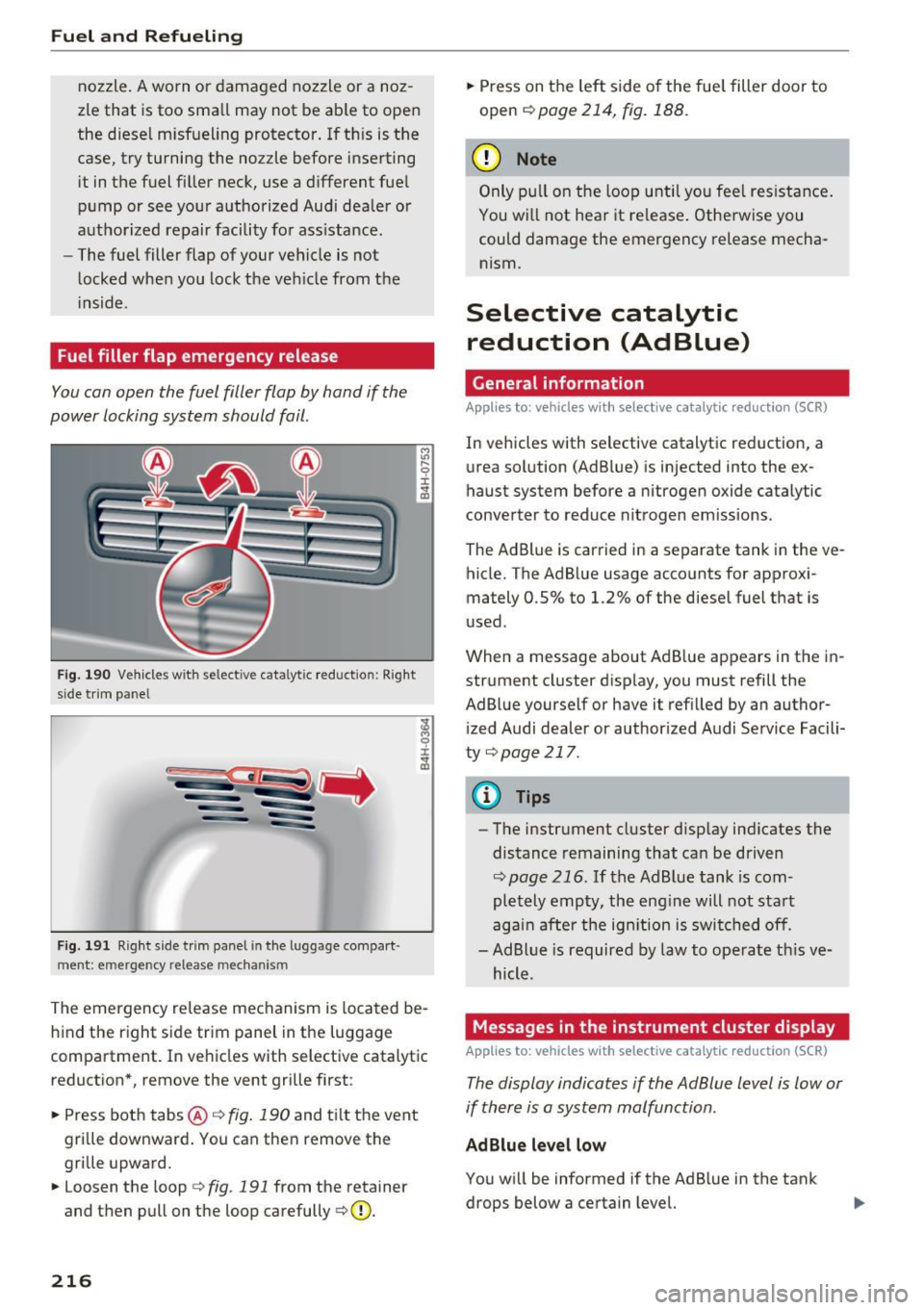
Fuel filler flap emergency release
You can open the fuel filler flap by hand if the
power locking system should fail.
F ig . 190 Vehicles w ith se lect ive cata lytic reductio n: Right
side tr im pane l
Fig. 191 Right side trim panel in the lu ggage compart ·
ment: e mergency release mechan is m
...,
"' 9 ::i: ... (D
The emergency release mechanism is located be
hind the right side trim panel in the luggage
compartment. In vehicles with selective catalytic
reduction*, remove the vent grille first :
.. Press both tabs@¢
fig. 190 and tilt the vent
gri lle downward. You can then remove the
grille upward.
.. Loosen the loop¢
fig. 191 from the retainer
and then pull on the loop carefully ¢(D.
216
.. Press on the left side of the fuel filler door to
open
¢ page 214, fig. 188.
(D Note
Only pull on the loop until you feel resistance .
You wi ll not hea r it re lease . Otherwise you
could damage the emergency release mecha nism.
Selective catalytic reduction (Ad Blue)
General information
Applies to: vehicles with selective catalytic reduction (SCR)
In vehicles with selective catalytic reduction, a
urea solution (AdBlue) is injected into the ex
haust system before a nitrogen oxide catalytic
converter to reduce nitrogen emissions .
The Ad Blue is carried in a separate tank in the ve
hicle. The AdBlue usage accounts for approxi
mately 0.5% to 1.2% of the diesel fuel that is
used.
When a message about Ad Blue appears in the in
strument cluster display, you must refill the
Ad Blue yourself or have it refilled by an author ized Audi dealer or author ized Audi Service Facili
ty
¢ page 217.
@ Tips
-The instrument cluster display indicates the
distance remaining that can be driven
¢page 216. If the AdBlue tank is com
pletely empty , the eng ine will not start
again after the ign ition is switched off.
- Ad Blue is required by law to operate th is ve
hicle.
Messages in the instrument cluster display
Applies to: vehicles with selective catalytic reduction (SCR)
The display indicates if the Ad Blue level is Low or
if there is a system malfunction .
AdBlue level low
You will be informed if the AdBlue in the tank
drops below a certain level.
Page 219 of 302

Please refill Ad B lue . Range 1500 mi (2400 km )
This message appears when there is only eno ugh
Ad Blue lef t to d rive the distance indicated in the
d river information system . Fill the AdBlue.
AdBlue ,0 Refill AdBlue! No re start in 600 mi
( 1000 km )! See owner 's manual
This message appea rs when there is only eno ugh
Ad Blue left to drive the distance indicated in the
driver info rmation system . Fill the Ad Blue . Ot he r
wise the eng ine will not sta rt again if you s top it
once the d ist an ce in dicate d ha s been d riven. You
can also check t he remai ning dis tance in the on
board com puter.
Refill Ad Blue! No restart! See own-
er's manual
This message appears whe n the AdBlue ta nk is
empty . Fill the AdB lue. Otherwise you will not be
ab le to s tart the engine aga in once yo u stop it.
The AdBlue must be refilled when t he amount in
the tank has reached the minimum level
q page 217, Filling Ad Blue.
Incorrect filling /system malfunction
A message appears if the AdB lue tank was filled
with a fluid other than AdBlue and the system
has detected that the tan k was fi lled incor rect ly,
or if there is a system malfunction .
Ad Blue -I' Ad Blue: System fault! No restart in
600 mi (1000 km ). See owner's manual.
This message appears when it is only poss ible to
drive the d istance ind icated in the dr iver informa
tion system. Drive to t he nearest authorized Aud i
dealer o r authorized Aud i Serv ice Facility to have
the ma lfunction co rrected. Otherwise the engine
w ill not start agai n if you stop it once the d is
tance ind icated has been driven .
AdBlue: System fault No restart!
See owner's manual
This message appears if the system has detected
that the tank was filled inco rrectly o r that there
i s a malfunction . Drive immediately to the near
est authorized Aud i dea le r or authorized Aud i
Service Facility to have the malfunction correct-
Fuel and Refueling
ed. Ot herwise you wi ll not be able to star t the en
gine again once yo u stop it .
Filling AdBlue
Applies to : veh icles w ith selec tive catalytic re du ctio n (SCR)
Fig. 192 Right rear s ide of the ve hicle: re m ov ing t he A d Bl
u e cap
The Ad Blue tank open ing is located near t he d ie
sel tank opening. Add at least 1.5 gallons (5. 7L)
of Ad B lue . Thi s is the minim um amount requ ired
to ensure the system detects the refi lling and to
sta rt the eng ine. You can add a maxim um of 4
g allo ns ( 16L) .
Requireme nt: Th e reques t to add Ad Blue m ust
appear in the instrum ent clus te r disp lay .
.,. Switch t he ignit ion off.
.,. Open the tank door ¢ page 214 .
.,. Tu rn the cap on t he tank opening to the left to
remove ¢fig . 192.
.,. Fill t he A d Bl ue w ith the bottle ¢ page 218 or
t he ca n iste r ¢p age 218.
WARNING
A d Bl ue can irrita te the s kin, eyes an d re sp ira
tory system. If there is contact with t he f lui d,
fl ush immed iate ly w ith plenty of water . Con
sult a phys ician if necessary.
(D Note
- Only use Ad Blue th at con forms to t he
s tandar d ISO 2 22 41-1. Do not m ix any addi
tives with the Ad Blue and do not dilute it
w ith wate r.
- Ad Blue must not be filled in the diese l ta nk
and diese l fue l must not be filled in the
217
Page 220 of 302
Fuel and Refueling
Ad Blue tank. If the wrong fluid is filled in
the tank, do not start the engine under any
circumstances. If yo u do, you risk damaging
the tank system and the engine. See an au
thorized Audi dealer or authorized Audi
Service Fac ility for assistance .
- AdBlue attacks surfaces such as painted ve
hicle components, plastic and carpet. Re
move the fluid as quickly as poss ible with a
damp cloth and plenty of cold water. If the
Ad Blue has already crysta llized, use wa rm
water and a sponge. Ad Bl ue residue that is
not removed will crystallize and can damage
the affected surface.
- Do not store refill bott les or canisters per
manently in the vehicle . If the container
l eaks, the escaping AdBlue could damage
the vehicle interior.
- Do not allow AdBlue to come into contact
with clothing. If there is contact with the
flu id, f lush immed iate ly w ith plenty of wa
ter.
(D Tips
Follow the Ad Blue manufacturer's instruc
tions for use and storage .
Refilling Ad Blue with a bottle
Applies to: veh icles w ith selective catalyt ic reduction (SCR)
"'Remove the cap from the refill bottle c> A in
Filling Ad Blue on page 217,
¢ @) in Filling
AdBlue on page 21 7.
"' Pos ition the bottle on the filler tube and turn
the bottle clockwise until it stops turning .
"'Pr ess lightly against the bottom of the bottle
to empty it. Continue press ing the bottom of
the bottle until it is empty or until fluid stops
flowing into the tank.
"' Remove the bottle and close the filler neck
c> page 219, Completing AdBlue refill .
(D Note
Only use refill bottles that are approved for
your vehicle. Using other systems can cause
Ad Blue to leak.
218
(D Tips
-You can obtain refi ll bott les from an author
ized Aud i dea ler or authorized Audi Service
Facility.
- A permitted refill bottle contains approxi
mately 0.5 gallon (1.9 liters) of AdBlue.
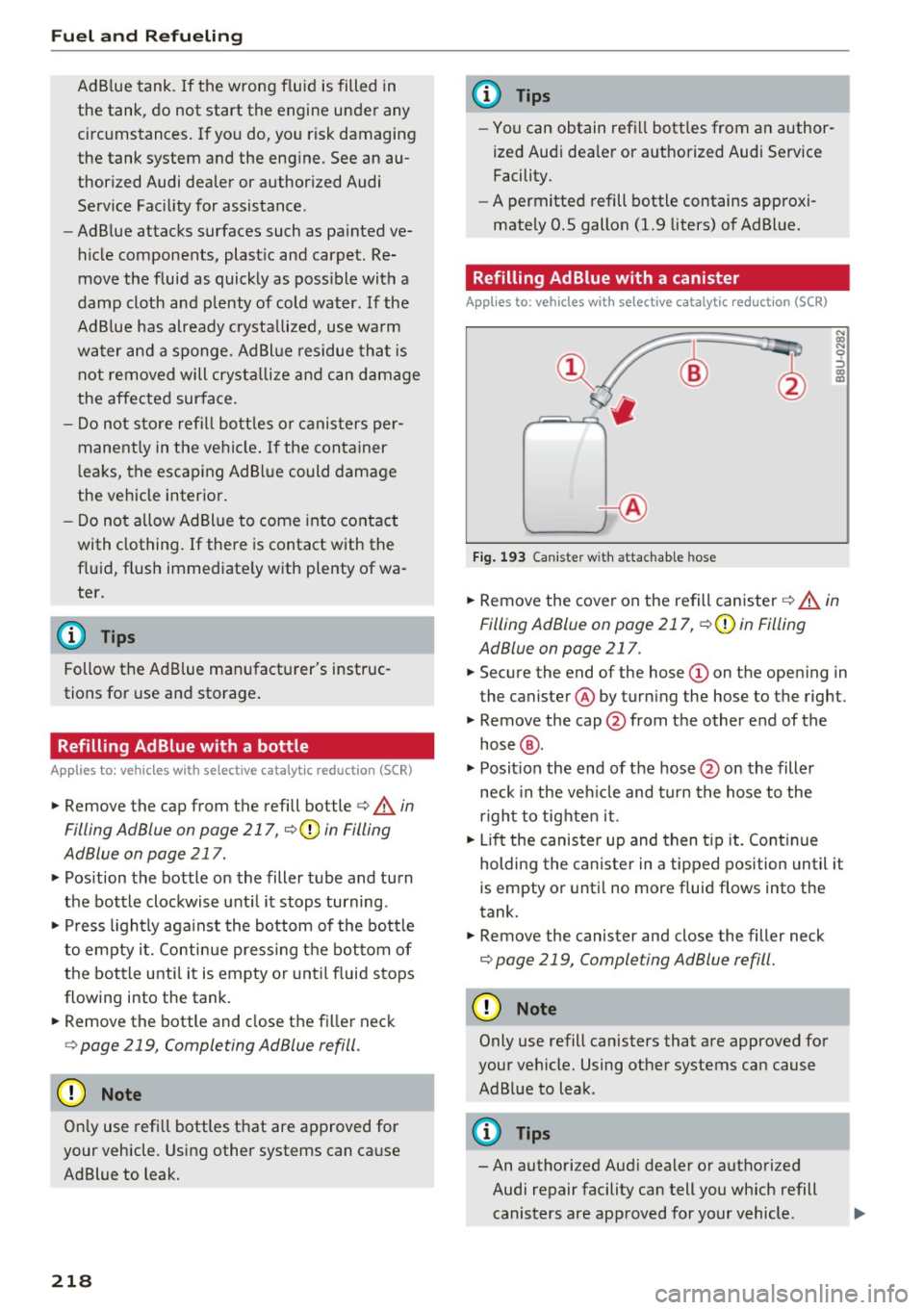
· Refilling Ad Blue with a canister
App lies to : vehicles with selective cata lyt ic r educt ion (SCR)
®
+®
Fig. 193 Canis te r w ith attachab le hose
N
Filling AdBlue on page 217, ¢(Din Filling
AdBlue on page 217.
"' Secure the end of the hose (Don the opening in
the canister @by turn ing the hose to the right.
"' Remove the cap @from the other end of the
hose @.
"' Posit ion the end of the hose @on the filler
neck in the vehicle and turn the hose to the
r ig ht to tighten it.
"' Lift the canister up and then tip it. Continue
holding the canister in a tipped position until it
is empty or until no more fluid flows into the
tank.
"' Remove the canister and close the filler neck
¢ page 219, Completing AdBlue refill.
(D Note
Only use refill canisters that are approved for
your vehicle. Using other systems can cause Ad Blue to leak .
0) Tips
-An authorized Audi dealer or authorized
Audi repair facility can tell you which refill
canisters are approved for your vehicle .
Page 221 of 302
-A permitted refill canister contains approxi
mately 1.3 gallons (5 liters) of Ad B lue .
Completing AdBlue refill
Applies to: veh icles with selective catalyt ic reduction (SCR)
Cl os ing the fill er ne ck
~ Turn the Ad Blue cap to the r ight on the fill er
tube unti l the cap clicks into place ¢
A in Fill
ing Ad Blue on page 217,
¢ CD in Filling Ad Blue
on page 217 .
~ Then press on the left side of the tank door un -
t il you hear it lock.
After filling
T he vehicle must be driven so that the system
recogni zes th at the Ad Blue was refilled. Th is
process can take several minutes.
~ If there was no Ad Blue left in the tank and a
range of
O m i (0 km ) was shown in the display,
switch the ign ition on for about 30 seconds be
fore starting the engine.
Ad Blue can freeze at very low temperatures. If th is happens, the system will not detect
that the Ad Blue was refilled and it wi ll contin
ue to inform yo u of the low Ad Blue level. The
message turns off as soon as the tank thaws
out again .
Fuel and R efueling
219