lock AUDI S8 2016 Service Manual
[x] Cancel search | Manufacturer: AUDI, Model Year: 2016, Model line: S8, Model: AUDI S8 2016Pages: 302, PDF Size: 75.68 MB
Page 122 of 302
Parking system s
If the distance to an obstacle r emains constant,
the volume of the distance warn ing gradually
drops after about four seconds (th is does not ap
ply in the continuous tone range) .
Rear vie w cam era
The rea r view camera is located above the rear li
cense plate bracket. Make sure that the lens for
the park ing system
¢ fig . 132 is not covered by
deposits or any other obst ructions because this
can affe ct the function of the parking system . For
information on clean ing, refer to¢
page 206.
The rear view camera coverage area includes@
¢fig. 131 . Only this a rea is shown in the Info
tainment display. Objects that are outside of th is
area @are not displayed.
The accuracy of the orientation lines and the blue
surfaces is reduced if the adaptive air suspen
sion " is faulty, if the vehicle is lifted or if the
dy
n amic
mode is activated ¢ page 106 .
A WARNING
-Always read and follow the applicable warn
ings
¢ .& in General information on
page 118 .
-If the posit io n and the installation angle of
the rear view camera was changed , for ex
ample, after a co llision, do not continue to
use the system for safety reasons . Have i t
checked by your author ized Audi dealers hip
or authorized repair faci lity .
- Only use the rear view came ra to assist you
if it shows a good, clear picture . For exam
ple, the image may be affected by the sun
shining into the lens, dirt on the lens or if
there is a system fau lt .
- Use the rear view camera only if the l uggage
compartment lid is completely closed. Make
sure any objects you may have mounted on
the luggage compartment lid do not block
the rear view camera.
- The camera lens enlarges and distorts the
field of vis ion. T he object appears both al
tered and inaccurate on the screen .
- In certain situations, people or objects in
the d isplay appear closer or further away :
120
-objects that do not to uch the ground, such
as the bumper of a parked vehicle , a tra iler
hitch or the rear of a truck. Do not use the
help lines in this case.
- If driven from a level surface onto an in
cline, or a downward slope .
- If driven toward protruding objects.
-If the vehicle is carrying too much load in
the rear.
(D Note
- Always read and fo llow the applicable wa rn
ings
¢ (i) in General information on
page 118 .
-The orange co lored orientation lines in the
Infota inment display show the vehicle path
depending on the steer ing whee l ang le . The
front of the vehicle front swings out more
than the rear of the vehicle. Maintain plenty of distance so that your outside mirror or a
corner of your vehicle does not collide w ith
any obstacles .
Switching on /off
Applies to: vehicles with parking system plus with rear view
camera
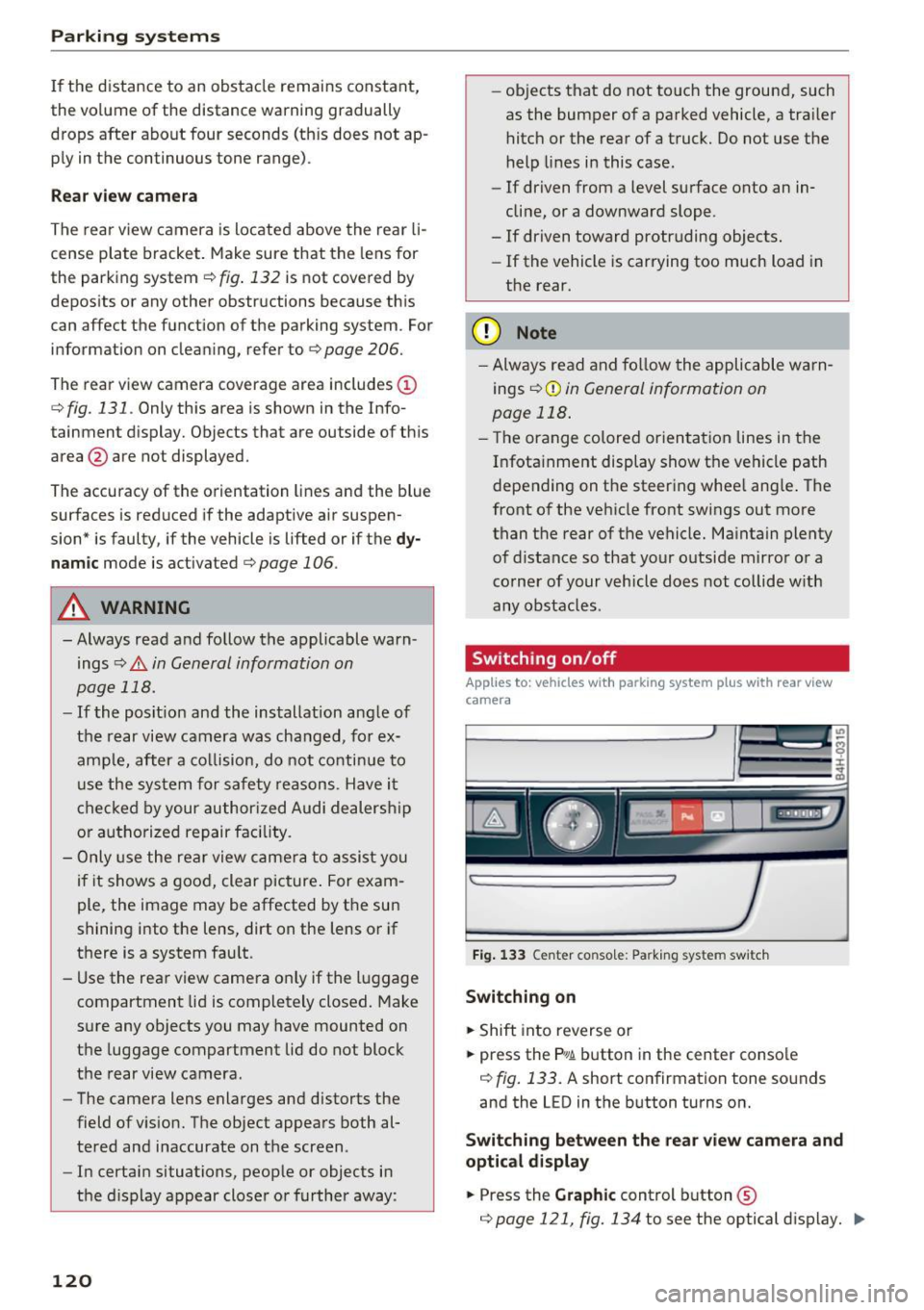
F ig . 133 Center co n sole : Pa rk ing syste m swi tch
Switching on
... Shift into reverse or
... press the
p,q ~ button in the center conso le
¢ fig. 133. A short confirmation tone so unds
and the LED in the b utton turns on.
Switching b etween the rear view camera and
optica l d isplay
... Press the Graphic cont rol button ©
¢page 121, fig. 134 to see the optical d isplay . ..,.
Page 133 of 302
For detailed information on how to adjust the
driver's seat, see
¢ page 59.
A WARNING
Drivers who are unbelted, out of position or
too close to the airbag can be seriously in
jured by an airbag as it unfolds. To help re
duce the risk of serious personal injury:
- Always adjust the driver's seat and the
steering wheel so that there are at least 10 inches (25 cm) between your breastbone
and the steering wheel.
- Always adjust the driver's seat and the
steering wheel so that there are at least
4 inches (10 cm) between the knees and the
lower part of the instrument panel.
- Always hold the steering wheel on the out
side of the steering wheel rim with your
hands at the 9 o'clock and 3 o'clock posi
tions to help reduce the risk of personal in
jury if the driver's airbag inflates.
- Never hold the steering wheel at the
12 o 'clock position or with your hands at
other positions inside the steering wheel
rim or on the steering wheel hub. Holding
the steering wheel the wrong way can cause
serious injuries to the hands, arms and head if the driver's airbag inflates.
- Pointing the steering wheel toward your face decreases the ability of the supplemen
tal driver's airbag to protect you in a colli
sion.
- Always sit in an upright position and never
lean against or place any part of your body
too close to the area where the airbags are
located.
- Before driving, always adjust the front seats and head restraints properly and make sure
that all passengers are properly restrained.
- Never adjust the seats while the vehicle is
moving . Your seat may move unexpectedly
and you could lose control of the vehicle.
- Never drive with the backrest reclined or
tilted far back! The farther the backrests are
tilted back, the greater the risk of injury due
to incorrect positioning of the safety belt
and improper seating position.
Driving safety
- Children must always ride in child seats
¢
page 168. Special precautions apply
when installing a child seat on the front passenger seat¢
page 146.
Proper seating position for the front
passenger
T he proper front passenger seating position is
important for safe, relaxed driving .
For your own safety and to reduce the risk of in
jury in the event of an accident, we recommend
that you adjust the seat for the front passenger
to the following position :
... Adjust the angle of the seatback so that it is in
an upright position and your back comes in full
contact with it whenever the vehicle is moving.
... Adjust the head restraint so the upper edge is
as even as possible with the top of your head.
If
that is not possible, try to adjust the head re
straint so that it is as close to this position as
possible
¢ page 132.
... Keep both feet flat on the floor in front of the
front passenger seat.
... Fasten and wear safety belts correctly
¢page 141.
For detailed information on how to adjust the
front passenger's seat, see¢
page 58.
A WARNING
-Front seat passengers who are unbelted, out
of position or too close to the airbag can be
seriously injured or killed by the airbag as it
unfolds . To help reduce the risk of serious
personal injury:
- Passengers must always sit in an upright po
sition and never lean against or place any part of their body too close to the area
where the airbags are located.
- Passengers who are unbelted, out of posi
tion or too close to the airbag can be seri
ously injured by an airbag as it unfolds with
great force in the blink of an eye . ..,
131
Page 137 of 302
-Never place or install floor mats or other
floor coverings on top of already installed
floor mats. Additional floor mats and other
coverings will reduce the size of the pedal
area and interfere with the pedals .
- Always properly reinstall and secure floor
mats that have been taken out for cleaning.
- Always make sure that objects cannot fall
into the driver footwell while the vehicle is
moving . Objects can become trapped under
the brake pedal and accelerator pedal caus ing a loss of veh icle control.
Storing cargo correctly
Loading the luggage compartment
All luggage and other objects must be properly
stowed and secured in the luggage compart
ment.
L oose items in the luggage compartment can
shift suddenly, changing vehicle handling charac
teristics. Loose items can also increase the risk of
serious personal injury in a sudden vehicle ma
neuver or in a collision.
.. Distribute the load evenly in the luggage com
partment.
.. Always place and properly secure heavy items in
the luggage compartment as far forward as
possible.
.,. Secure luggage items using the tie-downs pro
vided
¢ page 68, Luggage compartment .
A WARNING
Improperly stored luggage or other items can
fly through the vehicle causing serious per
sonal injury in the event of hard braking or an
accident. To help reduce the risk of serious
personal injury:
- Always put objects, for example, luggage or
other heavy items in the luggage compart
ment.
- Always secure objects in the luggage com
partment using the tie-down hooks and
suitable straps .
Driving safety
A WARNING
Heavy loads will influence the way your vehi
cle handles. To help reduce the risk of a loss
of control lead ing to serious personal injury:
- Always keep in m ind when transporting
heavy objects, that a change in the center of
gravity can also cause changes in vehicle handling:
- Always distribute the load as evenly as
possible .
- Place heavy objects as far forward in the
luggage compartment as possible.
- Never exceed the Gross Axle Weight Rating
or the Gross Vehicle Weight Rating specified
on the safety compliance sticker on the left
door jamb. Exceeding permissible weight
standards can cause the vehicle to slide and handle differently.
- Please observe information on safe driving
¢page 129.
A WARNING
To help prevent poisonous exhaust gas from
being drawn into the vehicle, always keep the
rear lid closed while driving .
- Never transport objects larger than those
f itting completely into the luggage area be
cause the rear lid cannot be fully closed.
- If you absolutely must drive with the rear lid open, observe the following notes to reduce
the risk of poisoning:
- Close all windows,
- Close the power roof,
- Open all air outlets in the instrument pan-
el,
- Switch off the air recirculation
,
- Set the fresh air fan to the highest speed .
A WARNING
Always make sure that the doors, all win
dows, the power roof and the rear lid are se
curely closed and locked to reduce the r isk of
in jury when the vehicle is not being used.
- After closing the rear lid, always make sure
that it is properly closed and locked.
-
135
Page 144 of 302
Safe ty belts
locks the belt when the belt is pu lled out fast,
during hard braking and in an accident. The belt
may a lso lock when you drive up or down a steep
h ill or through a sharp curve. Dur ing normal driv
ing the belt lets you move freely.
Safety belt p reten sion ers
The safety belts are equipped with a belt preten
sioner that helps to tighten the safety belt and
remove slack when the pretensioner is activated
c> page 144. The function of the pretensioner is
monitored by a warning light
c::> page 18.
Con vertibl e loc king r etracto r
Every safety belt except the one on the driver
seat is equipped with a convertible locking retrac
tor that
must be used when the safety belt is
used to attach a child seat. Be sure to read the
important information about this feature
c>page 177.
_&. WARNING
Improperly pos it ioned safety be lts can cause
ser ious injury in an accident
c::> page 142,
Safety belt position.
- Safety belts offer optimum protection only
when the seatback is upright and belts are
prope rly positioned on the body.
- Never a ttach the safety belt to the buck le
for ano ther seat. Attaching the belt to the
wrong b uck le wi ll reduce safe ty belt effec
t iveness and can cause ser ious persona l in
jury.
- A passenger who is not p roper ly restrained
can be seriously injured by the safety be lt it
self when it moves from the stronger parts
of the body into critical areas like the abdo
men.
- Always lock the convert ible lock ing retractor
when you are securing a child seat in the ve
hicle
c::> page 179.
@ Tips
For information on safety be lt pretensioners,
refer to
c::> page 144.
142
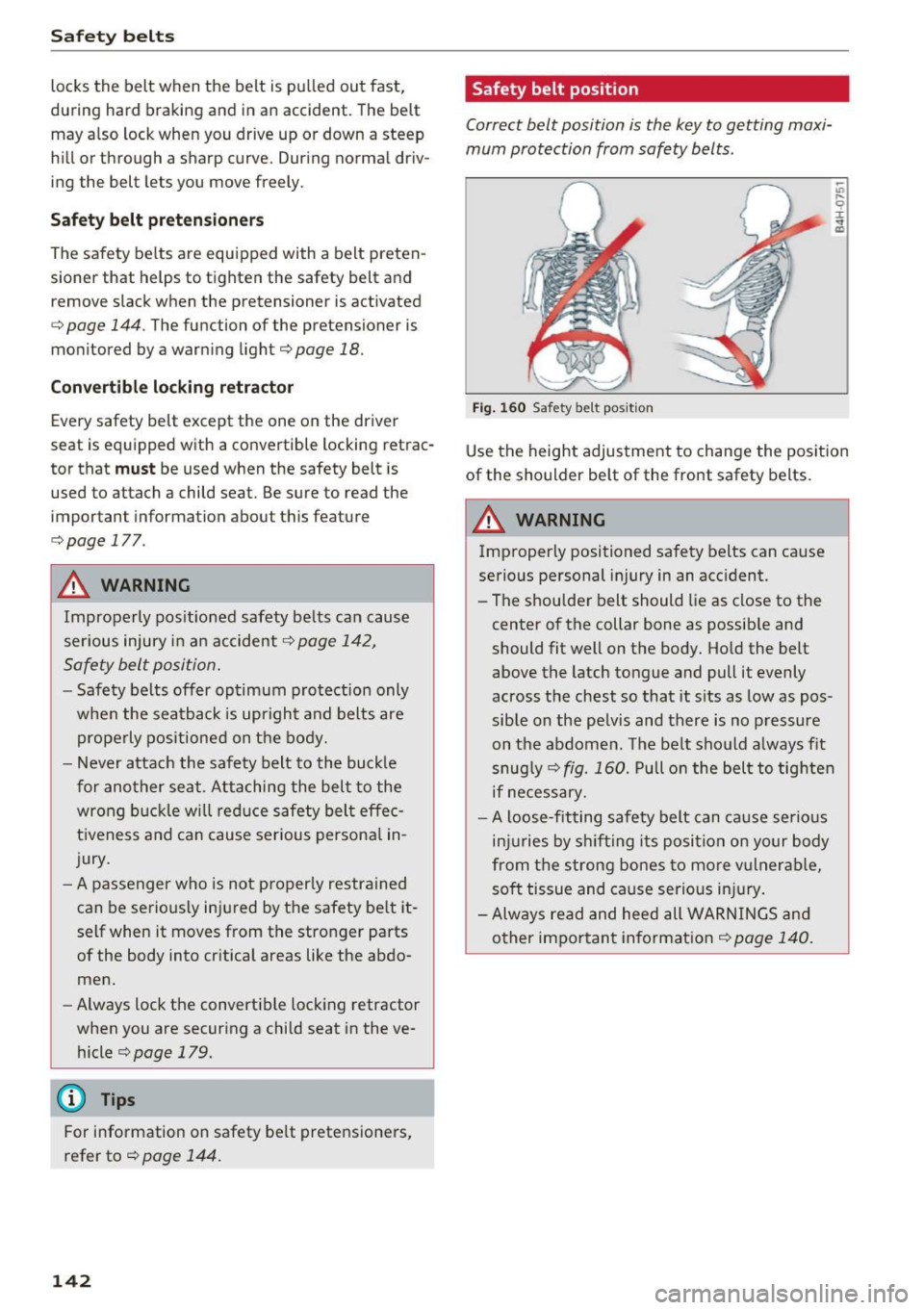
Safety belt position
Correct belt position is the key to getting maxi
mum protection from safety belts .
Fig. 160 Safety belt position
Use the height adjustment to change the positio n
of the shoulder belt of the front safety belts.
_&. WARNING
Improperly positioned safety belts can cause
serious personal injury in an accident.
- The shou lder belt should lie as close to the
center of the collar bone as possib le and
should fit well on the body. Hold the belt
above the latch tongue and pull it evenly
across the chest so that it s its as low as pos
sible on the pe lvis and there is no p ressure
on the abdome n. T he belt sho uld a lways fit
snug ly
c::> fig. 160. Pu ll on the bel t to tigh ten
if necess ary.
- A loose-fit ting safety belt can ca use serious
in ju ries by s hifting its posi tion on yo ur body
from the strong bones to mo re v ulnerab le,
so ft tissue and cause serious in jury.
- Always read and heed all WARNINGS an d
other impor tan t information
c::> page 140 .
Page 159 of 302

The PASSENGER AIR BAG O FF light is located in
the center of the instrument panel
¢ fig. 166 .
The PASS ENGER AIR BAG OFF light will come on
and stay on to tell you when the front Advanced
Airbag on the passenger side has been turned off
by the electronic control unit . Each time you
sw itch on the ignition, the
PASSENGER AIR BAG
OF F
light will flash for a few seconds and :
- will stay on if the front passenger seat is not
occupied,
- will stay on if the re is a sma ll child or child re
straint on the front passenger seat,
- wi ll go out if the front passenger seat is occu
pied by an adult as registered by the weight
sensing mat.
The
PA SSENGER AIR BAG O FF light mu st co me
o n and st ay on
if the igni tion is on and
- a car bed has been insta lled on the front seat,
o r
- a rearward-facing child restrai nt has been in
stalled on the front passenger seat , or
- a forward-facing child restra int has been instal
led on the front passenger seat, or
- the weight reg istered on the front passenger
seat is equal to or less than the combined
weight of a typical 1 year-o ld restrained in one
of the rear-facing or forward-fac ing infant re
straints listed in Federal Motor Vehicle Safety
Standard 208 w ith which the Advanced A irbag
System in your vehicle was certified.
I f the front passenger seat is no t occupied, the
fron t air bag w ill not deploy, and the
PASSENGER
AIR BAG OFF
light will stay on . Never install a
rearward -fac ing child restraint on the front pas
senger seat, the safest p lace for a child in any
kind of child restraint is at one of the seating po
sitions on the rear seat
¢page 147, Child re
straints on the front seat -some important
things to know
and ¢ page 168, Child safety .
If the PASSENGER AIR BAG OFF light comes on
when one of the conditions listed above is met,
be sure to check the light regularly to make cer
tain that the
PAS SENGER AIR BA G OFF light
stays on cont inuously whenever the ign ition is
on. If the
PASSENGER AIR BAG OFF light does
Airb ag sys tem
not appear on and does not stay on a ll the time,
stop as soon as it is safe to do so and
- react ivate the system by sw itch ing the ig nition
off and then switching it on aga in;
- remove and re insta ll the chi ld restraint. Make
sure that the chi ld restraint is properly insta l
led and that the safety belt for the front pas
senger seat has bee n correct ly routed through
the child restraint as desc ribed in the c hild re
straint manufacturer's instruct ions;
- make sure that the convertible locking retrac
tor on the safety belt for the front passenger
seat has been activated and that the safety belt has been pulled tight. The belt must not be
loose or have loops of slack so that the sensor
below the safety belt latch on the seat can do
its job
¢ page 177 .
-make sure that th ings that may increase the
weight of the child and ch ild seat are not being
transpo rted o n the front passenge r seat;
- make sure that the safety belt tens ion sensor is
not b locked . Shake the safety belt la tch on the
front passenger seatback and fo rth;
- If a strap or tether is being used to tie the child
seat to the front passenger seat, make su re
t ha t it is not so tight that it causes the weight
sensing mat to measure more weight than is
ac tually on the seat.
If th e PASSENGER AIR BAG OFF light still doe s
not come on
and does not stay on continuously
(whe n the ignition is switched on),
- take the child restraint off the front passenger
seat and install it p roper ly at one of the rear
seat pos itions . Have the airbag system inspect
ed by yo ur Audi dealer immed iate ly.
- move the child to a rear seat pos ition and ma ke
sure that t he chi ld is proper ly rest rained in a
child restra int that is appropr iate for its s ize
and age .
T he
PAS SENGER AIR BAG OFF light should NOT
come on when the ignit io n is on and an adu lt is
s itting in a proper seat ing pos ition on the front
passenge r seat. If the
PASSENGER AIR BAG OFF
light comes on and stays on or flashes for about
5 seconds whi le dr iv ing, under these c ircumstan-
ces, make sure that :
Ill-
157
Page 173 of 302
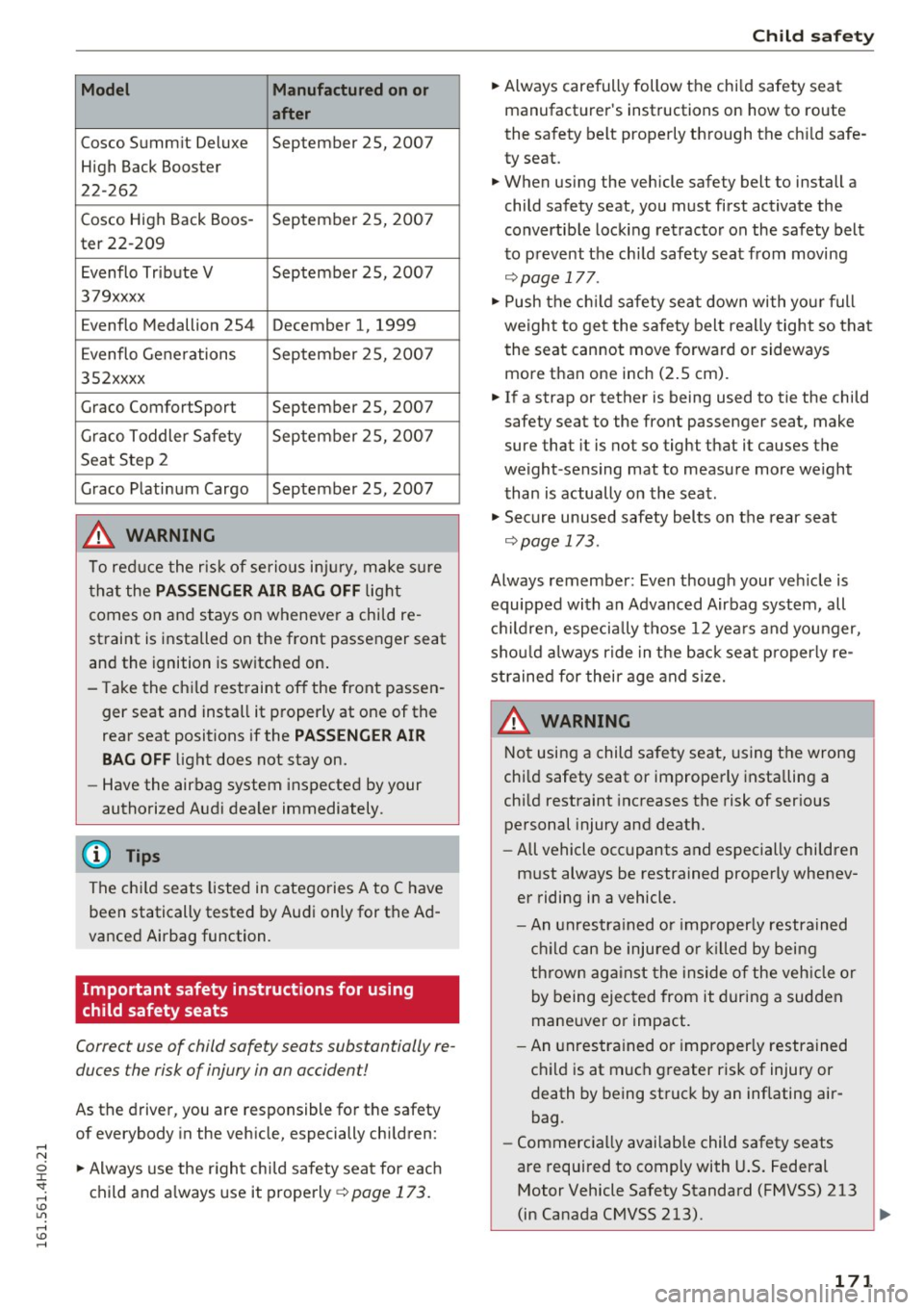
Model Manufactured on or
after
Cosco Summit Deluxe September 25, 2007
High Back Booster
22-262
Cosco High Back Boos -
September 25, 200 7
ter 22-209
Evenflo Tr ibute V September 25, 2007
379xxxx
Evenflo Medallion 254 December 1, 1999
Evenflo Generations September 25, 2007
352xxxx
Graco ComfortSport September 25, 2007
Graco Toddler Safety September 25, 2007
Seat Step 2
Graco Platinum Cargo September 25, 2007
.&, WARNING
To reduce the risk of serious inju ry, make sure
that the
PA SSEN GER AIR BAG OFF light
comes on and stays on whenever a child re
straint is installed on the front passenger seat
and the ignition is switched on.
- Take the child restraint off the front passen
ger seat and install it properly at one of the
rear seat positions if the
P A SSEN GER AIR
BAG OFF
light does not stay on.
- Have the airbag system inspected by your
authorized Audi dealer immediately.
(D Tips
The chi ld seats listed in categories A to C have
been statically tested by Audi only for the Ad
vanced Airbag function.
Important safety instructions for using
child safety seats
Correct use of child safety seats substantially re
duces the risk of injury in an accident!
As the driver, you are responsible for the safety
of everybody in the veh icle, especially children:
.,. Always use the right chi ld safety seat for each
child and a lways use it properly
q page 173.
Child safety
.,. Always carefully follow the chi ld safety seat
manufacturer's instructions on how to route
the safety belt properly through the ch ild safe
ty seat.
.,. When using the vehicle safety belt to install a
child safety seat, you must first activate the
convertible locking retractor on the safety belt
to prevent the chi ld safety seat from moving
q page 177.
.,. Push the ch ild safety sea t down with yo ur full
weight to get the safety belt really tight so that the seat cannot move forward or sideways
more than one inch (2.5 cm).
.,. If a strap or tether is being used to tie the child
safety seat to the front passenger seat, make
sure that it is not so tight that it causes the
weight -sensing mat to measure more weight
than is actually on the seat .
.,. Secure unused safety belts on the rear seat
q page 173.
Always remember: Even though your veh icle is
equipped with an Advanced Airbag system, all
c hi ldren, especia lly t hose 12 yea rs and younger,
sho uld a lways ride in th e back seat p roper ly re·
strained for their age and s ize.
A WARNING
=
Not using a child safety seat, using the wrong
chi ld safety seat or improperly insta lling a
chi ld restraint increases the risk of serious
personal injury and death.
- All vehicle occupants and especially children
must always be restrained properly whenev
er riding in a vehicle.
- An unrestra ined o r improperly restrained
c hi ld can be injured o r killed by being
thrown aga inst the inside of the veh icle or
by being ejected from it during a sudden
maneuver or impact.
- An unrestra ined or improperly restrained
child is at much greater risk of injury or
death by being struck by an inflating air bag.
- Commercially availab le child safety seats
are requi red to comply with U .S. Federal
Motor Vehicle Safety Standard (FMVSS) 213
(in Canada CMVSS 213). ..,_
17 1
Page 175 of 302
-Take the child restraint off the front passen
ger seat and install it properly at one of the
rear seat positions if the
PASS ENGER A IR
B AG O FF
light does not stay on.
- Have the airbag system inspected by your
authorized Audi dealer immediately.
Secure unused safety belts on the rear seat
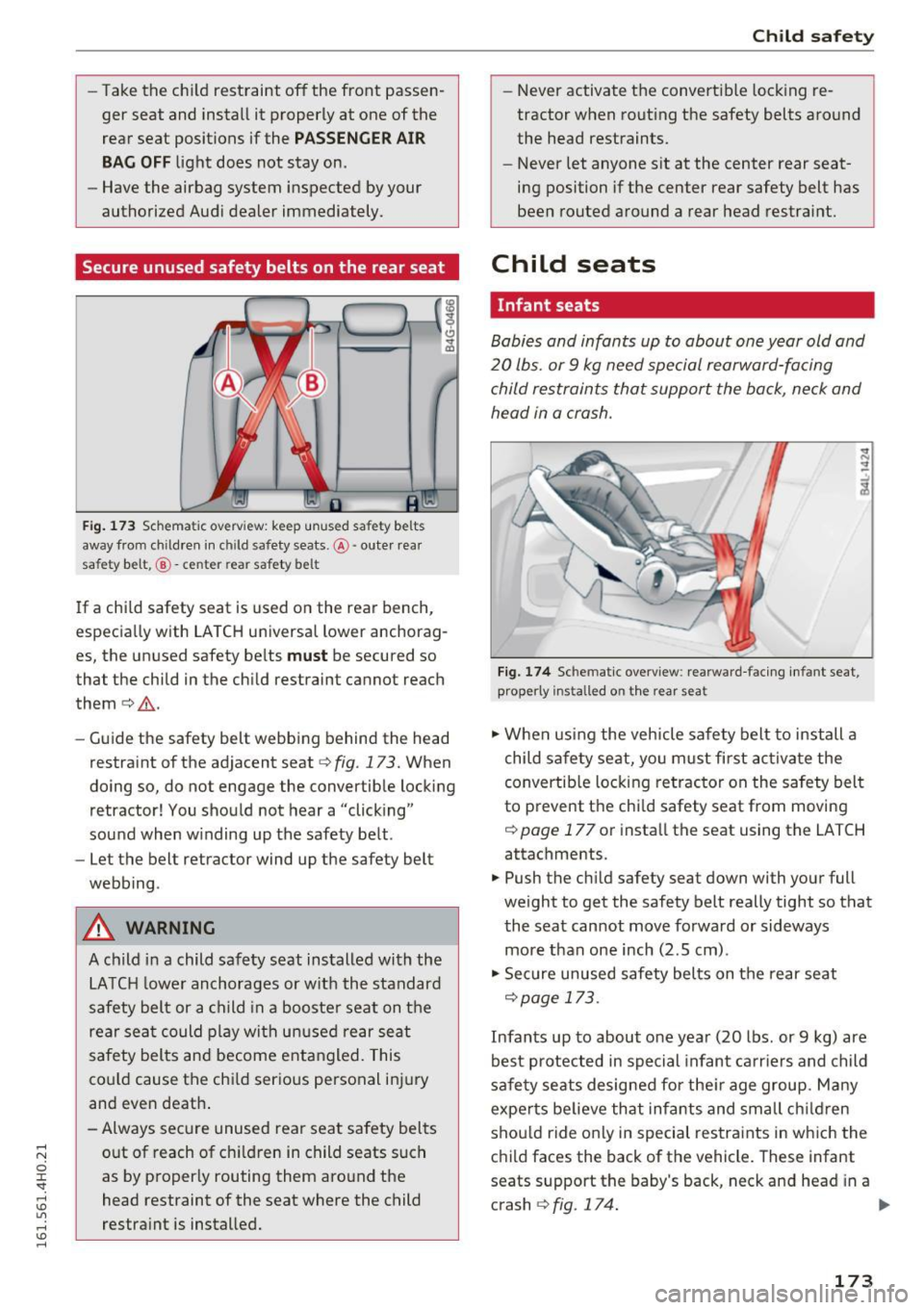
F ig . 173 Schemat ic overv iew: keep unused s-afety belts
away from children in c hild safety seats.@· oute r rear
sa fety belt,
@ -center rear safety belt
If a chi ld safety seat is used on the rear bench,
especia lly with LA TCH universal lower anchorag
es, the unused safety belts
mu st be secured so
that the child in the chi ld restraint cannot reach
them
c::> ,& .
-Guide the safety belt webbing behind the head
restraint of the adjacent seat
c::>fig . 173. When
doing so, do not engage the convertible locking
retractor! You should not hear a "clicking"
sound when winding up the safety belt.
- Let the belt retractor wind up the safety belt
webbing .
A WARNING
A child in a child safety seat installed with the
LATC H l ower anchorages or with the standard
safety belt or a child in a booste r seat on the
rear sea t could play with unused rear seat
safety belts and become entangled. This
co uld cause the chi ld serious personal injury
and even death .
- Always secure unused rear seat safety belts out of reach of ch ild ren in child seats such
as by properly routing them around the
head restraint of the seat where the child
restra int is installed.
Ch ild sa fety
- Never activate the convertible lock ing re
tractor when rout ing the safety belts around
the head restraints.
- Never let anyone sit at the center rear seat
ing position if the center rear safety belt has
been routed around a rear head restraint.
Child seats
Infant seats
Babies and infants up to about one year old and
20 lbs. or
9 kg need special rearward-facing
child restraints that support the back, neck and
head in a crash.
F ig. 174 Sc hematic overview : rearward-facing in fant seat ,
properly installed o n th e rear seat
... When using the vehicle safety belt to install a
child safety seat, you must first activate the
convertib le locking retractor on the safety belt
to prevent the child safety seat from moving
c::> page 177 or insta ll the seat using the LATCH
attachments.
... Push the child safety seat down with your full
weight to get the safety belt really tight so that
the seat cannot move forward or sideways
more than one inch (2.5 cm) .
... Secure unused safety belts on the rear seat
c::> page 173.
Infants up to about one year (20 lbs. or 9 kg) are
best protected in special infant carriers and child
safety seats designed for the ir age group. Many
expe rts be lieve that infa nts and small chi ldren
shou ld ride only in special restraints in which the
child faces the back of the vehicle. These infant
seats support the baby's back, neck and head in a
crash
c::> fig . 174. ...,
173
Page 176 of 302
Child safety
The airbag on the passenger side makes the front
seat a potentially dangerous p lace for a child to
ride. The front seat is not the safest place for a
child in a forward-facing child seat. It is a very
dangerous place for an infant or a larger child in
a rearward-fac ing seat.
A WARNING
Not using a ch ild safety seat, using the wrong
child safety seat or improperly installing a
child restra int increases the r isk of serious
personal inju ry and death in a crash.
- Never install rear-facing chi ld safety seats
or infant carriers on the front passenger
seat -even with an Advanced Airbag System.
A chi ld will be seriously injured and can be
killed when the inflating airbag hits the
child safety seat or infant carrier with great
force and smashes the child safety seat and
child against the backrest, center armrest,
door or roof
c::, page 147, Child restraints on
the front seat -some important things to
know.
- Always install rear-facing child safety seats
or infant carr iers on the rear seat.
- Never install a rear-facing child restra int in
the forward-facing direct ion. Such restraints
are designed for the spec ial needs of infants
and very sma ll children and cannot protect
them properly if the seat is forward-fa cing.
- If you must install a rearward fac ing ch ild
safe ty seat on the front passenger seat be
ca use of exceptiona l circumsta nces and the
PASSENGER AIR BAG OFF light does not
come on and stay on, immed iate ly install
the rear-facing chi ld safety seat in a rear
seat ing position and have the airbag system
inspected by your Audi dealer.
-Always read and heed all WARNINGS when
ever using a child restrained in a vehicle is
being used
c:> page 138, Safety belts,
c::, page 146, Airbag system and
c:> page 168, Important information.
174
Convertible child safety seats
Properly used convertible child safety seats can
help protect toddlers and children over age one
who weigh between 20 and 40 lbs. (9 and 18 kg)
in a crash.
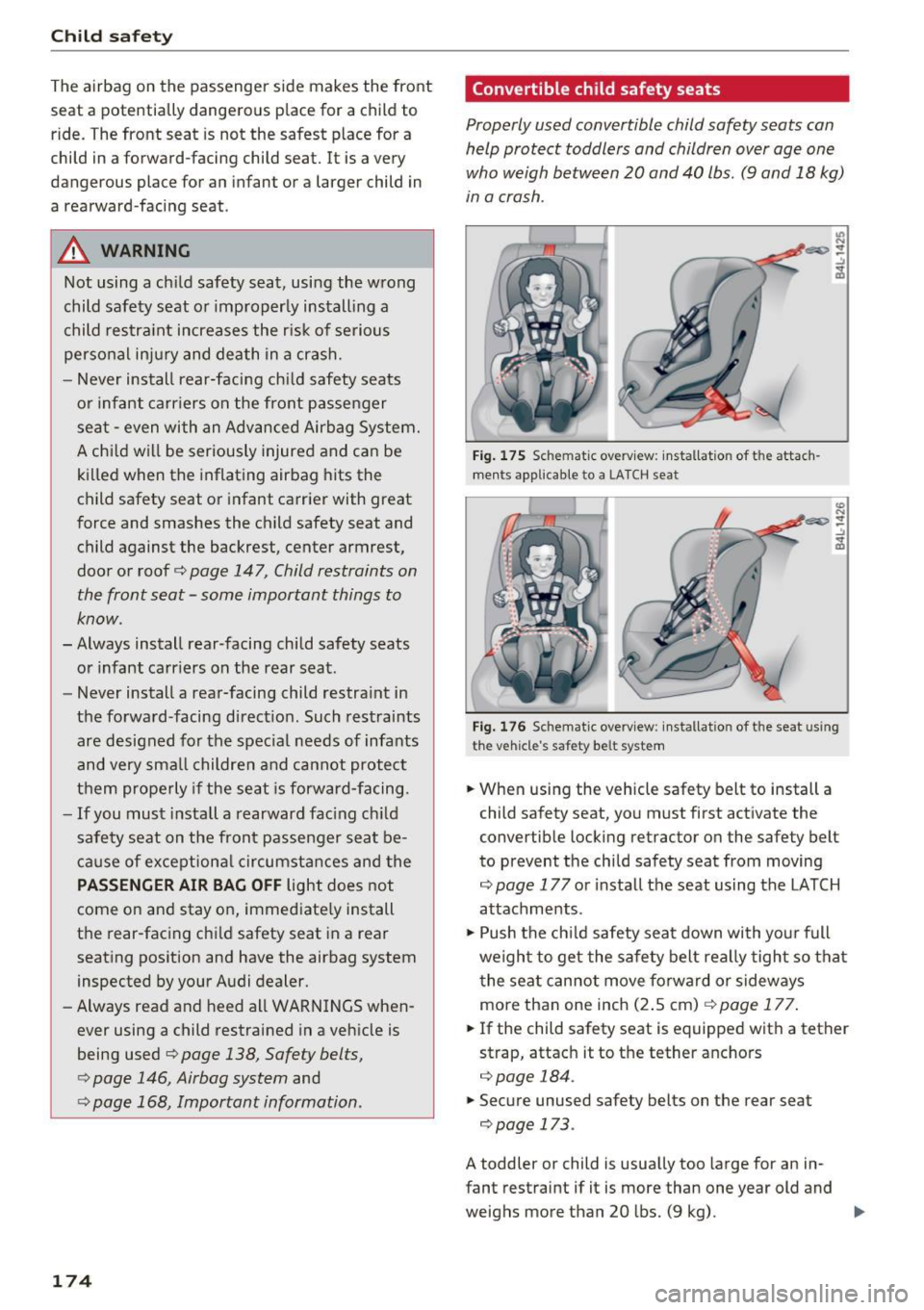
Fig . 1 7 5 Schemat ic overv iew : installat ion of the attach
ments applicable to a LA TCH seat
Fig. 176 Schemat ic overv iew: i nstallat ion of the seat using
the vehicle's safety belt system
.. When using the vehicle safety belt to install a
child safety seat, you must first activate the
convertib le locking retractor on the safety belt
to prevent the child safety seat from moving
c:> page 177 or install the seat using the LATCH
attachments .
.. Push the chi ld safety seat down wi th your full
we igh t to get the safe ty belt really tight so that
the seat cannot move forward or sideways
more than one inch (2 .5 cm)
c:>page 177.
.. If the child safety seat is equipped with a tether
strap, attach it to the tether anchors
c:>page 184.
.. Secure unused safety belts on the rear seat
c:>page 173.
A toddler or child is usually too large for an in
fant restraint if it is more than one year old and
weighs more than 20 lbs. (9 kg). ..,.
Page 178 of 302
Child safety
Booster seats and safety belts
Properly used booster seats can help protect
children weighing between about 40 lbs . and 80
lbs. (18 kg and 36 kg) who are less than 4
ft. 9
in. (57 inches/1.45 meters) tall .
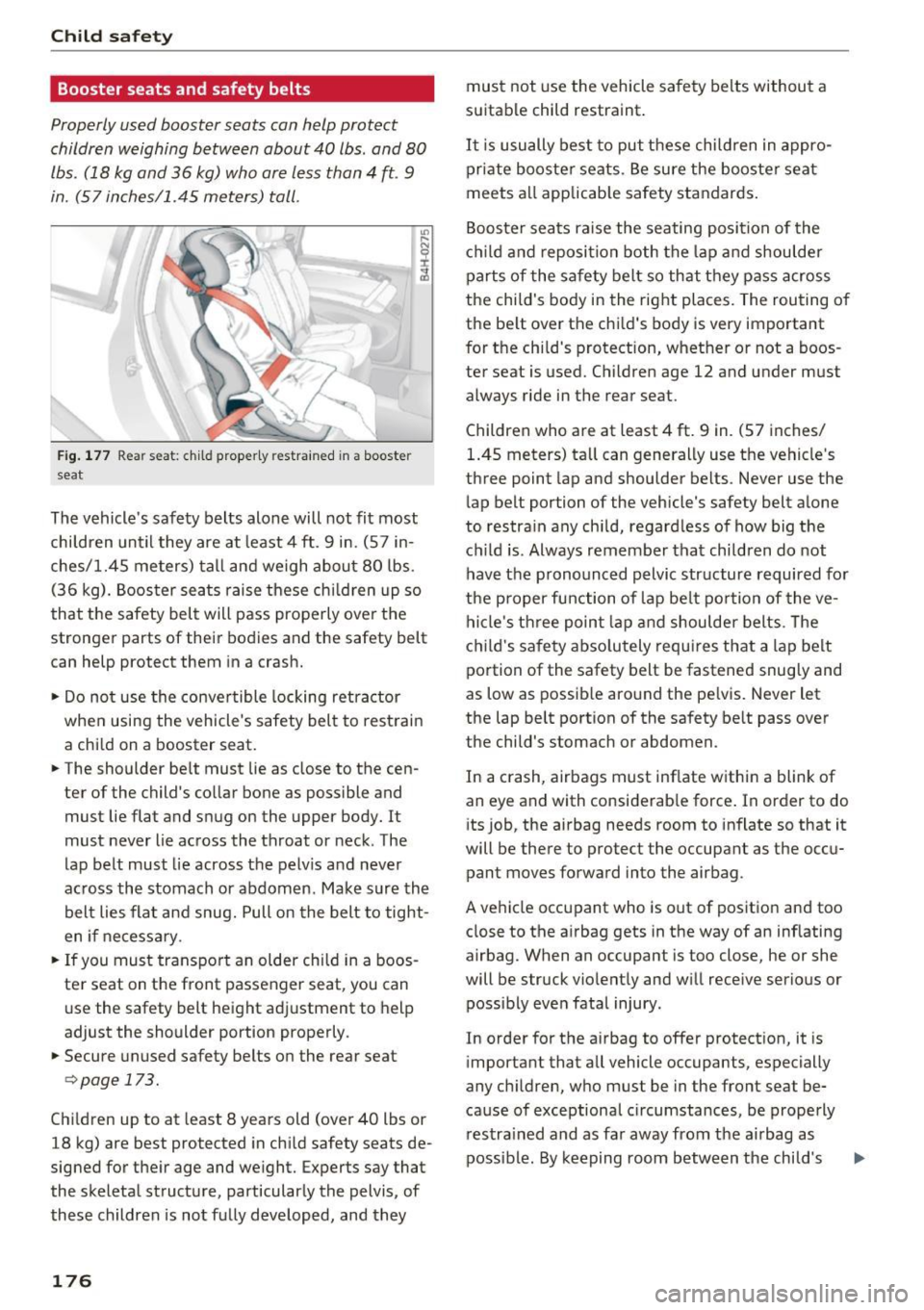
Fig. 177 Rear seat: ch ild proper ly restrained in a booster
seat
The vehicle's safety belts alone will not fit most
children until they are at least 4
ft . 9 in. (57 in
ches/1.45 meters) tall and weigh about 80 lbs.
(36 kg). Booster seats raise these chi ld ren up so
that the safety belt will pass properly
over the
stronger parts of their bodies and the safety belt
can help protect them in a crash.
• Do not use the convertible locking retractor
when using the vehicle's safety belt to restrain
a chi ld on a booster seat.
• The shoulder be lt must lie as close to the cen
ter of the child's collar bone as possible and
must lie flat and snug on the upper body. It
must never lie across the throat or neck. The
lap belt must lie across the pelv is and never
across the stomach or abdomen . Make sure the
belt lies flat and snug. Pull on the belt to tight
en if necessary .
• If you must transport an older child in a boos
te r seat on the front passenger seat, you can
use the safety belt height adjustment to help
adjust the shoulder portion properly .
• Secure unused safety belts on the rear seat
c> page 173.
Children up to at least 8 years old (over 40 lbs or
18 kg) are best protected in child safety seats de
signed for their age and weight. Experts say that
the skeletal structure, particularly the pelvis, of
these children is not fully developed, and they
176
must not use the vehicle safety belts without a
suitable child restraint .
It is usually best to put these children in appro
priate booste r seats. Be sure the booster seat
meets all applicab le safety standards.
Booster seats raise the seating position of the
child and reposition both the lap and shoulder
parts of the safety belt so that they pass across
the child's body in the right places. The routing of
the be lt
over the chi ld's body is very important
for the child's protection, whether or not a boos
ter seat is used. Children age 12 and under m ust
always ride in the rear seat.
Children who are at least 4
ft. 9 in. (57 inches/
1.45 meters) ta ll can generally use the vehicle 's
three point lap and shoulder belts. Never use the
lap belt portion of the vehicle's safety belt alone
to restrain any child, regard less of how big the
c hi ld is. Always remember that children do not
have the p ronounced pelvic structure required for
the proper function of lap belt portion of the
ve
hicle's three point lap and shoulder belts. The
c hi ld's safety absolutely requ ires that a lap belt
portion of the safety belt be fastened snugly and
as low as possible around the pe lvis. Never let
the lap belt portion of the safety belt pass over
the child's stomach or abdomen.
In a crash, airbags must inflate within a blink of
an eye and with considerab le force . In order to do
i ts job, the airbag needs room to inflate so that it
will be there to protect the occupant as the occu
pant
moves forward into the airbag.
A ve hicle occupant who is out of position and too
close to the a irbag gets in the way of an inflating
airbag. When an occupant is too close, he or she
will be struck violently and will receive serious or
possibly even fatal injury .
In order for the a irbag to offer protection, it is
important that all vehicle occupants, especially
any ch ildren, who must be in the front seat be
cause of exceptional c ircumstances, be properly
re stra ined and as far away from the a irbag as
possible. By keeping room between the child's .,..
Page 179 of 302
body and the front of the passenger compart
ment, the airbag can inflate completely and pro
vide supp lemental protect ion in certain frontal
collisions.
_&. WARNING
Not using a booster seat, using the booster
seat improperly, incorrectly installing a boos
ter seat or using the vehicle safety belt im properly increases the risk of serious personal
injury and death in a collision or other emer
gency situat ion. To help red uce the risk of se
rious personal injury and/or death:
- T he shoulder be lt must lie as close to the
center of the child's collar bone as possible
and must lie f lat and snug on the upper
body. It must never lie across the throat or
neck. The lap belt must lie across the pelvis
and never across the stomach or abdomen.
Make sure that the belt lies flat and snug.
Pull on the belt to tighten if necessary.
- Failure to properly route safety belts over a
child's body will cause severe injuries in an
accident or other emergency situation
¢page 138.
-The rear side of the child safety seat should
be pos itioned as close as poss ible to the
backrest on the vehicle seat. Adjust the rear
seat head restraint if it is difficu lt to install
the ch ild seat with the head restraint in
place
¢page 132. Driv ing with head re
straints that are not properly adj usted in
creases the risk of serious or fatal neck in
jury dramatically .
- Children on the front seat of any car, even with Advanced Airbags, can be seriously in
jured or even killed when an airbag inflates.
- Never let a child stand or knee l on any seat,
for example the front seat.
- Never let a child ride in the cargo area of your vehicle.
- Always remember that a child leaning for ward, sitting sideways or out of position in any way during an accident can be struck by
a deploying airbag. This will result in ser ious
personal injury or death.
- If you must install a booster seat on the
front passenger seat because of exceptional
Ch ild safety
circumstances the PASSEN GER AIR BAG
O FF
light must come on and stay on, when
ever the ignition is switched on.
- If the
PASS ENG ER AIR BAG OF F light does
not come on and stay on, perform the
checks described¢
page 156, Monitoring
the Advanced Airbag System.
-Take the child restra int off the front passen
ger seat and install it properly at one of the rear seat positions if the
PA SSENGER A IR
BAG OFF
light does not stay on whenever
the ignition is switched on.
- Always read and heed all WARNINGS when
ever using a child restrained in a vehicle is
be ing used¢
page 138, Safety belts,
¢ page 146, Airbag system and
¢ page 168, Important information .
Securing child seats
Securing a child safety seat using a safety
belt
Safety belts for the rear seats and the front pas
senger can be locked with the convertible locking
retractor to properly secure child safety seats .
The safety belts emergency locking retractors for
the rear seats safety belts and for the front pas senger's seat safety belt have a convertible lock
i ng retractor for child restra ints . The safety be lt
must be lo ck ed so that be lt webb ing cannot un
ree l. The ret racto r can be activated to lock the
sa fety be lt and prevent the safety belt webbing
from loosening up during norma l driving. A chi ld
safety seat can on ly be properly installed when
the safety belt is locked so that the ch ild and
child safety seat will stay in place.
Always remember: Even though your vehicle is equipped with an Advanced Airbag system, all
children, especially those 12 years and younger,
shou ld always ride in the back seat proper ly re
strained for their age and size.
_&. WARNING
-Improperly installed child safety seats in
crease the risk of serious personal injury and
death in a co llision.
-
177