wheel AUDI S8 2016 Manual PDF
[x] Cancel search | Manufacturer: AUDI, Model Year: 2016, Model line: S8, Model: AUDI S8 2016Pages: 302, PDF Size: 75.68 MB
Page 255 of 302
been damaged, replace the t ire as soon as
possible .
- T hese tires may wear more q uickly than others.
- Please a lso remembe r th at, while these tires
deliver responsive handling, they may r ide less
comfortab ly and make more noise than other
choices .
Reduc ed performance in wint er/ cold sea son
condit ions
All ti res are designed fo r ce rtain purposes. The
l ow aspect ratio, ultra high performance tires
originally insta lled on your vehicle are intended
for maximum dry and wet road performance and handling . They are not suitable for cold, snowy or
i cy weather cond it ions. If you dr ive under those
circumstances, you should equ ip your vehicle
with a ll-season or winter tires, wh ich offer better
traction under those condit ions. We suggest you
use the recommended snow or all-season tires
specified for yo ur vehicle, or the ir eq uivalent.
Refer to
c::;, page 251 for more detai led informa
tion rega rding winter tires.
Uniform tire quality grading
- T read wear
- T raction AA A B C
- Temperature ABC
Quality grades can be found where applicable on
the tire side wall between tread shoulder and maximum sect ion w idth
c::> page 236, fig . 205.
For e xample: Tread wear 200 , Traction AA , Tem
perature A.
All passenger car tires m ust conform to Federa l
Safety Requirements in addition to these grades .
Tread wea r
The
tread wear grade is a comparat ive rating
based on the wear rate of the t ire when tes ted
under cont ro lled conditions on a specified gov
ernment test course.
F or examp le, a t ire graded
150 would wear one
and one h alf
(1 1/2) times as well on the govern
ment course as a tire g raded
100 .
Wh eel s
The re lat ive pe rformance of tires depends upon
the actual cond itions of their use, however, and
may depart significantly from the norm due to
variations in driv ing habits, service practices and
differences in road character istics and cl imate.
T raction
The
traction grades, from highest to lowest, are
AA, A, Band
C. Those grades rep resent the tire's
ability to stop on wet pavement as measured un
der controlled cond itions on specified govern
ment test surfaces of asphalt and concrete. A tire
marked C may have poor traction performance
c::;, .&_ .
Te mperature
The
temperature grades are A (the highest), B,
and C, representing the tire 's resistance to the
generat ion of heat and its ability to dissipate
heat when tested under controlled conditions on
a specified indoor laboratory test wheel.
Sustained h igh temperature can cause the mate
rial of the tire to degenerate and reduce tire life,
and excessive temperature can lead to sudden
tire failure c::;, .&. .
The grade C corresponds to a level of perform
ance which all passenger car tires must meet un
der the Federal Motor Vehicle Safety Standard
No.
109 . Grades Band A represent higher levels
of pe rformance on the laboratory test wheel than
the minim um req uir ed by law.
A WARNING
-
The t ract io n grade assigned to this t ire is
based on straight -ahead braking traction
tests, and does not include acceleration, co r
nering, hydroplaning or peak traction charac
terist ics.
A WARNING
-The temperature grade for this tire is estab
lished for a tire that is properly inflated and
not overloaded. Excessive speed, underinfla
tion, or excessive loading, either separately or
i n comb inat ion, can cause heat bu ildup and
-
possib le tire fai lure. ~
253
Page 256 of 302
Wheels
_& WARNING
Temperature grades apply to tires that are
properly inflated and not over or underinf lat
ed.
Tire pressure monitoring system
U) General notes
Applies to: vehicles with tire pressure monito ring system
Each tire, including the spare (if provided),
should be checked monthly when cold and inflat
ed to the inflation pressure recommended by the
vehicle manufacturer on the vehicle placard or
tire inflat ion pressure label. (If your vehicle has
tires of a different size than the size indicated on
the vehicle placard or tire inflation pressure la
bel, you should determine the proper tire infla
tion pressure fo r those tir es) .
As an added safety feature, your vehicle has been
equipped with a t ire pressure monitoring system
(TPMS) that illuminates a low tire pressure tell
tale when one or more of your tires is significant
ly under-inflated . Accord ingly, when the low tire
p ressure telltale illuminates, you should stop and
check your tires as soon as possible, and inflate
them to the proper pressure. Driving on a signifi
cantly under-inflated tire causes the tire to over
heat and can lead to tire failure. Under-inflation
also reduces fuel efficiency and tire tread life,
and may affect the vehicle's handling and stop
ping ability.
Please note that the TPMS is not a substitute for
proper tire maintenance, and it is the driver's re
sponsib ility to maintain correct tire pressure,
even if under-inflation has not reached the level
to trigger illumination of the TPMS low tire pres
sure telltale.
Your vehicle has also been equipped with a TPMS
malfunct ion indicator to indicate when the sys
tem is not operating properly. The TPMS mal
function indicator is comb ined w ith the low tire
pressure telltale. When the system detects a
malfunction, the telltale will flash for approxi
mately one minute and then remain cont inuous ly
illuminated. This sequence will continue upon
254
subsequent vehicle start-ups as long as the mal
function exists.
When the malfunction indicator is illum inated,
the system may not be able to detect or s ignal
low tire pressure as intended . TPMS malfunctions
may occur for a variety of reasons, including the
i nstallation of replacement or alternate tires or
wheels on the vehicle that prevent the TPMS
from functioning properly. Always check the
TPMS malfunction telltale after replacing one or
more tires or wheels on your vehicle to ensure
that the replacement or alternate tires and
whee ls allow the TPMS to continue to function
properly.
If the Tire Pressure Monitoring System
indicator appears
Applies to: vehicles with tire pressure monitoring system
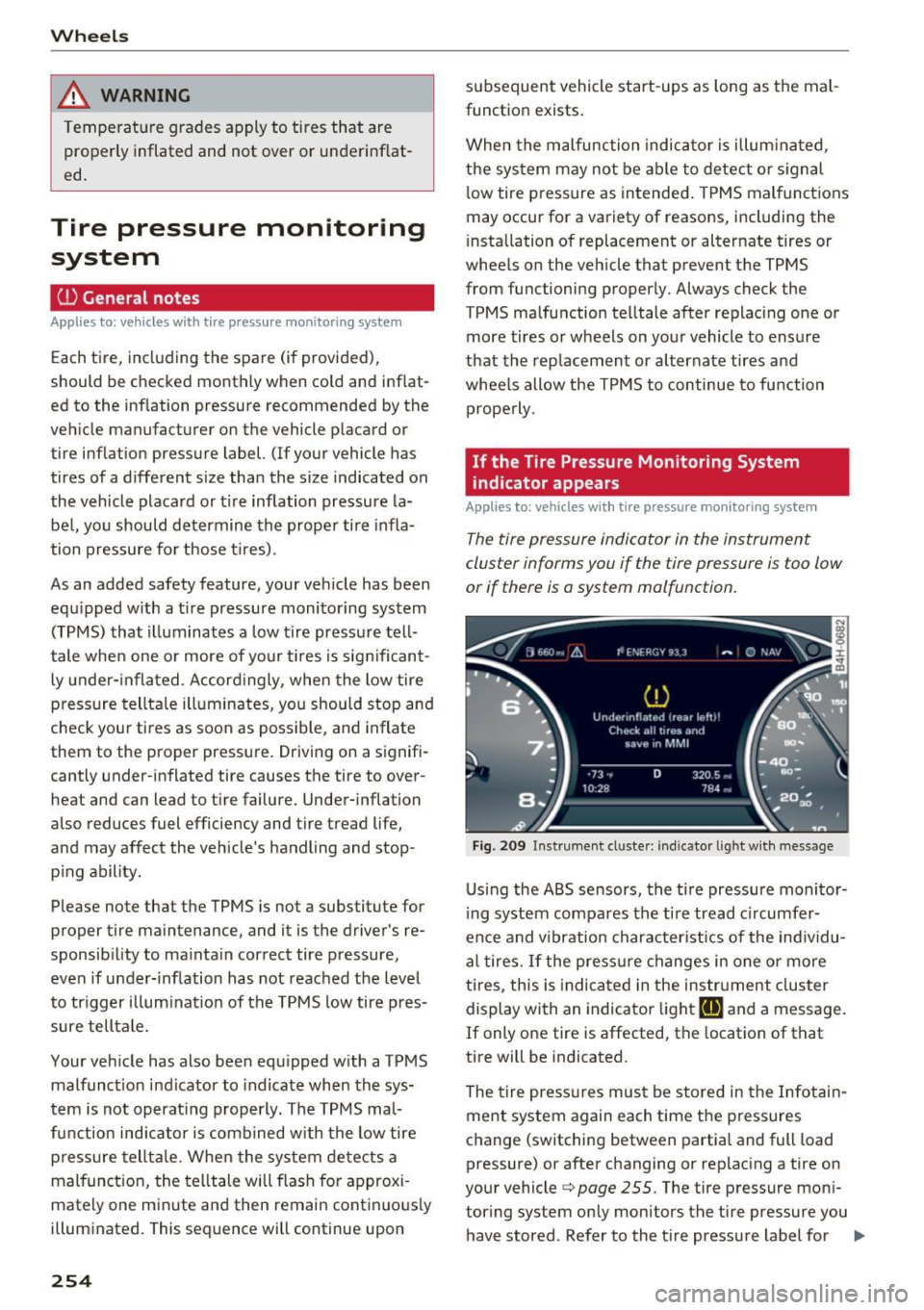
The tire pressure indicator in the instrument
cluster informs you if the tire pressure is too low
or if there is a system malfunction.
Fig . 209 Instrument cl uste r: indicator light with me ssage
Using the ABS sensors, the tire pressure monitor
ing system compares the tire tread c ircumfer
ence and v ibration characteristics of the individu
al tires.
If the pressure changes in one or more
ti res, this is ind icated in the instrument cluster
display with an indicator light
[I] and a message.
If only one tire is affected, the locat ion of that
tire will be indicated.
The tire pressures must be stored in the Infotain
ment system again each time the pressures
change (switching between partial and full load
pressure) or after changing or replacing a tire on
your vehicle ¢
page 255. The tire pressure moni
tor ing system only monitors the tire pressure you
have stored . Refer to the t ire pressure label for ..,.
Page 259 of 302
Depending on the equipment, the vehicle tool kit
may be located under the spare tire under an ad
d itional cover or in the too l box. The position of
the vehicle jack* may vary.
A WARNING
Improper use of the vehicle jack can cause se
r ious personal injuries.
- Never use the screw driver hex head to
t ighten wheel bolts, since the bolts cannot
attain the necessary tighten ing torque if you
use the hex head, potentia lly causing an ac
c ident.
- The factory-supplied jack is intended on ly
for your vehicle model. Under no circum
stances should it be used to lift heavy
vehicles or other loads; yo u risk injuring
yo urself.
- Never start the engine whe n the vehicle is
raise d, which could ca use a n accident.
- Support the veh icle secure ly with appropr i
a te stands if wor k is to be perfo rmed u nder
neath the veh icle; otherwise, the re is a po
tential risk for in jury.
- Never use the jack s upplied with your Audi
on another vehicle, particularly o n a heav ier
one. The jack is only suitab le for use on the
vehicle it came wit h.
@ Tips
The vehicle j ack* in your vehicle is mainte
nance -free.
Em ergen cy a ssis tanc e
Space-saving spare tire (compact spare
tire)
Applies to: vehicles with space-saving spare tire
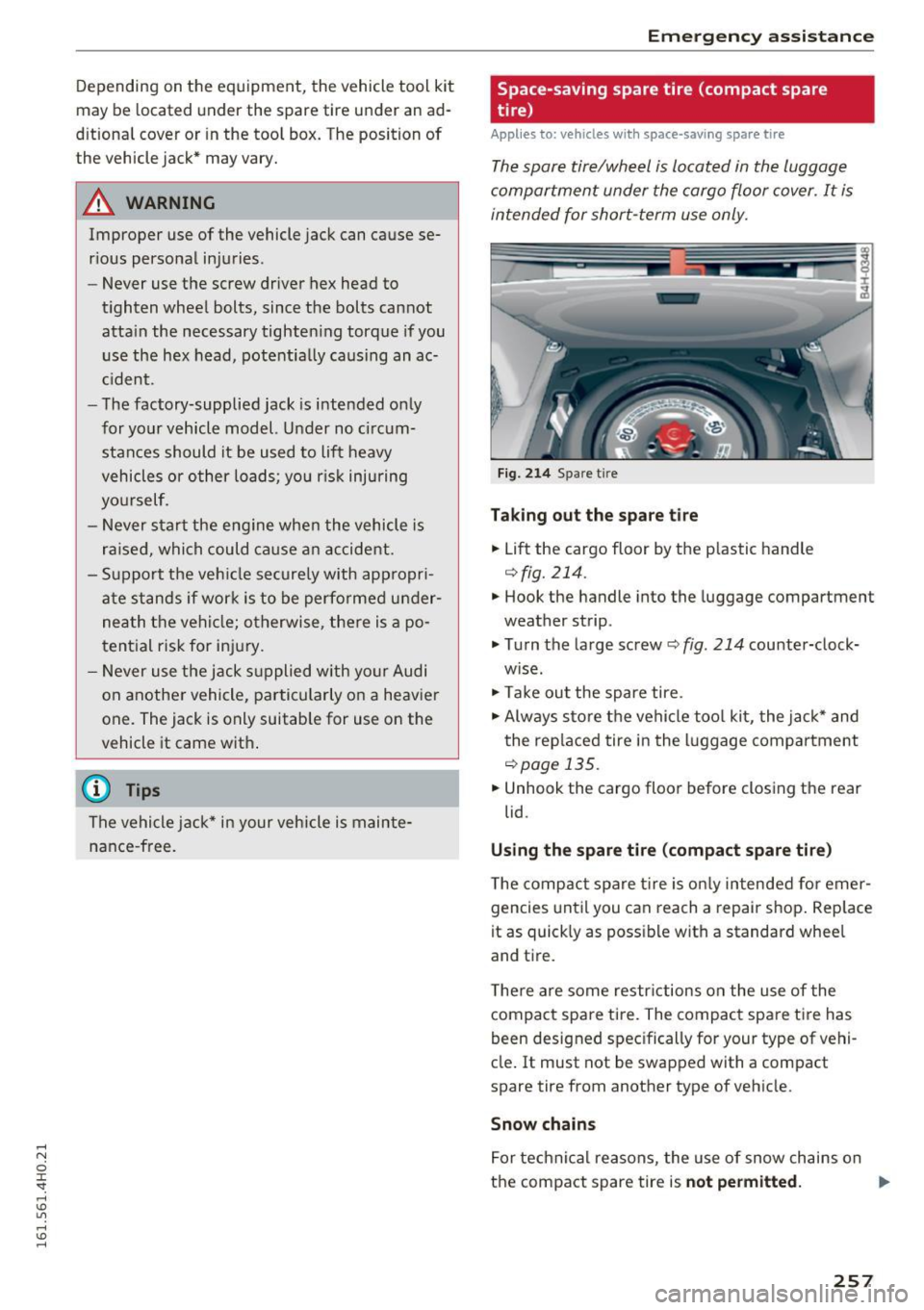
The spare tire/wheel is located in the luggage
compartment under the cargo floor cover . It is
intended for short-term use only.
Fig . 21 4 Spare tire
Ta king out the spare tir e
... Lift the cargo floor by the p lastic handle
q fig. 214.
.,. Hook the handle into the luggage compartment
weather strip.
.,. Turn the large screw
r:=;, fig . 214 cou nter-clock
w ise.
.,. Take ou t the spare tire.
.,. Always s to re the vehicle too l kit, the jac k* and
the rep laced tire i n the luggage compartment
r:::;, page 135.
.,. Unhook the cargo floor before closing the rear
lid.
Using the spare tire (compact spare tire )
The compact spare tire is on ly intended for emer
gencies until you can reach a repair shop . Rep lace
it as quick ly as poss ible with a standard wheel
and tire.
T here are some restr ictions on the use of the
compact spare tire. The compact spa re tire has
been designed specifically for your type of vehi
cle . It must not be swapped with a compact
spare tire from another type of vehicle.
Snow chains
For technical reasons, the use of snow chains on
the compact spare tire is
not permitted. .,..
257
Page 260 of 302
Emerg ency assis ta nce
If you do have to drive with snow chains and a
front tire fails, mount the spare wheel with tire
instead of a rear tire . Install the snow chains on
the rear tire and use it to replace the defective
front tire.
A WARNING
- Never use the spare tire if it is damaged or if
it is worn down to the tread wear indicators.
- If the spare tire is more than 6 years old,
use it only in an emergency and with ex
treme caution and ca refu l dr iving .
- The spare tire is intended only for tempora
ry and short-term use . It should be replaced
as soon as possible with the normal wheel
and t ire.
- After mounti ng the compact spare t ire, the
tire pressure must be checked as soon as possible. The tire pressure of the compac t
spare tire must be 4.2 bar; otherwise, you risk having an accident.
- Do not drive faster than SO mph (80 km/h).
Yo u risk hav ing an accident.
- Avoid full-throttle accelerat ion, heavy brak
ing, and fast cornering. You risk having an
acc ident .
- Never dr ive using more than one spare
wheel and tire. You risk having an acciden t.
- Normal summer or winter tires must not be
mounted on the compact spare wheel rim.
- For technical reasons, the use of tire chains
on the spare tire is not pe rm itted. If it is
necessary to drive with tire chains, the spare
wheel m ust be mounted on the front ax le in
the event of a flat in a rear tire. The new ly
available front wheel must then be insta lled
in place of the rear wheel with the flat t ire.
Installing the tire chain before mounting
the wheel and t ire is recommended.
- Loose items in the passenger compartment
can cause ser ious personal injury during
hard braking or in an accident. Never store
the inflatable spare t ire or jack and too ls in
the passenger compartment.
258
Spare wheel
Applies to: vehicles with spare whee l
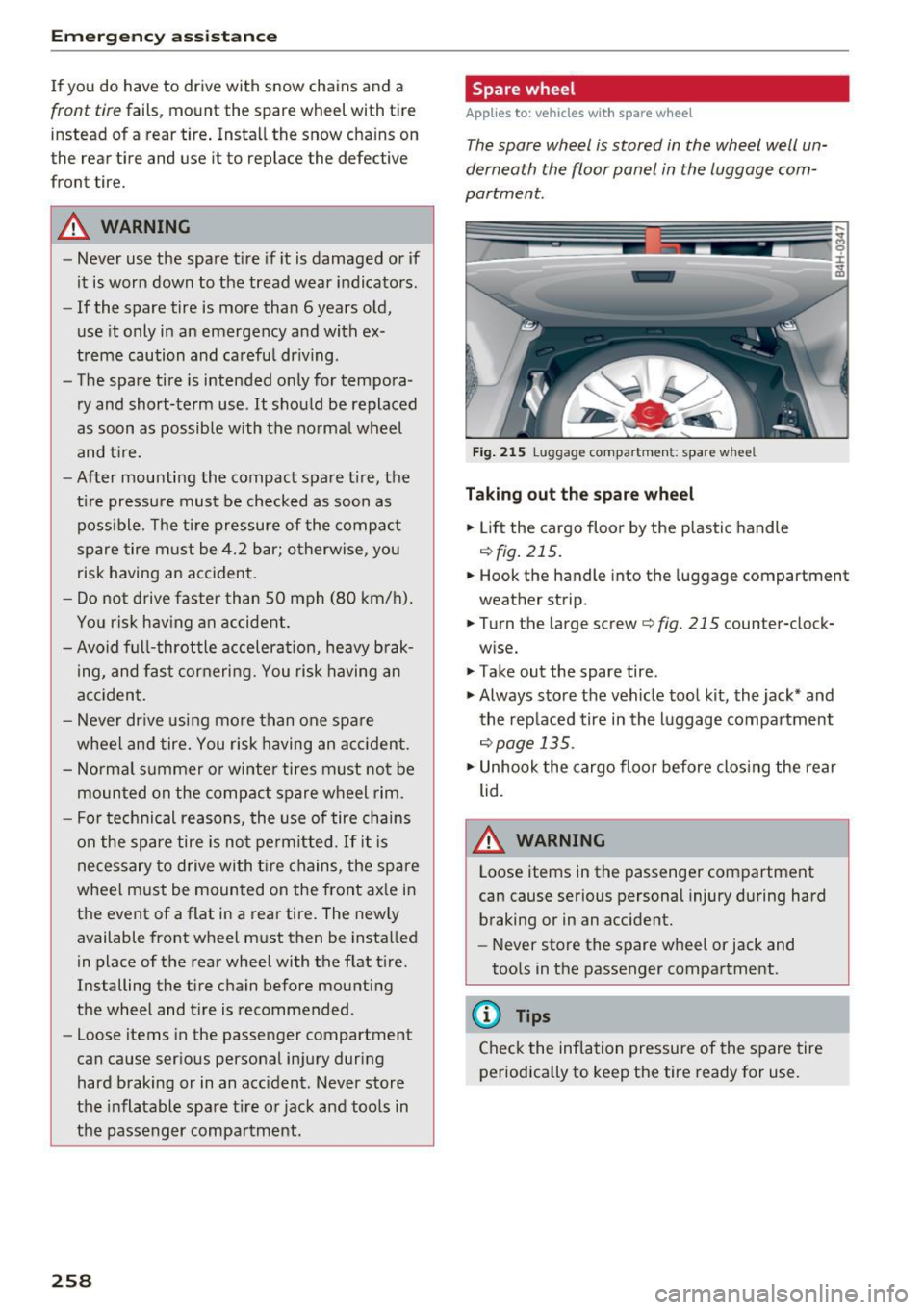
The spore wheel is stored in the wheel well un
derneath the floor panel in the luggage
com
portment.
Fig . 215 Luggage compartmen t: spare whee l
Taking out th e spar e wh eel
.. Lift the cargo floor by the plastic handle
¢ fig. 215.
.. Hook the handle into the luggage compartment
weather strip.
.. Turn the large screw
¢fig. 215 counter-clock
wise .
.,. Take out the spare tire.
.,. Always store the vehicle tool kit , the jack* and
the rep laced tire in the luggage compartment
¢page 135.
.. Unhook the cargo floo r before clos ing the rear
lid.
A WARNING
Loose items in the passenger compartment
can cause serious personal injury during hard braking or in an acc ident.
- Never store the spare wheel or jack and
too ls in the passenger compartment .
(D Tips
Check the inflation pressure of the spare tire
periodically to keep the tire ready for use.
-
Page 261 of 302
Replacing wheels
Before changing a wheel
Observe the following precautions for your own
and your passenger's safety when changing a
wheel.
.,. After you experience a tire failure, pull the car
well away from moving traffic and try to reach
level ground before you stop¢.,&. .
.. All passengers should
leave the car and move
to a safe location (for instance, beh ind the
guardrail) ¢.,&. .
.,. Engage the
parking brake to prevent your vehi
cle from rolling unintentionally ¢.,&. .
.. Move
selector lever to position P ¢ .,&. .
1> lfyou are towing a trailer, unhitch the trailer
from your vehicle.
.,. Take the
jack and the spare tire out of the lug
gage compartment,
¢page 257.
..&, WARNING
You or your passengers could be injured wh ile
changing a wheel if you do not follow these
safety precautions:
- If you have a flat tire, move a safe distance
off the road. Turn off the engine, turn the
emergency flashers on and use other warn
ing devices to alert other motorists.
- Make sure that passengers wa it in a safe
place away from the vehicle and well away
from the road and traffic.
- T o help prevent the vehicle from moving
sudden ly and possibly slipping off the jack,
always fully set the parking brake and block
the wheel diagonally opposite the wheel be
ing changed. When one front wheel is lifted
off the ground, plac ing the Automatic
Transmission in "P" (Park) will
not prevent
the vehicle from moving.
- Before you change a wheel, be sure the
ground is level and firm . If necessary, use a
sturdy board under the jack .
- Always store the vehicle tool k it, the jack
and the replaced tire in the luggage com
partment ¢
page 135.
Emergency assistance
{!) Tips
Before changing the wheel, you must activate
the jacking mode, so that the automat ic con
tro ls for the Adaptive Air Suspension do not
make it more difficult to lift the vehicle with
the jack ¢
page 261 .
Changing a wheel
When you change a wheel , follow the sequence
described below step-by-s tep and in exactly tha t
order .
l. Activate the vehicle jack mode ¢ page 261 .
2. Remove the decorative wheel cover*. For
more details see also¢
page 260, Decora
tive wheel covers
or¢ page 260, Wheels
with wheel bolt caps .
3. Loosen the wheel bolts¢ page 260.
4. Locate the proper mounting point for the
jack and align the jack below that point
¢ page 261 or¢ page 262.
5. Raise the car with the jack¢ page 261 or
¢page 262.
6. Remove the wheel with the flat tire and then
install
the spare ¢ page 263.
7. Tighten all wheel bolts lightly .
8.
Lower the vehicle with the jack .
9. Use the wheel bolt wrench and
firmly tighten
all wheel bolts<=>
page 260.
10. Replace the decorative wheel cover*.
11. Deactivate the vehicle jack mode in the MMI :
I CAR! function button > Car systems contro l
button
> Servicing & checks > Air susp.: jack
mode > Off.
The vehicle jack mode switches off automatically
at speeds above 10 km/h .
..&, WARNING
Always read and follow all WARNINGS and in
formation
¢ .&. in AB: Raising the vehicle on
page 262
and ¢ page 264.
259
Page 262 of 302
Emergency assistance
After changing a wheel
A wheel change is not complete without the do
ing the following .
• Always store the vehicle tool kit, the jack* and
the replaced tire in the luggage compartment
<=>page 135.
• Check the tire pressure on the spare wheel im
mediate ly after mounting it.
• As soon as possible, have the
tightening tor
ques
on all wheel bolts checked with a torque
wrench. The correct tightening torque is 90 ft
lb (120 Nm).
• Have the flat tire
replaced as soon as possible.
@ Tips
- If you notice that the whee l bolts are cor
roded and difficu lt to turn while changing a
tire, they should be replaced before you
check the tightening torque .
- Drive at reduced speed until you have the
tightening torques checked.
- After changing a wheel, the tire pressure in
a ll four tires must be checked/corrected and
the tire pressure mon itor ing indicator must
be stored in the MMI
c> page 255.
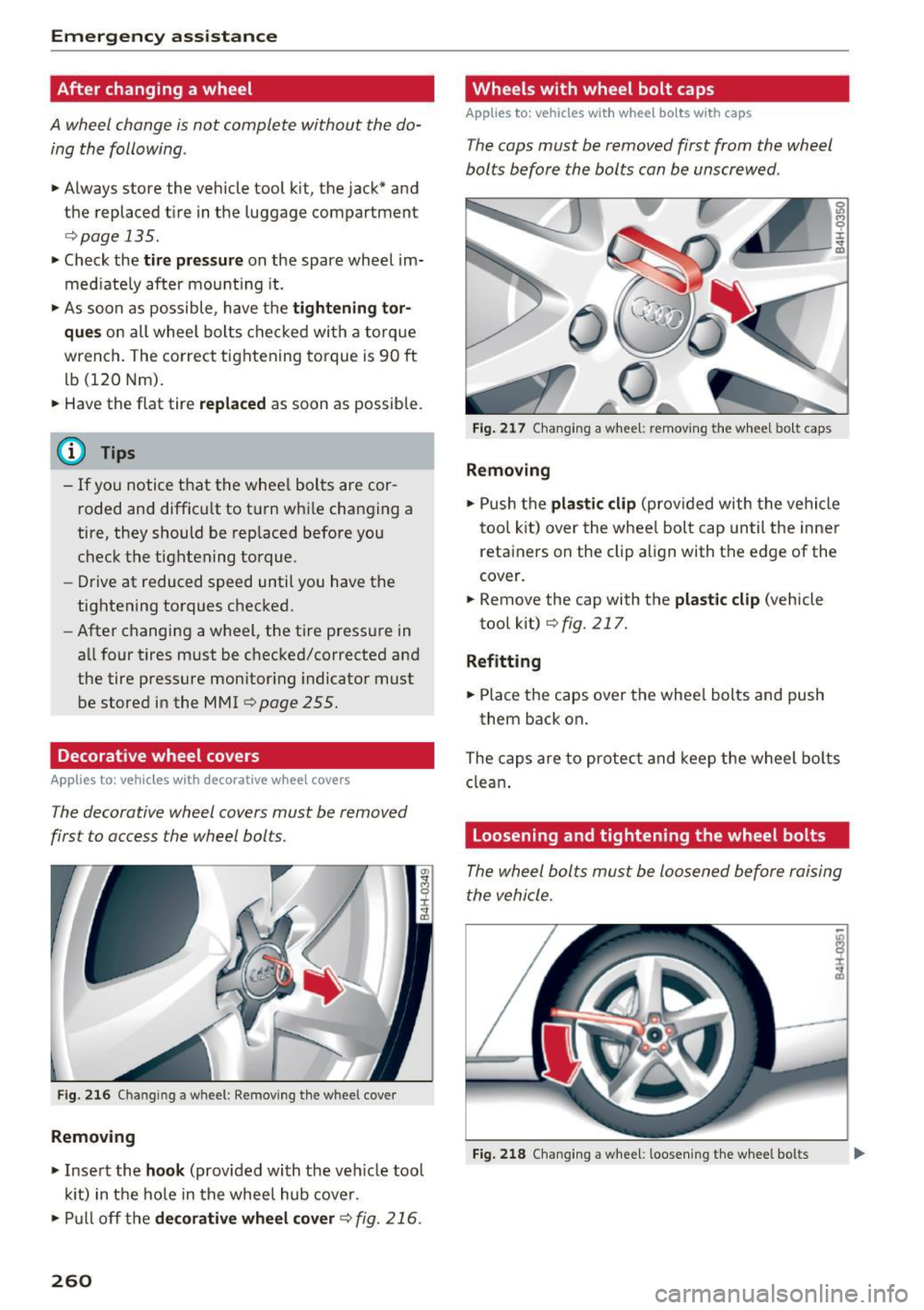
Decorative wheel covers
App lies to: vehicles with decorative wheel covers
The decorative wheel covers must be removed
first to access the wheel bolts .
Fig. 216 Chan gin g a w heel : Removing the whee l cover
Removing
• Insert the hook (provided with the ve hicle tool
kit) in the hole in the wheel hub cover.
• Pull off the
decorative wheel cover c> fig. 216.
260
Wheels with wheel bolt caps
Applies to: vehicles with wheel bo lts with caps
The caps must be removed first from the wheel
bolts before the bolts can be unscrewed .
Fig. 217 Changing a wheel: removing the wheel bo lt caps
Removing
• Push the plastic clip (provided with the vehicle
tool kit) over the whee l bolt cap until the inner
retainers on the clip align with the edge of the
cover.
• Remove the cap with the
plastic clip (vehicle
tool kit)
<=> fig. 217 .
Refitting
• Place the caps over the wheel bolts and push
them back on .
The caps are to protect and keep the wheel bolts
clean.
Loosening and tightening the wheel bolts
The wheel bolts must be loosened before raising
the vehicle.
Fig. 218 Chang ing a wheel: loosening the wheel bo lts
Page 263 of 302
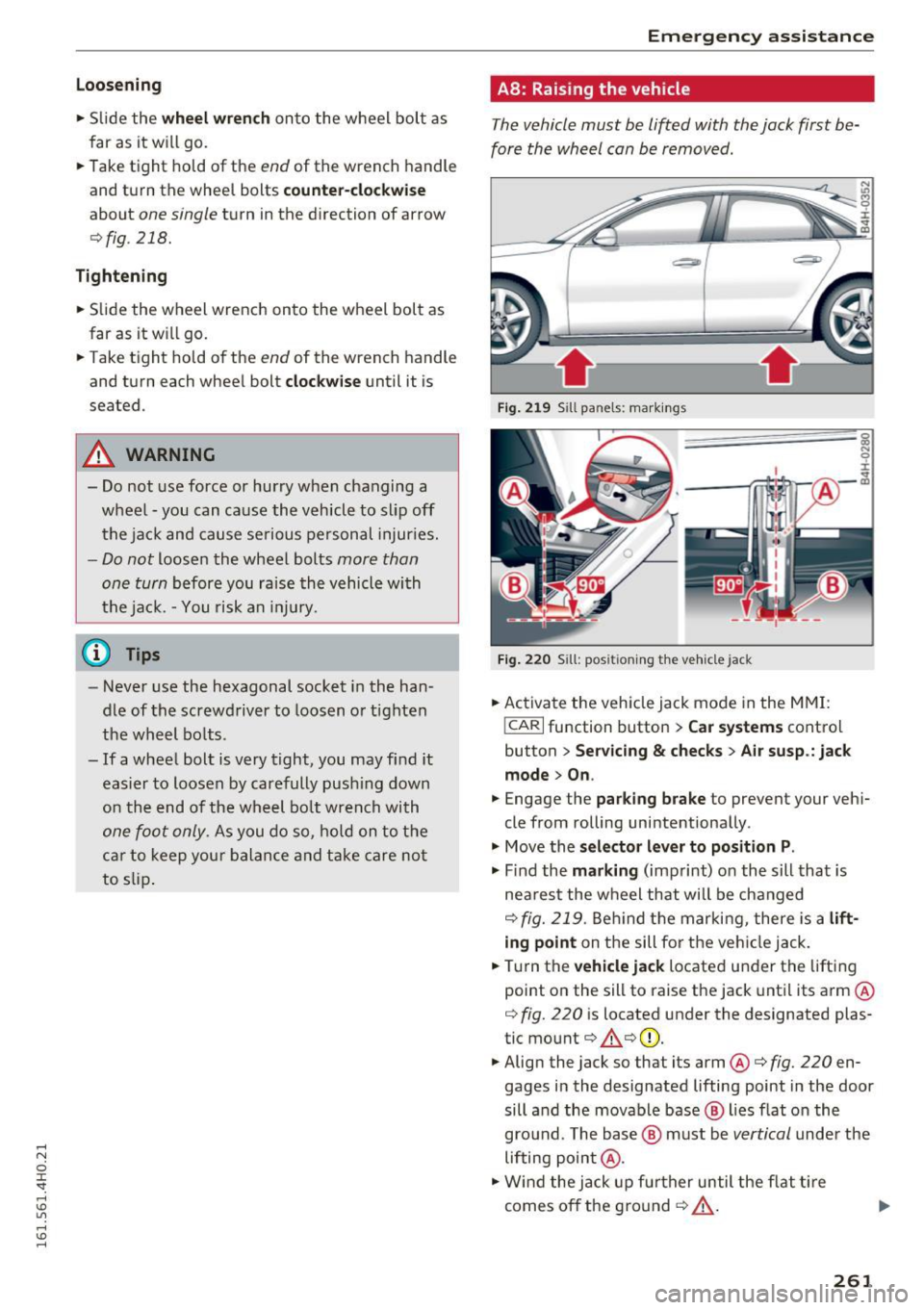
Loosening
• Slide the wh eel wr ench onto the wheel bolt as
far as it will go.
• Take tight hold of the
end of the wrench handle
and turn the wheel bolts
counter-cloc kwise
about one single turn in the direction of arrow
<=>fig. 218.
Tightening
• Slide the wheel wrench onto the wheel bolt as
far as it w ill go.
• Take tight hold of the
end of the wrench handle
and turn each wheel bolt
cloc kwise until it is
seated.
A WARNING
- Do not use force or hurry when changing a
wheel· you can cause the vehicle to slip off
the jack and cause se rious personal injur ies.
- Do not loosen the wheel bolts more than
one turn
before you raise the vehicle with
the jack. -You risk an injury.
(D Tips
- Never use the hexagonal socket in the han
dle of the screwdriver to loosen or tighten
the wheel bo lts .
- If a wheel bolt is
very tight, you may find it
easier to loosen by carefully push ing down
on the end of the wheel bo lt wrench with
one
foot only . As you do so, hold on to the
car to keep your balan ce and take care no t
to slip .
Emergen cy a ssis tanc e
A8: Raising the vehicle
The vehicle must be lifted with the jack first be
fore the wheel can be removed.
Fig . 219 Sill panels: markings
F ig . 220 S ill: positioning the vehicle jack
• Activate the vehicle jack mode in the MMI:
!CARI function button > Car systems control
button
> Ser vicing & chec ks> A ir su sp .: jac k
mode > On .
• Engage the pa rki ng br ake to prevent your veh i
cle from rolling unintentionally.
"' Move the
selector l eve r to position P .
"' Find the mark ing (imprint) on the sill that is
nea rest the wheel that will be changed
<=> fig. 219 . Behind t he marking, there is a lift
ing point on the sill fo r th e vehi cle jack.
• Turn the
vehicle jack located under the lifting
point on the sill to raise the jack unt il its arm @
<=> fig. 220 is located under the designated plas
tic mount<=> .&.<=>CD.
"' Align the jack so that its arm@<=>
fig. 220 en
gages in the designated lifting point in the door
sill and the movable base @ lies flat on the
gro und . The base @ must be
vertical under the
lifting point@.
"' Wind the jack up fu rther until the f lat ti re
comes off the ground ¢..&._ . ""
261
Page 264 of 302
Emerg ency assis ta nce
Position the vehicle jack only under the designat
ed lifting po ints on the sill
¢fig. 219. There is ex
actly
one locat ion for each wheel. The jack must
not be positioned at any other location
c> &<=>0.
An uns table su rf a ce under the jack can cause the
vehicle to slip off the jack. Always provide a firm
base for the jack on the ground . If necessary
place a sturdy board or similar support under the
jack. On
hard, slippery su rfaces (such as tiles)
use a rubber mat or similar to prevent the jack
from slipping
c> ,&..
A WARNING
-
-Yo u or your passengers could be injured
wh ile chang ing a wheel if you do not follow
these safety precaut ions:
- Position the vehicle jack only at the desig
nated lifting points and align the jack.
Otherw ise, the vehicle jack cou ld slip and
cause an injury if it does not have suffi
cient hold on the vehicle.
- A soft or unstable s urface under the jack
may cause the vehicle to slip off the jack.
Always p rovide a firm base for the jack on
the ground. If necessary, use a sturdy
board under the jack.
- On hard, s lippery surface (such as tiles)
use a rubber mat or similar to prevent the
jack from slippi ng.
- T o help prevent injury to yo urself and yo ur
passenge rs:
- Do not raise the vehicle unti l you are sure
the jack is securely engaged .
- Passengers must not remain in the vehicle
when it is jacked up.
- Make sure that passengers wait in a safe
place away from the vehicle and well away
from the road and traffic.
- Make sure jack position is correct, adjust
as necessary and then continue to raise
the jack.
- Changes in temperature or load can affect
the height of the vehicle.
(D Note
Do not lift the vehicle by the sill . Position the
vehicle jack only at the designated lifting
262
points on the sill. Otherwise, your vehicle wi ll
be damaged .
(1) Tips
The vehicle jac k mode sw itches off automa ti
cally at speeds above 10 km/h.
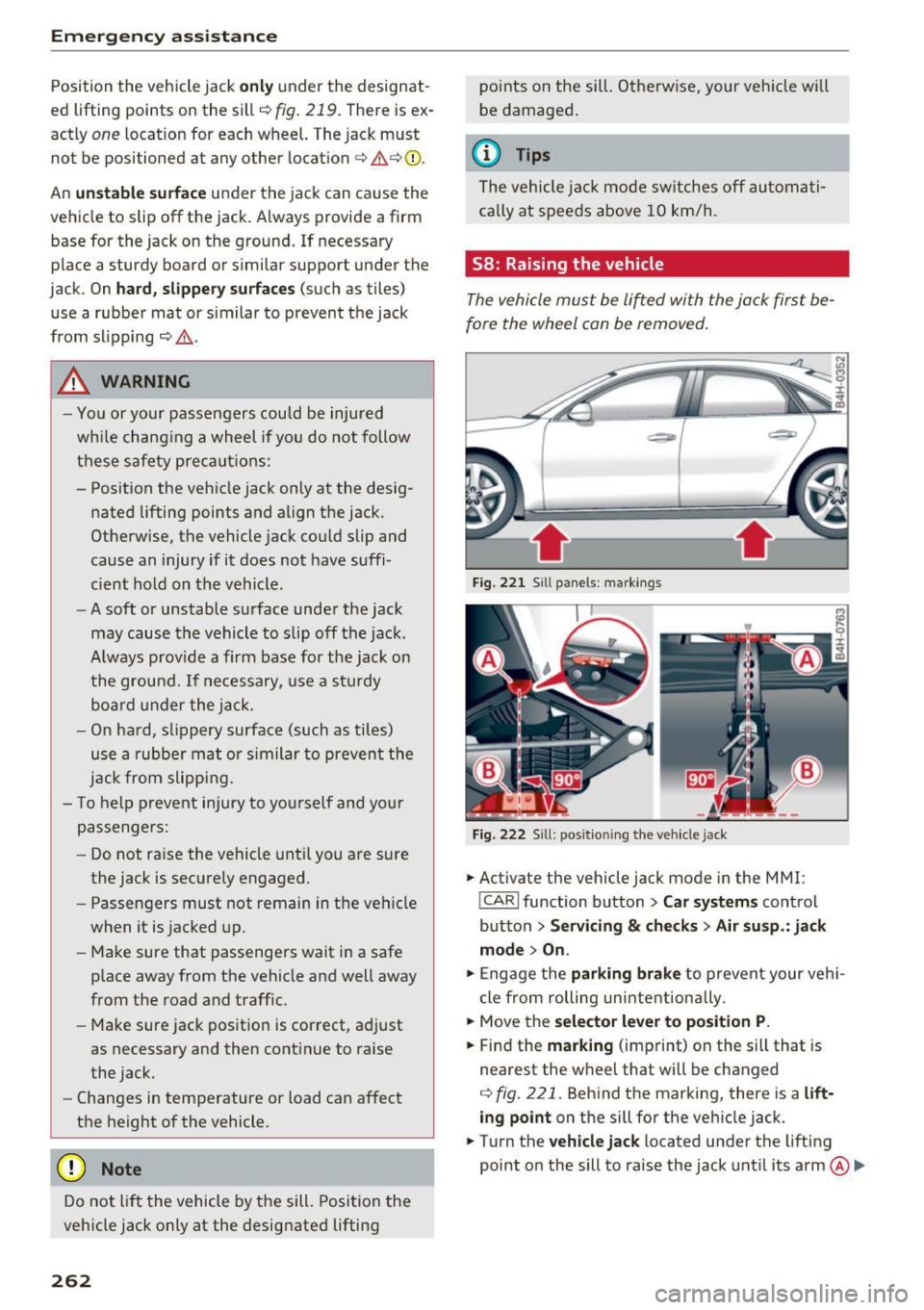
58: Raising the vehicle
The vehicle must be li~ed with the jack first be
fore the wheel can be removed .
Fig. 221 Sill panels : ma rkings
F ig. 222 Sill : pos ition ing the veh icle jack
.. Activate the vehicle jack mode in the MMI :
!CARI function button > Car s yst ems control
button
> Ser vicin g & che cks > A ir su sp .: jack
mode > On .
.. Engage the parking brake to prevent your vehi
cle from rolling uni ntentiona lly .
.. Move the
select or lever t o positi on P.
.. Find the marking (imprint) on the sill that is
nearest the wheel that will be changed
<=>fig. 221 . Behind the marking, there is a lift
ing point
on the sill for the vehicle jack.
.. Turn the
vehicl e jack located under the lifting
point on the sill to raise the jack until its arm
@ Ill>
Page 265 of 302
c::> fig. 222 is located under the designated plas
tic mount
c::> A in AB: Raising the vehicle on
page
262 <=:>(D.
.. Align the jack so that its arm®
c::> fig. 222 en
gages in the designated lifting point in the door
sill and the movable base ® lies flat on the
ground . The base ® must be
vertical under the
li ft ing po int @ .
.,. Wind the jack up further unt il the fla t tire
c omes off the ground
c::> A in AB: Raising the
vehicle on page
262.
Position the veh icle jack
onl y under the designat
ed lifting points on the sill
<=:>page 261, fig. 219 .
There is exactly one locatio n for each wheel. The
jack must not be positioned at any other location
c::> .&. in AB: Raising the vehicle on page 262<=:> 0.
An
un stabl e surface under the jac k can ca use the
vehi cle to slip off the jack . Always provide a firm
base for the jack on the ground. If necessary
p lace a sturdy board or similar support under the
jack. On
hard , slippery surfaces (such as tiles)
use a rubber mat or similar to prevent the jack
from slipping
c::> .&. .
A WARNING
-
-You or your passengers could be injured
wh ile chang ing a wheel if you do not follow
these safety precautions :
- Position the vehicle jack only at the desig
nated lifting points and align the jack.
Otherw ise, the vehicle jack cou ld slip and
cause an injury if it does not have suffi
cient hold on the vehicle.
- A soft or unstable surface under the jack
may cause the vehicle to slip off the jack.
Always provide a firm base for the jack on
the ground .
If necessary, use a sturdy
board under the jack.
- O n hard, s lippery surface (such as tiles)
use a rubber mat or s imilar to prevent the
jack from slipp ing.
- To help prevent inju ry to yourself and your
passenge rs:
- Do not raise the vehicle unt il you are sure
the jack is secure ly engaged .
Emergen cy a ssis tanc e
-Passengers must not remain in the vehicle
when it is jacked up.
- Make sure that passengers wait in a safe
place away from the vehicle and well away
from the road and traffic.
- Make sure jack position is correct, adjust
as necessary and then continue to raise
the jack .
- Changes in temperature or load can affect
the height of the veh icle.
(D Note
Do not lift the vehicle by the si ll. Position the
vehicle jack on ly at the designated lift ing
points on the sill. Otherwise, your veh icle w ill
be damaged.
@ Tips
The vehicle jack mode switches off automati
cally at speeds
above 10 km/h.
Taking the wheel off/installing the spare
Follow these instructions step-by-step for chang
ing the wheel .
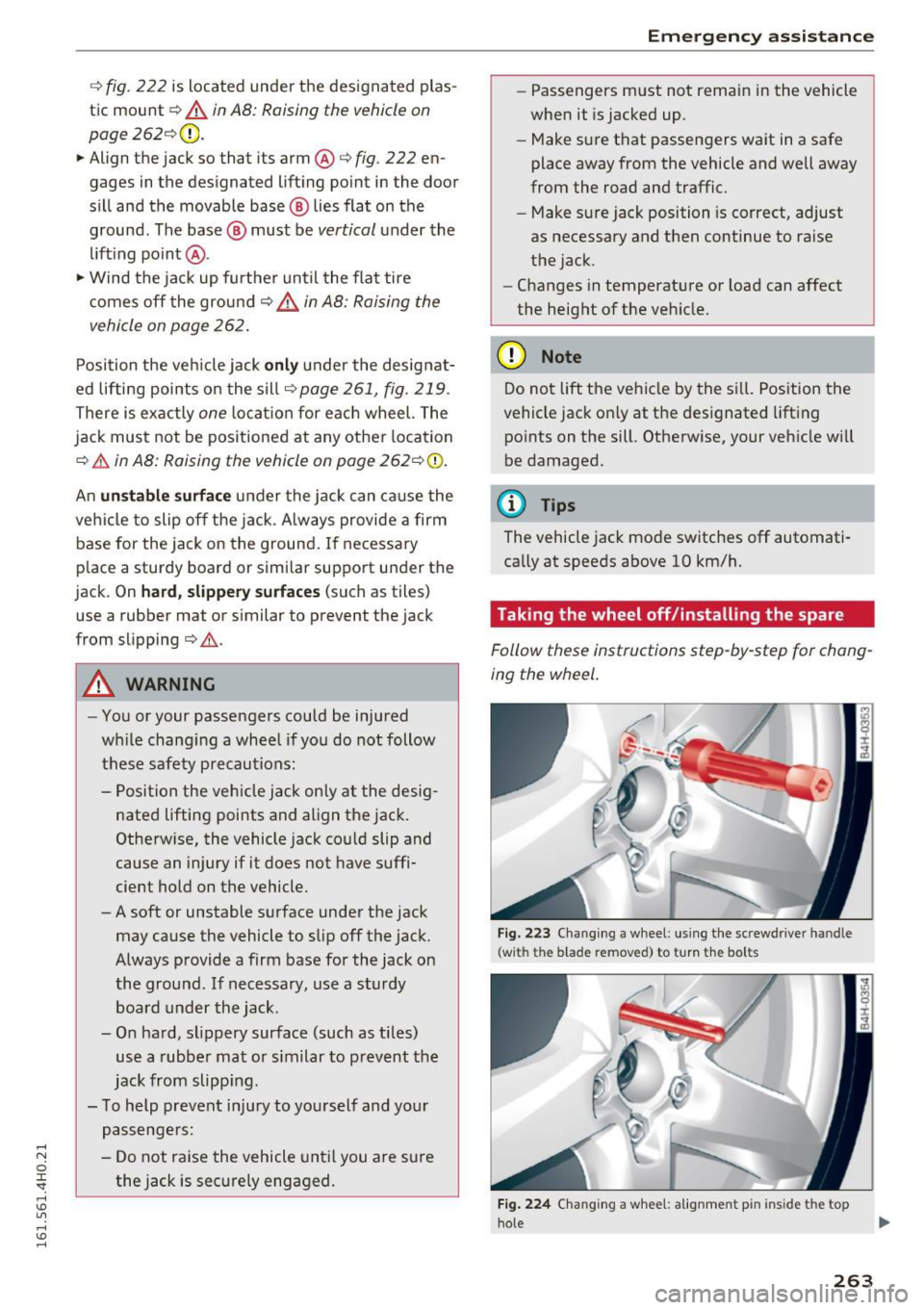
Fig . 223 Cha ngin g a w heel: us ing the screwdriver handle
(wit h the b lade removed) to turn th e bolts
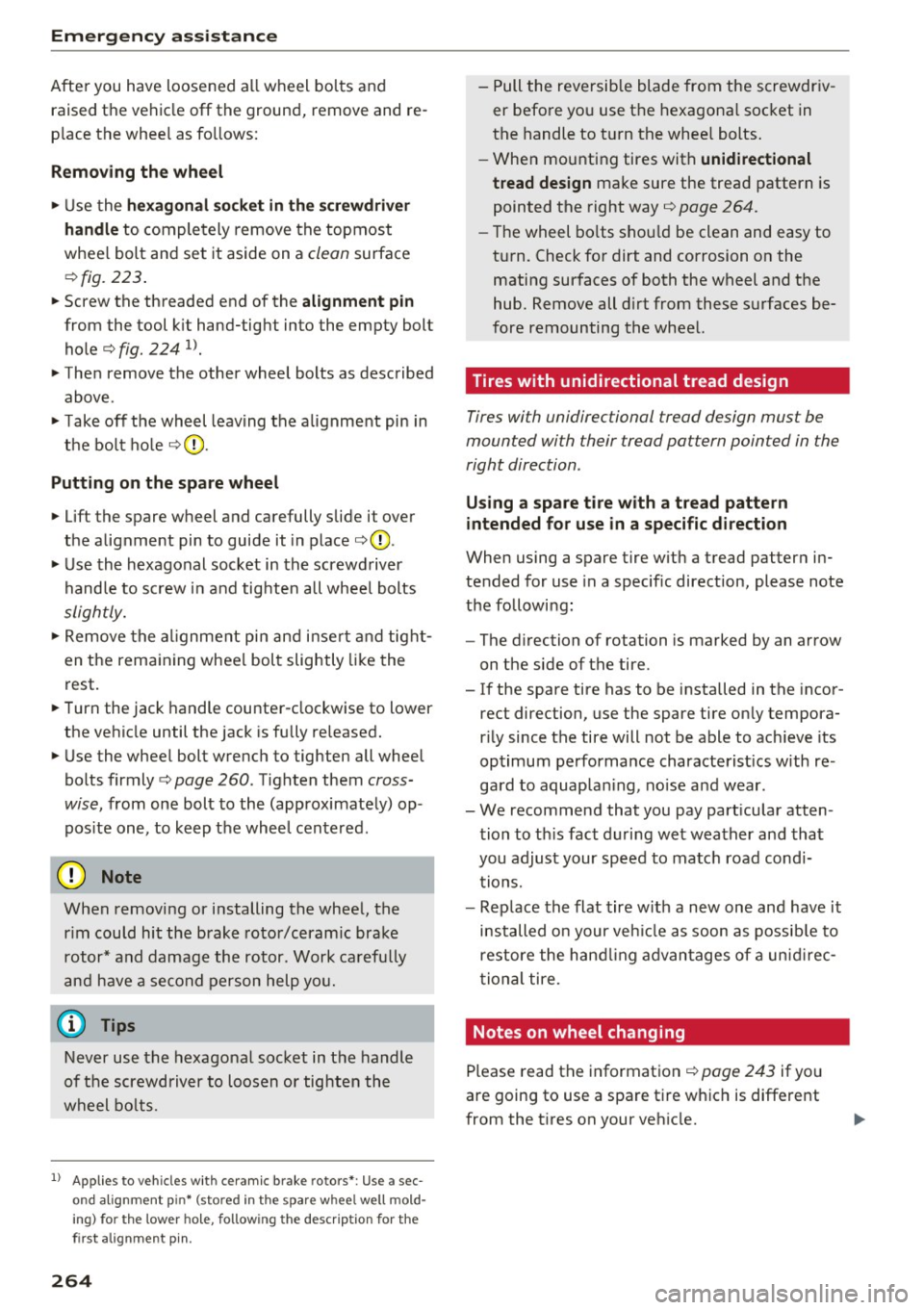
Fig. 224 Changing a w hee l: a lig nment p in in side the top
hole
263
Page 266 of 302
Emergency assistance
After you have loosened all wheel bolts and raised the vehicle off the ground, remove and re
place the wheel as follows:
Removing the wheel
.,. Use the hexagonal socket in the screwdriver
handle
to completely remove the topmost
wheel bolt and set it aside on a
clean surface
.::!> fig. 223.
.,. Screw the threaded end of the alignment pin
from the tool kit hand-tight into the empty bolt
hole¢
fig. 224 1> .
.,. Then remove the other wheel bolts as described
above.
.,. Take off the wheel leaving the alignment pin in
the bolt hole ¢0 .
Putting on the spare wheel
.,. Lift the spare wheel and carefully slide it over
the alignment pin to guide it in place ¢0 .
.,. Use the hexagonal socket in the screwdriver
handle to screw in and tighten all wheel bolts
slightly .
.,. Remove the alignment pin and insert and tight
en the remaining wheel bolt slightly like the
rest.
.,. Turn the jack handle counter-clockwise to lower
the vehicle until the jack is fully released.
.,. Use the wheel bolt wrench to tighten all wheel
bolts firmly ¢
page 260 . Tighten them cross
wise,
from one bolt to the (approximately) op
posite one, to keep the wheel centered.
0 Note
When removing or installing the wheel, the
rim could hit the brake rotor/ceramic brake
rotor* and damage the rotor . Work carefully
and have a second person help you.
Never use the hexagonal socket in the handle
of the screwdriver to loosen or tighten the
wheel bolts.
1
> A pp lies to vehicles with cer amic brake rotors*: Use a sec
o n d alignment p in* (sto re d in th e s pare w hee l well mold
in g) fo r the lower hole , fol low ing the descrip tion for the
fir st a lig nme nt pin .
264
-Pull the reversible blade from the screwdriv
er before you use the hexagonal socket in
the handle to turn the wheel bolts.
- When mounting tires with
unidirectional
tread design
make sure the tread pattern is
pointed the right way¢
page 264.
-The wheel bolts should be clean and easy to
turn. Check for dirt and corrosion on the
mating surfaces of both the wheel and the
hub. Remove all dirt from these surfaces be
fore remounting the wheel.
Tires with unidirectional tread design
Tires with unidirectional tread design mus t be
mounted with their tread pattern pointed in the
right direction .
Using a spare tire with a tread pattern
intended for use in a specific direction
When using a spare tire with a tread pattern in
tended for use in a specific direction, please note
the following:
- The direction of rotation is marked by an arrow
on the side of the tire.
- If the spare tire has to be installed in the incor
rect direction, use the spare tire only tempora
rily since the tire will not be able to achieve its
optimum performance characteristics with re
gard to aquaplaning, noise and wear.
- We recommend that you pay particular atten
tion to this fact during wet weather and that
you adjust your speed to match road condi tions.
- Replace the flat tire with a new one and have it
installed on your vehicle as soon as possible to
restore the handling advantages of a unidirec
tional tire.
Notes on wheel changing
Please read the information¢ page 243 if you
are going to use a spare tire which is different
from the tires on your vehicle.