wheel AUDI S8 2016 Service Manual
[x] Cancel search | Manufacturer: AUDI, Model Year: 2016, Model line: S8, Model: AUDI S8 2016Pages: 302, PDF Size: 75.68 MB
Page 158 of 302
Airbag syste m
-Never place or attach accessories or other
objects (such as cup ho lders, te lephone
brackets, large, heavy or bulky objects) on
the doors, over or near the area marked "AIRBAG" on the steering wheel, instru
ment pane l, seat backrests or between
those areas and yourself. These objects
could cause injury in a crash, especially
when the airbags inflate.
- Never recline the front passenger's seat to
transport objec ts. Items can also move into
the area of the side airbag or the front a ir
bag dur ing braking or in a sudden maneu
ver. Objects near the airbags can become projectiles and cause injury, particularly
when the seat is reclined.
A WARNING
The fine dust created when airbags deploy can
cause breath ing problems for people w ith a
history of asthma or other breathing condi
t ions.
- To reduce the risk of breathing problems,
those w ith asthma or other respiratory con
ditions should get fresh air right away by
gett ing out of the vehicle o r opening w in
dows o r doors.
- If you are in a collision in which airbags de
ploy, wash your hands and fa ce with mild
soap and water befo re eat ing.
- Be careful not to get the dust into your eyes,
o r into any cu ts or sc ratches.
- If the resid ue should get into yo ur eyes,
flush them with water.
Monitoring the
Advanced Airbag System
~i (USA models)/!f (Canada models)
Airbag monitoring indicator light
Two separate indicators monitor the function of
the Advanced Airbag System: the airbag moni
toring indicator light and the
PASSENGER AIR
BAG OFF
light.
The Advanced Airbag System (including the elec
tron ic co ntrol unit, senso r ci rcui ts and system
w iri ng) is monitored con tinuously to make su re
156
that it is functioning properly whenever the igni
tion is on. Each time you switch on the ignition,
the airbag mon itor ing indicator light
rl (U SA
models)/ E,I (Canada models) will come on for a
few seconds (se lf diagnostics) .
The system mu st be inspected wh en th e
indicat or light
II (USA models) /m (Canada
models ):
- does not come on when the ignition is sw itched
on,
- does not go out a few seconds after you have
sw itched on the ignit ion, or
- comes on while driving.
If an airbag system malfunction is detected, the
indicator light will first start flashing to catch the
driver's attention and then stay on continuously
to serve as a constant reminder to have the sys
tem inspected immediately .
If a malfunction occurs that turns the front air
bag on the passenger side off, the
PASSENGER
AIR BAG OFF
light will come on and stay on
whenever the ignition is on .
A WARNING
An airbag system that is not functioning prop
e rly cannot provide supplemental protectio n
i n a fronta l crash.
- If the ai rbag ind icator light
Q page 18
comes when the veh icle is being used, have
t he system inspected immedia tely by your
author ized Audi dealer . It is possi ble that
the airbag will inflate when it is not sup
posed to, or will not inflate when it should .
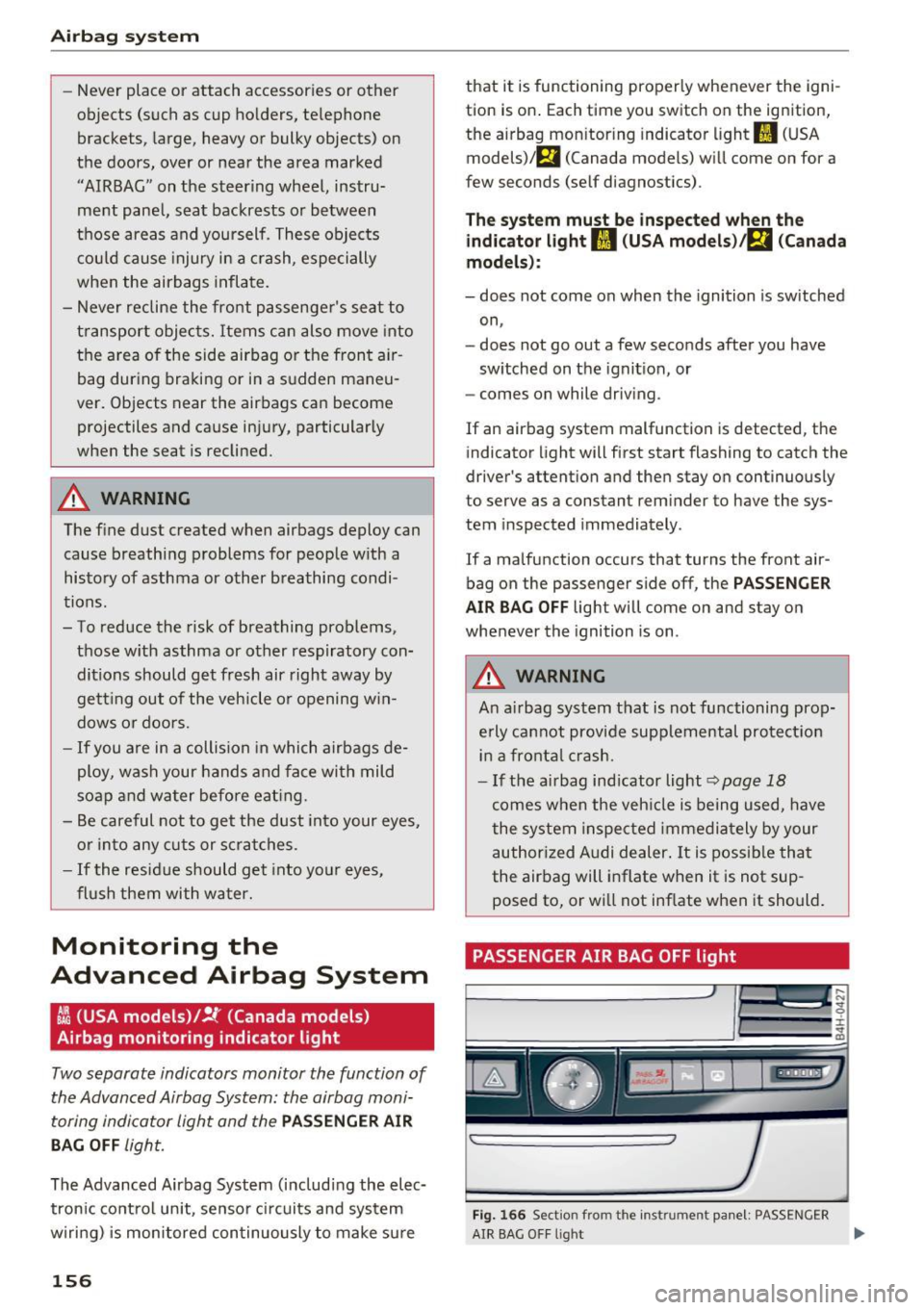
PASSENGER AIR BAG OFF light
Fig. 16 6 Sect ion from the instrument panel: PASSENGER
AIR BAG O FF light .,,_
Page 161 of 302
(D Tips
If the weight-sensing mat in the front passen
ger seat detects an empty seat, the front air
bag on the passenger side will be turned off,
and the
P ASS ENGER AI R BA G OFF light will
stay on.
Repair , care and disposal of the airbags
Parts of the a irbag system are installed at many
d ifferent p laces on your Aud i. Installing , remov
ing, servic ing or repa iring a part in an area of the
vehicle can damage a part of an airbag system
and p revent that system from working properly
in a co llision.
There are some important things you have to
know to make su re that the effectiveness of the
system w ill not be impaired and that discarded
components do not cause injury or pollute the
environm ent .
A WARNING
Improper care, serv icing and repa ir proce
dures can increase the risk of personal injury
and death by preventing an airbag from de
ploying when needed or deploying an airbag
unexpectedly:
-
- Never cover, obstruct, or change the steer
ing wheel horn pad or a irbag cover or the in
strument panel or mod ify them in any way .
- Never attach any objects such as cup holders or telephone mountings to the surfaces cov
er ing the airbag units.
- For cleaning the horn pad or instrument
pane l, use on ly a soft, dry cloth or one mois
tened with plain water. Solvents or cleaners cou ld damage the a irbag cover or change
the stiffness or strength of the material so
that the airbag cannot dep loy and protect
properly.
- Never repair, adjust, or change any parts of
the airbag system.
- All work on the steering wheel, instr ument
pane l, front seats or electrical system (in
cluding the installation of audio equipment,
cellu lar telephones and CB radios, etc.)
must be performed by a qualified technician
Airb ag sys tem
who has the training and special equ ipment
necessary.
- For any wo rk on the airbag system, we
strong ly recommend that you see your au
thorized Audi dealer or qualified workshop .
- Never modify the front bumper or parts of
the vehicle body.
- Always make sure that the side a irbag can
inflate without interference:
- Never install seat covers or replacement
upholstery ove r the front seatbacks that
have not been specifica lly approved by
Audi .
- Never use addi tional seat c ushions that
cove r the areas where the side airbags in
flate.
- Damage to the orig inal seat cove rs or to
the seam in the area of the s ide airbag
module must a lways be repaired immedi
ate ly by an authorized Aud i dealer.
- The airbag system can be activated only
once . A fter an airbag has inflated, it must
be replaced by an authorized Audi dealer or
qualified technic ian who has the technical
information, t raining and spec ial equ ipment
necessary.
- The airbag system can be deployed only
once . After an airbag has been deployed, it
must be replaced with new rep lacement
parts des igned and approved especially for
your Aud i model version. Replacement of
comp lete airbag systems or airbag compo
nents must be performed by qualified work
shops only. Ma ke sure that any airbag serv
ice act ion is en tered in your Aud i Wa rranty
& Maintenance booklet under AIRBAG RE
PLACEMENT RECORD.
- For safety reasons in severe accidents, the
alternator and starter are separated from
the vehicle battery with a pyrotechnic circ uit
interrupter.
- Wo rk on the pyrotechnic c ircuit inte rrupt
er must on ly be performed by a qua lified
dealer -risk of an acc ident!
- If the vehicle or the circuit interr upter is
scrapped, all applicable safe ty p recau tions
mus t be followed.
159
Page 171 of 302
exceptional circumstances and the
PASS ENGER AIR BAG OFF light does not
come on and stay on, immed iately install
the rear-fac ing ch ild safety seat in a rear
seating pos it ion and have the airbag system
inspected immediately by your Audi dealer .
A WARNING
If, in exceptio nal circumstances, you must in
stall a forward-facing chi ld restraint on the
front passenger's seat:
- Always make sure the forward-fac ing seat
has been designed and ce rtified by its man
ufact urer fo r use on a front seat with a pas
senger front and side airbag .
- Always follow the manufact urer's instruc
tions prov ided with the ch ild safety seat or
carrier.
- Always move the passenger seat into its
rearmost position in the seat's fore and aft
adjustment range, as far away from the air
bag as possib le before installing the child
restraint. The backrest must be adjusted to
an upr ight position.
- Always make sure that the
PA SSENGER AIR
BAG OFF
light comes on and stays on all the
t ime whenever the ignition is switched on.
{D) Tips
Always replace chi ld restraints that were in
stalled in a vehicle dur ing a crash . Damage to
a child restraint that is not visible could cause
it to fail in another collision situation.
Advanced front airbag system and children
Your veh icle is equipped with a front "Advanced
Airbag System " in compliance w ith United States
F edera l Moto r Vehicle Safety Standard (FMVSS)
208, as well as Canada Motor Ve hicle Safe ty
Stand ard (CMVSS) 208 as appli cable at the t ime
your vehicle was manufactured .
The Advanced Airbag system in your ve hicle has
been ce rtified to meet the "low-risk " requ ire
ments for 3 -and 6-year old children on the pas
senger side and small adults on the driver side .
The low risk deployment criteria are intended to
Ch ild safety
reduce the risk of injury through interaction with
the airbag that can occur, for example, by being
too close to the steering wheel and instr ument
panel when the airbag inflates. In addition, the
system has been cert ified to comply with the
"suppression" requirements of the Safety Stand
ard, to turn off the front airbag for infants up to
12 months who are restrained on the front pas
senger seat in ch ild rest raints that are lis ted in
the S tanda rd .
Even thoug h your veh icle is equipped with an Ad
vanced Airbag system, all ch ildren, especially
those 12 yea rs and younger, sho uld a lways ride
i n the back seat properly restra ined for their age
and size . The airbag on the passenger side makes
the front seat a potentia lly dangerous p lace for a
child to ride. The front seat is not the safest place
for a ch ild in a forward-fac ing ch ild safety seat. It
can be a very dangerous place for an infant or a
larger ch ild in a rearward-facing seat .
Advanced Airbags and the weight -sensing
mat in the front seat
T he Advanced A irbag System in you r vehicle de
tects the presence of a n in fan t or child in a ch ild
restra int on the front passenger seat using the
weight-sensing mat in the seat cushion and the sensor below the safety belt latch on the front
passenger seat that measures the tension on the
safety belt.
The weight-sensing mat measures total weight
of the child and the chi ld safety seat and a child
blanket on the front passenger seat. The weight
on the front passenger seat is related to the de
s ign of the child restra int and its "footprint" , the
s ize and shape of the bottom of the c hild re
straint as it s its on the seat. The weight of a chi ld
r estra int and its "footprint " va ry for different
k inds of child restra ints and for the different
models of the same kind of ch ild rest raint of
fered by child restraint manufacturers.
T he weight ranges for the individ ual types,
makes and mode ls of chi ld restrain ts that the
N HT SA has spec ified in the Safety Standard to
gether with the weight ranges o f typical infants
and typical 1 year-old chi ld have been stored in .,.
169
Page 189 of 302
Audi pre sense Preventative passenger
protection
A ppl ies to: ve hicles with Audi pre se nse
Audi pre sense can initiate steps to help protect
vehicle occupants in certain situations. The func
tions described depend on equipment installed in
your veh icle:
Audi pre sense basic
The following functions can be triggered in cer
tain driving situations:
- Tightening of the safety belts (for examp le,
during heavy braking): the front safety belts
have reversible belt pretensione rs. If a collision
does not occur, the safety belts loosen slightly
and are ready to be t ightened again.
- Closing the windows and the sunroof*: the win
dows and the sunroof* close leaving a small
open gap .
Audi pre sense basic functions can be triggered at
speeds above 20 mph (30 km/h). The deploy ment time is adapted in the drive select mode dy
namic.
Audi pre sense front (vehicles with adaptive
cruise control*)
Audi pre sense front includes the functions in
Audi pre sense basic . In addition, within the lim
its of the system, the likelihood of a collision
with the vehicle immediately ahead is also calcu lated.
If the system senses an imminent collision
the following functions can be triggered:
- Braking guard
~ page 96
- Tightening the safety belts
- Closing the windows and the sunroof* (leaving
a small open gap)
Audi pre sense rear (vehicles with Audi side
assist*}
Audi pre sense rear includes the functions in Audi
pre sense basic. In addition, the likelihood of a
rear-end collision with the vehicle coming from
behind is also calculated.
If the risk of a collision
is detected , the following functions can be trig
gered:
Audi pre sense
-Tig htening the safety belts
- Closing the windows and the sunroof* ( leaving
a small open gap)
- Adjusting the seats: the settings for the power
head restrains, the upper sections of the backr
ests and the pneumatic side bolsters* are opti mized for the front seats and the outboard rear
seats*. If a co llision does not occur, the previ
ous seat settings are restored.
Audi pre sense plus
Audi pre sense plus includes the functions in Audi
pre sense front and Audi pre sense rear.
Error message
Audi pre sense: not available
Preventative passenger protection is not availa
ble . See your authorized Audi dealer immediately
to have the malfunction corrected .
A WARNING
-
Audi pre sense cannot overcome the laws of
physics. It cannot prevent a collision. Do not
l et the increased safety provided tempt you to
take risks. This will increase the risk of a colli
sion and serious personal injuries.
- The sensors cannot always detect all ob
jects. This increases the risk of a collision.
-Audi pre sense does not detect people or an
imals or objects that are crossing the vehi
cle's path
~ page 90.
-The radar sensor's vision can be reduced by
heavy rain, ice, snow, heavy road sp ray and
reflections from guard rails, tunne l entran
ces, etc. These and similar conditions can prevent vehicles from being accurately de
tected and in some cases they may not be
detected at all.
(D Note
The sensors can be displaced by impacts or
damage to the bumper, wheel housing and
underbody. This can affect the function of the
Audi pre sense system . Have your authorized
Audi dealer check to make sure that the sys
tem is work ing properly.
187
Page 192 of 302
Smart Technology
shared, please see your contract with the
wireless te lecommunications provider and the
"About Audi connect" tab in your vehicle's
MMI:
! MENUI button> Audi connect> About
Audi connect.
Electronic Stabilization
Control (ESC)
Description
ESC helps to improve road holding and vehicle
dynamics to help reduce the probability of skid
ding and loss of vehicle control. It works only
when the engine is running. ESC detects certain
difficult dr iving situations, including when the
veh icle is beginn ing to spin (yaw) out of contro l
and helps you to get the vehicle back under con
trol by se lectively braking the wheels, and/or re
ducing engine power and providing steering as
sistance to help hold the vehicle on the driver's
intended course. The indicator light
GI in the in
strument cluster blinks when ESC is taking action
to help you control the vehicle.
ESC has limitations. It is important to remember
that ESC cannot overcome the laws of physics. It
will not always be able to help out under all con
ditions you may come up against . For example,
ESC may not always be able to help you master
situations where there is a sudden change in the
coefficient of friction of the road surface. When
there is a section of dry road that is suddenly cov
ered with water, slush o r snow , ESC cannot per
form the same way it wou ld on the dry surface. If
the vehicle hydrop lanes (rides on a cushion of wa
ter instead of the road surface), ESC wi ll not be
able to he lp you steer the vehicle because contact
with the pavement has been interrupted and the
vehicle cannot be braked or steered. During fast cornering, part icularly on w inding roads, ESC
cannot always deal as effective ly w ith difficult
driving situat ions than at lower speeds . When
towing a trailer, ESC is not able to help you re
ga in control as it would if you were not towing a
trai ler.
Always adjust your speed and driving sty le to
road, traffic and weather conditions. ESC cannot
override the vehicle's physical limits, increase the
190
available traction, or keep a vehicle on the road if
road departure is a result of driver inattention.
Instead, ESC improves the possib ility of keeping
the vehicle under control and on the road during extreme maneuvers by using the driver's steering
inputs to help keep the vehicle going in the in
tended direction . If you are traveling at a speed
that causes you to run off the road before ESC
can provide any assistance, you may not exper i
ence the benefits of ESC.
ESC is switched on all the time. In certa in s itua
tions when you need less traction, you can sw itch
off ASR by press ing the button above
~ page 192, fig. 186 the selector lever. Be sure
to switch ASR on again when you no longer need
l ess traction.
The following systems are integrated in the ESC:
Anti-lock braking system (ABS)
ABS prevents the wheels from locking up when
braking. The vehicle can still be steered even dur
i ng hard braking . Apply steady pressure to the
brake pedal. Do not pump the pedal. A pulsing in
the brake pedal indicates that the system is help
i ng you to brake the vehicle.
Brake assist system
The brake assist system can decrease braking dis
tance. It increases braking power when the dr iver
presses the brake pedal quickly in emergency sit
uations. You must press and hold the brake pedal
u nt il the situation is over. In vehicles with adap
tive cruise control*, the brake assist system is
more sensitive if the d ista nee detected to the ve
hicle ahead is too sma ll.
Anti-slip regulation (ASR)
ASR reduces engine powe r when the dr ive wheels
begin to spin and adapts the force to the road
cond itions. This makes it easier to start, acceler
ate and drive up hills.
Electronic differential lock (EDL)
The EDL brakes wheels that are spinning and
transfers the drive power to the other wheels.
This function is not available at higher speeds .
Page 193 of 302
In extreme cases, EDL automatically switches off
to help keep the brake on the braked wheel from
overheating. EDL w ill switch on aga in a utomati
cally when conditions have returned to normal.
Ste ering recommendat ion
The ESC helps to stabilize the ve hicle by chang ing
the s teering torque .
I n vehicles with dynamic steering*, ESC also
h e lps to s tabilize the stee ring in critical s itua
tions.
Selective wh eel torqu e control
Select ive whee l torque control is used when driv
in g on curves . T he front wheel on the inside of
the cu rve or both wheels o n the inside of the
curve are br aked selec tively as needed . This al
l ows more precise driv ing in curves . The applica
b le system may not activate when driving in wet
or snowy conditions.
Automatic post-collision braking system
The "Automatic post-co llision bra king system"
can help to reduce the ris k of slid ing and of other
coll is ions after an accident. If the airbag contro l
module detects a col lision above a certain vehicle
speed, the vehicle is b raked by t he ESC.
The vehicle does not b rake automatica lly if :
- the driver p resses the accelerator pedal, or
- the braking force generated by the pressed
brake pedal is greate r than the brak ing force
that wou ld be initiated by the system, or
- the ESC, the brake system or the vehicle electri
ca l system are not f unction ing .
Sma rt Technology
A WARNING
- The ESC and its integrated systems cannot
overcome the limits posed by natural physi
cal laws . This is especia lly important on s lip
pe ry o r we t roads .
If the systems beg in act
i n g to stab iliz e your ve hicle, yo u should im
mediately change yo ur speed to ma tch the
road and traffic con dit ions . Do not let the
increased safety provided by these systems
tempt you to take r isks. Do ing so will in
crease the r isk of a loss of vehicle contro l,
coll is ion and serious pe rsonal in juries.
- Always adapt your speed to road, traffic and
weather conditions. The risk of losing con
trol of the vehicle increases when driving too fast, especially through curves and on
slippery or wet roads, and when driving too
close to vehi cles up ahead. The ESC and its
i n teg ra ted systems ca nnot alw ays preven t
coll is io ns -the re is s till a risk of accide nts!
- Always accelerate w ith specia l care on even,
smooth s urfaces su ch as those that are wet
or covere d wi th ice and snow. The d rive
whee ls can spin eve n wit h these assistance
systems that cannot always help to reduce
the risk of loss of vehicle contro l.
(D Tips
-ABS a nd ASR only wo rk cor rec tly when all
four wheels a re equipped wi th identi cal
tires. Diffe rent tire s izes can lead to a red uc
tion i n engine power .
- You may hear noises when the systems de
scribed are working .
191
Page 194 of 302

Smart Technology
Switching on and off
ESC turns on automatically when you start the engine.
Fig. 186 Center console w it h ESC O FF but ton
ESC level s
Sport mode on
The following situations are exceptions where it
may be useful to switch on sport mode to allow
the wheels to spin:
- Rocking the vehicle to free it when it is stuck
- Driving in deep snow or on loose ground
- Dr iving with snow chains
Sport mode off
Behavior
The ESC and ASR stabilization functions The full stabilization function of the ESC
are limited ¢
A:,.. and ASR is ava ilable again .
Operation Press the 00 button. Press
the[!] button again.
Indicator II turns on. II turns off .
lights
Driver mes- Stabilization control (ESC): Sport Warn- Stabilization control (ESC): On
sages ing! Reduced stability
A WARNING
You should only switch sport mode on if your
dr iv ing abilities and road condit ions perm it .
- The stabilization function is limited when
sport mode is sw itched on. The driving
wheels cou ld spin and the vehicle could
swerve, espec ially on s lick o r sli ppery road
s urfac es.
Sport mode cannot be sw itched on if t he
cruise cont rol system* or the adaptive cru ise
cont rol* is switched on.
Braking
What affects braking efficiency?
New brake pads
During the first 250 miles (400 km), new brake
pads do not possess the ir full braking effect, they
have to be "broken in" first ¢
.1:,.. The break-in pe
riod can be considerably longe r fo r vehicles with
192
ceramic brake rotors*. You can compensate for
this slightly reduced braking power by push ing
harder on the brake pedal. Avoid heavy braking
lo ads during the break-in period.
Operating conditions and driving habits
The brakes on today's automobiles are still sub
j ect to wear, depending large ly on operating con
ditions and driving habits¢,& . On vehicles that
are either driven mostly in stop-and-go city traf
fic or are driven hard, the brake pads should be
checked by your authorized Audi dealer more of
ten than specified in the
Warranty & Mainte
nance booklet .
Failure to have your brake pads
inspected can result in reduced brake perform
ance.
On steep slopes, you should use the brak ing ef
fect of the engine. T his way, you prevent unnec
essary wea r on the brake system. If you mus t use
your brakes, do not hold the brakes down contin-
u ously. Pump th e brakes at intervals. ..,.
Page 195 of 302

Operating noi se
Noises may occur when braki ng depend ing on the
speed, braking force and outside cond itions s uch
as temperature and humidity.
Due to the na ture of t he mate ria ls used in ce ram
ic bra ke rotors*, noises m ay become mo re appa
ren t at low speeds.
Effect of wat er and road salt
In ce rtain situat ions, for example after driving
through water, in heavy ra in, afte r ove rnig ht con
densat ion or after washing your car, the braking
effe ct can be red uced by moisture or ice on the
b rake rotors and brake pads. The brakes must be
dried first w ith a few careful brake applications .
At highe r speeds and with t he windsh ie ld wipers
turned o n, the bra ke pads p ress against the bra ke
rotors for a short amount of time . This occ urs at
regular intervals without the driver noticing and
provides for better bra ke response time under
wet conditions.
The effectiveness of the brakes can be reduced
when the vehicle is dr iven on a salt-covered road
and the brakes are not used. L ikewise, you clean
off accumu lated salt coat ing from brake discs
and pads with a few cautious applications of the
brake
c::> ,& .
Due to their sur face characteristics, ceramic
brake rotors* absorb mo isture in such condit ions.
This can cause a temporary reduction in braking
force compared to dry brakes. You can compen
sate for this by pressing the brake peda l harder.
Cor rosion
There may be a tendency for dirt to b uild up on
the brake pads and corros ion to form on the discs
if the car is not driven regularly or only for short
tr ips with little use of the brakes.
If the brakes are not used frequently, or if corro
sion has formed on the discs, it is adv isable to
clean off the pads and discs by brak ing firmly a
few t imes from a moderately high speed
c::> ,& .
Sma rt Technology
Faults in the brake system
If you s hou ld notice a sudden increase in br ake
peda l travel, then one of the two bra ke circu its
may have fai led
c::> ,& .
Low brake fluid level
Malfunctions ca n occu r in the brake system if the
brake fluid level is too low . T he brake flu id leve l
is monitored elect ronically.
Brake boost er
The brake booster works w ith vacuum pressure
wh ich is created only when the engine is runn ing
c::> ,& .
Brake lining wear status
Brake lining wear may be checked by visua l in
spect ion of the cond ition of the brake pads
t hr ough the openings in the wheel. If necessary,
the wheel may be removed for t his inspection
c::> page 259, Replacing wheels .
.8_ WARNING
-New b rake p ads don't h ave the bes t stop
p ing power an d must be "broken-in" during
the initial 250 miles (400 km) . The break-in
pe riod can be considerably longer for
veh icles with ceramic brake rotors*. You can
compensate for this by pressing the brake
pedal more firmly. This also applies late r
when new pads are installed.
- You shou ld perform braking maneuvers for
the purpose of cleaning the brake system only i f road co ndit ions pe rmit . Other road
users m ust not be put at r is k -you may
cause an ac cident!
- Before descending a steep g rade, reduce
speed and sh ift transmission into a lower
gear o r lower dr iving range. Do not r ide the
b ra kes or hold the pe dal down too long or
too often. This cou ld cause the b rakes to ge t
hot and dimin ish b raking effic iency .
- Do not " ride the bra kes" by rest ing you r foot
on the pedal when you do no t intend to
brake. This may cause the brakes to over
heat, premature wear and increased stop
p ing distance.
193
Page 196 of 302
Smart Techn olo gy
- Under certain climatic and operating condi
tions such as passing through water, driving
in heavy rain or after washing the vehicle,
the effectiveness of the brakes can be re
duced . In w inter, ice can accumulate on the
brake pads, linings, discs and drums . Care
fully apply brakes fo r a tes t. Brakes w ill dry
and ice coatings wi ll be cleaned off after a
few careful brake applications .
- Driving for an extended pe riod of time on
salt-covered roads witho ut using your
brakes can also affect bra king efficiency.
Clean off accumulated salt coating from
brake discs and pads with a few carefu l
brake applications.
- If you damage the front spoiler, or if you in
stall a different spoiler, be sure the air flow
to the front brakes is not obstructed. Other
wise the brake system could overheat reduc
ing the effectiveness of the entire brake sys
tem.
- Failure of one brake circuit will impair the
braking capability result ing in an increased
stopp ing distance. Avoid driving the vehicle
and have it towed to the nea rest Aud i dealer
or qualified workshop.
- Never let the vehicle roll to a stop with the
engine shut off.
- If the brake booster is not working, the
brake pedal must be pressed considerably
harder to make up for the lac k of booster
assistance.
Electromechanical power
assist, dynamic steering
The electromechanical power assist helps the
driver when steering.
Power steering adapts electronically based on
the vehicle speed.
Ind icator light s and messages
• Stee ring defective! St op th e ve hicle
If th is ind icator light turns on and stays on and
this message appears, the power steer ing may
have fa iled.
194
Do not continue driving. See your authorized
Audi dealer or other qualified repair facility for
ass istance .
,Ion Steering : System faul t You can c ontinue
dri ving
If the indicato r light turns on and the message
appears, the steeri ng may be more diff icult to
move o r more sensitive than usu a l. T he steer ing
whee l may also be at an angle when driving
straight.
D rive slowly to your a uth orized Aud i dea ler or
qualified wo rkshop to have the malfunct ion cor
rected.
1;r,ij D ynamic steering : Init ializing
If this driver message appears and the indicator
light is flashing on the instrument panel, dynam
i c steer ing* is being re initialized . After starting
the engine, t he steering wheel w ill move slightly.
Re- initializa tion might be necessary if the steer
i ng whee l was moved hard to the left and right
while the vehicle was not moving . The display
goes out as soon as initialization is comp lete .
D rive slowly to your a uth orized Aud i dea ler or
qualified wo rkshop to have the mal func tion cor
rected.
.&_ WARNING
Have the dynamic steering * system malfunc
tion repaired as soon as possible by an au
thorized Audi dealer or qualif ied workshop -
risk of acc ident!
(D Tips
If the . or ,Ion indicator light only stays on
for a short time, you may continue driving.
- The dynamic steering* stabi lity systems are
not ava ilable in the event of a system mal
function.
- For additiona l information on dynamic
steering *, refer to~
page 106 .
Page 197 of 302
Driving with your
quattro
With All Wh eel Drive , all four wh eels are driven .
General information
With All W heel Drive, power is dis tribute d to all
four wheels . This happens automatically depend
ing on your dr iving style and the road conditions
at the time . See also¢
page 190 . With the sport
d ifferent ial*, power d istr ibution to the rear
wheels is variable and can be adjusted with Audi
d rive select*
¢ page 106. Always read and fo llow
safety preca utio ns ¢ ,&. .
Winter tires
When drivi ng in the w inter, you r vehicle with All
Wheel Drive has an advantage, even with reg ular
tires. In winter road cond itions it may be adv isa
b le to mount w inte r tir es (or a ll-season tires) for
i mproved d riveab ility and bra king : these tires
must be mounted on
all four wheels . See also
¢ page 251, W inter tires.
Snow chains
Where snow chains are mandatory on certain
roads, this normally also a pplies to vehicles w it h
All Whee l Dr ive ¢
page 251, Snow chains.
Replacing wheels /tires
Veh icles w ith All Wheel Drive must always have
tires of the same s ize. A lso avo id tires wi th d iffer
ent tread depths. For detai ls see page
¢ page 243.
Off-Road driving?
Your Aud i does not have e nough g round clear
a nce to be used as an off-road vehicle . It is there
fore best to avoid rough tracks and uneve n ter
r ain as m uch as possible . Also refe r to
¢page 197.
_& WARNING ,~ -
Always adjust you r driv ing to road and t raffic
conditions . Do not let the extra safety affo rd
ed by All Wheel Drive tempt you into taking
extra risks.
Sma rt Technology
- Although the A ll Whee l Drive is very effec
tive, always remember that braking capacity
is limited by t ire tract ion. You shou ld there
fore not dr ive at excessive speeds on icy or
slippe ry road surfaces .
- On wet road surfaces, be careful not to dr ive
too fast because the front wheels could be
g in to slide on top of the water (aquap la n
ing) . If th is should oc cur, you will have no
warn ing from a sudden increase in engine
speed as with a front-wheel d rive vehicle.
Always d rive at speeds which are suited to
the road conditions -risk of c rash.
Energy management
Starting ability is optimized
Energy management controls the distribution of
electrical energy and thus op timizes the availa
bility of electrical energy for starting the engine .
If a vehicle with a conventional energy system is
not driven for a long pe riod of time, the battery is
discharged by id ling curre nt consumers (e.g. im
mobilize r) . In certain circumstances i t can resu lt
in t he re being i nsufficien t energy ava ilable to
sta rt the engine.
Intelligent energy manageme nt in you r vehicle
hand les the distribution of electrical energy .
Start ing ability is markedly improved and the life
of the ba ttery is ex tended.
Bas ica lly, energy management cons ists of
bat
tery diagnosis , idling current management
and
dynamic energy management .
Battery diagnosis
Battery d iagnosis continuously dete rm ines the
state of the battery. Sensors determine battery
vo ltage, battery current and battery tempera
tu re. This de termines the current state o f ch arge
and the power of the battery .
Idling current management
Idling current management reduces energy con
sumption while the vehicle is standing. With the ..,_
195