change time AUDI TT 2012 Owner's Manual
[x] Cancel search | Manufacturer: AUDI, Model Year: 2012, Model line: TT, Model: AUDI TT 2012Pages: 132, PDF Size: 89.43 MB
Page 95 of 132

Downloaded from www.Manualslib.com manuals search engine ~..:..---~--------==-----------------------------------
Checkingandfilling18:
Detergentadditivesintheoilwillmakefresh
oillookdarkaftertheenginehasbeenrun
ning
forashorttime.Thisisnormalandisnot
areasontochangetheoilmoreoftenthan
recommended.
DamageormaLfunctionsduetoLackof
maintenance
Itisessentialthatyouchangeyouroilatthe
recommendedintervalsusingonlyengineoil
thatcomplieswithAudioiLstandard
VW50200.Your Limited NewVehicle War
rantydoesnotcaverdamageormalfunctions
duetofailuretofollowrecommendedmainte
nanceanduserequirementsassetforthin
theAudiOwner'sManuaLandWarranty&
Maintenancebooklet.YourdealerwilLhaveto
denywarrantycaverageunlessyoupresentto
thedealerproofintheformofServiceorRe
pairOrdersthatallscheduledmaintenance
wasperformedinatimelymanner.
Engineailconsumption
Theengineinyourvehicle depends onan ade
quate
amountofoilto lubricate andcoolail
ofitsmoving parts.
Inordertoprovideeffectivelubricationand
coolingofinternaLenginecomponents,allin
ternalcombustionenginesconsumeacertain
amountofoil.Oilconsumptionvariesfram
enginetoengineandmaychangesignificantly
overthelifeoftheengine.Typically,engines
withaspecified break-inperiod(see
~page162)consumemoreoilduringthe
break-inperiodthantheyconsumeafteroil
consumptionhasstabilized.
Undernormalconditions,therateofoilcon
sumptiondependsonthequalityandviscosity
oftheoil,theRPM(revolutionsperminute)at
whichtheengineisoperated,theambient
temperatureandroadconditions.Furtherfac
torsaretheamountofoildilutionfromwater
condensationorfuelresidueandtheoxida
tionleveloftheoil.Asanyengineissubjectto
wearasmileagebuildsup,theoilconsump
tionmayincreaseovertimeuntilreplacement
ofworncomponentsmaybecomenecessary.
Withallthesevariablescomingintoplay, no
standardrateofoilconsumptioncanbees
tablishedorspecified.Thereisnoalternative
toregularandfrequentcheckingoftheoilLev
el,seeNote.
Iftheyellowengineoillevelwarningsymbol
in
theinstrumentclusterlllightsup, you
shouldchecktheoilLeveLassoonaspossible
withtheoildipstick~page187.Topoffthe
oilatyourearliestconvenience~page187.
AWARNING
Before youcheckanythingintheengine
compartment,alwaysreadandheedall
WARNINGS
~.&.inWarkingintheengine
compartmenton page182.
CDNote
DrivingwithaninsufficientoiLlevelislike
lytocauseseveredamagetotheengine.
ijJ)Tips
-TheoiLpressurewarningdispLay is
notanindicatoroftheoilLeve!.Donot
reLyonit.Instead,checktheoiLLeveLin
yourengineatreguLarintervals,pref
erabLy
eachtimeyourefueL,andaLways
beforegoingona Longtrip.
-Ifyou havetheimpressionyourengine
consumesexcessiveamountsofoil,we
recommendthatyo~onsuLtyourAudi
dealertohavethecauseQ,fyourconcern
properlydiagnosed.Keep inmindthat
theaccuratemeasurementofoilcon
sumptionrequiresgreatcareandmay
takesometime.Your Audidealerhasin
structionsabouthowtomeasureoilcon
sumptionaccurately.
checkingtheengineailLeveL
Fig.142Illustration ofprinciple1:Markers onaildip
stick
Fig.143Illustration ofprinciple 2:Markers onaildip
stick
Before youcheckanythingintheenginecom
partment,aLwaysreadandheedaUWARN
INGS~AinWorkinginthe engine compart
ment
onpage182.
DeterminingaiLLeveL
• Parkyourvehiclesothatitishorizontally
level.
• While
atoperatingstatetemperature,
brieflyLettheenginerunatidleandthen
shutit off.
• Wait
approx.twominutes.
• Pullouttheoil dipstick.Wipeofftheoil
dipstick
withacleancloth,andslideit back
inasfarasitwill go.
•
PulLit backoutandreadofftheoillevel
C:>fig.142or~fig.143.Topofftheengine
oil, ifapplicable~page187.
QiLLeveLwithinrange0
•Donotaddoil.
QiLLeveLwithinrange®
•Vouconaddoil.Afterwards,theoiLleveL
shouldbewithinrange0.
OiLLeveLwithinrangeCV
•Voumustaddoil.Afterwards,theoillevel
shouldbewithinrange0.
Theoillevelneedstobecheckedatregularin
tervals.Thebesttimestodothisarewhenev
eryourefuelandpriortoLongtrips.
Dependingonthewaythevehicle isdriven
andtheoperatingconditions,oilconsumption
canbeupto1/2quartper600miLes(0.5liter
perl,DaOkm).Consumptionmaybehigher
withinthefirst3,000miles(5,000km).
AddingengineaiL't::r.
Fig.144Enginecompartment:Oilfiller caplocation
Before youcheckanythingintheenginecom
partment,aLwaysreadandheedaUWARN
INGS~AinWarkinginthe engine compart
mentanpage182.
•Unscrewthecap~totheengineoiLfilling
hole~fig.144.
•Carefullytopoffwiththeappropriateoilin
0.5literdoses.
•Checktheoillevelagainaftertwominutes
~page187.
•Topofftheoilagain,ifnecessary.
•Screwthecapbackonthefilling holeand
slidetheoildipstickinasfarasitwill go.
AWARNING
-Whiletoppingoff,theoilmustnotcome
incontactwithhotengineparts-fire
hazard!
- The oilfiller
capmustbeproperlyse
curedtopreventoilfrombeingsprayed
onthehotengineandexhaustsystem
whentheengineisrunning-fire hazard!~
Page 96 of 132
Downloaded from www.Manualslib.com manuals search engine lBBCheckingandfilling
-Ifyourskinhascomeincontactwiththe
engineoil,youmustsubsequently
cleanseitthoroughly.
CDNote
-Theoillevelmustnotbe aboverangeCV
-dangerofconverterorenginedamage!
Contactanauthorizeddealershiptodraw
offoil, ifnecessary.
- Audi
doesnotrecommendtheuseofoil
additives.Theymaydamagetheengine
andadverselyaffectyourNew Vehicle
Warranty.
@JForthesakeoftheenvironment
-Under nocircumstancescantheoilcome
incontactwiththesewagenetworkor
thesoil.
- Observe
andfollow Legalregulations
when disposingofemptyoilcontainers.
Changingtheengineoil
Werecommendthathaveyouroilchanged by
an authorized Audidealer oraqualified serv
icestation.
Beforeyoucheckanythingintheenginecom
partment,alwaysreadandheedaILWARN
INGS
q&.inWorkinginthe engine compart
mentonpage182.
Theengineoilmustbechangedaccordingto
theintervals specifiedinyourWarranty&
Maintenancebooklet.Thisisveryimportant
becausethelubricatingpropertiesofoildi
minish gradually during
normalvehicleuse.
Under
somecircumstancestheengineoil
shouldbechangedmorefrequently. Change
oil
moreoftenif you drivemostlyshortdis
tances,operatethevehicleindustyareasor
underpredominantlystop-and-go traffic con
ditions,
orhaveyourvehiclewheretempera
turesremainbelowfreezingforextendedpe
riods.
Detergentadditivesintheoil willmakefresh
oillookdarkaftertheenginehasbeenrun
ning
forashorttime.This isnormalandisnot
areasontochangetheoilmoreoftenthan
recommended.
Becauseoftheproblemofproperdisposal,
alongwiththespecialtoolsandnecessaryex
pertiserequired, westronglyrecommendthat
youhaveyouroilchangedbyanauthorized
Audidealeroraqualified servicestation.
Ifyouchoosetochangeyouroilyourself,
pleasenotethefollowingimportantinforma
tion:
AWARNING
Toreducetheriskofpersonalinjury ifyou
mustchangetheengineoilinyour vehicle
yourself:
-
Weareyeprotection.
-Toreducetheriskofburnsfromhoten-
gineoil,lettheenginecool downtothe
touch.
-Whenremovingtheoildrain plugwith
yourfingers,stayasfaraway aspossible.
Always keepyour
forearmparalleltothe
groundtohelppreventhotoilfromrun
ning down
yourarm.
-Draintheoilintoacontainerdesigned
forthispurpose,onelargeenoughto
holdatleastthetotalamountofoilin
yourengine.
-Engine oilispoisonous. Keepitwellout
ofthereachofchildren.
- Continuous contact-with used
engineoil
is
harmfultoyour skin.Âlwaysprotect
yourskinbywashing oiloffthoroughly
withsoapandwater.
CDNote
Nevermixoiladditives withyourengine
oil.These additives candamageyouren
gineandadverselyaffectyourAudi Limit
ed New Vehicle Warranty.
@Forthesakeoftheenvironment
-Beforechangingyour oil,first make sure
you know
whereyoucanproperly dispose
oftheusedoil.
- Always
disposeofusedengineoil proper-~ly.Donotdumpitongardensoil,
--woodedareas,intoopenstreamsor
down
sewagedrains.
_Recycle usedengineoilbytakingittoa
used
engineoil collection facilityinyour
area, or
contactaservicestation.
EnginecooLingsystem
Coolant
Theengine coolant performs twofunctions:it
keeps theengine fromoverheating anditpro
tects theengine fromfreezing
inthewinter.
Thecoolingsystemissealedandgenerallyre
quires little
attention.
Thecoolingsystemhasbeenfilledatthefac
tory with a
permanentcoolantwhichdoesnot
needtobechanged.Thecoolantconsistsofa
mixture
ofwaterandthemanufacturer'sgly
col-basedcoolantadditive G12++antifreeze
withanticorrosion additives(50%forUSA
models;60%forCanadianmodels).This mix
ture
bathassuresthenecessaryfrostprotec
tion and
protectsmetalcomponentsinthe
engine's coolingsystemfromcorrosionand
scaling.Ttalsoraisestheboilingpointofthe
coolant.
Donotreducetheconcentrationofthecool
ant
inthesummerbyaddingplain water. The
proportionofcoolantadditivemustbeat
least50%butnotmorethan60%tomain
tain
antifreezeprotectionandcooling efficien
cy.Ifthecoolantfrostprotectionistoolow,
the
coolantcouldfreezeanddamagethevehi
cle heating
andenginecoolingsystem.
Foryear-round driving,antifreezeisaddedat
thefactoryfortemperaturesdownto:
--310F(-35°C)U5A
--40OF(-40oC)Canada.
You
can mixtheG12++coolantadditive with
other
additives(G12+orG12). Always check
WithyourauthorizedAudidealer.
6WARNING
Before youcheck
anythingintheengine
...:ompartment,always readandheedall
CheckingandfiLlinglE
WARNING5qfi:,.inWorkingintheengine
compartmentonpage 182.
CDNote
-Beforewintersetsin,havethecoolant
checkedtaseeifthecoolantadditivein
your vehicleissufficienttomeetthecli
mateconditions. Thisisespeciallyimpor
tantifyouliveinaregionwherethewin
terisextremelycold.Ifnecessary, in
creasetheproportionofcoolantadditive
to60%.
-Whenaddingcoolantadditivetoyour
'cooling
system,remember:
- Werecommendusing onlycoolantad
ditive G12++ (checkthelabel)foryour
vehicle. Thiscoolantadditiveisavaila
ble
atauthorizedAudidealers.Other
typesofantifreezecan significantly re
ducecorrosionprotection.Theresult
ing corrosion can
causealossofcool
antandseriousenginedamage.
-Donotaddanytypeofradiatorleakseal
anttayour vehicle'senginecoolant.
Addingradiatorrepairfluid mayadverse
lyaffectthefunctionandperformanceof
yourcoolingsystemandcouldresultin
damagenotcoveredbyyour NewVehicle
Limited Warranty.
Checkingtheenginecoolantlevel
Theenginecoolant levelcanbechecked with
a quick glance.
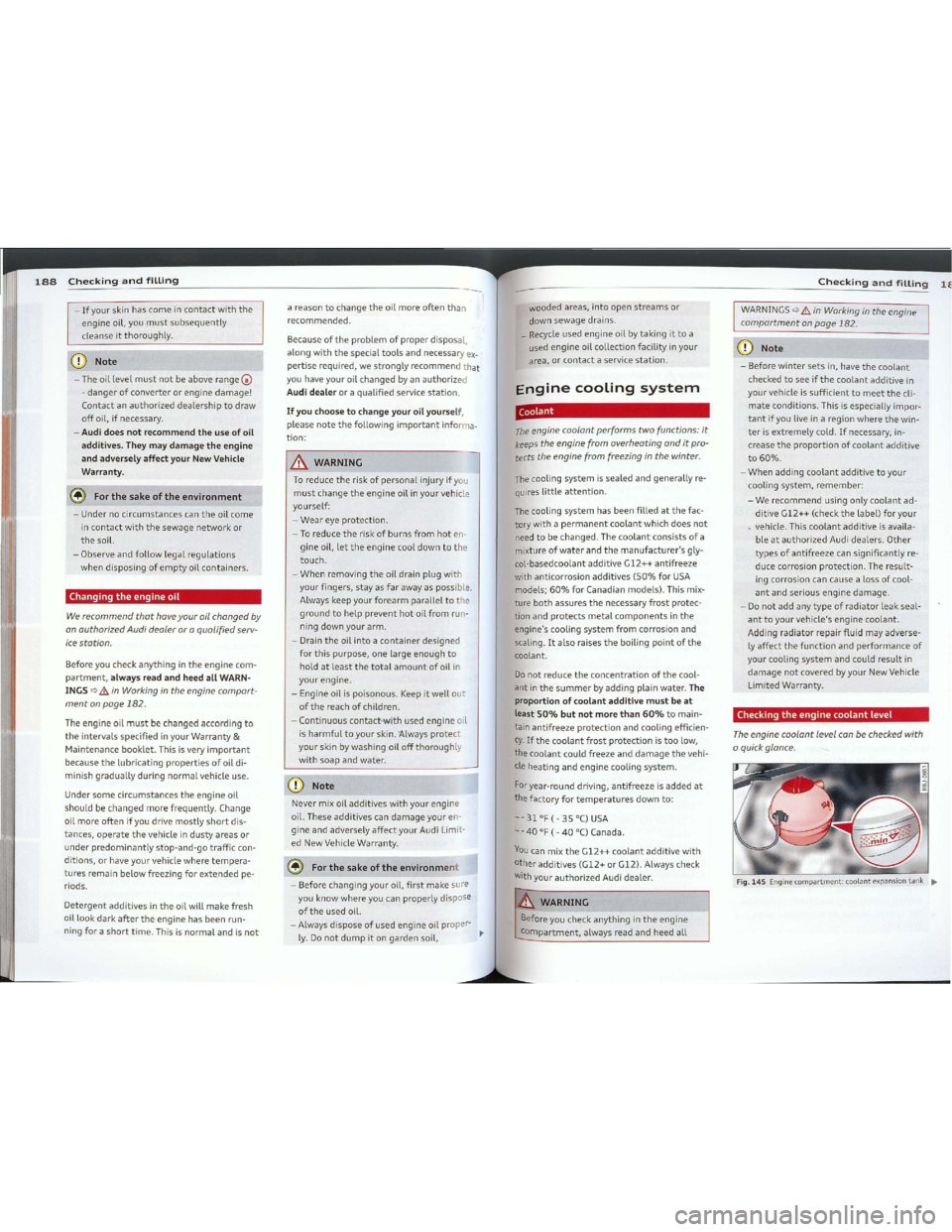
Fig.14SEnginecompartment:(oolantexpansiontank..
Page 98 of 132

Downloaded from www.Manualslib.com manuals search engine IfthebrakefluidlevelfalLsconsiderablybe
Lowthe"MIN" mark,thebrakewarning/indi-
catorlight(U.s.models:,Canadian
models:.)willcomeonqpage14.Donot
continuetooperatethevehicle. Thecomplete
brakesystemshouldbethoroughlychecked
byanauthorizedAudidealerorotherquali
fied facility
andthecausecorrected.Ifthe
brakefLuidLevelistoolow,thebrakewarning/
indicator lightwillilluminate.Contactanau
thorizedAudidealerimmediately.
Changing brakefluid
Havethebrake fluidchanged byan experi
enced technician.
Brakefluidabsorbsmoisturefromtheair.If
thewatercontentinthebrakefluidistoo
high, corrosioninthebrakesystemmayresult
afteraperiodoftime.The boilingpointofthe
brake fluidwillalsodecreaseconsiderablyand
decreasebrakingperformance.
Therefore,thebrake fluidmustbechanged
everytwoyears.Always usenew brake fluid
which
conformstoFederal MotorVehicle
Standard"FMVSS116DOT4".
Thebrake fluidreservoir canbedifficultto
reach,therefore,werecommendthatyou
have
thebrake fluidchangedbyyourauthor
izedAudi deaLer. Yourdealerhasthecorrect
tools,therightbrakefluidandtheknow-how
todothisforyou.
&.WARNING
- Brake fluidispoisonous.
Itmustbestor
ed onlyintheclosed originalcontainer
outofthereachofchiLdren!
- Brake failure can
resultfromoldorinap
propriatebrakefluid. Observethesepre
cautions:
- Use only brake fluid
thatmeetsSAE
specification]1703andconformsto
Federal MotorVehicleStandard116.
Always checkwithyourauthorizedAudi
dealertomakesureyouareusingthe
correctbrake fluid.Thecorrecttypeof
brake fluidisalsoindicated onthe
brakefluidreservoir.
- The brake fluid
mustbenew. Heavy use
ofthebrakes cancauseavaporLockif
thebrake fluidisleftinthesystemtoo
long.Thiscanseriouslyaffecttheeffi
ciency
ofthebrakesaswellasyour
safety.This could resuLtinanaccident.
CDNote
Brake fluidwill
damagethepaintofyour
vehicle.
@lForthesakeoftheenvironment
Because
oftheproblemofproperdisposal
ofbrake fluidaswell asthespecialtools
requiredandthenecessaryexpertise,we
recommendthatyouhavethebrakefLuid
changedbyyourauthorizedAudi deaLer.
Battery
General information •
Your vehicle
isequippedwithaspeciaL bat
tery,
anAGMbattery.Thisbatteryis located
intheluggagecompartmentandmustbe re
placed with
anoriginalequipmentbattery.
Under
normaloperatingconditions,thebat
teryismaintenance-free.
Havethebatterycheckedwhenyoutakeyour
vehicle
inforservice.YOlr"arewell advisedto
replace abatterythatisoldèr-thanSyears.
Disconnecting thebattery terminaIs
Somevehiclefunctions(powerwindowregu
lators,forexample)arelostifthebatteryter
minalsaredisconnected.Thesefunctionshave
toberelearnedafterthebatteryterminalsare
connectedagain.Topreventthis,thebattery
shouldonly bedisconnectedfromthevehicle
electricalsystemwhenabsolutelynecessary
for repairs.
Vehicles notdriven forlong periods
Ifyouaregoingtoletyourvehiclestandfora
longtimeandnotdriveit,youshouldremern
berthereareelectricalcomponentswhich are~
stillfunctioningandtheywilldrawenergy
fromthebatteryanddrain it,forexample,the
engine immobilizer.Topreventthis,youcan
either
chargethebatteryoccasionallytokeep
it
ingood working condition oryou candis
connect
thenegativecableonthebattery.
Winter operation
During
thewintermonths,batterycapacity
tendstodecreaseastemperaturesdrop. This
isbecausemorepowerisaLsoconsumedwhile
starting,andtheheadlights,rearwindow de
fogger,
etc.,areusedmoreoften.
Avoidunnecessarypowerconsumption,par
ticularly
incity traffic orwhentraveling only
shortdistances.LetyourauthorizedAudi
dealer check
thecapacityofthevehicle bat
tery before
wintersetsinqpage196.Awell
charged
batterywillnotonlypreventstarting
problems whentheweatheriscold,butwill
also
lastlonger.
Replacing battery
Thenewbatterymusthavethesamecapaci
ty,voltage(12volts),amperage,construction
andplugsealing,astheoriginalbattery.Spec
ifications
arelisted onthebatteryhousing.
Batteries specially
developedbyAudifulfill
the
maintenance,output,andsafetyrequire
ments.
When installing
thebattery,makesuretheig
nition
andailelectricalconsumersareswitch
edoffq(j).
Werecommendthatyou usemaintenance
freeorcycle-resistant/leak-proofbatteries
accordingtothestandardsTL82S06(from
December
1997)andVW7SO73(fromAu
gUst2001).
Replacingthebatteryshouldbe carriedbya
qualified workshop. Pleasefollowtheinstruc
tions on
thebatterycover.
CDNote
-Allworkonthebatteryrequirestechni
calknowledge. PleasecontactanAudi
dealershiporanotherauthorizedfacility
Checkingandfilling19:
forquestionsaboutthebattery-danger
ofacidburnsandexplosionhazard!
- The
batterymustnotbeopened!Donot
trytochangethebattery'sliquid level,
otherwisedetonatinggaswillescape
fromthebattery-explosion hazard!
- The
AGMbatteryintheluggagecom
partmentcannotleak,becausetheelec
trolyteforthisbatteryisabsorbedinto a
special
glassmat.This leak-proofbattery
mustnotbereplace withaconventional
battery.
-Makesuretheventilationhose onthe
sideofthebatteryisconnected,other
wisefumesorbatteryacidcanleakout.
-Batteryholderandterminalsalways
have
tobesecured correctly.
- Bèfore allwork on
thebatteryfollowthe
warnings belowq.&inWorkingonthe
batteryonpage 194.
eForthe sakeoftheenvironment
Because
oftheproblemofproperdisposal
ofabattery,werecommendyourauthor
ized Audidealerchangethebatteryfor
you.Batteriescontainsulfuric acidand
leadandmustalwaysbedisposedofprop
erly
incompliancewithall environmental
regulations.Disposingofvehiclebatteries
improperlyisverydangeroustotheenvi
ronment.Makesurethattheremovedbat
terycannotoverbalance,otherwisesulfu
ric acid
mightescape!
iTips
Ifyourvehicleisleftstandingforseveral
weeksatextremelylowtemperatures,the
vehiclebatteryshouldberemovedand
storedwhereitwillnotfreeze. Thiswill
preventitfrombeingdamagedandhaving
tobereplaced.
Page 99 of 132

Downloaded from www.Manualslib.com manuals search engine 194CheckingandfiLLing
ThebotteryocidLeveLinthebotteryconbe
checkedthroughthec1eorinspection windaw.
CDNote
Donotoverfillthebattery,otherwisebat
teryacidwilloverflowthroughthevent
opening. Thiscandamagethepaintand
causecorrosion.
Fig.148Luggagecompartment:8atterywithmagic
eye.
CheckingthebatteryacidLeveLonmagiceyebatteries·
Ontopofthebattery,thereisa round"win
dow". Thiswindow (magiceye)changescolor
asthebatterychargeandacid levelchange.
~Readandheed allWARNINGSq.&.in
Warking anthebotteryanpage194
~Readtheacidlevel fromthewindowonthe
batteryqfig.14B.
Airbubblesinthewindow cancauseaninac
curatereading.Carefullytaponthesideof
thewindow.
-
Ifthewindowisgreen,thebatteryacid level
iscorrect.
-
Ifthewindow hasnocolororisbrightyel
low,
thebatteryacid levelistoolow.Have
thebatterytestedbyyourauthorizedAudi
dealeroraqualified workshop.
-Ifthewindowisblack,thenthebatteryis
insufficientlycharged.Rechargethebattery
assoonaspossibleqpoge196.J!Note
mustbedisconnected.Ifyouarejustgo
ing
toreplace alight bulb,thenitis
enoughtoswitch offthelights.
-Before disconnectingthebattery,switch
off
theanti-theftalarmsystem!Other
wise youwill
setoffthealarm.
-When disconnectingthebattery,first
disconnectthenegative cableandthen
thepositive cable.
- Before reconnecting
thebattery,make
sureallelectricalconsumersare switch
ed off. Reconnect
thepositive cablefirst
and
thenthenegative cable.Neverinter
changethecables -thiscouldstartafire!
-Neverchargeafrozenorathawed-out
battery.Ttcould explode!Ifabatteryhas
frozen,
thenitmustbe replaced. Adis
charged
batterycan freeze overat32OF(0oC).
-Makesuretheventhoseisalwaysattach
edtotheopeningonthesideofthebat
tery.
- Never use
batterieswhicharedamaged.
Dangerofexplosion! Alwaysreplacea
damagedbattery.
-Donotdisconnectthevehiclebattery
whentheignitionisswitchedonorwhen
theengineisrunning,otherwise,youwill
damageelectroniccomponentsinthe
electricalsystem.
-Ifyour vehicleisgoingtostandfora
long period
oftimewithoutbeing driven,
protectthebatteryfrom"freezing",oth
erwiseitwillbedamagedandwillthen
havetobereplaced.
.&WARNING
California Proposition
65Warning:
- Battery
posts,terminalsandrelatedac
cessories containleadandleadcom
pounds, chemicals known
totheStateof
Californiatocausecancerandreproduc
tive
problems.Washhandsafterhan
dling.
AWARNING
Wheneverworking onthebatteryoron
theelectricalsystem,thereistheriskof
injury,accidentand even fire.Read and
heedthefollowing WARNINGS:
- Always
weareye protection.Donotlet
batteryacidorany lead particlesgeton
your skinorclothing. Shieldyoureyes.
Explosive
gasescancauseblindness or
otherinjury.
-Batteryacidcontainssulfuric acid.Sulfu
rieacidcancauseblindness andsevere
burns.
- Always
weargloves andeyeprotection.
Donottiltthebatterybecauseacid
could leak
outoftheventilation open
ings.
-
Ifyougetbatteryacidinyour eyesor
on your skin,
immediatelyrinse with
cold
waterfor severalminutesandget
medicalattention.
-Ifyoushouldingestanybatteryacid,
seekmedicalattentionimmediately.
-Donotexposethebatterytoanopen
flame,electricsparksoranopenlight.
-
Donotsmoke.
-Donotinterchangethepositive andneg-
ative cables.
-
Whenworking onthebattery,besure
nottoshort-circuittheterminalswith
toolsorothermetaobjects.Thiswould
causethebatterytohe-qtupvery quickly,
which couldlead
todamageorexplosion
and
personalinjury.
-When abatteryischarged, itproduces
hydrogen
gaswhichisexplosive and
could
causepersonalinjury.
-Always keepthebatterywelloutofthe
reachofchildren.
-Beforeworkisdoneontheelectrical sys
tem,disconnectthenegativegroundca
ble.
- Before performing anywork on
theelec
trical
system,switch offtheengine and
ignition
aswell asany electrical equip
ment.Thenegative cableonthebattery
Beespeciolly carefuLwhenworking anorneor
thebattery!
Fig.147Luggage compartment:AGMbattery
Workingonthebattery
No
•sparks
-flames
•smoking.
Whenabatteryischarged,itproduces
~hydrogengaswhichisexplosiveand
couldcausepersonalinjury.
~ALwayskeepthebatterywelloutof
~reachofchiLdren.
The
batteryislocatedintheluggagecompart
ment.
~Swing
uptheluggagecompartmentfloor.
The positive
(+)batteryterminalisprotected
byaplastic coyer.Thiscoyermustberemoved
toaccessthepositive(+)terminalwhencon
necting
jumpercablestostarttheengine.
Always heed
thesafetywarnings,whenwork
ing on
thevehiclebatteryorthevehicle elec
trical
systemtopreventinjury.
ThefollowingWARNINGSareveryimportantwhenworkingonthebattery:
AlwaysheedthefollowingWARNINGSYM
BOLSandsafetyprecautionswhenworking
onthebattery.
®ALwaysweareyeprotection.
Batteryacidcontainssulfuric acid.Al
wayswearglovesandeyeprotection.
Page 102 of 132

Downloaded from www.Manualslib.com manuals search engine Occupantdistributioninanor
mallyloadedvehicle
2
infront
Tiresandwheels2(
meansthatload onanindividual tirethatis
determinedbydistributingtoeachaxleits
shareofthemaximumloaded vehicleweight
anddividingbytwo.
meansthatthetirewasproducedinthe22nd
weekof2011.Theothernumbersaremarket
ingcodesthatmayormaynotbeusedbythe
tiremanufacturer.Thisinformationisusedto
contactconsumersifatiredefectrequiresa
recall.
Vehiclenormalloadonthetire
meansthatload onanïndividualtirethatis
determinedbydistributingtoeach axleits
shareofthecurbweight,accessoryweight,
andnormaloccupantweight(distributedin
accordancewithtablebelowc:>page201)
anddividingbytwo.
Vehiclemaximumloadonthetire
tiremeetsallfederalstandards.Thenexttwo
numbersorlettersindicatetheplantwhereit
wasmanufactured,andthelastfournumbers
representtheweekandyearofmanufacture.
Forexample,
DOT...2211...
Vehiclecapacityweight
meanstheratedcargoandluggageload plus
ISO lbs.
(68kilograms)timesthevehicle'sto
talseatingcapacityaslisted onthelabel10
catedonthedriver's sideB-pillar.
Vehicle
normalload,number
ofoccupants
2
Designatedseatingcapacity,
numberofoccupants
4
Thisisthetire's"serialnumber"Itb~gins
withtheletters"DOl"andindicatesthatthe
Occupantloadinganddistributionforvehiclenormalloadforvariousdesignatedseating
capacities
UniformTireQualityGrading
isa tireinformationsystemdevelopedbythe
UnitedStatesNational HighwayTrafficSafety
Administration(NHTSA)thatisdesignedto
helpbuyers makerelativecomparisonsamong
tires.TheUTQGisnotasafetyratingandnota
guaranteethatatirewilllastfora prescribed
numberofmiles orperforminacertainway.
ltsimplygives tirebuyersadditionalinforma
tion
tocombinewithotherconsiderations,
suchaspriee, brand loyaltyanddealerrecom
mendations.UnderUTQG,tiresaregradedby
thetiremanufacturersinthreeareas:tread
wear,tractionandtemperatureresistance.
TheUTQGinformationonthetires,moldedin
tathesidewalls.
U.S.
DOTTireIdentificationNumber(TIN)
Treadwearindicators(TWO
rneanstheprojections withintheprincipal
grooves
designedtogive avisual indicationof
thedegreesofwearofthetread.See
Qpage207,TreadWearIndicator(TWI)for
moreinformationonmeasuringtirewear.
Tread
separation
rneans
pulling awayofthetreadfromthetire
carcass.
Tread
rneans
thatportionofa tirethatcomesinto
contactwiththeroad.
Sidewall
meansnominaldistancebetweenrim flanges.
meansthatportionofatirebetweenthe
treadandbead.
Rimwidth
Recommendedinflationpressure
seec:>page199,Coldtireinflationpressure.
Rimsizedesignation
meansrimdiameterandwidth.
Rim
Rim
diameter
Reinforcedtire
meansa tiredesignedtaoperateathigher
loadsandathigherinflationpressuresthan
thecorrespondingstandardtire. Reinforced
tiresmaybeidentifiedas"XL","xl","EXTRA
LOAD",or "RF" onthesidewall.
meansametalsupportforatire oratire and
tubeassemblyuponwhichthetirebeadsare
seated.
meansnominaldiameterofthebeadseat.If
youchangeyourwheelsize, youwill haveto
purchasenew tirestomatchthenew rimdi
ameter.
Speedrating(lettercode)'---meansthespeedatwhicha'tireisdesignedta
bedriven forextendedperiodsoftime.The
ratingsrangefrom93mph(ISOkm/hlto
186mph(298km/hlc:>page210.Youmay
notfindthisinformationonalltires because
it
isnotrequiredbylaw.
The
speedratinglettercode,whereapplica
ble, is
moldedonthetiresidewallandindi
catesthemaximumpermissibleroadspeeds
c:>ID.inWintertires onpage213.
Tirepressuremonitoringsystem
meansasystemthatdetectswhenoneor
moreofavehicle'stiresareunderinflatedand
illuminatesa low tirepressurewarning tell
tale.
Maximumloadedvehicleweight
meansthesumof:
-------------------------------------------
Normaloccupantweight
meansISOlbs.(68kilograms)timesthe
numberofoccupantsseatedinthevehicle up
tathetotalseatingcapacityofyourvehicle.
Overallwidth
Maximum(permissible)inflationpressure
meansthemaximumcoldinflationpressure
tawhich atire maybeinflated.Also called
"maximuminflationpressure."
meansthelineardistancebetweentheexteri
orsofthesidewallsofaninflatedtire,includ
ing
elevationsduetalabeling,decorations,or
protectivebandsorribs.
meansa layerofrubber-coatedparallelcards.
meansdistributionofoccupantsinavehicle.
Productionoptionsweight
meansthecombinedweightofthoseinstalled
regularproductionoptionsweighing over5
lbs. (2.3
kg)inexcessofthosestandarditems
whichtheyreplace,notpreviouslyconsidered
incurbweightoraccessory weight,including
heavy
dutY brakes, ridelevelers, roofrack,
heavy
dutYbattery,andspecialtrim.
meanstheoveralldiameterofaninflatednew
tire.
(a)Curbweight
(b)Accessoryweight
(c)Vehiclecapa cityweight,and
(d) Productionoptionsweight
Outerdiameter
Occupantdistribution
Radialplytire
Ply
meansapneumatietireinwhichtheplycords
thatextendtothebeadsare laidatsubstan
tially90degreestothecenterlineofthe
tread.
Page 103 of 132
Downloaded from www.Manualslib.com manuals search engine Remember,yoursafetyandthatofyourpas
sengersalsodependsonmakingsurethat
load limitsarenotexceeded.Vehicle loadin
cludeseverybodyandeverythinginandonthe
vehicle.Theseload limitsaretechnieally refer
red
toasthevehicle's GrossVehicleWeight
Rating ("GVWR"). TheGross AxleWeightRat
ing ("GAWR")
isthemaximumloadthatcan
beappliedateachofthevehicle'stwoaxles.
The Gross Vehicle
WeightRatingandthe
GrossAxleWeightRatingarelistedonthe
safetycompliancestickerlabellocatedonthe
driver's sideB-pillar. Thetirepressurelabel on
yourAudiliststhemaximumcombined~
TiresandwheeLs2C
change. Intheeventofdiscrepancies,thetire
coveredbyyourOwner's Literatureatthevehi-
pressurelabel(on driver'ssideB-pillar) always
cle'scapacityweightandthetiresizes instal-
takes
precedence.led ontherespectivemodelsasoriginal
The
tablebelowliststherecommendedcoldequipment,orasafactoryoption.
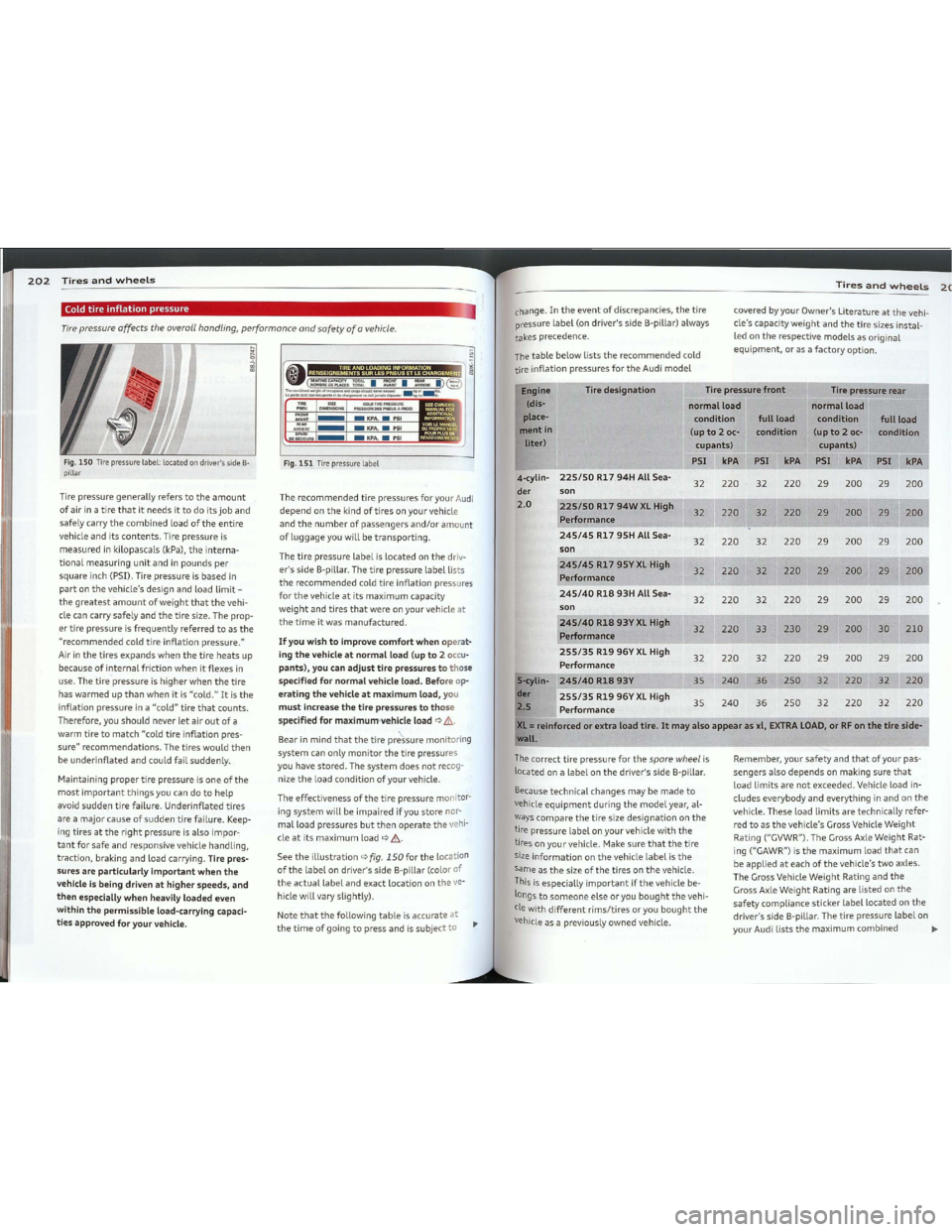
tire inflation
pressuresfortheAudimodel
EngineTiredesignationTirepressurefrontTirepressurerear
(dis-normalloadplace-conditionfullloadfullloadmentin(upto2oc-condition
conditionliter)cupants)
PSIkPA PSIkPA
4-cylin-
225/50RI794HA115ea-32220322202920029200derson
2.0322203229
245/45RI795HA1l5ea-3222032220292002920050n
245/45RI795YXLHigh32220Performance
245/40RI893HA1l5ea-32220322202920029200son
245/40RI893YXLHigh32220332302920030210Performance
255/35RI996YXLHigh32220322202920029200Performance
5-cylin-245/40RI893Y35240362503222032220
der255/35RI996YXlHigh2.S35240362503222032220Performance
~L=reinforcedorextraloadtire.Itmayalsoappeara5 xl,EXTRALOAD,orRFonthetireside-
wall.
Thecorrecttirepressureforthespore wheelis
located onalabel onthedriver's sideB-pillar.
Because
technicalchangesmaybemadeta
vehicleequipmentduringthemodelyear, al
ways
comparethetire sizedesignationonthe
tirepressurelabel onyour vehicle withthe
tiresonyour vehicle. Makesurethatthetire
size
informationonthevehiclelabelisthe
sameasthesizeofthetiresonthevehicle.
Thisisespeciallyimportantifthevehicle be
longs
tosomeoneelseoryouboughtthevehi
ele with
differentrims/tiresoryouboughtthe
Vehicleasapreviouslyownedvehicle.
SIlECOl.OTlREPflESSUftEPNEU DlMENSK>NS l'ftESSIONDESPNEUSAFROID:~_ _KPA••PSI~E_ _KPA.•PSI
TherecommendedtirepressuresforyourAudi
dependonthekindoftiresonyour vehicle
andthenumberofpassengersand/oramount
ofluggageyouwill betransporting.
Thetirepressurelabelislocatedonthedriv
er'ssideB-pillar. Thetirepressurelabellists
therecommendedcoldtireinflation pressures
forthevehicleatitsmaximumcapacity
weightandtiresthatwereonyour vehicleat
thetimeitwasmanufactured.
Bear inmindthatthetirepressuremonitoring
systemcan onlymonitorthetirepressures
you havestored.Thesystemdoesnotrecog
nize
theload conditionofyourvehicle.
The
effectivenessofthetirepressuremonitor
ing
systemwill beimpairedifyoustorenor
malloadpressuresbutthenoperatethevehi
cle
atitsmaximumloadq,&.
Seetheillustrationqfig.150forthelocation
ofthelabel ondriver'ssideB-pillar (colorof
theactuallabelandexactlocation ontheve
hiclewillvary slightly).
Note
thatthefollowingtableisaccurateat
thetimeofgoingtopressandissubjectto
""'"DfSfCOURS_ _KPA,•PSI
Ifyouwishtoimprovecomfortwhenoperat
ing
thevehicleatnormalload(upto2 occu
pants),youcanadjusttirepressurestothose
specifiedfornormalvehicleload.Before op
eratingthevehicleatmaximumload,you
mustincreasethetirepressurestothose
specifiedformaximunrvehicleloadq,&.
Fig.151Tirepressure label
(oldtireinflationpressure
TiresandwheeLs
Tirepressureaffectstheoverallhandling, performanceandsafetyof0vehicLe.
Fig.150Tirepressure label:locatedondriver's sideBpillar
Tirepressuregenerallyreferstotheamount
ofairinatirethatitneedsittodo itsjoband
safely carrythecombinedloadoftheentire
vehicleanditscontents.Tirepressureis
measuredinkilopascals (kPa),theinterna
tionalmeasuringunitandinpoundsper
squareinch(PSI). Tirepressureisbasedin
partonthevehicle'sdesignandloadlimit
thegreatestamountofweightthatthevehi
cle can carry
safelyandthetiresize. Theprop
ertirepressureisfrequentlyreferredtoasthe
"recommendedcold tireinflationpressure."
Airinthetiresexpandswhenthetireheatsup
becauseofinternalfrictionwhenitflexesin
use. Thetirepressureishigherwhenthetire
haswarmedupthanwhenitis"cold."Itisthe
inflationpressureina"cold" tirethatcounts.
Therefore, youshouldneverletairoutofa
warmtiretomatch"coldtireinflation pres
sure"
recommendations.Thetireswouldthen
beunderinflatedandcould failsuddenly.
Maintainingpropertirepressureisoneofthe
mostimportantthingsyoucandotohelp
avoid
suddentire failure.Underinflatedtires
areamajorcauseofsuddentire failure. Keep
ing
tiresattherightpressureisalsoimpor
tantforsafeandresponsive vehiclehandling,
traction,brakingandloadcarrying. Tirepres
suresareparticularlyimportantwhenthe
vehicle isbeingdrivenathigherspeeds,and
thenespeciallywhenheavilyloadedeven
withinthepermissibleload-carryingcapaci
tiesapprovedforyourvehicle.
Page 104 of 132

Downloaded from www.Manualslib.com manuals search engine 204TiresandwheelsTiresandwheels20
weightofalloftheoccupantsandluggageor
othercargothatthevehiclecancarry. Forthe
locationofthetirepressurelabelqfig.150.
AWARNING
Overloading avehicle cancauselossofve-
hicle
control,a crash orotheraccident,se-
riouspersonalinjury,andevendeath.
- Carryingmoreweightthanyour vehicle
wasdesignedtocarry willpreventthe
vehiclefromhandlingproperlyandin-
creasetheriskofalossofvehicle con-
trol.
- The brakes onavehicle
thathasbeen
overloaded maynotbeabletostopthe
vehiclewithinasafedistance.
-Tires onavehiclethathasbeenoverload-
ed can
failsuddenlycausing lossofcon-
trolandacrash.
AWARNING
-Incorrecttirepressuresand/orunderin-
flation canlead
toaseriousorfatalacci-
dent.
-Incorrecttirepressuresand/orunderin-
flation
causeincreased tirewearandcan
affectthehandlingofthevehicle.
-
Incorrecttirepressuresand/orunderin-
flation can
alsoleadtosuddentirefail-
ure, including a
blowoutandsuddende-
flation,
causinglossofvehiclecontrol.
Checkingtirepressure
Thecorrect tirepressure forthe tires originol
Iyinstolled onyourvehicleislistedonthe tire
pressure
lobellocotedon driver's sideB-pil
lar.
Therecommendedtirepressuresareonthe
tirepressurelabelandinthetable
qpage 202,Coldtireinflation pressure.This
meansthatthepressuremustbechecked and
adjustedwhenthetirehasnotbeendriven for
morethanacoupleofmiles (kilometers)at
lowspeedsduringthepreviousthreehours.
Airinthetiresexpandswhenthetireheatsup
asaresultofinternalfrictionasitflexesin
use. Thetirepressureishigherwhenthetire
has
warmedupthanwhenitis"cold."
ltistheinflationpressureina "cold" tirethat
counts.Therefore, youshouldneverletairout
ofawarmtiretomatch"Cold tireinflation
pressure"recommendationsqpoge 202.The
tireswouldthenbeunderinflatedandcould
failsuddenly.
Thetirepressurelabel onyourAudiliststhe
recommendedcoldtireinflationpressuresfor
thenew, originalequipmenttiresthatwere
on
yourvehicleatthetimeitwasmanufac
tured.Forthelocationofthelabel
qpage 202,fig.150.
Mosttireslose air naturally overtime.They
can
alsolosesomeairifyou drive overapot
hole
orhit acurb while parking.ltisusually
notpossibletoseewhethertheradial tires
used
todayareunderinflatedjustbylooking
atthem.
Therefore,besuretocheck tirepressuresat
leastonceamonthandalwaysbeforegoing
on along trip.Make
suretotakethenumber
ofpeopleandtheamountofluggageintoac
countwhenadjustingtirepressureforatrip
evenonethatyou wouldnotconsidertobe
"long."Seeqpage 206,Tiresandvehicle
load limits
formoreimportantinformation.
Always use
anaccuratetirepressuregauge
whencheckingandadjustinginflation pres
sures.Checkallofthetiresandbesurenotto
forgetthesparetire.Ifthepressureinany tire
istoohighwhenthetireis"cold,"letairout
ofthetire slowly withtheedgeofthetire
gaugeandkeepcheckingthepressureuntil
you reach
thepressurethatiscorrect forthe
load(passengersandluggage)andkindof
driving youplan
todo.
Ifthepressureinanytire istoolow,notethe
differencebetweenthepressureinthecold
tire
andthepressureyou need and addtheair
thatyouneedtoreachthecorrectpressure for
thevehicleload(passengersandluggage) for
thetiresonyourvehicleaslistedontheon
your vehicle
andinthismanualandthekind
ofdriving youplantodo. Never
exceedthemaximuminflationpres
surelistedonthetiresidewallforanyrea
son.
Rememberthatthevehiclemanufacturer,not
thetiremanufacturer,determinesthecorrect
tirepressureforthetireson your vehicle.
Itisimportanttocheckthetirepressurewhen
thetiresarecold.
_Readtherequired tirepressurefromthetire
pressure
labellocatedon driver's sideB-pil
lar.
_ Turn
thevalvestemcapcounter-clockwise
toremove itfromthetire valve.
_ Place
theairpressuregaugeonthevalve.
- The tire
pressuresshouldonlybechecked
and
adjustedwhenthetiresarecold. The
slightly raised
pressuresofwarmtiresmust
notbereduced.
- Adjust
thetirepressuretotheload youare
carrying.
-Reinstallthevalvestemcap onthevalve.
Whenshould1checkthetirepressure?
Thecorrecttirepressureisespecially impor
tantathighspeeds.Thepressureshould
thereforebecheckedatleastonceamonth
and alwaysbeforestartingajourney.
Whenshould1adjustthetirepressures?
Adjustthetirepressuretotheload youare
carrying. Afterchangingawheelorreplacing
wheels youhave
toadjustthetirepressures
onallwheels.Inaddition, youmusttheniniti
alize
thenewtirepressuresinthetire pres
Sure
monitoringsystemqpage216.
lÀWARNING
Incorrecttirepressuresand/orunderinfla
tion canleadsuddentirefailure, lossof
control, collision,seriouspersonalinjury
or even
death.
-Whenthewarningsymbol[D]appearsin
theinstrumentcluster,stopandinspect
thetires.
-
Incorrecttirepressureand/orunderinfla
'-tion cancauseincreased tirewearand
canaffectthehandlingofthevehicleand
stoppingability.
-
Incorrecttirepressuresand/orunderin
flation can
alsoleadtosuddentirefail
ure, including a
blowoutandsuddende
flation,causing lossofvehiclecontrol.
- The driver
isresponsibleforthecorrect
tire
pressuresforalltiresonthevehicle.
The
applicablepressurevaluesarelocat
ed on asticker on
thedriver's sideB-pil
lar.
- Only
whenalltiresonthevehiclearefil
Ledtothecorrectpressure,thetire pres
suremonitoringsystemcanwork cor
rectly.
- The use
ofincorrecttirepressurevalues
c~nleadtoaccidentsorotherdamage.
Therefore itisessentialthatthedriver
observethespecifiedtirepressurevalues
forthetiresandthecorrectpressuresfor
thefunctionofthetirepressuremonitor
ingsystem.
-Always inflatetirestotherecommended
andcorrecttirepressurebeforedriving
off.
-Driving withunderinflatedtiresbend
more,lettingthemgettoohotresulting
intreadseparation,suddentirefailure
andlossofcontrol.
-Excessivespeedand/overloadingcan
causeheatbuild-up,suddentire failure
andlossofcontrol.
-Ifthetirepressureistoolowortoohigh,
thetireswillwearprematurelyandthe
vehicle willnothandlewell.
-
Ifthetireisnotflatandyoudonothave
tochangeawheelimmediately, driveat
reducedspeedtothenearestservicesta
tiontocheckthetirepressureand add
airasrequired.
rCDNote
Drivingwithoutvalvestemcapscancause
damagetothetire valves.Topreventthis,
always makesurethatfactory installed
valve
stemcapson allwheelsaresecurely
mountedonthevalve.
1
Page 110 of 132

Downloaded from www.Manualslib.com manuals search engine 216Tiresand\NheelsTiresand\Nheels217
Tirepressure
monitoringsystem
GeneralnotesApptiestovehicles:withtirepressuremonitoringsystem
Eachtire,includingthespare(ifprovided),
shouldbecheckedmonthlywhencoldandin
flatedtotheinflationpressurerecommended
bythevehiclemanufactureronthevehicle
placard
ortireinflationpressurelabel.(Ifyour
vehiclehastiresofadifferentsizethanthe
sizeindicatedonthevehicleplacardortirein
flationpressurelabel,youshoulddetermine
thepropertireinflationpressureforthose
tires.)
Asanaddedsafetyfeature,yourvehiclehas
beenequippedwithatirepressuremonitoring
system(TPMS)thatilluminatesa lowtire
pressuretelltalewhenoneormoreofyour
tiresissignificantlyunder-inflated.According
ly,whenthelowtirepressuretelltaleillumi
nates,youshouldstopandcheckyourtiresas
soonaspossible,andinflatethemtothe
properpressure.Drivingonasignificantlyun
der-inflatedtirecausesthetiretooverheat
andcanleadtotirefailure.Under-inflational
soreducesfuelefficiencyandtiretreadlife,
andmayaffectthevehicle'shandlingand
stoppingability.
PleasenotethattheTPMS isnotasubstitute
forpropertiremaintenance,anditisthedriv
er'sresponsibilitytomaintaincorrecttire
pressure,evenifunder-inflationhasnot
reachedtheleveltotriggerilluminationofthe
TPMSlowtirepressuretelltale.
Yourvehiclehasalsobeenequippedwitha
TPMS
malfunctionindicatortoindicatewhen
thesystemisnotoperatingproperly.The
TPMSmalfunctionindicatoriscombinedwith
thelowtirepressuretelltale.Whenthesys
temdetectsamalfunction,thetelltalewill
flashforapproximatelyoneminuteandthen
remaincontinuouslyilluminated.Thisse
quencewillcontinueuponsubsequentvehicle
start-upsaslongasthemalfunctionexists.
Whenthemalfunctionindicatorisilluminat
ed,thesystemmaynotbeabletodetector
signallowtirepressureasintended.TPMS
malfunctionsmayoccurfora varietyofrea
sons,includingtheinstallationofreplace
mentoralternatetiresorwheelsonthevehi.
cle
thatpreventtheTPMSfromfunctioning
properly. AlwayschecktheTPMSmalfunction
telltaleafterreplacingoneormoretiresor
wheelsonyourvehicletoensurethatthere
placementoralternatetiresandwheelsallow
theTPMStocontinuetofunctionproperly.
Tire pressure indicator appears •
Appliestovehicles:withtirepressuremonitoringsystem
Thetirepressure indicatorintheinstrument
c/uster informs you
ifthetire pressureistoo
LoworifthereisasystemmaLfunction.
Fig.1S6Display: Systemmalfunction
UsingtheABSsensors,thetirepressuremoni
toringsystemcomparesthetiretreadcircurn
ferenceandvibrationcharacteristicsofthein
dividualtires.Ifthepressuredecreasesinone
ormoretires,thisisindicatedintheinstru
mentclusterwithawarningsymbolganda
messageqfig.155.The drivermessageinthe
displaygoesoutafter5seconds.Thedriver
messagecanbedisplayedagainbypressing
the[CHECKIbutton®qpage10,fig.3.Ifon
lyonetireisaffected,thedisplaywillindicate
itsposition.
Thetirepressuremonitoringmustberesetin
themenudisplayeachtimethepressuresare
adjusted(e. g.whenswitchingbetweenparti
alandfullloadpressure)orafterchangingor
replacing atireonyourvehicleqpage218.
Voucanfindtherecommendedtirepressures
foryourvehicleonthelabelonthedriver's
door pillar
qpage202.
Tiretreadcircumferenceandvibrationcharac·
teristicscanchangeandcauseatirepressure
warningif:
_thetirepressureinoneormoretiresistoo
low,
-
thetirehasstructuraldamage,
_thetirepressurewaschanged,wheelsrotat
edorreplacedbuttheTPMSwasnotreset
qpage218.
Warning symbols
[D]Lossofpressureinatleastonetireq/D,.
Checkthetireortiresandreplaceorrepairif
necessary. The
indicatorlightgintheinstru
mentclusteralsoilluminatesqpage13.
Check/correctthepressuresofallfourtires
andresetTPMSinthemenudisplay.
~(TirePressureMonitoringSystem)Tire
pressure!Systemmalfunction.IflDmap
pearsafterswitchingtheignitiononorwhile
drivingqfig.156andtheindicatorlightgin
theinstrumentclusterblinksforapproxi
matelyoneminuteandthenstayson,thereis
a
systemmalfunction.Seeyourauthorized
Audidealerassoonaspossible.
AWARNING
-Ifthetirepressureindicatorappearsin
theinstrumentclusterdisplay,oneor
moreofyourtiresissignificantlyunder
inflated.Reduceyourspeedimmediately
andavoidanyhardsteeringorbraking
maneuvers.Stopassoonaspossibleand
checkthetiresandtheirpressures.In
fla
tethetirepressuretotheproperpres-
sureasindicatedonthevehicle'stire
pressurelabelqpage202.Drivingona
significantlyunder-inflatedtirecauses
thetiretooverheatandcanleadtotire
failure.Under-inflationalsois likelyto
impairthevehicle'shandlingandstop
ping ability.
-
Thedriverisresponsibleformaintaining
thecorrecttirepressures.Youmust
checkthetirepressuresregularly.
-
Undercertainconditions(suchasaspor
tydrivingstyle,winterconditionsorun
paved
roads),thepressuremonitorindi
catormaybedelayed.
- AskyourauthorizedAudidealerif run
flattiresmaybeusedonyourvehicle.
Your vehicle
registrationbecomesinvalid
if
yàuusethesetireswhennotpermit
ted.Damagetoyourvehicleoraccidents
couldalsoresult.
-Ifyouswitchbetweenstandardandrun
flattires,anauthorizedAudidealeror
qualifiedworkshopmustreprogramthe
controlmodule.
1Tips
- The
tirepressuremonitoringsystem
stopsworkingwhenthereis an ESP/ABS
malfunction.
-Usingsnowchainsmayresultin asystem
malfunction.
-Tireswiththeidentification"AD"or"RD"
have
beenspeciallymatchedwithyour
Audi.Werecommendusingonlythese
tiresbecausetheymeetthehighest
standardsregardingsafetyanddriving
characteristicswhenusedcorrectly. Your
authorizedAudidealerwillgladlypro
vide you
withmoreinformation.
Page 112 of 132
Downloaded from www.Manualslib.com manuals search engine 220Tiresandwheels
CDNote
Run-flat
tireshave specialcharacteristics
andrequirements,thatareverydifferent
fromconventionaltires. Run-flattiresre
quire special rims
forrun-flatuseandcan
notbeusedonconventionalwheelrims.
Tips
-
Ifyouarenotabletocontinuedriving
with
run-flattires,pleaseseekprofessio
nalassistance.
- PleasecontactyourauthorizedAudi
dealerorAudiofAmerica, Inc.ifyou
have
questionsabouttiresandrims.
Driving
withrun-flat tires
Appliestavehicles:withRun-flat tires
Handling characteristics changewhentire
pressure
islaw.
Driving ontireswithlowtirepressurechanges
theway avehiclehandles,particularLywhen
corneringandbraking. Thehandling charac
teristicsofrun-flattiresdonotseemto
changealotEvenwhendrivingonlow pres
sureorintherun-fLatmode.Neverthelessyou
muststilltakespecialprecautionswhenoper
atingavehicleonrun-flattireswhentire pres
sureisLoworthetirets) isflat:
~The Electronic Stabilization Program(ESP)
mustbeswitchedon.
~Neverdrivefasterthan50mph(80km/hl
q.&..
~Planaheadwhendrivingandanticipate
whatyouwilLhavetodoconsidering traffic
androadconditionsupahead.
~Acceleratecarefully.
~Avoidunnecessaryandsuddensteeringand
brakingmaneuvers.
~Reduceyourspeedinplentyoftimebefore
intersections,curvesandotherplaceswhere
youmay havetoreactquickly.
Please
see:qpage219,Whenitisnatpossi
bLeta continue driving,Evenwithrun-fLat
tires?
Handling characteristics changewhen
driving withlowairpressure orwithflattires evenwithspecial run-flat tires
A low
pressureorflatfront tireaffectsvehicle
handlingcharacteristicsbypullingthevehicle
slightlytothesidewherethetireismounted
andreducesbrakingperformance.
AlowpressureorfLatreartirealsoaffects
drivingcharacteristicsbypullingtotheside
wherethetireismountedandalso reduces
braking
performance.Theeffecton vehicle
handling
ismostnoticeablewhendriving
aroundcurves.
.&..WARNING
Changed vehiclehandlingcharacteristics
whendrivingintherun-flatmodecan
causelossofvehiclecontrol,acrash and
seriouspersonalinjury.
- Driving onspecial
run-flattiresinthe
run-flatmodewillchangevehicle han
dling
characteristicsduringbraking,
whencorneringandunderheavy acceler
ation.
-Never drivefasterthanthemaximum
ratedspeedof50mph(80km/hlwhen
driving
intherun-flatmode.
- Alwaysadjustvehiclespeedtotraffic,
road
andweathercond itionsanddrive
slowerthanthemaximumratedspeedif
necessaryweathera~roadconditions
aretakenintoaccount.
- Always obey
speedlimitsandothertraf
fic laws.
CDNote
We always
recommenddriving withEven
morecarewhenusingthesespecialtiresin
therun-flatmode.Always avoidsudden
maneuvers.
Replacing run-flattiresandrims
APpliestavehlcles:wlthRun-flattires
yourvehicLewasespeciaLLydesignedtause
speciaL run-fLat tires.
Voumayuseandcombineonlyapprovedrun
fIat tires
andspecialmatchingrimsthathave
been
designedforrun-flattires. Mounting
special
run-flattiresonstandardwheelswilL
not workandwillnotprovidetheadvantages
fotherun-faltfeature.Neverusespecialrun
flat tires on
standardwheelrims.
After driving withatire
intherun-flatmode,
always havethevehicleandaffectedtirets)
and rimes)
inspectedbyanauthorizedAudi
dealer. Tires
thathavebeendrivenintherun
flat
modemustbe replaced.
fbWARNING
Useofdamagedrun-flattiresandrims can
cause vehicle
damagethatcanLeadtoloss
ofvehiclecontrol,acrashandseriousper
sonal
injury.
- Always have
thevehicleandaffected
tirets)andrimes)inspectedbyanauthor
izedAudidealerafterdriving atireinthe
run-flatmode.
-Tiresthathavebeendrivenintherun
flatmodemustbereplaced.
Tiresandwheels
Page 114 of 132

Downloaded from www.Manualslib.com manuals search engine ~Removethe"max.50mph"(80km/hl
sticker fromthesealantbottleandaffix itto
theinstrumentclusterinthedriver's view.
AWARNING
-Turnthehazardflashersonandsetup
thewarning triangleifyou have aflat
tireinmoving traffie.Inthis way youpro
tectyourselfandotherroad users.
- Make
surethatallpassengersareina
safeplace,outofthedangerzone (for
example, behindaguard rail).
CDNote
Particular careisnecessary ifyouaremak
ing atire repair ona
steepincline.
((DTips
Obeyalllaws.
Makingatirerepair
Appliestavehicles:withTireMobilitySystem
Tire repoirconsistsofthefollowingsections.
Fig.164PartsoftheTireMobilitySystem
Fig. 16S Connector
fortheTire Mobility System
1)TheeleetricairpumpshouldneverrunforLonger than8minutes.
AssemblingTireMobilitySystem
~Openthelid0oftheelectric airpump
9fig.164.
~PuIItheplug@andthepressure hose®
withthegaugeoutofthehousing.
~Screwthepressurehose®oftheelectric
air
pumpentatheflange®ofthesealant
bottle@.
~Pushthesealantbottlewiththeflange
down into
therecess®onthelidofthe
electric airpump.
~Removethedustcap fromthevalveofthe
defective tire.
~Screwthehose@entathevalve0
9fig.165.
[email protected]
for
thecigarettelighter.
~Switch ontheignition.
Inflatingtire
~Movetheswitch®9fig.165ontheelec
tric air
pump1)toposition1.After 5mi
nutes,tire pressuremusthave reachedat
least1.8bar.
~Switchtheelectric airpumpoff-switchin
positiono.Iftherequired tirepressure ofat
least1.8barhasnotbeen reached, follow
theinstructionsinthesectionRe-infloting
tire.
Re-inflatingtire
~Removethehosefrol'fl-l:hevalve andpull
theplugoutofthesocket.'.
~Drivethevehicle slowly10metersback
ward orforward. Thishelps
todistribute the
sealantbetter.
~Removetheemptyinflationbottleand
screw
thehose®9fig.164fromtheelec
tric
pumpdirectlyantethevalve.
[email protected]
for
thecigarettelighter.
~Switch ontheignition. •
Movetheswitch®9fig.165ontheelec
tric air
pump1)toposition1.After 5mi
nutes, tirepressure
musthave reachedat
least1.8bar.
• Switch
theelectric airpumpoff-switchin
positionO.Iftherequired tirepressureofat
least1.8barhasnotbeenreached, itisnot
possibletomakearepair withthetireseal
ant. Seek professional
assistance.
DisassemblingTireMobilitySystem
~Removethehosefromthevalve andpull
theplugoutofthesocket.
• Screw
thedustcapontothevalve.
• Place
theemptysealantbottlebackinthe
original packaging andclipitinplaceunder
thefloor50thatnotiresealantcan runout
intothevehicle.
~Placetheelectric airpumpintheluggage
compartmentforthetimebeing.
~Startdrivingrightaway50thatthesealant
isdistributedinthetire.
WARNING
- Follow
themanufacturer'ssafetyinstruc
tions on
thedecal fortheairpumpand
thesealantbottle.
-Ifatire pressureof1.8barcannotbe
achieved
afterpumping for5minutes,
thetireistooseverelydamaged.Donot
continuetodrive.
- Seek professional
assistanceifitisnot
possibletorepairthetire withthetire
sealant.
Tips
-Donotoperatetheelectric airpumpfor
morethan8minuteswithoutstopping,
otherwise itcan overheat.Whentheair
pumphascooled down,youcancontinue
touseit.
-Ifsealanthasescaped, allowittodry,
thenyoucanpeel itoff.
1)The eLeetricairpumpshouLdnever runforLonger than8minutes.
Finalcheck
AppLiestavehicles:withTireMobilitySystem
Afterdrivingforashortdistance,tirepressuremustbechecked
~Afterdriving forabout10minutes,stop
andcheckthetirepressure.
~Iftirepressureisstillatleast1.3bar, in
fla
tethetiretospecified pressure(seedriv
efsside 8-pillar), drivetothenextrepair
shopandhavethetireandthesealantbot
tlereplaced.
~Iftire pressureislessthan1.3bar,thetire
is
tooseverelydamaged.Donotcontinueto
drive. Seekprofessional assistance.
AWARNING
Iftirepressureislessthan1.3barafter
driving for10minutes,thetireistoose
verelydamaged.Donotcontinuetodrive.
Seek professional
assistance.
IDTips
After atire repair, havethesealantbottle
replacedatadealership. Thisrestores full
functionality
totheTire Mobility System.
WhatshouLd1be
awareofwhen
changingatire?
Generalinformation
Thefollowing sectionswillprovide youwith
importantinformation onhowtochangea
tire using
thevehicletoolkit.
However, we
recommendthatyouhave a
qualified service
centerchangethetireand
perform allwork
associatedwith changing it.