run flat AUDI TT 2012 Owners Manual
[x] Cancel search | Manufacturer: AUDI, Model Year: 2012, Model line: TT, Model: AUDI TT 2012Pages: 132, PDF Size: 89.43 MB
Page 3 of 132
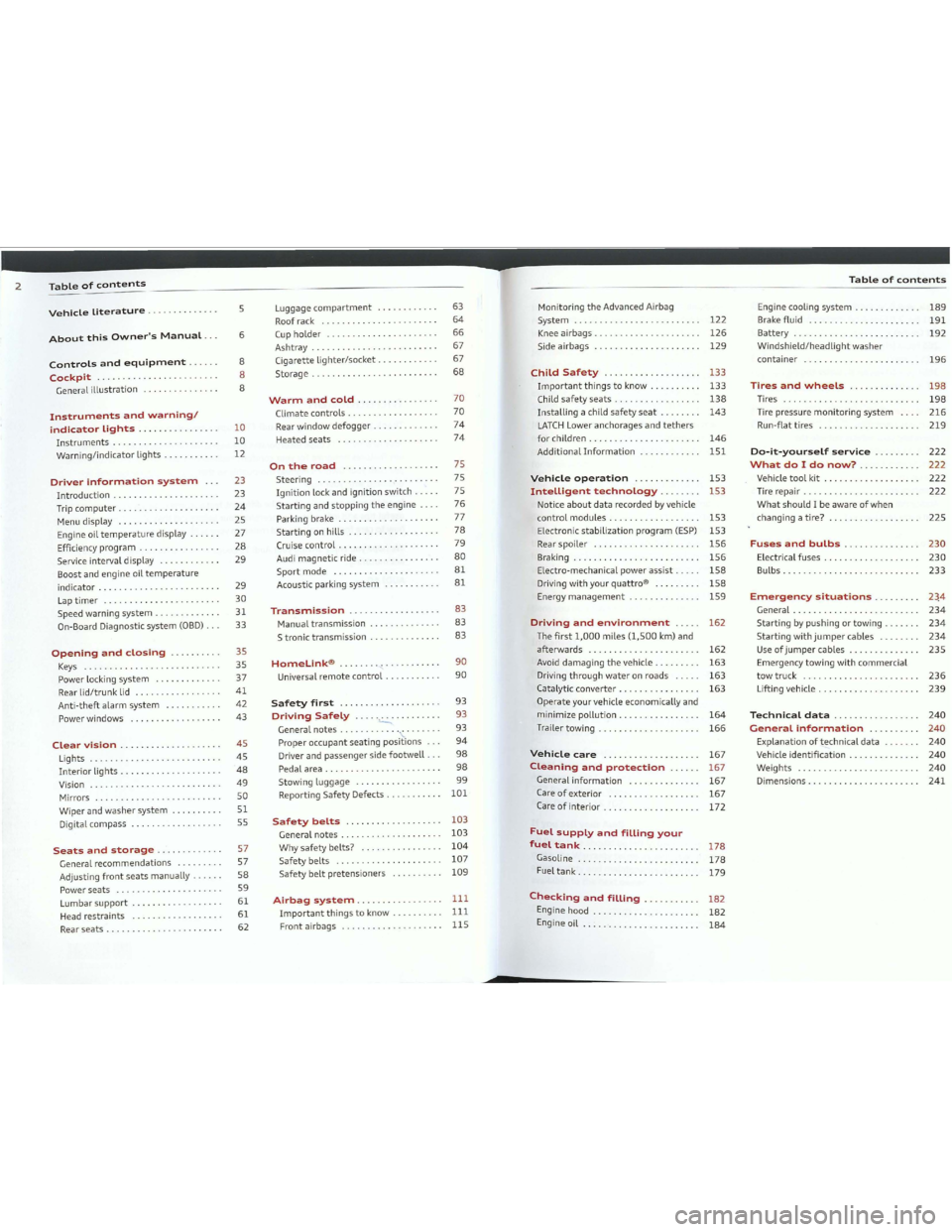
Downloaded from www.Manualslib.com manuals search engine 2TabLeofcontentsTabLeofcontents
VehicLeliterature.
AboutthisOwner'sManuaL...
ControLsandequipment.
Cockpit···.
Generalillustration......•......
Instrumentsandwarning/
indicatorlights.
Instruments.
Warning/indicatorlights.
Driverinformationsystem.
Introduction.
Trip
computer.
Menu display .
Engine
oiltemperaturedisplay .
Efficiency program .
Service
intervaldisplay .
Boost andengine
oiltemperature
indicator .
Laptimer.
Speed warning system .
On-Board Diagnostic system
(OBD).
Openingandclosing.
Keys. .
Power locking system .
Rear
lid/trunklid .
Anti-theftalarmsystem .
Power windows
.............•....
CLearvision.
Lights .
Interiorlights............•.......
Vision .
Mirrors .
Wiperandwasher system....•...
Digitalcompass... . . .... .
Seatsandstorage.
General recommendations .
Adjusting
frontseats manually .
Power seats .
Lumbar
support.
Head restraints .
Rear seats .
5
6
8
8
8
la
la
12
23
23
24
25
27
28 29
29
30
31 33
35
35
37
41
42
43
45
45
48
49
5051
55
57
57 58
59
61 61
62 Luggage
compartment....•.......
Roof
rack .
Cupholder.
Ashtray .
Cigarette
lighter/socket.
Storage
................•........
WarmandcoLd.
Climate controls .
Rearwindowdefogger.
Heated seats .
Ontheroad.
Steering .
Ignitionlockandignitionswitch .
5tartingandstoppingtheengine .
Parking brake .
5tartingonhills.
Cruise
control.
Audi
magneticride .
5portmode .
Acoustic parkingsystem .
Transmission.
Manualtransmission .
S
tronictransmission .
HomeLink®. . . . .
Universalremotecontrol.
Safetyfirst.
DrivingSafeLy~.
Generalnotes'\..
Proper occupant seatingpositions .
Driver andpassenger
sidefootwell.
Pedal area .
Stowing luggage .
Reporting SafetyDefects .
SafetybeLts.
Generalnotes.............•......
Whysafetybelts? .
Safety belts .
5afetybeltpretensioners .
Airbagsystem.
Importantthingstoknow.
Front airbags .63
64
66
67
67
68
70
70
74
74
75
75
75
76
77
78
79
80
8181
83
83
83
90
90
9393
93
94
98
98
99
101
103
103
104
107
109
111
111
115
MonitoringtheAdvanced Airbag
5ystem
122
Kneeairbags.. . . . . . . . . . . . . . . . . ...126
Sideairbags.. . . . . . . . . . . . . . . . . ...129
ChiLdSafety133
Importantthingstoknow . . . . . . . ...133
Childsafety seats. . . . . . . . . . . . . . ...138
Installingachild safety seat. . . . . ...143
LATCHLower anchorages andtethers
forchildren. . . . . . . . . . . . . . . . . . . ...146
AdditionalInformation151
Vehicleoperation153
InteLligenttechnoLogy. . . . . ...153
Noticeaboutdatarecorded byvehicle
controlmodules.. . . . . . . . . . . . . . ...153
Electronic stabilization program(ESP)153
Rearspoiler156
Braking. . . . . . . . . . . . . . . . . . . . . . ...156
Electro-mechanical powerassist. . ...158
Drivingwithyourquattro®158
Energymanagement.. . . . . . . . . . ...159
Drivingandenvironrnent.....162
Thefirst1,000miLes(l,500km)and
afterwards
162
Avoid damagingthevehicle . . .163
Drivingthroughwateronroads.....163
CataLytic converter . . . . . . . . . . . . . ...163
Operateyourvehicle economically and
minimize
pollution.. . . . . . . . . . . . ...164
Trailertowing. . . . . . . . . . . . . . . . . ...166
Vehiclecare167
CLeaningandprotection167
GeneraLinformation167
Careofexterior167
Careofinterior........•..........172
FueLsuppLyandfiLlingyour
fueLtank.............. ..... ....178
Gasoline. . . . . . . . . . . . . . . ...178
FueLtank.. . . . . . . . . . . . . . . . . . . . . .179
CheckingandfiLling. . . . . . . . ...182
Engine hood . . . . . . . . . . . ...182
Engineoil. • . . . . . . . . . ...184
Enginecooling system .
Brake
fluid.
Battery .
Windshield/headlightwasher
container .
TiresandwheeLs.
Tires.
Tire pressure
monitoringsystem .
Run-flat tires .
Do-it-yourseLfservice.
Whatdo1donow?.
Vehicletoolkit...........•.......
Tirerepair .
Whatshouldlbe awareofwhen
changing atire? .
FusesandbuLbs.
Electricalfuses .
Bulbs
....
Emergencysituations.
General .
5tartingbypushingortowing.
Starting
withjumpercabLes.
Useofjumpercables .
Emergency
towingwithcommercial
towtruck.
Lifting vehicle .
TechnicaLdata.
GeneraLinformation.
Explanationoft,:chnicaldata.
Vehicle
identification.
Weights .
Dimensions .
189
191
192
196
198
198
216
219
222
222 222
222
225
230
230
233
2~4
234
234
234
235
236
239
240
240
240
240
240
241
Page 56 of 132

Downloaded from www.Manualslib.com manuals search engine Howsafety beltpretensioners work
.AWARNING
Improperlywornsafetybeltsincreasethe
riskofseriouspersonalinjuryanddeath
wheneveravehicleisbeing used.
- Always make
surethatallvehicle occu
pantsarecorrectlyrestrainedandstayin
acorrectseatingpositionwheneverthe
vehicle isbeingused.
-Always readandheedallWARNINGSand
otherimportantinformation
qpage106.
iTips
Thesafetybeltpretensionercan only be
activatedonce.
- In
minorfrontalandsidecollisions,in
rear-end collisions,inarolloverandin
accidentsinvolving veryLittleimpact
force,thesafetybeltpretensionerare
notactivated.
-Whenthesafetybeltpretensionerisac
tivated,afinedustisreleased.Thisis
normalandisnotcausedbyafireinthe
vehicle.
- The
relevantsafetyrequirementsmust
beobservedwhenthevehicle orcompo
nentsofthesystemarescrapped.A
quaLified
dealershipis famiLiar with~
Safetybeltpreten
sioners
Thesafetybeltsforthefrontseatingpositions
areequippedwithsafetybeltpretensioners.
Thesystemisactivatedbysensorsinfront
andsidecollisionsofgreatseverity. Thistight
ensthebeltandtakesupbeltslackq.&.in
Service
anddisposa/ofsafetybe/tpreten
sioneronpage110.Taking uptheslackhelps
toreduceforwardoccupantmovementduring
a
coLLision.
In frontandside collisionsaboveaparticu/ar
severity,
safetybeltsinuseoretensionedau
tomatically.
Fig.111Releasing thetongue framthebuckle
Incorrect/ypositionedsafetybe/tsconcouse
severeinjuries.
Improperly wornsafety belts
•Neverpermitanyonetoassumeanincorrect
sitting position
inthevehiclewhiLetravelingq&,.
Wearingsafetybeltsimproperly cancausese
rious
injuryordeath.Safetybeltscan only
work when
theyarecorrectlypositionedon
thebody.Improperseatingpositionsreduce
the effectiveness
ofsafetybeltsand will even
increase
theriskofinjuryanddeathbymov
ingthesafetybelttocriticalareasofthe
body.Improperseatingpositionsalsoin
crease
theriskofseriousinjuryanddeath
when anairbag depLoysandstrikesanoccu
pant who
isnotinthecorrectseatingposi
tion. Adriver
isresponsibleforthesafetyof
all vehicleoccupantsandespecially forchil
dren. Therefore:
&WARNING
Neverunfastensafetybeltwhilethevehi
deismoving. Doingsowillincreaseyour
risk
ofbeing injuredorkilled.
unfastening safetybelts
~Pushtheredreleasebuttononthebuckle
c:>fig.111.ThebeLttonguewillspringout
ofthebucklec:>A·~Letthebeltwindupontheretractorasyou
guide
thebelttonguetoitsstowedposition.
klethesafetybe/twlththeredreleaseUnbuc on/yafterthevehidehasstopped.button~------r~--:I:=::::::::::-~
Toprovidemaximumprotection,safetybelts
mustalwaysbepositionedcorrectly
onthe
wearer'sbodyc:>page108.
~Adjustthefrontseatandheadrestraintcor
rectlyc:>page57,Genera/recommenda
tians.
~Makesuretheseatbackoftherearseat
benchisinuprightpositionandsecurely
latchedinplacebeforeusingthebelt.
~Holdthebeltbythetongueandpull it
evenLyacrossthechestandpelvis
c:>fig.110,c:>A.
~Insertthetongueintothecorrect buckleof
yourseatuntilyouhe~tlatchsecurely
c:>page107,fig.108.\..
~PulLonthebelttomakesurethatitisse
curely
latchedinthebuckle.
Pregnant womenmustalsobeproj)ërlyrestrained_.
AWARNING
Improperlypositionedsafetybeltscan
causeseriouspersonalinjuryinanacci
dent.
-Expectantmothersmustalwayswearthe
Lapportionofthesafetybeltaslowas
possibleacrossthepelvisandbelowthe
roundingoftheabdomen.
-Always readandheedallWARNINGS and
otherimportantinformationc:>lninFas·
teningsafetybe/tsonpage107.
Fig.110Safety beltposition duringpregnancy
Thebestwaytaprotectthefetusistamoke
surethotexpectantmothersa/ways wear
safetybe/tscorrect/y-throughoutthepreg
nancy.
AWARNING
Improperlypositionedsafetybeltscan
causeseriouspersonalinjuryinan acci
dent.
-The shouLder beLtportionofthesafety
beltmustbepositionedoverthemiddle
oftheoccupant'sshoulderandnever
acrosstheneckorthroat.
-Thesafetybeltmustlieflatandsnugon
theoccupant'supperbodyc:>fig.109.
Pull onthebelttotightenifnecessary.
- The lap
beltportionofthesafetybeLt
mustbepositionedaslowaspossible
acrosspelvisandneverovertheabdo
men.Makesurethebeltliesflatand
snugC:>fig.109.Pull onthebelttotight
enifnecessary.
- A
loose-fittingsafetybeltcancauseseri
ousinjuries byshifting itsposition on
your body
fromthestrongbonestomore
vuLnerable,softtissueandcauseserious
injury.
-
ALwaysreadandheed allWARNINGSand
otherimportantinformation
c:>poge106.
Safety beltposition
Fig.109Head restraint andsafety beltposition as
seen framtheside
Correctbe/tpositionisthekeytagetting
maximumprotectionfromsofetybe/ts.
Usetheheightadjustmenttochangetheposi
tion
oftheshouLderstrapsofthefrontseat
safetybelts.
Page 75 of 132

Downloaded from www.Manualslib.com manuals search engine AWARNING
ImproperuseofLATCHloweranchorages
cancauseseriouspersonalinjuryinanac
cident.
-
ALwaysca refully followthechildre
straintsmanufacturer'sinstructionsfor
properinstallationofthechildrestraint
andproperuseoftheloweranchorages
orsafetybeltsinyourvehicle.
- Never
secureorattachanyluggageor
otheritemstotheLATCHlower ancho
rages.
-
ALwaysreadandheedtheimportantin
formationaboutchiLdrestraintsinthis
chapterandWARNINGS9page133,
ChildSafety.
Lower anchorages
The lower
anchorageattachmentpointsare
locatedbetweentherearseatbackandrear
seatcushion9fig.126.
Loweranchoragessecurethechildrestraintin
theseatwithoutusingthevehicle'ssafety
belts. Anchorages provideasecureandeasy
to'useattachmentandminimizethepossibili
ty
ofimproperchildrestraintinstallation.
AllchildrestraintsmanufacturedafterSep
telilberl,2002,musthave loweranchorage
attachmentsfortheLATCHsystem.
Rememberthattheloweranchoragepoints
areonlyintendedforinstallationandattach
mentofchildrestraintsspecifically certified
forusewithLATCHloweranchorages.Child
restraintsthatarenotequippedwiththelow
eranchorageattachmentscan stillbeinstal
Ledincompliancewiththechildrestraint
manufacturer'sinstructionsonusing vehicle
safetybeLts.
Attachment
locatormarkers
forlower
anchorages
Circular Locator
buttonsontherearseatback
indicatetheloweranchoragelocationsonthe
rearseatingpositions9fig.125.
_Inothercountries,theterm"ISOFIX"is
usedtodescribetheloweranchorages.
Fig.125Rearseatbacks: locatorbuttonsforlower an
chorages
Fig.126Rear seats: loweranchorage bracketlocations
Fig.1245chematic overview:LATCHanchorage pointlocations
Description
Location
Theloweranchoragepositionsaremarked
for
quick locating.
Theillustrationshowstheseatinglocationsin
yourvehicle whichareequippedwiththelow
er universaL
anchoragessystem.
--
AWARNING
Improperinstallationofchildrestraints
will increasetheriskofinjuryanddeathin
acrash.
- Always follow
theinstructionsprovided
by
themanufacturerofthechild re
straintyouintendtoinstalLinyourvehi
cleo
-Neverinstallachildrestraintwithouta
properly
attachedtoptetherstrapifthe
childrestraintmanufacturer'sinstruc
tionsrequirethetoptetherstraptobe
used.
-ImproperuseofchildrestraintLATCH
loweranchoragepGÎlüscan leadtoinjury
in acollision. The
LATCHloweranchorage
pointsaredesignedtowithstandonly
thoseloadsimposedbycorrectlyfitted
childrestraints.
-Nevermounttwochildrestraintsystems
ononeLATCHloweranchoragepoint.
- Never
secureorattachany lu.g.gage or
otheritemtotheLATCHLoweranchorag
es.
ChildrestraintmanufacturersofferLATCH
loweranchoragesontheirchildseatswith
hook-on
orpush-onconnectorsattachedto
adjustablestraps.
InadditiontotheLATCHloweranchorages,
thesechildrestraintsystemsusually require
theuseoftetherstrapstohelpkeepthechiLd
restraintfirmlyinplace.
Installingachildrestraintthatrequires atop
tetherwithoutonecanseriously impairthe
performanceofthechildrestraintanditsabil
ity
toprotectthechildina collision. Installing
a child
restraintthatrequires atoptether
withoutthetoptethermaybeaviolation of
stateLaw.
r((DTips
-InCanada,theterms"toptether"with
"loweruniversalanchorages"(or"lower
universal
anchoragebars")areusedto
describethesystem.~
ChildSafety
feature.IftheconvertibleLockingretractoris
notdeactivated,thesafetybeltwill gradually
becometighteranduncomfortabletowear.
LATCHLower
anchoragesandtethers
forchildren
Child Restraint Systemanchors andhow
are they relatedtochild safety
AWARNING
Improperlyinstalledchildsafetyseatsin
creasetheriskofseriouspersonalinjury
anddeathinacollision.
- Never
unfastenthesafetybelttodeacti
vatetheconvertiblelockingretractorfor
childrestraintswhilethevehicle ismov
ing.
Vouwouldnotberestrainedand
couldbeseriously injuredinanaccident.
-AlwaysreadandheedallWARNINGS
wheneverusing achildrestrainedinave
hicle
isbeing used9page133.Special
precautionsapplywheninstalling achild
safetyseatonthefrontpassengerseat
9page113,Childrestraintsonthefront
seat-someimportantthingstoknow.
Toprovide asimplerandmorepracticable way
toattachthechildrestraintonthevehicle
seat,Federalregulationsrequirespeciallower
anchoragesinvehiclesanddevicesonnew
child
restraintstoattachtothevehicle ancho
rages.
The
combinationofthetetheranchoragesand
theloweranchoragesis nowgenerallycalled
theLATCHsystemfor "LowerAnchoragesand
TethersforChildren." InCanada,theterms
"toptether"with"Lower universalanchorag
es"(or"lower universalanchoragebars")are
used
todescribethesystem.
Forward-facing childrestraintsmanufactured
afterSeptemberl,1999,arerequiredbyU.S.
federalregulationstocomplywithnewchild
head
movementperformancerequirements.
These newperformancerequirementsmakea
tethernecessaryonmostnewchildseats.
Page 93 of 132
Downloaded from www.Manualslib.com manuals search engine 182Checkingandfilling
----
-
missionto"P"(Park);putmanual
transmissioninNeutral.
- Always
useextremecautiontoprevent
clothing, jewelry,orlong hairfromget
tingcaughtintheradiatorfan,V-belts
or
othermovingparts,orfromcontact
inghotparts.Tie back hairbefore
starting,andwearnoclothingthatwill
hangordroopintotheengine.
-Minimizeexposuretoemissionand
chemicalhazardsq,&.
.&.WARNING
California Proposition65Warning:
- Engine
exhaust,someofitsconstituents,
andcertainvehiclecomponentscontain
(Jremitchemicals knowntothe5tateof
Californiatocausecancerandbirthde
fectsandreproductiveharm.Inaddition,
certainfluidscontainedinvehiclesand
certainproductsofcomponentwearcon
tainoremitchemicalsknowntothe
5tateofCaliforniatocausecancerand
birthdefectsorotherreproductiveharm.
-Batteryposts,terminalsandrelatedac
cessoriescontainleadandleadcom
pounds,chemicalsknowntothe5tateof
Californiatocausecancerandreproduc
tive
harms.Washhandsafterhandling.
«!»Forthesakeoftheenvironment
Todetectleaksintime,inspectthevehicle
floor pan
fromunderneathregularly.If
youseespotsfromoilorothervehicle flu
ids, have your vehicle
inspectedbyanau
thorizedAudidealer.
rCDNote
Whenaddingfluids, always makesurethat
theyarepouredintothepropercontainer
orfilleropening,otherwiseseriousdam
agetovehiclesystemswilloccur.
_Applytheparking brake.
_Moveselectorleverofautomatictrans
missionto"P"(Park);putmanualtrans
missioninNeutral.
_Alwayslettheenginecooldown. Hot
componentswillburn skinoncontact.
_Toreducetheriskofbeingburned,never
openthehood ifyouseeorhearsteam
orcoolantescapingfromtheengine
compartment.Waituntilnosteamor
coolantcanbeseenor heardbeforecare
fully
openingthehood.
- Keep children away
fromtheenginecom
partment.
-Never spillfluids onhotenginecompo
nents.Theycancauseafire.
-Nevertouchtheradiatorfan. Theauxili
ary electric fan
istemperaturecontrolled
andcanswitch onsuddenly.
- Never
openthecoolantreservoir cap
when
theengineisstillwarm.The cool
antsystemispressurizedandhotcool
antcould sprayout.
-Protectyourface,handsandarmfrom
steamorhotenginecoolantbyplacing a
thick ragover
thecapwhenyouopenthe
coolantreservoir.
-Ifworkonthefuelsystemortheelectri
cal
systemisnecessary:
- Always
disconnectthebattery.
- Neversmokeor worknearheatersor
openflames.Fluidsintheenginecom
partmentcouldstartafire.
-Keepanapprovedfireextinguisherim
mediatelyavailable.
-Toavoid electrical shockandpersonalin
jury while
theengineisrunning orbeing
started,nevertouch:
-Ignitioncables
-Othercomponentsofthehighvoltage
electronic ignitionsystem.
-Ifyoumustperformacheckorrepair
with
theenginerunning:
-First, fullyapplytheparking brake,
move
selectorleverofautomatictrans-
AWARNING
A hood
thatisnotcompletelylatched
could flyupandblock yourview while driv
ing.
-
Whenyou closetheenginehood, checkit
tomakesurethesafetycatchhasproper
lyengaged.The hoodshouldbeflush
withthesurroundingvehicle bodyparts.
-
Ifyounotice whiledrivingthatthehood
is
notsecuredproperly,stopatonce and
closeit.
.&.WARNING
Hotenginecoolantcanburn you.
-
Toreducetheriskofbeingburned,never
openthehood ifyouseeorhearsteam
orcoolantescapingfromtheengine
compartment.Waituntilnosteamor
coolantcanbeseenorheardbeforecare
fully
openingthehood.
.&.WARNING
Tohelp avoid injury,beforeyoucheck any
thingunderthehood:
- 5witch
offtheengine.
- Removetheignition key.
Closingtheenginehood•
~Pullthehooddownuntilthepressurefrom
thestrutsisreduced.
~Letthehooddropdownandlatchinplace.
Donottrytopushitshut;itmay failtoen
gageq.LÎ::l,..
Workingintheenginecompartmëii!f"-Beespecially carefulwhen8J(eryouworkin
theenginecomportment!
Wheneveryoumustperformanyworkinthe
enginecompartment,forexamplechecking
andfillingthedifferentfluids,thereisarisk
ofinjury,burnsandaccidents.Toprevent
personalinjuryalwaysobservethefollowing
WARNINGS. The
enginecompartmentofany
vehicleisahazardousarea!q.&
The enginehoodisreleosed frominsidethe
vehicle.
Releasingtheenginehood
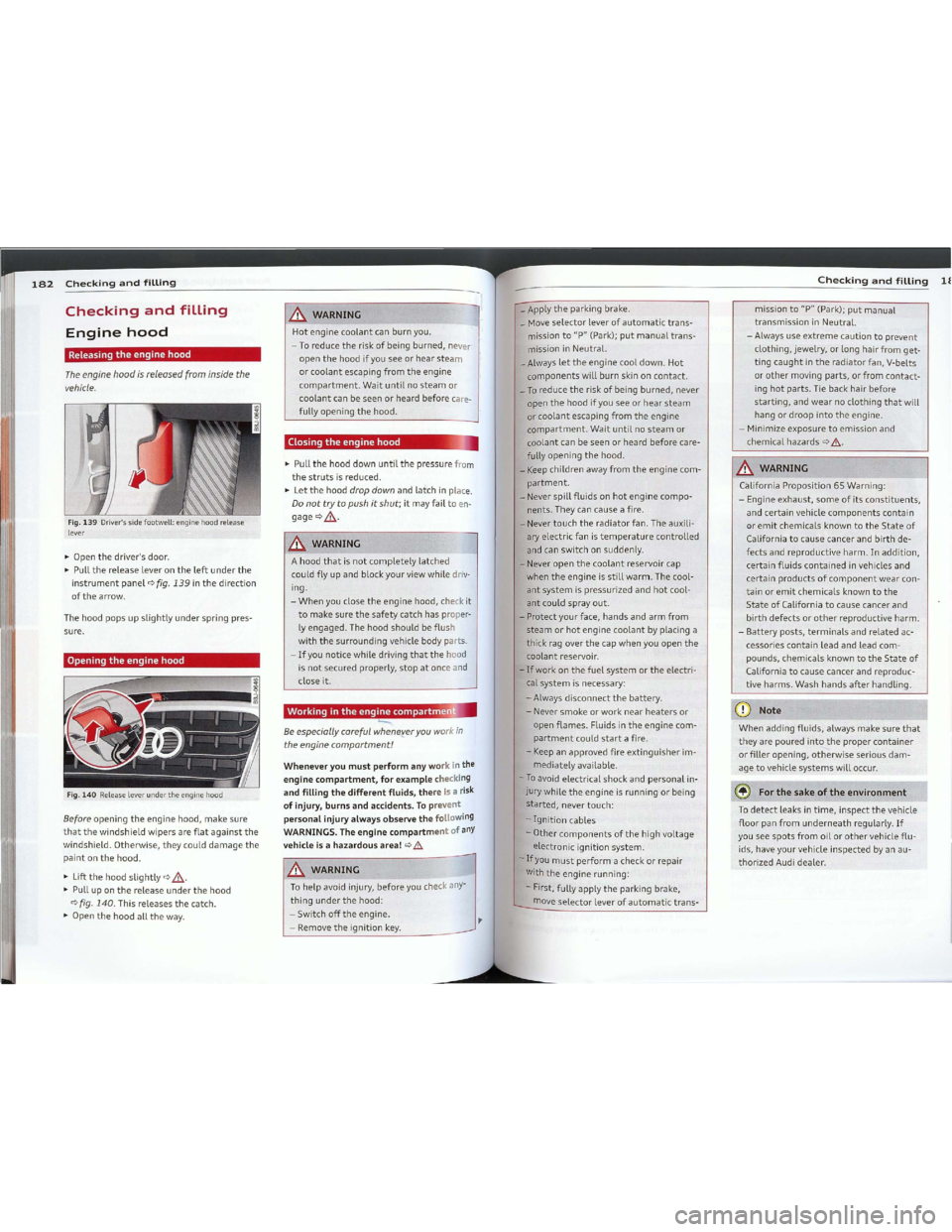
Fig.139Driver's sidefootwell: enginehoodrelease
lever
Checkingandfilling
Enginehood
Openingtheenginehood
~Openthedriver's door.
~Pullthereleaseleverontheleftunderthe
instrumentpanelqfig.139inthedirection
ofthearrow.
Fig.140Release leverundertheengine hood
Thehoodpopsupslightlyunderspringpres
sure.
Beforeopeningtheenginehood, makesure
thatthewindshield wipers areflatagainstthe
windshield.Otherwise,theycoulddamagethe
paintonthehood.
~Liftthehoodslightlyq.LÎ::l,..
~Pulluponthereleaseunderthehood
qfig.140.Thisreleasesthecatch.
~Openthehoodalltheway.
Page 104 of 132

Downloaded from www.Manualslib.com manuals search engine 204TiresandwheelsTiresandwheels20
weightofalloftheoccupantsandluggageor
othercargothatthevehiclecancarry. Forthe
locationofthetirepressurelabelqfig.150.
AWARNING
Overloading avehicle cancauselossofve-
hicle
control,a crash orotheraccident,se-
riouspersonalinjury,andevendeath.
- Carryingmoreweightthanyour vehicle
wasdesignedtocarry willpreventthe
vehiclefromhandlingproperlyandin-
creasetheriskofalossofvehicle con-
trol.
- The brakes onavehicle
thathasbeen
overloaded maynotbeabletostopthe
vehiclewithinasafedistance.
-Tires onavehiclethathasbeenoverload-
ed can
failsuddenlycausing lossofcon-
trolandacrash.
AWARNING
-Incorrecttirepressuresand/orunderin-
flation canlead
toaseriousorfatalacci-
dent.
-Incorrecttirepressuresand/orunderin-
flation
causeincreased tirewearandcan
affectthehandlingofthevehicle.
-
Incorrecttirepressuresand/orunderin-
flation can
alsoleadtosuddentirefail-
ure, including a
blowoutandsuddende-
flation,
causinglossofvehiclecontrol.
Checkingtirepressure
Thecorrect tirepressure forthe tires originol
Iyinstolled onyourvehicleislistedonthe tire
pressure
lobellocotedon driver's sideB-pil
lar.
Therecommendedtirepressuresareonthe
tirepressurelabelandinthetable
qpage 202,Coldtireinflation pressure.This
meansthatthepressuremustbechecked and
adjustedwhenthetirehasnotbeendriven for
morethanacoupleofmiles (kilometers)at
lowspeedsduringthepreviousthreehours.
Airinthetiresexpandswhenthetireheatsup
asaresultofinternalfrictionasitflexesin
use. Thetirepressureishigherwhenthetire
has
warmedupthanwhenitis"cold."
ltistheinflationpressureina "cold" tirethat
counts.Therefore, youshouldneverletairout
ofawarmtiretomatch"Cold tireinflation
pressure"recommendationsqpoge 202.The
tireswouldthenbeunderinflatedandcould
failsuddenly.
Thetirepressurelabel onyourAudiliststhe
recommendedcoldtireinflationpressuresfor
thenew, originalequipmenttiresthatwere
on
yourvehicleatthetimeitwasmanufac
tured.Forthelocationofthelabel
qpage 202,fig.150.
Mosttireslose air naturally overtime.They
can
alsolosesomeairifyou drive overapot
hole
orhit acurb while parking.ltisusually
notpossibletoseewhethertheradial tires
used
todayareunderinflatedjustbylooking
atthem.
Therefore,besuretocheck tirepressuresat
leastonceamonthandalwaysbeforegoing
on along trip.Make
suretotakethenumber
ofpeopleandtheamountofluggageintoac
countwhenadjustingtirepressureforatrip
evenonethatyou wouldnotconsidertobe
"long."Seeqpage 206,Tiresandvehicle
load limits
formoreimportantinformation.
Always use
anaccuratetirepressuregauge
whencheckingandadjustinginflation pres
sures.Checkallofthetiresandbesurenotto
forgetthesparetire.Ifthepressureinany tire
istoohighwhenthetireis"cold,"letairout
ofthetire slowly withtheedgeofthetire
gaugeandkeepcheckingthepressureuntil
you reach
thepressurethatiscorrect forthe
load(passengersandluggage)andkindof
driving youplan
todo.
Ifthepressureinanytire istoolow,notethe
differencebetweenthepressureinthecold
tire
andthepressureyou need and addtheair
thatyouneedtoreachthecorrectpressure for
thevehicleload(passengersandluggage) for
thetiresonyourvehicleaslistedontheon
your vehicle
andinthismanualandthekind
ofdriving youplantodo. Never
exceedthemaximuminflationpres
surelistedonthetiresidewallforanyrea
son.
Rememberthatthevehiclemanufacturer,not
thetiremanufacturer,determinesthecorrect
tirepressureforthetireson your vehicle.
Itisimportanttocheckthetirepressurewhen
thetiresarecold.
_Readtherequired tirepressurefromthetire
pressure
labellocatedon driver's sideB-pil
lar.
_ Turn
thevalvestemcapcounter-clockwise
toremove itfromthetire valve.
_ Place
theairpressuregaugeonthevalve.
- The tire
pressuresshouldonlybechecked
and
adjustedwhenthetiresarecold. The
slightly raised
pressuresofwarmtiresmust
notbereduced.
- Adjust
thetirepressuretotheload youare
carrying.
-Reinstallthevalvestemcap onthevalve.
Whenshould1checkthetirepressure?
Thecorrecttirepressureisespecially impor
tantathighspeeds.Thepressureshould
thereforebecheckedatleastonceamonth
and alwaysbeforestartingajourney.
Whenshould1adjustthetirepressures?
Adjustthetirepressuretotheload youare
carrying. Afterchangingawheelorreplacing
wheels youhave
toadjustthetirepressures
onallwheels.Inaddition, youmusttheniniti
alize
thenewtirepressuresinthetire pres
Sure
monitoringsystemqpage216.
lÀWARNING
Incorrecttirepressuresand/orunderinfla
tion canleadsuddentirefailure, lossof
control, collision,seriouspersonalinjury
or even
death.
-Whenthewarningsymbol[D]appearsin
theinstrumentcluster,stopandinspect
thetires.
-
Incorrecttirepressureand/orunderinfla
'-tion cancauseincreased tirewearand
canaffectthehandlingofthevehicleand
stoppingability.
-
Incorrecttirepressuresand/orunderin
flation can
alsoleadtosuddentirefail
ure, including a
blowoutandsuddende
flation,causing lossofvehiclecontrol.
- The driver
isresponsibleforthecorrect
tire
pressuresforalltiresonthevehicle.
The
applicablepressurevaluesarelocat
ed on asticker on
thedriver's sideB-pil
lar.
- Only
whenalltiresonthevehiclearefil
Ledtothecorrectpressure,thetire pres
suremonitoringsystemcanwork cor
rectly.
- The use
ofincorrecttirepressurevalues
c~nleadtoaccidentsorotherdamage.
Therefore itisessentialthatthedriver
observethespecifiedtirepressurevalues
forthetiresandthecorrectpressuresfor
thefunctionofthetirepressuremonitor
ingsystem.
-Always inflatetirestotherecommended
andcorrecttirepressurebeforedriving
off.
-Driving withunderinflatedtiresbend
more,lettingthemgettoohotresulting
intreadseparation,suddentirefailure
andlossofcontrol.
-Excessivespeedand/overloadingcan
causeheatbuild-up,suddentire failure
andlossofcontrol.
-Ifthetirepressureistoolowortoohigh,
thetireswillwearprematurelyandthe
vehicle willnothandlewell.
-
Ifthetireisnotflatandyoudonothave
tochangeawheelimmediately, driveat
reducedspeedtothenearestservicesta
tiontocheckthetirepressureand add
airasrequired.
rCDNote
Drivingwithoutvalvestemcapscancause
damagetothetire valves.Topreventthis,
always makesurethatfactory installed
valve
stemcapson allwheelsaresecurely
mountedonthevalve.
1
Page 106 of 132
Downloaded from www.Manualslib.com manuals search engine 208Tiresandvvheels
0:>fig.152runningacrossthetread.Depend
ing on
themake,therewill besixtoeightof
themevenlyplacedaroundthetire. Marks on
thetiresidewall(forexample"TWI"orother
symbols)indicatethepositionsofthetread
wearindicators. Worntiresmustbereplaced.
Different
figuresmay applyinothercountries
o:>A.
Tirepressure
Incorrecttirepressurecausesprematurewear
andcancausesuddentireblow-out. Forthis
reason,tirepressuremustbecheckedatleast
once amonth0:>page204.
Drivingstyle
Drivingfastaroundcurves, heavyacceleration
and hard braking increase tirewear.
Rotatingtiresformoreevenwear
Forallfourtiresonyour vehicletohavethe
sameservice life,werecommendthatthe
frontandreartiresarerotatedaccordingto
thetiremanufacturer'ssuggestedtire rota
tion intervals.
Pleaserememberthefollow
ing:
- Tire
rotationintervalsmay differfromthe
vehicle service intervalsoutlinedinyour
Warranty&MaintenanceBooklet.
- The
longeronetireisusedinonelocation
onthevehicle,themoreitwearsatcertain
points;therefore,werecommendthatyou
follow
thetiremanufacturer'ssuggested
tirerotationintervals.
- Vehicles with
front-wheeldriveexperience
moretreadwearonthefrontwheelscom
pared
toall-wheeldrive(quattro"').
- Pleaserotatetiresasshown0:>fig.153.
-Extra caremustbetakenwhenrotatingdi-
rection-specifie tires
0:>page229.
Wheelbalancing
Thewheelsonnewvehiclesarebalanced.
However, varioussituationsduringeveryday
driving can
causethemtobecomeunbal
anced,resultinginvibrations youcanusually
feelthroughthesteeringwheel.
-----Unbalancedwheelsmustberebalancedto
avoid excessivewearonsteering,suspension
and tires. A
wheelmustalsoberebalanced
whenanewtireisinstalled.
Incorrectwheelalignment
Incorrectwheelalignmentcancauseexces
sive tirewear, impairing
thesafetyofthevehi
cle.Iftiresshowexcessive wear,havethe
wheelalignmentcheckedbyanauthorized
Audi
dealerorqualified workshop.
all-wheeldrive
Vehicleswithquattro"'mustalwayshavetires
ofthesamesize,constructionandtreadtype.
For
detailssee0:>page158.
.&.WARNING
Suddentire failure canleadtolossofcon
trol,acrash andseriouspersonalinjury!
- Never driveavehicle
whenthetreadon
any tireisworn downtothewearindica
tors.
-Worn tiresareasafetyhazard,theydo
notgrip well onwetroads andincrease
yourriskof"hydroplaning" andlossof
control.
- Always keep
chemicalsthatcancause
tiredamage,suchasgrease,oil,gasoline
andbrake fluidawayfromtires.
- Tires
ageeven iftheyarenotbeing used
andcanfailsuddenly, especiallyathigh
speeds.Tiresthataremorethan6years
old can only beused
inanemergency
andthenwith special careandatlower
speeds.
-Nevermountusedtireson your vehicleif
youarenotsureoftheir"previous histo'
ry."
Oldused tiresmayhave beendam'
agedeventhoughthedamagecannotbe
seenthatcanleadtosuddentirefailure
andlossofvehicle control. New
tiresandreplacingtiresandwheels
Newtiresandwheels
havetobebroken in.
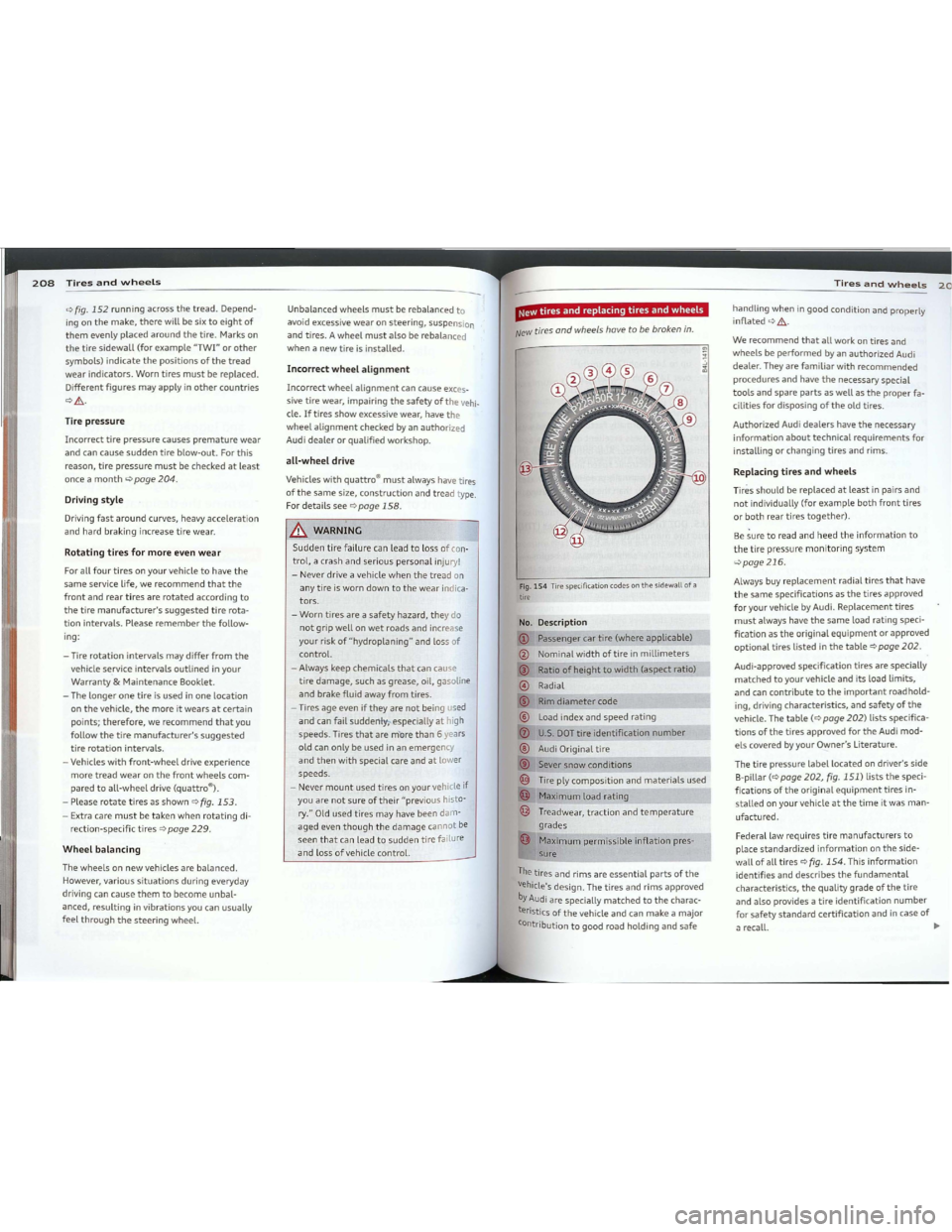
Fig.154Tirespecification codesonthesidewall ofatire
No.Description
@Passengercartire(where applicable)
®Nominal widthoftireinmillimeters
®Ratioofheighttowidth(aspectratio)
@Radial
®Rimdiametercode
®Loadindex andspeedrating
@Maximum loadrating
@Treadwear,tractionandtemperature
grades
@Maximum permissible inflationpres
sure
Thetiresandrimsareessentialpartsofthe
vehicle's design.Thetires andrims approved
byAudiarespeciallymatchedtothecharac
teristics
ofthevehicleandcanmakea major
COntribution
togood roadholding andsafe
Tiresandvvheels20
handling wheningoodcondition andproperly
inflated0:>A.
Werecommendthatallwork ontires and
wheelsbeperformedbyanauthorized Audi
dealer. Theyarefamiliar with
recommended
proceduresandhavethenecessary speciaL
toolsandsparepartsaswellastheproperfa
cilities fordisposing
oftheoLdtires.
Authorized Audi
dealershavethenecessary
information
abouttechnicalrequirementsfor
installing
orchanging tiresandrims.
ReplacingtiresandwheeLs
Tiresshould bereplacedatleastinpairsand
notindividually (forexamplebothfronttires
orbothreartirestogether).
Se sure
toread andheedtheinformationto
thetirepressuremonitoringsystem
0:>page216.
Always buyreplacementradialtiresthathave
thesamespecifications asthetiresapproved
foryourvehiclebyAudi.Replacementtires
mustalways havethesameloadrating speci
fication
astheoriginalequipmentor approved
optionaL tireslisted
inthetableo:>page202.
Audi-approved specificationtiresarespecially
matchedtoyourvehicleanditsload limits,
andcancontributetotheimportantroadhold
ing, driving characteristics, and
safetyofthe
vehicle.Thetable(0:>page202)listsspecifica
tionsofthetires approved fortheAudimod
elscoveredbyyourOwner's Literature.
The tire
pressurelabellocatedondriver'sside
S-pillar
(0:>page202,fig.151)liststhespeci
fications
oftheoriginalequipmenttires in
stalledonyour vehicleatthetimeitwasman·
ufactured.
Federallawrequires tiremanufacturersto
placestandardizedinformation ontheside
wall
ofall tires0:>fig.154.This information
identifies anddescribes
thefundamental
characteristics,thequalitygradeofthetire
andalso provides atireidentificationnumber
forsafetystandardcertification andincaseof
arecall.~
Page 107 of 132
Downloaded from www.Manualslib.com manuals search engine ~T~i~re~s-.:a~n~d~vv~h'.':e~e~l=s~______
Tirespecifications
Knowledgeoftirespecificationsmakesiteas
ier
tochoosethecorrecttires. Radialtires
havethetirespecificationsmarked onthe
sidewall,forexample:
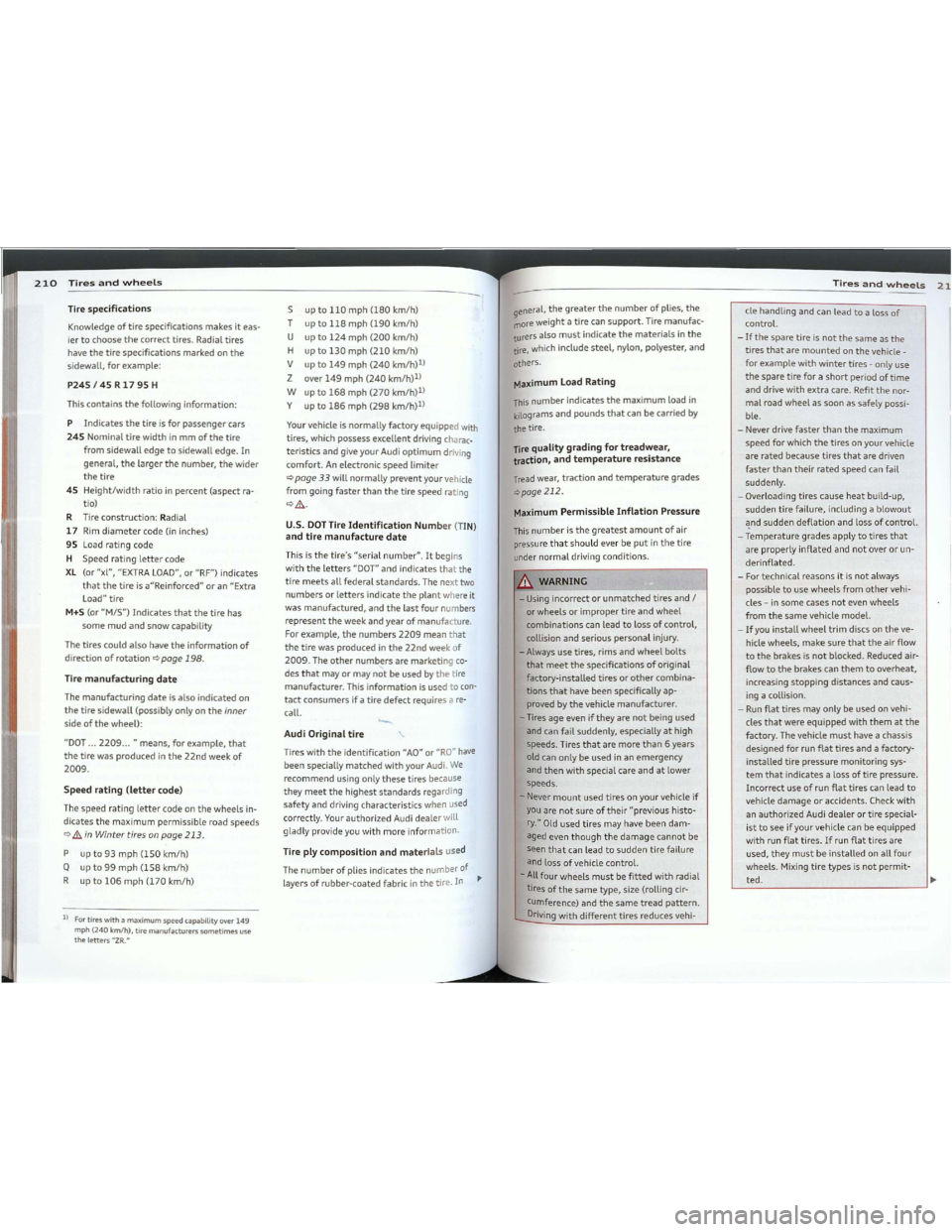
P245145R1795H
This
containsthefollowinginformation:
PIndicatesthetire isforpassengercars
245Nominaltirewidthinmmofthetire
fromsidewalledgetosidewalledge.In
general,thelargerthenumber,thewider
thetire
45Height/widthratioinpercent(aspectra-
tio)
R Tire
construction:Radial
17Rimdiametercode (ininches)
95Load ratingcode
HSpeedratinglettercode
XL(or"xl","EXTRALOAD",or"RF") indicates
thatthetireisa"Reinforced" oran"Extra
Load" tire
M+5 (or
"MIS")Indicatesthatthetirehas
somemudandsnowcapability
The
tirescouldalsohavetheinformationof
directionofrotation9page198.
Tiremanufacturingdate
Themanufacturingdateisalsoindicated on
thetiresidewall(possiblyonlyontheinner
sideofthewheell:
"DOT...2209..."means,forexample,that
thetirewasproducedinthe22ndweekof
2009.
Speedrating(Iettercode)
Thespeedratinglettercode onthewheelsin
dicatesthemaximumpermissibleroadspeeds
9,&.inWintertires onpage 213.
Pupto93mph(150km/hl
Qupto99mph(158km/hl
Rupto106mph(170km/hl
1)For tireswithamaximum speedcapabiUty over149mph(240km/hl,tiremanufacturerssometimesusetheletters"ZR."
SUpto110mph(180km/hl
Tupto118mph(190km/hl
Uupto124mph(200km/hl
Hupto130mph(210km/hl
V upto149mph(240km/h)l)
Zover149mph(240km/h)ll
W upto168mph(270km/h)ll
V upto186mph(298km/h)ll
Vour vehicle isnormallyfactoryequippedwith
tires,whichpossessexcellentdriving charac
teristicsandgiveyour Audioptimumdriving
comfort.Anelectronicspeedlimiter
9page33willnormallypreventyour vehicle
fromgoingfasterthanthetirespeedrating
9,&..
U.5.DOTTireIdentificationNumber(TIN)andtiremanufacturedate
Thisisthetire's"serialnumber".Itbegins
withtheletters"DOT"andindicatesthatthe
tire
meetsallfederalstandards.The next two
numbersorlettersindicatetheplantwhereit
wasmanufactured,andthelastfournumbers
representtheweekandyearofmanufacture.
For
example,thenumbers2209meanthat
thetirewasproducedinthe22ndweekof
2009.Theothernumbersaremarketingco
desthatmay ormaynotbe usedbythetire
manufacturer.Thisinformationisusedtocon
tactconsumersifatiredefectrequires are
call.
AudiOriginaltire
Tires withtheidentification"AO"or"RO"have
beenspeciallymatchedwithyour Audi.We
recommendusing onlythesetiresbecause
theymeetthehigheststandardsregarding
safetyanddrivingcharacteristicswhen used
correctly. Vour
authorizedAudidealerwill
gladly provide youwith
moreinformation.
Tire
plycompositionandmaterialsused
Thenumberofpliesindicatesthenumberof
layers
ofrubber-coatedfabricinthetire.In~
--general,thegreaterthenumberofplies,the
oreweighta tire cansupport.Tiremanufac
rnrsalsomustindicatethematerialsintheture
. e which includesteel,nylon, polyester,andtir,
others.
MaximumLoadRating
Thisnumberindicatesthemaximumloadin
kilogramsandpoundsthatcanbecarriedby
thetire.
Tire
qualitygradingfortreadwear,traction,andtemperatureresistance
Tread wear,tractionandtemperaturegrades
Qpage212.
MaximumPermissibleInflationPressure
Thisnumberisthegreatestamountofair
pressure
thatshouldever beputinthetire
under
normaldriving conditions.
WARNING
-Usingincorrectorunmatchedtiresand/
or
wheelsorimpropertireandwheel
combinationscan leadtolossofcontrol,
collisionandseriouspersonalinjury.
- Always
usetires, rimsandwheelbolts
thatmeetthespecificationsoforiginal
factory-installed
tiresorothercombina
tionsthathavebeenspecifically ap
proved by
thevehiclemanufacturer.
-Tiresageeveniftheyarenotbeingused
and canfailsuddenly, especially
athigh
speeds.Tiresthataremorethan6years
oldcan onlybeusedinanemergency
andthenwith special careandatlower
speeds.
-Nevermountusedtiresonyourvehicle if
you
arenotsureoftheir"previous histo
ry."Oldusedtiresmayhavebeendam
agedeventhoughthedamagecannotbe
seenthatcanleadtosuddentirefailure
and loss
ofvehicle control.
-Allfourwheelsmustbefittedwithradial
tires
ofthesametype, size(rolling cir
cumference)
andthesametreadpattern.
Drivingwithdifferenttiresreducesvehi-
dehandlingandcan leadtoalossofcontrol.
-
Ifthesparetire isnotthesameasthe
tiresthataremountedonthevehide
forexamplewithwintertires-onlyuse
thesparetireforashortperiodoftime
anddrive withextracare.Refitthenor
malroadwheelassoonassafely possi
ble.
- Never drive
fasterthanthemaximum
speedforwhichthetiresonyour vehicle
areratedbecausetiresthataredriven
fasterthantheirratedspeedcanfail
5uddenly.
- Overloading
tirescauseheatbuild-up,
suddentire failure, including ablowout
andsuddendeflationandlossofcontrol.
-
Temperaturegradesapplytotiresthat
areproperlyinflatedandnotoverorun
derinflated.
- Fortechnicalreasonsitisnotalways
possible
tousewheelsfromothervehi
cles -
insomecasesnotevenwheels
fromthesamevehicle model.
-
Ifyouinstallwheeltrimdiscs ontheve
hicle
wheels,makesurethattheair flow
tothebrakes isnotblocked. Reducedair
flow
tothebrakescanthemtooverheat,
increasingstoppingdistancesandcaus
ing acollision.
- Run
flattiresmay only beused onvehi
cles
thatwereequippedwiththematthe
factory. Thevehiclemusthave achassis
designedforrunflattiresandafactory
installedtirepressuremonitoringsys
temthatindicatesa lossoftirepressure.
Incorrectuseofrunflattirescan leadto
vehicledamageoraccidents. Checkwith
anauthorizedAudidealerortire special
ist
toseeif your vehicle canbeequipped
withrunflattires.Ifrunflattiresare
used,theymustbeinstalledonallfour
wheels.Mixingtiretypesisnotpermit-
~.~
Page 110 of 132

Downloaded from www.Manualslib.com manuals search engine 216Tiresand\NheelsTiresand\Nheels217
Tirepressure
monitoringsystem
GeneralnotesApptiestovehicles:withtirepressuremonitoringsystem
Eachtire,includingthespare(ifprovided),
shouldbecheckedmonthlywhencoldandin
flatedtotheinflationpressurerecommended
bythevehiclemanufactureronthevehicle
placard
ortireinflationpressurelabel.(Ifyour
vehiclehastiresofadifferentsizethanthe
sizeindicatedonthevehicleplacardortirein
flationpressurelabel,youshoulddetermine
thepropertireinflationpressureforthose
tires.)
Asanaddedsafetyfeature,yourvehiclehas
beenequippedwithatirepressuremonitoring
system(TPMS)thatilluminatesa lowtire
pressuretelltalewhenoneormoreofyour
tiresissignificantlyunder-inflated.According
ly,whenthelowtirepressuretelltaleillumi
nates,youshouldstopandcheckyourtiresas
soonaspossible,andinflatethemtothe
properpressure.Drivingonasignificantlyun
der-inflatedtirecausesthetiretooverheat
andcanleadtotirefailure.Under-inflational
soreducesfuelefficiencyandtiretreadlife,
andmayaffectthevehicle'shandlingand
stoppingability.
PleasenotethattheTPMS isnotasubstitute
forpropertiremaintenance,anditisthedriv
er'sresponsibilitytomaintaincorrecttire
pressure,evenifunder-inflationhasnot
reachedtheleveltotriggerilluminationofthe
TPMSlowtirepressuretelltale.
Yourvehiclehasalsobeenequippedwitha
TPMS
malfunctionindicatortoindicatewhen
thesystemisnotoperatingproperly.The
TPMSmalfunctionindicatoriscombinedwith
thelowtirepressuretelltale.Whenthesys
temdetectsamalfunction,thetelltalewill
flashforapproximatelyoneminuteandthen
remaincontinuouslyilluminated.Thisse
quencewillcontinueuponsubsequentvehicle
start-upsaslongasthemalfunctionexists.
Whenthemalfunctionindicatorisilluminat
ed,thesystemmaynotbeabletodetector
signallowtirepressureasintended.TPMS
malfunctionsmayoccurfora varietyofrea
sons,includingtheinstallationofreplace
mentoralternatetiresorwheelsonthevehi.
cle
thatpreventtheTPMSfromfunctioning
properly. AlwayschecktheTPMSmalfunction
telltaleafterreplacingoneormoretiresor
wheelsonyourvehicletoensurethatthere
placementoralternatetiresandwheelsallow
theTPMStocontinuetofunctionproperly.
Tire pressure indicator appears •
Appliestovehicles:withtirepressuremonitoringsystem
Thetirepressure indicatorintheinstrument
c/uster informs you
ifthetire pressureistoo
LoworifthereisasystemmaLfunction.
Fig.1S6Display: Systemmalfunction
UsingtheABSsensors,thetirepressuremoni
toringsystemcomparesthetiretreadcircurn
ferenceandvibrationcharacteristicsofthein
dividualtires.Ifthepressuredecreasesinone
ormoretires,thisisindicatedintheinstru
mentclusterwithawarningsymbolganda
messageqfig.155.The drivermessageinthe
displaygoesoutafter5seconds.Thedriver
messagecanbedisplayedagainbypressing
the[CHECKIbutton®qpage10,fig.3.Ifon
lyonetireisaffected,thedisplaywillindicate
itsposition.
Thetirepressuremonitoringmustberesetin
themenudisplayeachtimethepressuresare
adjusted(e. g.whenswitchingbetweenparti
alandfullloadpressure)orafterchangingor
replacing atireonyourvehicleqpage218.
Voucanfindtherecommendedtirepressures
foryourvehicleonthelabelonthedriver's
door pillar
qpage202.
Tiretreadcircumferenceandvibrationcharac·
teristicscanchangeandcauseatirepressure
warningif:
_thetirepressureinoneormoretiresistoo
low,
-
thetirehasstructuraldamage,
_thetirepressurewaschanged,wheelsrotat
edorreplacedbuttheTPMSwasnotreset
qpage218.
Warning symbols
[D]Lossofpressureinatleastonetireq/D,.
Checkthetireortiresandreplaceorrepairif
necessary. The
indicatorlightgintheinstru
mentclusteralsoilluminatesqpage13.
Check/correctthepressuresofallfourtires
andresetTPMSinthemenudisplay.
~(TirePressureMonitoringSystem)Tire
pressure!Systemmalfunction.IflDmap
pearsafterswitchingtheignitiononorwhile
drivingqfig.156andtheindicatorlightgin
theinstrumentclusterblinksforapproxi
matelyoneminuteandthenstayson,thereis
a
systemmalfunction.Seeyourauthorized
Audidealerassoonaspossible.
AWARNING
-Ifthetirepressureindicatorappearsin
theinstrumentclusterdisplay,oneor
moreofyourtiresissignificantlyunder
inflated.Reduceyourspeedimmediately
andavoidanyhardsteeringorbraking
maneuvers.Stopassoonaspossibleand
checkthetiresandtheirpressures.In
fla
tethetirepressuretotheproperpres-
sureasindicatedonthevehicle'stire
pressurelabelqpage202.Drivingona
significantlyunder-inflatedtirecauses
thetiretooverheatandcanleadtotire
failure.Under-inflationalsois likelyto
impairthevehicle'shandlingandstop
ping ability.
-
Thedriverisresponsibleformaintaining
thecorrecttirepressures.Youmust
checkthetirepressuresregularly.
-
Undercertainconditions(suchasaspor
tydrivingstyle,winterconditionsorun
paved
roads),thepressuremonitorindi
catormaybedelayed.
- AskyourauthorizedAudidealerif run
flattiresmaybeusedonyourvehicle.
Your vehicle
registrationbecomesinvalid
if
yàuusethesetireswhennotpermit
ted.Damagetoyourvehicleoraccidents
couldalsoresult.
-Ifyouswitchbetweenstandardandrun
flattires,anauthorizedAudidealeror
qualifiedworkshopmustreprogramthe
controlmodule.
1Tips
- The
tirepressuremonitoringsystem
stopsworkingwhenthereis an ESP/ABS
malfunction.
-Usingsnowchainsmayresultin asystem
malfunction.
-Tireswiththeidentification"AD"or"RD"
have
beenspeciallymatchedwithyour
Audi.Werecommendusingonlythese
tiresbecausetheymeetthehighest
standardsregardingsafetyanddriving
characteristicswhenusedcorrectly. Your
authorizedAudidealerwillgladlypro
vide you
withmoreinformation.
Page 111 of 132

Downloaded from www.Manualslib.com manuals search engine -
Tiresandwheels21
Whenitisnotpossibletocontinuedriving,evenwithrun-flattires?
-IftheElectronicStabilization Program(ESPl
isnotworkingorkeepscoming on.
-IftheTirePressure MonitoringSystemdoes
notwork.
-Ifthetirehasbeen severelydamaged,ina
crash, for
example.Thetreadcanseparate
framadamagedtireasthewheelturns,and
hitpartsofthevehicle, suchasthefueltank
fillerneck,fuellinesorbrake lines.
-Donotcontinuedriving ifsevere vibration
occurs orif
thetirestartstosmokebecause
thetireisrunning hot.
-
Donotcontinue drivingifdamagetothe
tire,suchascracksinthesidewall,appears.
AWARNING1=Improperuseofrun-flattires cancause
vehidedamagethatcan leadtolossofve
hidecontrol, acrash andseriouspersonal
injury.
- Run-flat tirescanonly beused with
spe
cialrims.
- Run-flat tire5
mustalwaysbemonitored
withapraperlyprogrammedTire Pre
ssureMonitoringSystem.
-Alwaysinspectatirethathaslostairto
makesureitissafetodrive withthetire
intherun-flatmode.
-Never drivewithrun-flattiresthathave
beendamagedinacollision.
- Never drivewith
run-flattiresifheat
build-upcausesthetiretogiveoff
smoke.
- Never drivewith
run-flattiresifthevehi
deshakesorvibrates severely.
- Never drivewitharun-flat tire
thatde
velops sidewall cracksor
otherdamage
whileinuse.
-
Ifyouswitchbetweenstandardand run
flattires, anauthorizedAudidealeror
qualified
workshopmustreprogramthe
controlmodule.~
Reinforced sidewallsgivethetiresrun-flatca
pability iftire
pressureislost.
Run-flattires
Tips
BeforeresettingtheTPMS,thecurrent
pressuresofailfourtiresmustcorrespond
to
thespecified values.Adjustthetire
pressureandresetthepressureinthetire
pressure
monitoringsystemaccordingto
theload youarecarryingqpage202.
Introduction
ReturningtotheStartmenu
~Pressthe1Resetlbuttonlongerthan2sec
onds
toreturnfrom anymenuleveltothe
Startmenu.
Run-flattirescanbeidentifiedbytheletters
"RSC'onthetiresidewall.
Ifyou dochangethetiresonyourvehidefrom
normal
torun-flat tires,youmustbuythe
special rimsrequired forrun-flat tires,andthe
TirePressureMonitoringSystemmustbere
programmed
byanauthorizedAudidealeror
other qualified workshop.
Whatdorun-flattiresdo?
Thesespecial tireshave run-flat capabilities
thathelpkeep youmoving ifatireloses pres
sUreandgoesflat.Under favorable conditions
tires canbedriven
atleast30miles(50km),
but you
mustnotdrivefasterthan50mph
(80km/hlqpage 220,Driving withrun-flat
tires.
Run-flat
tireshelpkeep youmoving
ifatire
goes fiat.
Appliestovehicles:withRun-flattires
Werecommendthatrun-flattiresonly be
mounted on
vehidesthatwereoriginally
equipped with
thesespecialtiresatthefacto
ryandhave aTire Pressure Monitoring Sys
tem.
Fig.159Display: Tirepressure
Applies
tovehicles:withtirepressuremonitoringsystem
@Tips
BeforeresettingtheTPMS,thecurrent
pressuresofailfourtiresmustcorrespond
tothespecified
values.Adjustthetire
pressureandresetthepressureinthetire
pressuremonitoringsystemaccording to
theloadyouarecarryingqpage202.
Resettirepressuremonitoringsyst~(Step2)•
Enteringandconfirming
~Selectthemenu:Storenow
~PressthetResetlbutton@.
~Selectthemenu:Confim
~Pressthe1Resetlbutton@.
Storingtirepressures
~Turn ontheignition.
~Selectthemenu:>Adjusting*>Tirepres
su re
>Store.
Fig.160Display: Tirepressure'"-
!Resetlbutton@androckehwitch®
qpage218,fig.157functions:
~---®
Fig.158Display:Startmenu
Fig.
157Wiperlever:
Controlsforthemenu display
Ifthetire pressure isadjusted, wheelsarero
totedorchonged, theTPMSmustberesetin
themenudisplay.
AppUestavehicles:withtirepressuremonitoringsystem
Resettirepressuremonitoringsystem(Stepl)
Toopenthemenu
~Pressthe1Resetlbutton@untilthemenu
displayqfig.158appears
Enteringandconfirming
~Pressthe1Resetlbutton@.
ReturningtotheStartmenu
~Pressthe1Resetlbuttonlongerthan2sec
ondstoreturnframanymenuleveltothe
Startmenu.
Selectionsandsettings
~Presstherocker switch®toreachamenu
display. Theswitchisoperatedthesameas
thedisplay (up/downl.
!Resetlbutton@androckerswitch®
qfig.157functions:
Page 112 of 132
Downloaded from www.Manualslib.com manuals search engine 220Tiresandwheels
CDNote
Run-flat
tireshave specialcharacteristics
andrequirements,thatareverydifferent
fromconventionaltires. Run-flattiresre
quire special rims
forrun-flatuseandcan
notbeusedonconventionalwheelrims.
Tips
-
Ifyouarenotabletocontinuedriving
with
run-flattires,pleaseseekprofessio
nalassistance.
- PleasecontactyourauthorizedAudi
dealerorAudiofAmerica, Inc.ifyou
have
questionsabouttiresandrims.
Driving
withrun-flat tires
Appliestavehicles:withRun-flat tires
Handling characteristics changewhentire
pressure
islaw.
Driving ontireswithlowtirepressurechanges
theway avehiclehandles,particularLywhen
corneringandbraking. Thehandling charac
teristicsofrun-flattiresdonotseemto
changealotEvenwhendrivingonlow pres
sureorintherun-fLatmode.Neverthelessyou
muststilltakespecialprecautionswhenoper
atingavehicleonrun-flattireswhentire pres
sureisLoworthetirets) isflat:
~The Electronic Stabilization Program(ESP)
mustbeswitchedon.
~Neverdrivefasterthan50mph(80km/hl
q.&..
~Planaheadwhendrivingandanticipate
whatyouwilLhavetodoconsidering traffic
androadconditionsupahead.
~Acceleratecarefully.
~Avoidunnecessaryandsuddensteeringand
brakingmaneuvers.
~Reduceyourspeedinplentyoftimebefore
intersections,curvesandotherplaceswhere
youmay havetoreactquickly.
Please
see:qpage219,Whenitisnatpossi
bLeta continue driving,Evenwithrun-fLat
tires?
Handling characteristics changewhen
driving withlowairpressure orwithflattires evenwithspecial run-flat tires
A low
pressureorflatfront tireaffectsvehicle
handlingcharacteristicsbypullingthevehicle
slightlytothesidewherethetireismounted
andreducesbrakingperformance.
AlowpressureorfLatreartirealsoaffects
drivingcharacteristicsbypullingtotheside
wherethetireismountedandalso reduces
braking
performance.Theeffecton vehicle
handling
ismostnoticeablewhendriving
aroundcurves.
.&..WARNING
Changed vehiclehandlingcharacteristics
whendrivingintherun-flatmodecan
causelossofvehiclecontrol,acrash and
seriouspersonalinjury.
- Driving onspecial
run-flattiresinthe
run-flatmodewillchangevehicle han
dling
characteristicsduringbraking,
whencorneringandunderheavy acceler
ation.
-Never drivefasterthanthemaximum
ratedspeedof50mph(80km/hlwhen
driving
intherun-flatmode.
- Alwaysadjustvehiclespeedtotraffic,
road
andweathercond itionsanddrive
slowerthanthemaximumratedspeedif
necessaryweathera~roadconditions
aretakenintoaccount.
- Always obey
speedlimitsandothertraf
fic laws.
CDNote
We always
recommenddriving withEven
morecarewhenusingthesespecialtiresin
therun-flatmode.Always avoidsudden
maneuvers.
Replacing run-flattiresandrims
APpliestavehlcles:wlthRun-flattires
yourvehicLewasespeciaLLydesignedtause
speciaL run-fLat tires.
Voumayuseandcombineonlyapprovedrun
fIat tires
andspecialmatchingrimsthathave
been
designedforrun-flattires. Mounting
special
run-flattiresonstandardwheelswilL
not workandwillnotprovidetheadvantages
fotherun-faltfeature.Neverusespecialrun
flat tires on
standardwheelrims.
After driving withatire
intherun-flatmode,
always havethevehicleandaffectedtirets)
and rimes)
inspectedbyanauthorizedAudi
dealer. Tires
thathavebeendrivenintherun
flat
modemustbe replaced.
fbWARNING
Useofdamagedrun-flattiresandrims can
cause vehicle
damagethatcanLeadtoloss
ofvehiclecontrol,acrashandseriousper
sonal
injury.
- Always have
thevehicleandaffected
tirets)andrimes)inspectedbyanauthor
izedAudidealerafterdriving atireinthe
run-flatmode.
-Tiresthathavebeendrivenintherun
flatmodemustbereplaced.
Tiresandwheels