ECU AUDI TT 2013 Owner´s Manual
[x] Cancel search | Manufacturer: AUDI, Model Year: 2013, Model line: TT, Model: AUDI TT 2013Pages: 262, PDF Size: 65.91 MB
Page 95 of 262
-Passengers must always sit in an upright
position and never lean against or place
any part of their body too close to the
area where the airbags are located.
- Passengers who are unbelted, out of po
sition or too close to the airbag can be
seriously injured by an airbag as it un
folds with great force in the blink of an
eye .
- Always make sure that there are at least
10 inches (25 cm) between the front
passenger's breastbone and the instru
ment panel.
- Always make sure that there are at least
4 inches (10 cm) between the front pas
senger 's knees and the lower part of the
instrument panel.
- Each passenger must always sit on a seat
of their own and properly fasten and
wear the safety belt belonging to that
seat.
- Before driving , always adjust the front
passenger seat and head restraint prop
erly.
- Always keep your feet on the floor in
front of the seat. Never rest them on the
seat, instrument panel, out of the win
dow, etc. The airbag system and safety
belt will not be able to protect you prop
erly and can even increase the risk of in
jury in a crash .
- Never drive with the backrest reclined or
tilted far back! The farther the backrests are tilted back , the greater the risk of in
jury due to incorrect positioning of the
safety belt and improper seating posi
tion.
- Children must always ride in child seats
¢
page 130. Special precautions apply
when installing a child seat on the front
passenger seat¢
page 108.
Driving Safely 93
Proper seating positions for passengers
in rear seats
Rear seat passengers must sit upright with
both feet on the floor consistent with their
physical size and be properly restrained
whenever the vehicle is in use.
To reduce the risk of injury caused by an incor
rect seating position in the event of a sudden
braking maneuver or an accident, your pas
sengers on the rear bench seat must always
observe the following:
.,. Make sure that the seatback is securely
latched in the upright position¢
page 59.
.,. Keep both feet flat in the footwell in front
of the rear seat.
.,. Fasten and wear safety belts properly
¢page 104.
.,. Make sure that children are always properly
restrained in a child restraint that is appro
priate for their size and age¢
page 130.
A WARNING
Passengers who are improperly seated on
the rear seat can be seriously injured in a
crash.
- Each passenger must always sit on a seat
of their own and properly fasten and
wear the safety belt belonging to that
seat.
- Safety belts only offer maximum protec
tion when the seatback is securely latch
ed in the upright position and the safety
belts are properly positioned on the
body. By not sitting upright, a rear seat
passenger increases the risk of personal
injury from improperly positioned safety
belts!
•
•
Page 97 of 262
-never put you r feet out the window
- never put your feet on the instrument panel
- never rest your feet on the seat cushion o r
back of the seat
- never ride in the footwe ll
- never ride in the cargo area
A WARNING
Imprope r seat ing positions increase the
r is k of se rious personal injury and death
whenever a veh icle is being used .
- Always make sure that all vehicle occu
pants stay in a proper seating pos it ion
and are properly restra ined whenever the
vehicle is be ing used .
Driver and passenger
side footwell
Important safety instructions
A WARNING
Always make sure that the knee airbag can
inflate without interference. Objects be
tween yourse lf and the airbag can increase
the risk of injury in an acc ident by interfer
ing w ith the way the a irbag deploys or by
being p ushed into you as the airbag de
ploys.
- No persons (ch ild ren) or animals should
ride in the footwell in front of the pas
senger seat. If the airbag deploys, t his
c an res ult in serious or fat al inju ries.
- No objects of any k ind shou ld be carried
in t he footwe ll area in front of the driv
er's or passenger's seat. Bul ky objec ts
(shopping bags, for example) can ham
per or prevent p roper deployment of the
airbag. Small objects can be thrown
thro ugh the vehicle if the airbag deploys
and injure you or your passengers.
-
Dr iving Safel y 95
Pedal area
Pedals
The pedals must always be free to move and
must never be interfered with by a floor mat
or any other object.
Make sure that a ll peda ls move free ly without
interfe rence and that nothing prevents them
from return ing to their orig inal positions .
Only use floor mats t hat Leave t he pedal area
free and can be secured with floor mat fasten ers .
If a brake circ uit fai ls, increased brake pedal
trave l is required to b ring the vehicle to a f ull
stop.
A WARNING
Pedals that cannot move free ly can cause
Loss of vehicle control and increase the risk
of ser ious injury.
- Never p lace any objects in the driver's
footwell. An object cou ld get into the
pe dal area and inte rfe re with pedal func
tion. In case of sudden brak ing o r an ac
cident, yo u wo uld not be able to b rake or
accelerate!
- Always ma ke sure tha t no thing can f all
or move into the driver's footwel l.
Floor mats on the driver side
Always use floor mats that can be securely
attached to the floor mat fasteners and do
not in terfere with the free movement of the
pedals.
"' Ma ke su re that the floor mats are prope rly
secured and cannot move and in terfere with
t he peda ls ¢ ..&_ .
U se only floor mats that leave the peda l area
u nobst ructed and th at are firmly secu re d so
that they c annot slip o ut o f posi tion. You c an
obta in suitab le floor mats from yo ur aut ho r
ized Audi Dealer.
Floor mat fastene rs a re in sta lled in your Aud i.
1111>
•
•
Page 98 of 262
96 Driving Safely
Floor mats used in your vehicle must be at
tached to these fasteners. Properly securing
the floor mats will prevent them from sliding into positions that could interfere with the
pedals or impair safe operation of your vehicle
in other ways .
A WARNING
Pedals that cannot move freely can result
in a loss of vehicle control and increase the
risk of serious personal injury .
- Always make sure that floor mats are
properly secured.
- Never place or install floor mats or other
floor coverings in the vehicle that cannot
be properly secured in place to prevent
them from slipping and interfering with
the pedals or the ability to control the
vehicle.
- Never place or install floor mats or other
floor coverings on top of already instal
led floor mats. Additional floor mats and
other coverings will reduce the size of
the pedal area and interfere with the pedals.
- Always properly reinstall and secure floor
mats that have been taken out for clean
ing.
- Always make sure that objects cannot
fall into the driver footwell while the ve
hicle is moving. Objects can become
trapped under the brake pedal and accel
erator pedal causing a loss of vehicle
control.
Stowing luggage
Loading the luggage compartment
All luggage and other objects must be prop
erly stowed and secured in the luggage com
partment.
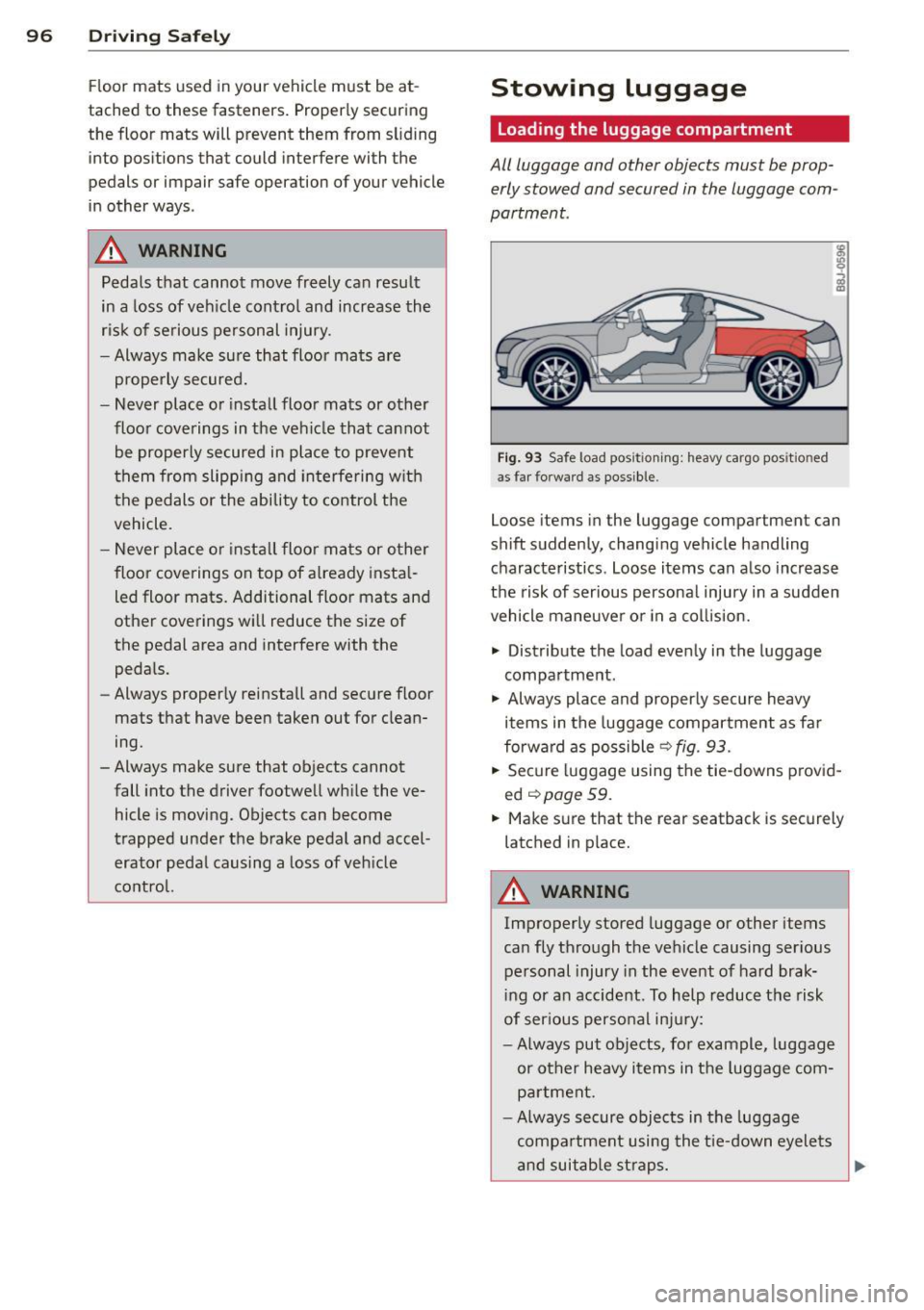
Fig. 93 Safe load posi tioning: heavy ca rgo pos it io ned
as far forwar d as possible.
Loose items in the luggage compartment can
shift suddenly, changing vehicle handling characteristics. Loose items can also increase
the risk of serious personal injury in a sudden
vehicle maneuver or in a collision.
.., Distribute the load evenly in the luggage
compartment.
.., Always place and properly secure heavy
items in the luggage compartment as far
forward as possible
r:::>fig . 93.
.,. Secure luggage using the tie-downs provid
ed
<:!) page 59.
... Make sure that the rear seatback is securely
latched in place.
A WARNING
-Improperly stored luggage or other items
can fly through the vehicle causing serious
personal injury in the event of hard brak
ing or an accident. To help reduce the risk
of serious personal injury:
- Always put objects, for example , luggage
or other heavy items in the luggage com
partment.
- Always secure objects in the luggage
compartment using the tie-down eyelets
and suitable straps.
~
Page 99 of 262
A WARNING ,~
Heavy loads will influence the way your ve
hicle handles. To help reduce the r isk of a
loss of control leading to ser ious personal
injury:
-Always keep in m ind when transporting
heavy objects, that a change in the cen
ter of g ravity can also cause changes in
vehicle handling:
- Always distribute the load as even ly as
possible.
- Place heavy objects as far forward in
the luggage compartment as possible.
- Never exceed the Gross Ax le Weight Rat
ing or the Gross Vehicle Weight Rating
specified on the safety compliance stick
er on the left door jamb. Exceeding per missible we ight standards can cause the
vehicle to slide and handle differently .
- Please observe information on safe driv
ing
i:> page 90.
A WARNING
To help prevent poisonous exhaust gas
from be ing drawn into the veh icle, always
keep the rear lid closed while dr iving.
- Never transport objects larger than those fitting completely into the luggage
area because the rear lid cannot be fully
cl osed.
- If you absolutely must drive with the rear
lid open, observe the follow ing notes to
reduce the risk of poisoning:
- Close all windows,
- Open all air outlets in the instrument
panel,
- Sw itch off the air recircu lation,
- Set the fresh ai r fan to the h ighes t
speed .
A WARNING
Always make sure that the doors, all win
dows and the rear lid are securely closed
and locked to reduce the risk of injury
when the veh icle is not being used.
Dr iving S afel y 97
-After closing the rear lid, always make
sure that it is properly closed and locked.
- Never leave your vehicle unattended es
pecially with the rear lid left open. A
child could crawl into the vehicle through
the luggage compartment and close the
rear lid becoming trapped and unable to
get o ut. Being trapped in a vehicle can
lead to serious personal injury.
- Never let ch ildren play i n or around the
veh icle .
- Never let passengers ride in the luggage
compartment. Vehicle occupants must
always be prope rly restra ined in one of
the vehicle 's seating pos it ions .
(D Tips
- Air circulation helps to reduce window
fogging. Stale a ir escapes to the outside
through vents in the trim panel, on the
left side of the luggage compartment. Be sure to keep these s lots free and
open.
- The tire pressure m ust correspond to the
load. The tire pressure is shown on the
tire pressure label. The tire pressure la
bel is located on the driver's side B-pillar.
The tire pressure label lists the recom
mended co ld tire inflation pressures for
the vehicle at its maximum capacity
we ight and the tires that were on your
vehicle at the t ime it was manufactured .
For recommended tire pressures for nor
ma l load cond itions, please see chapter
i=>page 200.
Tie-downs
The luggage compartment is equipped with
four tie-downs to secure luggage and other
items.
Use the t ie-downs to secure your cargo prop
erly
c> page 96, Loading the luggage com
partment .
In a collision, the laws of physics mean that
even smaller items that are loose in the vehi-
cle w ill become heavy missiles that can cause .,.
•
•
Page 100 of 262
98 Driving Safely
serio us injury . Items in the vehicle possess en
ergy which vary with vehicle speed and the
weight of the item. Vehicle speed is the most
significant factor.
F or example, in a frontal collision at a speed
of 30 mph (48 km/h), the forces acting on a 10- lb (4.5 kg) object are about 20 times the
norma l weight of the item. Th is means that
the we ight of the item would suddenly be
about 200 lbs. (90 kg). You can imagine the
i njuries that a 200 lbs . (90 kg) item flying
freely through the passenge r compartm ent
could cause in a collision like t his.
_& WARNING
Weak, damaged or improper s traps used
to secure i tems to tie-downs can fail du r
ing hard b rak ing o r in a collision and cause
ser ious personal inju ry .
- Always use suitab le mounting s traps and
properly secure items to the tie-downs in
the luggage compartment to help pre
vent items from shifting or flying for
ward as dangerous miss iles.
- When the rear seat backrest is folded
down, always use su itab le mounting
straps and properly secure items to the
t ie-downs in the luggage compartment
to help prevent items from flying for
wa rd as dangerous miss iles into the pas
senger compartment.
- Never attach a child safe ty seat tether
st rap to a tie-down.
Reporting Safety
Defects
Applicable to U.S.A.
If you believ e that your vehi cle
ha s a def ect whi ch could cau se
a cra sh or could cau se injur y or
d eath, yo u should immediatel y
inform the N ational High way
Tr affic S afe ty Admini stration (
NHTSA) in addition to notif y
in g Audi of Am erica , Inc .
If NHTSA receive s similar com
plaints, it may open an inve sti
gation , and if it finds that a
s afety defects e xis ts in a group
of vehicles , it may order a recall
and remedy campaign . Howe v
er, NHTSA cannot become in
vol ved in individual problems
between you, your dealer , or
Audi of America, Inc.
To conta ct NHTSA, you may call
the V ehi cle Saf ety Hotline toll
fr ee at:
Tel. : 1-888-3 27-4236 (TTY :
1-800-424-9153)
or
1-800-424-9393
or you ma y write to:
Administra tor
NHT SA
1200 New Jer sey A venue , SE
Wa shington , D .C .
20590
You can al so obtain other infor
mation about motor vehicle
s afety from:
http: //www. safe rc a r. gov
Applicable to Canada
If yo u live in Canad a and you
b e lie ve that your vehicle ha s a
Page 105 of 262
forces on the body more "tolerable" and less likely to cause injury.
Although these examples are based on a fron
tal collision , safety belts can also substantial
ly reduce the risk of injury in other kinds of
crashes. So, whether you're on a long trip or
just going to the corner store, always buckle
up and make sure others do, too. Accident sta
tistics show that vehicle occupants properly
wearing safety belts have a lower risk of being
injured and a much better chance of surviving
an accident . Properly using safety belts also
greatly increases the ability of the supplemen
tal airbags to do their job in a collision. For
this reason, wearing a safety belt is legally re
quired in most countries including much of
the United States and Canada.
Although your Audi is equipped with airbags ,
you still have to wear the safety belts provid
ed. Front airbags, for example, are activated
only in some frontal collisions. The front air
bags are not activated in all frontal collisions,
in side and rear collisions, in roll overs or in
cases where there is not enough deceleration
through impact to the front of the vehicle .
The same goes for the other airbag systems in
your Audi. So, always wear your safety belt
and make sure everybody in your vehicle is
properly restrained!
Important safety instructions about
safety belts
Safety belts must always be properly posi
tioned across the strongest bones of your
body.
.,. Always wear safety belts as illustrated and
described in this chapter.
.,. Make sure that your safety belts are always
ready for use and are not damaged.
A WARNING
Not wearing safety belts or wearing them
improperly increases the risk of serious
personal injury and death. Safety belts can
work only when used correctly .
Safety belts 103
-Always fasten your safety belts correctly
before driving off and make sure all pas
sengers are properly restrained.
- For maximum protection, safety belts
must always be positioned correctly on
the body .
- Never strap more than one person, in cluding small children, into any single
safety belt.
- Never place a safety belt over a child sit
ting on your lap.
-Always keep feet in the footwell in front
of the seat while the vehicle is being driv
en.
- Never let any person ride with feet on
the instrument panel or sticking out the
window or on the seat.
- Never remove a safety belt while the ve
hicle is moving . Doing so will increase
your risk of being injured or killed .
- Never wear belts twisted.
- Never wear belts over rigid or breakable objects in or on your clothing, such as
eye glasses, pens, keys, etc., as these
may cause injury .
- Never wear the shoulder part of the belt
under your arm or otherwise out of posi
tion .
- Several layers of heavy clothing may in
terfere with correct positioning of belts and reduce their effectiveness .
- Always keep belt buckles free of anything
that may prevent the buckle from latch
ing securely.
- Never use comfort clips or devices that
create slack in the shoulder belt. Howev
er, special clips may be required for the
correct use of some child restraint sys
tems .
- Never allow safety belts to become dam
aged by being caught in door or seat
hardware.
- Torn or frayed safety belts can tear and
damaged belt hardware can break in an
accident. Inspect belts regularly. If web-
bing, bindings, buckles, or retractors are .,..
L,_ _______________ _J
•
•
Page 106 of 262
104 Safety belts
damaged, have belts replaced by an au
thorized Audi dealer or qualified
workshop.
- Safety belts that have been worn and
loaded in an accident must be replaced
with the correct replacement safety belt
by an authorized Audi dealer or qualified
workshop. Replacement may be necessa
ry even if damage cannot be clearly seen.
Anchorages that were loaded must also
be inspected.
- Never remove, modify, disassemble, or
try to repair the safety belts yourself.
- Always keep the belts clean . Dirty belts
may not work properly and can impair
the function of the inertia reel
c:> page 174, Safety belts.
Safety belts
Fastening safety belts
Seat first -everybody buckle up!
,
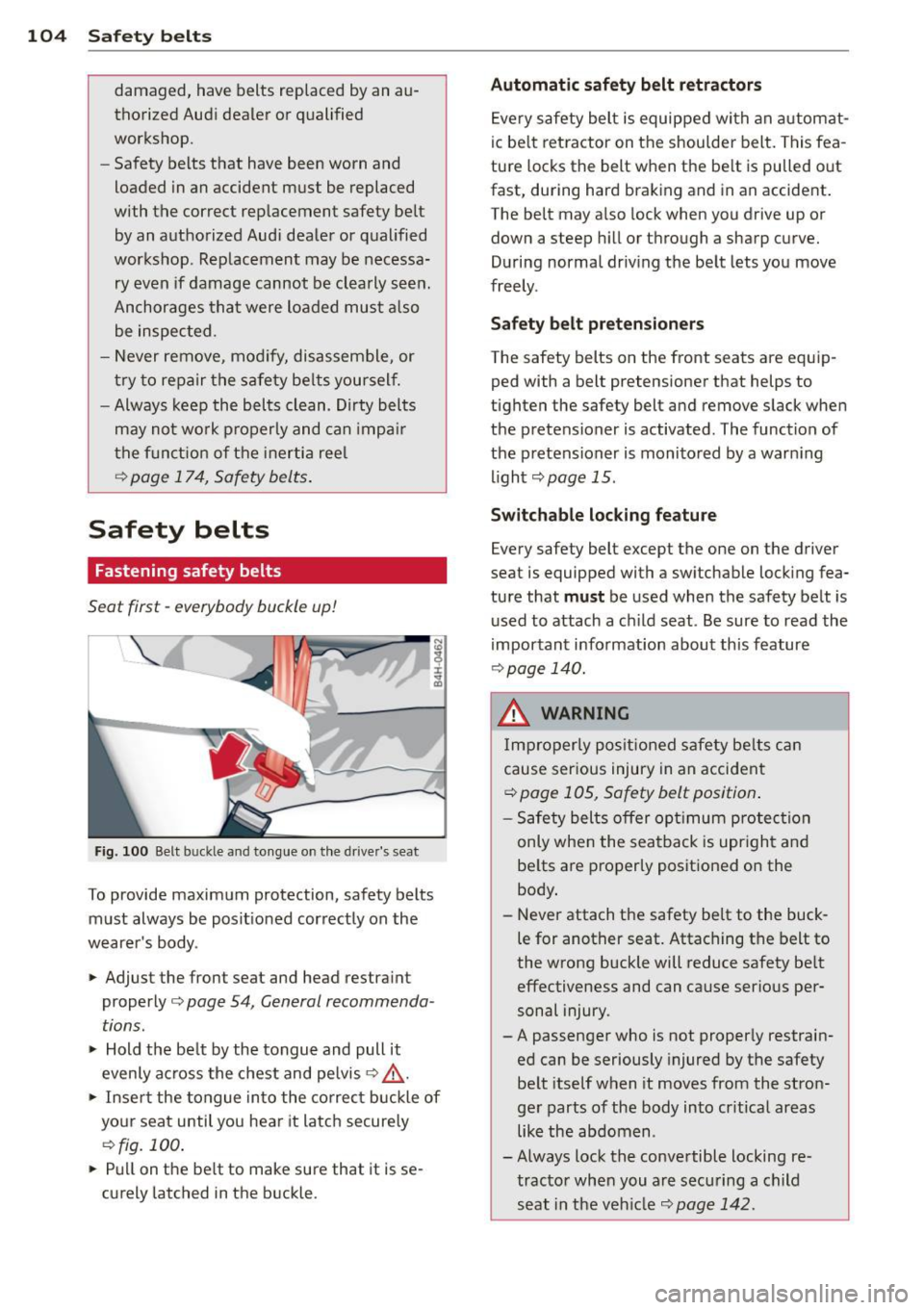
Fig. 100 Belt buck le an d tongue o n the driver' s seat
To provide maximum protection, safety belts
must always be positioned correctly on the
wearer's body .
• Adjust the fron t sea t and he ad restraint
properly
c:> page 54, General recommenda
tions .
• Hold the belt by the tongue and pull it
evenly across the chest and pelvis
c:> &-
• Insert the tongue into the correct buckle of
your seat until you hear it latch securely
c:> fig. 100.
• Pull on the belt to make sure that it is se
curely latched in the buckle .
Automatic safety belt retractors
Every safety belt is equipped with an automat
ic belt retractor on the shoulder belt. This fea
ture locks the belt when the belt is pulled out
fast, during hard braking and in an accident.
T he belt may also lock when you drive up or
down a steep hill or through a sharp curve.
During normal driving the belt lets you move
freely .
Safety belt pretensioners
The safety belts on the front seats are equip
ped with a belt pretensioner that helps to
tighten the safety belt and remove slack when
the pretensioner is activated. The function of
the pretensioner is monitored by a warning light
c:> page 15 .
Switchable locking feature
Every safety belt except the one on the driver
seat is equipped with a switchable locking fea
ture that
must be used when the safety belt is
used to attach a child seat . Be sure to read the
important information about this feature
c:> page 140.
_& WARNING
Improperly positioned safety belts can
cause serious injury in an accident
c:> page 105, Safety belt position .
-Safety belts offer optimum protection
only when the seatback is upright and
belts are properly positioned on the
body .
-
-Never attach the safety belt to the buck
le for another seat. Attaching the belt to
the wrong buckle will reduce safety belt
effectiveness and can cause serious per
sonal injury .
- A passenger who is not properly restrain
ed can be seriously injured by the safety
belt itself when it moves from the stron-
ger parts of the body into cr itical areas
like the abdomen .
- Always lock the- convertible locking re tractor when you are securing a child seat in the vehicle
c:> page 142 .
Page 107 of 262
Safety belt position
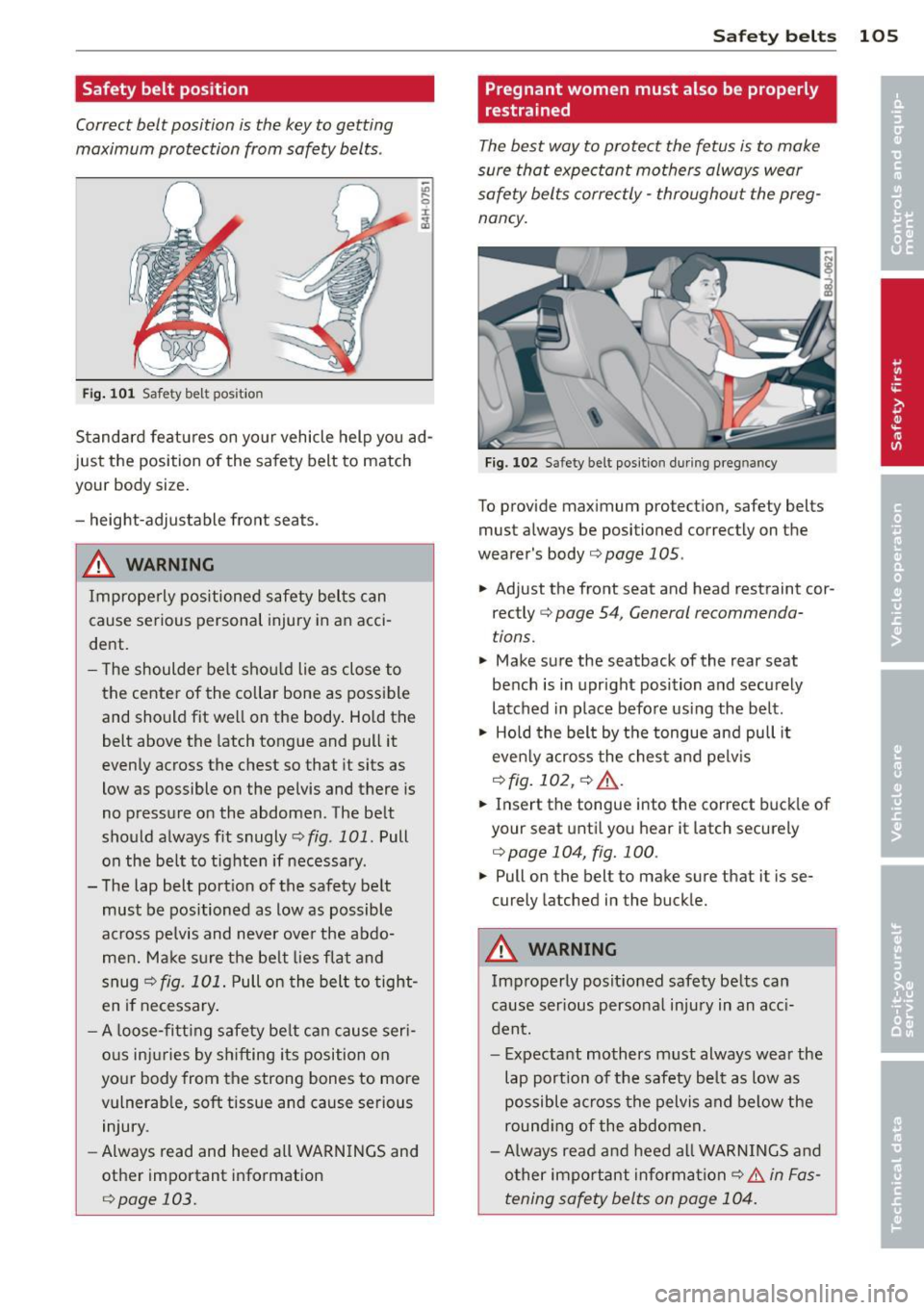
Correct be.It position is the key to getting
maximum protection from safety belts .
Fig. 1 01 Safety belt pos it io n
Standard features on yo ur vehicle help you ad
just the position of the safety belt to match
your body size.
- height-adjustable front seats.
& WARNING
Improperly positioned safety belts can
cause serious personal injury in an acci
dent.
-
- T he shoulder be lt shou ld lie as close to
the cente r of the collar bone as poss ible
and should fit we ll on the body . Ho ld the
belt above the latch tongue and pull it
evenly across the chest so that it sits as
low as possible on the pelvis and there is
no pressure on the abdomen. The be lt
should always fit snugly
c:> fig . 101 . Pull
on the belt to tighten if necessary .
- The lap belt port ion of the safety be lt
must be positioned as low as possible
across pelvis and never ove r the abdo
me n. Ma ke su re the be lt lies flat and
snug
c:> fig. 101 . Pull on the belt to tight
en if necessary .
- A loose-fi tt ing safety be lt c an cause seri
o us inj uries by s hifting its position on
yo ur body from the strong bones to more
vulnerab le, soft tissue and cause serious
injury.
- Always read and heed all WARN INGS and
other important info rmation
c:> page 103.
Safety belts 105
Pregnant women must also be properly
, restrained
The best way to protect the fetus is to make
sure that expectant mothers always wear
safety belts corre ctly -throughout the preg
nancy.
Fi g. 102 Safety be lt po sit ion d uring preg nancy
To provide max imum protect ion, safety belts
must a lways be positioned correctly on the
wearer 's body
c> page 105.
.,. Adjust the front seat and head restraint cor
rectly
c:> p age 54 , General recommenda
t ions .
.,. Make s ure the seatback of the rear seat
bench is in upright position and securely
latched in p lace befo re using the belt.
.,. Hold the belt by t he tongue and pull it
even ly across the ches t and pelv is
c> fig.10 2,c> .&., .
.,. Insert the tongue into the correct buck le of
your seat unti l yo u h ear it latch securely
<=> page 104, fig. 100 .
.,. Pull on the belt to make sure that it is se
curely latched in the buck le.
& WARNING
Imp roperly posit ioned safety belts can
cause ser ious persona l inju ry in an acc i
dent.
-
- Expectant mothers must always wear the
lap port ion of the safety belt as low as
possible a cross the pelvis and below the
round ing of the abdomen.
- Always read a nd heed all WAR NIN GS a nd
o ther impo rtant inform ation
c:> & in Fas
tening safety belts on page 104.
Page 137 of 262
as possible before installing the child
restraint.
- Always make sure that nothing pre
vents the front passenger's seat from
be ing moved to the rearmost position
in its fore and aft adjustment range.
- Always make sure that the backrest is
in the upr ight position.
- Always buck le the child safety seat firmly
in place even if a child is not sitting in it.
A loose ch ild safety seat can fly around
dur ing a sudden stop or in a col lision .
- Always read and heed all WARNINGS
whenever using a child restrained in ave
hicle is being used
¢page 100, Safety
belts,¢ page 108, Airbag system
and
¢ page 130, Child Safety.
A WARNING
To reduce t he ris k of serious injury, make
sure that the
PASSENGER AIR BAG OFF
light comes on and stays on whenever a
child rest raint is installed on the front pas
senger seat and the ignition is switc hed
on.
- Take the child restraint off t he fro nt pas
senger seat and install it properly at one of the rear seat positions if the
PASSEN ·
GER AIR BAG OFF
light does not stay on.
- Have the airbag system inspected by
your authorized Aud i dealer immediate
ly.
Secure unused safety belts on the rear
seat
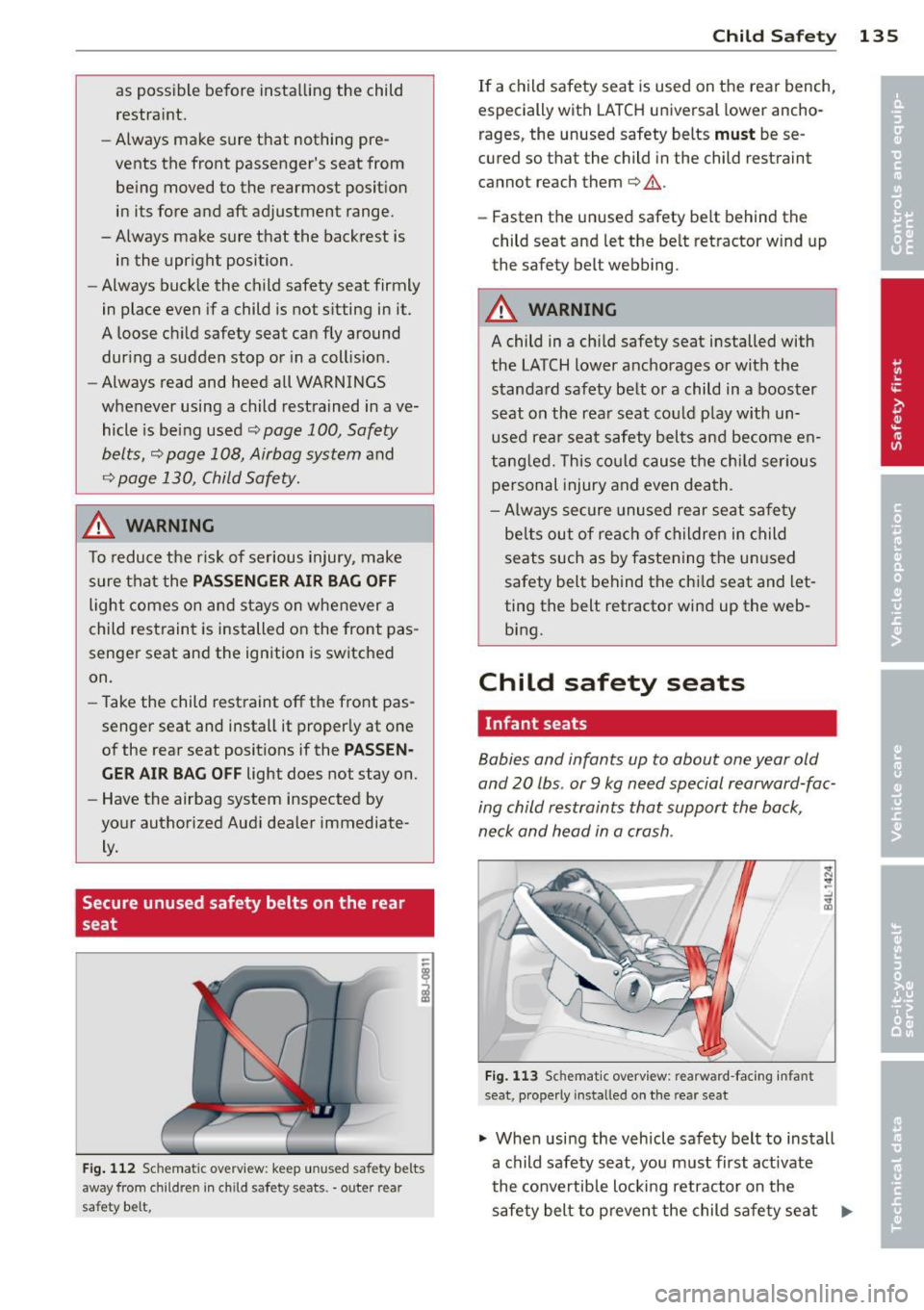
F ig. 112 Schematic overv iew: keep un used safety belts
away from children in child safety seats. • outer rear
safety belt,
Child S afety 13 5
If a child safety seat is used on the rea r bench,
especially with LATCH universal lower ancho
rages, the unused safety belts
must be se
cured so that the child in the child restraint
cannot reach them
¢ &.
-Fasten th e un used safety be lt behind the
child seat and let the be lt ret ractor wind up
the safety belt webbing.
A WARNING
A child in a chi ld safety seat installed with
the LATCH lower anchorages or with the
standard safety belt or a child in a booster
seat on the rea r seat co uld p lay w ith un
used rear seat safety belts and become en
tang led. This cou ld cause the chi ld ser ious
personal injury and even dea th.
- Always secure unused rear sea t safe ty
be lts ou t of re ach o f chi ldren in child
seats such as by fastening the un used
safety belt behind the ch ild seat and let
ting the belt retracto r wind up the web
bing.
Child safety seats
Infant seats
Babies and infants up to about one year old
and 20 lbs . or
9 kg need special rearward-fac
ing child restraints that support the back,
neck and head in a crash .
Fig. 1 13 Schema tic overv iew: rea rward-facing infant
seat, properly installed on the rear seat
.,. When usi ng the vehicle safety belt to install
a child safety seat, you must first activate
the convertib le locki ng retractor on the
safety bel t to p reven t the child safe ty seat
Ill>-
Page 138 of 262
136 Child Safet y
from moving ¢ page 140 or install the seat
using the LATCH attachments .
• Push the child safety seat down with your
full weight to get the safety belt really t ight
so that the seat cannot move forward or
sideways more than one inch (2 .5 cm) .
• Secure unused safety be lts on the rear seat
¢ page 135.
Infants up to about one year (20 lbs . or 9 kg)
a re best protected in special infant carriers
a nd chi ld safety seats designed for their age
group. Many experts believe that i nfants a nd
small children should ride only in spec ial re
strai nts in which the ch ild faces the back of
the vehicle . These infant seats support the ba
by's back, neck and head in a cras h¢
fig . 113 .
The airbag on the passenger side makes the
front seat a po tentially dangerous place for a
chi ld to r ide. The front seat is not the safest
p lace for a child in a forward-facing child seat.
It is a very dangerous p lace for an infant or a
larger child in a rearward-facing seat .
A WARNING
Not using a child safety seat, using the
wrong ch ild safety seat or improperly in
stall ing a child restraint inc reases the risk
of serious persona l injury and d eath in a
c rash .
- Never install rear-fac ing ch ild safety
seats or infant carriers on the front pas senger seat -even wi th an Advanced Air
bag System. A child w ill be seri ously in
jured an d can be k illed when the inflat
ing airbag hits the child safety seat o r in
fant ca rr ier with great force and smashes
the ch ild safety seat and ch ild aga inst
the backrest, doo r or roof ¢
page 110,
Child restraints on the front seat -some
important things to know.
- Always install rear-facing child safety
seats or infant car riers on the rear seat.
- Never install a rear-facing child restraint
in t he forward-facing direction. Such re
straints are des igned for the spec ial
needs of infants and very small childre n and cannot protect them properly if the
seat is forward-facing.
-
If you must install a rearwa rd facing
child safety seat on the front passenger
seat because of exceptional c ircumstan
ces and the
PASSENGER AIR BAG OFF
light does not come o n and stay on, im
mediately insta ll the rear-fac ing ch ild
safety seat in a rear seating position and
have the airbag system inspe cted by your
Aud i dea le r.
- Always read a nd heed a ll WAR NINGS
whenever us ing a chi ld re strained in ave
hicle is be ing used
¢ page 100, Safety
belts, ¢page 108, Airbag system
and
¢ page 130, Important things to know .
Convertible child safety seats
Properly used convertible child safety sea ts
can help protect toddlers and childr en ov er
age one who weigh between 20 and 40 lbs . (9
and 18 kg) in a crash.
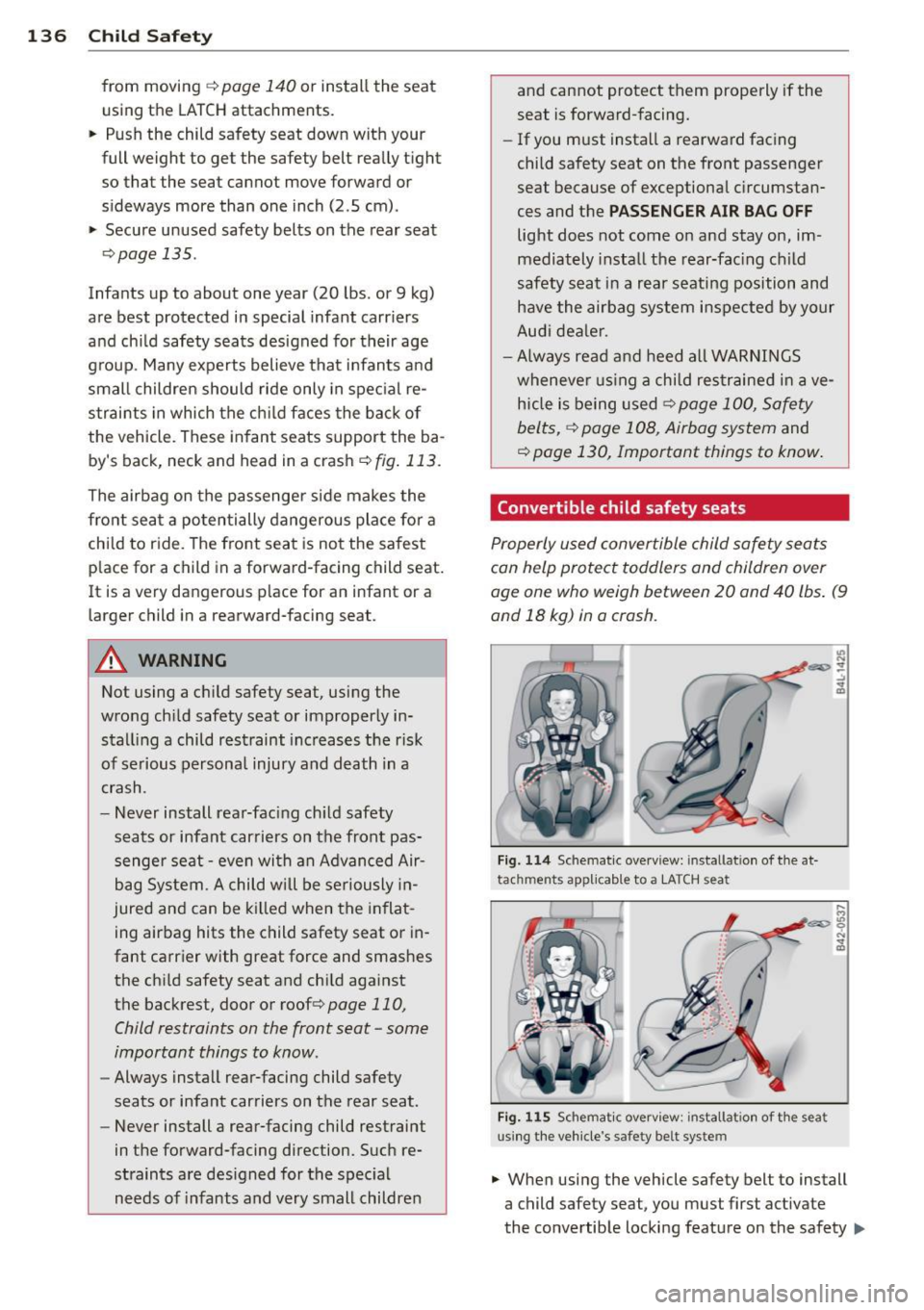
Fig . 1 14 Sc hema tic overview: instal lat ion of the at·
t ac hme nts applicab le to a LA TCH sea t
Fig. 115 Sc hemat ic overview: installa tion of t he sea t
us ing t he ve hicle 's safety be lt sys te m
• When using the vehicle safety belt to install
a child safety seat, you must first activate
the convertible locking feature on the safety ..,_