transmission AUDI TT 2013 Owner´s Manual
[x] Cancel search | Manufacturer: AUDI, Model Year: 2013, Model line: TT, Model: AUDI TT 2013Pages: 262, PDF Size: 65.91 MB
Page 176 of 262
174 Cleaning and protection
• Once the stain is no longer visib le, use a
soft dry cloth or tissue to soak up the mois
ture.
Do not use leather cleaning products on Al
cantara .
You may use a suitable shampoo fo r remov ing
d ust and dirt.
Dust and grit in the pores and seams can
scratch and damage the surface. If the ca r is
l eft standing i n the sun fo r long periods, the
A lcantara should be protected against direc t
sunlight to prevent it from fading. Slight co lor
variations will deve lop in normal use and are
not an indication of material deterioration.
{[) Note
-Never use chemical solvents (e.g . lighter
fl uid, turpentine), waxes, shoe polis h or
similar products on Alcantara ® surfaces.
- To avoid damage, have stubborn stains removed by a commercial cleaning spe
cia list.
- Do not use br ushes, stiff sponges or sim
ilarly abrasive cleaning aids.
Safety belts
Only well -maintained safety belts work relia
bly when needed .
Heavily soiled safety belts may no t retr act
p roperly.
• Keep be lts clean.
• Fo r cl eaning, use a m ild soap and wate r sol
u tion. Let be lts dry thoro ughly and away
from direct sunlight .
• Do not a llow inertia reel safety be lts to re
tract before they are completely dry .
• Check the condition of your safety belts
reg
ularly.
.&_ WARNING
Damaged safety belts can break in a crash.
1l Use o nly the co rrect cleaning so lu tions. Never use gas
o line or d iese l fue l.
-Anyth ing that might damage your safety
be lts could mean that you and your pas
sengers would not be adequate ly pro
tected in an accident.
- Safety belt performance depends on cor
rect insta llation. Never remove be lts
from the veh icle to clean them .
- Do not use chemical clean ing agents,
b leach or dyes. They have co rrosive prop
erties which wea ken the webb ing.
- When clean ing your safety be lts, inspect
them for damage . If you discover dam
age, see your Audi dealer.
'
- Always read a nd heed all WARNINGS and
the information
<=;> page 164.
Engine compartment
Be especially careful when cleaning the en
gine comportment.
Alway s swit ch off the ign ition before clean
ing the engine <=;>.&, .
Plenum panel
Remove leaves from the plenum panel in front
of the w indshield under the eng ine hood . This
prevents the water drain holes from becoming
blocked, and it prevents debris from enter ing
the vehicle interior t hro ugh the heating and
ventilat ion ducts.
Corrosion protection
T he engine compartment and transmission
have been corrosion -protected at the factory .
Good anti- corrosion treatmen t is very impor
tant, particu larly in the w inter.
If the vehicle
is frequently driven on salt treated roads, the
entire engine compartment and p lenum panel
shou ld be thoroughly cleaned at the end of
winter and retreated to prevent salt damage.
At the same time, the underside of the vehicle
shou ld be washed as well.
If the engine compartment is cleaned at any
time with grease removing solutions
1>, or if ..,.
Page 183 of 262
-Apply the parking brake.
- Move selector lever of automatic trans-
mission to "P" (Park); put manual trans
mission in Neutral.
- Always let the engine cool down . Hot
components will burn skin on contact.
- To reduce the risk of being burned, never
open the hood if you see or hear steam
or coolant escaping from the engine
compartment . Wait until no steam or
coolant can be seen or heard before care
fully opening the hood.
- Keep children away from the engine com
partment .
- Never spill fluids on hot engine compo
nents. They can cause a fire.
- Never touch the radiator fan. The auxili
ary electric fan is temperature controlled
and can switch on suddenly.
- Never open the coolant reservoir cap
when the engine is still warm. The cool
ant system is pressurized and hot cool ant could spray out .
-Protect your face, hands and arm from
steam or hot engine coolant by placing a
thick rag over the cap when you open the
coolant reservoir .
- Do not remove the engine cover under
any circumstances. This increases the
risk of burns.
- If work on the fuel system or the electri
cal system is necessary:
- Always disconnect the battery.
- Never smoke or work near heaters or
open flames. Fluids in the engine com
partment could start a fire.
- Keep an approved fire extinguisher im
mediately available.
- To avoid electrical shock and personal in
jury while the engine is running or being
started, never touch:
- Ignition cables
- Other components of the high voltage
electronic ignition system.
-If you must perform a check or repair
with the engine running:
Checking and filling 181
- First, fully apply the parking brake,
move selector lever of automatic trans
mission to "P" (Park); put manual
transmission in Neutral.
- Always use extreme caution to prevent
clothing, jewelry, or long hair from get
ting caught in the radiator fan, V -belts
or other moving parts, or from contact ing hot parts. Tie back hair before
starting, and wear no clothing that will hang or droop into the engine.
- Minimize exposure to emission and
chemical hazards~,& .
.8, WARNING
California Proposition 65 Warning:
- Engine exhaust, some of its constituents,
and certain vehicle components contain
or emit chemicals known to the State of
California to cause cancer and birth de
fects and reproductive harm. In addition,
certain fluids contained in vehicles and
certain products of component wear con
tain or emit chemicals known to the
State of California to cause cancer and
birth defects or other reproductive harm.
- Battery posts, terminals and related ac
cessories contain lead and lead com
pounds, chemicals known to the State of
California to cause cancer and reproduc
tive harms. Wash hands after handling.
(D Note
When adding fluids, always make sure that
they are poured into the proper container
or filler opening, otherwise serious dam
age to vehicle systems w ill occur.
@ For the sake of the environment
To detect leaks in time, inspect the vehicle
floor pan from underneath regularly. If
you see spots from oil or other veh icle flu
id s, have your vehicle inspected by an au
thorized Audi dealer . •
•
Page 199 of 262
-Never mount used tires on yo ur vehicle if
yo u are not sure of their "previous histo
ry." Old used tires may have been dam
aged even though the damage cannot be
seen that can lead to sudden tire failure
and loss of vehicle control.
- If you notice unusual vibration or if the
vehicle pulls to one side when d riving, al
ways stop as soon as it is safe to do so
and check the wheels and tires for dam
age .
(D Note
Please note that summe r and wi nte r tires
are designed for the cond itions that are
Glossary of tire and loading terminology
Accessory weight
means the comb ined weight (in excess of
those sta ndard items which may be rep laced)
of au toma tic transmission, power steer ing ,
power brakes, power windows, power seats,
radio, and heater, to the extent that these
items are availab le as factory-installed equip
ment (whether installed or not) .
Aspect ratio
means the rat io o f the height to the w idth of
the tire in percent . Numbers of 55 or lower in
dicate a low sidewall for improved steering re
sponse and better overa ll handling on dry
pavement .
Bead
means the part of the t ire t hat is made o f
steel wires, wrapped or reinforced by ply cords
and that is shaped to fit the r im.
Bead separation
means a b reakdown of the bond between
components in the bead .
Cord
means the strands forming the plies in the
tire.
Tire s an d wheel s 197
typica l in those seasons . Aud i recommends
using winter tires during the winter
months . Low temperatures signif icant ly
dec rease the e lasticity of summer t ires,
which affects tract ion and brak ing ability.
If summer t ires are used i n very co ld tem
peratures, cracks ca n form o n the tread
bars , res ulting in perma nen t tire damage
that can cause loud driving noise and un
bala nced ti re s. Audi i s not respon sible for
th is type of damage .
Cold tire inflation pressure
means the tire p ress ure recommended by t he
vehicle manufacture r fo r a tire o f a des ignated
s ize t hat has not bee n driven for more than a
coup le o f miles (k ilometers) at low speeds in
the three hour period before the tire press ure
is m easured or adjusted.
Curb weight
me ans the we ight of a motor ve hicle with
st andard equipmen t incl ud ing the max imum
capacity of fuel, oi l, and coolant, air condi
tioning and additional weig ht of optiona l
equipment.
Extra load tire
means a t ire designed to operate a t higher
loads and at higher inflat ion p ress ures than
the corresponding standar d tire. Extra load
ti res may be ident ified as "XL", "xl", "EXTRA
LOAD", or "RF" on the sidewall.
Gross Axle Weight Rating ("GAWR")
me ans the lo ad-ca rry ing capa city of a si ngle
axle system, measured a t the tire -ground in
te rfaces.
Gross Vehicle Weight Rating ("GVWR ")
mea ns the maximum total loaded we ight of
the ve hicl e. .,.. •
•
Page 223 of 262
The tire sea lant mu st not be us ed :
- for c uts or punctures in the tire which are
l arger than 0.16 inch (4 mm)
q fig. 153 (D
- for damage to the rim@
- if you have been driving with very low ti re
pressures or tires with no air @
Using the
TM S is described in the section
q page 221, Preliminary steps .
TMS can be used at temperatures down to
-4 °F ( -20 °() .
A WARNING
Take the following precautions after re
pairing the tire:
- Do not drive faster than
50 mph (80 km/
h)!
- Avoid full-throttle accelerat ion, heavy
braking and fast cornering .
- The veh icle's road behavior can be affect
ed .
- Tires sealed with
TMS are intended only
for
temporar y, short -term use.
-After using the t ire sealant the tire pres
sure monitoring system may no longer
work prope rly. Drive carefully to the next
professional repair fac il ity.
- TMS must NOT be used,
- for cuts or punctures in the tire which are larger t han 0.16 inch (4 mm)
- for damage to the rim
- if you have been driv ing with very low
tire pressures or t ires with no air
- Seek profess ional assistance if it is not
poss ible to repair the tire with the tire
sealant.
A WARNING
T he tire sealant must not come into con
tact w ith skin, eyes or cloth ing.
- If you get any tire sealant in your eyes or
come into contact with it, r inse the af
fec ted area t ho roughly with cle an wate r.
Find a physician immediately!
- Change any clot hing contaminated with
t ire sea lant immed iate ly.
- Do not inhale the vapo r!
-
What do I d o now ? 221
-If you have swallowed tire sealant, rinse
your mouth thoro ughly right away and
drink plenty of water.
- Do not induce vom it ing! Find a physi
c ian immediately!
- I f you have allergic react ions, find a
phys ician immediately.
- Keep the tire sealant away from children .
(D Note
Do not use commercially available tire
sealants . The e lectr ica l components of the
tire pressu re monitoring system will no
l onge r work properly .
@ For the sake of the env ironment
Used sealant bottles can be dropped off at
a recycling facility.
@ Tips
- If sea lant has run out, allow it to dry.
Then you can peel it off.
- Have the t ire sea lant replaced every 4
years at a dealership.
Preliminary steps
Applies to vehicles: with Tire Mobility System
Some preliminary steps are necessary for tire
repair.
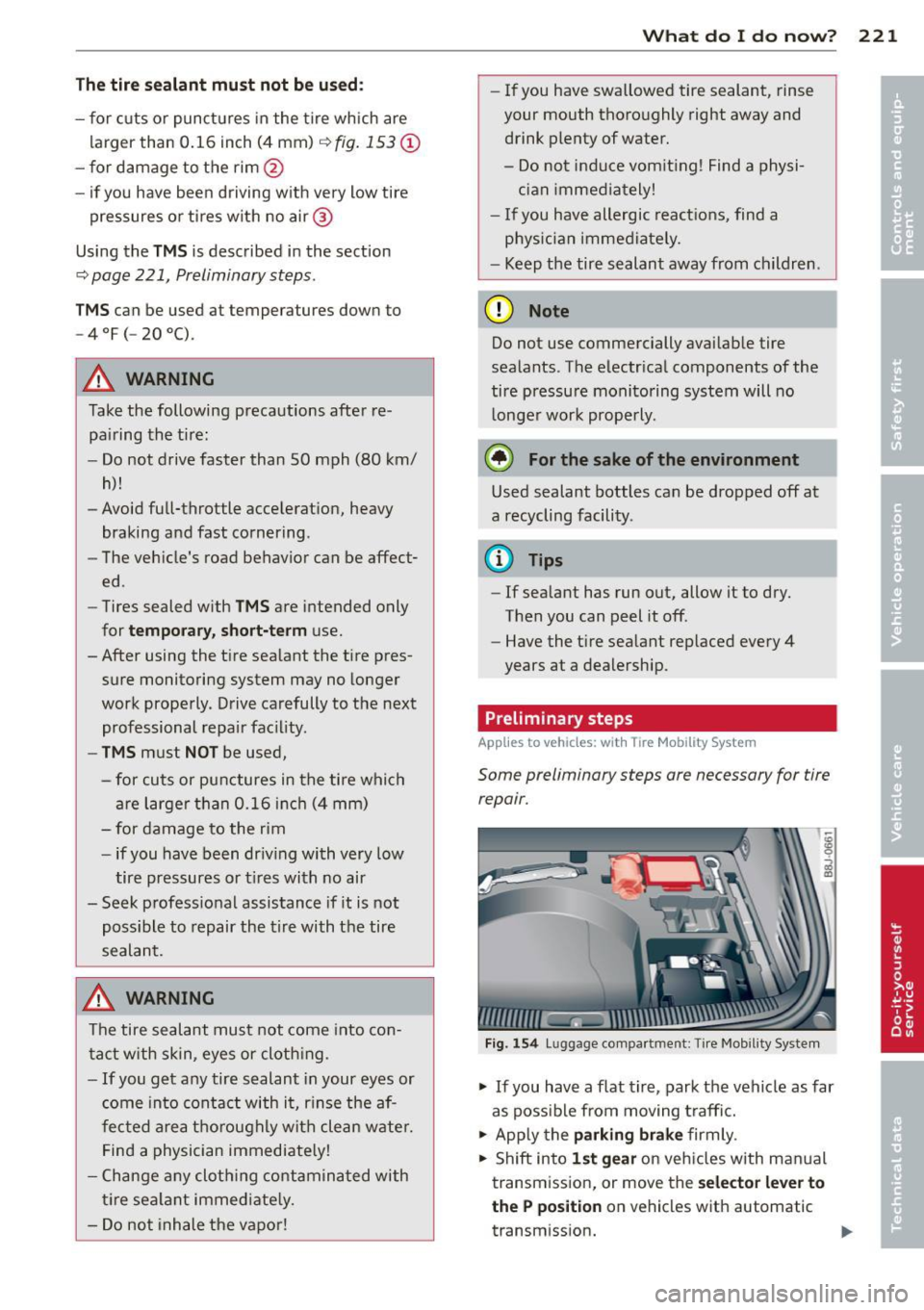
Fig. 154 Lu ggage compartment: Tire Mob ility System
.,.. If you have a flat tire, park the vehicle as far
as poss ib le from moving t raff ic.
.,.. App ly the
parking brake firmly .
.,.. Shift into
1st gear on veh icles with man ual
transmission, or move the
s electo r le ver to
the P po sit io n
on vehicles with automatic
transmiss ion.
Page 232 of 262
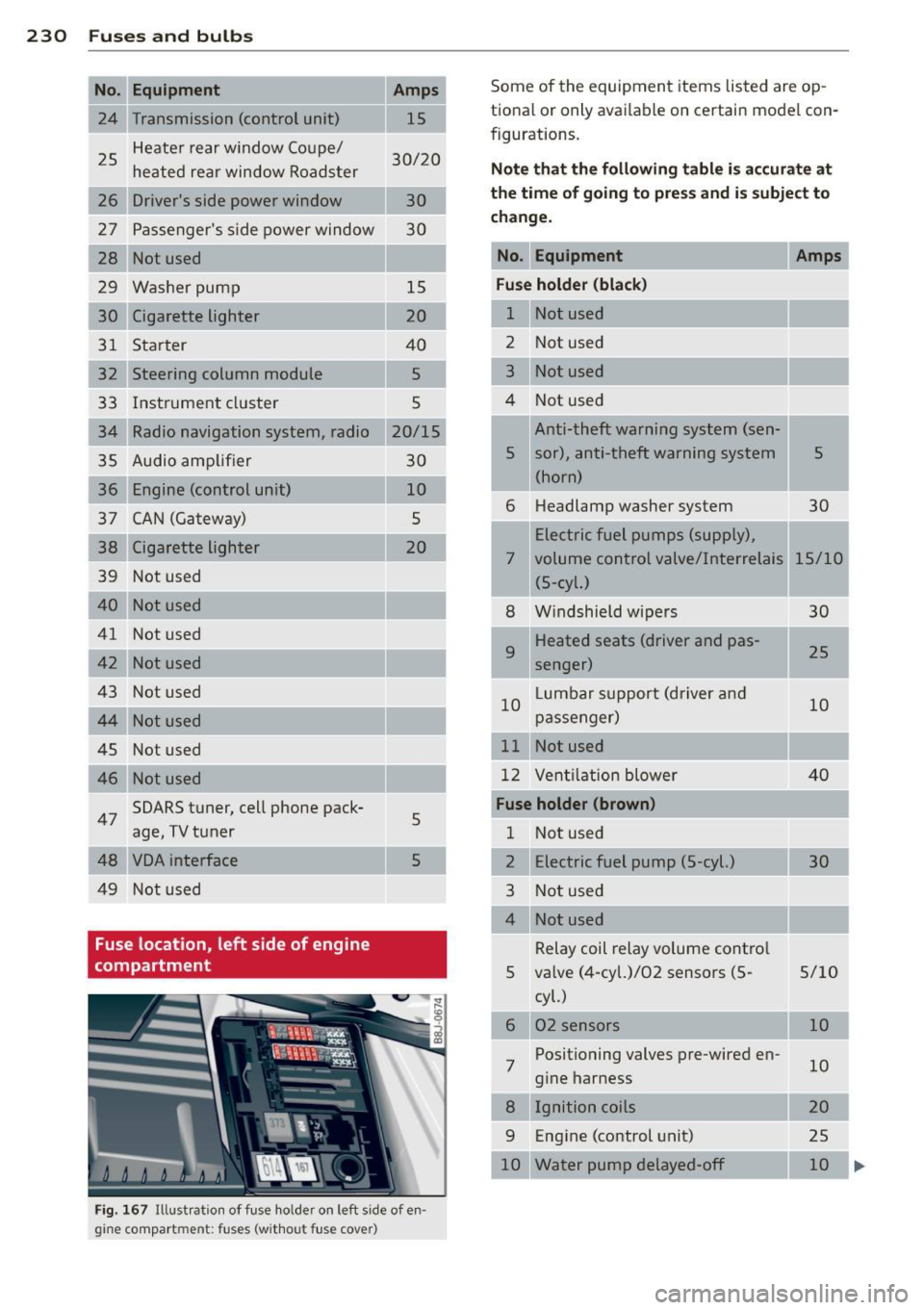
230 Fuses and bulbs
-No. Equipment
24 Transmission (control unit)
25 Heater rear
window Coupe/
heated rear window Roadster
26 Driver's side power window
27 Passenger's side power window
28 Not used
29 Washer pump
30 Cigarette lighter
31 Starter
32 Steering column module
33 Instrument cluster
34 Radio navigation system, radio
35 Audio amplifier
36 Engine (control unit)
37 CAN (Gateway)
38 Cigarette lighter
39 Not used
40
------------4 l Not used
42
43 Not used
44
45 Not used
46
47 SOARS tuner, cell phone pack-
age, TV tuner
48
49 Not used
Fuse location, left side of engine
compartment Amps
15
30/20
30
30
-15
20
40 5
5
20/15
30
10 5
20
-
-
5
5
Fig. 167 Illust ration of fuse holder on left side of en·
gine compartment: fuses (without fuse cover)
Some of the equipment items listed are op-
t ional or only available on certain model con-
figurations.
Note that the following table is accurate at
the time of going to press and is subject to
change.
No. Equipment Amps
Fuse holder (black)
1 Not used
-2 Not used
3 Not used
4 Not used
Anti-theft warning system (sen-
'
5 sor), anti-theft warning system 5
(horn)
6 Headlamp
washer system
30
Electric fuel pumps (supply),
7 volume control valve/Interrelais 15/10 (5-cyl.)
8 Windshield wipers
30
9 Heated seats (driver and pas-
25
senger)
10 Lumbar
support (driver and
10
passenger)
11 Not used
12 Ventilation blower 40
Fuse holder (brown)
1 Not used
2 Electric fuel pump (5-cyl.) 30
3 Not used
Relay coil relay volume control
5 valve (4-cyl.)/02 sensors (5- 5/10
7 cyl.)
02 sensors
Positioning valves pre-wired en
gine harness
Ignition coils
9 Engine (control unit)
10 Water pump delayed-off 10
10
20
25 10 ..,_.
Page 234 of 262
232 Emergency situations
Emergency situations
General
This chapter is intended for trained emer
gency crews and working personnel who
have the necessary tools and equ ipment to
perform these ope rations.
Starting by pushing or
towing
Q;) Note
Vehicle s with an automati c transmission
cannot be started by pushing or towing .
Starting with jumper
cables
If necessary, the engine can be started by
connecting it to the battery of another vehi
cle.
If the engine should fail to start because of a
discha rged or wea k batte ry, the battery can be
connected to the battery o f
another vehicle,
using a
pair of jumper cables to start the en
g ine .
Jumper cables
Use only jumper cab les of sufficiently
large cross section to safely carry the starter
cur rent. Refer to the manufacturer's specifica
ti ons.
Use on ly jumper cables which have
insulated
termina l clamps and are properly marked for
d istinction :
plus(+) cable in most cases colo red red
minu s(-) cable
in most cases colo red black .
_& WARNING
Batterie s contain elec trici ty, a cid, and ga s.
Any of th ese c an cause ve ry seri ous or f ata l
inju ry . Follow the instructions below fo r
safe han dling of your ve hicle's battery.
- Alw ays s hield yo ur eyes and avoid lean
ing over the batte ry w henever possib le . -
A discharged battery can a lready freeze
at temperatures just be low 32 °F (0 °C).
Before connect ing a jumper cab le, the
frozen battery must be thawed com
p letely, othe rwise it cou ld explode .
- Do not allow batte ry acid to contact eyes
or skin . Fl ush any contacted a rea wi th
water immediat ely .
- Imp roper use of a booster battery to
s tart a vehicle may cause an explosion.
- Vehicle batter ies generate explosive gas
es . Keep sparks, flame and lighted ciga
rettes away from ba tte ries .
- Do not try to jump start a ny ve hicle w ith
a low ac id leve l in the battery .
- The vo ltage of the booster batte ry m ust
a lso have a 12-Vo lt rat ing . The capacity
(A h) of the booster batte ry should not b e
lowe r than that of the discharged bat
tery . U se o f batt erie s of d iffe ren t voltage
or subs tanti ally diffe ren t "Ah" rat ing
may c ause an exp losion and person al in
ju ry .
- N ever ch arge a fr ozen bat te ry. Gas t rap
ped in the ice may ca use an ex plosion .
- N ever ch arge o r use a batt ery th at has
been fro zen. T he battery case may have
be weakened.
- Us e of batt erie s of di ffere nt vo lta ge or
substan tially differen t ca pa city (Ah) rat
i ng may cause an exp losion and injury.
T he capac ity (Ah) of the booster battery
should not be lower than that of the dis
charged batte ry.
- Before you check anything in the engine
compartment, always read and heed a ll
W ARNI NGS
c::;,page 174, Engine com
partment .
@ Note
-App lying a hig her voltage booster ba t
tery will cause expens ive damage to se n
sitive electronic components, such as
cont ro l units , relays, rad io, etc.
- There must be no electrical contact be
twee n the vehicles as otherwise current
cou ld already start to flow as soo n as th e
posi tive (+) term inals are connect ed. ""
Page 235 of 262
@ Tips
The discharged battery must be properly
connected to the vehicle's electrical sys
tem.
Use of jumper cables
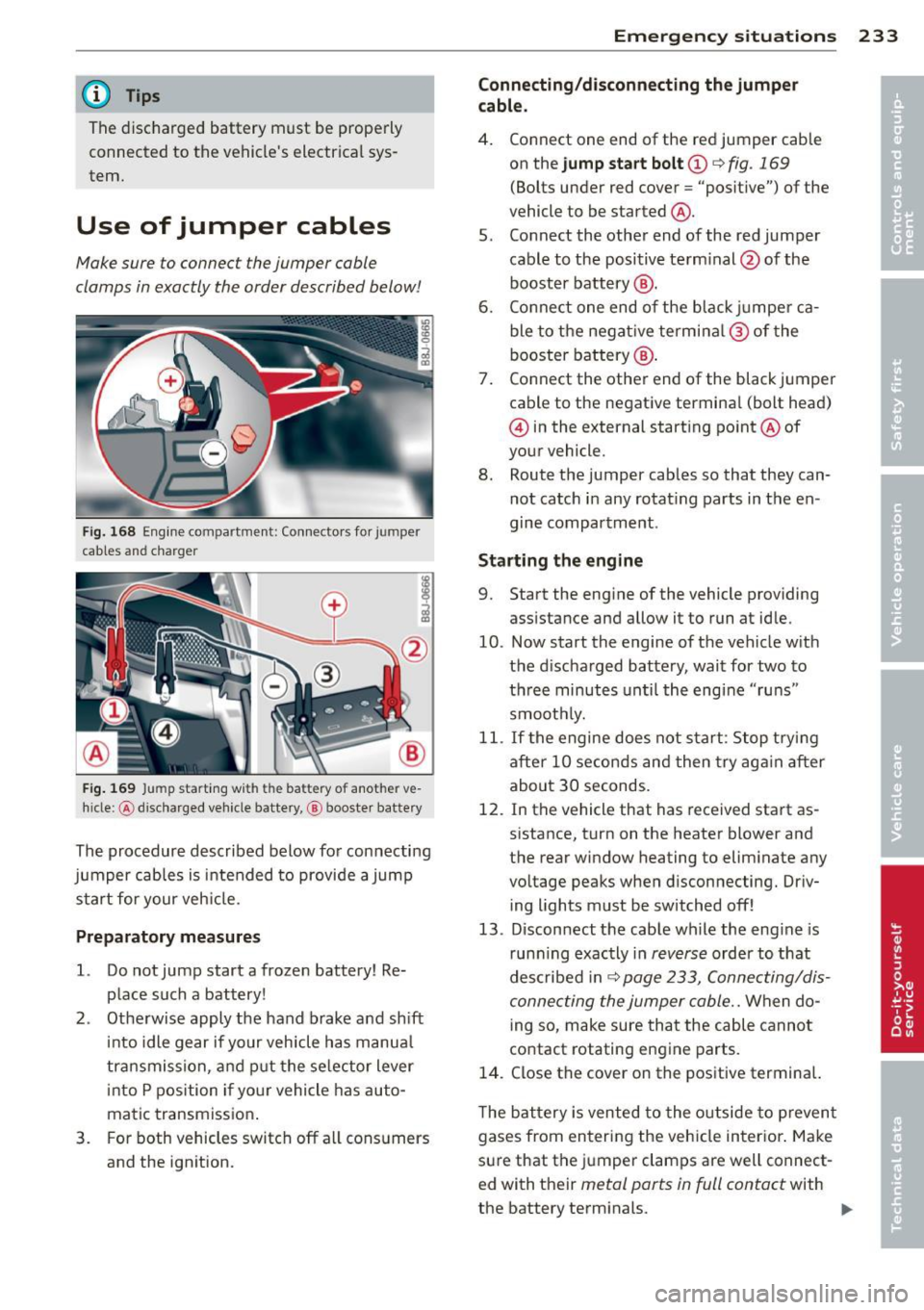
Make sure to connect the jumper coble
clomps in exactly the order described below!
Fi g. 168 Engine compartment: Connecto rs for jumper
cables and charger
Fig. 169 Jump starting with the battery of another ve
h icle: @discharged veh icle batte ry, @ booste r battery
The procedure described below for connecting
jumper cables is intended to provide a jump
start for your veh icle.
Preparatory measures
1. Do not jump start a frozen battery! Re
place such a battery!
2 . Otherwise apply the hand brake and shift
in to idle gear if your veh icle has manua l
transmission , and put the selector lever
into P position if your vehicle has auto
matic transm ission.
3. For both vehicles switch off all consumers
and the ignition.
Emergency situations 233
Connecting/disconnecting the jumper
cable.
4. Connect one end of the red jumper cable
on the
jump start bolt (D c:> fig. 169
(Bolts under red cover= "positive") of the
vehicle to be started @.
5. Connect the other end of the red jumper
cable to the positive term inal @of the
booster battery @.
6. Connect one end of the black jumper ca
ble to the negative terminal@ of the
booster battery @.
7. Connect the other end of the black jumper
cable to the negative terminal (bolt head)
@ in the external starting point @of
your vehicle.
8. Route the jumper cables so that they can not catch in any rotat ing parts in the en
gine compartment .
Starting the engine
9. Start the engine of the vehicle providing
assistance and allow it to run at idle.
10. Now start the engine of the vehicle w ith
the d ischarged battery, wait for two to
three minutes until the engine "runs"
smoot hly.
11. If the engine does not start: Stop trying
after 10 seconds and then try again after
about 30 seconds.
12. In the vehicle that has received start as
s istance, turn on the heater blower and
the rear window heating to eliminate any
voltage peaks when disconnecting. Driv ing lights must be switched off!
13. Disconnect the cable while the eng ine is
running exactly in
reverse order to that
described inc:>
page 233, Connecting/dis
connecting the jumper coble ..
When do
ing so, make sure that the cable cannot
contact rotating engine parts.
14. C lose the cover on the positive terminal.
T he battery is vented to the outside to prevent
gases from entering the vehicle interior . Make
sure that the jumper clamps are well connect
ed with their
metal ports in full contact with
the battery term inals.
Page 239 of 262
Lifting vehicle
lifting with workshop hoist and with
floor jack
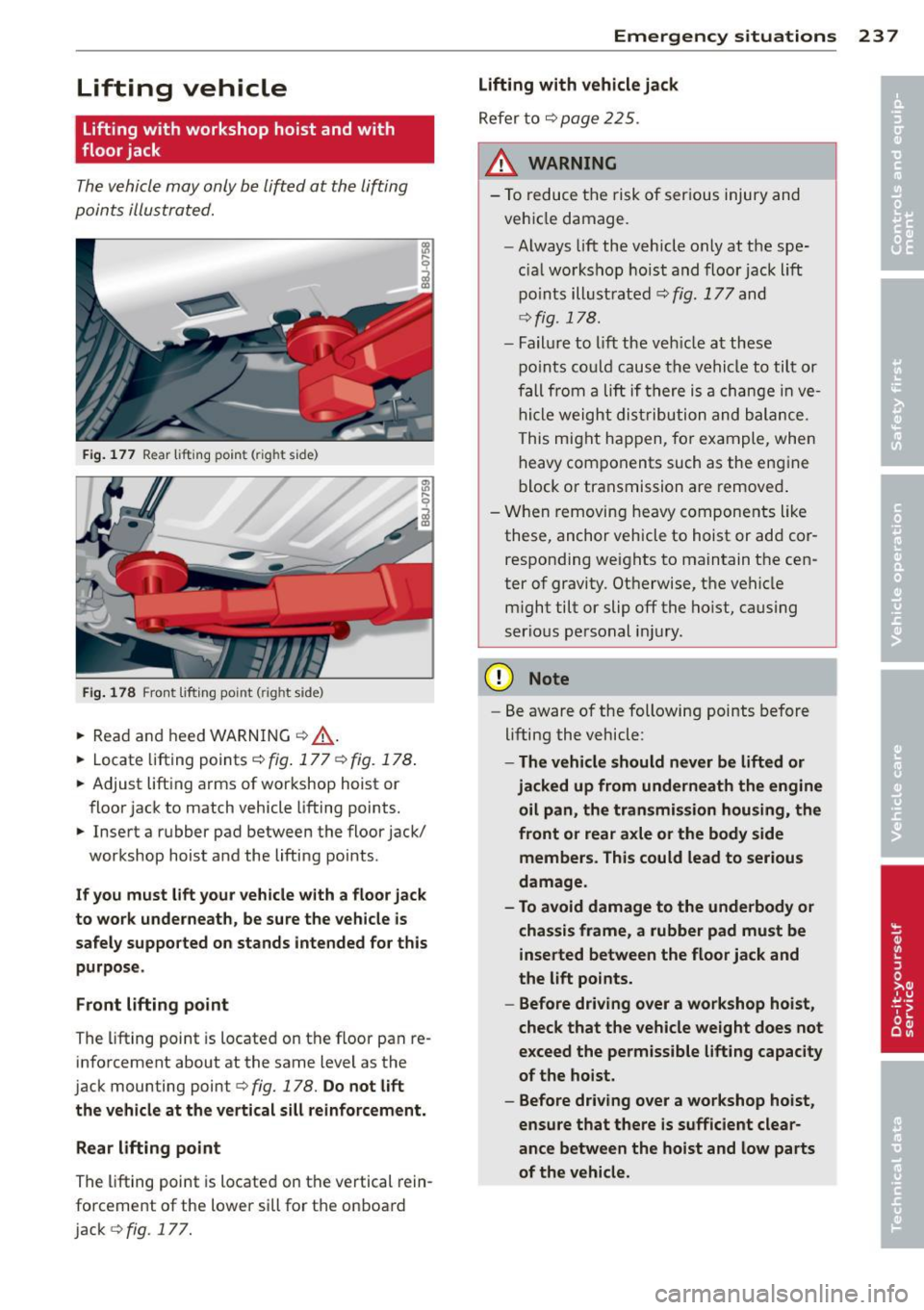
The vehicle may only be lift ed at the lifting
poin ts illustra ted.
F ig. 177 Rear lift ing point (r ig ht side)
Fi g. 178 Front lift ing po int frig h t side)
• Rea d and h eed WARN ING c:::> A-
• Locate lifting points c:::> fi g. 177 c:::> fig. 178 .
• Adjust lift ing arms o f wor kshop hoist or
f loor jac k to match vehicle lifting points.
• Inse rt a r ubber pad between the floor jac k/
workshop hoist a nd the lifti ng points.
If you must lift your vehicle with a floor jack
to work underneath, be sure the vehicle is safely supported on stands intended for this
purpose.
Front lifting point
The lifting point is locate d on the f loor pan re
info rcement about at the same level as the
jack mounting point
c:::> fig. 178. Do not lift
the vehicle at the vertical sill reinforcement .
Rear lifting point
The lifting poi nt is locate d on t he vertical rein
forcement of the lower sill for t he on boa rd
jack
c:::> fig. 177.
Emergency situations 237
lifting with vehicle jack
Re fer to c:::> page 225 .
_&. WARNING
-To re duce t he risk of ser ious injury an d
ve hicl e damage.
- Alwa ys lift the veh icl e only at the spe
c ial w orkshop hoist and floor jack lift
p oin ts ill ust rated
c:::> fig. 177 and
c:::> fig. 178 .
-Fa il u re to Lift th e ve hicl e at th ese
p o ints co uld cau se the ve hi cle to til t or
f all from a lift if th ere i s a cha nge in ve
h icl e weigh t distr ibu tion and balan ce.
This mi ght h app en, fo r ex am ple, whe n
h eavy co mpon ent s such as the eng ine
b lock o r transmission are remove d.
- Wh en removin g hea vy componen ts li ke
these, anchor vehicle to h oist or ad d cor
respo nding wei ghts to ma intain t he ce n
ter of gravity. Ot herwis e, th e ve hicle
might tilt or slip off the ho ist, caus ing
serio us pe rso nal i nju ry.
CI) Note
-Be aware of the following points before
lifting the vehicle:
- The vehicle should never be lifted or
jacked up from underneath the engine
oil pan, the transmission housing, the
front or rear axle or the body side
members. This could lead to seriou s
damage.
- To avoid damage to the underbody or
chassis frame, a rubber pad must be inserted between the floor jack and
the lift points.
- Before driving over a workshop hoist ,
check that the vehicle weight does not
exceed the permissible lifting capacity
of the hoist.
- Before driving over a workshop hoist ,
ensure that there is sufficient clear
ance between the hoist and low parts
of the vehicle.
-
Page 240 of 262
238 General information
General information Explanation of
technical data
Some of the technical data listed in this man
ual require further explanation.
The tecical data for your vehicle are listed in
the charts starting on ¢
page 240. This chap
ter provides general information, notes and
restrictions which apply to these data .
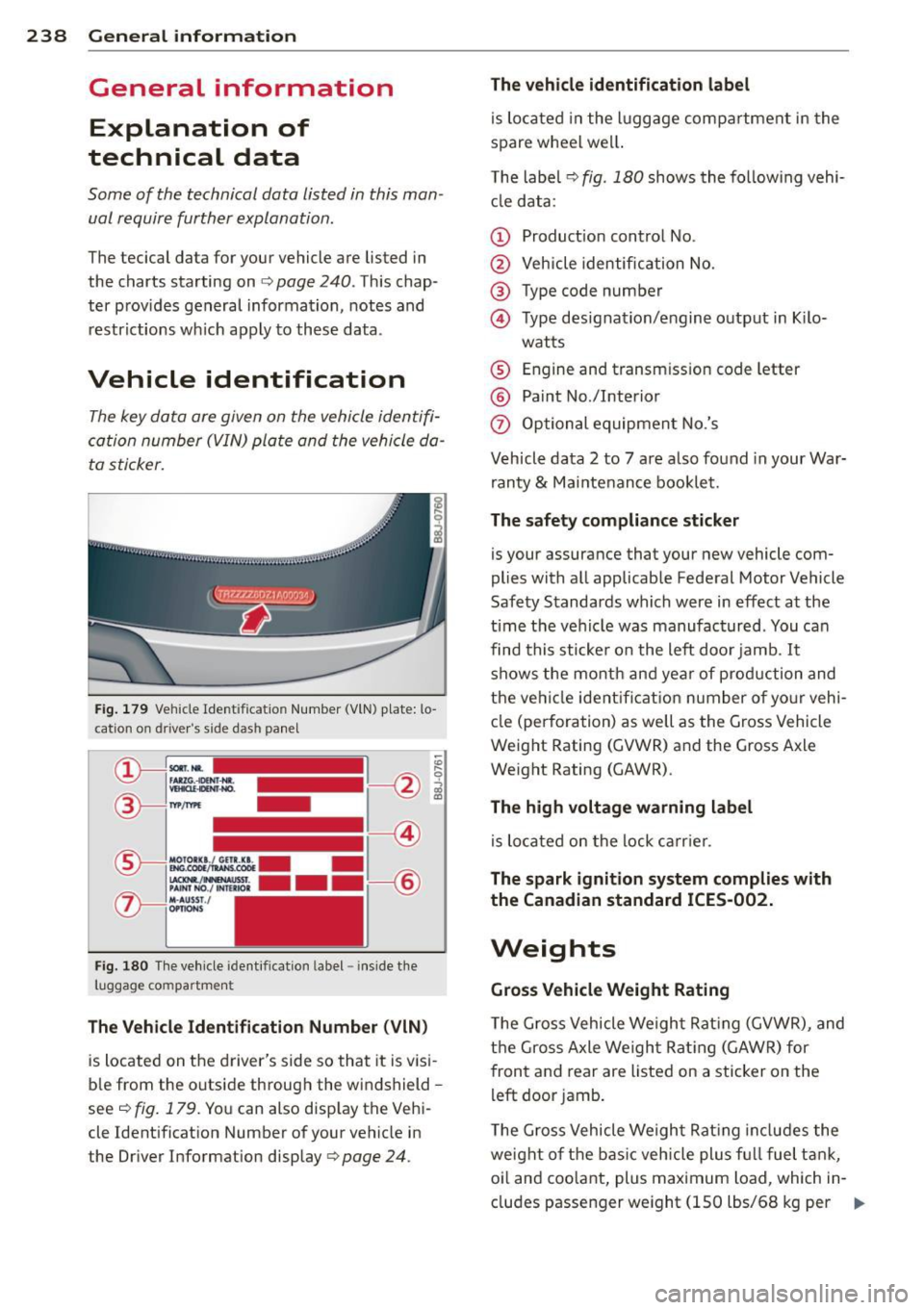
Vehicle identification
The key data are given on the vehicle identifi
cation number (VIN) plate and the vehicle da
ta sticker.
Fig. 179 Veh icle Ide ntificat io n Number (VlN) plate: lo
cation on driver 's side das h panel
Fig. 180 Th e vehicle identi fication label -inside the
luggage co mpa rtmen t
The Vehicle Identification Number (VIN)
is located on the driver's side so that it is visi
ble from the outside through the windshield -
seer:!> fig. 179. You can also display the Vehi
cle Identification Number of your vehicle in
the Driver Information display¢
page 24 .
The vehicle identification label
is located in the luggage compartment in the
spare wheel wel l.
The label¢
fig. 180 shows the following vehi
cle data :
(D Product ion control No .
@ Vehicle identification No.
® Type code number
@ Type designation/engine output in Kilo-
watts
® Engine and transmission code letter
@ Paint No./Interior
(f) Optional equipment No.'s
Vehicle data 2 to 7 are also found in your War
ranty
& Maintenance booklet.
The safety compliance sticker
is your assurance that your new vehicle com
plies with all applicable Federal Motor Vehicle
Safety Standards which were in effect at the
time the vehicle was manufactured . You can
find this sticker on the left door jamb.
It
shows the month and year of production and
the ve hicle ident ification number of your vehi
cle (perforation) as well as the Gross Vehicle
Weight Rating (GVWR) and the Gross Axle
Weight Rating (GAWR) .
The high voltage warning label
is located on the lock carr ier .
The spark ignition system complies with
the Canadian standard ICES-002.
Weights
Gross Vehicle Weight Rating
The Gross Vehicle Weight Rating (GVWR), and
the Gross Axle Weight Rating (GAWR) for
front and rear are listed on a sticker on the
left door jamb.
The Gross Vehicle Weight Rating includes the
weight of the basic vehicle plus full fuel tank,
oi l and coolant, plus maximum load, wh ich in
cludes passenger weight (150 lbs/68 kg per
Ill>
Page 246 of 262
24 4 Con sum er Inf ormation
steadi ly reduced the scope of maintenance
and repairs which can be carried out by vehicle
owners.
Als o, sa fe ty a nd en vir onm ent al con
cerns place very strict limits on the nature of
repairs and adjustments to engine and trans
miss ion parts which an owner can perform .
Maintenance, adjustments and repa irs usua lly
require special tools, testing devices and oth
er equipment available to specially trained
workshop personnel in order to assure proper pe rformance, reliab ility and safety of the vehi
cle and its many systems.
Improper maintenance, adjustments and re
pa irs can impair the operation and reliab ility
of your vehicle and even void your vehicle war
ranty. Therefore, proof of servic ing in accord
ance w ith the ma intenance schedule may be a
condition for upholding a poss ible warranty
claim made within the warranty period.
Above all, operational safety can be adversely
affected, c reating unnecessary risks for you
and your passengers.
If in doubt about any se rv icing, have it done
by your author ized Audi dealer or any other
p roperly equipped and qualified workshop.
We strong ly urge you to give yo ur autho rized
Audi dealer the opportunity to perfo rm all
schedu led maintenance and necessary repairs.
Your dea ler has the facilities, original parts
and trained specialists to keep your vehicle
running properly.
Performing limit ed m aint enance yours elf
The following pages describe a limited num
ber of proced ures which can be performed on
your vehicle with ordinary too ls, shou ld the
need arise and trained personnel be unavaila
ble. Before performing any of these proce
dures, always thoroughly read all of the app li
cable text and carefully follow the instruc
tions given . Always rigorously obse rve the
WARNINGS p rovided.
Before you ch eck anything in th e eng ine
co mpartm ent , alway s re ad and h eed all
WA RNINGS
c::> .&. and c::> .&. in Working in the
engine compartment on page 180.
_& WARNING
- Serious personal injury may occur as a re
sult of improperly performed mainte
nance, adjustments or repa irs.
- Always be extremely careful when work
ing on the vehicle. Always follow com
monly accepted safety pract ices and gen
eral common sense. Never r is k personal
inju ry.
- Do not attempt any of the maintenance,
checks or repairs descr ibed on the fol
lowing pages if you are not fu lly fam iliar
with these or other procedures with re
spect to the vehicle, or are uncertain how
to proceed .
- Do not do any work without the proper
too ls and equipment. Have the necessa ry
work done by your authorized A udi deal
er or another proper ly equipped and
qualified workshop.
- The engine compartment of any motor
veh icle is a potentially hazardous area.
Never reach into the area around or
touch the radiator fan. It is temperature controlled and can sw itch on suddenly -
even when the engine is off and the igni
tion key has been removed. The rad iator
fan switches on automatical ly when the
coo lant reaches a certain temperature
and will continue to run until the coo lant
temperature drops .
- Always remove the ign ition key before
anyone gets under the vehicle.
- Always support your vehicle with safety
stands if it is necessary to work under
neath the vehicle. The jack supplied with
the vehicle is not adequate for this pur
pose and cou ld collapse causing serious
personal injury.
- If you must work underneath the vehicle
with the wheels on the ground, always
make sure the vehicle is on leve l ground,
that the wheels a re a lways secure ly
b locked and that the engine cannot be
started.
- Always make sure the transmission se
lector lever (automatic transmission) is