warning lights AUDI TT 2013 Owner´s Manual
[x] Cancel search | Manufacturer: AUDI, Model Year: 2013, Model line: TT, Model: AUDI TT 2013Pages: 262, PDF Size: 65.91 MB
Page 22 of 262
20 Instruments and warning /indicator lights
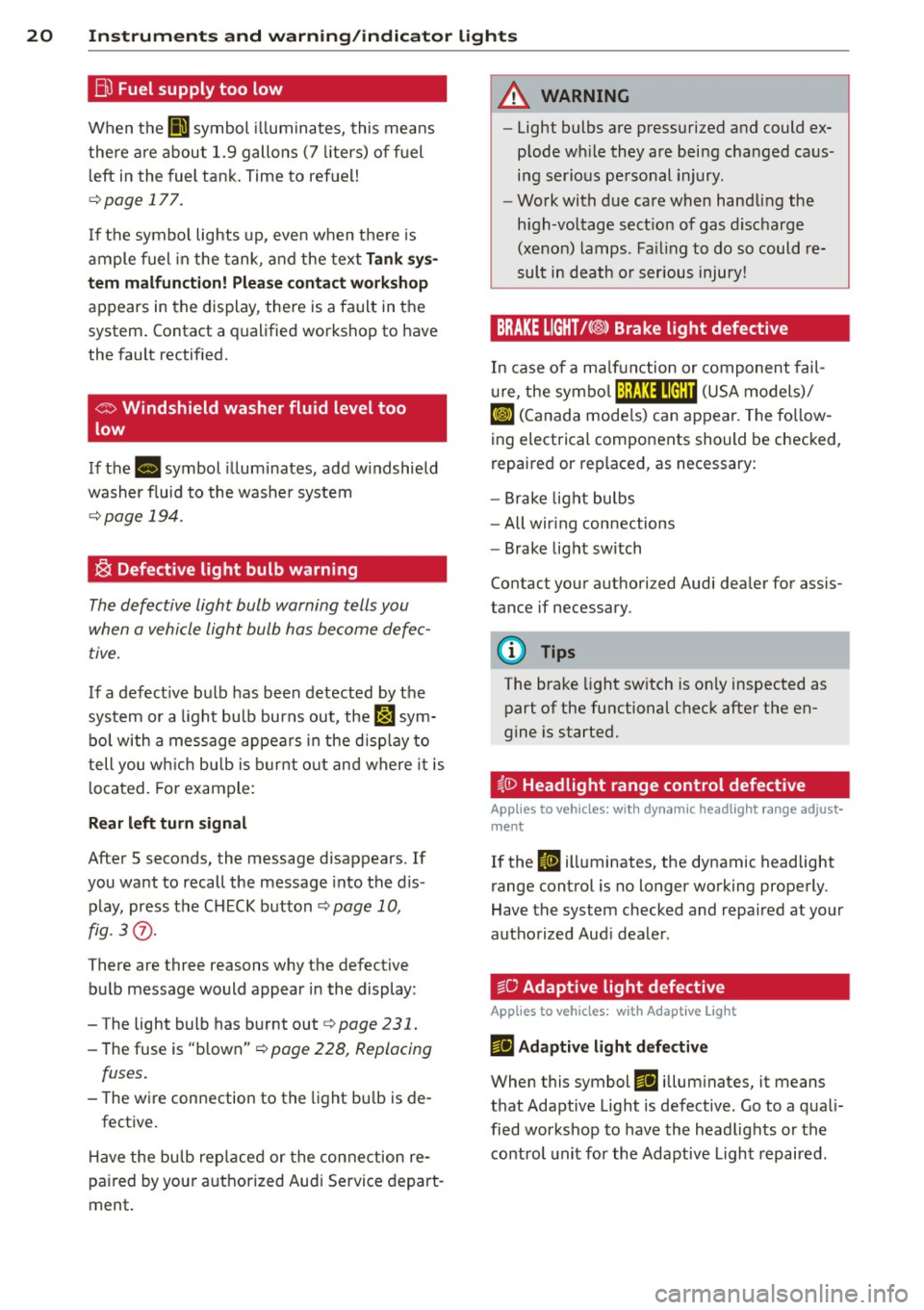
Bi) Fuel supply too low
When the (g symbol illuminates, this means
there are about 1.9 gallons (7 liters) of fuel
left in the fuel tank. Time to refuel!
Qpage 177.
If the symbol lights up, even when there is
ample fuel in the tank, and the text
Tank sys
tem malfunction! Please contact workshop
appears in the display, there is a fault in the
system. Contact a qualified workshop to have
the fault rectified.
c::>
Windshield washer fluid level too
low
If the Ill symbol illuminates, add w indshield
washer f luid to the washer system
Qpage 194.
® Defective light bulb warning
The defective light bulb warning tells you
when a vehicle light bulb has become defec
tive.
If a defect ive bulb has been detected by the
system or a light bu lb burns out, the
fsl sym
bol with a message appears in the disp lay to
tell you wh ich bu lb is burnt out and where it is
l ocated. For example:
Rear left turn signal
After 5 seconds, the message disappears. If
you want to recall the message into the dis
p lay, press the CH ECK button
Q page 10,
fig.
3 (?) .
There are three reasons why the defective
bulb message would appear in the display:
- The light bulb has burnt out
Q page 231.
- The fuse is "blown" Q page 228, Replacing
fuses.
- The wire connection to the light bu lb is de-
fective.
H ave the bu lb rep laced or the connection re
pa ired by your a uthorized Audi Service depart
ment.
A WARNING
- Light bulbs are pressurized and could ex
plode wh ile they are being changed caus
ing serious pe rsonal injury.
- Work with due care when handling the
h igh-voltage sect ion of gas discharge
(xenon) lamps. Fa iling to do so could re
sult in death or serious injury!
BRAKE LIGHT t<® > Brake light defective
In case of a ma lfunction or component fail-
ure, the symbo l (USA models)/
(@ ll
repaired or replaced, as necessary:
- Brake light bulbs
- All wir ing connections
- Brake light switch
Contact your authorized Audi dea ler for assis
tance if necessary.
(D Tips
The brake light sw itch is on ly inspected as
part of the functional check after the en
gine is started.
i,0 Headlight range control defective
Applies to vehicles: wit h dynamic headlight range adjust
ment
If the II illuminates, the dynamic headlight
range control is no longer working properly.
Have the system checked and repaired at your
authorized Audi dealer .
rsO Adaptive light defective
Applies to vehicles: with Ada ptive Lig ht
rm Adaptive light defective
When this symbol rm illuminates, it means
that Adaptive Light is defect ive. Go to a qua li
fied workshop to have the headlights or the
control unit for the Adaptive Light repaired.
Page 23 of 262
Instrument s and warnin g/indic ator ligh ts 21
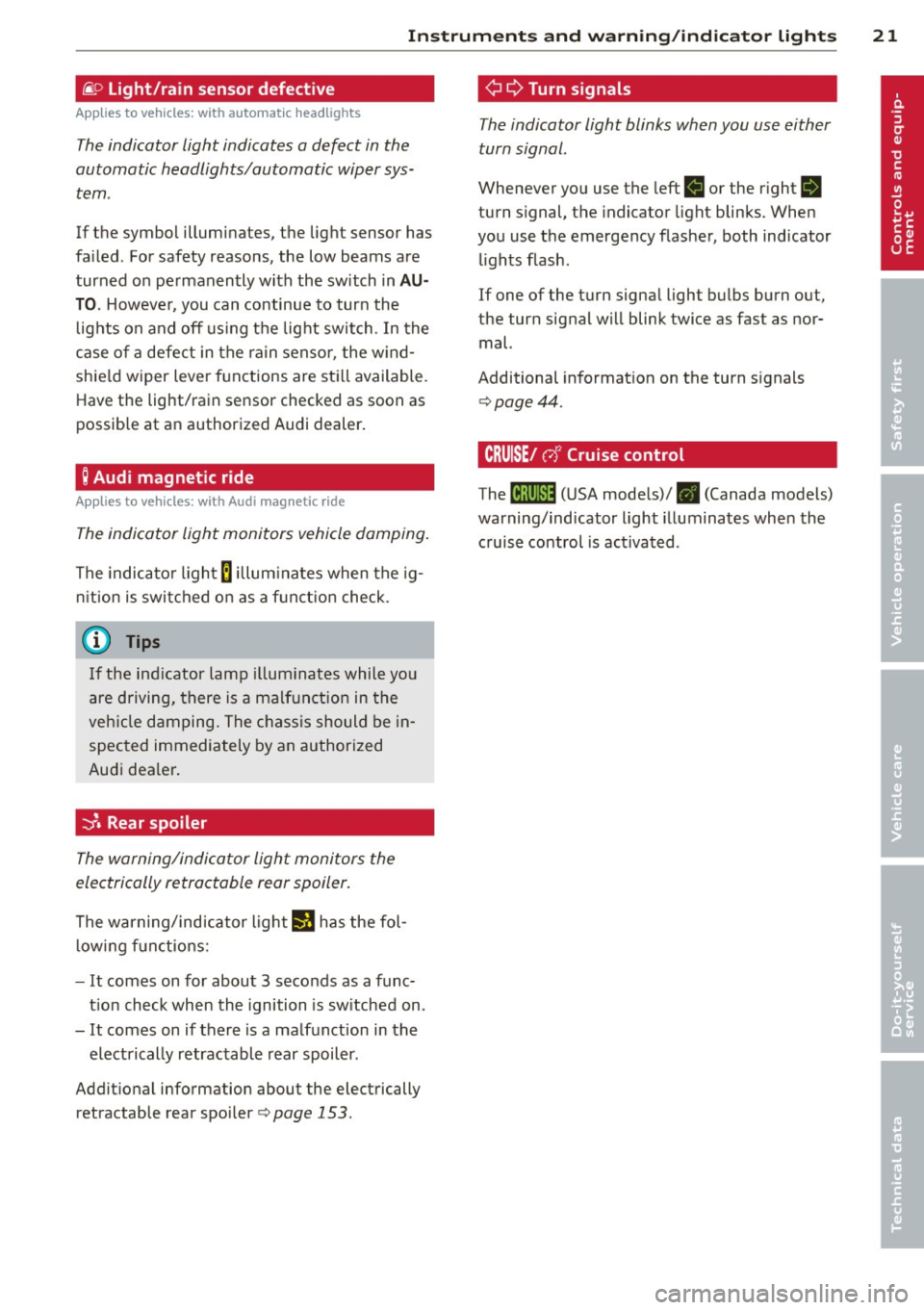
@:> Light/rain sensor defective
Applies to vehicles: with a utomat ic head lights
The indicator light indicates a defect in the
automatic headlights/automatic wiper sys
tem .
If the symbol illuminates, the light sensor has
failed . For safety reasons, the low beams are
turned on permanently with the switch in
A U
TO . However , you can continue to turn the
lights on and off using the light switch . In the
case of a defect in the rain sensor, the w ind
shie ld wiper lever functions are sti ll available.
Have the light/rain sensor checked as soon as
possible at an authorized Audi dealer.
; Audi magnetic ride
App lies to vehicles: with Audi magnetic ride
The indicator light monitors vehicle damping .
The indicato r light B illum inates when the ig
n it ion is switched o n as a funct ion check.
(j) Tips
If the ind icator lamp illum inates while you
are driving, there is a malfunct ion in the
veh icle damping. The chass is should be in
spected immediately by an authorized
Audi dea ler .
:::/, Rear spoiler
The warning/indicator light monitors the
electrically retractable rear spoiler.
The warning/indicator light l'J has the fol
l owing f un ctions:
- It comes on for about 3 seconds as a func
t ion check when the ignition is sw itched on .
- It comes on if there is a malfunction in the
electrically retractable rear spoiler .
Addit ional information about the electrically
retractable rear spo iler
¢ page 153.
¢ Q Turn signals
The indicator light blinks when you use either
turn signal .
Whenever you use the left II or the r ight II
turn s ignal, the indica tor light blinks. When
you use the emergency flasher, both indicator lights flash .
If one of the turn signa l light bulbs burn out,
the turn signal will blink twice as fast as nor
mal.
Additional informat ion on the turn signals
¢ page 44.
CRUISE/ 0" Cruise control
The tB;(l)~i# (USA models)/ . (Canada models)
warning/indicator light illuminates when the
cruise control is act ivated .
Page 36 of 262
34 Opening and closing
Power locking system
General description
The power locking system locks or unlocks all
doors simultaneously.
The power lock ing system in your ve hicle in
corporates the fo llow ing funct ions:
- Central locking function
- Remote con tro l feature q page 33 .
- Anti -Theft Alarm Sys tem q page 38.
A ll the doors and the rear lid are locked by the
centra l locking system when you lock the vehi
cle.
The unlocking a nd lock ing mode * can be
changed in t he d river i nfo rmation system
qpage24.
Unlocking the vehicle
You can un lock the vehicle from outs ide e ither
by using the remote control
or by insert ing
a nd turning the key in t he driver's door lock.
When you
unlock your veh icle:
- The anti-theft alarm system is deactivated br iefly.
- The veh icle inter ior lights ill uminate for ap
proximate ly 30 seconds.
- All turn signa l lights will f lash twice w hen
the car is unlocked.
- After unlock ing the vehicle, yo u have 30 sec
onds to open a door or the rear lid. After 30
seconds, the vehicle automatically locks and
the ant i-theft a larm system activates again.
The rear lid can be locked or un locked either
by using the remote control
or by insert ing
a nd turning the key in the driver's door lock.
Unlock ing the ve hicle w ith the remote co ntrol
c::::5 will only unlock the rear lid, to open it, the
lid handle needs to be p ressed .
Locking the vehicle
You can lock the vehicle from o utside e ither by
using the remote control
or by insert ing and
turning the key in the drivers's door lock.
When you
lo ck the vehicle:
- All doors and the rear lid are locked. -
All turn signal lights wi ll flash once when
the car is loc ked .
- The ant i-theft a larm system is ac tiva ted.
The ho rn of the anti -theft alarm system wi ll
sound and t he anti-theft a la rm system read
iness light, located in the center of the in
strument panel be low the w indshield on the
r ight side of the air vent, will start to blink.
- The vehicle interior lights turn off.
Automat ic lock ing*
T he au tom atic locking fea ture locks a ll the ve
hicle doors an d the rear lid when you drive
faster than 9 m ph (15 km/h).
You can unlock t he vehi cle from the i nside by:
- remov ing the key from the igni tion swi tc h
(the vehi cle w ill automatically u nlock itself)
or
- pressi ng the un loc k pa rt of the power lock
sw itch
ll:D or
pull ing the door ha ndle (to open the doo r).
If you wish, yo u can have an a utho rized Aud i
dealer convert your power doo r lock system to
automat ic locking.
Unintentionally locking yourself out
T he veh icle does not lock with t he centra l
l ocking switch
¢ page 3 6 if the driver's door
is open .
D o no t lock your ve hicle w ith the
remote mas
ter key
un til a ll doo rs and t he rea r lid are
cl osed. In this way yo u avoid locking yourse lf
o ut accidentally .
_& WARNING
- When you loc k yo ur vehicle from o utside,
nobody- espec ia lly children -shou ld re
main inside the vehicle. Remember,
when yo u lock the vehicle from the out
side th e wi ndows cannot be o pened from
the inside.
- Wh en you leav e th e ve hicle, always re
move the ign ition key and take it w ith
you. This will preven t passe ngers (chil
d ren, f or example) from acci denta lly be
i n g loc ke d in the vehicle s hould they
Page 37 of 262
accidentally press the power locking
switch.
- Do not leave children inside the vehicle
unsupervised. In an emergency it would
be impossible to open the doors from
the outside without the key.
@ Tips
- In the event of a crash with airbag de
ployment a ll locked doors will be auto
matically unlocked to g ive access to the
vehicle occupants from the outside.
- If the power locking system should mal
function, you can lock each door individ
ually using the vehicle key .
- If the power locking system should fail,
you can still open the fue l tank flap in an
emergency
c>page 179.
- You are well advised not to keep valua
bles inside an unattended vehicle, visible
or not . Even a properly locked vehicle
cannot provide the security of a safe!
Unlocking and locking the vehicle w ith
the remote control
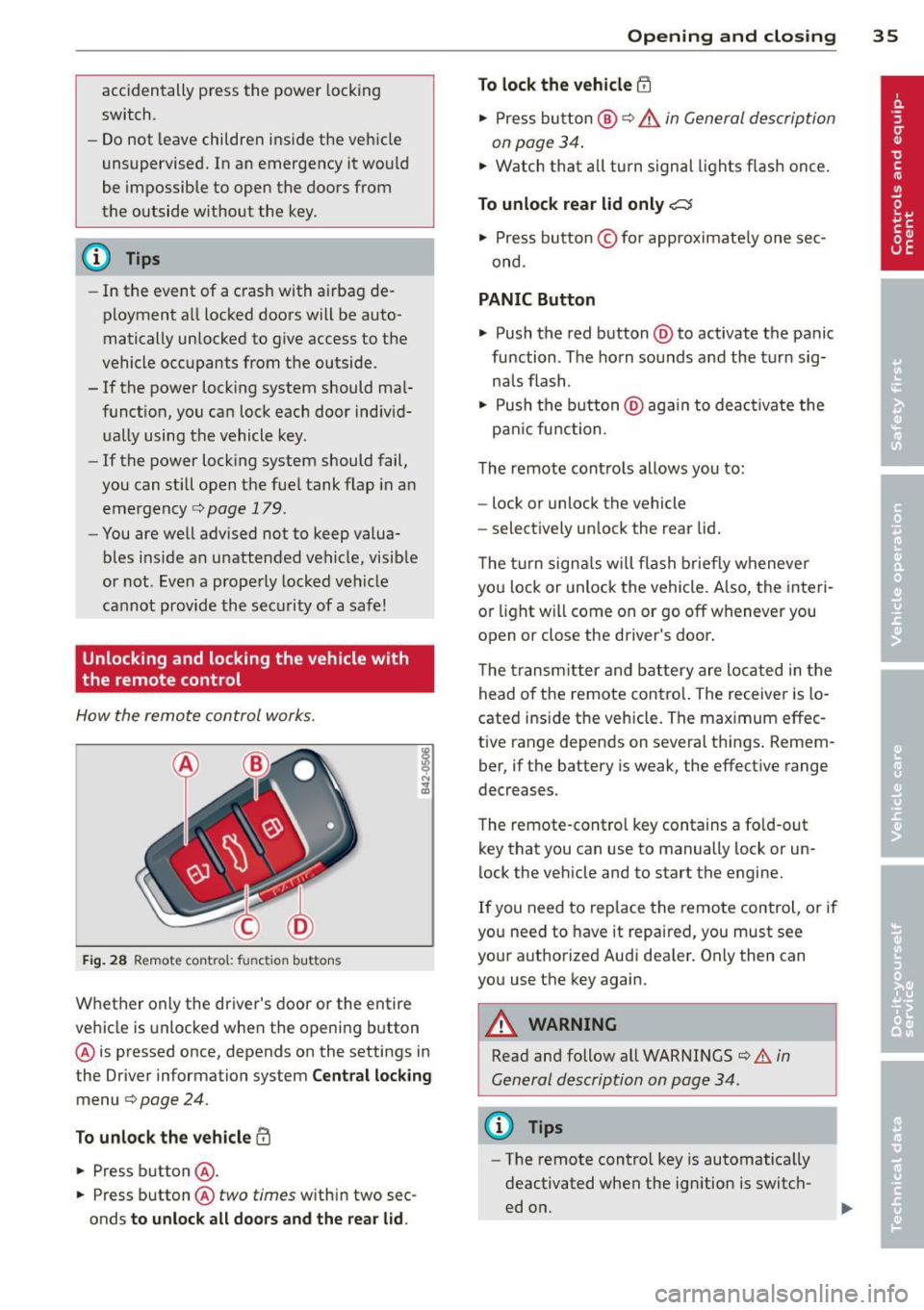
How the remote control works.
Fig . 28 Remote contro l: fu nctio n buttons
Whether only the driver's door or the entire
vehicle is unlocked when the opening b utton
@ is pressed once, depends on the settings in
the Driver information system Central locking
menu
c> page 24.
To unlock the vehicle !Ii
.,. Press button @.
.,. Press button @
two times with in two sec
onds to unlock all doors and the rear lid.
Opening and closing 35
To lock the vehicle efl
.,. Press button @ c> .&. in General description
on page 34 .
.,. Watch that a ll turn signal lights flash once.
To unlock rear lid only~
.,. Press button © for approximate ly one sec
ond .
PANIC Button
.,. Push the red button @to activate the panic
function . The horn sounds and the turn sig
na ls flash .
.,. Push the button @aga in to deact ivate the
pan ic function .
The remote controls allows you to:
- lock or unlock the vehicle
- select ively unlock the rear lid.
The turn signals will flash briefly whenever
you lock or unlock the vehicle. Also, the interi
or light will come on or go off whenever you
open or close the driver's door .
The transm itter and battery are located in the
head o f the remote contro l. The receiver is lo
cated ins ide the vehicle. The max imum effec
tive range depends on several th ings . Remem
ber, if the battery is weak, the effective range
decreases.
The remote-control key contains a fo ld-out
key that you can use to manually lock or un
lock the vehicle and to start the engine.
If you need to replace the remote control, or if
you need to have it repaired, you must see
your authorized Aud i dealer. Only then can
you use the key again.
A WARNING
Read and follow all WARNINGS c> .&. in
General description on page 34.
(0 Tips
- The remote contro l key is automatically
deactivated when the ignition is switch
ed on.
-
Page 45 of 262
light sensor ch ecked as soon as possible at a
deal ership.
Com ing home /leaving home function *
The functio n is switched on when the switch is
i n the AU TO* posi tion and the function is
shown as active in the driver information sys
tem .
The
coming hom e function illuminates the
a rea aro und the veh icle when the ign ition is
switched off and the driver 's door is opened.
The length of time the lights remain on can be
set in the menu display
( Illumin ation > Exte
rior lights > coming hom e).
The leaving home func tion i llum inates the
area around the vehicle when unlocking it.
A WARNING
- Never use dayt ime running lights to see
where you are going. They are not bright
enough and w ill not let you see far
enough ahead for safety, especially at
dusk or when it is dark . Always switch on
the low beams at dusk or when it is dark.
- Automatic headlights are only intended
to assist the dr ive r. T hey do not relieve
the driver of his responsibility to check
the headlights and to tu rn them on man
ually acco rding to the c urrent light and
visibili ty cond itions. For example, fog
and rain cannot be detected by the light
sensors . So a lways switch on the head
lights under these weather cond itions
and when driving in the dark
io .
-Crashes can happen when yo u cannot see
the road ahead and when you cannot be
seen by other motorists .
- Always tur n on t he headlights so that
you can see ahead and so that o thers
c a n see yo ur ca r from the ba ck.
- Please obse rve lega l regu lations whe n
us ing the light ing systems descr ibed .
(D Tips
-The light sensor for headlight control is
l ocated in the rear v iew m irror mount .
Do not apply a ny stic kers to the w ind-
Clear vis ion 43
shield in th is area to p revent malfunc
tions or fai lures.
- Some exter io r light ing funct ions can be
adjusted in the d river informat ion sys
tem
~ page 24.
- If you remove the ignition from the igni
tion lock while the headlights are still
on, a buzzer w ill sound as long as the
dr iver's door is open to rem ind you to
t u rn off the lights.
- Always observe the specific loca l regula
tions for your area as to when to use your
lights.
- With automatic headlights, the high
beam function is also available, but w it h
one restrict ion:
If you have not sw itched
t he high beams back to low beams dur
ing automatic headlight operation (fo r
example, afte r d riving throug h a tunnel),
only the low be ams come on the next
t ime au tomatic headlights are switched
on. To use the high beams, you firs t have
to pull the high beam lever back and
then push the leve r forward again.
- In coo l or damp weather, the inside of
the headlights, turn signals and tail
lights can fog over due to the tempera
ture difference between the inside and
outside. They w ill clear shortly after
sw itching them on. This does not affect
the se rv ice life of t he lig hti ng .
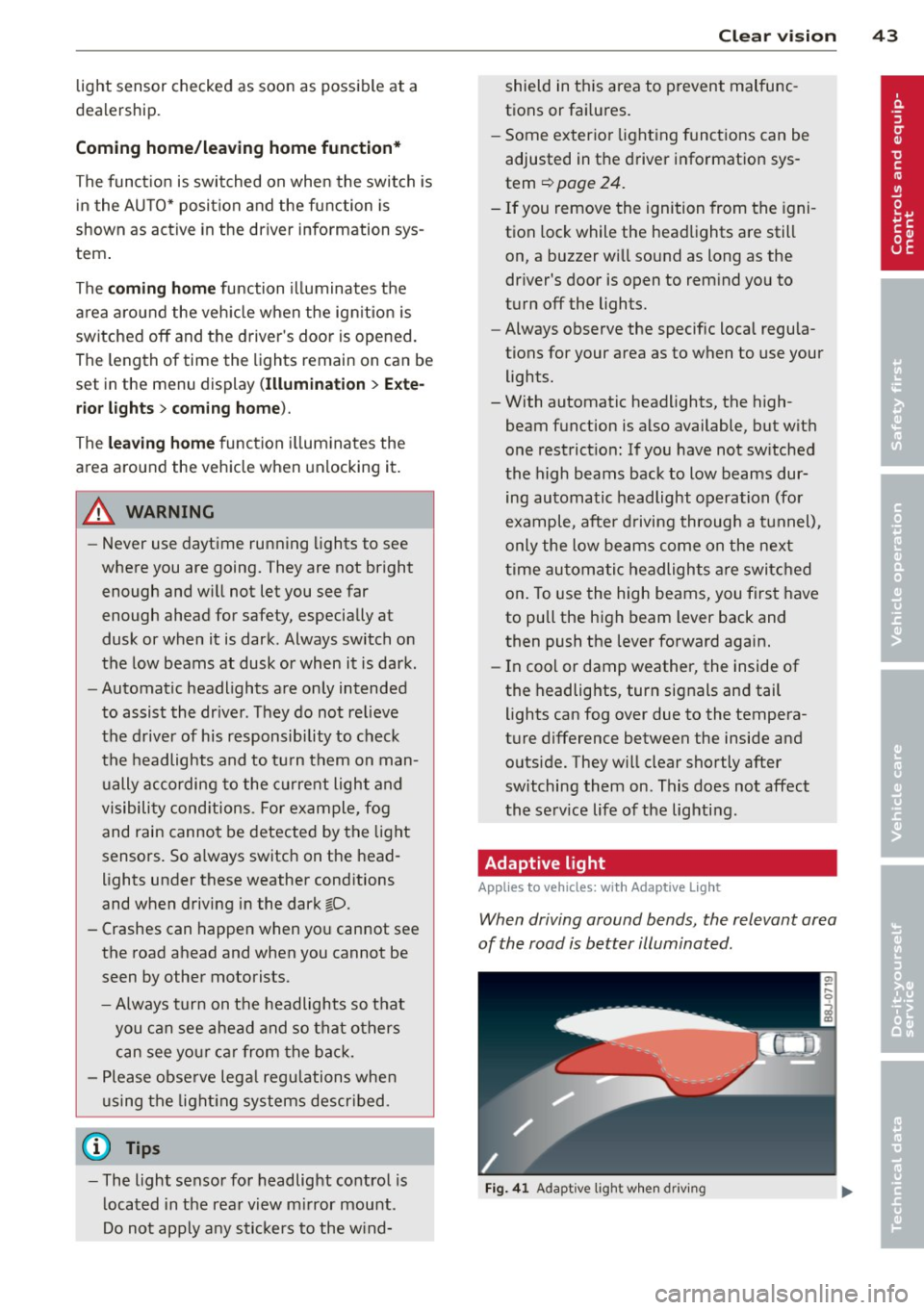
Adaptive light
Applies to veh icles: w ith Adaptive light
When driving around bends, the relevant area
of the road is better illuminated .
Fig. 4 1 Adapt ive li ght w hen driv ing
Page 47 of 262
instrument cluster illuminates when the
high beams are on.
- The
headlight flasher works only as long as
yo u hold the lever -even if there are no
l ights turned on . The indicator light
El in
the instrument cluster illuminates when you
use the headlight flasher.
A WARNING
Do not use the hig h beam or headlight
flasher if you know that these could blind
oncoming traffic.
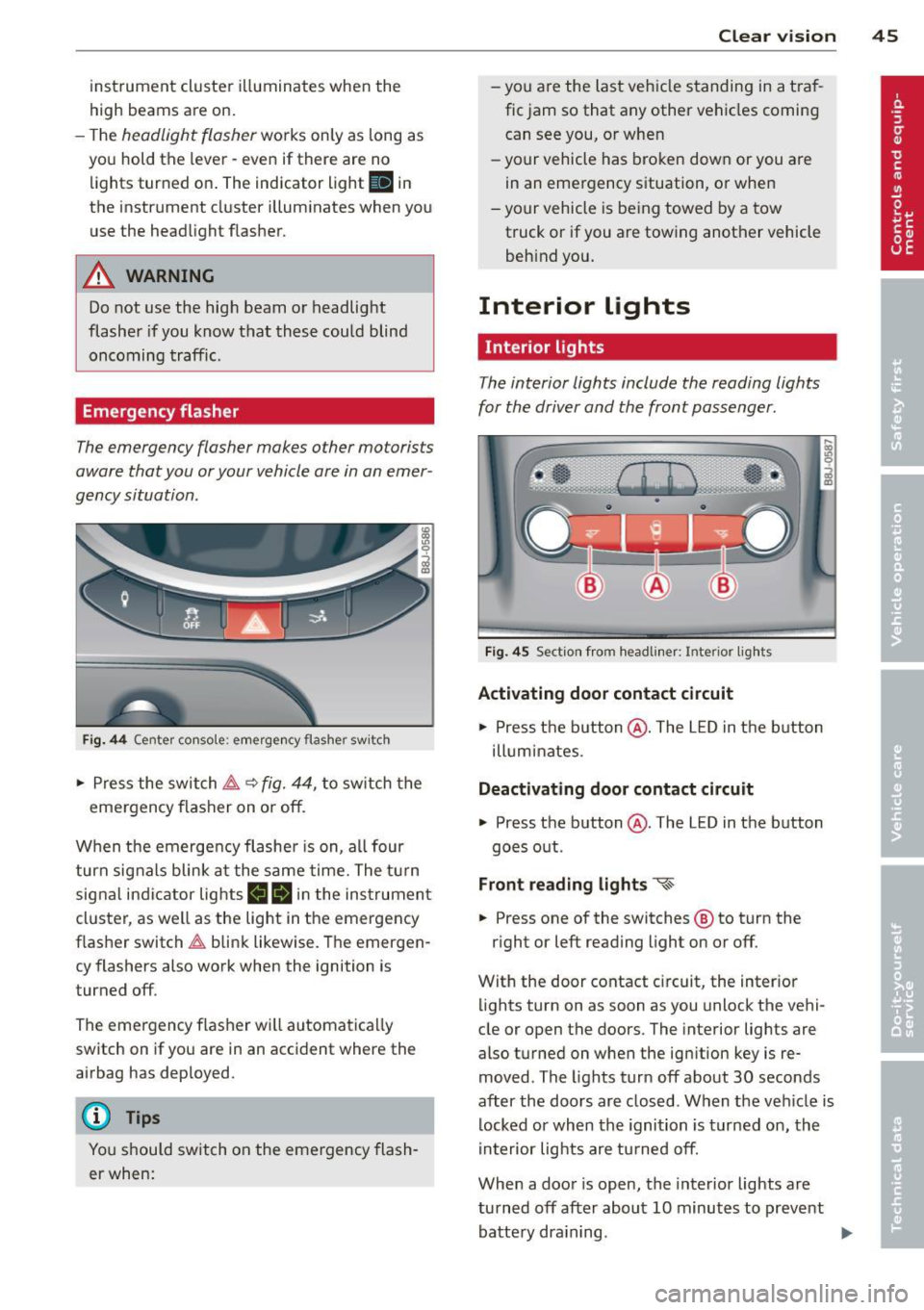
Emergency flasher
The emergency flasher makes other motorists
aware that you or your vehicle are in an emer
gency situation.
Fi g. 44 Cente r co nso le: emerge ncy flasher switch
.,.. Press the switch ~ ~fig. 44, to sw itch the
eme rgency flasher on or off.
When the emergency flashe r is on, all four
turn signals blink a t the same time. The tu rn
signa l indicator lights
BB in the ins trument
cluster, as we ll as the light in the emergency
f lasher switch ~ blink likewise. The emergen
cy flashers also work when the ignition is
turned off.
The emergency flasher will automatica lly
switch on if you are in an acc ident where the
airbag has deployed.
@ Tips
You shou ld switch on the emergency flash
er when: Clear vi
sion 45
- you are the last vehicle standing in a tra f
fic jam so that any other vehicles coming
can see you, or when
- your vehicle has broken down or you are
in an emergency s ituation, or when
- your vehicle is be ing towed by a tow
truck or if you are towing another vehicle
behind you.
Interior Lights
Interior lights
The interior lights include the reading lights
for the driver and the front passenger.
Fi g. 45 Sect ion from hea dlin er: Interior lights
Activating door contact circuit
.,.. Press the button @. The LED in the b utton
illuminates .
Deactivating door contact circuit
.,.. Press the button @. The LED in the button
goes out.
Front reading lights "<~
.,.. Press one of the switches ® to turn the
r ight or left reading light on or off.
With the door contact circuit, the inter ior
lights turn on as soon as you unlock the vehi
cle or open the doors. The interior lights are
also t urned on when the ignition key is re
moved. The lights turn off about 30 seconds
after the doors are closed. When the veh icle is
locked or when the ignition is turned on, the
interior lights are turned off.
When a door is open, the interior lights are
turned off after about 10 minutes to prevent battery dra ining.
Page 49 of 262
Mirrors
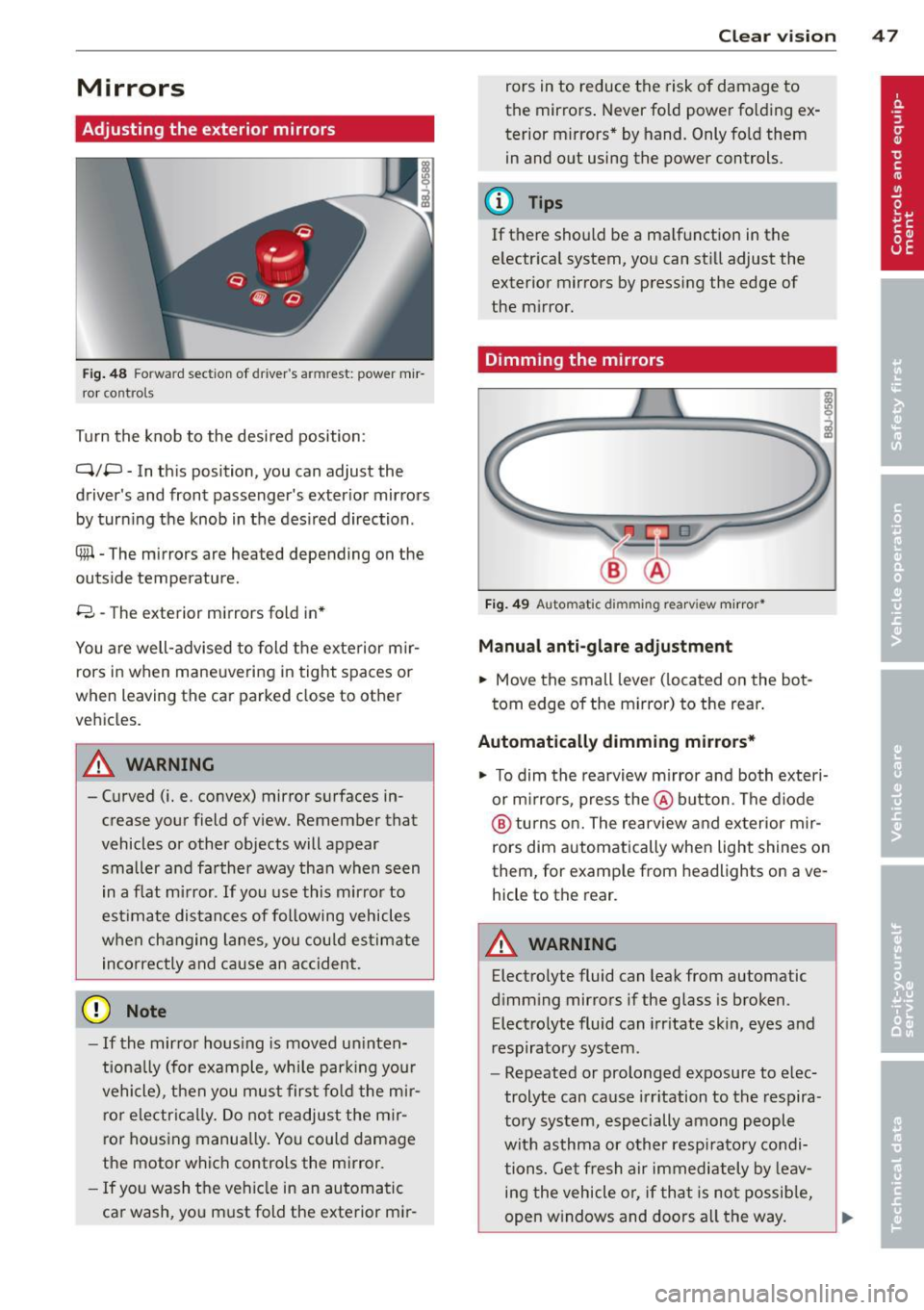
Adjusting the exterior mirrors
Fig. 48 Forw ar d section of driver's armrest: powe r m ir
r or co nt rols
Turn the knob to the desi red position :
Q/P -In th is position, you can adjust the
driver's and front passenger's exter ior mir rors
by turn ing the knob in t he des ired direction .
® -The m irrors are heated depending on the
out side temperature .
8 -The exterior mirrors fold in *
You are well-advised to fold the exterior m ir
r ors in when maneuveri ng in tight spaces or
when leaving the car parked close to other
ve hicles .
A WARNING
- Curved ( i.e. convex) mirror s urfaces in
crease your field of view. Remember that
vehicles or other objects will appear
smaller and fa rther away than when seen
in a flat m irror .
If you use this mirro r to
est imate distances of following vehicles
whe n changing lanes, you cou ld es tim ate
incorrectly and cause an accident.
(D Note
- If the mirro r hous ing is moved un inten
tiona lly (fo r example, while park ing your
vehicle), then you must firs t fold t he mir
ror electrica lly. Do not readjus t the m ir
ror ho using manua lly. You could damage
the motor which controls the mirror.
- If you wash the ve hicle in an au tomati c
ca r wash, yo u m ust fold the exterior mir-
-
Clear vi sion 4 7
rors in to reduce the risk of damage to
the mirro rs . Never fo ld powe r fo lding ex
terior m irrors* by hand. Only fo ld them
in and o ut using the power controls.
@ Tips
If there sho uld be a ma lf u nction in the
e lectr ica l system, you can sti ll adjust the
exterior mirrors by pressing the edge of
the m irror.
Dimming the mirrors
Fi g. 4 9 Auto matic dimming re arv iew m irro r*
Manual anti -glare adjustment
.,. Move the small leve r (located on the bot
tom edge o f the mirror) to the rear .
Automatically dimming mirrors*
"' To dim the rearview m irror and both exteri
or m irrors, press the@ button . The diode
@ turns on. The rearview and ex terior m ir
rors dim automatically when light shines on
them, for examp le from headlights on ave
hicle to the rear .
A WARNING
= -
Electrolyte fluid can leak from automatic
d imm ing mirrors if the glass is broken.
Electro lyte fluid can irr itate skin , eyes and
respira to ry system .
- Repeated or prolonged exposure to e lec
trolyte can cause irritation to the respira
to ry system, especially among people
wit h asthma or other resp irato ry condi
t ions. Get fresh air immediately by leav
ing the vehicle o r, if th at is no t possib le,
open w indows and doors a ll the way.
~
Page 51 of 262
come back a while later and drive off, the rain
sensor will reactivate itself after the vehicle
speed has exceeded 4 mph (6 km/h).
The rain sensor* is only activated with the
wiper lever set to position(!). When it starts
to rain, the rain sensor will automatically acti
vate the intermittent wiping mode.
To reduce the sensitivity of the sensor, move
switch @ down. To increase the sensitivity,
move the switch up. The higher you adjust the
sensitivity, the faster the sensor will react
when it senses moisture on the windshield. The pauses between wiper turns depend not
only on the sensitivity setting, but on the ve
hicle speed as well.
During brief stops, e.g . at a red light, wiper
motion will automatically be reduced to the
next lower speed . Wipers already turning at
low speed change to intermittent wiping.
When the ignition is turned on, the washer
jets are heated .
A WARNING
-Wiper blades are crucial for safe driving!
Only when they are in good condition are
they able to clear the windows properly
to provide uncompromising visibility.
Worn or damaged wiper blades are a
safety hazard
r=;, page 51, Replacing
windshield wiper blades!
- The light/rain sensor* is only designed to
assist and support the driver.
It remains
entirely the driver's responsibility to
monitor outside weather conditions and
to manually activate the wipers as soon
as rain or drizzle reduces visibility
through the windshield.
- The windshield must not be treated with
water-repellent materials. They can in
crease glare under poor visibility condi
tions such as wetness, darkness, or when
the sun is low on the horizon. In addi
tion, they can cause the windshield wip
ers to chatter.
Clear vision 49
@ Note
In freezing or near freezing conditions:
- Always check that the wiper blades are
not frozen to the glass before you turn
the wipers on. Loosen a wiper blade
which is frozen in place before operating
the wipers to prevent damage to the
wiper blade or the wiper motor.
- Do not use the wipers to clear a frosted
window. Using the wipers as a conven ient ice scraper will destroy the wiper
blades .
- Before you take your vehicle to an auto
matic car wash, make sure you have the
windshield wiper system switched off (lever in position
0), otherwise the wind
shield wiper system could get damaged
in the car wash if it should suddenly
come on.
@ Tips
-The windshield wipers are switched off
when the ignition is turned off. Activate
the windshield wipers after the ignition
is switched back on by moving the wind
shield wiper lever to any position.
- Worn or dirty windshield wiper blades
cause smearing, which can affect the op
eration of the light/rain sensor*. Check
the condition of your windshield wiper
blades regularly.
-The rain sensor is part of the interval
wiping system. Turning off the ignition
will also deactivate the rain sensor. To re
activate the sensor, switch off the inter
val wiping function, then switch it back
on again.
-Applies to vehicles with light/rain sen
sor: When the wipers are switched on
manually and in rain conditions, the au
tomatic headlights* turn on
r=;, page 42,
Switching the headlights on and off
or
off during the day when the wipers are
no longer operating. The automatic
headlights* function is available in this
case only when the light switch is in the
"AUTO" position¢
page 42, fig. 39.
Page 74 of 262
72 On the road
you leave your veh icle . This makes a vehicle
theft even more difficult ¢ .&. .
Ignition ke y saf ety lock
After swi tching off the ignition, the ig nit ion
key can on ly be removed from the ign it ion
lock when the se lector lever is in the "P"
(Park) position . After you have removed the
key, the selector lever is locked and cannot be
moved.
Ignition on @
If it is diffic ult to turn the key after you have
inserted it into the ignition lock, turn the
steering wheel back and forth. This will take
the load
off the steering lock mechanism and
you will be able to turn the key freely and
start the engine.
Starting the engine @
In this position the engine starts . While the
engine is starting, the power supply to the headlights and other e lectrica l consumers is
temporari ly interrupted to conserve battery
power. After the engine has started, release
the key and it will return to posit ion
(D .
Before the starter can be operated again the
key must be turned back to position @. The
non -repeat loc k prevents you from damaging
the starter when the engine is runn ing .
A WARNING
-Never remove the key from the ign ition
lock whi le the vehicle is moving. The
steeri ng wheel will lock causing loss of
c ontrol.
- If you have to leave your vehicle -even
for just a m inute -always remove t he ig
nition key and take it with you. This is es
pecially important if you a re going to
leave ch ildren behind in the vehicle. The
children co uld start the engine or use
other vehicle controls. Unsupervised use
of vehicle controls (for examp le, power
windows) can cause serious personal in
jur ies .
(!) Tips
If the vehicle battery has been disconnect
ed and then reconnected, then you must
l eave the key in position
(D for about 5
seconds before you can start the engine.
Starting and stopping
the engine
Starting the engine
The engine can only be started with an origi
nal Audi key.
.,. Set the park ing brake.
.,. Move the se lector lever to the neutral posi
tion (automatic transmission): selector lever
in
P or N) ¢ .&_ .
.,. On vehicles with manua l transmission, fully
depress the clutch pedal.
.,. Turn the ignition key to pos it ion @
¢ page 71, fig . 71 -do not depress the gas
pedal when starting the engine!
.,. Let go of the key as soon as the engine
starts.
A cold engine may at first be loud after it has
been sta rted. This is due to the hydrau lic
valves bu ild ing up the oil pressure. This nor
mal and no need for co nce rn .
If the engine does not start immediately, stop
trying after 10 seconds and then try to restart
the engine abou t 30 seconds late r.
A WARNING
Neve r star t or let the eng ine run in a con
f ined or enclosed area . Exhaust fumes
from the engine contain carbon monoxide,
a colorless and odor less gas . Ca rbon mon
oxide can be fatal if inhaled.
- Never leave the engine id ling unattend
ed. An unattended veh icle w ith a runn ing
engine poses a danger of personal injury
or theft.
Page 83 of 262
The park lock must only be engaged with the
vehicle
stationary c::> &.
To engage P and to remove the lever from th is
position, you must depress the release b utton
(button in the selector lever handle)
and si
multaneously you must step on the brake
pedal.
R · re verse
I n th is position, reverse is engaged.
Reverse gear must only be engaged with the
veh icle
stationary and the eng ine runn ing at
id le speed
c::> ,&. .
To engage R, you have to depress the release
button
and s imultaneously step on the brake
pedal. In the R position, the back-up lights il
lum inate with the ign ition on.
N • N eutra l
The transmission is in neutral in this position .
D -Norm al p osi tion f or d riving forwa rd
In this position, the forward gears are auto matica lly shifted up and down, depending on
engine load and vehicle speed.
To engage D from N, the brake peda l must be
depressed at speeds be low 5 km/h or when
the vehicle is stationary
c::> & .
In certain circumstances (driving in the moun
tains for examp le) it can be beneficial to
switch temporarily to the manua l shift pro
gram
c::> page 84 in order to adjust the gear
ratios to driving cond itions
manually.
S -Sport setting
The 5 se tt ing shou ld be selected for spor ty
d riving . The power reserves of the engine can
be fu lly exp loited through later upshifts.
To engage S from N, the brake pedal must be depressed at speeds be low 5 km/h or when
the vehicle is stationary
c::> & .
Tra n sm iss io n 81
A WARNING
- Never p lace the selector lever in the R or
P posit ion while the veh icle is moving -
risk of an accident!
- With the engine running, it is necessary
to hold the vehicle with the foot brake in all selector lever positions (except P and N), because even at idle speed the trans
fe r of power is never completely inter
rupted -the vehicle " creeps". If the vehi
cle is stationary and the transmission is
engaged, the engine should never be
speeded up unintentionally (e .g. manual
ly from under the hood). Otherwise the
veh icle w ill immediately start to move -
sometimes even if the park ing brake is
firmly applied - risk of an accident!
- Before you or other persons open the
hood and work on a running engine, the
selecto r lever must be moved to P and
the park ing brake applied f irmly - risk of
an accident! Follow the wa rning sticke rs
c::> page 174, Engine compartment.
(D Tips
If yo u have inadvertently shifted into N
while the vehicle is moving, you shou ld re
move you r foot from the accelerator and
wait unt il the engine speed has dropped to
idle before shifting back to Dor 5 .
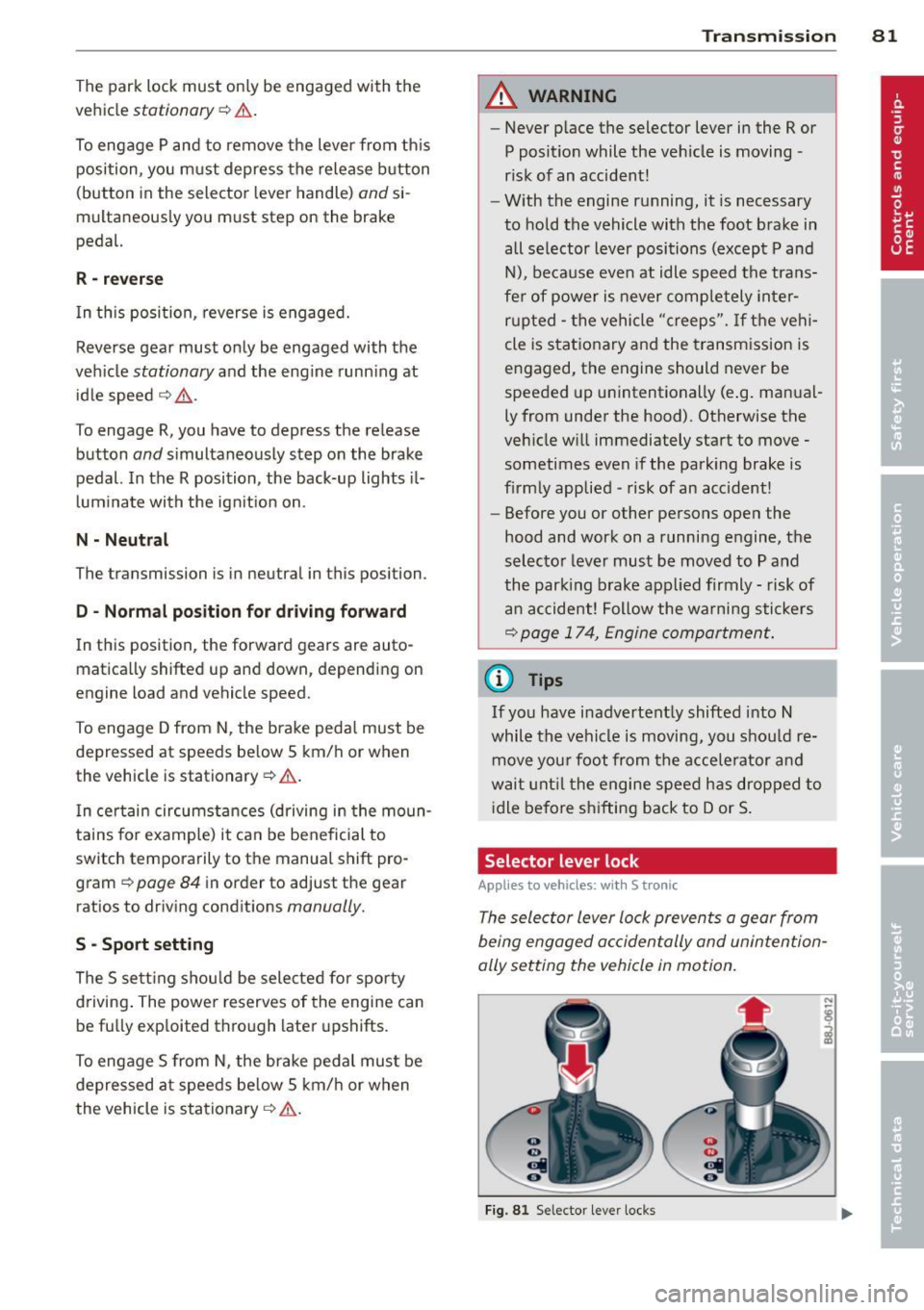
Selector lever lock
Applies to veh icl es: w ith S tronic
The selector lever lock prevents a gear from
being engaged accidentally and unintention
ally setting the vehicle in mo tion.
F ig. 81 Selector lever locks