window AUDI TT 2013 Owner´s Manual
[x] Cancel search | Manufacturer: AUDI, Model Year: 2013, Model line: TT, Model: AUDI TT 2013Pages: 262, PDF Size: 65.91 MB
Page 69 of 262
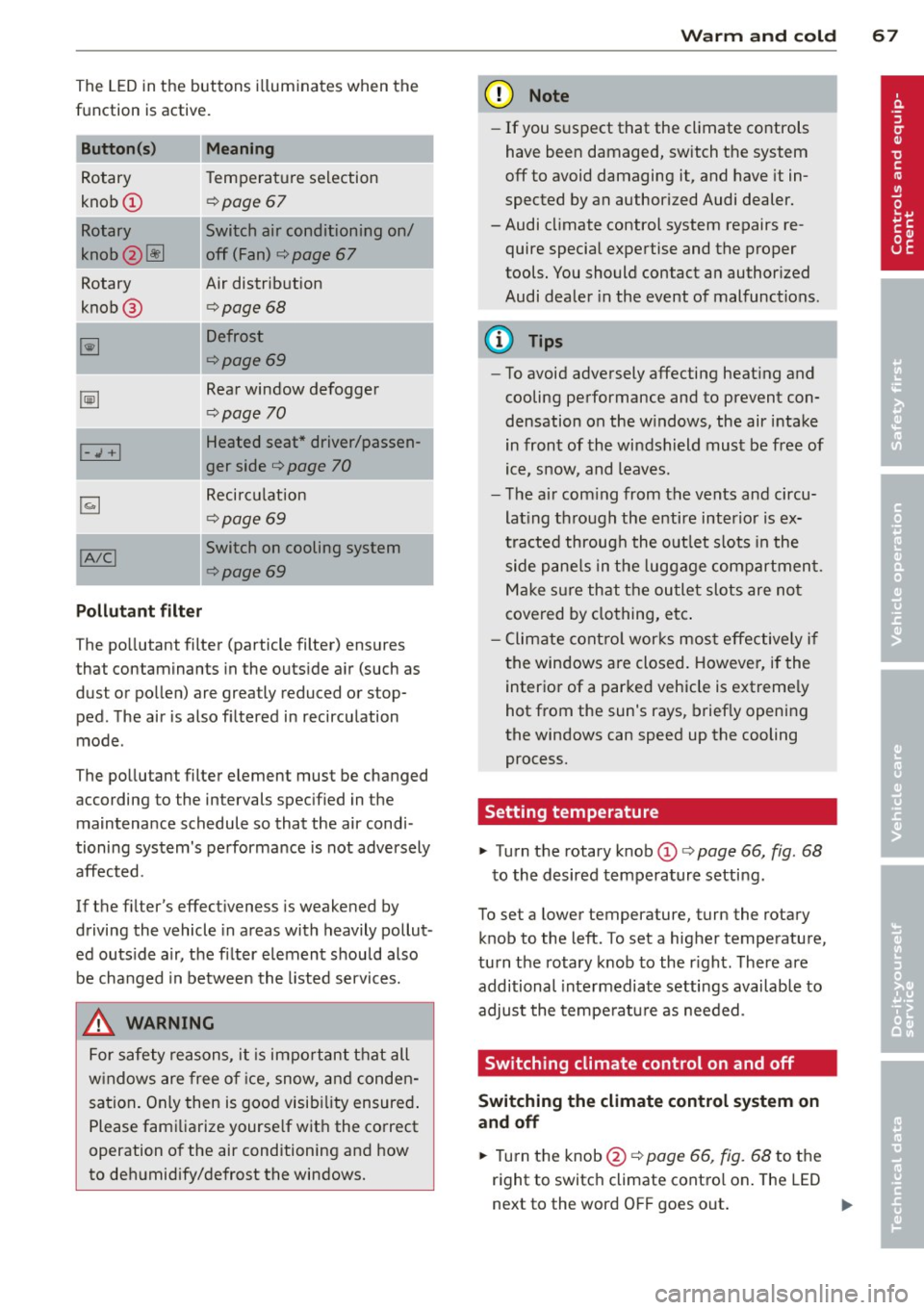
The LED in the buttons illum inates when the
function is active.
Button (s) Meaning
Rotary Tem
perature selection
knob
CD r=;, poge 67
Rotary Switch air cond itioning on/
knob
2 ~ off (Fan) ¢ page 67
Rotary Air distribution
knob @
¢page 68
~
Defrost
r=;,page69
~
Rear window defogger
¢page 70
Heated seat * driver/passen-I-.,; +I
ger side ¢ page 70
~
Recirculation
¢page 69
!AIC! Switch on cooling system
r=;, page69
Pollutant filter
The po llutant filter (particle filter) ensures
that contaminants in the outs ide a ir (such as
dust or pollen) are greatly reduced or stop ped. The air is also f iltered in recirculation
mode .
The pollutant filter element must be changed according to the intervals spec ified in the
maintenance schedule so that the air cond i
tioning system's pe rformance is not adversely
affected.
If the filter's effect iveness is weakened by
driving the vehicle in areas with heavily pollut
ed outs ide a ir, the fi lter element should also
be changed in between the listed services.
,&. WARNING
For safety reasons, it is impo rtant that all
w indows are free o f ice, snow, a nd conden
sation . Only then is good visib ility ensured .
Please fami liarize yourse lf wit h the correct
operation of the air conditioning and how
to deh umidify/defrost the windows.
Warm and c old 67
@ Note
-If you s uspect that the climate controls
have been damaged, switch the system
off to avoid damaging it, and have it in
spected by an authorized Audi dealer.
-Audi cl imate control system repairs re
quire special expertise and the proper
tools. You should contact an author ized
Audi dealer in the event of malfunctions.
(D Tips
- To avoid adversely affecting heat ing and
cooling performance and to prevent con
densation on the w indows, the air i ntake
in front of the windshield must be free of
ice, snow, and leaves.
- T he a ir com ing from the vents and circu
lat ing th rough the e ntire interior is ex
tracted throug h the o utlet s lots in the
side p ane ls in the luggage compartmen t.
Ma ke s ure th at the outlet slots are no t
cove red by clo thing, e tc.
- C limate cont ro l wor ks mos t effectively i f
t he windows are closed. Howeve r, if the
interior of a par ked vehicle is extreme ly
hot from the sun's rays, brief ly opening
the windows can speed up the cooling
process.
Setting temperature
"' Turn the rotary knob CD ¢ page 66, fig. 68
to the desired temperature setting.
To set a lower temperature, turn the rotary
knob to the left . To set a higher temperatu re,
turn the rotary knob to the r ight . There are
additional inte rmediate settings available to
adjust the tempe ratu re as needed .
Switching climate control on and off
Switching the climate control system on
and off
"' Turn the knob@ r=;, page 66, fig. 68 to the
right to switc h climate contro l on . The LED
next to the word OFF goes o ut. ..,.
Page 70 of 262
68 Warm and cold
• Turn the knob@c:> page 66, fig. 68 to the
l eft to switch the climate contro l system off.
T he LED next to the word OFF comes on .
Setting fan speed ~
• Turn the knob@c:> page 66, fig. 68 to the
setting you want to adjust fan speed (ai r
quantity).
I n automat ic mode the cl imate control sys
tem automatically regulates fan speed de
pending on interior temperature . You can ad-
Air distribution
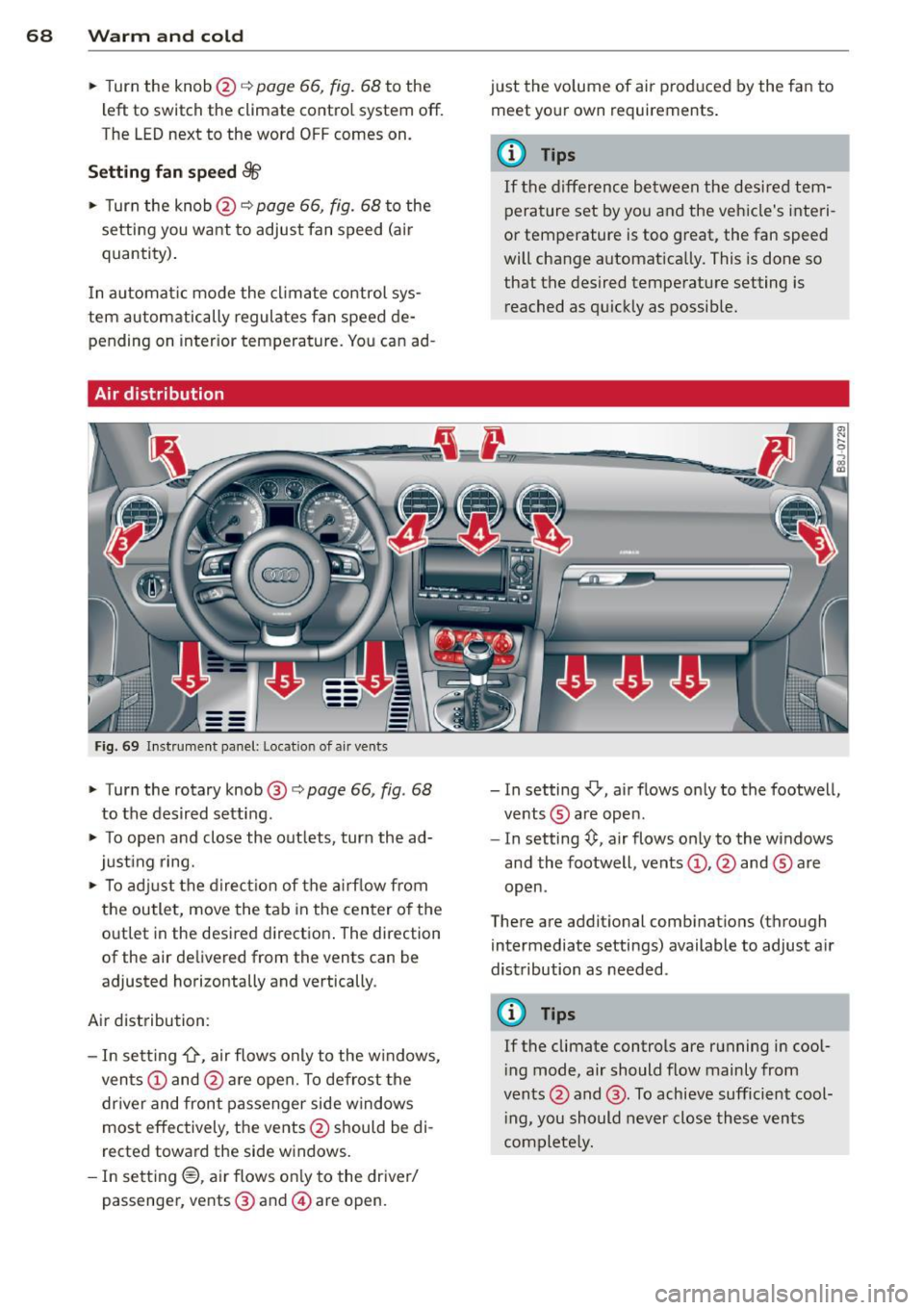
F ig. 6 9 In st ru m ent panel: Locat io n of air ven ts
• Turn the rotary knob @ c:> page 66, fig . 68
to the desired setting.
• To open and close the out lets, turn the ad
just ing ring.
• To adj ust the direct ion of the a irf low from
the outlet, move the tab in the center o f the
outlet in the desired d irection . The direction
of the air delivered from the vents can be
adjusted horizontally and vertically .
Air distribution:
- In sett ing
-0-, air flows only to the w indows,
ven ts @ and @are open. To defrost the
dr iver and front passenger side windows
most effectively, the vents @should be di
rected toward the side w indows.
- In sett ing®, ai r flows on ly to the dr iver/
passenger , vents @ and @are open. just the volume of air produced by the fan to
meet your own requirements .
(D Tips
If the d ifference between the desired tem
pera ture set by you and the vehicle's interi
or temperature is too great, the fan speed
will change automat ically. This is done so
that the desired temperature setting is
reached as quickly as possib le.
- In setting
-0, air flows only to the footwell,
ve nts ® are open.
- In setting~. air flows only to the windows
and the footwell , vents @, @ and ® are
open .
There are additional comb inations (through
intermediate settings) available to adjust a ir
distribution as needed .
(D Tips
If the climate controls are running in cool
i ng mode, air should flow mainly from
vents @and @. To achieve sufficient cool
i ng, you should never close these vents
complete ly.
Page 71 of 262
Defrost~
The windshield and side windows ore defrost
ed or cleared of condensation as quickly as
possible .
.,. To turn on the defogger/defroster, press the
~button <=>
page 66, fig. 68 .
.,. To turn the defogger/defroster off, press
the ~ button aga in, or the
! AUTO ! button.
T emperature is controlled automatically . T he
maximum amount of a ir flows mainly from
vents 1
¢ page 68 .
A small amoun t of air flows from vents 2 -if
they are open <=>
page 68.
Pressing the~ button switches off recircula
tion mode.
Automatic operation ~
Standard operating mode at all times of the
year.
Turnin g on autom atic operation
.,. Set the temperature you want .
.,. Press the
!AUTO I button <=> page 66, fig. 68 .
Automatic operation ensu res constant tem
perat ures in the inter ior and dehum idifies the
air inside the vehicle . Air temperature, vol
ume , and distribution are controlled automat
ically to reach or maintain the desired interior
temperature as quickly as possib le. Fluctua
tions in exterior temperature and the effects
of temperature from the posi tion o f the sun
are compensated for automat ically.
Manual air recirculation mode~
The recirculation mode prevent s polluted out
side air from entering the vehicle interior .
Swit c hi ng on air r ecircu lat ion
.,. Press the button~<=> page 66, fig. 68
¢ _&. .
Sw itching off air r ecir culation
.,. Press the but ton ~ again, or
.,. Press the
!AUTO I button, or
Warm and c old 69
.,. Press the~ button .
In recircu lation mode, air is drawn from the
vehicle interior, filtered, and recirculated . We
recommend that yo u se lect reci rculation
mode
briefly <=>.& under the fo llowing condi
tions:
When dr iv ing thro ugh a tunnel or in a traffic
jam so that exhaust fumes and odors cannot enter the vehicle interior .
_&. WARNING ~
You should not use the recirculation mode
for an extended period s ince no fresh air is
drawn in, and with the air condit ioning
switched off the windows can fog up -th is
increases the r isk of an accident!
A/C operation ~
Switching on A /C
.,. Press the !A/Cl button <=> page 66, fig. 68 .
Switching A/C off
.,. Press the IA/C l butto n again .
T he air is not coo led and humidity is not re
moved when cooling mode is switched off.
This can cause fog on the windows. Cooling mode switches off automatically when the
outside temperature is be low zero .
(D Tips
If the LED in the switch stays on after A/C
ope ration has been switched off(= switch
i ng the A/C off), there is a fault in an air
cond itioning component. Please consult
an authorized Audi dealer when there is an
operat ing problem.
Using the climate controls economically
Economical use of the clima te controls helps
to save fuel .
When climate control is working in cooling
mode, engine performance is reduced and
fuel consumpt ion is affected . To keep the time.,.
Page 72 of 262
70 Warm and cold
the air conditioning is on as short as possible,
you should do the fo llowing:
... If you wo uld like to save f uel , sw itch the air
cond ition ing off .
... If you open the windows whi le driving,
switch the air conditioning off .
... If the vehicle is extremely hot due to the
heat of the sun, brief ly open doors and win
dows.
@) For the sake of the environment
When you save fuel, you reduce emissions
from the vehicle.
Rear window defogger
The rear window defogger clears the rear win
dow of condensation .
... Press the [iii) button c:> page 66, fig. 68 to
turn the rear window defogger on and off.
The rear window defogger works only when
the eng ine is running. The indicator light in
the button illuminates when t he rear window
defogger is turned on.
The rear window defogger is switched off au
tomatically after 10 to 20 minutes, depend ing on the outside temperature.
At very low outside temperatures, the rear
window defogger can be switched on continu
ously by pushing the
[iii) button for more than
2 seconds. This remains stored unt il the igni
tion is sw itched off. A rear window defogger
that was switched on also remains stored for
15 minutes after the ignition is switched off .
If the engine is restarted within these 15 mi
nutes, the rear window defogger is act ivated
for 10 to 20 minutes, depend ing on outs ide
temperature . With a vehicle that is parked for
a short time, the rear w indow defogge r does
not need to be ma nually activated again.
@, For the sake of the environment
As soon as the rear window is clear, you
should switch the rear window defogger off.
The reduced power consumption has a
beneficial effect on fuel consumption .
Heated seats
Applies to vehicles : w ith hea ted seats
The seat cushion and the seatback of the
front seats can be heated electrically.
... Press the heated seats button I-J + I
c:> page 66, fig. 68 to set the level of heating
desired.
The range of cont ro ls goes from 1 to 3. Th e
heat setting selected is shown by LEDs above
the button.
A WARNING
-Indiv iduals with reduced sens itivity to pain
or temperature could develop burns when
using the seat heating function . To reduce
the r isk of injury, these ind ividuals should
not use seat heating.
~ Note
To avoid damage to the heating elements
in the seats, do not kneel on the seats or
place heavy loads on a small area of the
seat.
Page 74 of 262
72 On the road
you leave your veh icle . This makes a vehicle
theft even more difficult ¢ .&. .
Ignition ke y saf ety lock
After swi tching off the ignition, the ig nit ion
key can on ly be removed from the ign it ion
lock when the se lector lever is in the "P"
(Park) position . After you have removed the
key, the selector lever is locked and cannot be
moved.
Ignition on @
If it is diffic ult to turn the key after you have
inserted it into the ignition lock, turn the
steering wheel back and forth. This will take
the load
off the steering lock mechanism and
you will be able to turn the key freely and
start the engine.
Starting the engine @
In this position the engine starts . While the
engine is starting, the power supply to the headlights and other e lectrica l consumers is
temporari ly interrupted to conserve battery
power. After the engine has started, release
the key and it will return to posit ion
(D .
Before the starter can be operated again the
key must be turned back to position @. The
non -repeat loc k prevents you from damaging
the starter when the engine is runn ing .
A WARNING
-Never remove the key from the ign ition
lock whi le the vehicle is moving. The
steeri ng wheel will lock causing loss of
c ontrol.
- If you have to leave your vehicle -even
for just a m inute -always remove t he ig
nition key and take it with you. This is es
pecially important if you a re going to
leave ch ildren behind in the vehicle. The
children co uld start the engine or use
other vehicle controls. Unsupervised use
of vehicle controls (for examp le, power
windows) can cause serious personal in
jur ies .
(!) Tips
If the vehicle battery has been disconnect
ed and then reconnected, then you must
l eave the key in position
(D for about 5
seconds before you can start the engine.
Starting and stopping
the engine
Starting the engine
The engine can only be started with an origi
nal Audi key.
.,. Set the park ing brake.
.,. Move the se lector lever to the neutral posi
tion (automatic transmission): selector lever
in
P or N) ¢ .&_ .
.,. On vehicles with manua l transmission, fully
depress the clutch pedal.
.,. Turn the ignition key to pos it ion @
¢ page 71, fig . 71 -do not depress the gas
pedal when starting the engine!
.,. Let go of the key as soon as the engine
starts.
A cold engine may at first be loud after it has
been sta rted. This is due to the hydrau lic
valves bu ild ing up the oil pressure. This nor
mal and no need for co nce rn .
If the engine does not start immediately, stop
trying after 10 seconds and then try to restart
the engine abou t 30 seconds late r.
A WARNING
Neve r star t or let the eng ine run in a con
f ined or enclosed area . Exhaust fumes
from the engine contain carbon monoxide,
a colorless and odor less gas . Ca rbon mon
oxide can be fatal if inhaled.
- Never leave the engine id ling unattend
ed. An unattended veh icle w ith a runn ing
engine poses a danger of personal injury
or theft.
Page 92 of 262
90 Driving Safel y
Driving Safely
General notes
Safe driving habits
Please remember -safety first!
This chapter contains important information,
tips, instructions and warnings that you need
to read and observe for your own safety, the
safety of your passengers and others . We have
summarized here what you need to know
about safety belts, a irbags, ch ild restra ints as
well as child safety. Your safety is for us
priori
ty number 1.
Always observe the info rmat ion
and warn ings in th is sect ion -fo r yo ur own
safety as well as for that of your passengers.
The information in this se ction app lies to all
model ve rsions of your veh icle . Some of the
feat ures desc ribed in this sec tions may be
standard equipment on some models, or may
be optional equipment on others . If you are
not sure, ask your authorized Aud i dealer.
A WARNING
- Make certain that you follow the instruc
t ions and heed the WARNINGS in this
Manual. It is in your interest and in the
interest of your passengers .
- Always keep the complete Owner's Liter
ature in your Audi when you lend or sell
yo ur vehicle so that this important info r
mation will a lways be ava ilable to the
dr iver and passenge rs.
- Always keep the Owner's literature handy
so that you can find i t eas ily if you have
ques tions.
Safety equipment
The safety features are part of the occupant
restraint system and work together to help
redu ce the risk of injury in a wide variety of
accident situations.
Your safety and the safety of your passenge rs
should not be left to chance. Advances in
technology have made a varie ty o f fea tures
avai la bl e to he lp re duce the risk of injury in an accident
. The following is a lis ting o f just a
few of the safety features in your Audi:
- sophis tic ated s afety be lts fo r drive r and a ll
passenger sea ting pos it ions,
- safety belt pre-tensione rs,
- fro nt airbags,
- knee airbags for the front seats,
- side airbags in the front seats,
- LATCH anchorages for child restraints,
- ad justab le steering column .
T hese ind iv idual safety features can wor k to
ge ther as a sys tem to he lp p rotec t you and
you r passengers in a wide range of accidents.
These features cannot wo rk as a system if
they are not always p roper ly adjusted and
properly used!
Safet y is everyb ody's re spon sibilit y!
Important things to do before driving
Safety is everybody's job! Vehicle and occu
pant safety always depends on the informed and careful driver.
For yo ur safety and the safety of you r passen
gers,
befor e driving alwa ys:
"' Make su re that all lig hts and signa ls a re op
erati ng correctly .
"' Ma ke s ure that the ti re p ressu re is co rrec t.
"' Mak e s ure th at all windows are clean and
afford good v is ibility to the o utside .
"' Secu re a ll luggage and other items caref ully
I:!) page 64.
"' Make s ure that nothing can interfere with
the pedals.
"' Adjust front seat, head restraint and mir
rors co rrectly for your height .
"' Instruct passenge rs to adjust the head re
st raints accord ing to the ir height .
"' Ma ke s ure to use the r igh t child re straint
correc tly to protect c hildren¢
page 130,
Child Safety .
"' Sit properly in your seat and make s ure that
your passengers do the same
I:!) page 54,
General recommendations. .,_
Page 96 of 262
94 Driving Safel y
Proper adjustment of head restraints
Correctly adjusted head restraints are an im
portant part of your vehicle's occupant re
straint system and can help to reduce the risk of injuries in accident situations.
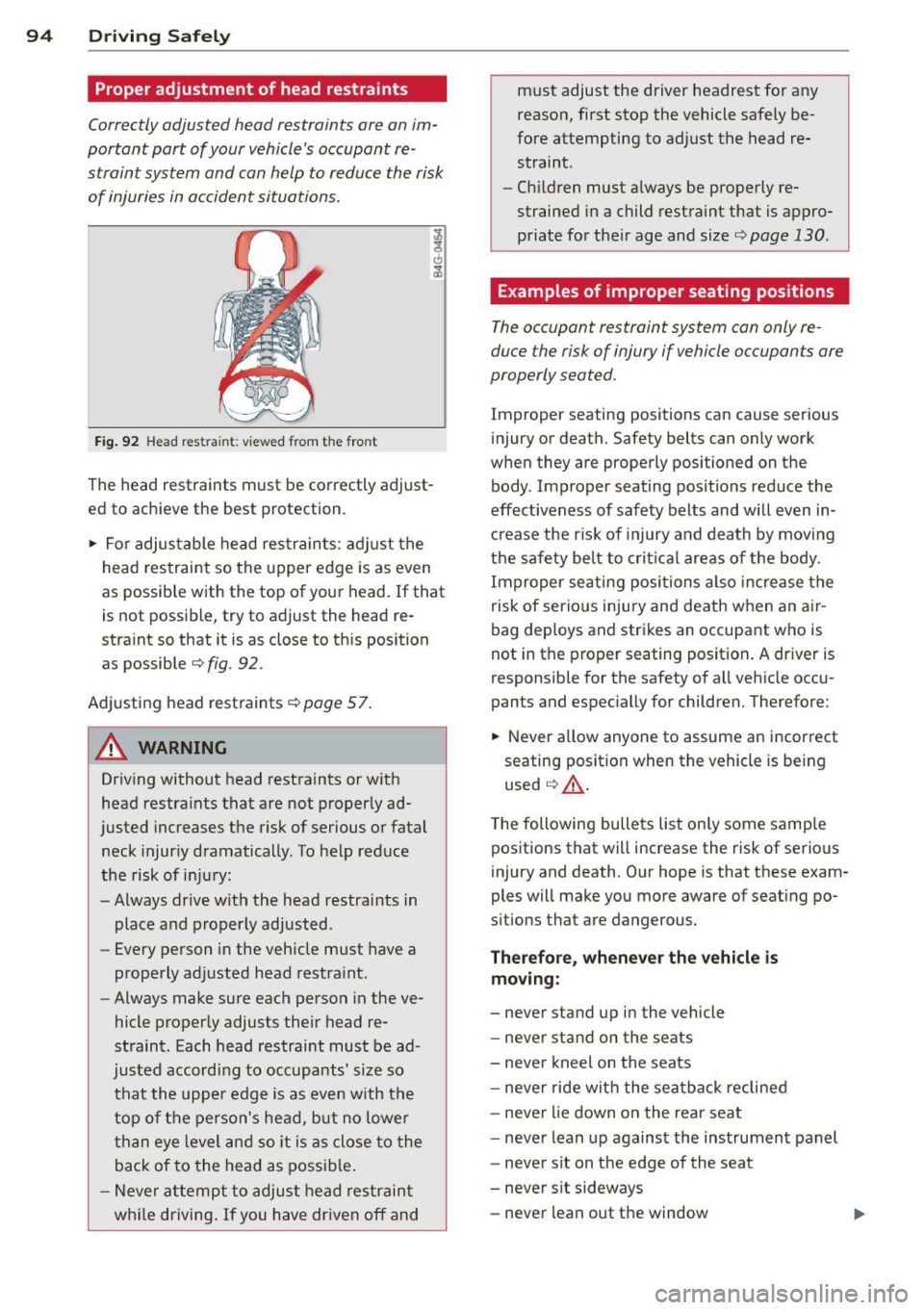
Fig. 92 Head restra int : viewed from t he fro nt
The head restraints must be correctly adjust
ed to achieve the best protection.
~ For adjustable head restraints: adjust the
head restraint so the upper edge is as even
as possible with the top of your head. If that is not possible, try to adjust the head re
straint so that it is as close to this position as possible
r:::> fig. 92 .
Adjusting head restraints r:::> page 57.
&_ WARNING
Driving without head restraints or with
head restraints that are not properly ad
justed increases the risk of serious or fatal
neck injuriy dramatically. To help reduce
the risk of injury:
- Always drive with the head restra ints in
place and properly adjusted.
- Every person in the vehicle must have a
properly adjusted head restraint.
- Always make sure each person in the ve
hicle properly adjusts their head re
straint. Each head restraint must be ad
justed according to occupants' size so
that the upper edge is as even w ith the
top of the person's head, but no lower
th an eye level and so it is as close to the
back of to the head as possible.
- Never attempt to adjust head restraint
wh ile driving. If you have driven
off and must adjust the driver headrest for any
reason, first stop the vehicle safely be
fore attempting to adjust the head re straint .
- Ch ildren must always be properly re
strained in a child restraint that is appro
priate for their age and size
c:> page 130.
· Examples of improper seating positions
The occupant restraint system can only re
duce the risk of injury if vehicle occupants are
properly seated .
Improper seating positions can cause serious
injury or death. Safety belts can only work
when they are properly positioned on the body . Improper seating positions reduce the
effectiveness of safety belts and will even in
crease the risk of injury and death by moving
the safety belt to critical areas of the body.
Improper seating posi tions also increase the
risk of serious injury and death when an air
bag deploys and strikes an occupant who is
not in the proper seating position . A dr iver is
responsible for the safety of all vehicle occu
pants and especially for children. Therefore :
~ Never allow anyone to assume an incorrect
seating position when the vehicle is being
used
c::> _& .
The following bullets list only some sample
positions that will increase the risk of serious
injury and death. Our hope is that these exam
ples will make you more aware of seating po
sitions that are dangerous.
Therefore , whenever the vehicle is
moving:
- never stand up in the vehicle
- never stand on the seats
- never kneel on the seats
- never ride with the seatback reclined
- never lie down on the rear seat
- never lean up against the instrument panel
- never s it on the edge of the seat
- never sit sideways
- never lean out the window
Page 97 of 262
-never put you r feet out the window
- never put your feet on the instrument panel
- never rest your feet on the seat cushion o r
back of the seat
- never ride in the footwe ll
- never ride in the cargo area
A WARNING
Imprope r seat ing positions increase the
r is k of se rious personal injury and death
whenever a veh icle is being used .
- Always make sure that all vehicle occu
pants stay in a proper seating pos it ion
and are properly restra ined whenever the
vehicle is be ing used .
Driver and passenger
side footwell
Important safety instructions
A WARNING
Always make sure that the knee airbag can
inflate without interference. Objects be
tween yourse lf and the airbag can increase
the risk of injury in an acc ident by interfer
ing w ith the way the a irbag deploys or by
being p ushed into you as the airbag de
ploys.
- No persons (ch ild ren) or animals should
ride in the footwell in front of the pas
senger seat. If the airbag deploys, t his
c an res ult in serious or fat al inju ries.
- No objects of any k ind shou ld be carried
in t he footwe ll area in front of the driv
er's or passenger's seat. Bul ky objec ts
(shopping bags, for example) can ham
per or prevent p roper deployment of the
airbag. Small objects can be thrown
thro ugh the vehicle if the airbag deploys
and injure you or your passengers.
-
Dr iving Safel y 95
Pedal area
Pedals
The pedals must always be free to move and
must never be interfered with by a floor mat
or any other object.
Make sure that a ll peda ls move free ly without
interfe rence and that nothing prevents them
from return ing to their orig inal positions .
Only use floor mats t hat Leave t he pedal area
free and can be secured with floor mat fasten ers .
If a brake circ uit fai ls, increased brake pedal
trave l is required to b ring the vehicle to a f ull
stop.
A WARNING
Pedals that cannot move free ly can cause
Loss of vehicle control and increase the risk
of ser ious injury.
- Never p lace any objects in the driver's
footwell. An object cou ld get into the
pe dal area and inte rfe re with pedal func
tion. In case of sudden brak ing o r an ac
cident, yo u wo uld not be able to b rake or
accelerate!
- Always ma ke sure tha t no thing can f all
or move into the driver's footwel l.
Floor mats on the driver side
Always use floor mats that can be securely
attached to the floor mat fasteners and do
not in terfere with the free movement of the
pedals.
"' Ma ke su re that the floor mats are prope rly
secured and cannot move and in terfere with
t he peda ls ¢ ..&_ .
U se only floor mats that leave the peda l area
u nobst ructed and th at are firmly secu re d so
that they c annot slip o ut o f posi tion. You c an
obta in suitab le floor mats from yo ur aut ho r
ized Audi Dealer.
Floor mat fastene rs a re in sta lled in your Aud i.
1111>
•
•
Page 99 of 262
A WARNING ,~
Heavy loads will influence the way your ve
hicle handles. To help reduce the r isk of a
loss of control leading to ser ious personal
injury:
-Always keep in m ind when transporting
heavy objects, that a change in the cen
ter of g ravity can also cause changes in
vehicle handling:
- Always distribute the load as even ly as
possible.
- Place heavy objects as far forward in
the luggage compartment as possible.
- Never exceed the Gross Ax le Weight Rat
ing or the Gross Vehicle Weight Rating
specified on the safety compliance stick
er on the left door jamb. Exceeding per missible we ight standards can cause the
vehicle to slide and handle differently .
- Please observe information on safe driv
ing
i:> page 90.
A WARNING
To help prevent poisonous exhaust gas
from be ing drawn into the veh icle, always
keep the rear lid closed while dr iving.
- Never transport objects larger than those fitting completely into the luggage
area because the rear lid cannot be fully
cl osed.
- If you absolutely must drive with the rear
lid open, observe the follow ing notes to
reduce the risk of poisoning:
- Close all windows,
- Open all air outlets in the instrument
panel,
- Sw itch off the air recircu lation,
- Set the fresh ai r fan to the h ighes t
speed .
A WARNING
Always make sure that the doors, all win
dows and the rear lid are securely closed
and locked to reduce the risk of injury
when the veh icle is not being used.
Dr iving S afel y 97
-After closing the rear lid, always make
sure that it is properly closed and locked.
- Never leave your vehicle unattended es
pecially with the rear lid left open. A
child could crawl into the vehicle through
the luggage compartment and close the
rear lid becoming trapped and unable to
get o ut. Being trapped in a vehicle can
lead to serious personal injury.
- Never let ch ildren play i n or around the
veh icle .
- Never let passengers ride in the luggage
compartment. Vehicle occupants must
always be prope rly restra ined in one of
the vehicle 's seating pos it ions .
(D Tips
- Air circulation helps to reduce window
fogging. Stale a ir escapes to the outside
through vents in the trim panel, on the
left side of the luggage compartment. Be sure to keep these s lots free and
open.
- The tire pressure m ust correspond to the
load. The tire pressure is shown on the
tire pressure label. The tire pressure la
bel is located on the driver's side B-pillar.
The tire pressure label lists the recom
mended co ld tire inflation pressures for
the vehicle at its maximum capacity
we ight and the tires that were on your
vehicle at the t ime it was manufactured .
For recommended tire pressures for nor
ma l load cond itions, please see chapter
i=>page 200.
Tie-downs
The luggage compartment is equipped with
four tie-downs to secure luggage and other
items.
Use the t ie-downs to secure your cargo prop
erly
c> page 96, Loading the luggage com
partment .
In a collision, the laws of physics mean that
even smaller items that are loose in the vehi-
cle w ill become heavy missiles that can cause .,.
•
•
Page 102 of 262
100 Safety belts
Safety belts
General notes
Always wear safety belts!
Wearing safety belts correctly saves lives!
This chapter explains why safety belts are nec
essary, how they work and how to adjust and
wear them correctly .
.. Read all the information that follows and
heed all of the instructions and WARNINGS.
A WARNING
Not wearing safety belts or wearing them
improperly increases the risk of serious
personal injury and death.
- Safety belts are the single most effective
means available to reduce the risk of se
rious injury and death in automobile acci
dents. For your protection and that of
your passengers, always correctly wear
safety belts when the vehicle is moving.
- Pregnant women, injured, or physically
impaired persons must also use safety
belts. Like all vehicle occupants, they are
more likely to be seriously injured if they
do not wear safety belts. The best way to
protect a fetus is to protect the mother -
throughout the entire pregnancy.
Number of seats
Your Audi TT Coupe has two seating positions in the front and two height-limited seating
positions in the rear. Each seating position has
a safety belt. The rear seat area in your Audi
TT Coupe does not have enough room for pas
sengers of all sizes. For reasons of safety, no
person taller than 4'11" (1.S meters) should
ever ride in the rear seat area.
A WARNING
Not wearing safety belts or wearing them
improperly increases the risk of serious
personal injury and death. -
Never strap more than one person, in
cluding small children, into any belt.
It is
especially dangerous to place a safety belt over a child sitting on your lap.
- Never let more people ride in the vehicle
than there are safety belts available.
- Be sure everyone riding in the vehicle is
properly restrained with a separate safe
ty belt or child restraint.
- Persons taller than 4'11" (1.5 m) as well
as children in booster seats who are too
close to the rear window and roof can
suffer severe head and neck injuries
when the rear lid is closed or in a crash .
- The minimum clearance between the passenger's heads and the rear window
must never -under any circumstances -
be less that 1 inch (2.5 cm.) when the
passengers sit fully upright.
- Always make sure that rear seat passen
gers cannot be struck when the rear lid is
closed.
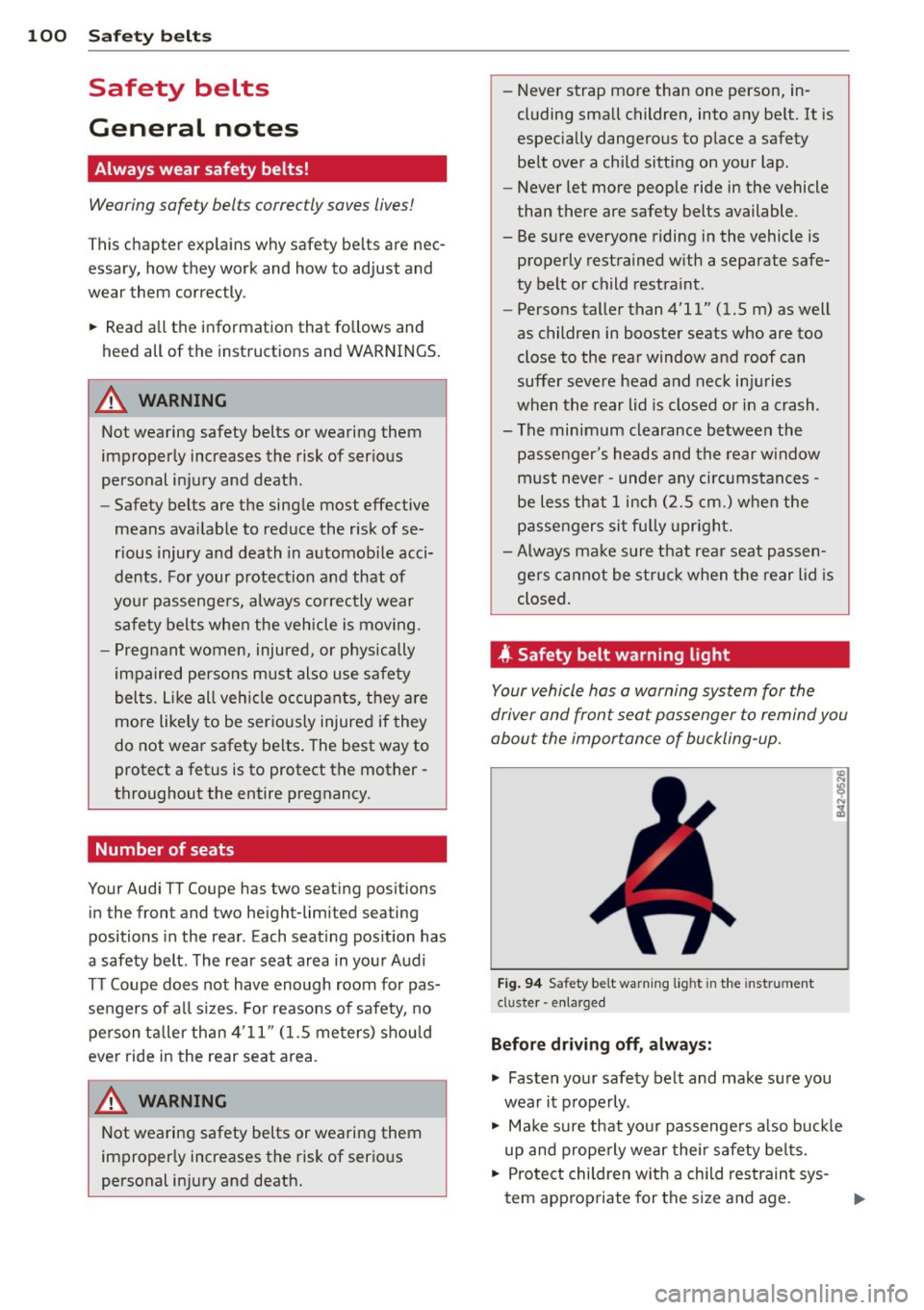
,! Safety belt warning light
Your vehicle has a warning system for the
driver and front seat passenger to remind you
about the importance of buckling-up.
Fig. 94 Safety belt warning light in the instrument
cluster· enlarged
Before driving off, always:
" Fasten your safety belt and make sure you
wear it properly .
.. Make sure that your passengers also buckle
up and properly wear their safety belts.
.. Protect children with a child restraint sys-
tem appropriate for the size and age.
Ill-