brake light AUDI TT 2013 Owner´s Manual
[x] Cancel search | Manufacturer: AUDI, Model Year: 2013, Model line: TT, Model: AUDI TT 2013Pages: 262, PDF Size: 65.91 MB
Page 152 of 262
150 Intelligent technology
Intelligent technology
Notice about data
recorded by vehicle
control modules
Your vehicle is not equipped with an Event Da
ta Recorder (EDR), installed by some manu
facturers fo r the express purpose of capturing
data for retrieval after an accident or crash
event . EDR's are sometimes ca lled "crash re
corders".
Some state laws restrict the retr ieval or down
loading of data stored by EDR's that were in
stalled in a vehicle for the express purpose of
retrieving data after an accident or crash
event without the owner's consent.
A lthough your vehicle is not equipped with an
EDR, it is equipped with a number of electron
ic control modules for various vehicle systems
such as, for examp le, eng ine function, em is
sion control, as well as for the airbags and
safety belts.
These electronic contro l modules also record
vehicle-re lated data during normal vehicle op
eration for diagnostic and repair purposes.
The recording capacity of the electronic con
trol modules is limited to data (no sound is re
corded) and only a small amount of data is ac
tually recorded over a very limited pe riod of
time and stored when a system fault or other
condition is sensed by a control unit. Some of
the data then stored may relate to vehicle
speed, direction, braking as we ll as restraint
system use and performance in the event of a
crash or other condition. Stored data can only
be read and downloaded with special equip
ment.
Electronic Stabilization
Control (ESC)
Description
ESC helps to improve road holding and vehicle
dynamics to help reduce the probability of
skidd ing and loss of vehicle control. It works
only when the engine is running. ESC detects certain difficult driving situat
ions, including
when the vehicle is beginning to spin (yaw)
out of control and helps you to get the veh icle
back under control by se lectively braking the
wheels, and/or reducing engine power and
providing steering assistance to help hold the
vehicle on the driver's intended course. The in
dicator light
G) in the instrument cluster
blinks when ESC is taking action to help you
control the vehicle.
ESC has limitations.
It is important to remem
ber that ESC cannot overcome the laws of
physics. It wi ll not always be able to help out
under all conditions you may come up against.
For example, ESC may not always be able to
help you master situations where there is a
sudden change in the coefficient of friction of
the road surface. When there is a section of
dry road that is suddenly covered with water,
slush or snow, ESC cannot perform the same
way it wou ld on the dry surface . If the vehicle
hydroplanes (rides on a cushion of water in
stead of the road surface), ESC will not be
able to help you steer the vehicle because con
tact with the pavement has been interrupted
and the vehicle cannot be braked or steered.
During fast cornering, particularly on winding
roads, ESC cannot always deal as effectively
with difficult driving situations as at lower
speeds.
Always adjust your speed and driving style to
road , traffi<;: and weather conditions. ESC can
not override the vehicle's physical limits, in
crease the available tract ion, or keep a vehicle
on the road if road departure is a result of
driver inattention . Instead, ESC improves the
poss ibility of keeping the vehicle under con
t rol and on the road during extreme maneu
vers by using the driver's steering inputs to
help keep the vehicle going in the intended di
rection . If you are traveling at a speed that
causes you to run off the road before ESC can
provide any assistance, you may not experi
ence the benefits of ESC.
ESC includes and/or works together with the
anti- lock brake system (ABS), brake assist sys-
tem and anti-slip regu lation (ASR). ESC is .,..
Page 153 of 262
switched on all the time. In certain situations
when you need less traction, you can switch
off ESC by pressing the button
lru . Be sure to
switch ESC on again when you no longer need
less traction.
Anti -loc k brak ing s ystem (ABS )
ABS prevents the wheels from locking up
when braking . The vehicle can still be steered
even during hard braking. Apply steady pres
sure to the brake pedal. Do not pump the ped
al. A puls ing in the brake pedal indicates that
the system is helping you to brake the vehicle.
B rake ass is t system
The brake assist system can decrease braking
d istance. It increases braking power when the
driver presses the brake pedal quickly in emer
gency situations. You must press and hold the
brake pedal until the situation is over .
Anti-slip regulati on (ASR )
ASR reduces engine power when the drive
wheels begin to spin and adapts the force to
the road condit ions. This makes it easier to
start, accelerate and drive up hills.
Elect ronic diff erential lock (EDL )
The EDL brakes wheels that are spinning and
transfers the drive power to the other drive
wheel or whee ls if the vehicle is equipped with
all-wheel drive*. This function is available up
to about 60 mph (100 km/h).
In extreme cases, EDL automat ica lly switches
off to help keep the brake on the braked wheel
from overheating. EDL w ill switch on again au
tomatically when conditions have returned to normal.
..&, WARNING
- ESC, ABS, ASR and EDL cannot ove rcome
t he laws of physics. This is espec ia lly im
portant on slippery or wet roads.
If the
systems begin act ing to stab ilize your ve
hicle, you should immediately change
yo ur speed to match the road and traffic
condit ions. Do not let the increased safe
ty provided by these systems tempt you
Intelligen t technolog y 151
to take risks. Doing so will increase the
risk of a loss of vehicle control, co llision
and serious personal injuries.
- Always adapt your speed to road, traffic
and weather conditions. The risk of los
ing control of the vehicle increases when
driving too fast, espec ially through
curves and on slippery or wet roads, and
when driving too close to vehicles up ahead. ESC, ABS, the brake assist sys
tem, EDL and ASR cannot preven t coll i
sions.
- Always ac celera te with spe cial care on
even, smooth s urfaces su ch as those th at
are wet or covered with ice and snow.
The drive wheels can spin even with these assistance systems that cannot al
ways he lp to reduce the risk of loss of ve
hicle control.
@ Tips
- ABS and ASR only work correct ly when
all four whee ls are equipped with identi
cal tires. D ifferent tire sizes can lead to a
reduction in engine power.
- You may hear noises when the systems described are working.
-If the ind icator lightD] orE (USA
models)/ [iJ (Canada models) appears,
there may be a malfunction¢ page 18,
¢page 17.
TT/TTS: Switching on/off
Applies to vehicles: TT Coupe and TTS Coupe
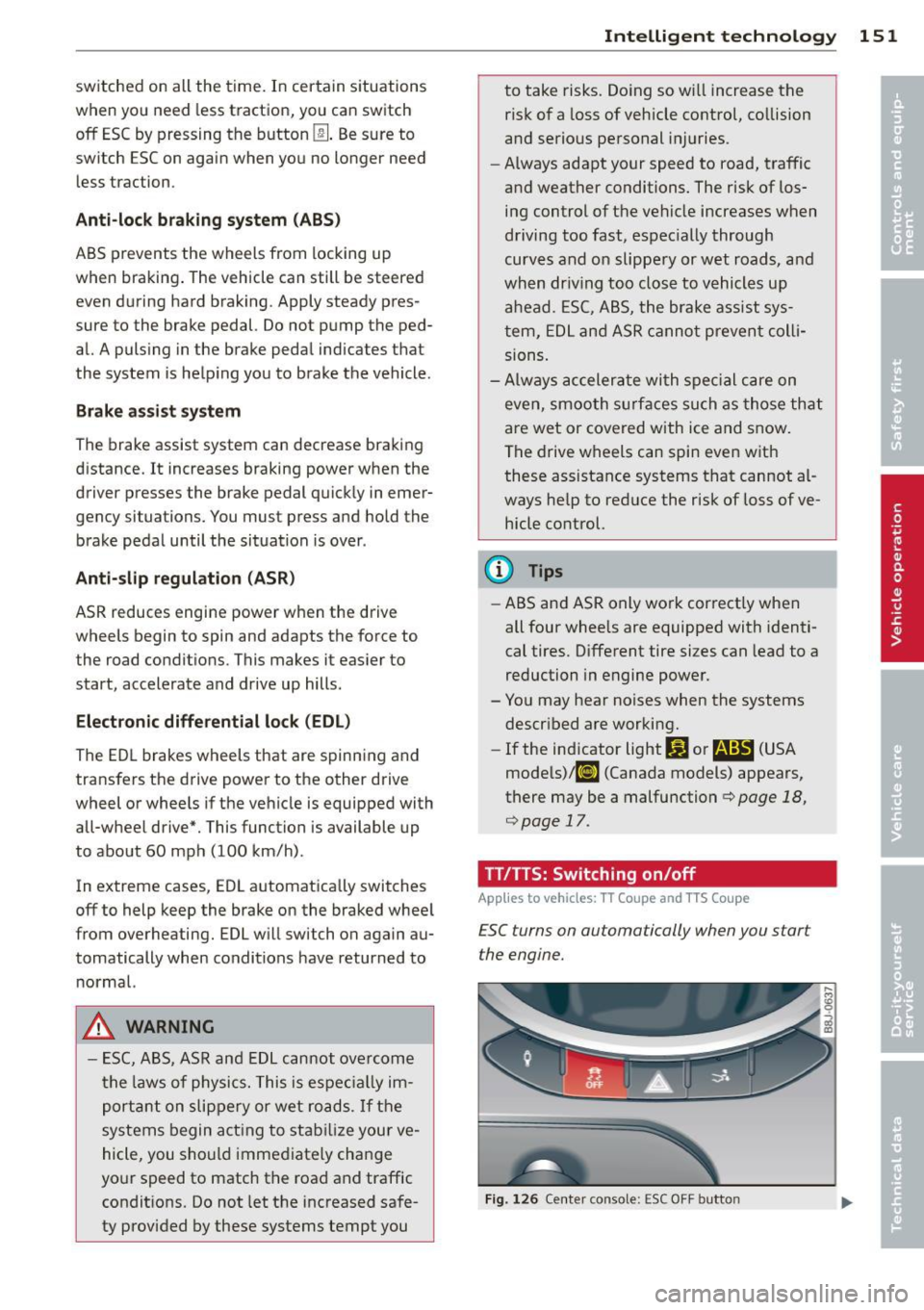
ESC turns on automatically when you start
the engine.
Fi g. 126 Cente r console: ESC OFF button
Page 155 of 262
Rear spoiler
Applies to vehicles: with retractable rear spoiler
The rear spoiler improves vehicle handling
and enhances driver control.
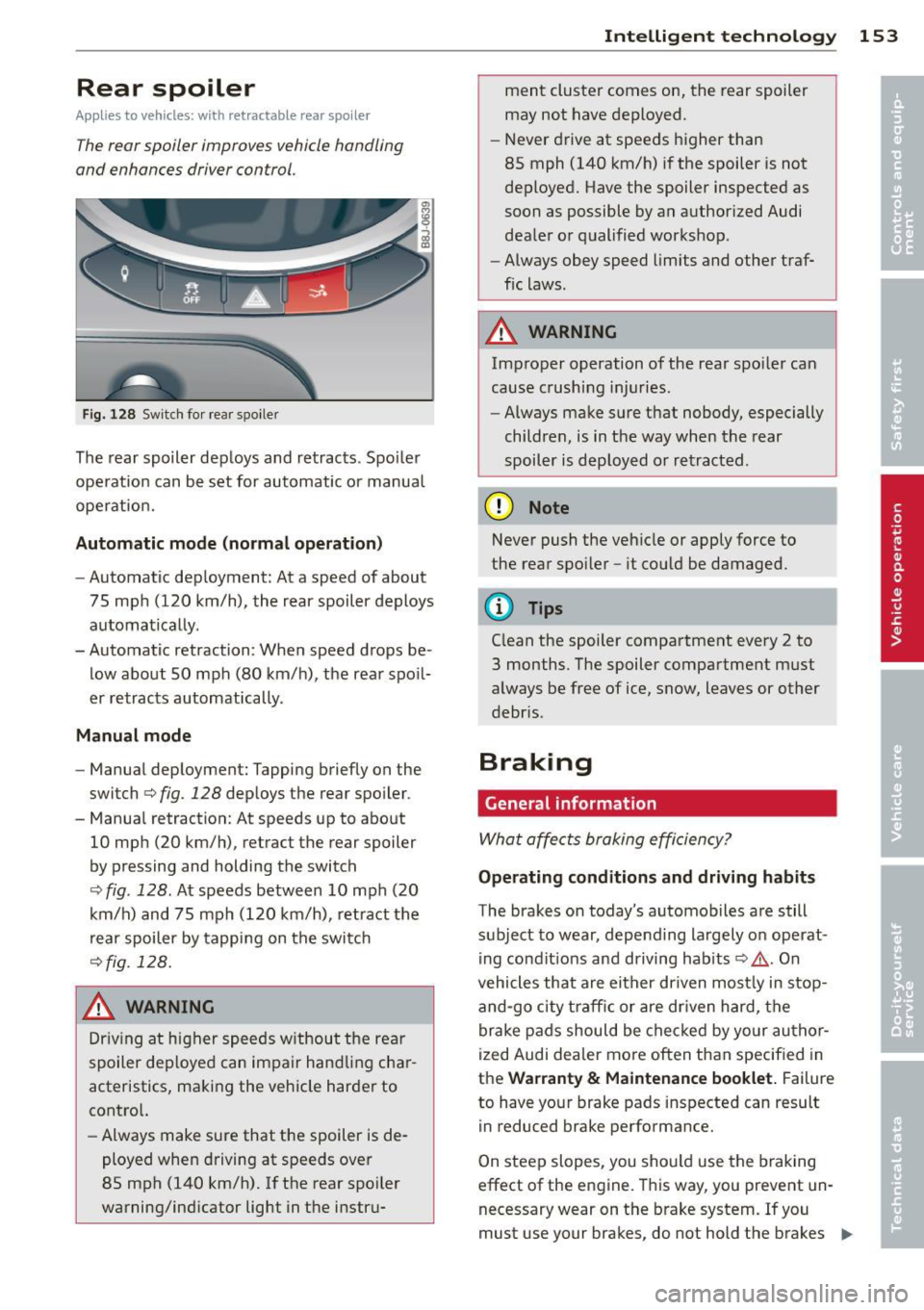
Fig. 128 Switc h for rear spo iler
The rear spoiler deploys and retracts . Spo iler
operation can be set for automatic or manua l
operation.
Automatic m ode (no rmal operat ion )
-Automatic deployment: At a speed of about
75 mph (120 km/h), the rear spoiler deploys
automatically.
-Automat ic retraction: When speed drops be
low about SO mph (80 km/h), the rear spo il
er retracts automatically .
Manu al mode
- Manual deployment: Tapping briefly on the
switch
c:> fig. 128 dep loys the rear spo iler .
- Manual retraction: At speeds up to about 10 mph (20 km/h), retract the rear spoiler
by pressing and holding the switch
c:> fig . 128 . At speeds between 10 mph (20
km/h) and 75 mph (120 km/h) , retract the
rear spoiler by tapping on the switch
c:>fig . 128.
_& WARNING
Dr iv ing at higher speeds w ithout the rear
spoiler dep loyed can impair hand ling cha r
acteristics, making the vehicle harder to
contro l.
- Always make sure that the spoiler is de
ployed when driving at speeds over
85 mph (140 km/h).
If the rear spoiler
warning/ind icator light in the instru-
Intelligen t technolog y 153
ment cluster comes on, the rear spoiler
may not have deployed .
- Never drive at speeds higher than
85 mph (140 km/h) if the spoiler is not
deployed. Have the spoiler inspected as
soon as possible by an authorized Audi
deale r o r qualified workshop .
- Always obey speed limits and other traf
fic laws.
_& WARNING
Improper operation of the rear spoiler can
cause crushing injuries.
- Always make sure that nobody, especially
children, is in the way when the rear
spoiler is deployed or retracted .
(D Note
Never push the vehicle or apply force to
the rear spoi ler -it cou ld be damaged.
{!) Tips
C lean the spoiler compartment every 2 to
3 months. The spoiler compartment must
a lways be free of ice, snow, leaves or other
debr is .
Braking
General information
What affects braking efficiency?
Ope rating cond itions and driving habits
The brakes on today's automobiles a re still
subject to wear, depe nd ing largely on operat
ing condit ions and driving hab its
c:> .&,. . On
vehicles that are either driven most ly in stop
and-go city t raff ic or are dr iven hard, the
brake pads should be checked by yo ur au thor
ized Audi dealer more often than specified in
the
Warr anty & Maintenance booklet. Failure
to have your brake pads inspected can result
in reduced brake performance.
On steep slopes, you should use the braking
effect of the engine. T his way, you prevent un
necessary wear on the brake system . If you
must use your brakes, do not hold the brakes .,.
Page 157 of 262
overheat reducing the effectiveness of
the ent ire brake system.
- Failure of one brake circuit will impair
the braking capability resulting in an in
creased stopp ing distance. Avoid driv ing
the vehicle and have it towed to the near est Aud i dealer or qualified workshop .
- Never let the vehicle roll to a stop w ith
the engine shut off.
- If the brake booster is not working, for
example when towing your ve hicle, or
because the brake booste r has somehow
been damaged, the brake pedal must be
pressed considerab ly harder to make up
for the lack of booster assistance.
Electro-mechanical
power assist
The electro-mechanical power assist helps
the driver when steering.
The degree of power assist is electronically
matched to vehicle speed.
The power steer ing system ass ists the driver
so that he can stee r the veh icle w ith red uced
phys ica l effort.
Power steering w ill not work if the engine is
off. As a result, the steering wheel w ill be hard
to turn.
& WARNING
If the system develops a prob lem, you
must seek qualified professional assis
tance.
(D Note
-
If there is an electronic malfunct ion, ser
votronic
wi ll sti ll function like a conven
tional power steering system, providing a
constant steering support force that is no
longer proportionate to the vehicle speed.
This is most noticeable when turning the
steer ing wheel at low speeds (for example
when parking), -more effort will be re
quired than usual.
Int ellig ent technolog y 155
-Be aware of the different than usual
steering response and adjust your steer
ing force accordingly.
- Have the problem checked and set right
by an authorized Audi dea ler as soon as
possible.
- If a steering malfunction occurs, this is
signaled with the,~ , or .• indicator
lights and a warn ing tone, see.
(D Tips
- If the power steering system sho uld fail,
or if the engine is not running (for exam
ple, while being towed), you will still be
able to steer the vehicle. However, more
effort will be required to do so.
- If the power steering system is not func
tioning properly, contact your authorized
Audi dealer immediately.
Driving with your
quattro ®
Applies to vehicles : wit h all -w hee l d rive
With oil -wheel drive, oil four wheels ore driv
en.
General information
With a ll-wheel drive, power is distr ibuted to
all four wheels. This happens automatically
depend ing on your driving style and the road
conditions at the time. See also
c::> page 1 SO.
The all-whee l dr ive concept is des igned for
high eng ine power. Your veh icle is except ion
ally powerfu l and has excellent driving charac
teristics both under normal driving conditions
and on snow and ice. Always read and follow
safety precautions
c::> &. .
Winter tires
When dr iving in the winter, your vehicle with
all-wheel drive has an advantage, even with
regular tires. In winter road conditions it may
be advisable to mount winter tires (or all-sea
son tires) for improved driveability and brak
ing: these tires must be mounted on
all fou r
wheels. See also c::> page 211, Winter tires. ..,_
•
•
Page 163 of 262
the exhaust system and this could cause
the catalytic converter to overheat.
- Do not turn off the ignition while the ve
hicle is moving .
- Do not con tinue to operate yo ur vehicle
under these conditions, as otherwise fuel
can reach the cata lytic converter . This
could result in overheating of the con
verter, requ iring its replacement.
- To assure efficient operation of the Emis
sion Control System:
- Have your veh icle ma inta ined properly
and in acco rdance with the service rec
ommendations in your Wa rranty
&
Ma intenan ce booklet.
- Lac k of proper maintenance as well as
improper use of the vehicle will impa ir
t he funct ion of the emission control
system and cou ld lead to damage.
@ For the sake of the environment
Even when the Emission Contro l System is
operating p roperly, the exhaus t gas can
have a s ulfu r- like exhaust gas smell under
some operating states. This depends on
the s ulfur content o f the fue l being used.
Using a different brand of fuel may help,
or filling the tank w ith lead-free super
grade gasoline .
Operate your vehicle
economically and
minimize pollution
General
Your personal style of driving will determine
the economy of your vehicle, as well as ex
haust and noise levels .
Fuel economy, environmental impact, and
wear on your engine, brakes and t ires largely
depend on three factors :
- your persona l driving style
- operating conditions
- technical lim itations
I f you anticipate w hat you need to do nex t and
d rive economically, you can eas ily cut your
Dri vin g and en vironm ent 161
fuel consumption by 10 -15 percent. Th is sec
tion w ill give yo u some tips on how you can
help the env ironment and your pocketbook .
(D Tips
The cons umption estimates as published
by ENVIRONME NTAL PROTEC TION AGENCY
(EPA) and Transport Canada may not corre
spond to your actual consumption on the road, which will vary depending upon vehi
cle load and speed, road and weather con
dit ions, trip length, etc.
Drive smoothly and keep a lookout
ahead
Vehicles use the most fuel when they are ac
celerating.
Avoid unnecessary accelerat ing and braking .
Vehicles use the most fuel when they are ac
ce lerat ing . If you anticipate what is going to
happe n next, you will need to brake less and,
th us, accele rate less. Let the vehicle coast
whenever possible -for examp le when you see
that the next t raff ic light is red.
Avoid full throttle
Driving at moderate speeds saves fuel and
improves your mileage.
"' Try and keep well below your car's maxi -
mum speed.
Acce lerat ing gently reduces fue l consump
tion, eng ine wear, and does not disturb the
environment.
Fuel consumpt ion, exhaust emiss ions and en
gine noise increase disproportionately at high
speeds. If you drive at approximately three
quarte rs of top speed, fuel consumption w il l
be reduced by one half. Never drive faster
t h an the posted speed limit and weathe r con
ditions perm it.
•
•
Page 166 of 262
164 Cleaning and protection
Cleaning and
protect ion
General information
Regular core preserves vehicle value .
Any automobile is exposed to industrial
fumes, corrosive road salt, etc. A well cared
for Audi can look like new many years after purchase . Regular and correct care w ill con
tr ibute to maintaining the beauty and value of
your Aud i.
Furth erm ore, goo d car e m ay be a c onditi on
for substantiat ing a warrant y claim shou ld
c orrosion dam age or paint d efe ct s occ ur.
Your author ized Audi dealer has a variety of
d ed ica ted vehicl e-ca re product s and can ad
vise which ones to use for cleaning the exter i
or and inte rior of your vehicle .
Whether you use products recommended by
Aud i or other commercially ava ilable clean ing
agents, please make sure you apply them cor
rectly .
A WARNING
-Cleaning agents may be poisonous. Keep
them out of the reach of children.
- Heed all caut ion labels.
- Always read directions on the container
before using any product . Follow the di
rect ions carefu lly.
- Most chemical cleaners are concentrated
and have to be diluted.
- Use spot removing fluids only in well
ventilated areas.
- Do not use gasoline, kerosene, d iesel
fuel, nail pol ish remover or other volati le
fluids. They may be toxic, flammab le or
hazardous in other ways. Do not wash,
wax or dry the vehicle with the ignit ion
on or the engine running.
- Do not clean the undersides of chassis,
fenders, wheel covers, etc. without pro
tecting your hands and arms. You may
c u t yourself on sharp-edged metal parts . -
Moisture and ice on brakes may impair
brak ing eff ic iency
c::> page 153 , General
information.
Test the brakes carefully
each time you wash the vehicle .
@ For the sake of the environment
Select on ly environ mentally friendly clean
i ng products. Leftover cleaning products
should not d isposed of in the househo ld
waste .
Care of exterior
Washing
Frequent washing protects the vehicle .
The best protection against environmental in
fluences is
frequent washing and waxing . How
often this is required depends on:
- How much the veh icle is used
- Where the veh icle is parked (garage, in the
open under trees, etc.)
- The seasona l and weather conditions
- Environmental infl uences
T he longer b ird droppings, insects, tree resin,
road and indus tria l gr ime, ta r, soot, road salt
and other materials remain on the vehicle paint, the more lasting their destructive ef
fects wi ll be .
High tempera tures, as from expos ure to in
tense sunlight, intensify the corrosive e ffect
particularly when humidity is high as well.
Under certa in ci rc u mstances,
we ekly washing
may be necessary. Unde r othe r cond it ions, a
monthly washing and waxing may be ade
quate.
After the winter, the unders ide of the vehicle
sho uld be thoro ughly washed p re ferab ly in a
pro fessional ca r wash.
A WARNING ~
A lways read and heed all WARNINGS and
the information
c::> page 164.
Page 171 of 262
~ Wipe the windows dry with a clean piece of
cloth or kitchen paper towel.
The best way to remove snow from windows
and mirrors is to use a brush. Use a non-abra
sive
plastic ice scraper -better still, a spray
deicer -to remove
ice from windows and mir
rors.
The windows must not be cleaned with insect
remover or wax since these can interfere with
the function of the windshield wiper blades
(chatter).
Oil, grease or silicone residue can be removed
with
glass cleaner or silicone remover. How
ever, wax residue requires the use of a special
ly formulated solvent. Please contact your
Audi dealer for advice on safe products for
wax removal.
Windows should also be cleaned on the inside
at regular intervals.
Never dry windows with the same chamois
that you use to dry painted surfaces. Wax resi
due on the chamois can impair vision through
the windows.
A WARNING
-The windshield must not be treated with
water-repellent materials. They can in
crease glare under poor visibility condi
tions such as wetness, darkness, or when
the sun is low on the horizon. In addi
tion, they can cause the windshield wip
ers to chatter.
- Always read and heed all WARNINGS and
other information
¢page 164.
(D Note
-Never use warm or hot water to remove
snow and ice from windows and mirrors.
This could cause the glass to crack.
- To prevent damage to the wires of the
rear defogger, do not place any adhesive
stickers on the inside of the rear window
over the wires.
- To help prevent dirt from scratching the
window, always scrape in a forward di-
Cleaning and protection 169
rection -pushing the scraper away from
you -never back and forth.
· Steel wheels
Applies to vehicles : with steel wheels
The wheels also have to be cleaned.
~ Always include the hub caps and wheel rims
when washing your vehicle to remove road
dirt, salt sprays and brake dust.
If necessary, use a commercial wheel cleaner
to remove accumulated brake dust.
The wheel rims are easier to keep clean if they
are regu larly coated with liquid wax.
Paint scratches should be touched up as soon
as possible to prevent corrosion
¢ page 168,
Touch-up paint.
A WARNING
-Moisture and ice on brakes may affect
braking efficiency -
¢ page 153, General
information.
Test the brakes carefully af
ter each vehicle wash.
- Always read and heed all WARNINGS and
the information
¢page 164.
Cast (light) alloy wheels
Applies to vehicles: with Cast alloy wheels
Cast (light) alloy wheels require special care.
~ Wash the wheels with a sponge or hose
brush every other week.
~ For deep cleaning afterwards, use only a
dedicated
acid-free cast alloy wheel cleaner .
~ Rub a coat of liquid wax onto the rims every
three month. Be sure to reach and treat all
parts of the rim.
To preserve the decorative appearance of the
cast alloy wheels, some special care is neces sary. In addition to road dirt and salt, brake
dust is also corrosiv e. If left on for too long,
brake dust can cause pitting.
Use only special
acid-free cleaners formulated
for alloy rims. Safe products are available at
your Audi dealer. Never leave the cleaner on .,..
•
•
Page 172 of 262
170 Cleaning and protection
the rims longer than specified on the label. If
not rinsed off promptly, the acid contained in
some cleaners can attack the threads on the
wheel bolts.
Never use abrasive or metal polishing clean
ing agents. If the protective coating has been
chipped, e.g. by kicked up road dirt, touch it
up as soon as possible.
A WARNING
-Moisture and ice on brakes may affect
braking efficiency¢
page 153, General
information.
Test the brakes carefully
each time you wash the vehicle.
- Always read and heed all WARNINGS and other information
qpage 164.
Body cavity sealing
The body cavity sealing does not need to be
checked.
-
All body cavities which could be affected by
corrosion have been given thorough protec
tion at the factory.
This sealing does not require any inspection or
additional treatment. If any wax should seep
out of the cav ity when the ambient tempera
ture is high, it can be removed with a plastic
scraper and a suitable solvent.
A WARNING
, -
Solvents can be dangerous.
- Benzine is flammable and toxic. If you use benzine for removing the wax, keep
sparks, flame and lighted cigarettes
away. Never dump benzine on the
ground, into open streams or down sew
age drains.
- Be sure to observe all safety and environ
mental regulations. Follow all instruc
tions on the container.
- Always read and heed all WARNINGS and
the information
¢page 164.
Chassis
Have the undercoating checked for damage
from time to time.
The lower body shell of your Audi is also thor
oughly protected against corrosion.
Any damage to the undercoating caused by
road hazards should be repaired promptly.
A WARNING
-Too much undercoating in the wrong pla-
ces can cause a fire.
- Do not apply additional undercoating or
rustproofing on or near the exhaust
manifold, exhaust pipes, catalytic con
verter or heat shields. While driving, the
substance used for undercoating could
overheat and cause a fire.
-Always read and heed all WARNINGS and
other information¢
page 164.
Exhaust tail pipes
Road salt and other corrosive materials will
damage the material in the exhaust tail pipes
if they are not cleaned regularly. Do not clean
the tail pipes with wheel cleaner, paint polish, chrome polish or other abrasive cleaners.
Clean the tail pipes with car care products
t h at are suitable for stainle ss steel.
Your authorized Audi dealer can provide clean ing products that have been tested and ap
proved for your vehicle.
Care of interior
Radio-/Navigation* display
.. Clean the display with a soft clean cloth and
an LCD cleaner.
The display can be cleaned with a professio
nally available "LCD cleaner ". The cloth should
be slightly dampened with the cleaning fluid
to clean the display. .,.
Page 184 of 262
182 Checking and filling
Engine compartment
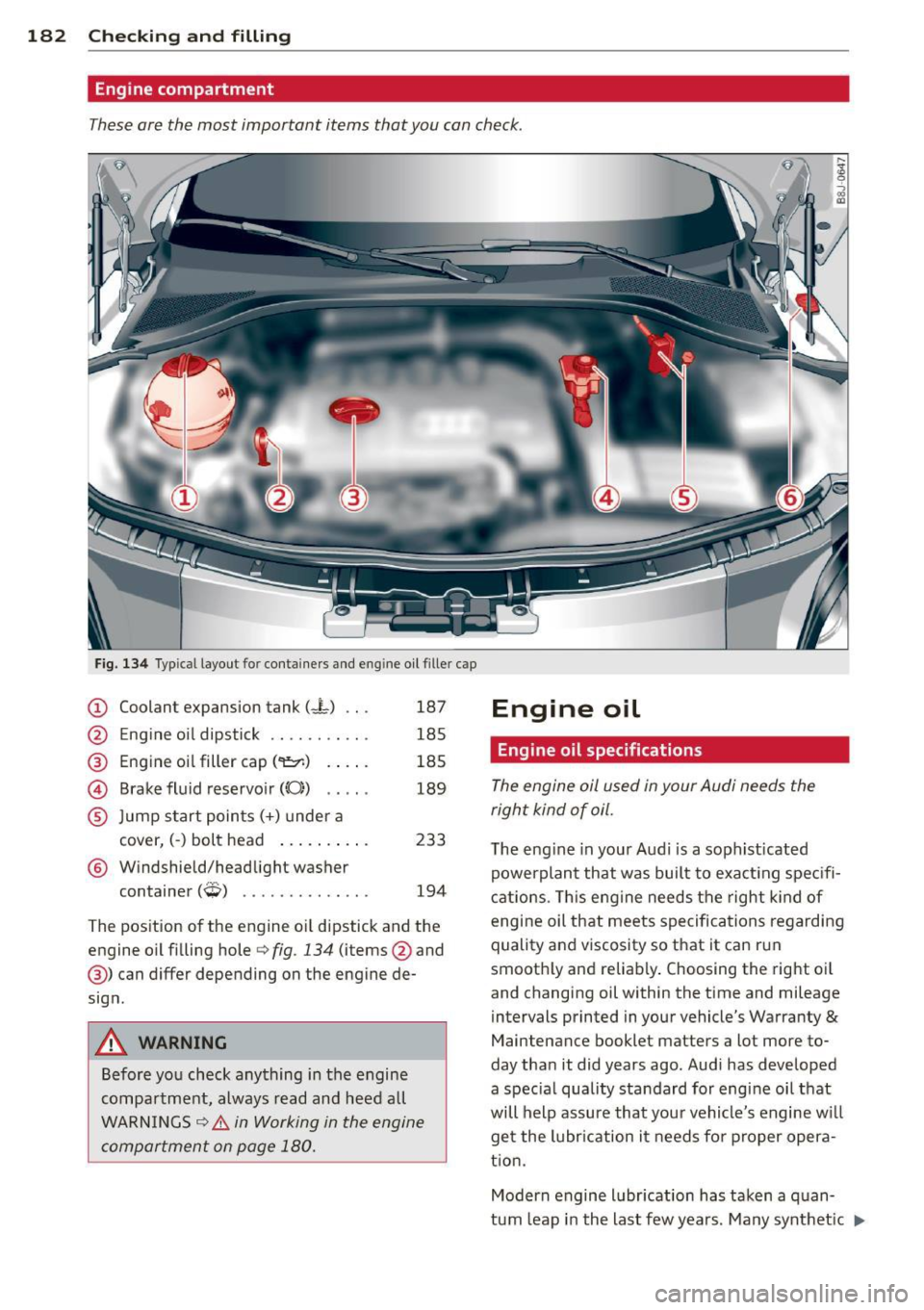
These are the most important items that you can check .
•
Fig. 134 Typ ica l layout for containers and eng ine oil filler cap
CD Coolant expansion tank (-L) .. .
'2' E . 'l d. . k \61 ngIne 0 1 1pst1c .......... .
@ Engine oil filler cap ('1:::r.) .. .. .
@ Brake fluid reservoir((();) .. .. .
® Jump start points(+) under a
cover, (-) bolt head .... ... .. .
® Windshield/headlight washer
t . (
;;p, ) con ainer ,-!,, •••.•••.•.•••.
187
185
185
189
233
194
The pos ition of the engine o il dipstick and the
engine o il fi lling hole
r::> fig. 134 (items @and
@) can differ depending on the engine de
sign .
A WARNING
Before you check anything in the engine
compartment, always read and heed all
WARN INGS
c::> .& in Working in the engine
compartment on page 180.
Engine oil
Engine oil specifications
The engine oil used in your Audi needs the
right kind of oil.
T he eng ine in your Aud i is a soph ist icated
powerplant that was built to exact ing spec ifi
cat ions . T his engine needs the right kind of
engine oil that meets specifications regard ing
quality and viscosity so that it can run
smooth ly and reliably . Choosing the right o il
and changing oil within the time and mileage
i ntervals printed in your vehicle's Warranty
&
Maintenance booklet matters a lot more to
day tha n it did years ago. Audi has developed
a spec ia l quality standard for engine oil that
will help assure that you r vehicle's engine w ill
get the lubr ication it needs fo r proper opera
t ion.
Modern engine l ubr ication has taken a q uan
tum leap in the last few years. Many synthet ic
1J.
Page 191 of 262
-To avoid being burned, do not spill an
tifreeze or coolant on the exhaust sys tem or hot engine parts. Under certain
conditions, the ethylene glycol in en
gine coolant can catch fire.
- Antifreeze is poisonous. Always store an
tifreeze in its original container and well out of the reach of children.
- If you drain the coolant, it must be
caught and safely stored in a proper con
tainer clearly marked "poison".
(D Note
- Coolant pollutes the environment and
could cause an engine fire. Excess cool
ant will be forced out through the pres
sure relief valve in the cap when the en
gine becomes hot.
- If, in an emergency, only water can be
added, the correct ratio between water
and antifreeze¢
page 187 must be re
stored as soon as possible.
@ For the sake of the environment
Drained coolant should not be reused. Al
ways dispose of used coolant while observ ing all environmental regulations.
Radiator fan
The radiator fan switches on automatically by
itself
The electric radiator fan is controlled by ther
moswitches that switch on and off depending
on coolant and engine compartment tempera
tures.
An auxiliary electric radiator fan* switches on
and off depending on coolant temperature
and other vehicle operation conditions.
After you switch the engine off, the auxiliary
fan can continue running for up to 10 minutes
- even with the ignition off.
It can even switch
on again later by itself
c::> &., , if
- the temperature of the engine coolant rises due to the heat build-up from the engine in
the engine compartment, or
Checking and filling 189
- the engine compartment heats up because
the vehicle is parked in intense sunlight.
A WARNING
-To reduce the risk of personal injury nev
er touch the radiator fan .
- The auxiliary electric fan is temperature
controlled and can switch on suddenly
even when the engine is not running.
- The auxiliary radiator fan switches on au
tomatically when the engine coolant
reaches a certain temperature and will
continue to run until the coolant temper
ature drops.
Brake fluid
Checking brake fluid level
The brake fluid level can be checked with a
quick glance.
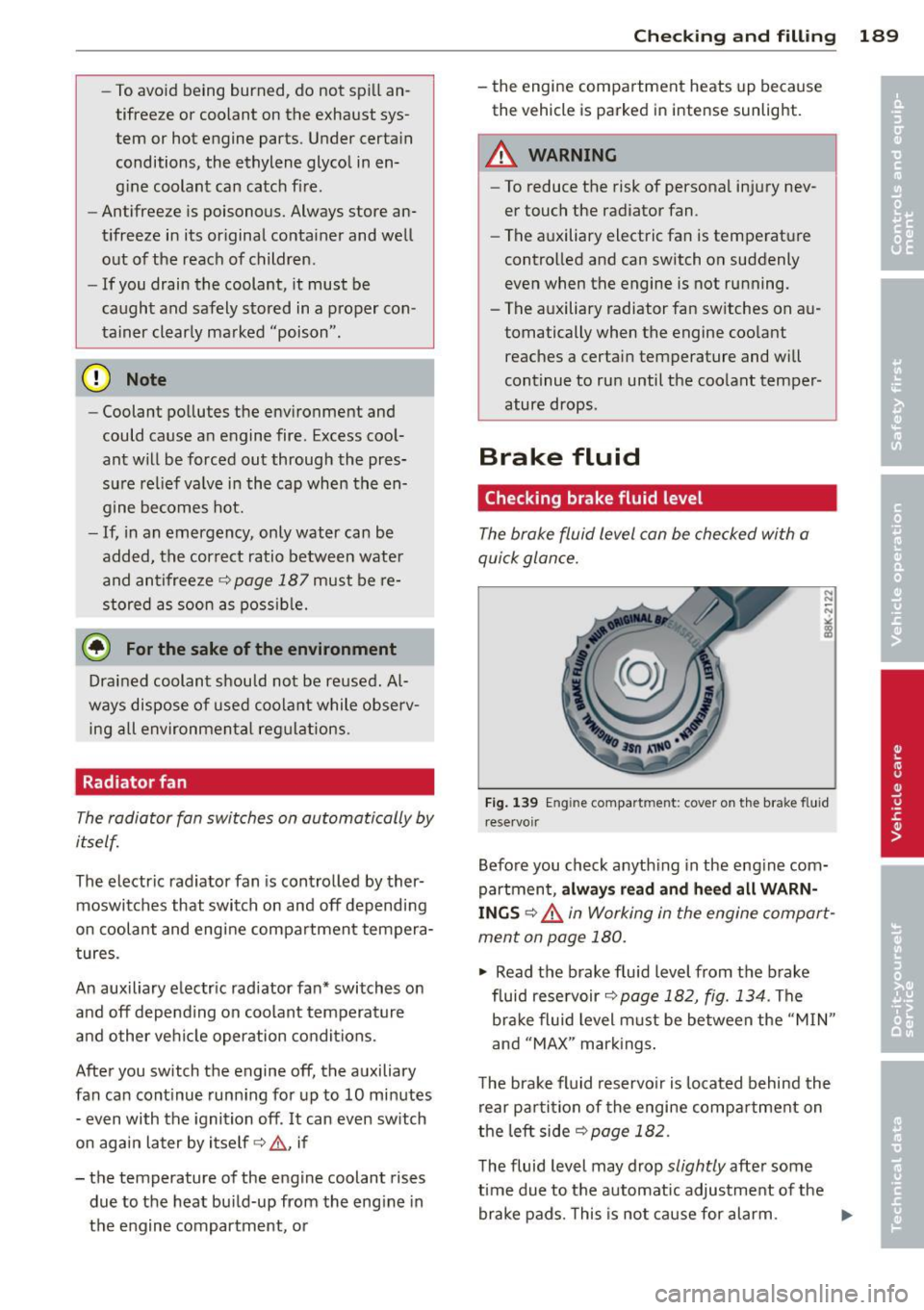
Fig. 139 Engin e compart ment: cover on th e br ake fluid
re se rvoir
Before you check anything in the engine com
partment,
always read and heed all WARN
INGS c::> .&. in Working in the engine compart
ment on page 180.
~ Read the brake fluid level from the brake
fluid reservoir
c::> page 182, fig. 134 . The
brake fluid level must be between the "MIN"
and "MAX" markings.
The brake fluid reservoir is located behind the
rear partition of the engine compartment on
the left side
c::> page 182.
The fluid level may drop slightly after some
time due to the automatic adjustment of the brake pads. This is not cause for alarm.
i,,.