belt AUDI TT 2013 Owner´s Manual
[x] Cancel search | Manufacturer: AUDI, Model Year: 2013, Model line: TT, Model: AUDI TT 2013Pages: 262, PDF Size: 65.91 MB
Page 144 of 262
142 Child Safety
-The inflating airbag will hit the child
safety seat or infant carrier with great
force and will smash the child safety seat and child against the backrest, door or
roof.
- Always be especially careful if you must
install a rearward facing child safety seat
on the front passenger seat in exception
al circumstances.
-A tight tether strap on a rearward-facing child restraint attached to the front pas
senger seat can put too much pressure
on the weight-mat in the seat and regis
ter a heavier weight in the Advanced Air
bag System. The heavier weight regis
tered can make the system work as
though an adult were on the seat and de
ploy the Advanced Airbag when it must
be suppressed causing serious or even
fatal injury to the child .
- Make sure that the
PASSENGER AIR BAG
OFF
light comes on and stays on all the
time whenever the ignition is switched on .
- If the
PASSENGER AIR BAG OFF light
does not come on and stay on, immedi
ately install the rear-facing child safety
seat in a rear seating position and have
the airbag system inspected by your Audi
dealer.
Activating the convertible locking retractor
Use the convertible locking retractor to se
cure a child restraint.
Always heed the child safety seat manufactur
er's instructions when installing a child re
straint in your vehicle. To activate the conver
tible lock ing retractor :
"' Place the child restraint on a seat, prefera
bly on the rear seat .
... Slowly pull the belt
all the way out.
... Route it around or through the child re
straint belt path
c:> ,& .
... Push the child safety seat down with your
full weigh t to get the safety belt really tight. "'
Insert the belt tongue into the buckle for
that seating position .
"' Guide the safety belt back into the retractor
until the belt lies flat and snug on the child
safety seat.
... You should hear a "clicking" noise as the
belt winds back into the inertia reel. Test the
convertible locking retractor by pulling on
the belt. You should no longer be able to
pull the belt out of the retractor. The con
vertible locking retractor is now activated.
... Make sure that the red release button is fac
ing away from the child restraint so that it
can be unbuckled quickly.
"' Pull on the belt to make sure the safety belt
is properly tigh t and fas tened so tha t the
seat cannot move forward or sideways more
than one inch (2.5 cm) .
A WARNING
Using the wrong child restraint or an im
properly installed child restraint can cause
serious personal injury or death in a crash.
-Always make sure that the safety belt re-
tractor is locked when installing a child
safety seat. An unlocked safety belt re
tractor cannot hold the child safety seat
in place during normal driving or in a
crash.
- Always buckle the child safety seat firmly
in place even if a child is not sitting in it.
A loose child safety seat can fly around
during a sudden stop or in a crash.
- Always make sure the seat backrest to
which the child restraint is installed is in
an upright position and securely latched
into place and cannot fold forward . Oth
erwise, the seatback with the child safety
seat attached to it could fly forward in
the event of an accident or other emer
gency situation.
- Always read and heed all WARNINGS
whenever using a child restrained in ave
hicle is being used
c:> page 130. Special
precautions apply when installing a child
safety seat on the front passenger seat
c:> page 110, Child restraints on the front
seat -some important things to know.
-
Page 145 of 262
Deactivating the convertible locking
retractor
The convertible locking retractor for child re
straints will be deactivated automatically when the belt is wound all the way back into the retractor.
" Press the red button on the safety be lt
buck le. The belt tongue will pop out of the
buck le .
" Guide the safety belt all the way back into
its stowed pos ition .
A lways let the safety belt retract complete ly
into its stowed pos ition . The sa fety belt can
now be used as an ordinary safety belt with
out the convertib le locking retractor for child
rest raints .
If the convertible locking retractor shou ld be
activated inadvertently , the safety belt must
be unfastened and guided completely back in
to its stowed position to deactivate this fea
t ure. If the conver tible locking retractor is not
deactivated, the safety belt will gradually be
come tighter and uncomfortable to wear .
A WARNING
Improperly insta lled child safety seats in
crease the risk of ser ious personal injury
and death in a collision.
- Never unfasten the safety belt to deacti
vate the convert ible lock ing ret ractor for
child restraints while the vehicle is mov
ing. You would not be rest rained and
cou ld be seriously injured in an accident.
- Always read and heed all WARN INGS
whenever using a child restrained in ave
hicle is being used
¢page 130. Special
precautions apply when installing a chi ld
safety seat on the front passenger seat
¢ page 110, Child restraints on the front
seat -some important things to know .
Child Safet y 143
LATCH Lower
anchorages and tethers
for children
Child Restraint System anchors and how
are they related to child safety
To prov ide a simpler and more practicable way
to attach the child restraint on the vehicle
seat, Federal regulat ions requ ire spec ial lower
anchorages in vehicles and devices on new
child restraints to attach to the vehicle ancho
rages.
T he combination of the tether anchorages and
the lower anchorages is now generally ca lled
the
LATCH system for " Lower Anchorages and
T ethers for Chil dren." In Canada, the terms
"top tether" with "lower universal anchorag
es" (or "lower universal anchorage bars") are
used to describe the system.
Forward-facing chi ld restraints manufactured
after September 1, 1999, are required by U.S.
federal regulations to comply with new child
head movement performance requirements .
These new performance requirements make a
tether necessary on most new child seats.
Installing a child restraint that requires a top
tether wi thout one can seriously impair the
performance of the child restraint and its abil
ity to protect the child in a coll is ion. Installing
a child restraint that requires a top tether
without the top tether may be a violat ion of
state law.
Child restraint manufacturers offer LATCH
lower anchorages on their child seats w ith
hook-on or push-on connectors attached to
adjustable straps.
In add ition to the LATCH lower anchorages,
these child restraint systems usua lly require
the use of tether straps to help keep the chi ld
restraint firmly in place.
A WARNING
Improper installation of child restraints
will increase the risk of injury and death in
a crash.
-
•
•
Page 146 of 262
144 Child Safet y
-Always follow the ins tructions provided
by the manufacturer of the ch ild re
straint you intend to install in your veh i
cle.
- Never install a child restraint without a
properly attached top tether strap if the
child restraint manufacturer's instruc
t ions requ ire the top tether strap to be
used .
- Improper use of child restra int LA TCH
lower anchorage po ints can lead to injury
in a coll ision. The LA TCH lower anc horage
poin ts ar e des igned to w it h stand only
those loads imposed by correct ly fit ted
child rest raints .
- Never mou nt two ch ild restr aint systems
on one LA TCH lower anchorage point .
- Never secure or attach any l ugg age or
other item to the LA TC H l ower anchorag
es .
(j) Tips
-In Canada, the terms "top tether" with
"lowe r univers al anchorages" (or " lower
u niversa l anchorage ba rs") are used to
describe the system.
- In ot her co untries, the te rm "IS0 FIX" is
u sed to describe the lower anchorages.
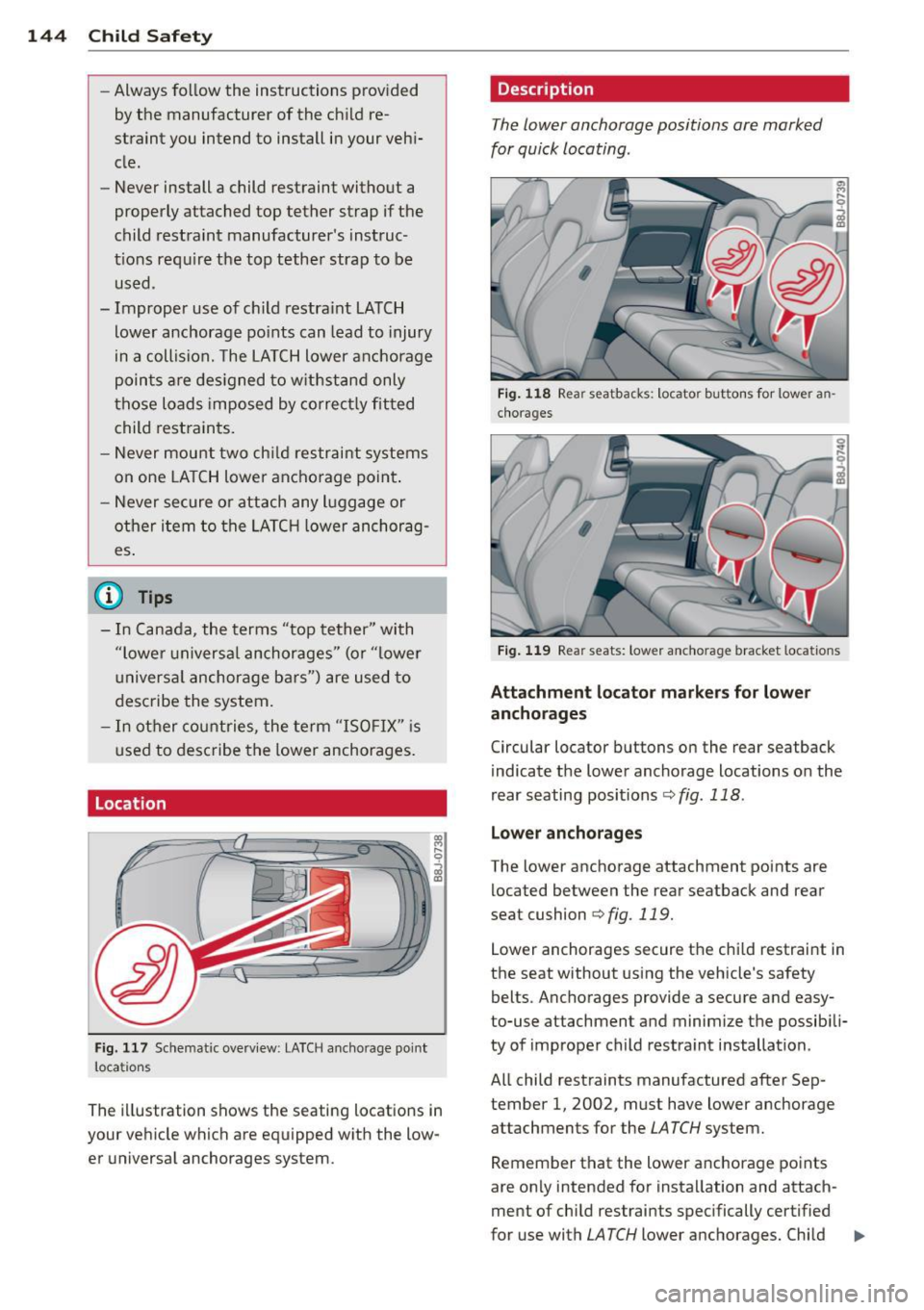
Location
F ig . 1 17 Schemat ic overview : LATCH a nch orage poi nt
loca tions
The i llustration shows the seating locations in
you r ve hicle which are equipped w ith the low
er universa l anchorages system.
Description
The lower anchorage positions are marked
for quick locating .
Fig . 1 18 Rea r seatbacks : locato r but to ns for lowe r an
c h orages
Fig. 11 9 Rear seats: lower anc horage bracke t locat ions
Atta chment lo cator mar kers for lowe r
anchor ages
Circular locator buttons on the rear seatback
indicate the lower anchorage locations on the
rear seating positions
~ fig . 118 .
Lo wer anchorages
The lower anchorage attachment points are
located between the rear seatback and rear
seat cushion
r::.> fig. 119.
Lower anchorages secure the ch ild restrai nt in
the seat without using the vehicle's safety
belts. Anchorages provide a secure and easy
to-use attachment and minimize the possib ili
ty of improper child restra int installation .
All child restraints manufactured after Sep
tember 1, 2002, must have lower anchorage attachments for the
LATCH system.
Remember that the lower anchorage po ints
are only intended for installation and attach ment of child restraints specifically certified
for use with
LATCH lower a nchorages. Chi ld IJ>
Page 147 of 262
restraints that are not equipped with the low
er anchorage attachments can still be instal
led in compliance with the child restra int
manufacturer's instructions on using vehicle
safety belts.
A WARNING
Improper use of LATCH lower anchorages
can cause serious personal injury in an ac
cident.
-Always carefully follow the ch ild re
straints manufacturer's inst ruct ions for
proper installation of the child restraint
and proper use of the lowe r anchorages
or safety belts in your vehicle.
- Never secure or attach any luggage or
other items to the
LATCH lower ancho
rages.
- Always read and heed the important in
formation about child restraints in this
chapter and WARNINGS
c;, page 130,
Child Safety.
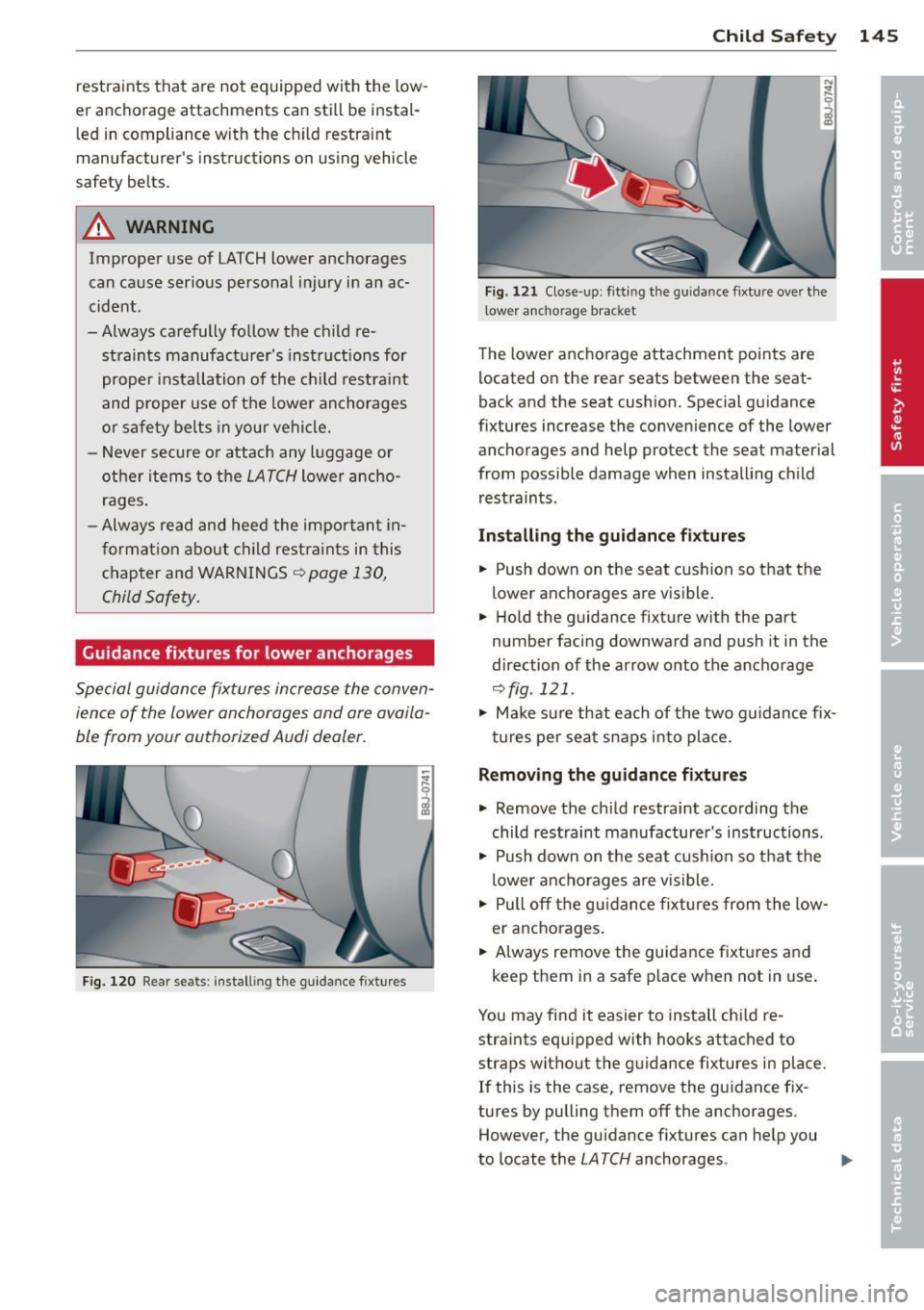
Guidance fixtures for lower anchorages
Special guidance fixtures increase the conven
ience of the lower anchorages and are availa
ble from your authorized Audi dealer.
F ig. 120 Rear seats : install ing the guidance fixtures
Child Safety 145
Fig. 121 Close -up: fitt ing the guidance fixture over the
l ower anchorage bracket
The lower anchorage attachment points are
located on the rear seats between the seat
back and the seat cushion. Special guidance
fixtures increase the convenience of the lower
anchorages and help protect the seat material
from possible damage when installing child restraints .
Installing the guidance fixtures
... Push down on the seat cushion so that the
lower anchorages are visible.
.,. Hold the guidance fixture with the part
number facing downward and push it in the
direction of the arrow onto the anchorage
c;,fig. 121.
.,. Make sure that each of the two guidance fix
tures per seat snaps into place.
Removing the guidance fixtures
... Remove the ch ild restraint according the
child restraint manufacturer's instructions .
.,. Push down on the seat cushion so that the
lower anchorages are visible .
.,. Pull off the guidance fixtures from the low
er anchorages .
... Always remove the guidance fixt ures and
keep them in a safe p lace when not in use.
You may find it easier to install chi ld re
straints equipped with hooks attached to
straps without the g uidance fixtures in place.
If this is the case, remove the guidance fix
tures by pulling them off the anchorages. However, the guidance fixtures can help you
to locate the
LATCH anchorages . ..,.
Page 148 of 262
146 Child Safet y
& WARNING
Improper use of tether anchorages or low
er anchorages can cause serious personal
injury in a crash.
- Always carefully follow the ch ild re
straint manufacturer 's instructions for
proper installation and use of child re
st raint systems .
- Never use the
LATCH or tethe r anchorag
es to attach safety belts or other kinds of
occupant restraints.
- Child restraint tether attachments and
lower attachments are only des igned to
se cu re a child res traint that has been
equipped to use these anchorages.
- T ether anchorages and lower anchorages
are designed to withstand only those loads imposed by correct ly fitted ch ild
restraints . Under no circumstances can
they be used safe ly for adu lt or chi ld
safety belts or harnesses.
- Never mount more than one chi ld re
straint to a sing le tether or to a lower an
chorage point. Attaching two chi ld re
straints to a single anchorage point can cause the anchorage to fail and cause se
rious personal injury in a crash.
(D Note
- Remove the guidance f ixtures before
fold ing the rear seatback to prevent
damaging the seat cushion.
- If you leave the guidance fixtures instal
led for several days, they could leave a
mark on the upholstery on the seat cush
ion and backrest in the area that the
guidance fixtures were insta lled. The up
ho lstery would also be permanently
stretched around the guid ance fixtu res.
This applies especially to leather seats.
Installing a child restraint with LATCH
lower anchorages
Whenever you install a child restraint always
follow the child restraint manufacturer's in
structions.
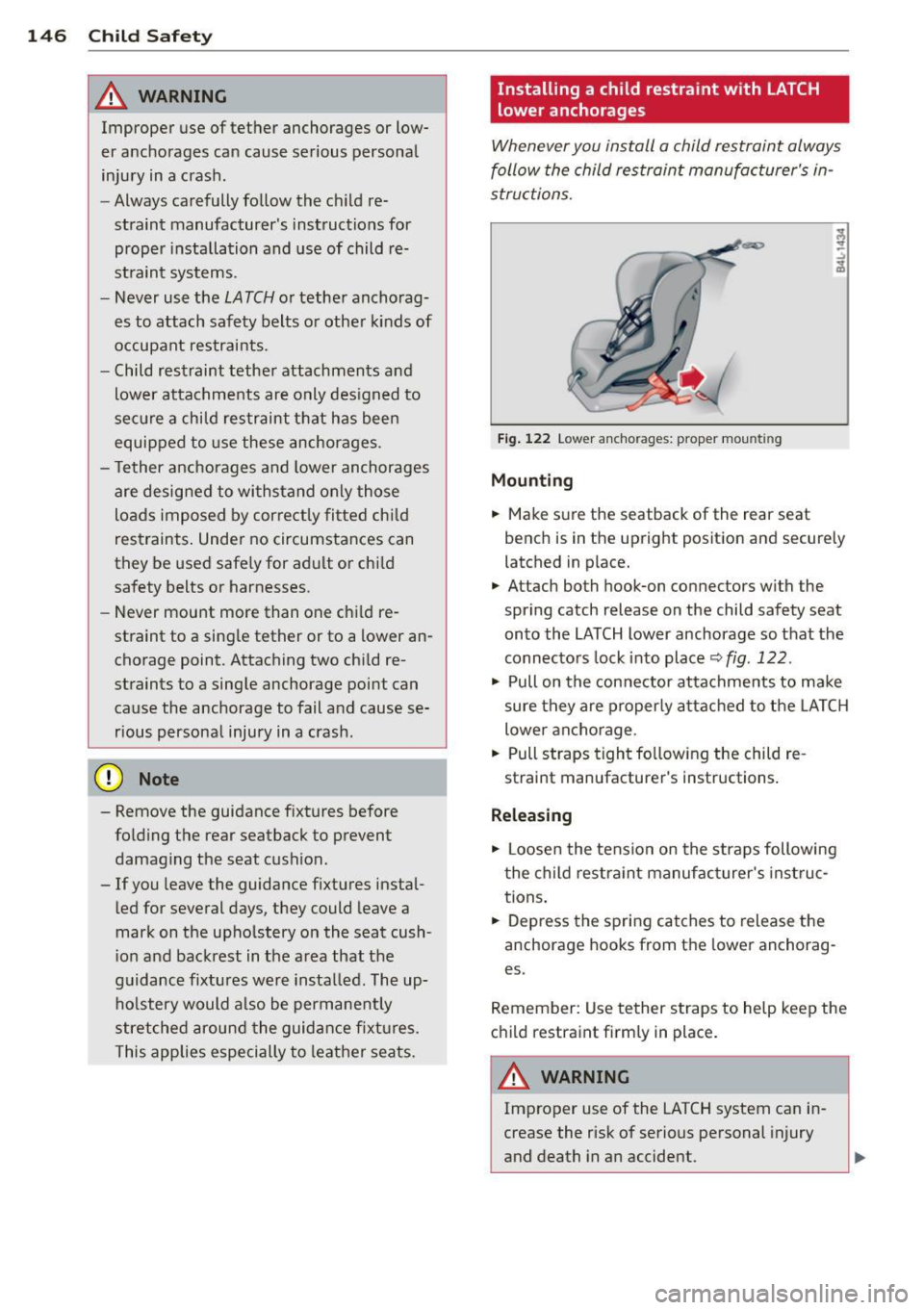
Fig . 122 Lower ancho rages: proper mount ing
Mo unting
.,. Make s ure the seatback of the rear seat
bench is in the upright position and securely
latched in place.
.,. Attach both hook-on connectors with the
spring catch release on the child safety seat
onto the LATCH lower anchorage so that the
connectors lock into place
~ fig. 122.
.,. Pull on the connector attachments to make
sure they are properly attached to the LATC H
lower ancho rage .
.,. Pull straps tight fo llow ing the child re
straint manufacturer's instructions .
Releasing
.,. Loosen the tension on the straps following
t he child restra int manufac turer's inst ruc
tions.
.. Depress the spring catches to release the
anchorage hooks from the lower anchorag
es.
Remember: Use tether straps to help keep the
child restraint firmly in place.
A WARNING
'-
Improper use of the LATCH system can in-
crease the risk of serious personal injury
and death in an accident.
Page 149 of 262
-These anchors were developed only for
child safety seats us ing the "LATCH" sys
tem.
- Never attach other child safety seats,
belts or other objects to these anchors .
- Always make sure that you hear a click
when latching the seat in place. If you do
not hear a click the seat is not secure and
could fly forward and h it the interior of
the vehicle, or be ejected from the vehi
cle.
A WARNING
Imprope r insta llation of chi ld restraints
w ill increase the risk of inju ry in an acci
dent .
- Always follow the child restraint system
man ufacturer's instructions for proper
installation of the child restraint system
and proper use of tether straps as we ll as
the lower anchorages or safety belts in
your vehicle.
- Always read and heed the important in
formation and WARNINGS about child
safety and the installation of child re
straint systems
¢ page 130, Child Safe
ty.
Tether anchors and tether straps
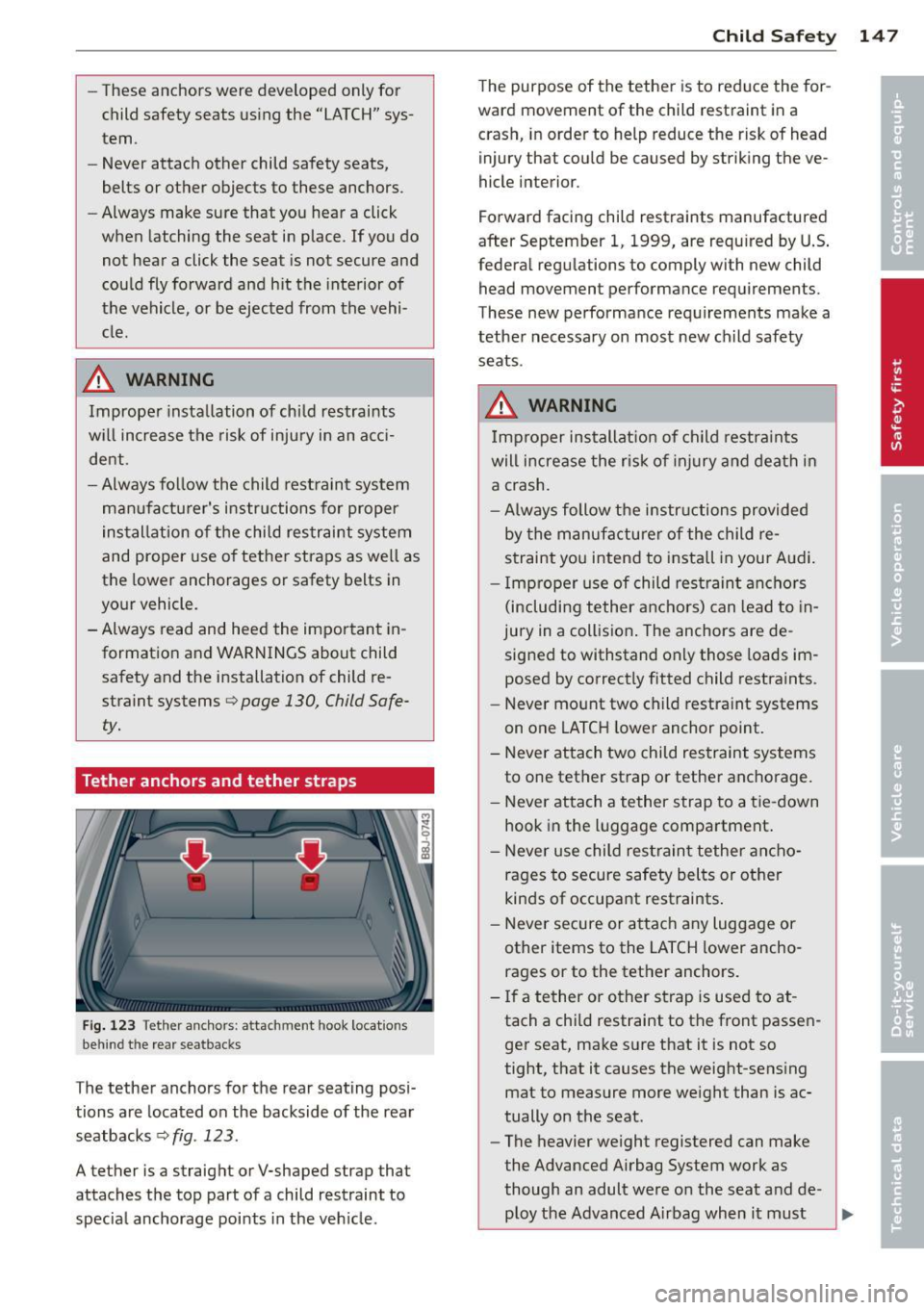
Fi g. 123 Tether ancho rs : attachment hook locatio ns
behind t he rear seatbacks
The tether anchors for the rear seating posi
tions are located on the backside of the rear
seatbacks
¢ fig . 123 .
A tether is a straight or V-shaped strap that
attaches the top part of a child restraint to
special anchorage points in the veh icle.
-
Child S afety 14 7
The purpose of the tether is to reduce the for
ward movement of the child restraint in a
crash, in order to help reduce the risk of head
injury that cou ld be caused by striking the ve
hicle interior .
Forward facing child restraints manufactured
after September 1, 1999, are requ ired by U.S .
federal regu lations to comply with new child
head movement performance requirements.
These new performance requirements make a
tether necessary on most new child safety
seats .
A WARNING
Imp roper installat ion of ch ild restra ints
will increase the risk of injury and death in
a crash.
- Always follow the instr uctions provided
by the manufacturer of the child re
straint you intend to install in your Audi.
- Improper use of child restraint ancho rs
(including tether anchors) can lead to in
jury in a collision . The anchors are de
signed to withstand only those loads im
posed by correctly fitted child restraints .
- Never mount two child restraint systems
on one LATCH lower anchor point.
- Never attach two child restraint systems to one tether strap or tether anchorage.
- Never attach a tether strap to a tie-down
hook in the luggage compartment .
- Never use child restraint tether ancho
rages to secure safety belts or other
kinds of occupant restraints .
- Never secure or attach any luggage or
other items to the LATCH lower ancho rages or to the tether anchors.
- If a tether or other strap is used to at
tach a chi ld restraint to the front passen
ger seat, make s ure that it is not so
tight, that it causes the weight-sens ing
mat to measure more we ight than is ac
tually on the seat .
- The heavier weight registered can make
the Advanced Airbag System work as
though an adult were on the seat and de-
ploy the Advanced Airbag when it must ..,
Page 151 of 262
-If you must insta ll a rearward facing
child safety seat on the front passenger
seat because of exceptional circumstan ces and the
PASS ENG ER AIR BAG OFF
light does not come on and stay on, im
med iately install the rea r-facing child
safety sea t in a rear seating position a nd
have t he a irbag system inspec ted by you r
Audi dealer .
Additional Information
Sources of information about child
restraints and their use
There are a numbe r of sources of additional
i n fo rmation abou t ch ild restrai nt sele ct io n, in
stallat io n a nd use :
NHTSA advises that t he best child safe ty seat
i s the one that fits your child and fits in your
ve hicl e, and that you w ill use cor rectly and
consis ten tly.
T ry befo re you buy!
U.S National Highway Traffic Safety Admin
istrat ion
T e l.: 1-888 -327 -4236 (T TY : 1-800 -424 -9153)
www .nhtsa .gov
National SAFE KIDS Campaign
Te l.: (202) 662-0600
www .safekids .org
Safety BeltS afe U .S .A
Te l.: (800) 745-SAFE (English)
Te l.: (800) 747-SANO (Spanish)
www .carseat .org
Transport Canada Inform ation Cent re
Te l.: 1 (800) 333-0371 or ca ll
1 (613) 998-8616 if you are in the Ottawa
area h ttp://www .tc .gc.ca/eng/roadsafety/
menu.htm
Audi Customer Relations
T e l.: (800) 822-2834
Child Sa fet y 149
•
•
Page 152 of 262
150 Intelligent technology
Intelligent technology
Notice about data
recorded by vehicle
control modules
Your vehicle is not equipped with an Event Da
ta Recorder (EDR), installed by some manu
facturers fo r the express purpose of capturing
data for retrieval after an accident or crash
event . EDR's are sometimes ca lled "crash re
corders".
Some state laws restrict the retr ieval or down
loading of data stored by EDR's that were in
stalled in a vehicle for the express purpose of
retrieving data after an accident or crash
event without the owner's consent.
A lthough your vehicle is not equipped with an
EDR, it is equipped with a number of electron
ic control modules for various vehicle systems
such as, for examp le, eng ine function, em is
sion control, as well as for the airbags and
safety belts.
These electronic contro l modules also record
vehicle-re lated data during normal vehicle op
eration for diagnostic and repair purposes.
The recording capacity of the electronic con
trol modules is limited to data (no sound is re
corded) and only a small amount of data is ac
tually recorded over a very limited pe riod of
time and stored when a system fault or other
condition is sensed by a control unit. Some of
the data then stored may relate to vehicle
speed, direction, braking as we ll as restraint
system use and performance in the event of a
crash or other condition. Stored data can only
be read and downloaded with special equip
ment.
Electronic Stabilization
Control (ESC)
Description
ESC helps to improve road holding and vehicle
dynamics to help reduce the probability of
skidd ing and loss of vehicle control. It works
only when the engine is running. ESC detects certain difficult driving situat
ions, including
when the vehicle is beginning to spin (yaw)
out of control and helps you to get the veh icle
back under control by se lectively braking the
wheels, and/or reducing engine power and
providing steering assistance to help hold the
vehicle on the driver's intended course. The in
dicator light
G) in the instrument cluster
blinks when ESC is taking action to help you
control the vehicle.
ESC has limitations.
It is important to remem
ber that ESC cannot overcome the laws of
physics. It wi ll not always be able to help out
under all conditions you may come up against.
For example, ESC may not always be able to
help you master situations where there is a
sudden change in the coefficient of friction of
the road surface. When there is a section of
dry road that is suddenly covered with water,
slush or snow, ESC cannot perform the same
way it wou ld on the dry surface . If the vehicle
hydroplanes (rides on a cushion of water in
stead of the road surface), ESC will not be
able to help you steer the vehicle because con
tact with the pavement has been interrupted
and the vehicle cannot be braked or steered.
During fast cornering, particularly on winding
roads, ESC cannot always deal as effectively
with difficult driving situations as at lower
speeds.
Always adjust your speed and driving style to
road , traffi<;: and weather conditions. ESC can
not override the vehicle's physical limits, in
crease the available tract ion, or keep a vehicle
on the road if road departure is a result of
driver inattention . Instead, ESC improves the
poss ibility of keeping the vehicle under con
t rol and on the road during extreme maneu
vers by using the driver's steering inputs to
help keep the vehicle going in the intended di
rection . If you are traveling at a speed that
causes you to run off the road before ESC can
provide any assistance, you may not experi
ence the benefits of ESC.
ESC includes and/or works together with the
anti- lock brake system (ABS), brake assist sys-
tem and anti-slip regu lation (ASR). ESC is .,..
Page 174 of 262
172 Cleaning and protection
-Serious injuries can result if plastic parts
come loos e when the airbag is deployed.
- Always read and heed all WARNINGS and
the informat ion
¢ page 164.
(D Note
Clean ing agents containing solvents will
attac k the material and can change the
way it behaves .
Instrument cluster glass
~ Clean the glass with a soft, damp cloth .
I n order to preserve the anti-glare properties
of the inst rument cl uste r glass, it should on ly
be cleaned with a soft, damp cloth.
Natural leather
Applies to vehicles: with natural leather
Audi makes great efforts to maintain the
properties , natural look and feel of interior
leather.
G ener al
We offe r many different types of leather on
our vehicles. Most are different types of nappa
l eather, which has a smooth su rface and
comes in var ious co lo rs .
The in tensi ty of the color de termines the v is u
a l characterist ics and appearance . If the sur
face of the leathe r has a typical natural look,
then the leather is a nappa leather that has
been left in a relatively natural cond ition. This
leather offers par ticularly good com fort and
breathes well . F ine veins, closed grains , in sect
b ites, ski n folds , and subtle var iations in color
remain visib le. These characte ristics demon
strate that the mater ia l is na tural.
Natural nappa leather is not covered by a col
or finish .
It is therefore more sens itive to soil
ing a nd wear, which is something you need to
consider if ch ild ren, an ima ls o r othe r factors
migh t prove to be particularly hard on the
l eathe r.
B y contrast, leather types that are cove red by
a co lored f inish laye r are more durable. This has a positive effect on the leather's resis
t
ance to wear and soiling in dai ly use. On the
other hand, the typ ica l character istics of natu
ral leather are barely or not apparent. Howev
er, th is does not mean that the leather itse lf
is of inferior quality .
Care and handling
Because of the exclusive nature of the types of
l eather that Aud i uses and their unique prop
erties (such as sensit ivity to oils, grease, soil
ing, etc.) , you will need to be somewhat care
ful with these leathers, and a certain type of ca re is req uired. Fo r example, dark clothing
mater ials can disco lor leather seats (especia l
l y if such clo thing is damp and was not dyed
correct ly) . D ust and dirt pa rticl es i n pores,
f olds, and seams can have an abrasive effect
and can damage the leather surface as we ll as
weaken seams.
T he lea ther should be clea ned regularly as
neede d. After hav ing been used for a relat ive ly
long time, your leather seats will acq uire a
rich aged finish . This is a characteristic of nat
u ral leather and a sign of true quality .
In order to maintain the val ue of this nat ural
product
over the life of your ve hicle, you
sho uld follow t he recommendations be low:
(D Note
- T o keep your lea ther from b leaching o ut,
do not allow it to be exposed to bright
sunlight for long periods of time . If yo u
have to leave the veh icle parked outside
for long per iods, cover the leather to
protect it from direct exposure to sun
light .
- Sharp objects on cloth ing, such as zip
pers, rivets o r sharp pieces on belts can
leave permanent sc ratches or scrape
ma rks on the su rface of the leath er.
(l) Tips
- After each time you clean the leather and
a t regular intervals , use a leathe r preser
vative c reme that con tains UV-b locke rs
and tha t wo rks into the leathe r. T his
Page 176 of 262
174 Cleaning and protection
• Once the stain is no longer visib le, use a
soft dry cloth or tissue to soak up the mois
ture.
Do not use leather cleaning products on Al
cantara .
You may use a suitable shampoo fo r remov ing
d ust and dirt.
Dust and grit in the pores and seams can
scratch and damage the surface. If the ca r is
l eft standing i n the sun fo r long periods, the
A lcantara should be protected against direc t
sunlight to prevent it from fading. Slight co lor
variations will deve lop in normal use and are
not an indication of material deterioration.
{[) Note
-Never use chemical solvents (e.g . lighter
fl uid, turpentine), waxes, shoe polis h or
similar products on Alcantara ® surfaces.
- To avoid damage, have stubborn stains removed by a commercial cleaning spe
cia list.
- Do not use br ushes, stiff sponges or sim
ilarly abrasive cleaning aids.
Safety belts
Only well -maintained safety belts work relia
bly when needed .
Heavily soiled safety belts may no t retr act
p roperly.
• Keep be lts clean.
• Fo r cl eaning, use a m ild soap and wate r sol
u tion. Let be lts dry thoro ughly and away
from direct sunlight .
• Do not a llow inertia reel safety be lts to re
tract before they are completely dry .
• Check the condition of your safety belts
reg
ularly.
.&_ WARNING
Damaged safety belts can break in a crash.
1l Use o nly the co rrect cleaning so lu tions. Never use gas
o line or d iese l fue l.
-Anyth ing that might damage your safety
be lts could mean that you and your pas
sengers would not be adequate ly pro
tected in an accident.
- Safety belt performance depends on cor
rect insta llation. Never remove be lts
from the veh icle to clean them .
- Do not use chemical clean ing agents,
b leach or dyes. They have co rrosive prop
erties which wea ken the webb ing.
- When clean ing your safety be lts, inspect
them for damage . If you discover dam
age, see your Audi dealer.
'
- Always read a nd heed all WARNINGS and
the information
<=;> page 164.
Engine compartment
Be especially careful when cleaning the en
gine comportment.
Alway s swit ch off the ign ition before clean
ing the engine <=;>.&, .
Plenum panel
Remove leaves from the plenum panel in front
of the w indshield under the eng ine hood . This
prevents the water drain holes from becoming
blocked, and it prevents debris from enter ing
the vehicle interior t hro ugh the heating and
ventilat ion ducts.
Corrosion protection
T he engine compartment and transmission
have been corrosion -protected at the factory .
Good anti- corrosion treatmen t is very impor
tant, particu larly in the w inter.
If the vehicle
is frequently driven on salt treated roads, the
entire engine compartment and p lenum panel
shou ld be thoroughly cleaned at the end of
winter and retreated to prevent salt damage.
At the same time, the underside of the vehicle
shou ld be washed as well.
If the engine compartment is cleaned at any
time with grease removing solutions
1>, or if ..,.