warning light AUDI TT 2013 Owner´s Manual
[x] Cancel search | Manufacturer: AUDI, Model Year: 2013, Model line: TT, Model: AUDI TT 2013Pages: 262, PDF Size: 65.91 MB
Page 138 of 262
136 Child Safet y
from moving ¢ page 140 or install the seat
using the LATCH attachments .
• Push the child safety seat down with your
full weight to get the safety belt really t ight
so that the seat cannot move forward or
sideways more than one inch (2 .5 cm) .
• Secure unused safety be lts on the rear seat
¢ page 135.
Infants up to about one year (20 lbs . or 9 kg)
a re best protected in special infant carriers
a nd chi ld safety seats designed for their age
group. Many experts believe that i nfants a nd
small children should ride only in spec ial re
strai nts in which the ch ild faces the back of
the vehicle . These infant seats support the ba
by's back, neck and head in a cras h¢
fig . 113 .
The airbag on the passenger side makes the
front seat a po tentially dangerous place for a
chi ld to r ide. The front seat is not the safest
p lace for a child in a forward-facing child seat.
It is a very dangerous p lace for an infant or a
larger child in a rearward-facing seat .
A WARNING
Not using a child safety seat, using the
wrong ch ild safety seat or improperly in
stall ing a child restraint inc reases the risk
of serious persona l injury and d eath in a
c rash .
- Never install rear-fac ing ch ild safety
seats or infant carriers on the front pas senger seat -even wi th an Advanced Air
bag System. A child w ill be seri ously in
jured an d can be k illed when the inflat
ing airbag hits the child safety seat o r in
fant ca rr ier with great force and smashes
the ch ild safety seat and ch ild aga inst
the backrest, doo r or roof ¢
page 110,
Child restraints on the front seat -some
important things to know.
- Always install rear-facing child safety
seats or infant car riers on the rear seat.
- Never install a rear-facing child restraint
in t he forward-facing direction. Such re
straints are des igned for the spec ial
needs of infants and very small childre n and cannot protect them properly if the
seat is forward-facing.
-
If you must install a rearwa rd facing
child safety seat on the front passenger
seat because of exceptional c ircumstan
ces and the
PASSENGER AIR BAG OFF
light does not come o n and stay on, im
mediately insta ll the rear-fac ing ch ild
safety seat in a rear seating position and
have the airbag system inspe cted by your
Aud i dea le r.
- Always read a nd heed a ll WAR NINGS
whenever us ing a chi ld re strained in ave
hicle is be ing used
¢ page 100, Safety
belts, ¢page 108, Airbag system
and
¢ page 130, Important things to know .
Convertible child safety seats
Properly used convertible child safety sea ts
can help protect toddlers and childr en ov er
age one who weigh between 20 and 40 lbs . (9
and 18 kg) in a crash.
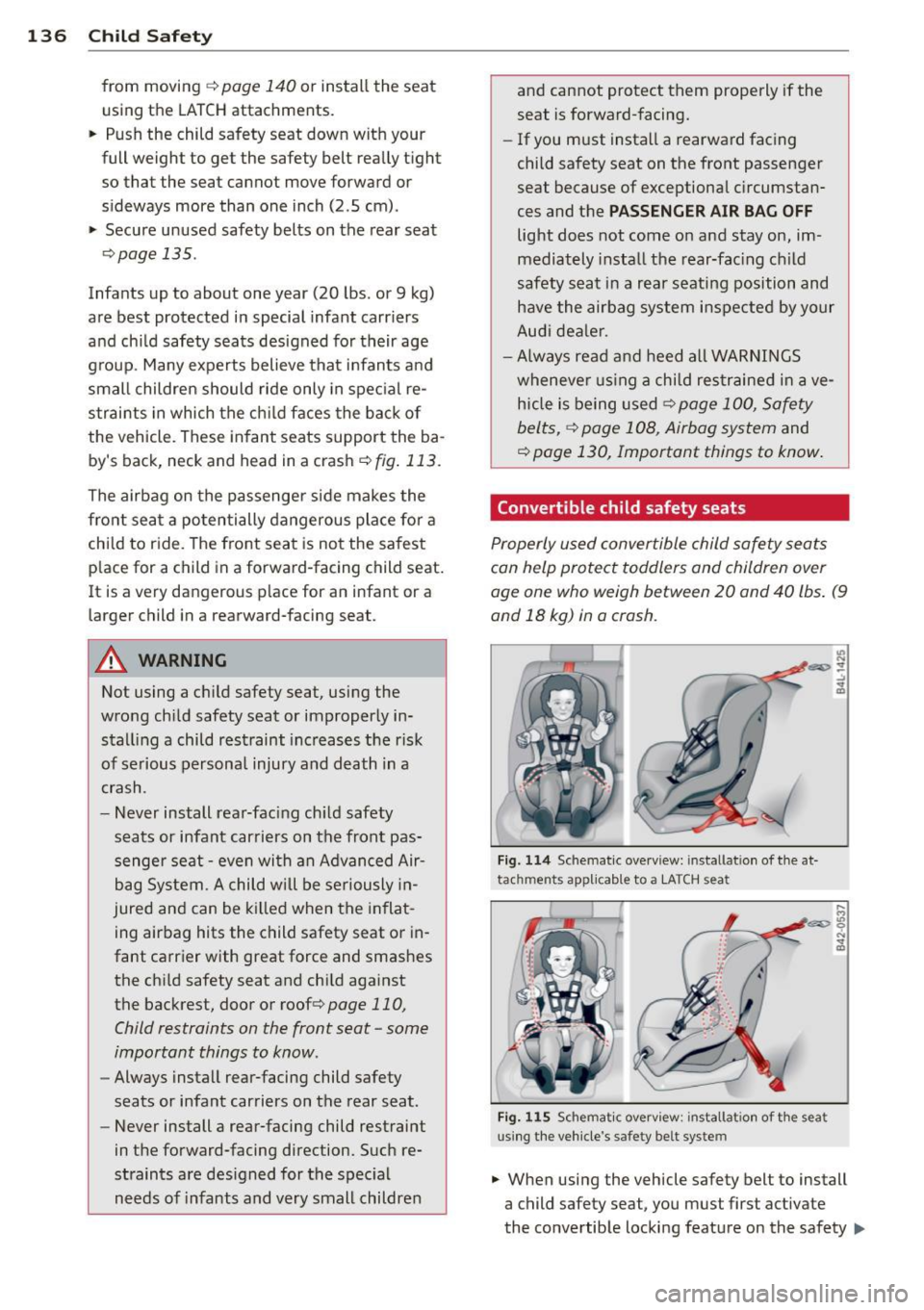
Fig . 1 14 Sc hema tic overview: instal lat ion of the at·
t ac hme nts applicab le to a LA TCH sea t
Fig. 115 Sc hemat ic overview: installa tion of t he sea t
us ing t he ve hicle 's safety be lt sys te m
• When using the vehicle safety belt to install
a child safety seat, you must first activate
the convertible locking feature on the safety ..,_
Page 139 of 262
belt to prevent the child safety seat from
moving
r::!> page 140 or insta ll th e seat using
the LA TCH attachments .
"' Push the child safety seat down w ith your
full weigh t to get the safety belt really t ight
so that the seat cannot move forward or s ideways more than one inch (2 .5 cm)
r::!> page 140 .
"' If the child safety seat is equ ipped with a
tether strap, attach it to the tether anchors
r::!> page 147 .
.. Secure unused safety belts on the rear seat
r::!> page 13 5 .
A toddler or child is usually too large for an in
fant restraint if it is more than one year o ld
and weighs more than 20 lbs . (9 kg) .
Todd le rs and c hildren who are older than one
year up to abo ut 4 years o ld and weigh more
than 20 lbs. (9 kg) up to 40 lbs . (18 kg) must
a lways be properly restrained in a chi ld safety
seat certified for their size and weight
r::!> fig. 114 and r:::>fig. 115.
The airbag on the passenge r side makes the
front seat a potentially dangerous place for a
chi ld to ride. The front seat is not the safest
p lace for a child in a forward-facing child safe
ty seat.
It is a very dangerous place for an in
fant or a larger child in a rearward-fac ing seat.
A WARNING
Not using a ch ild safety seat , using the
w rong chi ld safety seat or improperly in
stalling a child restraint increases the risk
of serious personal injury and death in a
co llision or other emergency s ituation.
- Children on the front seat of any car,
even with Advanced A irbags, can be seri
o usly injured or even killed when an air
bag inf lates . A child in a rearward-facing
child safety seat insta lled on the front
passenger seat w ill be seriously injured
and can be killed if the front airbag in
flates -even with a n Advanced Airbag
System.
- The inflating a irbag w ill hit the child
safety seat or infant carrier with great
-
Child Sa fet y 137
force and will smash the child safety seat
and child against the backrest, door or
roof.
- Always install rear-facing ch ild safety
seats on the rear seat .
- If you must insta ll a rearwa rd facing
child safety seat on the front passenger
seat because of exceptiona l circumstan
ces and the
PA SS ENGER AIR BAG OFF
light does not come on and stay on, im
mediately insta ll the rear-fac ing ch ild
safety seat i n a rea r seating position and
h ave the airbag system inspected by your
Aud i dea le r.
- Always read and heed al l WARNINGS
wheneve r using a child res trained in ave
hicle is being used
r=:> page 100, Safety
belts,
c:> page 108, Airbag system and
r::!> page 130, Important things to know .
A WARNING
If exceptional circumstances require the
use of a forward-facing child restraint on
the front passenger's seat, the child's safe
ty and well-being require that the follow ing spec ial precautions be taken:
- Make sure the forward-facing seat has
been designed and cert ified by its manu
facturer for use on a front seat with a passenger front and side airbag .
- Always follow t he manufacturer's in
structions p rov ided with the ch ild safety
seat o r infant ca rr ier .
- Always move the front passenger seat in
to the rearmost position of the passen
ge r seat's fo re and aft adjustment range,
a nd as far away from the ai rbag as possi
b le before installing the ch ild restraint.
- Always ma ke sure that no thing prevents
the front passenger 's seat from being
moved to the rearmost position in its
fore and aft adj ustment range.
- Always ma ke sure the backrest is in an
up right position .
- Ma ke sure that the
PASSENGER AIR BAG
-
OFF li ght comes on and stays on all the ~
•
•
Page 141 of 262
In o rder for the airbag to offer protection, it is
important t hat all vehicle occupants, especia l
l y any children, who must be in the front seat
because of exceptional circumstances, be
pro perly restrained and as far away from the
airbag as poss ible. By keep ing room between
the child's body and the front of the passen
ger c om partment, the airbag can inflate com
p letely and provide supp lemental p rotection
in certa in frontal col lis ions.
A WARNING
Not using a booster seat, us ing the boos
ter seat improperly, incorrect ly installing a
booster seat or using the vehicle safety
belt improperly increases the risk of seri
ous personal injury and death in a collision
or other emergency s ituation. To help re
duce the risk of ser ious personal injury
and/or death:
- The shoulder be lt must lie as close to the
center of the child's co llar bone as poss i
ble and must lie and snug on the upper
body.
It must never lie across the throat
o r neck. The lap belt must l ie across the
pelvis and never across the s tomach o r
abdomen. Make sure the belt lies flat
and snug. Pull on the be lt to tighten if
necessary.
- Failure to properly route safety belts
over a child's body will cause severe inju
ries in an acc ident or other emergency
situation
¢page 100.
-Children on the front seat of any car,
even with Advanced A irbags, can be seri
ous ly injured or even killed when an a ir
bag inflates.
- Never let a child stand or knee l on any
seat, for examp le the front seat.
- Never let a child ride in the ca rgo area of
your vehicle.
- Always remember that a ch ild lean ing
forward, sitt ing s ideways or out of posi
t ion in any way during an acc ident can be
struck by a deploying airbag . This will re
sult in se rious personal injury or death.
- If you must install a booster seat on the
front passenger seat because of excep-
-
Child Sa fet y 139
tional circ umstances the PASSENGER
AIR BAG OFF
li ght m ust come on and
stay on, whenever the ignition is switch
ed on .
- If the
PASSENGER AIR BAG OFF light
does not come on and stay on, perform
the checks descr ibed
¢ page 119, Moni
toring the Advanced Airbag System .
-Take the chi ld restraint off the front pas
senger seat and install it prope rly at one
of the rear seat positions if the
PASSEN
GER AIR BAG OFF
lig ht does not stay on
wheneve r the ignit ion is swi tched on.
- Always read and heed all WAR NINGS
wheneve r us ing a child res trained in ave
hicle is being used
¢page 100, Safety
belts,
¢ page 108, Airbag system and
¢ page 130, Important things to know .
Booster seats on the rear seat
Children who are about 7 years and older, who
weigh mo re than SS lbs . (25 kg) and are not
ta ller than 4'11" (1.5 m) are best protected
when properly rest rained on the rear seat.
D ue to limited rear seat head clearance c hil
dren 4'3" (1.3 m) and taller must not use
booster seats o n the rear seat of your Aud i TT
Coupe. The rear seat of your Audi TT Coupe
has been specially designed to permit ch ildren
who are betwee n 4'3" ( 1.3 m) and 4'11" ( 1.5
m) tall (about 7 to 12 years old) to use the
available th ree -point lap and s hou lde r safety
belts.
A WARNING
~ -
- T he rear sea t area is too sma ll to safely
transport passengers tal le r than 4 '11"
(1.5 m).
- Persons taller than 4'11" (1. 5 m) as well
as children in booster seats who are too
close to the rear window and roof can
suffer severe head and neck inju ries
when t he rear lid is closed or in a crash.
- The minimum clearance between the
passengers' heads and the rear w indow
•
•
Page 143 of 262
interior. The child can be seriously in
jured or killed.
- Never install rear-facing child safety
seats or infant carriers on the front pas
senger seat. A child will be seriously in
jured and can be killed when the passen ger airbag inflates .
- The inflating airbag will hit the child
safety seat or infant carrier with great
force and will smash the child safety seat
and child against the backrest, door or
roof.
- Always install rear-facing child safety
seats or infant carriers on the rear seat.
- Forward -facing child safety seats or in
fant carriers installed on the front pas
senger's seat may interfere with the de
ployment of the airbag and cause serious
injury to the child.
-It is safer to install a forward-facing
child safety seat on the rear seat.
- Always read and heed all WARNINGS
whenever using a child restrained in ave
hicle is being used~
page 130. Special
precautions apply when installing a child
safety seat on the front passenger seat
~ page 110, Child restraints on the front
seat -some important things to know.
_&. WARNING
Always take special precautions if you
must install a forward or rearward-facing
child restraint on the front passenger's
seat in exceptional situations:
- Whenever a forward or rearward-facing
child restraint is installed on the front
passenger seat, the
PASSENGER AIR
BAG OFF
light must come on and stay on
whenever the ignition is switched on.
- If the
PASSENGER AIR BAG OFF light
does not come on and stay on, perform
the checks described
~page 119, Moni
toring the Advanced Airbag System.
- Take the child restraint off the front pas
senger seat and install it properly at one
of the rear seat positions if the
PASS EN-
Child Safety 141
GER AIR BAG OFF light does not stay on
whenever the ignition is switched on.
- Improper installation of child restraints
can reduce their effectiveness or even
prevent them from providing any protec
tion.
-An improperly installed child restraint can interfere with the airbag as it deploys and seriously injure or even kill the
child.
- Always carefully follow the manufactur
er's instructions provided with the child
safety seat or carrier.
- Never place additional items on the seat
that can increase the total weight regis
tered by the weight-sensing mat and can cause injury in a crash.
_&. WARNING
Forward-facing child restraints:
- Always make sure the forward-facing
seat has been designed and certified by
its manufacturer for use on a front seat
with a passenger front and side airbag.
- Never put the forward-facing child re
straint up, against or very near the in
strument panel.
- Always move the passenger seat into its
rearmost position in the seat's fore and
aft adjustment range, as far away from
the airbag as possible before installing
the forward-facing child restraint. The backrest must be adjusted to an upright
position.
- Make sure that the
PASSENGER AIR BAG
OFF
light comes on and stays on all the
time whenever the ignition is switched
on .
_&. WARNING
Rearward-facing child restraints:
- A child in a rearward-facing child safety
seat installed on the front passenger
seat will be seriously injured and can be killed if the front airbag inflates - even
with an Advanced Airbag System .
•
•
Page 144 of 262
142 Child Safety
-The inflating airbag will hit the child
safety seat or infant carrier with great
force and will smash the child safety seat and child against the backrest, door or
roof.
- Always be especially careful if you must
install a rearward facing child safety seat
on the front passenger seat in exception
al circumstances.
-A tight tether strap on a rearward-facing child restraint attached to the front pas
senger seat can put too much pressure
on the weight-mat in the seat and regis
ter a heavier weight in the Advanced Air
bag System. The heavier weight regis
tered can make the system work as
though an adult were on the seat and de
ploy the Advanced Airbag when it must
be suppressed causing serious or even
fatal injury to the child .
- Make sure that the
PASSENGER AIR BAG
OFF
light comes on and stays on all the
time whenever the ignition is switched on .
- If the
PASSENGER AIR BAG OFF light
does not come on and stay on, immedi
ately install the rear-facing child safety
seat in a rear seating position and have
the airbag system inspected by your Audi
dealer.
Activating the convertible locking retractor
Use the convertible locking retractor to se
cure a child restraint.
Always heed the child safety seat manufactur
er's instructions when installing a child re
straint in your vehicle. To activate the conver
tible lock ing retractor :
"' Place the child restraint on a seat, prefera
bly on the rear seat .
... Slowly pull the belt
all the way out.
... Route it around or through the child re
straint belt path
c:> ,& .
... Push the child safety seat down with your
full weigh t to get the safety belt really tight. "'
Insert the belt tongue into the buckle for
that seating position .
"' Guide the safety belt back into the retractor
until the belt lies flat and snug on the child
safety seat.
... You should hear a "clicking" noise as the
belt winds back into the inertia reel. Test the
convertible locking retractor by pulling on
the belt. You should no longer be able to
pull the belt out of the retractor. The con
vertible locking retractor is now activated.
... Make sure that the red release button is fac
ing away from the child restraint so that it
can be unbuckled quickly.
"' Pull on the belt to make sure the safety belt
is properly tigh t and fas tened so tha t the
seat cannot move forward or sideways more
than one inch (2.5 cm) .
A WARNING
Using the wrong child restraint or an im
properly installed child restraint can cause
serious personal injury or death in a crash.
-Always make sure that the safety belt re-
tractor is locked when installing a child
safety seat. An unlocked safety belt re
tractor cannot hold the child safety seat
in place during normal driving or in a
crash.
- Always buckle the child safety seat firmly
in place even if a child is not sitting in it.
A loose child safety seat can fly around
during a sudden stop or in a crash.
- Always make sure the seat backrest to
which the child restraint is installed is in
an upright position and securely latched
into place and cannot fold forward . Oth
erwise, the seatback with the child safety
seat attached to it could fly forward in
the event of an accident or other emer
gency situation.
- Always read and heed all WARNINGS
whenever using a child restrained in ave
hicle is being used
c:> page 130. Special
precautions apply when installing a child
safety seat on the front passenger seat
c:> page 110, Child restraints on the front
seat -some important things to know.
-
Page 150 of 262
148 Child Safet y
be suppressed causing ser ious or even
fatal injury to the child .
- If you must install a rearward facing
child safety seat on the front passenger
seat because of exceptional circumstan
ces and the
P A SS EN GER AIR BA G OFF
light does not come on and stay on, im
med iately install the rear-facing child
safety seat in a rear seating position and
have t he a irbag system inspected by your
Audi dealer.
Installing the upper tether strap on the
anchorage
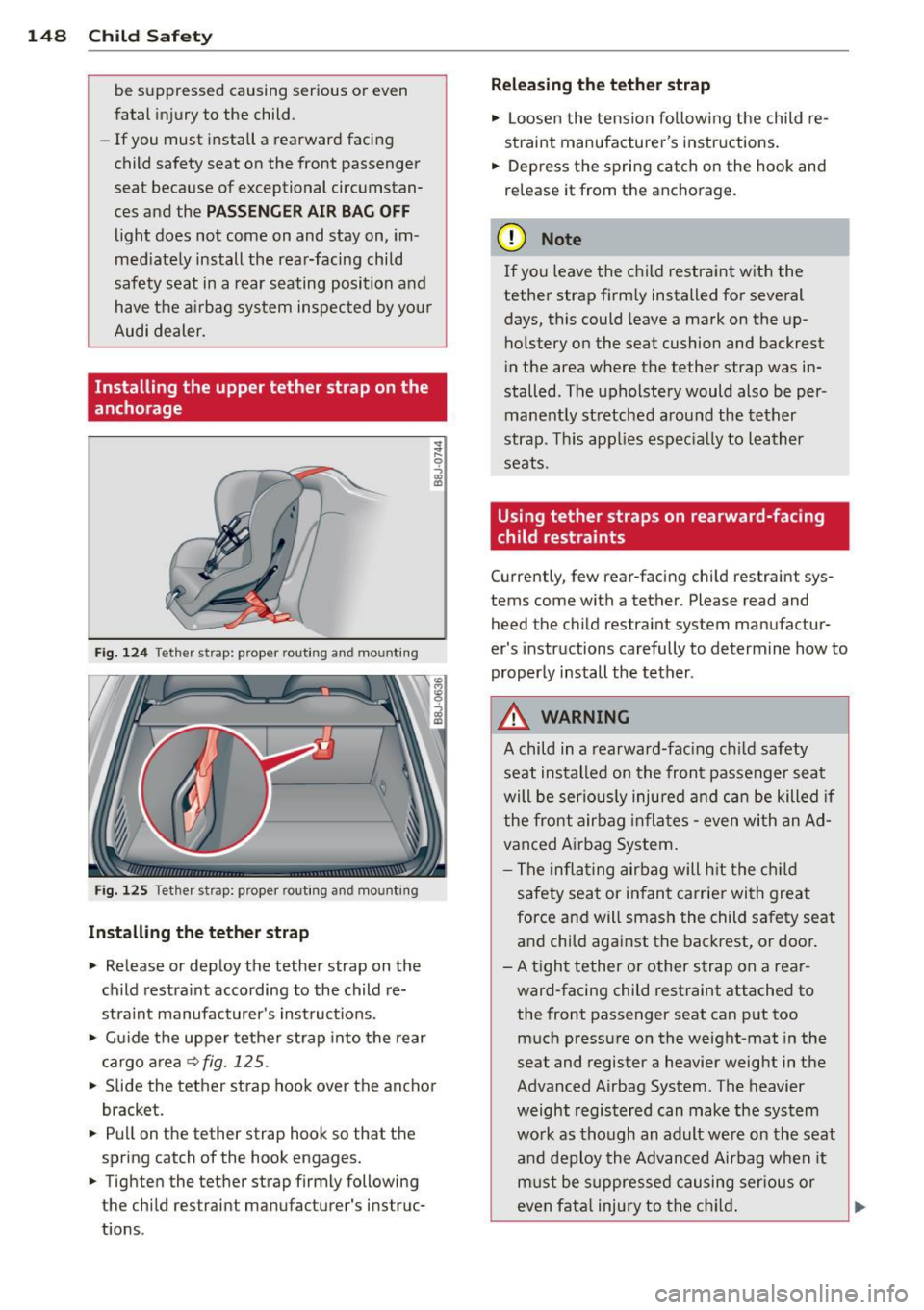
Fig. 12 4 Tet her st rap : proper ro uting a nd mountin g
F ig . 125 Tether strap: p rope r ro uting a nd mo unting
Inst all ing th e tether strap
.,. Release or deploy the tether strap on the
child restra int according to the child re
stra int manufacturer's instruct ions .
.,. Gu ide the upper tether st rap into the rear
cargo area
¢fig. 125 .
.,. Slide the tether strap hook over the anchor
bracket.
.,. Pull on the tether strap hook so that the
spring catch of the hook engages .
.,. Tighten the tether stra p firmly following
t he child res train t manufacturer 's instruc
t ions .
Releasing the teth er strap
.,. Loosen the tension follow ing the child re
straint manufacturer's instructions.
.,. Depress the spring catch on the hook and
release it from the anchorage .
(D Note
If you leave the child restraint with the
tether strap firm ly installed for several
days, this could leave a mark on the up
ho lstery on the seat cushion and backrest
i n the area where the tether strap was in
stalled . The upholstery would also be per
manently st retched a round the tether
strap. This applies especia lly to leather
seats .
· Using tether straps on rearward-facing
child restraints
C urrently, few rear-facing chi ld restraint sys
tems come with a tether . Please read and
heed the child restrain t system manufactur
er's instructions carefully to determine how to
properly install the tether .
A WARNING -
A child in a rearward-facing ch ild safety
seat installed on the front passenger seat
will be serio usly inju red and can be killed if
the front airbag infla tes - even wi th an Ad
vanced Airbag System.
- The infla ting airbag will h it the c hild
safety seat or infant carrier wi th great
force and will smash the child safety seat
a nd child against the backrest, or door .
- A t ight tether or o ther strap on a rea r
ward-facing child restraint attached to the front passenger seat can p ut too
much pressure on the weight-mat in the
seat and register a heavier weight in the
Advanced Airbag System . The heavier
weight registered can make the sys tem
work as though an adult we re on the seat
and deploy the Advanced Airbag when it
m ust be suppressed causing ser ious or
even fata l injury to the ch ild .
Page 153 of 262
switched on all the time. In certain situations
when you need less traction, you can switch
off ESC by pressing the button
lru . Be sure to
switch ESC on again when you no longer need
less traction.
Anti -loc k brak ing s ystem (ABS )
ABS prevents the wheels from locking up
when braking . The vehicle can still be steered
even during hard braking. Apply steady pres
sure to the brake pedal. Do not pump the ped
al. A puls ing in the brake pedal indicates that
the system is helping you to brake the vehicle.
B rake ass is t system
The brake assist system can decrease braking
d istance. It increases braking power when the
driver presses the brake pedal quickly in emer
gency situations. You must press and hold the
brake pedal until the situation is over .
Anti-slip regulati on (ASR )
ASR reduces engine power when the drive
wheels begin to spin and adapts the force to
the road condit ions. This makes it easier to
start, accelerate and drive up hills.
Elect ronic diff erential lock (EDL )
The EDL brakes wheels that are spinning and
transfers the drive power to the other drive
wheel or whee ls if the vehicle is equipped with
all-wheel drive*. This function is available up
to about 60 mph (100 km/h).
In extreme cases, EDL automat ica lly switches
off to help keep the brake on the braked wheel
from overheating. EDL w ill switch on again au
tomatically when conditions have returned to normal.
..&, WARNING
- ESC, ABS, ASR and EDL cannot ove rcome
t he laws of physics. This is espec ia lly im
portant on slippery or wet roads.
If the
systems begin act ing to stab ilize your ve
hicle, you should immediately change
yo ur speed to match the road and traffic
condit ions. Do not let the increased safe
ty provided by these systems tempt you
Intelligen t technolog y 151
to take risks. Doing so will increase the
risk of a loss of vehicle control, co llision
and serious personal injuries.
- Always adapt your speed to road, traffic
and weather conditions. The risk of los
ing control of the vehicle increases when
driving too fast, espec ially through
curves and on slippery or wet roads, and
when driving too close to vehicles up ahead. ESC, ABS, the brake assist sys
tem, EDL and ASR cannot preven t coll i
sions.
- Always ac celera te with spe cial care on
even, smooth s urfaces su ch as those th at
are wet or covered with ice and snow.
The drive wheels can spin even with these assistance systems that cannot al
ways he lp to reduce the risk of loss of ve
hicle control.
@ Tips
- ABS and ASR only work correct ly when
all four whee ls are equipped with identi
cal tires. D ifferent tire sizes can lead to a
reduction in engine power.
- You may hear noises when the systems described are working.
-If the ind icator lightD] orE (USA
models)/ [iJ (Canada models) appears,
there may be a malfunction¢ page 18,
¢page 17.
TT/TTS: Switching on/off
Applies to vehicles: TT Coupe and TTS Coupe
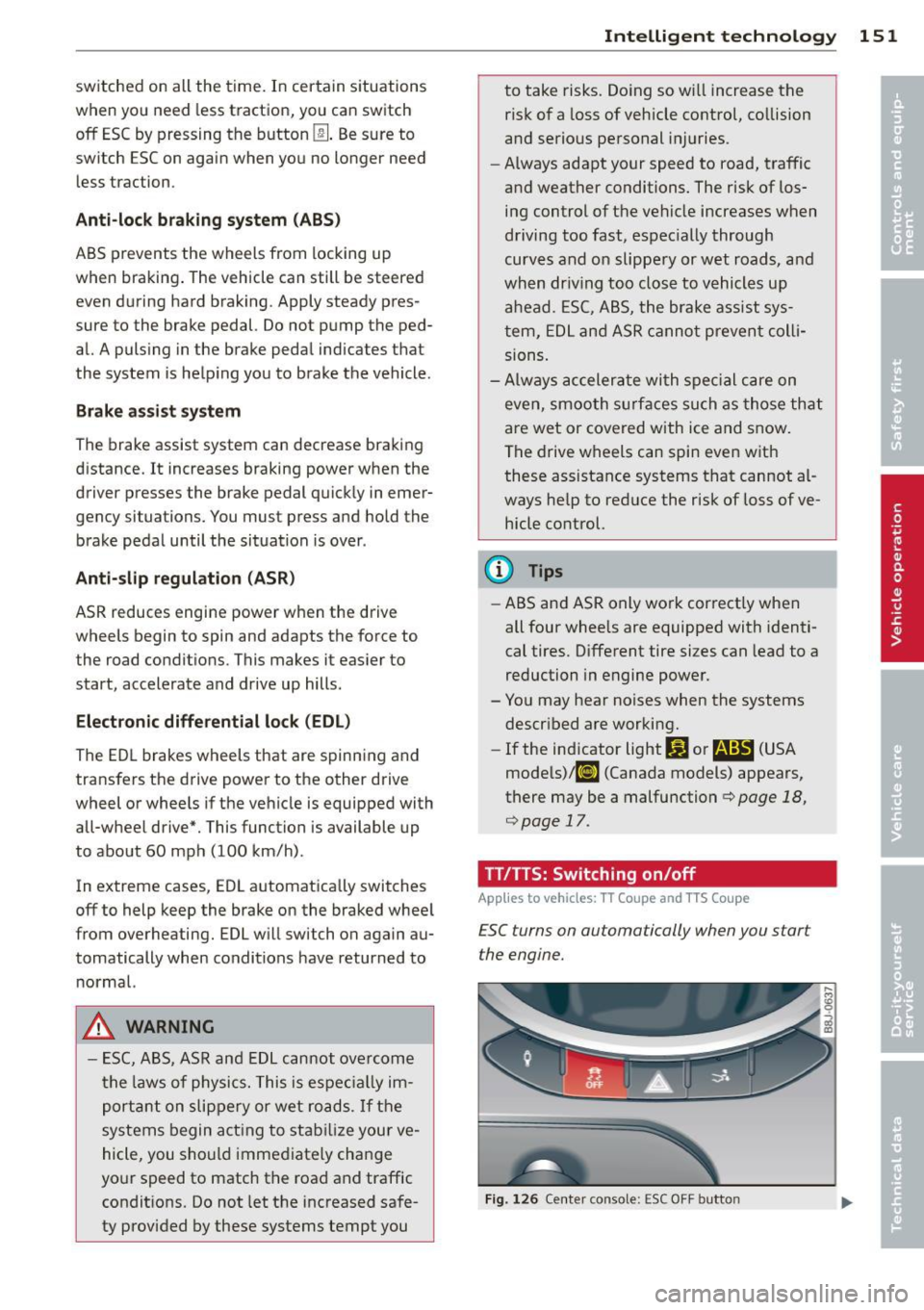
ESC turns on automatically when you start
the engine.
Fi g. 126 Cente r console: ESC OFF button
Page 154 of 262
152 Intelligent technology
Switching ESC off (sport m ode )
In certain situat ions, it m ight make sense to
allow some sl ip. For example :
- Rocking the vehicle to free it when it is stuck
- Driv ing in deep snow or on loose ground
- Driving with snow chains
Press the~ button . The ESC ind icator light
II
turns on and Stabilizati on prog ram off ap
pears in the d isplay. ASR deactivates com
p letely and the stabi lizat ion effects from the
ESC system are limited .
Switc hing on
Press the~ button again. The message Stabi
li zation p rog ram on
appears briefly in the dis
p lay.
A WARNING
Only switch ESC sport mode on when your
driving abilities and the traffic s ituation
permit. Please note that the dr iv ing
wheels can spin and the vehicle can break
away in ESC sport mode, especia lly when
the road is slippe ry.
@ Tips
If the re are faults in the rea r spo ile r sys
tem or in Audi magnet ic r ide, it may not be
possible to a ct ivate ESC spor t mode or
normal mode may a ct ivate aga in a utomat
ically.
n RS: Switching on/off
App lies to vehicles: TI RS Coupe
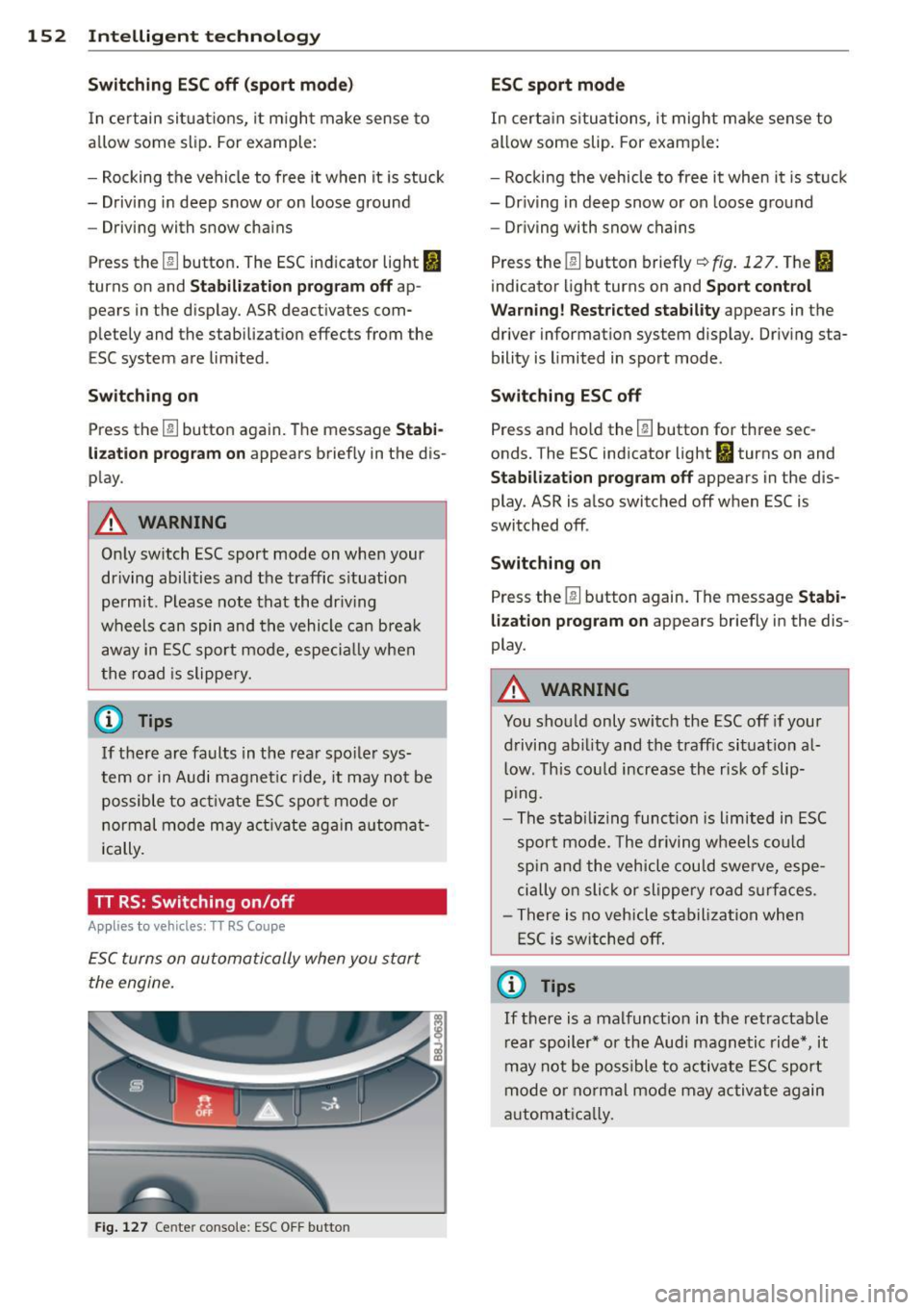
ESC turns on automatically when you start
the engine.
Fig . 12 7 Ce nter console: ESC OFF b utton
ESC sport mode
In certa in situations, i t might make sense to
al low some slip . For examp le:
- Rocking the vehicl e to free it when i t is st uck
- Dr iving in deep snow o r on loose gro und
- Driving with snow chains
Press the~ button briefly ¢
fig. 12 7. Th e fl
indicator light turns on and Spo rt cont rol
Wa rning! Rest rict ed stability
appears in the
driver information system disp lay. Driv ing sta
bility is limited in sport mode.
Switching ESC off
Press and hold the ~ button for three sec
onds. The ESC ind icator light
liJ turns on and
Stabilization program off appears in the dis
play. ASR is also switched
off w hen ESC is
switched
off .
Switching on
Press the~ button again. The message Stabi
lization program on
appears briefly i n the dis
play.
A WARNING
-You should only switch the ESC off i f your
d riving ab ility and the traffic sit uat ion al
l ow . This co uld increase the r isk of slip
p ing.
- The stab ilizing function is limited in ESC
sport mode. The driving wheels could
spin and the vehicle could swerve, espe
cially o n sli ck or slippery road s urf aces.
- There is no veh icle stabilization when
E SC is sw itched
off.
© Tips
If there is a malfunct ion in the re tractable
r ear spoiler* or the Aud i magneti c ride *, it
may not be poss ible to activate ESC sport
mode or no rm al mode may activa te again
a utomat ica lly.
Page 155 of 262
Rear spoiler
Applies to vehicles: with retractable rear spoiler
The rear spoiler improves vehicle handling
and enhances driver control.
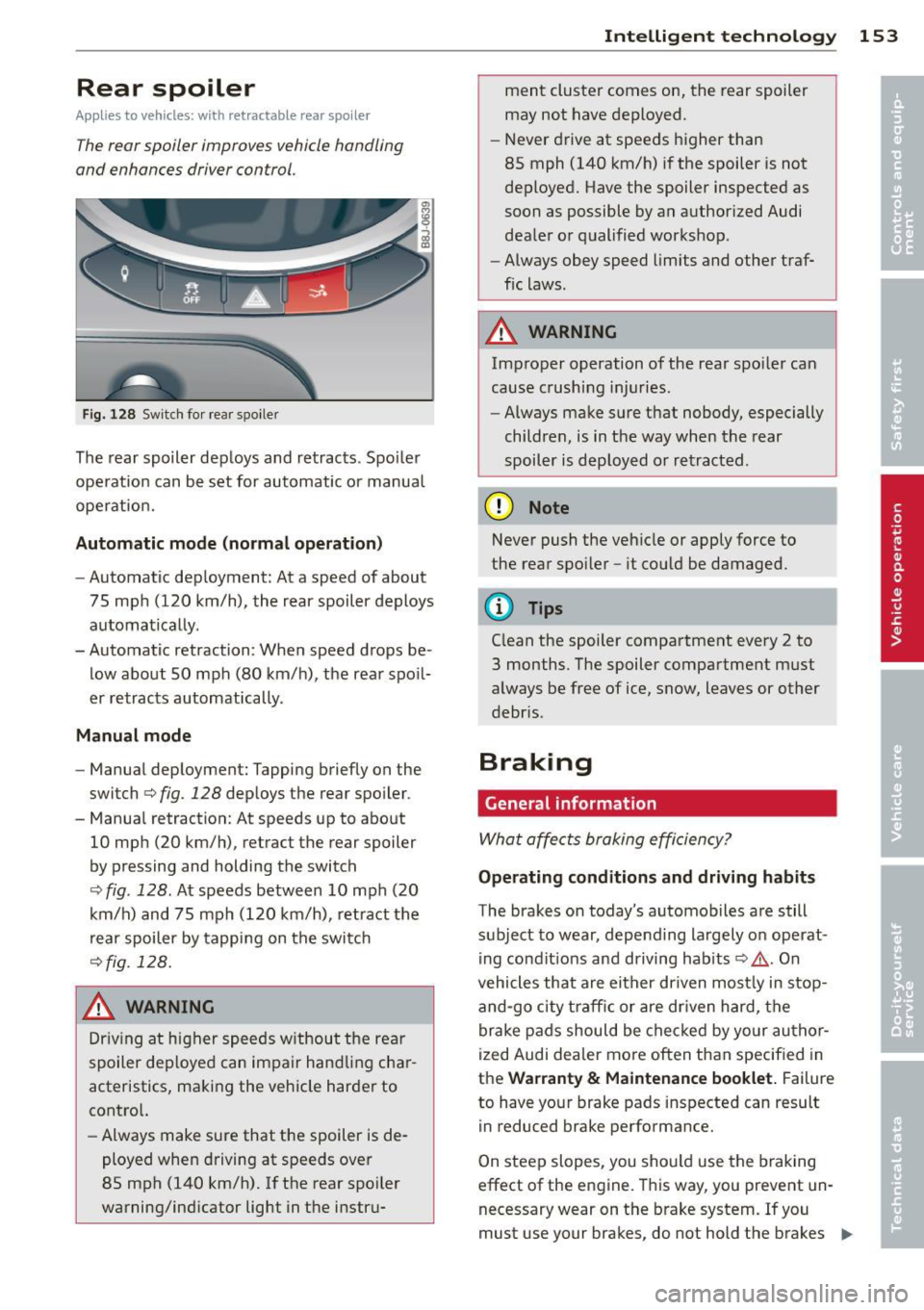
Fig. 128 Switc h for rear spo iler
The rear spoiler deploys and retracts . Spo iler
operation can be set for automatic or manua l
operation.
Automatic m ode (no rmal operat ion )
-Automatic deployment: At a speed of about
75 mph (120 km/h), the rear spoiler deploys
automatically.
-Automat ic retraction: When speed drops be
low about SO mph (80 km/h), the rear spo il
er retracts automatically .
Manu al mode
- Manual deployment: Tapping briefly on the
switch
c:> fig. 128 dep loys the rear spo iler .
- Manual retraction: At speeds up to about 10 mph (20 km/h), retract the rear spoiler
by pressing and holding the switch
c:> fig . 128 . At speeds between 10 mph (20
km/h) and 75 mph (120 km/h) , retract the
rear spoiler by tapping on the switch
c:>fig . 128.
_& WARNING
Dr iv ing at higher speeds w ithout the rear
spoiler dep loyed can impair hand ling cha r
acteristics, making the vehicle harder to
contro l.
- Always make sure that the spoiler is de
ployed when driving at speeds over
85 mph (140 km/h).
If the rear spoiler
warning/ind icator light in the instru-
Intelligen t technolog y 153
ment cluster comes on, the rear spoiler
may not have deployed .
- Never drive at speeds higher than
85 mph (140 km/h) if the spoiler is not
deployed. Have the spoiler inspected as
soon as possible by an authorized Audi
deale r o r qualified workshop .
- Always obey speed limits and other traf
fic laws.
_& WARNING
Improper operation of the rear spoiler can
cause crushing injuries.
- Always make sure that nobody, especially
children, is in the way when the rear
spoiler is deployed or retracted .
(D Note
Never push the vehicle or apply force to
the rear spoi ler -it cou ld be damaged.
{!) Tips
C lean the spoiler compartment every 2 to
3 months. The spoiler compartment must
a lways be free of ice, snow, leaves or other
debr is .
Braking
General information
What affects braking efficiency?
Ope rating cond itions and driving habits
The brakes on today's automobiles a re still
subject to wear, depe nd ing largely on operat
ing condit ions and driving hab its
c:> .&,. . On
vehicles that are either driven most ly in stop
and-go city t raff ic or are dr iven hard, the
brake pads should be checked by yo ur au thor
ized Audi dealer more often than specified in
the
Warr anty & Maintenance booklet. Failure
to have your brake pads inspected can result
in reduced brake performance.
On steep slopes, you should use the braking
effect of the engine. T his way, you prevent un
necessary wear on the brake system . If you
must use your brakes, do not hold the brakes .,.
Page 157 of 262
overheat reducing the effectiveness of
the ent ire brake system.
- Failure of one brake circuit will impair
the braking capability resulting in an in
creased stopp ing distance. Avoid driv ing
the vehicle and have it towed to the near est Aud i dealer or qualified workshop .
- Never let the vehicle roll to a stop w ith
the engine shut off.
- If the brake booster is not working, for
example when towing your ve hicle, or
because the brake booste r has somehow
been damaged, the brake pedal must be
pressed considerab ly harder to make up
for the lack of booster assistance.
Electro-mechanical
power assist
The electro-mechanical power assist helps
the driver when steering.
The degree of power assist is electronically
matched to vehicle speed.
The power steer ing system ass ists the driver
so that he can stee r the veh icle w ith red uced
phys ica l effort.
Power steering w ill not work if the engine is
off. As a result, the steering wheel w ill be hard
to turn.
& WARNING
If the system develops a prob lem, you
must seek qualified professional assis
tance.
(D Note
-
If there is an electronic malfunct ion, ser
votronic
wi ll sti ll function like a conven
tional power steering system, providing a
constant steering support force that is no
longer proportionate to the vehicle speed.
This is most noticeable when turning the
steer ing wheel at low speeds (for example
when parking), -more effort will be re
quired than usual.
Int ellig ent technolog y 155
-Be aware of the different than usual
steering response and adjust your steer
ing force accordingly.
- Have the problem checked and set right
by an authorized Audi dea ler as soon as
possible.
- If a steering malfunction occurs, this is
signaled with the,~ , or .• indicator
lights and a warn ing tone, see.
(D Tips
- If the power steering system sho uld fail,
or if the engine is not running (for exam
ple, while being towed), you will still be
able to steer the vehicle. However, more
effort will be required to do so.
- If the power steering system is not func
tioning properly, contact your authorized
Audi dealer immediately.
Driving with your
quattro ®
Applies to vehicles : wit h all -w hee l d rive
With oil -wheel drive, oil four wheels ore driv
en.
General information
With a ll-wheel drive, power is distr ibuted to
all four wheels. This happens automatically
depend ing on your driving style and the road
conditions at the time. See also
c::> page 1 SO.
The all-whee l dr ive concept is des igned for
high eng ine power. Your veh icle is except ion
ally powerfu l and has excellent driving charac
teristics both under normal driving conditions
and on snow and ice. Always read and follow
safety precautions
c::> &. .
Winter tires
When dr iving in the winter, your vehicle with
all-wheel drive has an advantage, even with
regular tires. In winter road conditions it may
be advisable to mount winter tires (or all-sea
son tires) for improved driveability and brak
ing: these tires must be mounted on
all fou r
wheels. See also c::> page 211, Winter tires. ..,_
•
•