warning light AUDI TT 2013 Owner´s Manual
[x] Cancel search | Manufacturer: AUDI, Model Year: 2013, Model line: TT, Model: AUDI TT 2013Pages: 262, PDF Size: 65.91 MB
Page 175 of 262
creme will nourish and moisturize the
l eather, helping it to b reathe and stay
supple . It also helps to b uild up a protec
tive coat ing on the surface.
- Clean the leather every 2 -3 months,
and clean any areas that get soiled.
- Remove fresh marks made by ba llpoint
pens, ink, lipstick, shoe polish, etc . as
soon as possib le.
- Preserve the color of the leather as need
ed by using a special colored leather care
creme to touch up areas of uneven color.
Cleaning and caring for leather
upholstery and trim
App lies to vehicles: with natural leather
Natural leather requires special care and at
tention .
Normal cleaning
~ Clean soiled areas wit h a slightly moistened
cotton or woolen cloth.
Mor e stubborn dirt
~ More stubbo rn dirt can be removed using a
cloth saturated with a mi ld soap so lution (2
tablespoons mi ld liquid soap) .
~ Never allow the soap solution to saturate
the leather, and make certa in that no water
soaks into the seams .
~ Wipe off the soap solution with a soft, dry
cloth .
Cleaning sp ots
~ Remove fresh w ater -b ased spots (such as
coffee, tea, ju ices, blood) w ith an absorbent
cloth or paper towel.
~ Remove fresh gr ea se or oil -ba sed spot s
(such as butter, mayonnaise, chocolate) with
an absorbent cloth or paper towe l, or use
the cleane r from the leathe r care kit if the
spot has not yet pene trated in to the surface
of the leather .
~ Use an oil/grease dissolving spray , if oil /
grea se spots h ave d ried on.
~ Remove specific kinds of spots (ballpoint
pen, felt marker, fingernail polish, water-
Cleaning and protec tion 173
based paint, shoe po lish, etc.) with a spot
remover specifically formu lated for leather .
Le ather car e
~ Every half yea r use an approved leather care
product (available from your Audi dea ler) to
care for the leathe r.
~ App ly the product very sparingly .
~ Wipe it off with a damp cloth.
If you have any questions abou t cleaning and
caring for the leather in your vehicle, it is best
to contact your authorized Audi dea ler, who
will be g lad to help you and tell you abo ut our
full range of leather care products, such as:
- Leather cleaning and care kit
- Cremes to care fo r colored lea ther
- Spot removers for ballpoint pens, shoe pol-
ish, etc.
- Oil/grease d issolving spray
- New and upcom ing products.
A WARNING
Always read and heed all WARNINGS and
the information r=) page 164.
Q) Note
- Never use chemical so lve nts (e.g. lighter
fluid, tu rpentine), waxes, shoe polish or
simi lar products on the leather surfaces
in yo ur Audi .
- To avoid damage, have stubborn sta ins
removed by a comme rcial clean ing spe
cialist.
Cleaning Alcantara ® (synthetic suede)
Applies to vehicles: with Alcantara upholstery
Removing dust and dirt
~ Moisten a cloth, squeeze out excess water
and wipe down the seat surfaces.
Removing stains
~ Moisten a cloth with lukewarm water or
w ith diluted
ethyl (rubbing ) alcohol.
~ Dab at the stain . Start at the outs ide and
work inwards . •
•
Page 176 of 262
174 Cleaning and protection
• Once the stain is no longer visib le, use a
soft dry cloth or tissue to soak up the mois
ture.
Do not use leather cleaning products on Al
cantara .
You may use a suitable shampoo fo r remov ing
d ust and dirt.
Dust and grit in the pores and seams can
scratch and damage the surface. If the ca r is
l eft standing i n the sun fo r long periods, the
A lcantara should be protected against direc t
sunlight to prevent it from fading. Slight co lor
variations will deve lop in normal use and are
not an indication of material deterioration.
{[) Note
-Never use chemical solvents (e.g . lighter
fl uid, turpentine), waxes, shoe polis h or
similar products on Alcantara ® surfaces.
- To avoid damage, have stubborn stains removed by a commercial cleaning spe
cia list.
- Do not use br ushes, stiff sponges or sim
ilarly abrasive cleaning aids.
Safety belts
Only well -maintained safety belts work relia
bly when needed .
Heavily soiled safety belts may no t retr act
p roperly.
• Keep be lts clean.
• Fo r cl eaning, use a m ild soap and wate r sol
u tion. Let be lts dry thoro ughly and away
from direct sunlight .
• Do not a llow inertia reel safety be lts to re
tract before they are completely dry .
• Check the condition of your safety belts
reg
ularly.
.&_ WARNING
Damaged safety belts can break in a crash.
1l Use o nly the co rrect cleaning so lu tions. Never use gas
o line or d iese l fue l.
-Anyth ing that might damage your safety
be lts could mean that you and your pas
sengers would not be adequate ly pro
tected in an accident.
- Safety belt performance depends on cor
rect insta llation. Never remove be lts
from the veh icle to clean them .
- Do not use chemical clean ing agents,
b leach or dyes. They have co rrosive prop
erties which wea ken the webb ing.
- When clean ing your safety be lts, inspect
them for damage . If you discover dam
age, see your Audi dealer.
'
- Always read a nd heed all WARNINGS and
the information
<=;> page 164.
Engine compartment
Be especially careful when cleaning the en
gine comportment.
Alway s swit ch off the ign ition before clean
ing the engine <=;>.&, .
Plenum panel
Remove leaves from the plenum panel in front
of the w indshield under the eng ine hood . This
prevents the water drain holes from becoming
blocked, and it prevents debris from enter ing
the vehicle interior t hro ugh the heating and
ventilat ion ducts.
Corrosion protection
T he engine compartment and transmission
have been corrosion -protected at the factory .
Good anti- corrosion treatmen t is very impor
tant, particu larly in the w inter.
If the vehicle
is frequently driven on salt treated roads, the
entire engine compartment and p lenum panel
shou ld be thoroughly cleaned at the end of
winter and retreated to prevent salt damage.
At the same time, the underside of the vehicle
shou ld be washed as well.
If the engine compartment is cleaned at any
time with grease removing solutions
1>, or if ..,.
Page 182 of 262
180 Checking and filling
Checking and filling
Engine hood
Releasing the engine hood
The engine hood is released from inside the
vehicle.
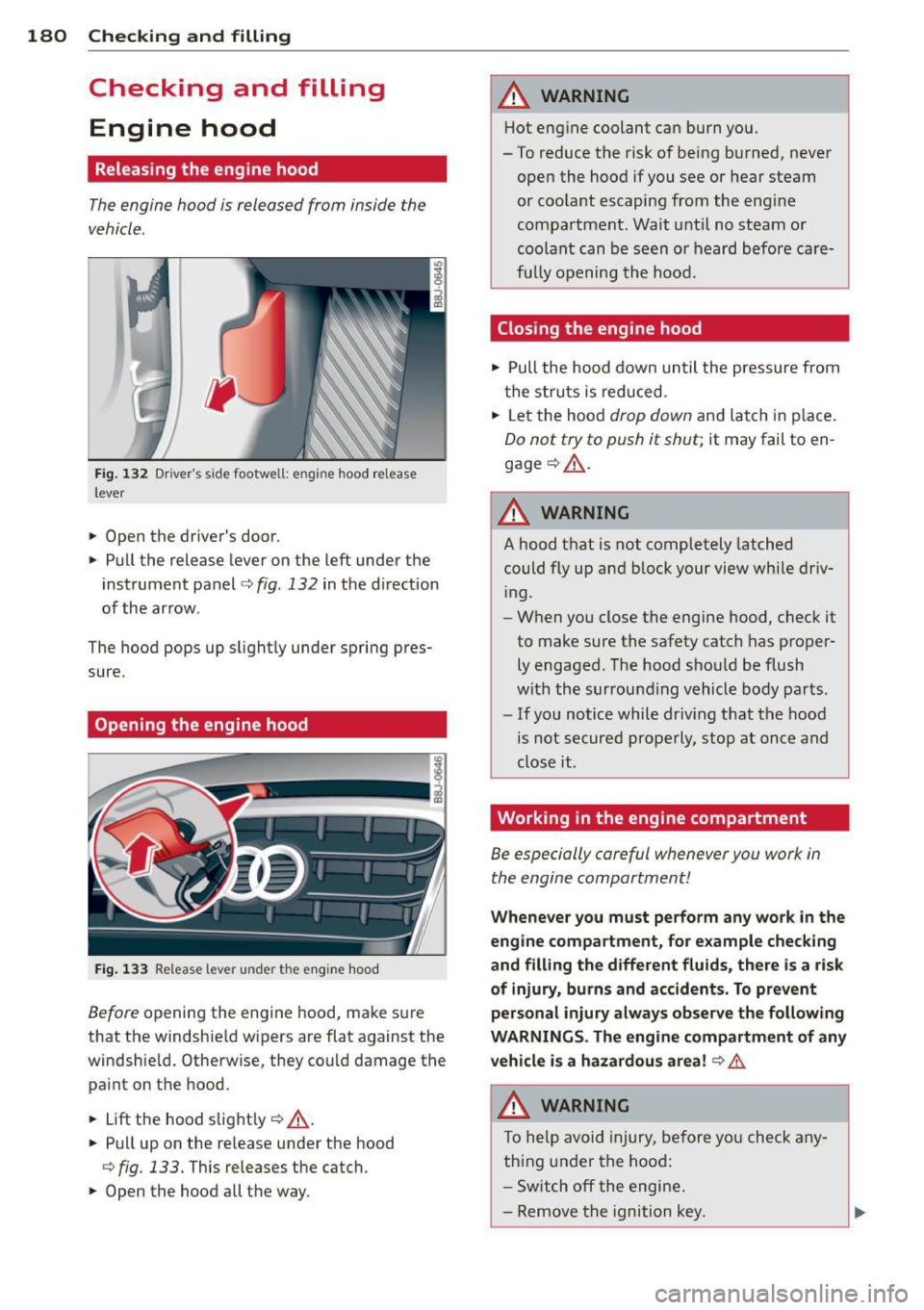
Fi g. 132 Dr iver's side footwell: engine hood re lease
lever
.. Open the driver's door.
.. Pull the release lever on the left under the
instrument panel
c> fig. 132 in the direction
of the arrow .
The hood pops up slight ly under spring pres
sure.
Opening the engine hood
Fig . 133 Re lease lever under the engine hood
Before opening the engine hood, make sure
that the windshie ld wipers are flat against the
windshie ld. Otherwise, they cou ld damage the
pa int on the hood.
.. Lift the hood s light ly
c> _& .
.. Pull up on the release under the hood
¢ fig. 133. This releases the catch.
.. Open the hood all the way.
A WARNING
-Hot engine coolant can burn you.
- To reduce the risk of being burned, never
open the hood if you see or hear steam
or coo lant escaping from the eng ine
compartment. Wait unt il no steam or
coolant can be seen o r heard before care
fu lly opening the hood.
Closing the engine hood
.. Pull the hood down until the pressure from
the struts is reduced .
.. Let the hood
drop down and latch in p lace.
Do not try to push it shut; it may fail to en
gage
c> _& .
A WARNING
--
A hood that is not completely latched
could fly up and b lock your view while dr iv
i ng.
- When you close the engine hood, check it
to make sure the safety catch has proper
ly engaged . The hood should be flush
with the surrounding vehicle body parts.
- If you notice while dr iv ing that the hood
is not secured properly, stop at once and
close it.
Working in the engine compartment
Be especially careful whenever you work in
the engine compartment!
Wheneve r you must pe rform any wo rk in the
eng ine compartment, for e xample chec king
and filling the different fluids, ther e is a risk
of injury, burns and a ccident s. To prevent
p ers onal injury al ways obs erv e the following
WARNINGS. The eng in e c ompartm ent of an y
vehicl e is a hazardou s area!
c> .&.
A WARNING
To he lp avoid injury, before yo u check any
thing under the hood:
- Sw itch off the engine .
- Remove the ignition key.
Page 184 of 262
182 Checking and filling
Engine compartment
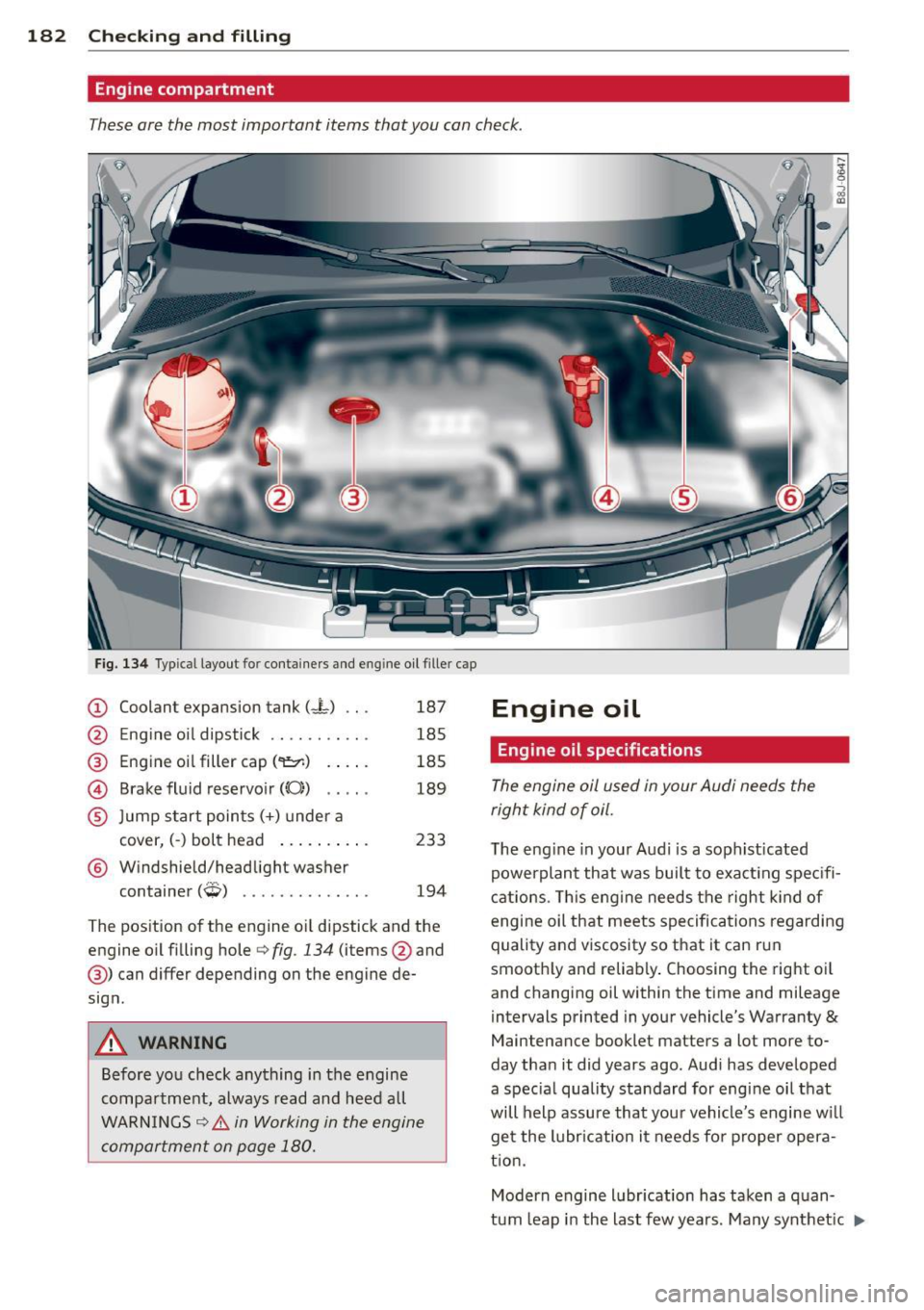
These are the most important items that you can check .
•
Fig. 134 Typ ica l layout for containers and eng ine oil filler cap
CD Coolant expansion tank (-L) .. .
'2' E . 'l d. . k \61 ngIne 0 1 1pst1c .......... .
@ Engine oil filler cap ('1:::r.) .. .. .
@ Brake fluid reservoir((();) .. .. .
® Jump start points(+) under a
cover, (-) bolt head .... ... .. .
® Windshield/headlight washer
t . (
;;p, ) con ainer ,-!,, •••.•••.•.•••.
187
185
185
189
233
194
The pos ition of the engine o il dipstick and the
engine o il fi lling hole
r::> fig. 134 (items @and
@) can differ depending on the engine de
sign .
A WARNING
Before you check anything in the engine
compartment, always read and heed all
WARN INGS
c::> .& in Working in the engine
compartment on page 180.
Engine oil
Engine oil specifications
The engine oil used in your Audi needs the
right kind of oil.
T he eng ine in your Aud i is a soph ist icated
powerplant that was built to exact ing spec ifi
cat ions . T his engine needs the right kind of
engine oil that meets specifications regard ing
quality and viscosity so that it can run
smooth ly and reliably . Choosing the right o il
and changing oil within the time and mileage
i ntervals printed in your vehicle's Warranty
&
Maintenance booklet matters a lot more to
day tha n it did years ago. Audi has developed
a spec ia l quality standard for engine oil that
will help assure that you r vehicle's engine w ill
get the lubr ication it needs fo r proper opera
t ion.
Modern engine l ubr ication has taken a q uan
tum leap in the last few years. Many synthet ic
1J.
Page 186 of 262
184 Checking and filling
Detergent additives in the o il will make fresh
oil look dark after the engine has been run
n ing for a short time . This is norma l and is not
a reason to change the oil more often than recommended.
D am ag e o r m alfun ction s due to lack of
m ainten ance
It is essent ial that yo u change your oil at the
recommended intervals using only engine oil
that complies with Audi oi l standard
VW 502 00 . Your Lim ited New Vehicle War
ranty does not cover damage or malfunctions
due to failure to follow recommended mainte
nance and use requ irements as set forth in
the Audi Owner's Manual and Warranty
&
M aintenance book let . Your dea ler will have to
deny warranty coverage un less you p resen t to
the dea ler proof in the form of Servi ce or Re
pa ir Orde rs that all schedu led maintenance
was performed in a timely manner.
Engine oil consumption
The engine in your vehicle depends on an ade
quate amount of oil to lubricate and cool all
of its moving ports.
I n o rder to prov ide effective lubr ication and
cooling of internal engine components, a ll in
ternal comb ustion engines consume a certain
amount of oil. Oi l consumption varies from
engine to engine and may change significantly
over the life of the eng ine . Typically, eng ines
with a specif ied break-in per iod (see
c::;, page 159) consume more oil during the
break-in per iod than they consume after oil
consumption has stabilized .
Under normal conditions, the rate of oil con
sumpt io n depends on the quality and viscosity
of the oil, the RPM (revolutions per m inute) at
which the engine is operated, the ambient
temperature and road cond it io ns. Furthe r fac
tors are the amo unt of o il d ilution from wate r
condensation or fuel residue and the ox ida
tion level of the oi l. As any engine is subject to
wear as mileage bui lds up, the oil consump
tion may increase over t ime until replacement
of worn components may become necessary. Wi
th a ll these variab les coming into p lay, no
standard rate of oil consumption can be es
tab lished or spec ified. There is no alte rnative
to regular and frequent check ing of the o il lev
el, see
Note .
If the yellow engine oil leve l warning symbo l
in the instr ument cluster
II lights up, you
sho uld check the oil leve l as soon as possib le
with the oil dipstick c::;, page 185. Top off the
o il at your earliest conven ience
c::;, page 185 .
A WARNING
-Before you chec k anything in the eng ine
compartment, a lways read and heed a ll
WAR NINGS
c::;, .& in Working in the engine
comportment on page 180.
CI) Note
D riving with an insufficient o il level is like
l y to cause sever e damage to the engine.
(D Tips
- The oil pressure warn ing display. is
not an indicator of the oil level. Do not
re ly on it . Instead, check the oil level in
your engine at regular intervals, pr ef
erably ea ch time you refu el, and alway s
before going on a long trip.
- If you have the impression yo ur engine
cons umes excessive amoun ts of oil, we
recommend that you consult your Aud i
dealer to have the cause of your concern
properly diagnosed. Keep in mind that
the accurate meas urement of o il con
sumption requ ires great care and may
take some t ime . Your Audi dea ler has in
struct ions about how to measure oil con
sumption acc urately.
Page 190 of 262
188 Checking and filling
Before you check anything in the engine com
partment,
alwa ys r ea d and heed all WARN
INGS ¢ A in Working in the engine compart
ment on page 180.
• Park your vehicle on a level surface.
• Switch the ignition off.
• Read the coolant level at the coolant expan
s ion tank ¢
page 182, fig . 134. With a cold
engine, it must be above the "min" mark .
With a hot engine, it ca n be a little above
the indicated range .
The location of the coolant expans ion tank
can be seen in the engine compartment illus
tration
¢ page 182.
To obtain an accurate read ing, the engine
must be switched off.
The expansion tank in yo ur vehicle is equipped
with an e lectric coolant level sensor .
When the coo lant level is too low, the warning
light in the A uto- Check System ¢
page 16 will
illuminate until yo u add coo lant and the level
has been restored to normal. Even though
there is an electric coo lant level sensor, we
still recommend you check the coolant leve l
from time to time .
Coolant loss
Coolant loss may indicate a leak in the cooling
system . In the event of coolant loss, the cool
ing system should be inspected immediately
by your author ized Audi dealer. It is not
enough merely to add coolant .
In a
sealed system, losses can occur only if
the boiling point of the coolant is exceeded as
a result of overheat ing.
(D Note
Do not add any type of radiator lea k seal
ant to your vehicle's eng ine coolant. Add
ing radiator repair f luid may adversely af
fect the function and performance of your
cooling system and could res ult in damage
not covered by your New Vehicle Limited
Warranty.
Adding coolant
Be very careful when adding engine coolant.
Before you check anyth ing in the engine com
partment,
always read and heed all WARN
INGS ¢ A in Working in the engine compart
ment on page 180 .
• Turn off the engine.
• Let the engine cool down.
• Place a thick rag over t he coo lant expansion
tank
¢ page 187, fig . 138 a nd carefully
tw ist the cap counter-clockwise ¢&_ .
• Add coo la nt.
• Twis t the cap on aga in
t ightly.
Replacement engine coolant must conform to
exact spec ificat ions ¢
page 18 7, Coolant.
Even in a n emerge ncy, if coolant add i-
t ive G1 2++, G12+ or G12 is not ava ilable , do
not use a d iffe ren t addit ive. Use plain water
instead unti l you can get the cor rect additive
and can restore the correct ratio . This sho uld
be done as soon as possible .
If you have los t a considerab le amount o f
coolant , then you sho uld add cold ant ifreeze
and co ld wate r on ly w hen the engine is cold.
Alw ays use
new engine coo la nt whe n refilling .
Do not fill coola nt above the "MAX" mark. Ex
cess coola nt wi ll be fo rced o ut through the
pressure relief valve in t he cap w hen the en
gine becomes hot.
,&. WARNING ~ -
- T he cooling system is under pressure and
can get very hot. Reduce the risk of
scalding from hot coolant by followi ng
these steps.
- T urn off the engine and allow it to coo l
down.
- Protect yo ur face, hands and arms from
escaping fluid and steam by covering
the cap w ith a large, t hick rag.
- T urn the cap s lowly a nd ve ry carefully
in a counter-clo ckwise direction while
applying light, downward pres sure on
the top of the cap.
Page 191 of 262
-To avoid being burned, do not spill an
tifreeze or coolant on the exhaust sys tem or hot engine parts. Under certain
conditions, the ethylene glycol in en
gine coolant can catch fire.
- Antifreeze is poisonous. Always store an
tifreeze in its original container and well out of the reach of children.
- If you drain the coolant, it must be
caught and safely stored in a proper con
tainer clearly marked "poison".
(D Note
- Coolant pollutes the environment and
could cause an engine fire. Excess cool
ant will be forced out through the pres
sure relief valve in the cap when the en
gine becomes hot.
- If, in an emergency, only water can be
added, the correct ratio between water
and antifreeze¢
page 187 must be re
stored as soon as possible.
@ For the sake of the environment
Drained coolant should not be reused. Al
ways dispose of used coolant while observ ing all environmental regulations.
Radiator fan
The radiator fan switches on automatically by
itself
The electric radiator fan is controlled by ther
moswitches that switch on and off depending
on coolant and engine compartment tempera
tures.
An auxiliary electric radiator fan* switches on
and off depending on coolant temperature
and other vehicle operation conditions.
After you switch the engine off, the auxiliary
fan can continue running for up to 10 minutes
- even with the ignition off.
It can even switch
on again later by itself
c::> &., , if
- the temperature of the engine coolant rises due to the heat build-up from the engine in
the engine compartment, or
Checking and filling 189
- the engine compartment heats up because
the vehicle is parked in intense sunlight.
A WARNING
-To reduce the risk of personal injury nev
er touch the radiator fan .
- The auxiliary electric fan is temperature
controlled and can switch on suddenly
even when the engine is not running.
- The auxiliary radiator fan switches on au
tomatically when the engine coolant
reaches a certain temperature and will
continue to run until the coolant temper
ature drops.
Brake fluid
Checking brake fluid level
The brake fluid level can be checked with a
quick glance.
Fig. 139 Engin e compart ment: cover on th e br ake fluid
re se rvoir
Before you check anything in the engine com
partment,
always read and heed all WARN
INGS c::> .&. in Working in the engine compart
ment on page 180.
~ Read the brake fluid level from the brake
fluid reservoir
c::> page 182, fig. 134 . The
brake fluid level must be between the "MIN"
and "MAX" markings.
The brake fluid reservoir is located behind the
rear partition of the engine compartment on
the left side
c::> page 182.
The fluid level may drop slightly after some
time due to the automatic adjustment of the brake pads. This is not cause for alarm.
i,,.
Page 192 of 262
190 Checking and filling
If the brake fluid level falls considerably b e
l ow the "MIN" mark, the brake warning/ indi
cator light (U .S . mode ls:
1111 , Canad ian
model s:. ) will come on
c> page 14 . Do not
continue to ope ra te the vehicle. The comple te
brake system shou ld be thoroughly checked
by an author ized Audi dealer or ot her quali
fied fac ility and the cause corrected . If the
b rake fluid level is too low, the b rake war ning/
i ndicator ligh t w ill illuminate. Contact an a u
thor ized A udi dealer
immediatel y.
Changing brake fluid
Hove the broke fluid changed by on experi
enced technician.
Brake fl uid abso rbs moist ure from the a ir. If
the wate r content in the b ra ke fluid is too
h igh, cor ros ion in the br ake sys tem may result
after a per iod of t ime . The bo iling point of the
brake fluid wi ll also decrease considerab ly and
decrease braking performanc e.
Therefore, the brake fl uid mus t be changed
every tw o year s. Always use new b rake fluid
which conforms to Federal Motor Veh icle
Standard "FMVSS 1 16 DOT 4".
The brake flu id rese rvoi r can be difficul t to
r each, therefo re , we recommend that yo u
have the brake f luid changed by yo ur autho r
ized
Audi dealer. Your dea ler has the correct
too ls , the right brake f luid and the know-how
to do this for you.
A WARNING
- Brake fluid is poiso nous . It must be stor
ed only i n the closed orig inal container
o ut o f the reac h of children!
- Brake fa ilure can result from old o r inap
propriate b rake fluid . Observe these pre
caut ions :
- Use only bra ke fluid that meets SAE
specif ication
J 1 703 and co nforms to
Federal Motor Vehicle Standard 116 .
Always check with your a uthori zed Audi
dealer to ma ke sure you are using the
correct brake flu id. The correct type of brake flu
id is also ind icate d on the
brake f lu id rese rvoir.
- The brake fluid must be new. Heavy use
of the brakes can cause a vapo r lock if
the brake fluid is left in the system too
long. This can seriously affect the effi
c iency of t he brakes as well as your
safety . T his co uld resu lt in a n accide nt.
([) Note
Brake fluid will damage the paint of your
vehicle.
@ For the sake of the environment
Because o f the prob lem of proper disposal
of brake fluid as well as the spec ial too ls
required and the necessary expertise, we
recomme nd that you have the brake flu id
changed by yo ur autho rize d Aud i deale r.
Battery
General information
Your vehicle is equipped with a specia l bat
tery, an
ACM battery. This battery is located
in the luggage compartment and must be re
placed with an origina l equipment battery .
U nder normal opera ting condit ions, the bat
te ry is
maintenance-fr ee .
Have the battery checked when you take your
vehicle in for serv ice . You a re well advised to
replace a battery that is o lde r th an 5 years .
Disconnecting the battery terminals
Some vehicle functions (power window reg u
lators, for example) are lost if the battery te r
mina ls are disconnected . T hese functions have
to be relearned after the battery termina ls are
connected again . T o p revent t his, t he battery
shou ld only be disconne cted from the veh icle
elect ric a l sys tem when abso lutely ne cessary
f or rep air s.
Vehicles not driven for long periods
If you do not drive your vehicle ove r a period
of seve ral days o r weeks , e lectr ica l compo-
nents a re g radually cut back or switched off.
Ill-
Page 193 of 262
This reduces energy consumption and main
tains starting capability over a longer period
c::>
page 156. Some of the convenience func
tions may not operate, such as the interior
lights or power seat adjustment. The conven
ience functions will be ava ilable again when
you switch on the ignition and start the en
g ine .
Winte r oper ati on
During the winter months, battery capacity
tends to decrease as temperatures drop. This
i s because more power is also consumed while
start ing, and the headlights, rear window de
fogger, etc., are used more often .
Avoid unnecessary power consumption, par
ticularly in city traffic or when traveling only
short distances . Let your authorized Audi
dealer check the capac ity of the vehicle bat
tery before winte r sets inc::>
page 193. A we ll
charged ba tte ry w ill no t only prevent starting
prob lems when the weathe r is cold, but will
a lso last longer .
Replacing battery
The new battery must have the same capaci
ty, vo ltage ( 12 volts), amperage, cons truction
and p lug sealing, as the origina l ba tte ry. Spec
if ications are listed on the batte ry housing.
Batteries specially developed by A udi fulfill
the maintenance, output, and safety require
ments.
When insta lling the battery, make sure the ig
nition and all electrica l cons umers are switch
ed off c::>
(i).
We recommen d that yo u use ma intenance
free or
cy cle- re sis tant /leak-pr oof batteries
according to the standards TL 825 06 (from
April 2008) and VW 7 SO 73 (from Apri l
2010).
Replacing the batte ry should be carried by a
q ua lified workshop. P lease follow the instruc
tions on the battery cover.
Checkin g and fillin g 191
@ Note
-All work on the battery requires techni
cal know ledge. Please contact an Audi
dealership or another authorized fac ility
for questions about the battery - danger
of ac id burns and exp losion hazard!
- The battery must not be opened! Do not
try to change the battery 's liquid level,
otherwise detonating gas will escape
from the battery - explosion hazard!
- The AGM battery in the luggage com
partment cannot leak, because the elec
t ro lyte for this batte ry is abso rbed into a
special glass mat. This lea k-proof battery
must not be replace with a convent iona l
bat tery.
- Make su re the ventilation hose on t he
side of the ba ttery is connected, othe r
w ise fumes or battery ac id can leak out.
- Batte ry holder and termin als always
have to be sec ured correc tly.
- Before all work on the batte ry follow the
warning s below c::> .&. in Working on the
battery on page
192 .
@ For the sake of the environment
Because of the p rob lem of proper disposal
of a ba ttery, we recommend your author
i zed Audi dealer change the bat tery fo r
you. Batteries contain sulfuric acid and l ead and must always be disposed of prop
erly in comp liance with a ll environmental
regulat ions. Disposing of vehicle batter ies
i mproperly is very dangerous to the envi
ro nment. Make sure that the removed bat
tery cannot overbalance, othe rwise sulfu
r ic acid might escape!
@ Tips
If your vehicle is left standing for several
weeks at extremely low temperatures, the
vehicle battery shou ld be removed and
stored w here it w ill not freeze. This will
p revent it from be ing dam aged and h aving
to be replaced .
•
•
Page 194 of 262
192 Checking and filling
Working on the battery
Be especially careful when working on or near
the battery!
The battery is located in the luggage compart
ment under the floor. Before you work on or
near the battery,
read and heed all WARN
INGS ~.&. -
Always heed the safety warnings, when work
ing on the vehicle battery or the vehicle elec
tr ical system to prevent injury .
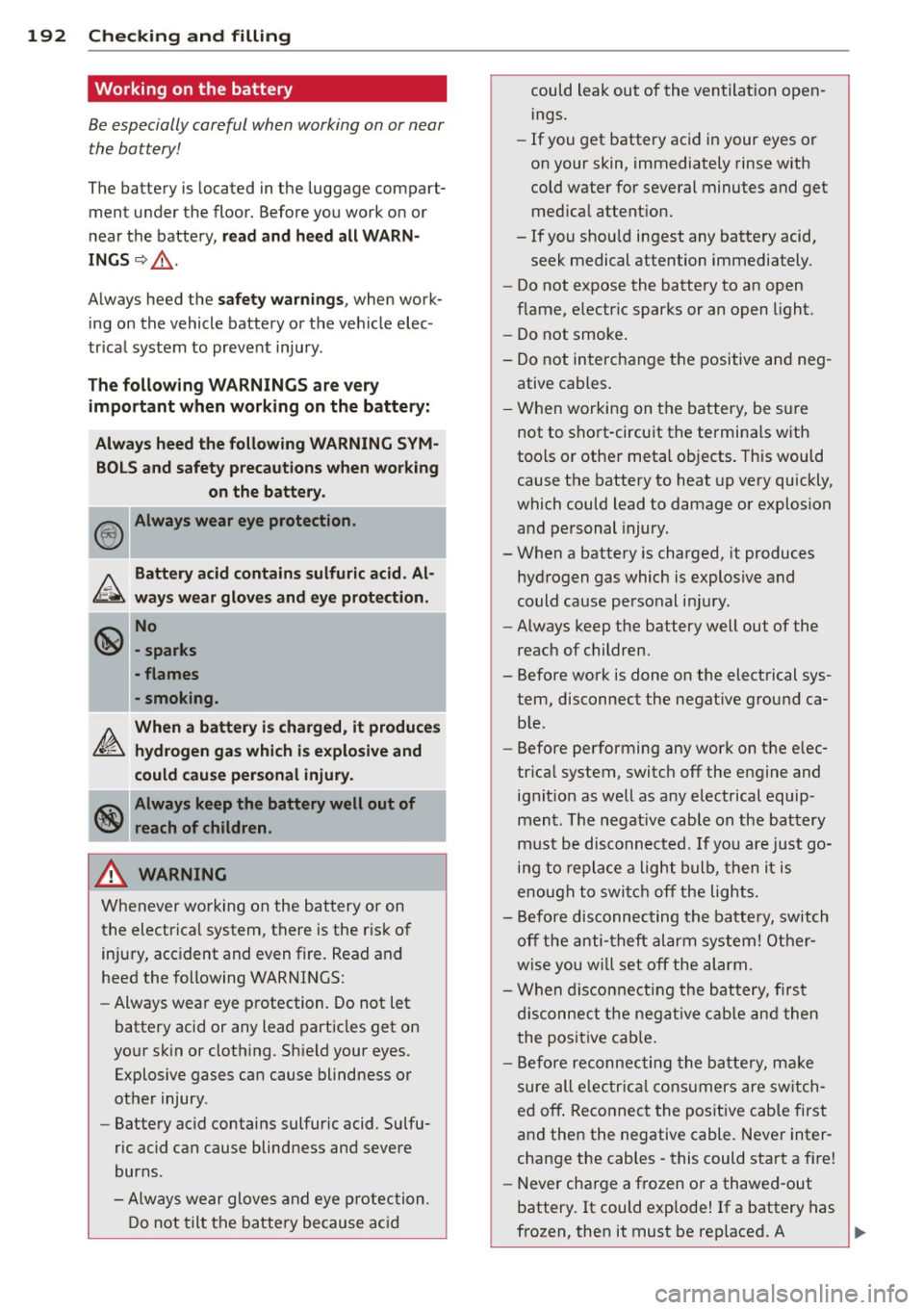
The following WARNINGS are very
important when working on the battery:
Always heed the following WARNING SYM· BOLS and safety precautions when working
on the battery.
@ Always wear eye protection .
b,. Battery acid contains sulfuric acid. Al
~ ways wear gloves and eye protection.
~~-
No
@ -sparks
-flames
-smoking.
When a battery is charged , it produces
hyd rogen gas which is explosive and
could cause personal injury.
I ~ Always keep the battery well out of
V;!J/ reach of children .
A WARNING
=
Whenever working on the battery or on
the electrical system, there is the risk of
injury, accident and even fire. Read and
heed the following WARNINGS:
- Always wear eye protection. Do not let
battery acid or any lead particles get on
your sk in or cloth ing. Sh ield your eyes.
Explosive gases can cause blindness or
other injury .
- Battery acid contains sulfur ic acid. Sulfu
ric acid can cause blindness and severe
burns.
- Always wear gloves and eye protection.
Do not tilt the battery because ac id
-
could leak out of the ventilation open
ings.
- If you get battery acid in your eyes or
on your skin, immediately rinse with cold water for several minutes and get
med ical attention.
- If you shou ld ingest any battery acid,
seek medical attention immediately.
- Do not expose the battery to an open
flame, e lectr ic sparks or an open light.
- Do not smoke .
- Do not interchange the positive and neg -
ative cables .
- When working on the battery, be sure
not to short-circuit the terminals with
too ls or othe r metal objects . This would
cause the battery to heat up very quickly,
which could lead to damage or explosion
and personal injury.
- When a battery is charged, it produces
hydrogen gas which is explosive and
could cause personal injury.
- Always keep the battery well out of the
reach of children.
- Before work is done on the electrical sys tem, disconnect the negat ive ground ca
ble.
- Before performing any work on the e lec
tr ical system, switch off the engine and
ignit ion as well as any electrical equip
ment. The negative cable on the battery
must be disconnected .
If you are just go
ing to replace a light bulb, then it is
enough to switch off the lights.
- Before disconnecting the battery, switch
off the anti-theft alarm system! Other
wise you will set off the alarm.
- When disconnecting the battery, first disconnect the negative cable and then
the positive cab le .
- Before reconnecting the battery, make
sure all electr ica l consumers are switch
ed off . Reconnect the positive cable first
and then the negative cable. Never inter
change the cables - this could start a fire!
- Never charge a frozen or a thawed-out
battery. It could exp lode! If a battery has
frozen, then it must be replaced. A
llll-