tire size AUDI TT 2013 Owner´s Manual
[x] Cancel search | Manufacturer: AUDI, Model Year: 2013, Model line: TT, Model: AUDI TT 2013Pages: 262, PDF Size: 65.91 MB
Page 102 of 262
100 Safety belts
Safety belts
General notes
Always wear safety belts!
Wearing safety belts correctly saves lives!
This chapter explains why safety belts are nec
essary, how they work and how to adjust and
wear them correctly .
.. Read all the information that follows and
heed all of the instructions and WARNINGS.
A WARNING
Not wearing safety belts or wearing them
improperly increases the risk of serious
personal injury and death.
- Safety belts are the single most effective
means available to reduce the risk of se
rious injury and death in automobile acci
dents. For your protection and that of
your passengers, always correctly wear
safety belts when the vehicle is moving.
- Pregnant women, injured, or physically
impaired persons must also use safety
belts. Like all vehicle occupants, they are
more likely to be seriously injured if they
do not wear safety belts. The best way to
protect a fetus is to protect the mother -
throughout the entire pregnancy.
Number of seats
Your Audi TT Coupe has two seating positions in the front and two height-limited seating
positions in the rear. Each seating position has
a safety belt. The rear seat area in your Audi
TT Coupe does not have enough room for pas
sengers of all sizes. For reasons of safety, no
person taller than 4'11" (1.S meters) should
ever ride in the rear seat area.
A WARNING
Not wearing safety belts or wearing them
improperly increases the risk of serious
personal injury and death. -
Never strap more than one person, in
cluding small children, into any belt.
It is
especially dangerous to place a safety belt over a child sitting on your lap.
- Never let more people ride in the vehicle
than there are safety belts available.
- Be sure everyone riding in the vehicle is
properly restrained with a separate safe
ty belt or child restraint.
- Persons taller than 4'11" (1.5 m) as well
as children in booster seats who are too
close to the rear window and roof can
suffer severe head and neck injuries
when the rear lid is closed or in a crash .
- The minimum clearance between the passenger's heads and the rear window
must never -under any circumstances -
be less that 1 inch (2.5 cm.) when the
passengers sit fully upright.
- Always make sure that rear seat passen
gers cannot be struck when the rear lid is
closed.
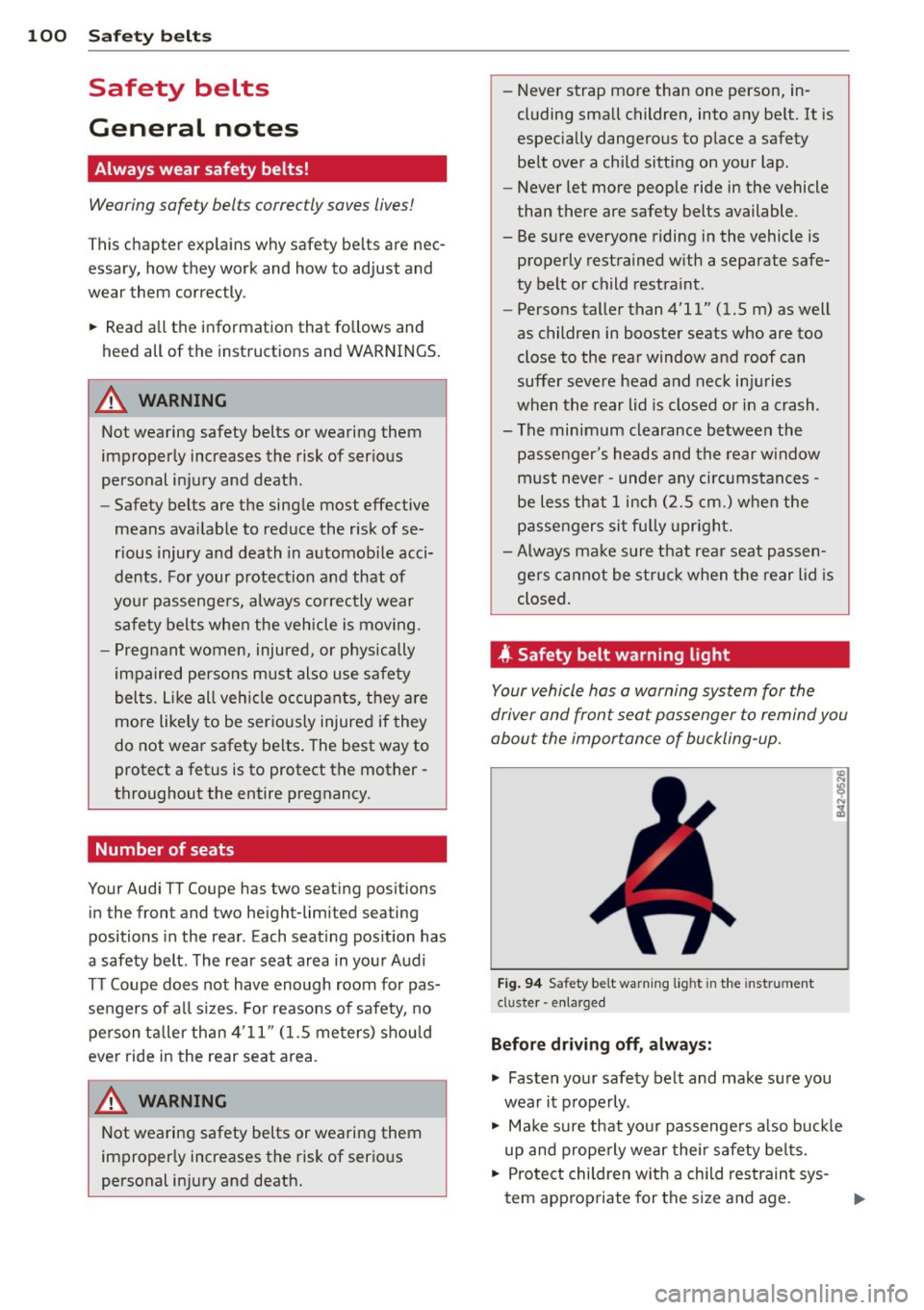
,! Safety belt warning light
Your vehicle has a warning system for the
driver and front seat passenger to remind you
about the importance of buckling-up.
Fig. 94 Safety belt warning light in the instrument
cluster· enlarged
Before driving off, always:
" Fasten your safety belt and make sure you
wear it properly .
.. Make sure that your passengers also buckle
up and properly wear their safety belts.
.. Protect children with a child restraint sys-
tem appropriate for the size and age.
Ill-
Page 153 of 262
switched on all the time. In certain situations
when you need less traction, you can switch
off ESC by pressing the button
lru . Be sure to
switch ESC on again when you no longer need
less traction.
Anti -loc k brak ing s ystem (ABS )
ABS prevents the wheels from locking up
when braking . The vehicle can still be steered
even during hard braking. Apply steady pres
sure to the brake pedal. Do not pump the ped
al. A puls ing in the brake pedal indicates that
the system is helping you to brake the vehicle.
B rake ass is t system
The brake assist system can decrease braking
d istance. It increases braking power when the
driver presses the brake pedal quickly in emer
gency situations. You must press and hold the
brake pedal until the situation is over .
Anti-slip regulati on (ASR )
ASR reduces engine power when the drive
wheels begin to spin and adapts the force to
the road condit ions. This makes it easier to
start, accelerate and drive up hills.
Elect ronic diff erential lock (EDL )
The EDL brakes wheels that are spinning and
transfers the drive power to the other drive
wheel or whee ls if the vehicle is equipped with
all-wheel drive*. This function is available up
to about 60 mph (100 km/h).
In extreme cases, EDL automat ica lly switches
off to help keep the brake on the braked wheel
from overheating. EDL w ill switch on again au
tomatically when conditions have returned to normal.
..&, WARNING
- ESC, ABS, ASR and EDL cannot ove rcome
t he laws of physics. This is espec ia lly im
portant on slippery or wet roads.
If the
systems begin act ing to stab ilize your ve
hicle, you should immediately change
yo ur speed to match the road and traffic
condit ions. Do not let the increased safe
ty provided by these systems tempt you
Intelligen t technolog y 151
to take risks. Doing so will increase the
risk of a loss of vehicle control, co llision
and serious personal injuries.
- Always adapt your speed to road, traffic
and weather conditions. The risk of los
ing control of the vehicle increases when
driving too fast, espec ially through
curves and on slippery or wet roads, and
when driving too close to vehicles up ahead. ESC, ABS, the brake assist sys
tem, EDL and ASR cannot preven t coll i
sions.
- Always ac celera te with spe cial care on
even, smooth s urfaces su ch as those th at
are wet or covered with ice and snow.
The drive wheels can spin even with these assistance systems that cannot al
ways he lp to reduce the risk of loss of ve
hicle control.
@ Tips
- ABS and ASR only work correct ly when
all four whee ls are equipped with identi
cal tires. D ifferent tire sizes can lead to a
reduction in engine power.
- You may hear noises when the systems described are working.
-If the ind icator lightD] orE (USA
models)/ [iJ (Canada models) appears,
there may be a malfunction¢ page 18,
¢page 17.
TT/TTS: Switching on/off
Applies to vehicles: TT Coupe and TTS Coupe
ESC turns on automatically when you start
the engine.
Fi g. 126 Cente r console: ESC OFF button
Page 158 of 262
156 Intellig ent technol ogy
Snow cha in s
Where t ire cha ins are mandatory on certain
roads, this normally a lso applies to vehicles
with a ll-wheel drive ¢
page 212, Snow
chains .
Replacing wheels /t ir es
Vehicles with all-wheel drive must a lways
have tires of the same size. Also avoid t ires
with different tread depths. For details see
page ~
page 207, New tires and replacing
tires and wheels.
Off -Ro ad dri ving?
Your Aud i does not have enough ground clear
ance to be used as an off -road veh icle.
It is
therefore best to avoid rough tracks and un
even terrain as much as possible . Also refer to
¢ page 160.
A WARNING
Always adjust your driving to road and traf
fic conditions. Do not let the extra safety
afforded by all-wheel dr ive tempt you into
taking extra r isks.
- Although the all-wheel dr ive is very ef
fective, always remember that braking capacity is limited by t ire traction . You
should the refore not dr ive at excessive
speeds on icy or slippery road su rfaces.
- On wet road surfaces, be careful not to
dr ive too fast because the front wheels
cou ld beg in to s lide on top of the wa ter
(aquaplaning) .
If this should occ ur, you
will have no warning from a sudden in
crease in engine speed as with a front
wheel drive vehicle. A lways drive at
speeds wh ich are suited to the road con
ditions. -risk of crash.
Energy management
Starting ability is optimized
Energy management controls the distribution
of electrical energy and thus optimizes the
availability of electrical energy for starting the engine.
If a vehicle with a conventional energy system
is not driven for a long per iod of t ime, the bat
tery is discharged by idling current consumers (e .g. immobilize r). In certa in circumstances it
can resu lt in the re be ing insufficient energy
available to start the engine.
Intelligent energy management in your vehi
cl e handles the distribution of e lectr ica l ene r
gy . Start ing ability is ma rkedly improved and
the life of the battery is extended .
Bas ica lly, energy management consists of
b att ery diag nosis, idlin g curre nt manage
m ent
and dynamic en erg y manag em ent .
Battery di agnosis
Battery diagnosis continuously determines
the state of the battery. Sensors determine
battery voltage, battery current and battery
temperature. This determines the current state o f charge and the power of the battery .
Idling current managem ent
Idling current management reduces energy
consumption while the vehicle is standing .
With the ig nition sw itched off, it controls the
energy supply to the various electri ca l compo
nents. Da ta from ba ttery diagnos is is cons id
ered.
Depend ing on the batte ry's state of cha rge,
individual cons ume rs a re g radually turned off
to prevent excessive discharge of the battery
and th us maintain starting capability.
Dynamic energ y manag ement
While the vehicle is being driven, dynamic en
ergy ma nagement distr ibutes the energy gen
era ted accord ing to t he needs of the individ u-
al components .
It regula tes consumption, so
that more electrical energy is not being used ..,.
Page 200 of 262
198 Tires and wheels
Groove
means the space between two adjacent tread
ribs .
Load rating (code)
means the maximum load that a tire is rated
to carry for a given inflation pressure. You
may not find this informat ion on all tires be
cause it is not req uired by law.
Maximum load rating
means the load rating for a t ire at the max i
mum permissible inflation pressure for that
tire.
Maximum loaded vehicle weight
means the sum of:
(a) Curb weight
(b) Accessory weight
(c) Vehicle capacity we ight, and
(d) Production options weight
Maximum (permissible) inflation pressure
means the maximum cold inflation pressure
to which a tire may be inflated. Also called
"maximum inflation pressure ."
Normal occupant weight
means 150 lbs. (68 kilograms) times the
number of occupants seated in the vehicle up
to the total seating capacity of your vehicle .
Occupant distribution
means distribution of occupants in a vehicle.
Outer diameter
means the overa ll diameter of an inflated new
tire.
Overall width
means the linear distance between the exteri
ors of the sidewalls of an inflated tire, includ
ing elevations due to labeling, decorations, or
protective bands o r ribs .
Ply
means a layer of rubber-coated parallel cords.
Production options weight
means the combined weight of those insta lled
regular production options weighing over 5
lb s. (2 .3 kg) in excess of those standard items
which they replace, not previously considered
in curb weight or accessory we ight, including
heavy duty brakes, ride levelers, roof rack,
heavy duty battery, and special tr im .
Radial ply tire
means a pneumat ic tire in which the ply cords
that extend to the beads are laid at substan
t ia lly 90 degrees to the center line of the
tread .
Recommended inflation pressure
see <=> page 19 7, Cold tire inflation pressure.
Reinforced tire
means a t ire designed to operate at higher
loads and at higher inflation pressures than
the cor responding standard tire. Reinf orced
ti res may be identified as "XL" , "xl", "E XTRA
LOAD", or "RF" on the sidewall.
Rim
means a metal support for a tire or a tire and
tube assembly upon which the tire beads are
seated.
Rim diameter
means nom inal diameter of the bead seat. If
you change your wheel s ize, you will have to
purchase new tires to match the new rim di
ameter.
Rim size designation
means r im diameter and width .
Rim width
means nominal distance between rim flanges.
Sidewall
means that portion of a tire between the
tread and bead.
Page 202 of 262
200 Tires and wheels
Occupant loading and distribution for vehicle normal load for various designated seating
capacities
Designated seating capacity,
number of occupants Vehicle normal load
, number Occupant distribution in a nor-
of occupants _____ mally loaded vehicle
4 2 2 in fro nt
Cold tire inflation pressure
Tire pressure affects the overall handling , p erformance and safe ty of a vehicle.
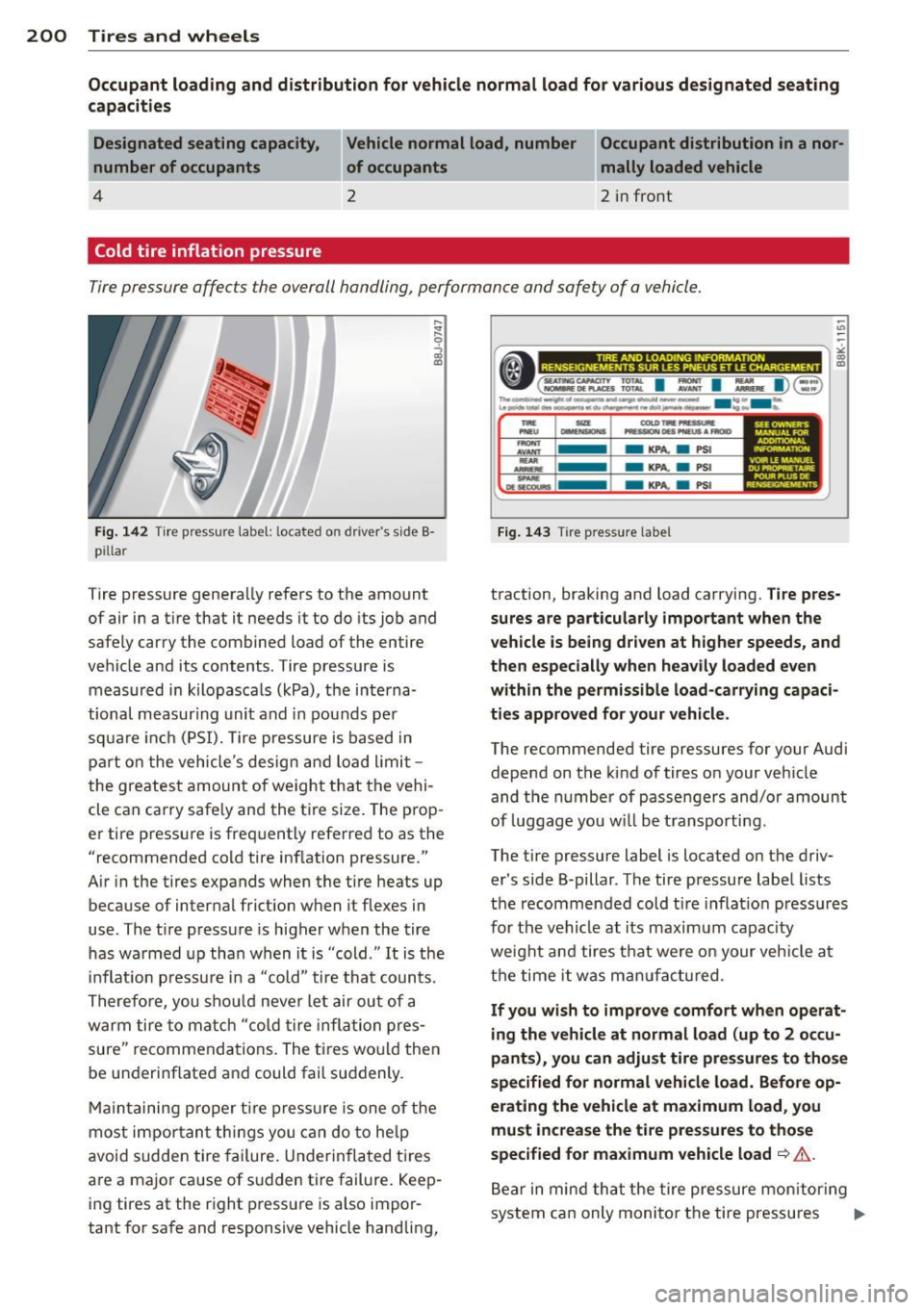
Fi g. 14 2 T ire p ress ure la b el: loca ted on driver's side B·
p ill ar
Tire pressure genera lly refers to the amount
of air in a t ire that it needs it to do its job and
safely carry the combined load of the entire
vehicle and its contents . Tire pressure is
measured in kilopasca ls (kPa), the i nterna·
tional measur ing unit and in pou nds pe r
squa re inc h (PSI). Tire pressure is based in
par t on the vehicle's desig n and load limit -
the greatest amoun t of weight that the vehi·
cle can carry safe ly and the t ire size . The prop·
er tire pressure is freq uently referred to as the
" recommended cold tire inf lation pressure."
A ir in the tires expands when the tire heats up
because of internal frict ion when it flexes in
use . The t ire p ressu re is higher when the tire
h as wa rmed up tha n when it is "cold ." It is the
in flat io n pressu re i n a "cold" tire that counts.
Th erefore, you shou ld neve r let air ou t of a
warm tire to match " co ld tire inflat ion pres
sure" recommendations . The t ires wo uld then
be underinflated and could fail su ddenly .
M ain taining p roper t ire pr essu re is one of the
most im po rt an t th ings you ca n d o to he lp
avoid sudden tire failure. Underin fla ted t ires
a re a ma jo r cause of s udden tire failure. Keep·
i n g tires at the right pressure is also impor
tant for safe and responsive vehicle handling,
-U'>
-
---------------------- ,;
•(=~= I: I::... 1)§ :l!: n-...,....,....,~ ...... ~-...,..., ..... _ ... U ........ ~-·~N.-..-.we..... .... lllt-
-AVANT ...,.
-...... .. _
-KPA. a PSI
- KPA. a PSI
-KPA. a PSI
Fig. 14 3 Tire pr essure labe l
SEE OWNEJICS MANUA1 FOA A,DOITl<>N.IU. INfORMATlON
VOIR L£ MANUll DUPR0ftlET""" P"OUR i-t.US DE RENSEIGMEMENfS
traction, braking and load carrying. Tire pres
sures are particularly important when the
vehicle is being driven at higher speeds, and
then especially when heavily loaded even
within the permissible load-carrying capaci
ties approved for your vehicle .
The recommended tire pressures f or y our Audi
depe nd on the kind of tires o n your ve hicle
and the numbe r of passe ngers and/o r amount
of luggage you w ill be t ransporti ng .
The tire pressure label is located on the driv
er 's side B-pillar . The tire pressure labe l lists
the recommended cold t ire inflat io n press ures
for the vehicle at its maximum capac ity
weig ht an d tires t hat were o n your veh icle at
t h e time it was m anufactur ed .
If you wish to improve comfort wh en operat
ing the vehicle at normal load (up to 2 occu
pant s), you can ad just tire pre ssure s to tho se
specified for normal vehicle load . Before op
erating the vehicle at maximum load, you
mu st increase the ti re pressures to those
specified for maximum vehicle load
~ ,&. .
Bear in min d that the tire pressure mon itor ing
system ca n only moni to r the tire pressures .,.
Page 203 of 262
Tires and wheels 201
you have stored. The system does not recog
nize the load condition of your vehicle.
The effectiveness of the tire pressu re monitor
ing system w ill be impaired if you store nor
mal load pressures but then operate the vehi
cle at its maximum load¢,& .
See the illustration ¢
fig. 142 for the location
of the label on driver's side B-pillar (color of
the actual labe l and exact location on the ve
hicle will vary slig htly) .
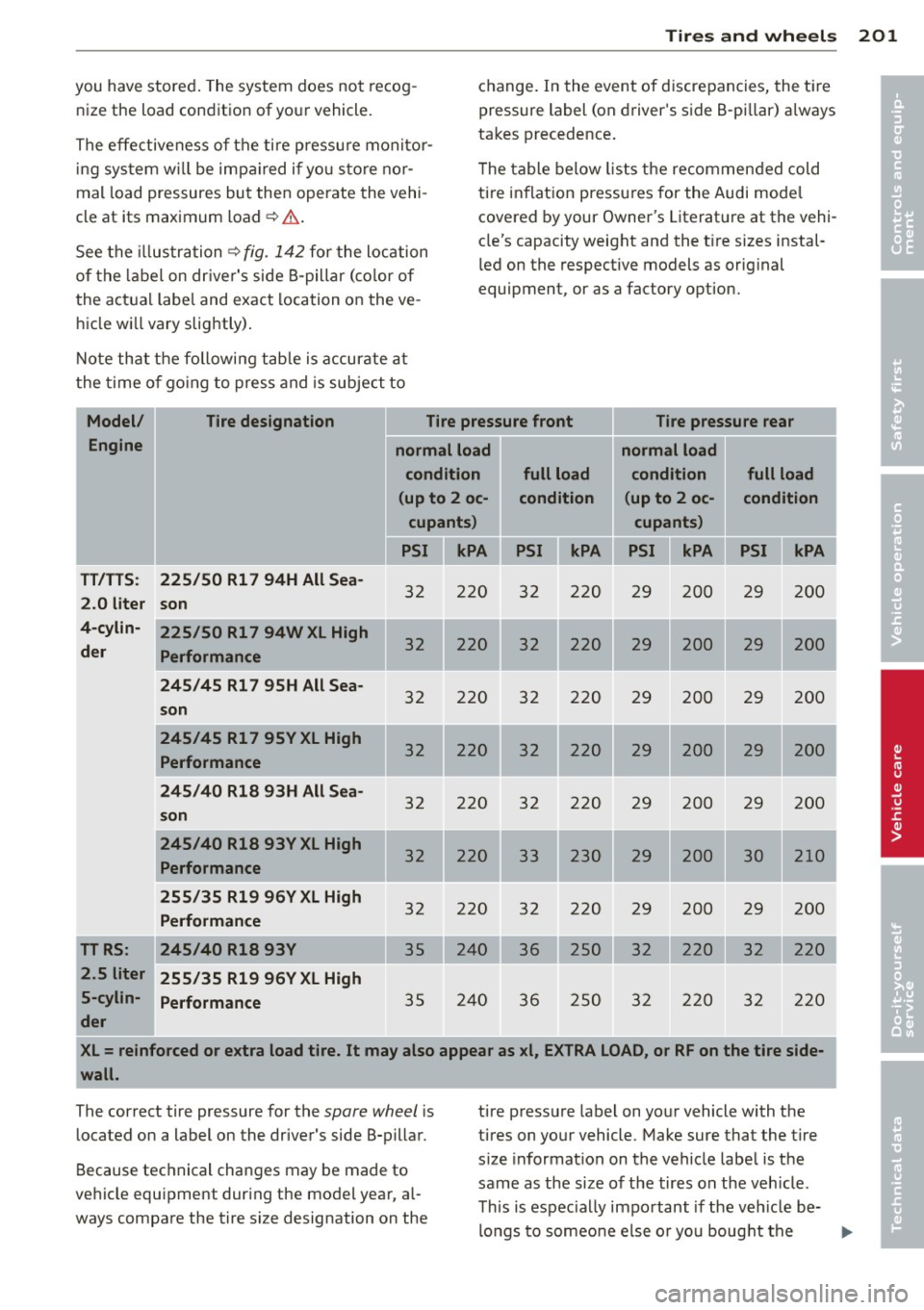
Note that the following table is accurate at
the time of go ing to press and is subject to change.
In the event of discrepancies, the tire
pressure label (on driver's side B-pi llar) always
takes precedence.
T he table below lists the recommended cold
ti re inflation pressures for the Audi mode l
covered by your Owner's Literature at the vehi
cle's capacity weight and the tir e sizes instal
l ed on the respective models as orig inal
equipment, or as a factory option.
I
Model/ U Tire designation Tire pressure front Tire pressure rear
Engine normal load normal load
condition full load condition full load
(upto 2 oc- condition (up to 2 oc-
condition
cupants) cupants)
PSI JI kPA PSI ]I kPA PSI II kPA PSI II kPA '.
TT/TIS: 225/50 Rl 7 94H All Sea-
32 220 32 220 29 200 29 200
2.0 liter son
4-cylin-
225/50 Rl 7 94W XL High
der Performance
32 220 32 220 29 200 29 200
245/45 R17 95H All Sea- 32 220 32 220 29 200 29 200
son
245/45 R17 95VXL High
32 220 32 220 29 200 29 200
Performance
245/40 R18
93H All Sea-
32 220 32 220 29 200 29 200 son
245/40 R18 93V XL High
32 220 33 230 29 200 30 210
Performance J
255/35 R19 96V XL High
32 220 32 220 29 200 29 200
Performance
TT RS:
245/40 R18 93V 220
2.5 liter
255/35 R19 96V XL High
5-cylin- Performance
35 240 36 250 32 220 32 220
der
XL= reinforced or extra load tire. It may also appear as xl, EXTRA LOAD, or RF on the tire side-
wall.
The correct tire pressure for the spore wheel i s
located on a label on the driver's side B-pillar.
Because technical changes may be made to
ve hicle equipment during the model year, a l
ways compare the tire size designation on the tire press
ure label on your vehicle with the
tires on your vehicle. Make sure that the tire
s ize info rmat ion on the vehicle label is the
same as the size of the tires on the veh icle .
This is especially important if the vehicle be-
long s to someone e lse o r you boug ht the ..,.
•
•
Page 208 of 262
206 Tires and wheels
Tire service life
The service life of tires depends on a lot of
different things including proper installation
and balancing, correct tire pressure and driv
ing style.
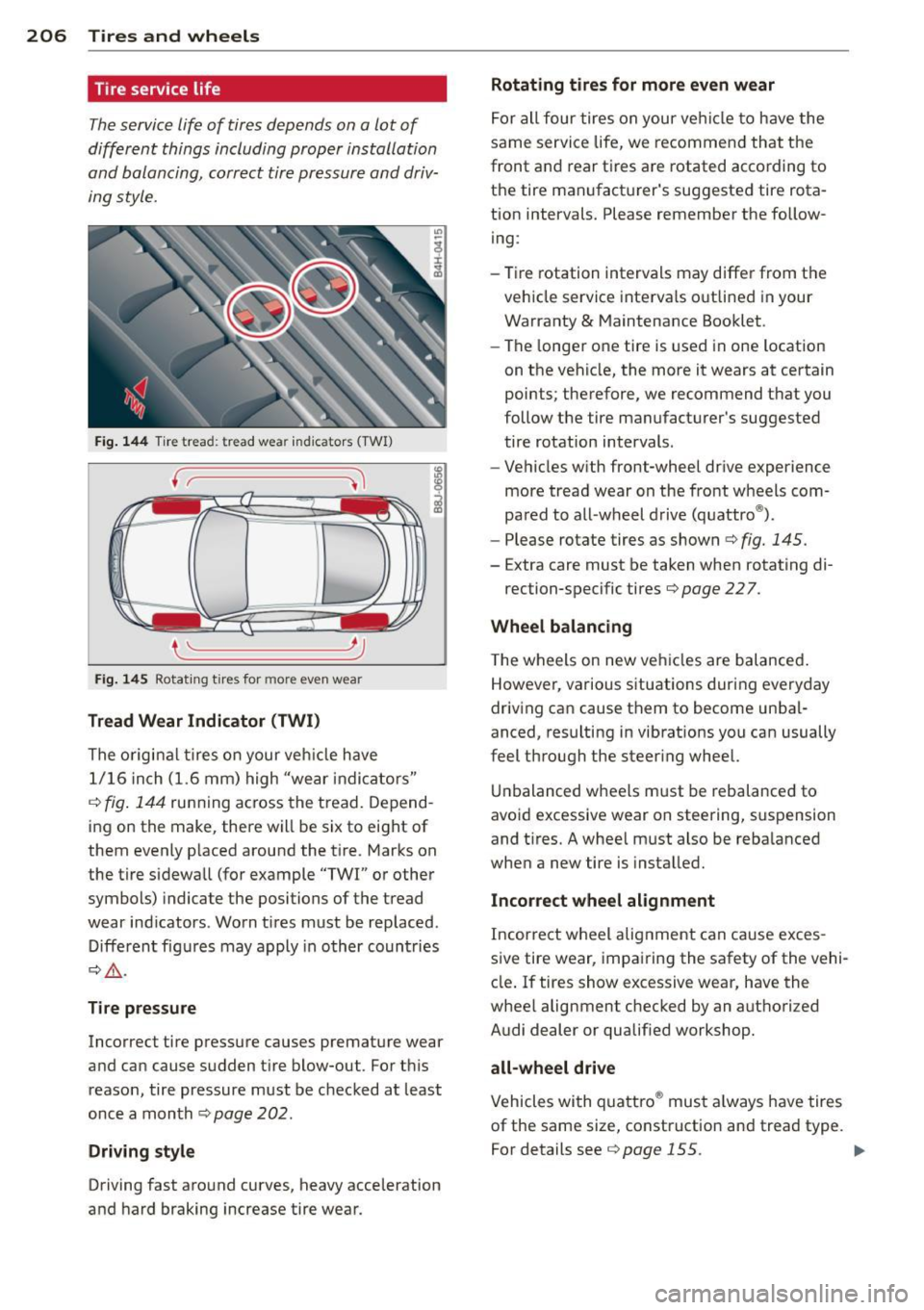
Fig. 144 Tire tread: tre ad wea r ind icators (TWI)
l --------- ---
Fig. 145 Rotating t ires for more ev en wea r
Tread Wear Indicator (TWI)
The original tires on your vehicle have
1/16 inch (1.6 mm) high "wear indicators"
c::> fig . 144 running across the tread. Depend
i ng on the make, there will be six to eight of
them evenly p laced around the tire. Marks on
the tire sidewa ll (for example "TWI" or other
symbols) indicate the positions of the tread
wear ind icators . Worn t ires must be replaced .
Different figures may apply in other countries
c::> & .
Tire pressure
Incorrect tire pressure causes premature wear
and can cause sudden t ire blow-out. For th is
reason, tire pressure must be checked at least
once a month
c::> page 202 .
Driving style
Driving fast around curves, heavy acceleration
and hard braking increase tire wear.
Rotating tires for more even wear
For all four tires on your vehicle to have the
same service life, we recommend that the
front and rear tires are rotated according to
the tire manufacturer's suggested tire rota
tion intervals. Please remember the follow
ing :
- Tire rotation intervals may differ from the
vehicle service interva ls outlined in your
Warranty
& Maintenance Booklet.
- The longer one tire is used in one location
on the vehicle, the more it wears at certain
points; therefore, we recommend that you
follow the tire manufacturer's suggested
tire rotation intervals .
- Vehicles with front-wheel drive experience
more tread wear on the front wheels com
pa red to all-wheel drive (quattro ®).
- Please rotate tires as shown
c::> fig. 145.
-Extra care must be taken when rotating di-
rection-specific tires
c::> page 22 7 .
Wheel balancing
The wheels on new vehicles are balanced.
However, various situations during everyday
driving can cause them to become unbal
anced, re sulting in vibrat ions you can usually
feel through the steer ing wheel.
Unbalanced wheels must be rebalanced to
avoid excessive wear on steering, suspension
and tires. A whee l must also be rebalanced
when a new tire is installed.
Incorrect wheel alignment
Incorrect wheel alignment can cause exces
sive tire wear, impairing the safety of the veh i
cle. If tires show excessive wear, have the
whee l alignment checked by an authori zed
Audi dealer or qualif ied workshop.
all-wheel drive
Vehicles with quattro ® mus t always have tires
of the same size, construction and tread type .
For details see
c::> page 155. ..,.
Page 211 of 262
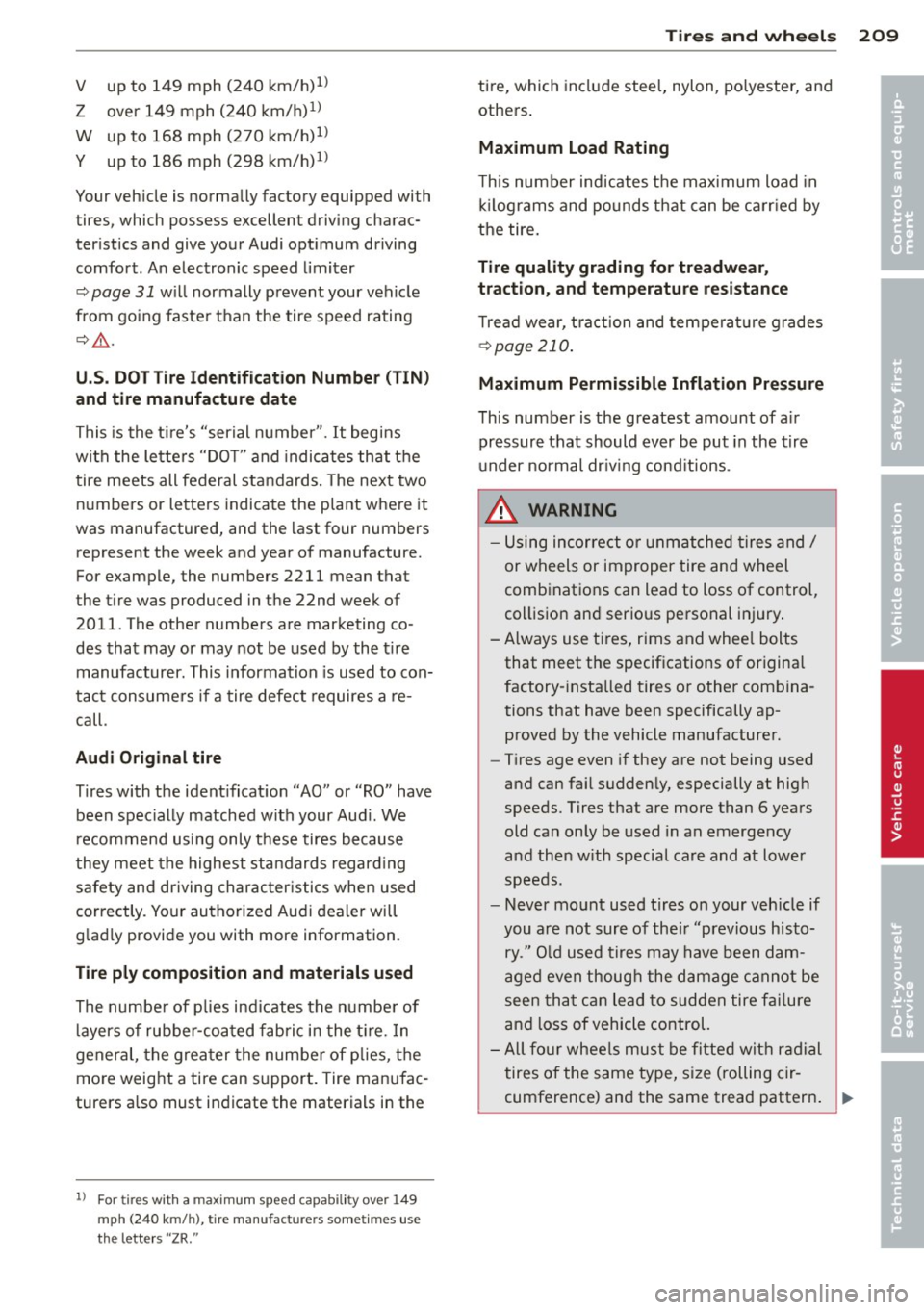
V up to 149 mph (240 km/h)l)
Z over 149 mph (240 km/h)
1
)
W up to 168 mph (270 km/h)ll
Y up to 186 mph (298 km/h)
1 )
Your veh icle is norma lly factory equipped with
t ires, which posses s excellen t driving charac
ter istics and give your Audi opt imum driving
comfort . An electronic speed limiter
¢ page 31 w ill normally prevent your vehicle
from go ing faste r th an the tire speed rating
¢ &_ .
U.S. DOT T ire Identification Number (TIN )
and tire manufactur e date
This is the t ire's "serial numbe r" . It begins
with the le tters "DOT" and indicates that the
tire meets all federal standards . The next two
numbers or letters indicate the p lant where it
was manufactured, and the last four numbers represent the week and year of manufactu re.
Fo r example, the numbers 2211 mean that
t he t ire was produced in the 22nd week of
2011. The other numbers are marketing co
des that may or may not be used by the t ire
manufacturer . This information is used to con
tact consume rs if a tire defect requires a re
call.
Audi Original tire
Tires with the ident ificat ion "AO" or "RO" have
been spec ially matched with your Aud i. We
recommend using only these tires because
they meet the highest standards regard ing
safety and driving charac ter istics whe n used
correctly. Yo ur authorized Audi dealer will
g lad ly provide you with more informat ion.
Tire ply composition and materials used
The numbe r of p lies ind icates the numbe r of
l ayers of rubber -coa ted fabric in the t ire. In
general, the greater the number of p lies, the
mo re weight a tire can support . Tire manufac
turers also must indicate the materials in the
1) F o r tires wit h a m ax im um s pee d ca pabil ity over 149
mph (2 4 0 k m/h) , tire ma nufa cturers some times use
t h e le tters "Z R."
Tire s an d wheel s 209
tire, which include stee l, nylon, po lyester, and
others .
Maximum Load Rating
This number indicates the max imum load in
kil ograms and po unds that can be ca rr ied by
the tire.
Tire quality grading for treadwear ,
tract ion , and temperature resistance
T read wear, t raction and tempe ra tur e grades
¢page 210 .
Maximum Permissible Inflation Pressure
This number is the greatest amount of a ir
pressure that should ever be put in the tire
u nder norma l dr iv ing cond itions .
_&. WARNING
-Using incorrect o r unm atc hed tires and/
or wheels or improper tire and wheel
comb inat ions can lead to loss of control
,
collision and serio us personal inj ury .
- Always use t ires, rims and whee l bolts
that meet the specifications of original
factory- insta lled tires or other combina
tions that have been specifically ap proved by the vehicle manufacturer.
- Tires age even if they are not being used
and can fai l sudden ly, especially at hig h
speeds. Tires that are more than 6 years
old can only be used in an emergency
and then w ith special care and at lower
speeds .
- Never mount used tires on your veh icle if
you are not sure of the ir "previous histo
ry ." O ld used tires may have been dam
a ged even thoug h the damage cannot be
seen tha t can lead to sudden tire fai lure
and loss of vehicle control.
.
- All fo ur whee ls must be fitted wit h ra dial
tires of the same type, size (rolling cir
cumference) and the same tread pattern . ..,
•
•
Page 213 of 262
The relative perform a nee of ti res depends
upon the actua l conditions of their use, how
ever, and may depart sign ificantly from the
norm due to var iat ions in dr iving habits, serv
ice practices and differences in road character
istics and climate .
Trac tion
The traction grades, from highest to lowest,
are AA, A, Band
C. Those grades represent the
tire's ability to stop on wet pavement as measured under controlled cond itions on
specified government test surfaces of asphalt
and concrete . A tire marked C may have poor
traction performance ¢,&. .
Temp erature
The temperature grades are A (the h ighest),
B, and
C, representing the t ire's resistance to
the generat ion of heat and its ability to dissi
pate heat when tested under controlled condi
tions on a specified i ndoor laboratory test
wheel.
Sustained high temperature can cause the
material of the tire to degenerate and reduce
tire life, and excessive temperature can lead
to sudden ti re fa ilu re ¢ ,&. .
The grade
C corresponds to a level of perform
ance which all passenger car tires must meet
u nder the Federa l Moto r Veh icle Safety Stand
ard No.
109. G rades Band A represent h igher
l eve ls of perfo rmance on the laboratory tes t
wheel than the minimum required by law .
A WARNING
The traction grade assigned to this tire is
based on stra ight-ahead b raking traction
tests, and does not include acceleration,
cornering, hydroplan ing or peak traction
character istics.
A WARNING
The temperature grade for this t ire is es
tablished for a t ire that is p roperly inflated
and not overloaded. Excessive speed, un
derinflation, or excessive loading, either
-
Tire s an d wheel s 211
separately or in combinat ion, can ca use
heat bui ldup and possible tire failure.
Winter tires
Winter tires can improve vehicle handling on
snow and ice. At temperatures below 45 °F (7 °C) we recommend changing to winter
tires.
In some heavy snow areas, local governments
may require true winter or "snow" tires, those
with very deeply cut tread. These tires should
o nly be used in pairs and be installed on all
four wheels . Make sure you purchase snow
t ires that are the same size and construction
type as the other tires on your vehicle.
If your vehicle is equipped w ith all-whee l
drive*, th is w ill improve traction during winter
driv ing, even with the standa rd tires. Howev
er, we strongly recommend that you always
equip all fou r wheels o n your veh icle w ith cor
rect ly fitted winter tires o r all-season t ires,
when winter road condit ions are expe cted .
T his also improves the veh icle's braking per
formance and reduces stopping distances.
Summe r tires provide less grip on ice and
snow.
Winter tires (snow tires) must always be fitted
o n all fo ur wheels .
Ask your authorized Audi dealer or qualified
workshop for permitted
winter tire siz es. Use
only rad ial w inter t ires.
Winter tires lose their effectiveness when the
tread is worn down to a depth of
0 .157 inch
(4 mm) .
Only drive w ith w inter t ires under w inter con
dit ions. Summer t ires handle better when
there is no snow or ice on the roads and the
temperature is above 45 °F (7 °() .
If you have a flat tire, see notes on spare
whee l
¢page 207.
Please a lways remember that winter tires may
have a lower speed rating than the tires origi -
nally installed on your vehicle at the time it .,.
•
•
Page 214 of 262
212 Tire s and wheel s
was manufactured . Please see q page 208,
Speed roting (letter code) for a listing of the
speed rat ing letter codes and the maximum
speed at wh ich the t ires can be driven .
The speed rating letter code
( c::> page 199) is
on the side wall of the tire
c::> page 207.
A WARNING
Winter tires have maximum speed limits
that may be lower than your vehicle's max
imum speed . Always know the maximum
speed before driving off . Never drive faster
than the speed permitted for your specific
w inter t ires. This will cause damage to the
tires leading to an accident and serious
pe rsonal inj ury to you and your passen
gers .
A WARNING
= ~
Driving faster than the maximum speed
for which the winter tires on your vehicle
were designed can cause tire fai lure in
cluding a blowout and sudden deflat ion,
loss of control, crashes and serious per
sonal injuries. Have worn or damaged tires
rep laced immed iate ly .
- Winter tires have maximum speed rat ing
that may be lower than your veh icle's
maximum speed .
- Never drive faster than the speed for
w hich the winter or other tires installed
on your vehicle are rated.
A WARNING
Always adjust your d riving to the road and
traffic conditions. Neve r let the good ac
celeration of the wi nte r t ir es and all-whee l
dr ive temp t you in to taking extr a ris ks . A l
ways remember :
- Whe n bra king , a n a ll-wheel d rive vehicle
hand les in the same way as a front drive
vehicle.
- Drive caref ully and reduce your speed on
icy and slippery roads, even winter tires
cannot he lp under black ice conditions.
{® For the sa ke of the env ironment
Use summer tires when weather condi
tions permit. They are qu ieter, do not wear
as quickly and reduce fuel consumption.
Snow chains
Snow cha ins may be f itted only to the front
whee ls, and only to certain tire sizes . Ask your
autho rized Aud i dealer on which tire sizes
snow c hains ca n be used.
If you are go ing to use snow chains, then you
must install them on the front whee ls at
least.
The snow chains must have low-prof ile links
and must not be t hicker than 0.53 inch
(13.5 mm), includ ing the lock .
Remove whee l center covers and trim discs
before putt ing snow cha ins on your vehicle
c::> Q) . For safety reasons cover caps must then
be fitted over the wheel bolts . These are ava il
able from autho rized Aud i dealers .
A WARNING
Using the wrong snow chai ns for your veh i
cle o r ins ta ll ing them in correct ly can in
crease the risk o f loss of cont ro l leading to
se rious personal injury.
- Snow chains are available in different
sizes. Always make sure to follow the i n
structions provided by the snow chain manufacturer .
- When driving with snow cha ins never
d rive faster than the speed permitted for
your specific snow chains.
- Always observe local regulations .
(D Note
-Remove snow chain s before dr iv ing o n
roads not covered with snow to avoid
damaging tires and wearing the snow
chains down unnecessa rily.
- Snow chains, which come in to direc t con
tact with the whee l rim, can scratch or
damage it . Therefore , make sure that the
1J1-