coolant AUDI TT COUPE 2009 User Guide
[x] Cancel search | Manufacturer: AUDI, Model Year: 2009, Model line: TT COUPE, Model: AUDI TT COUPE 2009Pages: 316, PDF Size: 71.16 MB
Page 226 of 316

-~_C_ h_e _c _ k_ i_n ...:::g::;...._ a_n_ d_ f_ i_ll _in -'g:::;.._ ___________________________________________ _
& WARN ING (c o ntinued )
• Continuou s contact with used en gine oil i s harmful to your
sk in. Alway s prote ct your skin b y wa shi ng oil off thoroughly with
soap and water .
0 Note
Never mix oil additives with your engine oil. These additives can
damage your engine and adversely affect you r Audi Limited New
Vehicle Warranty.
<£> For the sake of the environment
• Before changing your oil, first make sure you know where you
can proper ly dispose of t he used oil.
• Always dispose of used engine oil properly . Do not dump it on
garden soil, wooded areas, into open strea ms or down sewage
drains .
• Recycle used eng ine oi l by taking it to a used eng ine oi l collec
tion facility in your area, or contact a service station. •
Engine cooling system
Coolant
The e ngine coolant perfor ms tw o functions: i t kee ps the
en gine from overheatin g and i t pro tects the engi ne from
freezing in the winter.
The cooling system is sea led and general ly requires litt le attention.
The coo ling sys tem has been f illed at the factory with a permanen t
coo lant which does not need to be changed. The coolant consists of
a mixture of water and the ma nufacturer 's glyc ol- basedco olan t
additive
G12++ antifreeze w ith anti corrosion additives (50% for USA models; 60% for Canadian mode
ls) . T his mixture both assures the
n ecessary fros t pr otection a nd protects metal co mpo nents in the
engine's cooling system from corrosion and scaling. It also raises
t he boil ing point of the coolant .
Do not reduce the concentration of the coo lant in the su mmer by
adding plain water.
The proportion of coolant additive mu st be at
lea st 50 % but not more than 60 %
to maintai n antifreeze pro tection
and cooling efficiency. If the coolant frost protection is too low, the
coo la nt co uld free ze and damage the vehic le heating and engine
coo ling system .
For year-round driving, antifree ze is added at the factory for temper
atures down to:
• - 31 °F ( -35 °C) USA
• -40 °F ( -40 °C) Canada.
You can mix the
G 12+ + coolant additive with other additives (G12+
or G12). Always check w ith your authorized Audi dealer.
& WARNING
Before you check anything in the engine compartment, alway s
read and heed all WARNINGS
~ & in "Working in the engine
compartment " on
page 217.
0 Note
• Before winter sets in, have the coolant checked to see if the
coo lant additive in your vehicle is suff icient to meet the c limate
co nd itions . This is e special ly impor tant i f you live in a region where
the winter is extremely cold. If necessary, increase the proportion of coo lant additive t o 60%.
• When adding coolant additive to your cooling system,
r emem ber:
- We recommend using on ly coolant additive
G 12+ + (check the
l abel) for your veh ic le . Th is coolant additive is available at autho -
rized Audi dealers. Other types of antifreeze can significantly ._
Page 227 of 316

Checking and filling -
---------------------=----"=---------
reduce corrosion protection. The resu lting corrosion can cause a
loss of coolant and serious engine damage.
• Do not add any type of radiator leak sealant to your vehicle's
engine coolant. Adding radiator repair fluid may adverse ly affect the
function and performance of your cooling system and cou ld result
in damage not covered by your New Vehicle Limited Warranty. •
Checking the engine coolant level
The engine coolant level can be checked with a quick
gla nce .
Fig . 142 Engine
co mp artm ent : coo lan t
e xpa nsion t ank
Before you check anything in the engine compartment,
always read and heed all WARNINGS=> & in "Working in
the engine compa rtment" on
page 217.
- Switch the ignition of f.
- Read the coo lant l eve l at the coo lant exp ansio n tank
==> fig. 142. With a col d e ngine, it must b e above the
"min" mar k. Wit h a hot engine, it can be a little above t he
indicated range.
The location of the coolant expansion tank can be seen in the
engine compartment i llustration. To obtain an accurate reading, the engine must be switched off.
The expansion tank in your vehic
le is equipped with an e lectric
coolant level sensor.
When the coolant leve l is too low, the warning light in the Auto
Check System =>
page 34 will blink un til you add coolant and the
level has been restored to normal. Even though there is an e lectric
coo la n t level sensor, we still recommend you check the coolant level
from time to time .
Coolant loss
Coolant loss may indicate a leak in the cooling system . In the event
of coo lant loss, the co oling sys tem shou ld be i nspected immedi
ate ly by your authorized Audi dealer . It is not enough merely to add
coo lant .
In a
sealed system , losses can occur only if the boiling point of the
coolant is exceeded as a result of overheating .
0 Note
Do not add any type of radiator leak sea lant to your vehicle's engine
coolant. Adding rad iator repair fluid may adversely affect the func
tion and performance of your coo ling system and could resu lt in
damage not covered by your New Vehic le Limited Warra nty. •
Adding coo lant
Be very careful when adding engine coolant.
Before you check anything in the engine compartment,
always read and heed all WARNINGS==> & in "Working in
the engine compartment" on
page 217 .
-Turn off the engin e.
- Let the engine cool down.
Vehic le care I I irechnical data
Page 228 of 316
-~_C_ h_e _c _ k_ i_n ...:::g::;...._ a_n_ d_ f_ i_ll _in -'g:::;.._ ___________________________________________ _
-Pla ce a t hick ra g o ver the coola nt e xpansion tank
=>
page 225, fi g. 142 an d carefully tw ist the c ap counter
cl ockw ise=> &.
- Add coo lan t.
- Twist the cap on again
tightly .
Replacement engine coolant must conform to exact specifications
=>
page 224, "C oolant" . Even in an emerge ncy, if coo lant add it ive
G 12+ +, G 12+ or G12 is not availab le, do
not use a different additive.
Use p lain water instead until you ca n get the c orrec t addit ive and
can restore the correct ratio. This should be done as soon as possible.
If you have lost a considerable amount o f coo lant, then you should
add co ld antifreeze and cold water only when the engine is cold.
A lways use
new e ngine c oolan t when refil ling .
Do not fill coolant above the "MAX" mark. Excess coolant will be
forced ou t through the pressure relief va lve in the cap when the
engine becomes hot.
& WARNING
• The cooling sy stem is under pre ssure and can get very hot .
Reduce the risk of scalding from hot coolant by following these
s teps.
- Turn off the engine and allo w it to cool down .
- Protect your face, hands and arms from esc aping fluid and
steam by covering the cap with a large , thick rag .
- Turn the cap slo wly and very carefully in a counter -clockwise
dire ction while applying light , downward pressure on the top
of the cap .
- To avoid being burned, do not spill antifreeze or coolant on
the e xhaust system or hot engine parts . Under certain condi
tions, the ethylene glycol in engine coolant can catch fire .
& WARNING (continued )
• Antifreeze is poi sonous. Always store antifreeze in its original
container and well out of the re ach of children .
• If you drain the coolant , it must be caught and safely stored in
a proper container clearly marked "poison ".
0 Note
• Coo lant po llutes the environment and could cause an engine
fire. Excess coolant will be forced out through the pressure re lief
va lve in the cap when the engine becomes hot.
• If , in an eme rgency, o nly wa te r can be added, the correct rat io
between water and antifreeze=>
page 224 must be restored as soon
as possib le .
ffi For the sake of the environment
Drained coolant should not be reused. Always dispose of used
coo lant whi le observ ing all environmen tal regulat io n s. •
Radiator fan
The radi ator f an s witches on au tomati cally by itself.
T he e lectric radiator fan is control led bythe rmoswitches that switch
on and off depending on coolant and engine compartment temper
atures.
An auxiliary electric radiator fan* switches on and off depending on
coo la nt tempe rature a nd other veh ic le operati on cond itio ns.
After you switch the engine off, the aux iliary fan can continue
running for up to 10 m inutes -even with the ignition off. It can even
sw itch o n again later by itself=> & , if
• the temperature of the engine coo lant rises due to the heat
b ui ld-up fro m the eng ine in the eng ine co m partment, or
Page 229 of 316

_____________________________________________ C_h_ e_ c _ k_in --= g'-a _ n_d _ f_il _li _n -=g =-- ____.•
• the engine compartment heats up because the vehicle is parked
in intense sunlight.
& WARNING
• To reduce the risk of personal injury never touch the radiator
fan.
• The auxiliary electric fan is temperature controlled and can
switch on suddenly even when the engine is not running .
• The auxiliary radiator fan switches on automatically when the
engine coolant reaches a certain temperature and will continue to
run until the coolant temperature drops. •
Brake fluid
Checking brake fluid level
The brake fluid level can be checked with a quick glance.
Fig. 143 Engine
compartment: brake
fluid reservoir
Before you check anything in the engine compartment,
always read and heed all WARNINGS=> & in "Working in
the engine compartment" on
page 217.
-Read the brake fluid level from the brake fluid reservoir
=> fig. 143. The brake fluid level must be between the
"MIN" and "MAX" markings.
The brake fluid reservoir is located behind the rear partition of the
engine compartment on the left side~ page 218.
The fluid level may drop slightly after some time due to the auto
matic adjustment of the brake pads. This is not cause for alarm.
If the brake fluid level falls considerably below the "MIN" mark, the
brake warning/indicator light (U.S. models:
BRAKE, Canadian models:
(Cf))) will come on~ page 19 and~ page 33. Do not continue to
operate the vehicle. The complete brake system should be thor
oughly checked by an authorized Audi dealer or other qualified
facility and the cause corrected. If the brake fluid level is too low, the
brake warning/indicator light will illuminate. Contact an authorized
Audi dealer
immediately. •
Changing brake fluid
Have the brake fluid changed by an experienced techni
cian.
Brake fluid absorbs moisture from the air. If the water content in the
brake fluid is too high, corrosion in the brake system may result
after a period of time . The boiling point of the brake fluid will also
decrease considerably and decrease braking performance.
Therefore, the brake fluid must be changed
every two years. Always
use new brake fluid which conforms to Federal Motor Vehicle Stan
dard "FMVSS 116 DOT 4".
The brake fluid reservoir can be difficult to reach, therefore, we
recommend that you have the brake fluid changed by your autho
rized
Audi dealer. Your dealer has the correct tools, the right brake
fluid and the know-how to do this for you.
~
Vehic le care I I irechnical data
Page 235 of 316

Checking and filling -
------------- --------=----" =---------
& WARNING !continued )
• To reduce the danger of explosio n, never connect or di sconnect
c h arger cable s whi le the charger i s operating .
• Fast charging a battery i s dang erou s and should only be
atte mpt ed by a competent techni cian with the proper equipment .
• Battery acid that may spill during charging should be washed
off with a solut ion of w arm wat er and bak ing soda to ne utrali ze
the acid .
0 Note
Never use a fast charger as a boos ter to start the engine . This wil l
seriously damage sensitive electronic components, such as control
units, re lays, radio, etc ., as well as the battery charger .
[ i ] Tips
The vehicle battery must not be charged with a standard small
charger that plugs into the cigarette lighter or out let .•
Windshield /headlight washer
conta iner
Fi g. 14 7 Fend er, left:
Wind shi eld washer
flui d re ser voir
T h e w asher fluid container is mark ed wit h the symbol O on
its cap.
Before you c heck anything in the e ngine compartment,
always read and heed all WARNINGS~ & in "Workin g
in t he engi ne compartment" on
page 217.
Lift the fi ller cap to ngue to add washe r fluid . You can fill
t h e container to the top.
Press the cap bac k on to the fi ller neck after fi lling the
container .
You can find the reservoir ca pac ity in the tab le in => page 291.
To prevent lime residue fr om bui lding up on the spray jets, use
dis tilled water when refilling . Always add a g lass cleaner solut ion
(with frost pro tection in the winter).
0 Note
Do not mix eng ine coolant antifreeze or any other additives to fil l up
the windshield washer reservo ir. •
Vehic le care I I Technical data
Page 245 of 316
______________________________________________ T_ ir_e _s_ a_n_ d_ w_ h_ e_ e_ls __ __
•
technically referred to as the vehicle's Gross Vehi cle We ight Rating
("GVWR") .
T he "GVWR" includes the weight of the bas ic veh icle, al l factory
insta lled accessor ies, a full tank of fue l, oil, coolant and other f luids
p lus ma ximum load. The maxim um load includes the number o f
passengers that the vehicle is intended to carry ("seating capacity")
w it h an assu med weight o f 15 0 l bs (68 kg) for eac h passe nger at a
designated seating position and the total weight of any luggage in
th e veh ic le .
T he
Gross Axle Weight Rating ("GAWR"l is the maximum load that
can be applied a t each of the vehic le's two axles .
The Gross Ve hicle W eig ht Rati ng and the Gross A xle Weigh t Rating
a re l isted on the safety compliance sticker labe l located on the
dr iver's s ide B -p il lar . Y o ur Aud i has 4 seat ing positions, 2 in the fron t
and 2 in the rear for total seating capacity of 4. Each seating posit ion
has a sa fet y b elt
=> page 125, "Safe ty be lts" .
T he fact t hat the re is an uppe r lim it to your ve hicle's G ross V ehic le
Weight Rati ng means tha t the total we igh t of w hateve r is bei ng
ca rried in the vehicle is lim it e d. T he m ore pass engers in t he veh ic le
or passengers who are heavier than the standard weights assumed
mean that less we igh t ca n be ca rried as lu ggage .
T he tire pressure labe l o n you r Audi also lists the max imum
c o m bined weig ht of all of t he oc cupan ts a nd lu ggage or other ca rgo
t h at the ve hicle can carry. For the locat ion of the label
=> page 238,
fig . 14 8.
& WARNING
Overloading a vehicle can cause loss of vehicle control, a crash or
other accident , serious personal injury , and even death .
• Carrying more weight than your vehicle was designed to carry
will prevent the vehicle from handling properly and increase the
risk of the loss of vehicle control.
• The brakes on a vehicle that has been overloaded may not be
able to stop the vehicle within a safe distance.
& WARNING (continued )
• Tires on a vehicle that has been overloaded can fail suddenly,
including a blowout and sudden deflation , causing loss of control
and a crash .•
Determining correct load limit
Use the example below to calculate the
total weight of the passengers and
luggage or other things that you plan to
transport so that you can make sure that
your vehicle will not be overloaded.
Steps for Determining Correct
Load Limit
1 . Locate the statement "THE COMBINED
WEIGHT OF OCCUPANTS AND CARGO SHOULD NEVER EXCEED XXX KG OR XXX
LBS "on your vehicle 's placard (tire infla
tion pressure label)~
page 238, fig. 148.
2. Determine the combined weight of the driver and passengers that will be riding
in your vehicle. ..,
Vehicle care I t •
Page 291 of 316
_________________________________________________ G_ e_ n_ e_r _a _l_ i_n _f_o _ r_ m_ a_ t _i _o _ n __ lftlll
vehicle identification number of your vehicle (perforation) as well as
the Gross Vehicle Weight Rating (GVWR) and the Gross Axle Weight
Rating (GAWRl.
The high voltage warning label
is located on the lock carrier.
The spark ignition system complies with the Canadian
standard ICES-002. •
Displaying Vehicle Identification
Number in the Driver Information
display
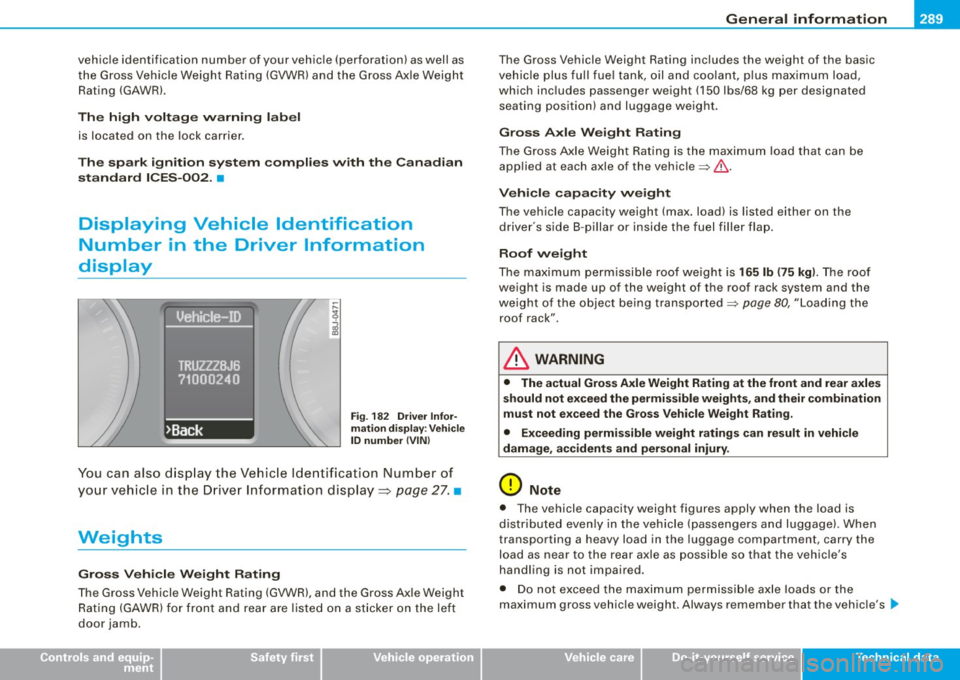
Fig. 182 Driver Infor
mation display: Vehicle
ID number (VIN)
You can also display the Vehicle Identification Number of
your vehicle in the Driver Information display~ page
27. •
Weights
Gross Vehicle Weight Rating
The Gross Vehicle Weight Rating (GVWR), and the Gross Axle Weight
Rating (GAWR) for front and rear are listed on a sticker on the left
door jamb.
Controls and equip ment Safety first Vehicle operation
The
Gross Vehicle Weight Rating includes the weight of the basic
vehicle plus full fuel tank, oil and coolant, plus maximum load,
which includes passenger weight (150 lbs/68 kg per designated
seating position) and luggage weight.
Gross Axle Weight Rating
The Gross Axle Weight Rating is the maximum load that can be
applied at each axle of the vehicle~&.
Vehicle capacity weight
The vehicle capacity weight (max. load) is listed either on the
driver's side 8 -pillar or inside the fuel filler flap.
Roof weight
The maximum permissible roof weight is 165 lb (75 kg). The roof
weight is made up of the weight of the roof rack system and the
weight of the object being transported
~ page 80, "Loading the
roof rack".
& WARNING
• The actual Gross Axle Weight Rating at the front and rear axles
should not exceed the permissible weights, and their combination
must not exceed the Gross Vehicle Weight Rating.
• Exceeding permissible weight ratings can result in vehicle
damage, accidents and personal injury.
0 Note
• The vehicle capacity weight figures apply when the load is
distributed evenly in the vehicle (passengers and luggage). When
transporting a heavy load in the luggage compartment, carry the
load as near to the rear axle as possible so that the vehicle's
handling is not impaired.
• Do not exceed the maximum permissible axle loads or the
maximum gross vehicle weight. Always remember that the vehicle's .,_
Vehicle care Do-it-yourself service Tec hn ica l da ta
Page 297 of 316
__________________________________________________ C_o_ n _ s_u_ m_ e ___ r_l_ n _f_ o_ r _m...:....:.. a:.;..:. ti .... o:.. n ........ _lllll
& WARNING (continued)
• The engine compartment of any motor vehicle is a potentially
hazardous area. Never reach into the area around or touch the
radiator fan. It is temperature controlled and can switch on
suddenly -even when the engine is off and the ignition key has
been removed. The radiator fan switches on automatically when
the coolant reaches a certain temperature and will continue to run
until the coolant temperature drops .
• Always remove the ignition key before anyone gets under the
vehicle.
• Always support your vehicle with safety stands if it is neces
sary to work underneath the vehicle. The jack supplied with the
vehicle is not adequate for this purpose and could collapse
causing serious personal injury.
• If you must work underneath the vehicle with the wheels on
the ground, always make sure the vehicle is on level ground, that
the wheels are always securely blocked and that the engine
cannot be started .
• Always make sure the transmission selector lever (automatic
transmission) is in "P" (Park position) (automatic transmission) or
Neutral (manual transmission) and the hand brake is firmly
applied.
<£> For the sake of the environment
• Changing the engine settings will adversely affect emission
levels. This is detrimental to the environment and increases fuel
consumption .
• Always observe environmental regulations when disposing of
old engine oil, used brake fluid, dirty engine coolant, spent batteries
or worn out tires.
• Undeployed airbag modules and pretensioners might be classi
fied as Perchlorate Material -special handling may apply, see
www.dtsc.ca.gov/hazardouswaste/perchlorate . When the vehicle or
parts of the restraint system including airbag modules safety belts
Controls and equip ment Safety first Vehicle operation with pretensioners are scrapped, all applicable laws and regula
tions must be observed. Your authorized Audi dealer is familiar with
these requirements and we recommend that you have your dealer
perform this service for you. •
Additional accessories,
modifications and parts replacement
Additional accessories and parts
replacement
Always consult an authorized Audi dealer before
purchasing accessories.
Your vehicle incorporates the latest safety design features ensuring
a high standard of active and passive safety.
This safety could be compromised by non -approved changes to the
vehicle. For this reason, if parts have to be replaced, please observe
the following points when installing additional accessories:
Approved Audi accessories and genuine Audi parts are available
from authorized Audi dealers .
These dealers also have the necessary facilities, tools and trained specialists to install the parts and accessories properly .
& WARNING
Using the wrong spare parts or using non-approved accessories
can cause serious personal injury.
• Use only accessories expressly approved by Audi and genuine
Audi spare parts
• These parts and accessories have been specially designed to
be used on your vehicle.
• Never install accessories such as telephone cradles or
beverage holders on airbag covers or within the airbag deploy-
Vehicle care Do-it-yourself service Tec hn ica l da ta
Page 302 of 316
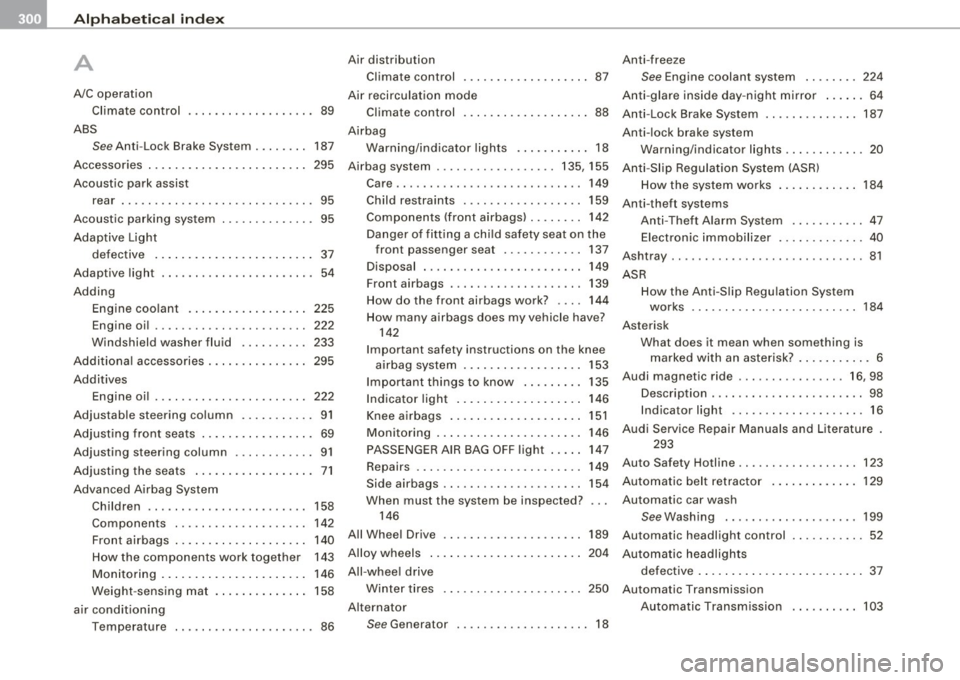
___ A---" lp_ h_ a_b_ e_ t_ i_ c _ a_ l_ in_ d_ e_x ______________________________________________ _
A
A/C operation
Climate control ............ ....... 89
ABS See Anti -Lock Brake System . . . . . . . . 187
Accessories . . . . . . . . . . . . . . . . . . . . . . . . 295
Acoustic park assist rear . . . . . . . . . . . . . . . . . . . . . . . . . . . . . 95
Acoustic parking system .. .... ... .... . 95
Adaptive Light defective . . . . . . . . . . . . . . . . . . . . . . . . 37
Adaptive light . . . . . . . . . . . . . . . . . . . . . . . 54
Adding Engine coolant .. ... .... .... .... . 225
Engine oil ....................... 222
Windshield washer fluid . . . . . . . . . . 233
Additiona l accessories .. ........ .... . 295
Additives Engine oil ... ..... .... ... ... ... .. 222
Adjustable steering column .... .... ... 91
Adjusting front seats . ...... .... .... .. 69
Adjusting steering column ...... .. ... . 91
Adjusting the seats .... .... .... .... .. 71
Advanced Airbag System
Children ........................ 158
Components .. .... .... ......... . 142 Air distribution
Climate control ..... .. .... .... .... 87
Air recirculation mode Climate control ...... .... ... .. .... 88
Airbag Warning/indicator lights ......... .. 18
Airbag system .................. 135, 155
Care ............................ 149
Child restraints .... .... .... .... .. 159
Components (front airbags) .. ...... 142
Danger of fitting a chi ld safety seat on the
front passenger seat . . . . . . . . . . . . 137
Disposa I . . . . . . . . . . . . . . . . . . . . . . . . 149
Front airbags . . . . . . . . . . . . . . . . . . . . 139
How do the front airbags work? . . . . 144
How many airbags does my vehicle have?
142
Important safety instructions on the knee
airbag system . . . . . . . . . . . . . . . . . . 153
Important things to know . ... .. ... 135
Indicator light ....... .... ... .. ... 146
Knee airbags .... .... .... ... .... . 151
Monitoring . . . . . . . . . . . . . . . . . . . . . . 146
PASSENGER AIR BAG OFF light ... .. 147
Repairs . . . . . . . . . . . . . . . . . . . . . . . . . 149
Side airbags ... ...... ....... ..... 154
When must the system be inspected? ...
146 Anti-free
ze
See Engine coolant system ...... .. 224
Anti -glare inside day-night mirror .... .. 64
Anti-Lock Brake System .............. 187
Anti- lock brake system
Warning/indicator lights ............ 20
Anti -Slip Regulation System (ASR)
How the system works . . . . . . . . . . . . 184
Anti-theft systems Anti-Theft A larm System ...... ..... 47
Electronic immobilizer . .... .... .... 40
Ashtray ................... .......... 81
ASR How the Anti -S lip Regu lation System
works ... .... .... .... ... .... ... 184
Asterisk What does it mean when something is
marked with an asterisk? . .... ...... 6
Audi magnetic ride ......... .... ... 16, 98
Description ....................... 98
Indicator light ...... ..... ..... ... . 16
Audi Service Repair Manuals and Literature . 293
Auto Safety Hotline ... ..... .. ... ..... 123
Automatic belt retractor 129
Automatic car wash
See Washing .. ........ .... ...... 199
Front airbags ....... .... .... .... .
140 All Wheel Drive
......... ....... ..... 189 Automatic headlight control ........... 52
How the components work together 143 Alloy wheels ... .. ...... .... ... .. ... 204 Automatic headlights
Monitoring .. .... .... .... ... .... . 146 All-whee l drive defective .
.... ... .... .... .... ..... 37
Weight -sensing mat . ... .. .... .... 158 Winter tires ..................... 250 Automatic Transmission
air conditioning Alternator Automatic Transmission
.......... 103
Temperature . . . . . . . . . . . . . . . . . . . . . 86 See Generator . . . . . . . . . . . . . . . . . . . . 18
Page 303 of 316

______________________________________________ A_ l.:.. p _h_ a_ b_e _t_ic _ a _ l _in _ d_e _ x __ _
Automatic transmission ..... ... .. .... . 99
Driving Notes ... .. .... ... .... .... 102
Emergency program .. .... ... .... . 105
Emergency release . . . . . . . . . . . . . . . 106
Ignition key safety lock ....... .... .. 92
Kick-down .. ... .. .... .... ...... .. 105
Launch Control Program ........... 105
Selector lever lock .. ...... ...... .. 101
Selector lever positions ........... 100
Tiptronic ... .. .... .... ........... 103
Tiptronic controls on the steering wheel
104
Average fuel mileage ... .... .... .... .. 26
Average speed . ... .. .... .... .... .... . 26
Avoid damaging the vehicle ......... . 192
B
Battery . ...... ..... ... .... .... . 228, 231
Battery location inside the engine compartment ... .... .... .... 218,219
Charging . .... .... .... ... .... .... 232
Checking battery acid level .... 231, 232
Connecting ... ... ..... ... .... ... . 228
Disconnecting ....... ....... .... . 228
Important warnings when working on the
battery ..... .... ....... ...... .. 229
Replacing the battery . ....... .... . 228
Winter operation . .... .... ... .... . 228
Working on the battery ... .... .... . 229
Battery voltage ......... .... ......... 36
Before driving .. ...... .. ....... ..... 114
Bi -Xenon headlights ........... .. .... . 57
Blended gasoline ... .... .... ... .... . 211
Controls and equip
ment Safety first
Body
cavity sealing .... .. ..... ... ... . 204
Booster seats .... .... .... .... .... ... 165
How do I properly install a booster seat in
my vehicle? . ... ... ....... .. .... 165
Safety instructions ..... .... ... .... 165
Brake fluid Changing the brake fluid .. .... .... 227
Checking the brake fluid level ...... 227
What is the correct brake f luid level? 227
What should I do if the brake fluid warning
light comes on? . ........ ... ..... 227
Brake fluid reservoir ..... .... .... .... 227
Brake system . ... ...... ......... .... 227
Anti-lock brake system ... .... ... .. . 20
Brake Assistan t .... . .. .. .. . ... ... 187
Brake fluid .... ... .... ...... ...... 227
Brake fluid specifications for refi ll and
replacement . ... ..... ... .... .... 227
Brake light defective . .... .... .... .. 37
Brake pads ... ... ..... ... .... ... . 191
General information . .... .. .. .. ... 186
How does the moisture or road salt affect
the brakes? ............... ...... 1 86
Malfunction .... ........... ...... . 33
Warning/indicator lights .. ..... .... . 19
Worn brake pads symbo l .... ...... . 36
Break -in period ........ ............. 190
Brake pads ...... ..... ....... .... 191
Tires .... . ... ... ... ... .... .... ... 190
Bulbs ..... .. .... ..... .. ... ... ...... 278 C
California Proposition 65 Warning . .... 218
Battery specific .... ... .... .... .... 231
Capacities ... .... .... .... ... .... .... 291
Car care ... ..... .. .. .... .... .... .. . . 198
Interior .... ... .. .. .... ........ ... 205
Plastic and vinyl .. ............... . 202
Weatherstrips ... .. .... .. . .... ... . 203
Care of exterior . ..... ....... ....... . 198
Cargo area
See Luggage compartment . ... .... . 121
Cargo net .. .... .. .. .... .... .... .... . 78
Catalytic converter .. .... .... .... ... . 191
CD changer .... ... .. .... .... .... .. .. . 84
Certification .. ....... ....... ..... ... 296
Changing a flat tire ......... .... ... .. 268
Changing engine oi l .. .... ... .... .. .. 223
Chassis Undercoating . ... .... .... .... ... . 205
See also Audi magnetic ride .... .... . 98
Checking Battery acid level .. ....... .... 231, 232
Engine coolant level ...... .... .... 225
Checking tire pressure ..... .... ...... 241
Child restraint Danger of using ch ild restraints in the
front seat ... .... .... .... ... ... . 137
Child restraints What types of child restraint anchors are
avai lable? ... .... .... .... ...... . 171
Where can I get additional information
about child restraints? ........... 171
Vehicle operation Vehicle care Do-it-yourself service Technical data