height AUDI TT COUPE 2009 User Guide
[x] Cancel search | Manufacturer: AUDI, Model Year: 2009, Model line: TT COUPE, Model: AUDI TT COUPE 2009Pages: 316, PDF Size: 71.16 MB
Page 132 of 316
___ S_a_ f_ e_ t-= y_ b_e_ l_ t _s _______________________________________________ _
To provide maximum protection, safety belts must always
be positioned correctly on the wearer's body.
Adjust the front seat and head restraint properly
=> page 69, "General recommendations ".
Hold the belt by the tongue and pull it evenly across the
chest and pelvis=>&.
- Insert the tongue into the correct buckle of your seat
until you hear it latch securely => page
129, fig. 106.
Pull on the belt to make sure that it is securely latched in
the buckle.
Automatic safety belt retractors
Every safety belt is equipped with an automatic belt retractor on the
shoulder belt. This feature locks the belt when the belt is pulled out
fast, during hard braking and in an accident . The belt may also lock
when you drive up or down a steep hill or through a sharp curve.
During normal driving the belt lets you move freely.
Safety belt pretensioners
The safety belts on the front seats are equipped with a belt preten
sion er that helps to tighten the safety belt and remove slack when
the pretensioner is activated. The function of the pretensioner is
monitored by a warning light:::::,
page 78, "Airbag system
t!A (USA models) /!.ir (Canada models)".
Switchable locking feature
Every safety belt except the one on the driver seat is equipped with
a switchable locking feature that
must be used when the safety belt
is used to attach a child seat. Be sure to read the important informa
tion about this feature:::::,
page 168.
& WARNING
Improperly positioned safety belts can cause serious injury in an
accident :::::,
page 130, "Safety belt position".
• Safety belts offer optimum protection only when the seat back
is upright and belts are properly positioned on the body.
• Never attach the safety belt to the buckle for another seat.
Attaching the belt to the wrong buckle will reduce safety belt
effectiveness and can cause serious personal injury.
• A passenger who is not properly restrained can be seriously
injured by the safety belt itself when it moves from the stronger
parts of the body into critical areas like the abdomen.
• Always lock the convertible locking retractor when you are
securing a child seat in the vehicle:::::,
page 170. •
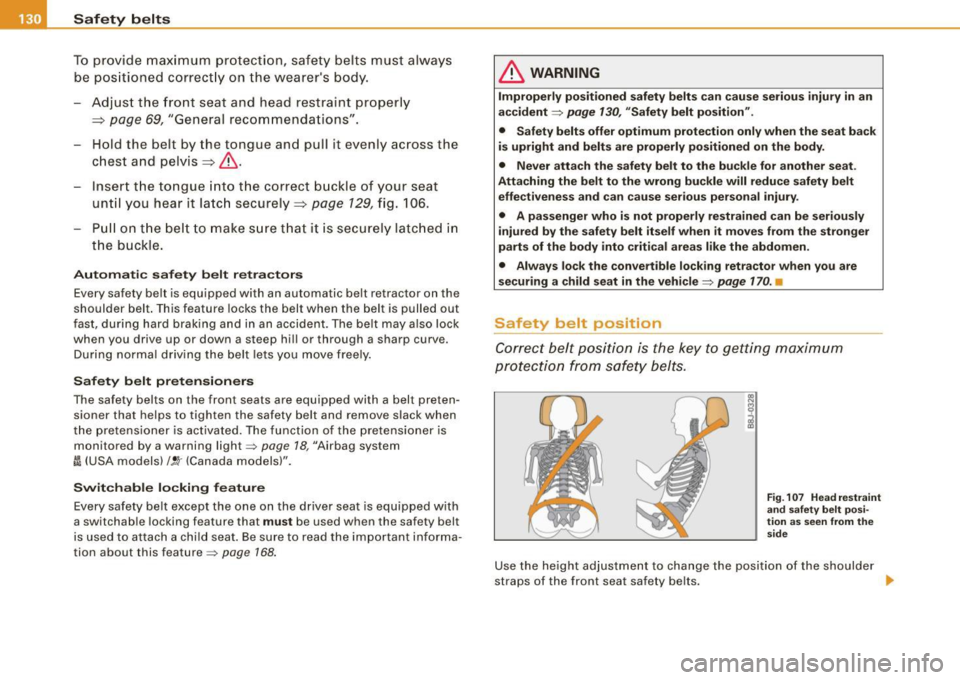
Safety belt position
Correct belt position is the key to getting maximum
protection f ram safety belts.
Fig. 107 Head restraint
and safety belt posi
tion as seen from the
side
Use the height adjustment to change the position of the shoulder
straps of the front seat safety belts.
~
Page 153 of 316

& WARNING
Items stored between the safety belt buckle and the center
console can cause the sensors in the buckle to send the wrong
information to the electronic control module and prevent the
Advanced Airbag System from working properly.
• Always make sure that nothing can interfere with the safety
belt buckles and that they are not obstructed.
as Perchlorate Material -special handling may apply, see
www.dtsc.ca.gov/hazardouswaste/perchlorate. When the vehicle or
parts of the restraint system including airbag modules safety belts
with pretensioners are scrapped, all applicable laws and regula
tions must be observed. Your authorized Audi dealer is familiar with
these requirements and we recommend that you have your dealer
perform this service for you. •
Safety first
Knee airbags
Description of knee airbags
Airbag system
The airbag system can provide supplemental protection
to properly restrained front seat occupants.
Fig. 114 Driver 's
airbag
The airbag for the driver is located in the instrument panel under
neath the steering wheel=> fig. 114, the airbag for the passenger is
at about the same height in the instrument panel underneath the
glove compartment.
The knee airbag offers additional protection to the driver's and
passenger's knees and upper and lower thigh areas as a supple
ment to the safety belts.
If the front airbags deploy, the knee airbags also deploy in frontal
collisions above a certain severity=>
page 144, "More importan t
things to know about front airbags".
Besides their normal safety function, safety belts work to help keep
the driver or front passenger in position in case of a frontal collision
so that the airbags can provide protection.
The airbag system is not a substitute for your safety belt. Rather, it
is part of the overall occupant restraint system in your vehicle.
Always remember that the airbag system can only help to protect
you if you are wearing your safety belt and wearing it properly. This •
Vehicle care I I irechnical data
Page 237 of 316
Tires and wheels -
----------------
•
& WARNING (continu ed )
crashes and serious personal in jur ies . Have worn or da maged t ires
replaced immediately .
• Tires age even if they are not being u sed and can fail suddenly ,
especially at high speeds. T ires that are more than 6 years old can
only be used in an emergency and then w ith special care and at
low speed.
Glossary of tire and loading terminology
Accessory weight
means the co mbined we ig ht ( in excess o f those sta nda rd items
which may be rep laced) of automatic transmission, power steering,
power brakes, power w indows, powe r seats, rad io, a nd heater, to
the extent that these items are avai lab le as factory-installed equip
m ent (w hether insta lled or not).
Aspect ratio
means t he ratio o f th e height to t he w idt h of the tire in perce nt.
N umbers of 55 or lower indicate a low sidewa ll for improved
steer ing respo nse and b ette r overall ha ndl ing on dry pave ment.
Bead
means the part of the tire that is made of stee l wires, wrapped or
reinforced by ply cords and that is shaped to fit the rim.
Bead separation
means a breakdow n of the bond be tween co mponents i n the bead.
Cord
means the strands fo rmi ng the plies in the ti re.
& W ARNING (continued )
• Never mount used tires on your vehicle if you are not sure of
their "previous history. " Old used t ire s may ha ve been damaged
even though the damage cannot be seen that can lead to sudden
tire failure and lo ss of vehicle control.
• If you noti ce unusual vibration or if the vehicle pulls to one side
when driving , always stop as soon as it is safe to do so and check
the wheels and tires for damage . •
Cold tire inflation pressure
mea ns t he ti re pressure reco mm ended by the ve hicle ma nufacturer
for a tire of a designated size that has not been d riven for more tha n
a cou ple o f miles (k ilometers) at low speeds in t he t hre e ho ur per iod
before the tire pressure is measured or ad justed .
Curb weight
means the weight of a moto r vehic le with standard equipment
i nc lud ing the max imu m capac ity o f fue l, o il, and coola nt, a ir c ond i
tioning and additiona l weight of optional equipment.
Extra load tire
means a tire designed to ope rate at higher loads and at higher infla
tion pressures than the corresponding standard tire. Extra load tires
my be identified as "XL",
"xi", "EX TRA LOAD", or "RF" on the side
wa ll.
Gross Axle Weight Rating ("GAWR ")
means the load -carrying capacity of a sing le ax le system, measured
at the ti re -ground interfaces.
Gross Vehicle Weight Rating ("GVWR "l
means the ma ximum tot al l oade d weigh t of the vehicle.
Vehicle care I t •
Page 249 of 316
________________________________________________ T_ i _r_e _s_ a_n_ d_ w_ h_ e_e _ l_s __ !II
•
holding, driving characteristics, and safety of the vehicle. The table
(::::>
page 238) l ists specifications of the tires approved for the Audi
models covered by your Owner's Literature.
The tire pressure labe l located on driver's side 8 -pillar (::::>
page 238,
fig. 149) lists the specifications of the or iginal equipment tires
installed on your vehicle at the time it was manufactured.
Federal law requires tire manufac turers to place standardized infor
mation on the sidewall of a ll tires::::>
page 246, fig . 152. This informa
tion identifies and describes the fundamenta l characteristics, the
quality grade of the tire and also provides a tire identification
number for safety standard certification a nd in case of a recall.
Tire sp ec ifica tio ns
Knowledge of tire specifications makes it easier to choose the
correct tires. Radial tires have the tire specifications marked on the
sidewall, for example:
P 245 / 45 R 17 9 5 H
This contains the following information :
P Indicates the tire is for passenger cars
245 Nominal tire width in mm of the tire from sidewall edge to side-
wall edge. In general, the larger the number, the w ider the tire
45 Height/width ratio in percent (aspect ratio)
R Tire construction: Radial
17 Rim diameter code (in inches)
95 Load rating code
H Speed rating letter code
XL (or "xi", "EXTRA LOAD", or "RF") indicates that the ti re is a"Rein
forced" or an "Extra Load" tire
M+ S (or "M/S") Indicates that the tire has some mud and snow capa
bility
The tires could a lso have the information of direction of rotation
=>
page 234 .
Tire manuf acturing date
The man ufact uring date is also indicated on the tire sidewall
(possibly on ly on the
inner side of the wheel):
"DOT ... 2209 . .. " means, for example, that the tire was produced in
the 22th week of 2009.
Speed rating (letter code )
The speed rating letter code on the wheels indicates the maximum
permissible road speeds=>
& in "Winter t ires" on page 250.
P up to 93 mph (150 km/h)
Q up to 99 mph (158 km/h)
R up to 106mph(170km/h)
S up to1 10mph(180km/h)
T upto118mph(190km/h)
U up to 124 mph (200 km/h) H up to 130 mph (2 10 km/h)
V up to 149 mph (240 km/h)3>
Z over 149 mph (240 km/h)3>
W up to 168 mph (270 km/h)3>
Y up to 186 mph (298 km/h)31
Your vehic le is normally factory equipped with tires, which possess
excellent driving characteris tics and give your Audi optimum
driving comfort. An electronic speed limiter:::>
page 25will normally
prevent your vehicle from going faster than the tire speed rat ing
=> & .
U.S . DOT Tire Identifi cation Number (TIN ) and tire
m anufa ctur e date
This is the tire's "serial number" . It begins with the letters "DOT"
and indicates that the tire meets all federa l standards . The next two
numbers o r letters indicate the plant where it was manufactured,
and the last four numbers represent the week and year of manufac -
~
31
For tires with a max imum speed capab il ity over 149 mph (240 km /h) , tire
manufacturers som etimes use th e le tters "ZR ."
Vehicle care I t •
Page 255 of 316
Tires a nd wh eels -
----------------
•
possible with a torque wrench -preferably by an authori zed Audi
dea ler or qua lified workshop. •
Low aspect ratio tires
Your Audi is factory-equipped with low aspect ratio tires. These t ires
have been thorough ly tested and been selected specifically for your
model for their superb performance , road feel and hand ling under
a variety of driving conditions . Ask your authorized Audi dealer for
more deta ils.
The low aspect rat io of these t ires is indicated by a numera l of
5 5 or
les s
in the tire's si ze designation. The numeral represents the ratio
of the tire's sidewa ll height in relation to its tread wid th expressed
in perc entage. Conv entiona l tires have a h eight/width ratio of 60 or
more .
The p erform an ce of lo w-aspe ct-r a tio tire s is pa rti cula rly sen siti ve to
improp er inflation pre ssure . It i s ther efore important that low
a spect ratio tir es are inflat ed to the sp ec ified pre ssure and th at the
i nflation pr es su re is regularl y checked and mainta ined . Tire pr es
s ure s should be che cked at le ast once a month and alw ay s before a
long tr ip :::;, page
247, "Checking tire pressure".
What you can d o to av oid tire and rim d amage
Low aspect ratio tires can be damaged more easi ly by impact with
potholes, curbs, gul lies or r idges on the road, particularly i f the t ire
is underinflated.
In order to min imize the occurrence of impact damage to the tires
of your vehicle , we recommend that you observe the following
precautions:
• Always maintain recommended inflat ion pressures . Check your
tire pressure every 2 ,000 miles (3,000 km) and add air if necessary.
• Drive carefully on roads with potholes , deep gullies or ridges.
The impact from driving through or over such obstacles can
damage your t ires. Impact with a curb may also cause damage to
your tires . •
After any impact , immediately inspect your tires or have them
inspected by the neares t authorized Audi dea ler . Replace a
damaged tire as soon as possib le.
• Inspec t you r tires every 2,000 miles (3,000 km) for damage and
wear . Damage is not always easy to see. Damage can lead to loss of
air and underin flation, which cou ld eventua lly cause tire fai lure. If
you be lieve that a tire may have been damaged , replace the tire as
soon as possible .
• These tires may wear more quickly than others.
• Please also remember that, while these tires de liver responsive
handling, they may ride less comfortably and make more noise than
other choices.
R edu ced p erform an ce in w int er/c old sea son
c ondition s
All tires are designed for c ertain purposes . The low aspect ratio,
ultra h igh performance tires origina lly instal led o n your vehic le are
intended for maximum dry and wet road performance and hand ling.
They are no t sui table for cold, snowy or icy weather conditions . If
you drive under those circumstances , you should equip your vehic le
with al l- season or winte r ti res, which offer better tract ion under
those conditions . We suggest you use the recommended snow or
all -season tires specified for your vehicle, or their equiva lent.
Refer to:::;,
page 250 for more de tai led information regarding winter
tires. •
Tire pressure monitoring system
Applies to vehi cles : with tire p ressu re mon itori ng sy stem
General notes ....J
Each t ire, including the spare (if p rovided), should be checked
month ly when co ld and inflated to the inflation pressure recom
mended by the vehicle manufacturer on the vehicle placa rd or tire
inf la tion pressure label. ( If your vehicle has tires of a different s ize _,.
Vehicle care I t •
Page 293 of 316

_______________________________________________________ D_ a _ t_a __ llll
Data
A pplie s t o vehic les: w it h 2 .0 lit er 4-cy l. engi ne
200 hp, 2.0 liter 4-cyl. turbo engine
Engin e da ta
Maximum output SAE net
Maximum torque SAE net
No . of cylinders
Displacement
Stroke
Bore
Compression ratio
Fuel
Dim ension s (app rox.)
Length (with licence plate bracke t)
Width (across mirrors)
Height (unloaded)
Turning circle diameter (curb to curb)
Ca pac ities (a pprox.)
F u el t ank
-Total capacity
- Reserve (of total capacity)
Wind shi eld and he adli ght * was her fluid container
E ngine oil
with filter change
Controls and equip
ment Safety first
hp@rpm
lb-ft@ rpm
CID (cm
3
)
in (mm)
in (mm)
200@ 5100 -6000
207 @ 1800 -5000
4
121 (1984)
3.65 (92.8)
3 .25 (82.5)
10.3 : 1
Premium unleaded (91 AKI) Recommended for maximum engine performance. Fur
ther details =>
page 217 , "Gasoline"
in (mm)
in (mm)
in (mm)
ft. (ml
164 .5 (4178)
76.9 (1952) 53 .2 (1352)
34 .7 (10.60)
gal/litres
gal/litres
quarts/litres
quarts/l itres 14.5 / 55 .0
1 .9 / 7.0
4.3
I 4.0
4.8
I 4.5 •
Vehicle operation Vehicle care Do-it-yourself service Tec hn ica l da ta
Page 294 of 316
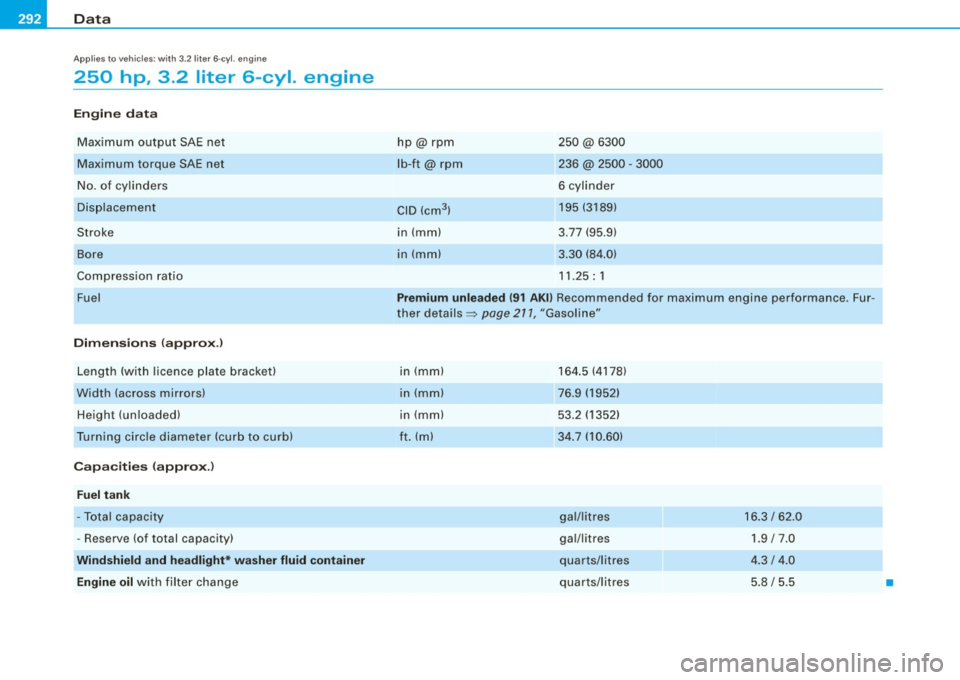
___ D_ a_ ta ______________________________________________________ _
Applies to vehicles : wit h 3.2 liter 6-c yl. en gine
250 hp, 3 .2 liter 6-cyl. engine
Engine data
Max imum output SAE net
Maximum torque SAE net
No . of cy linders
Di spl acement
Stroke
Bo re
Comp ress ion ratio
Fuel
Dimensions (appro x.>
Length (with licence plate brac ket)
Width (across mirrors) Height (un loaded)
Tur ning c ircle diameter (curb to curb)
Capacities {approx .>
Fuel tank
-To tal capacity
- Reserve (of total capacity)
Windshield and headlight* washer fluid container
Engine oil
with filter change hp@ rpm
lb-ft@ rpm
CID (cm
3
)
in (mm)
in (m m)
250@6300
236 @ 2500 -3000
6 cylinder
195 (3189)
3 .77 (95 .9)
3 .30 (84 .0)
11 .25 : 1
Premium unleaded {91 AKll Recommended for maximum engine performance . Fur
t her deta ils =:>
page 211, "Gasoli ne"
in (m m)
in (m m)
in (mm)
ft . (ml
16 4.5 ( 41 78)
76.9 (1952)
53 .2 ( 1352)
3 4. 7 (10 .60)
gal/litres
gal/ lit res
quarts/litres
quarts/l it re s 16.3 / 62 .0
1 .9 / 7 .0
4.3
I 4 .0
5.8 / 5.5
•