ECU AUDI TT COUPE 2009 Owner's Manual
[x] Cancel search | Manufacturer: AUDI, Model Year: 2009, Model line: TT COUPE, Model: AUDI TT COUPE 2009Pages: 316, PDF Size: 71.16 MB
Page 170 of 316
___ C_h_ i_ ld _ S_ a_ f_ e_ t_y ____________________________________________ _
& WARNING (continued )
• An improperly worn safety belt will not provide the best protec
tion in a crash and may cause serious personal injury . Always
m ake sure that children and other veh icle occupants properly
wear available restraint sy stem s. Carefully follow the instructions
provided by the manufacturers of child restraints . •
Installing a child safety seat
Securing a child safety seat using a safety
belt
S afety belts f or the rear sea ts an d the front pa ssenger can
b e l ocke d wit h th e co nv erti ble lockin g ret racto r to p rop
erly secu re c hild safety sea ts.
The safe ty be lts eme rgency loc king re tr acto rs for th e rea r s eat s
saf ety belts an d for t he front pass enger's seat safety be lt have a
co nve rtible lock ing retracto r for c hild r estra int s. The sa fet y b elt
must be loc ked so t hat belt we bbing cannot u nre el. T he r etrac to r
can be activated to lock the safety be lt and prevent the safety be lt
w eb bing fr om l oos enin g up dur ing n ormal dr ivi ng . A ch ild safe ty
seat can only be properly instal led when the safety belt is locked so
th at the chi ld and chi ld sa fety seat will st ay in pla ce.
Al ways rem embe r: Even t hough you r vehic le is equ ipped with an
A dva nced Airb ag s ystem, a ll chil dre n, esp ecia lly th ose 12 yea rs and
youn ger, s hou ld always ri de in the back seat prop erly rest rained for
thei r age and size .
& WARNING
Improperly installed child safety seats increase the risk of serious
personal injury and death in a collision .
& WARNING (continued)
• Always make sure that the safety belt retractor is locked when
installing a child safety seat . An unlocked safety belt retractor
cannot hold the child safety seat in place during normal driving or
in a crash.
• Always buckle the child safety seat firmly in place even if a
child is not sitting in it . A loose child safety seat can fly around
during a sudden stop or in a collision
• If the backrest is not securely latched, the child and the child
restraint will be thrown forward together with the backrest and
will strike parts of the vehicle interior . The child can be seriously
injured or killed .
• Never install rear-facing child safety seats or infant carriers on
the front passenger seat . A child will be seriously injured and can
be killed when the passenger airbag inflates .
• The inflating airbag will hit the child safety seat or infant
carrier with great force and will smash the child safety seat and child against the backrest, door or roof .
• Always install rear -facing child safety seats or infant carriers on
the rear seat.
• Forward-facing child safety seats or infant carriers installed on
the front passenger's seat may interfere with the deployment of
the airbag and cause serious injury to the child.
• It is safer to install a forward-facing child safety seat on the rear
seat .
• Always read and heed all WARNINGS whenever using a child
restrained in a vehicle is being used=> page
157 . Special precau
tions apply when installing a child safety seat on the front passenger seat=> page
137, "Child restraints on the front seat -
some important things to know" . ._
Page 172 of 316
___ C_ h_ il_ d _S_ a_fe _ ty ______________________________________________ _
Activating the convertible locking retractor
Use the convertible locking retractor to secure a child
restraint.
Always heed the child safety seat manufacturer's instruc
tions when installing a ch ild restraint in your vehicle. To
activate the convertible locking retractor:
- Place the child restraint on a seat, preferably on the rear
seat.
- Slowly pull the belt
all the way out .
-Route it around or through the child restraint belt path
=>& -
- Push the child safety seat down with your full weight to
get the safety belt really tight.
- Insert the belt tongue into the buckle for that seating
position.
- Guide the safety belt back into the retractor unt il the belt
lies flat and snug on the child safety seat .
- You should hear a "clicking" noise as the belt winds back
into the inertia reel. Test the convertible locking retractor
by pulling on the belt. You should no longer be able to
pull the belt out of the retractor. The convertible locking
retractor is now act ivated.
- Make sure that the red release button is facing away from
the child restraint so that it can be unbuckled quickly.
- Pull on the belt to make sure the safety belt is properly
tight and fastened so that the seat cannot move forward or sideways more than one inch (2 .5 cm) .
& WARNING
Using the wrong child restraint or an improperly installed child
restraint can cause serious personal injury or death in a crash.
• Always make sure that the safety belt retractor is locked when
installing a child safety seat. An unlocked safety belt retractor
cannot hold the child safety seat in place during normal driving or
in a crash.
• Always buckle the child safety seat firmly in place even if a
child is not sitting in it. A loose child safety seat can fly around
during a sudden stop or in a crash.
• Always make sure the seat backrest to which the child restraint
is installed is in an upright position and securely latched into place
and cannot fold forward. Otherwise, the seat back with the child
safety seat attached to it could fly forward in the event of an acci
dent or other emergency situation.
• Always read and heed all WARNINGS whenever using a child
restrained in a vehicle is being used=>
page 157. Special precau
tions apply when installing a child safety seat on the front
passenger seat=>
page 137, "Child restraints on the front seat -
some important things to know" .•
Deactivating the convertible locking retractor
The convertible locking retractor for child restraints will
be deactivated automatically when the belt is wound all
the way back into the retractor.
-Press the red button on the safety belt buckle. The belt
tongue will pop out of the buckle.
- Guide the belt all the way back into its stowed position .
Always let the safety belt retract completely into its stowed position.
The safety belt can now be used as an ordinary safety belt without
the convertible locking retractor for child restraints.
IJll-
Page 175 of 316
Description
Lower anchorages
Fig. 123 Rear seats:
lower anchorage
bracket locations
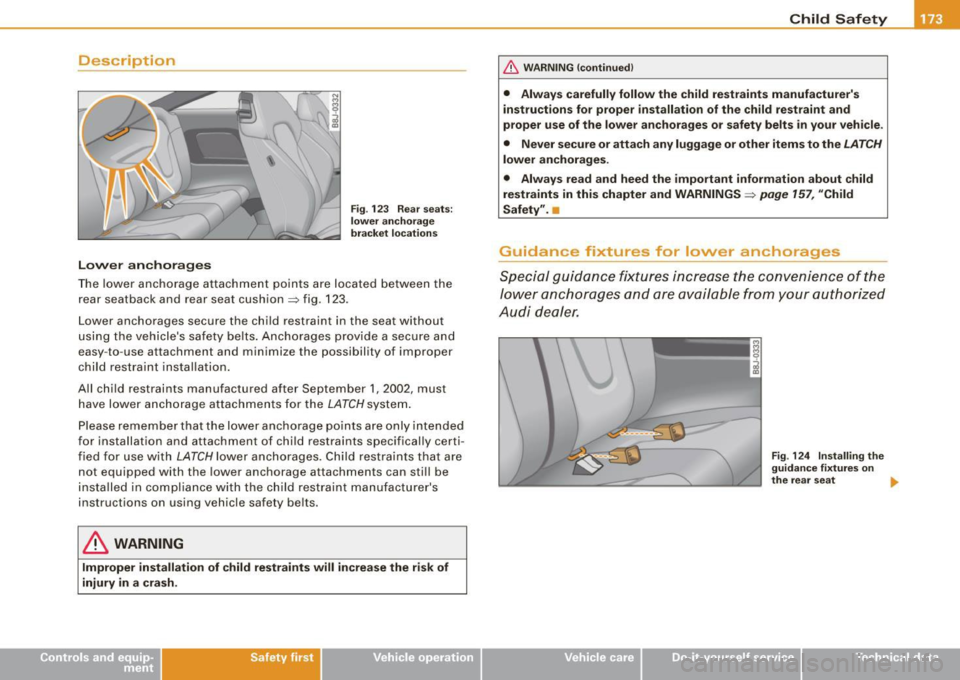
The lower anchorage attachment points are located between the
rear seatback and rear seat cushion~ fig. 123.
Lower anchorages secure the child restraint in the seat without
using the vehicle 's safety belts. Anchorages provide a secure and
easy -to -use attachment and minimize the possibility of improper
child restraint installation.
All child restraints manufactured after September 1, 2002, must have lower anchorage attachments for the
LATCH system.
Please remember that the lower anchorage points are only intended
for installation and attachment of child restraints specifically certi
fied for use with
LATCH lower anchorages . Child restraints that are
not equipped with the lower anchorage attachments can still be
installed in compliance with the child restraint manufacturer's
instructions on using vehicle safety belts.
,& WARNING
Improper installation of child restraints will increase the risk of
injury in a crash.
Safety first
Child Safety
& WARNING (continued)
• Always carefully follow the child restraints manufacturer's
instructions for proper installation of the child restraint and
proper use of the lower anchorages or safety belts in your vehicle.
• Never secure or attach any luggage or other items to the
LATCH
lower anchorages.
• Always read and heed the important information about child
restraints in this chapter and WARNINGS~
page 157, "Child
Safety". •
Guidance fixtures for lower anchorages
Special guidance fixtures increase the convenience of the
lower anchorages and are available from your authorized
Audi dealer.
Vehicle care I I
Fig . 124 Installing the
guidance fixtures on
the rear seat •
irechnical data
Page 176 of 316
___ C_h_ i_ ld _ S_ a_ f_ e_ t_y ____________________________________________ _
Fig. 125 Close-up:
fitting the guidance
fixture over the lower
anchorage bracket
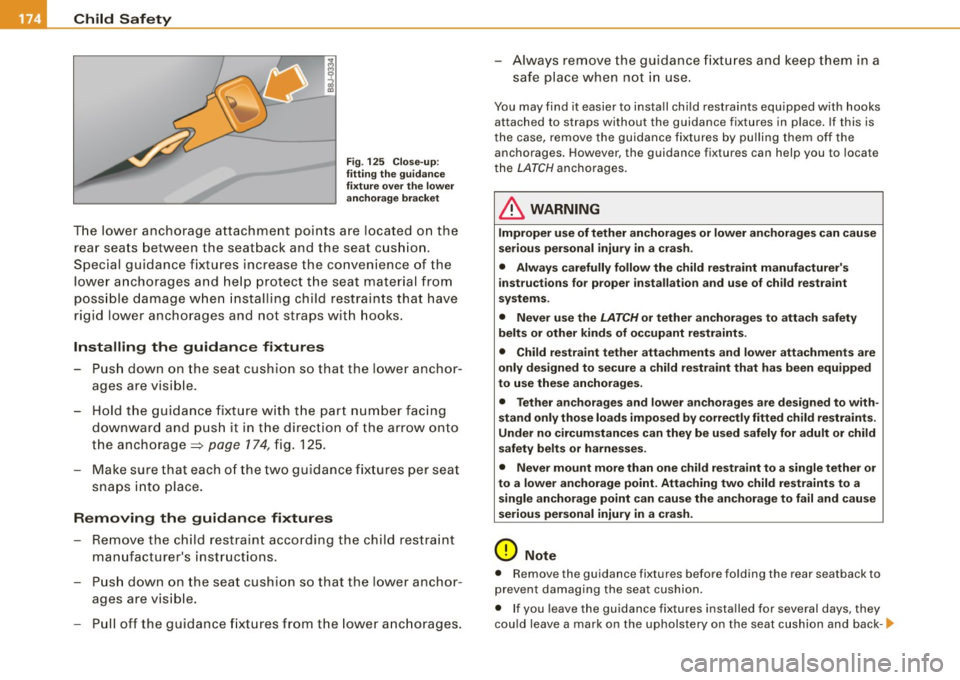
The lower anchorage attachment points are located on the
rear seats between the seatback and the seat cushion .
Special gu idance fixtures increase the convenience of the
lower anchorages and help protect the seat material from
possible damage when installing ch ild restraints that have
rigid lower anchorages and not straps with hooks.
Installing the guidance fixtures
- Push down on the seat cushion so that the lower anchor
ages are visible.
- Hold the guidance fixture with the part number facing
downward and push it in the direction of the arrow onto
the anchorage =>
page 174, fig. 125.
- Make sure that each of the two guidance fixtures per seat
snaps into place.
Removing the guidance fixtures
-Remove the child restraint according the child restraint
manufacturer's instructions.
- Push down on the seat cushion so that the lower anchor
ages are visible.
- Pull off the guidance fixtures from the lower anchorages. - Always remove
the guidance fixtures and keep them in a
safe place when not in use.
You may find it easier to install child restraints equipped with hooks
attached to straps without the guidance fixtures in plac e. If this is
the case , remove the guidance fixtures by pulling them off the
anchorages . However , the guidance fixtures can help you to locate
the
LATCH anchorages .
& WARNING
Improper use of tether anchorages or lower anchorages can cause
serious personal injury in a crash.
• Always carefully follow the child restraint manufacturer's
instructions for proper installation and use of child restraint
systems.
• Never use the
LATCH or tether anchorages to attach safety
belts or other kinds of occupant restraints.
• Child restraint tether attachments and lower attachments are
only designed to secure a child restraint that has been equipped
to use these anchorages .
• Tether anchorages and lower anchorages are designed to with
stand only those loads imposed by correctly fitted child restraints.
Under no circumstances can they be used safely for adult or child
safety belts or harnesses.
• Never mount more than one child restraint to a single tether or
to a lower anchorage point. Attaching two child restraints to a single anchorage point can cause the anchorage to fail and cause
serious personal injury in a crash.
0 Note
• Remov e the guidance fixtur es before folding th e rear se atback to
prevent damaging the seat cushion.
• If you leave the guidance fixtures installed for several days, they
could leave a mark on the upholstery on the seat cushion and back-~
Page 177 of 316
rest in the area that the guidance fixtures were installed. The uphol
stery would also be permanently stretched around the guidance
fixtures. This applies especially to leather seats.
[ i J Tips
• Always remove the guidance fixtures when not in use .
• Please keep the guidance fixtures in a safe place with the vehicle
when not in use.•
Installing a child restraint using the lovver
anchorages of the LATCH system
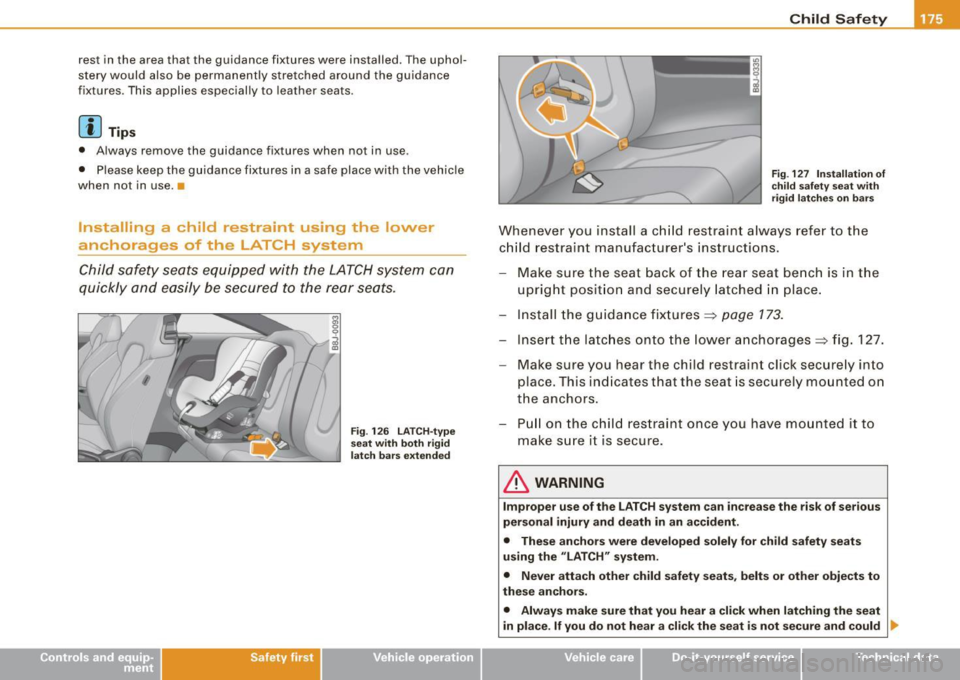
Child safety seats equipped with the LATCH system can
quickly and easily be secured to the rear seats.
Safety first
Fig . 126 LATCH-type
seat with both rigid
latch bars extended
Child Safety
Fig. 127 Installation of
child safety seat with
rigid latches on bars
Whenever you install a child restraint always refer to the
child restraint manufacturer's instructions.
- Make sure the seat back of the rear seat bench is in the
upright position and securely latched in place.
- Install the guidance fixtures==>
page 173.
Insert the latches onto the lower anchorages==> fig. 127.
- Make sure you hear the child restraint click securely into
place. This indicates that the seat is securely mounted on
the anchors.
- Pull on the child restraint once you have mounted it to
make sure it is secure.
& WARNING
Improper use of the LATCH system can increase the risk of serious
personal injury and death in an accident.
• These anchors were developed solely for child safety seats
using the "LATCH" system.
• Never attach other child safety seats, belts or other objects to
these anchors.
• Always make sure that you hear a click when latching the seat
in place. If you do not hear a click the seat is not secure and could .,
Vehicle care I I irechnical data
Page 178 of 316
___ C_h_ i_ld _ S_ a_ f_ e_ t-= y'------------------------------------------------
& WARNING (continued)
fly forward and hit the interior of the vehicle, or be ejected from
the vehicle.
& WARNING
Improper installation of child restraints will increase the risk of
injury in an accident.
• Always follow the child restraint system manufacturer's
instructions for proper installation of the child restraint system
and proper use of tether straps as well as the lower anchorages or
safety belts in your vehicle.
• Always read and heed the important information and WARN
INGS about child safety and the installation of child restraint
systems =>
page 157, "Child Safety" .•
Mounting and releasing the anchorage hook
If you use a child restraint system with hooks or other
latches attached to adjustable straps.
Mounting
Press the anchorage hook with the spring catch release
onto the lower anchorage so that the anchorage hook
locks into place.
Pull on the anchorage hook to make sure that it has
securely engaged the lower anchorage .
Tighten the strap following the child restraint manufac
turer's instructions.
Releasing
- Loosen the tension on the strap following the child
restraint manufacturer's instructions. -
Depress the spring catch on the hook.
- Hold the spring catch in depressed posit ion .
- Move the hook in the direction of the vehicle floor so that
there is enough space to release the anchorage hook
from the lower anchorage.
& WARNING
• Improper installation of child restraints will increase the risk of
injuries in a crash.
• Always refer to the child restraints manufacturer's instructions
for proper installation of the child restraint and proper use of the
lower anchorages or safety belts in your vehicle.
ti
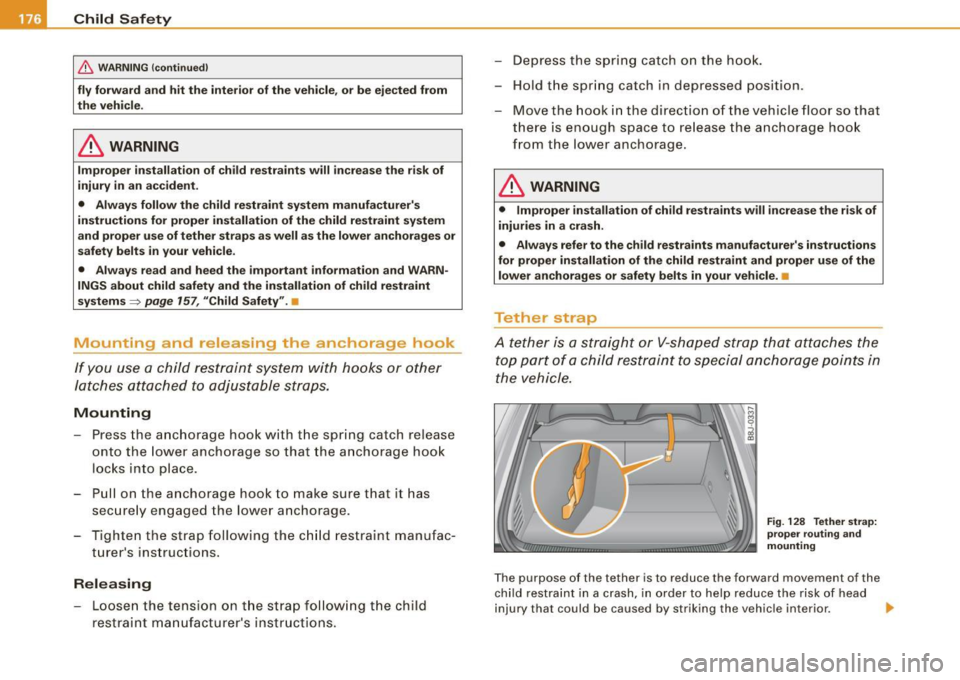
Tether strap
A tether is a straight or V-shaped strap that attaches the
top part of a child restraint to special anchorage points in
the vehicle.
Fig. 128 Tether strap:
proper routing and
mounting
Th e purpose of the tether is to reduce the forward movement of the
child restraint in a crash, in order to help reduce the risk of head
injury that could be caused by striking the vehicle int eri or. .,
Page 179 of 316
Fo rw ard facing child r estra ints manufactu red after September 1,
1 999, a re requ ired by U .S. f edera l r eg ulations to com ply wi th child
head movement pe rformance requ irements. These new perfo r
m ance req uir e m ent s m ake a tethe r neces sary on mos t new child
safety seats.
& WARNING
Improper installation of child restraints will increase the risk of
injury in a crash .
• Never attach a child safety seat tether strap to a tie-down hook
in the luggage compartment.
• Never secure or attach any luggage or other items to the LATCH
lower anchorages or to the tether.
• If a tether or other strap is used to attach a child restraint to the
front passenger seat , make sure that it is not so tight , that it
causes the weight-sensing mat to measure more weight than is
actually on the seat.
• The heavier weight registered can make the system work as
though an adult were on the seat and deploy the Advanced Airbag
when it must be suppressed causing serious or even fatal injury to
the child .•
Using tethers on rear-facing child restraint
systems
Curr ently, few r ear -facing chi ld restraint systems come with a tether.
P lease read and heed the c hild restrai nt s ystem manufac tu re r's
instructions careful ly to determine how to proper ly instal l the
tethe r.
Safety first
Child Safety
& WARNING
A child in a rearward -facing child safety seat installed on the front
passenger seat will be seriously injured and can be killed if the
front airbag inflates -even with an Advanced Airbag System .
• The inflating airbag will hit the child safety seat or infant
carrier with great force and will smash the ch ild safety seat and
child against the backrest , or door .
• A tight tether or other strap on a rearward-facing child restraint
attached to the front passenger seat can put too much pressure
on the weight-mat in the seat and register a heavier weight in the
Advanced Airbag System. The heavier weight registered can make
the system work as though an adult were on the seat and deploy
the Advanced Airbag when it must be suppressed causing serious or even fatal injury to the child.
• If you must install a rearward facing child safety seat on the
front passenger seat because of exceptional circumstances and
the PASSENGER AIR BAG OFF light does not come on and stay on ,
immediately install the rear-facing child safety seat in a rear
seating posit ion and have the airbag system inspected by your
Audi dealer . •
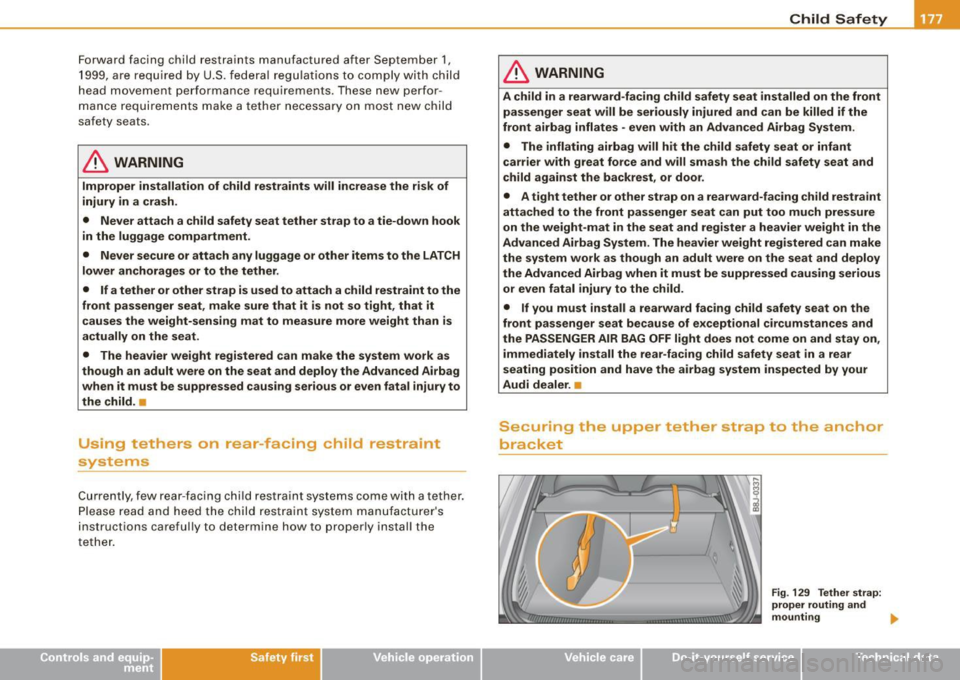
Securing the upper tether strap to the anchor
bracket
Vehicle care I I
Fig . 129 Tether strap:
prope r routing and
mounting ..
irechnical data
Page 219 of 316

___________________________________________ C_ h_e _c_ k_ i_n _g _ a_n _d_ f_il _li _n _g __ fflllll
•
Closing the engine hood
- Pull the hood down until the pressure from the struts is
reduced .
- Let the hood
drop down and latch in place. Do not try to
push it shut;
it may fail to engage => &.
& WARNING
A hood that is not completely latched could fly up and block your
view while driving.
• When you close the engine hood, check it to make sure the
safety catch has properly engaged. The hood should be flush with
the surrounding vehicle body parts.
• If you notice while driving that the hood is not secured prop
erly, stop at once and close it. •
Working in the engine compartment
Be especially careful whenever you work in the engine
compartment!
Whenever you must perform any work in the engine compartment,
for example checking and filling the different fluids, there is a risk of injury, burns and accidents. To prevent personal injury always
observe the following WARNINGS. The engine compartment of any
vehicle is a hazardous area!
~ &
& WARNING
To help avoid injury, before you check anything under the hood :
• Switch off the engine.
• Remove the ignition key.
• Apply the parking brake .
& WARNING (continued)
• Move selector lever of automatic transmission to "P" (Park);
put manual transmission in Neutral .
• Always let the engine cool down. Hot components will burn
skin on contact.
• To reduce the risk of being burned, never open the hood if you
see or hear steam or coolant escaping from the engine compart
ment. Wait until no steam or coolant can be seen or heard before
carefully opening the hood .
• Keep children away from the engine compartment.
• Never spill fluids on hot engine components . They can cause a
fire.
• Never touch the radiator fan. The auxiliary electric fan is
temperature controlled and can switch on suddenly.
• Never open the coolant reservoir cap when the engine is still
warm. The coolant system is pressurized and hot coolant could
spray out.
• Protect your face, hands and arm from steam or hot engine
coolant by placing a thick rag over the cap when you open the
coolant reservoir.
• If work on the fuel system or the electrical system is necessary:
- Always disconnect the battery.
- Never smoke or work near heaters or open flames. Fluids in
the engine compartment could start a fire .
- Keep an approved fire extinguisher immediately available.
• To avoid electrical shock and personal injury while the engine
is running or being started, never touch :
- Ignition cables
- Other components of the high voltage electronic ignition
system.
• If you must perform a check or repair with the engine running: ..,
Vehicle care
I t •
Page 225 of 316

Checking and filling -
--------------~-
•
-Screw the ca p back o n the filling h ole and sli de th e oil
dips tick in as far as it wil l g o .
& WARNING
• While topping off , the oil must not come in contact with hot
engine parts -fire haz ard!
• The oil filler cap must be properly secured to prevent oil from
being sprayed on the hot engine and exhaust system when the
engine is running -fire hazard!
• If your skin has come in contact with the engine oil , you must
subsequently cleanse it thoroughly.
0 Note
• T he oil level must not be above ran ge @ -da nge r of co nverter or
engine damage! Contact an authorized dealership to draw off oi l, if
n ec essary.
• Audi does not recommend the use of oil additives . They may
damage the engine and adversely affect your New Vehicle Warranty.
W For the sake of the environment
• Unde r no circumstances can the o il come in co ntact w ith the
sewage network or the soil.
• Observe an d follow le gal regulat io n s when d ispos ing o f empty
oi l containers. •
Changing the engine oil
We recom men d th at ha ve yo ur oil c hang ed by an a utho
r iz ed A ud i dealer o r a qualified servi ce s tatio n.
Befo re yo u ch ec k anything in the e ngine compa rtment, always read
and heed all WARNINGS=>
& in "Work ing in the en gine compart
ment" on
page 217 .
The engine oi l must be changed according to the interva ls specified
i n yo ur War ra n ty
& M ain te na n ce booklet . This is very i mportant
because the lubricating properties of oi l d iminish g radua lly during
no rma l vehicle use .
U nde r some circu msta nces the e ng in e o il s hou ld be cha nged mo re
frequently. Change oil more often if yo u drive most ly short
dista nces, opera te th e ve hicle i n dusty areas or under predo mi
nantly stop -and-go traffic conditions, or have your vehicle where
t empe ra tu re s rema in bel ow free zin g for e xtended per iods .
De tergent additives in th e oil will make fr esh oi l loo k dar k aft er the
eng ine ha s been ru nning f or a sho rt ti me. T his i s no rm al and is not
a reason to c hange th e o il more ofte n than reco mme nde d.
Because of the problem of proper disposal, along with the spec ial
to ols an d necessa ry ex pertise requ ired, we stro ngly reco mmend
that you have your oi l cha nged by an authorized
Audi dealer or a
q ua lif ied serv ice s ta tio n.
If you choose to change your oil yourself , please note the following
impo rtant infor mati on:
& WARNING
To reduce the risk of personal injury if you must change the engine
oil in your vehicle yourself :
• Wear eye protection .
• To reduce the risk of burns from hot engine oil , let the engine
cool down to the touch.
• When removing the oil drain plug with your fingers , stay as far
away as possible . Always keep your forearm parallel to the ground
to help prevent hot oil from running down your arm .
• Drain the oil into a container designed for this purpose, one
large enough to hold at least the total amount of oil in your engine .
• Engine oil is poisonous . Keep it well out of the reach of children . _,,,
Vehicle care
I t •
Page 231 of 316

_____________________________________________ C_h_ e_ c _ k_in -= g_a _ n_d _ f_il _li _n ..;::g =--____.""
When instal ling the battery, make sure the ignition and all electrica l
consumers are switched off~
0.
We recommend that you use maintenance -free or c yc le-re sis
tant/leak -proof
batteries according to the standards TL 825 06 (from
December 1997) and VW 7 50 73 (from August 2001 ) .
Rep lacing the battery should be carried by a qualified workshop .
Please follow the instruct ions on the battery cover.
0 Note
• All work on the battery requ ires technical knowledge . Please
contact an Audi dealership or another authorized facility for ques
t ions about the battery -dange r of acid burns and explosion hazard!
• T he battery must not be opened! Do not try to change the
battery 's liquid level, otherwise detona ting gas will escape from the
battery -explosion hazard I
• The AGM battery in the luggage compartmen t cannot lea k,
because the electrolyte for this battery is absorbed into a special
glass mat. Th is leak -proof battery must not be replace with a
conventional battery .
• Make sure the ventilation hose on the side of the battery is
connected, otherwise fumes or battery acid can leak out.
• Battery holder and term inals a lways have to be secured correctly.
• Before all work on the battery follow the
warnings below ~ & in
"Wor king on the battery" on
page 229 .
ci' For the sake of the environment
Because of the proble m of proper d isposal of a battery, we recom
mend your authorized Audi dealer change the battery for you.
Batteries contain sul furic acid and lead and m ust always be
disposed of properly in compliance with all environmenta l regula
t ions. Disposing of vehic le batteries improperly is ve ry dangerous to
the environment . Make sure that the removed battery cannot over
balance, otherwise su lfur ic ac id might escape!
[ i ] Tip s
If your vehic le is left standing for severa l weeks at extreme ly low
temperatures, the vehicle battery should be removed and stored
where it will not freeze. Th is will prevent it from being damaged and
having to be replaced .•
Working on the battery
Be especially ca ref ul when w orking on o r near the
battery!
F ig . 144 Luggag e
co mp artment :
AGM
battery
T h e ba ttery is loca ted in t he lug gage compartmen t.
Swing up the luggage compartment floor .
Remove the cover plate by t urning the thumb wheel.
The positive ( +l battery termina l is protected by a plastic cover. This
cover must be removed to access the posit ive ( +l terminal when
connecting jumper cab les to start the engine.
Always heed the
safety warning s, when working on the vehicle
battery or the vehicle e lectrica l system to prevent injury.
Vehic le care I I irechnical data