flat tire AUDI TT COUPE 2009 Owner's Manual
[x] Cancel search | Manufacturer: AUDI, Model Year: 2009, Model line: TT COUPE, Model: AUDI TT COUPE 2009Pages: 316, PDF Size: 71.16 MB
Page 260 of 316

-~_T_ ir_e_ s_ a_ n_d _ w_ h_ e_e _l_s _________________________________________________ _
• Transmitters with the same frequency , such as radio head
phones in the vehic le or radio equipment, can cause a temporary
disruption of the system through excessive electromagnetic fields .
• Elimina te the interference if possible/if you can and then
proceed as follows : Turn off the engine for 20 minutes . T hen drive
another
1 0 min. If the warning light comes on aga in, you should
contact your authorized Audi dealer immediately to have the problem corrected .
• Do not use commercially avai lable tire sea lants. Otherwise, the
e lectrical componen ts of the tire pressure monitoring system* wil l
no longer work properly and the sensor for the tire pressure moni
toring system * will have to be replaced by a qualified workshop .•
Run-flat tires
Ap plies to ve hic les : w it h R un -f la t tires
Introduction
Run-flat tires help keep you moving if a tire goes flat.
Re inforced sidewalls give the tires run -flat capability if t ire pressure
is lost .
We recommend that run -flat tires only be mounted on vehicles that
were origina lly equipped with these special tires at the factory and
have a Tire Pressure Monitoring System.
Run-flat tire s can be identified by the letter s "RSC" on the tire side
wa ll.
If you do change the tires on you r vehicle from normal to run -flat
tires , you must buy the special rims required for run -flat tires, and
the Tire Pressure Mon itoring System must be reprogrammed by an
authorized Audi dea ler or other qual ified workshop.
What do run -fl at tires do ?
These specia l tires have run-flat capabilities that help keep you
moving if a tire loses pressure and goes flat. Under favorab le condi -tions tires can be driven
a
t lea st 30 mile s (50 km ), but you must not
drive
fa ster than 50 mph (80 km/h )=> page 259, "Driving with run
flat tires".
The Tire Pressure Monitoring System constant ly checks the air pres
sure in the tires. If the run-flat system is active (shown in the center
display), you must inspect the affected t ire or t ires and then decide
whether to cont inue dr iving. Be sure to fol low these tips
=> page 259, "Driving with run -flat tir es" .
When it is n ot po ssible to c ontinue dri ving, ev en with
run-flat tir es?
• I f the Electronic Stabi lization Program (ESP) is not work ing o r
keeps coming on.
• I f the Tire Pressure Monitoring System does not work.
• I f the tire has been severely damaged, in a crash, for example .
T he t read can separate from a damaged tire as the wheel turns , and
hit parts of the vehicle, such as the fuel tank filler neck, fuel lines or
brake lines.
• Do not con tin ue d riving if severe vibra tion occurs or if the tire
starts to smoke because the tire is running hot.
• Do not conti nue drivi ng if da mage to the tire, such as cracks in
the sidewal l, appears .
& WARNING
Improper use of run -fl at tires can cause ve hic le da mage th at can
le ad to los s of vehicle control , a crash and seriou s personal injury .
• Run-flat t ires can only be used w ith spe cial rims .
• Run -fl at tires must always be monitored with a properly
programmed Tire Pre ssure Monitoring Sy stem.
• Alway s inspect a tire that ha s lo st air to make sure it i s safe to
drive with the tire in the run -flat mode .
• Never dr ive with run -fl at tire s th at have been dam aged in a
colli sion.
Page 261 of 316
________________________________________________ T_ ir_e _s_ a_n_ d_ w_ h _e_e_ l_s __ lfll
•
& WARNING (continued)
• Never drive with run-flat tires if heat build-up causes the tire to
give off smoke .
• Never drive with run-flat tires if the vehicle shakes or vibrates
severely.
• Never drive with a run-flat tire that develops sidewall cracks or
other damage while in use .
0 Note
Run-flat tires have specia l characteristics and requirements, that are
very different from conventional tires. Run-flat tires require special
rims for run-flat use and cannot be used on conventional wheel
rims.
[ i] Tips
• I f you are not able to continue driving with run -flat tires, please
seek professional assistance.
• Please contact your authorized Audi dealer or Audi of America,
Inc . if you have questions about tires and rims. •
Applies to vehic les: with Run-flat t ires
Driving with run-flat tires
Handling characteristics change when tire pressure is
low.
Driving on tires with low tire pressure changes the way a
vehicle handles, particularly when cornering and braking.
The handling characteristics of run-flat tires do not seem to
change a lot even when driving on low pressure or in the
run-flat mode. Nevertheless you must still take special
precautions when operating a vehicle on run-flat tires when
tire pressure is low or the tire(s) is flat: The
Electronic Stabilization Program (ESP) must be
switched on.
- Never drive faster than 50 mph (80 km/h)~
&-
Plan ahead when driving and anticipate what you will
have to do considering traffic and road conditions up
ahead.
- Accelerate carefully.
- Avoid unnecessary and sudden steering and braking
maneuvers.
Reduce your speed in plenty of time before intersections,
curves and other places where you may have to react
quickly.
Please see:=> page 258, "When it is not possible to continue driving,
even with run -flat tires?"
Handling characteristics change when driving with
low air pressure or with flat tires even with special run
flat tires
A low pressure or flat front tire affects vehicle handling characteris
tics by pulling the vehicle slightly to the side where the tire is
mounted and reduces braking performance.
A low pressure or flat rear tire also affects driving characteristics by
pulling to the side where the tire is mounted and also reduces
braking performance. The effect on vehicle handling is most notice
able when driving around curves.
& WARNING
Changed vehicle handling characteristics when driving in the run
flat mode can cause loss of vehicle control, a crash and serious personal injury. .,,,
Vehicle care
I t •
Page 262 of 316
_L-_T.:..:..: ir:...:e=. s=---.: a=-:... n:..:d ::.......: w:...:....: h....:..-= e..:e :...:1-=s --------------------------------------------------
& WARNING (continued)
• Driving on special run-flat tires in the run-flat mode will change
vehicle handling characteristics during braking, when cornering
and under heavy acceleration .
• Never drive faster than the maximum rated speed of 50 mph
180 km/h) when driving in the run-flat mode.
• Always adjust vehicle speed to traffic, road and weather condi
tions and drive slower than the maximum rated speed if necessary
weather and road conditions are taken into account .
• Always obey speed limits and other traffic laws.
0 Note
We always recommend driving with even more care when using
these special tires in the run-flat mode. Always avoid sudden
maneuvers. •
Applies t o veh icles: wit h Run -f lat tires
Replacing run -flat tires and rims
Your vehicle was especially designed to use special run
flat tires.
You may use and combine only approved run-flat tires and special
matching rims that have been designed for run-flat tires. Mounting
special run-flat tires on standard wheels will not work and will not
provide the advantages fo the run-falt feature. Never use special
run-flat tires on standard wheel rims .
After driving with a tire in the run -flat mode , always have the vehicle
and affected tire(sl and rim(s) inspected by an authorized Audi
dealer. Tires that have been driven in the run -flat mode must be
replaced.
& WARNING
Use of damaged run-flat tires and rims can cause vehicle damage
that can lead to loss of vehicle control, a crash and serious
personal injury .
• Always have the vehicle and affected tire(sl and rim(sl
inspected by an authorized Audi dealer after driving a tire in the
run-flat mode.
• Tires that have been driven in the run-flat mode must be
replaced. •
Page 268 of 316
1111...__W_ h_ a _ t_d_ o_ l _d _o_ n_ o_ vv_ ? ______________________________________________ _
[ i J Tips
• If sealant has run out, allow it to dry. Then you can peel it off .
• Have the tire sealant replaced every 4 years at a d ealership. •
Applie s to ve hicles: with T ire Mob ilit y Sy stem
Preliminary steps
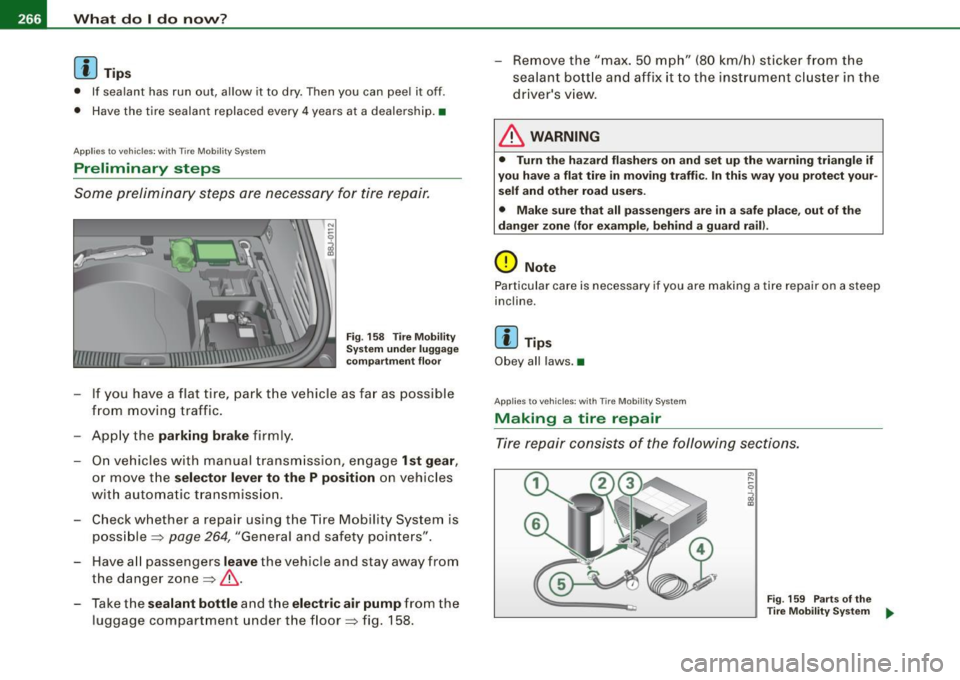
Some preliminary steps ore necessary for tire repair.
Fig . 158 Tire Mobility
System under luggage
compartment floor
- If you have a flat tire, park the vehicle as far as possible
from moving t raffic.
- Apply the
parking brake firmly.
- On vehicles w ith manual transmission, engage
1st gear,
or move the selector lever to the P position on vehicles
w ith automat ic transmission.
- Check whether a repair using the Tire Mob ility System is
possible ~
page 264, "General and safety po inters".
Have all passengers
leave the vehicle and stay away from
the danger zone~& .
- Take the
sealant bottle and the electric air pump from the
luggage compartment under the floor~ fig. 158. - Remove the "max. 50 mph"
(80 km/h) sticker from the
sealant bottle and affix it to the instrument cluster in the
driver's view.
& WARNING
• Turn the hazard flashers on and set up the warning triangle if
you have a flat tire in moving traffic. In this way you protect your
self and other road users.
• Make sure that all passengers are in a safe place, out of the
danger zone (for example, behind a guard raill.
(D Note
Particular care is necessary if you are making a tire repair on a steep
inc line .
[ i J Tips
Obey all laws. •
App lies to ve hicles: w ith T ire Mob ility System
Mak ing a tire repa ir
Tire repair consists of the following sections.
Fig. 159 Parts of the
Tire Mobility System ..
Page 269 of 316
_____________________________________________ W.:..:..; h:..:.= a:.:t ..:.d=-= o:....:... I .::d :.:o :....:.. n:.:o::.. w.:...:.. ?:...___J
Assembling Tire Mobility System
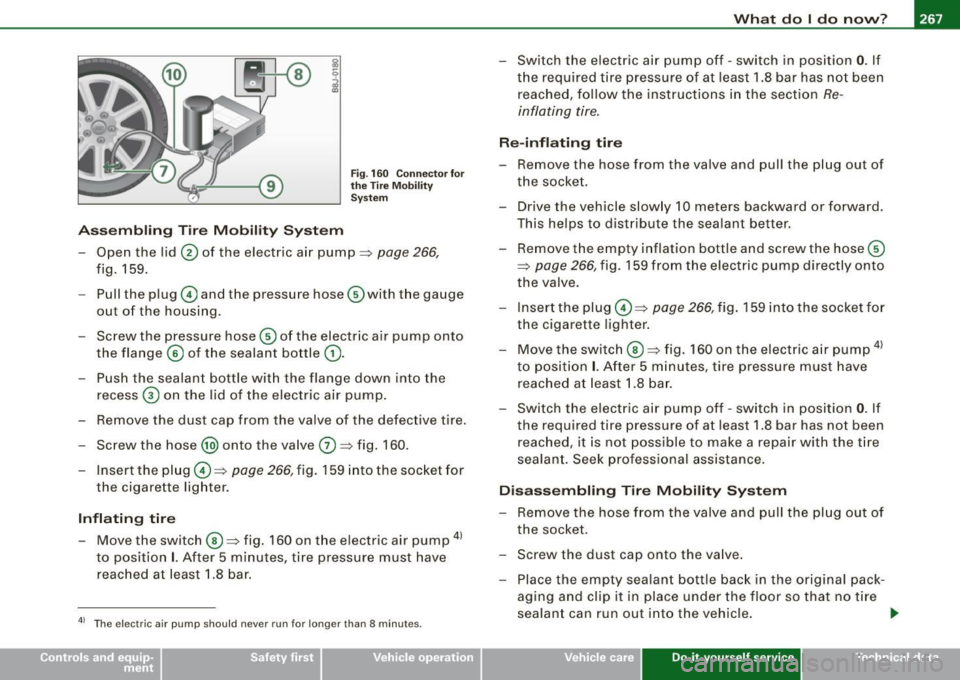
Fig . 160 Connector for
the Tire Mobility System
Open the lid 0 of the electric air pump:::;, page 266,
fig. 159.
- Pull the plug © and the pressure hose G)with the gauge
out of the housing.
- Screw the pressure hose© of the electric air pump onto
the flange © of the sealant bottle
G).
-Push the sealant bottle with the flange down into the
recess
0 on the lid of the electric air pump.
- Remove the dust cap from the valve of the defective tire.
- Screw the hose@) onto the valve
0:::;, fig. 160.
- Insert the plug©:::;,
page 266, fig. 159 into the socket for
the cigarette lighter.
Inflating tire
- Move the switch®:::;, fig. 160 on the electric air pump
4
l
to position I. After 5 minutes, tire pressure must have
reached at least 1.8 bar.
41 The electric a ir pump should never run for longer than 8 minutes .
-Switch the electric air pump off -switch in position 0. If
the required tire pressure of at least 1.8 bar has not been
reached, follow the instructions in the section
Re-
inflating tire.
Re-inflating tire
- Remove the hose from the valve and pull the plug out of
the socket.
- Drive the vehicle slowly 10 meters backward or forward.
This helps to distribute the sealant better.
- Remove the empty inflation bottle and screw the hose©
:::;, page 266, fig. 159 from the electric pump directly onto
the valve.
- Insert the plug ©:::;,
page 266, fig. 159 into the socket for
the cigarette lighter.
- Move the switch®:::;, fig. 160 on the electric air pump
4
l
to position I. After 5 minutes, tire pressure must have
reached at least 1.8 bar.
- Switch the electric air pump off -switch in position
0. If
the required tire pressure of at least 1.8 bar has not been
reached, it is not possible to make a repair with the tire
sealant. Seek professional assistance.
Disassembling Tire Mobility System
- Remove the hose from the valve and pull the plug out of
the socket.
- Screw the dust cap onto the valve.
- Place the empty sealant bottle back in the original pack-
aging and clip it in place under the floor so that no tire
sealant can run out into the vehicle. .,
Vehicle care Do-it-yourself service irechnical data
Page 270 of 316
11111.___W_ h_ a _ t_d_ o_ l _d _o_ n_ o_ w_ ? ______________________________________________ _
-Place the electric air pump in the luggage compartment
for the time being.
- Start driving right away so that the sealant is dist ributed
in the tire.
& WARNING
• Follow the manufacturer's safety instructions on the decal for
the air pump and the sealant bottle.
• If a tire pressure of 1.8 bar cannot be achieved after pumping
for 5 minutes, the tire is too severely damaged. Do not continue to
drive.
• Seek professional assistance if it is not possible to repair the
tire with the tire sealant.
[ i] Tips
• Do not operate the electric air pump for more than 8 minutes
without stopping, otherwise it can overheat. When the air pump has
cooled down, you can continue to use it.
• If sealant has escaped, allow it to dry, then you can peel it off. •
Applies to veh icles: with Tire Mob ili ty Sys tem
Final check
After driving for a short distance, tire pressure
must be checked
- After driving for about 10 minutes, stop and check the
tire pressure.
- If tire pressure is still at least 1.3 bar, inflate the tire to
specified pressure (see driveas side B-pillarl, drive to the
next repair shop and have the tire and the sealant bottle
replaced. -
If tire pressure is less than 1.3 bar, the tire is too severely
damaged. Do not continue to drive. Seek professional
assistance.
& WARNING
If tire pressure is less than 1.3 bar after driving for 10 minutes, the
tire is too severely damaged. Do not continue to drive. Seek profes
sional assistance.
[ i] Tips
After a tire repair, have the sealant bottle replaced at a dealership.
This restores full functionality to the Tire Mobility System. •
What should I be aware of when
changing a tire?
General information
The following sections will provide you with important information
on how to change a tire using the vehicle tool kit.
However, we recommend that you have a qualified service center
change the tire and perform all work associated with changing it. •
Page 273 of 316
What do I do now? -
------------------
Fig. 165 Close-up:
proper positioning of
lifting jack
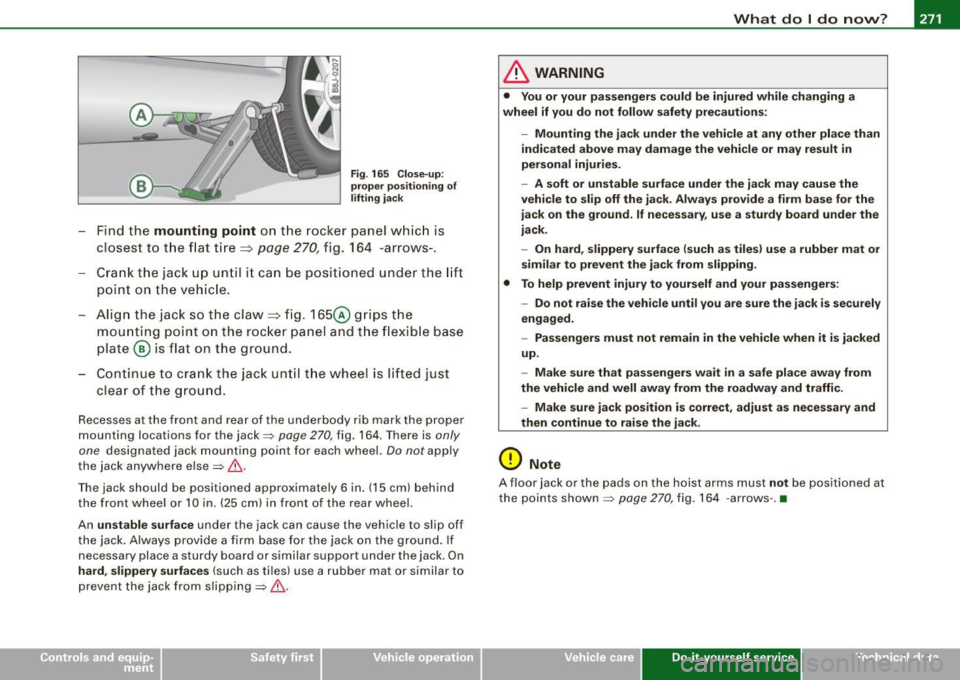
- Find the mounting point on the rocker panel which is
closest to the flat tire =>
page 270, fig. 164 -arrows-.
- Crank the jack up until it can be positioned under the lift
point on the vehicle.
- Align the jack so the claw=> fig. 165@ grips the
mounting point on the rocker panel and the flexible base
plate ® is flat on the ground.
- Continue to crank the jack until the wheel is lifted just
clear of the ground.
Recesses at the front and rear of the underbody rib mark the proper
mounting locations for the jack=>
page 270 , fig. 164. There is only
one
designated jack mounting point for each wheel. Do not apply
the jack anywhere else=>&.
The jack should be positioned approximately 6 in. (15 cm) behind
the front wheel or 10 in. (25 cm) in front of the rear wheel.
An
unstable surface under the jack can cause the vehicle to slip off
the jack. Always provide a firm base for the jack on the ground. If
necessary place a sturdy board or similar support under the jack. On
hard, slippery surfaces (such as tiles) use a rubber mat or similar to
prevent the jack from slipping=> &.
& WARNING
• You or your passengers could be injured while changing a
wheel if you do not follow safety precautions:
-Mounting the jack under the vehicle at any other place than
indicated above may damage the vehicle or may result in
personal injuries.
- A soft or unstable surface under the jack may cause the
vehicle to slip off the jack. Always provide a firm base for the
jack on the ground. If necessary, use a sturdy board under the
jack.
- On hard, slippery surface (such as tiles) use a rubber mat or
similar to prevent the jack from slipping.
• To help prevent injury to yourself and your passengers:
-Do not raise the vehicle until you are sure the jack is securely
engaged.
- Passengers must not remain in the vehicle when it is jacked
up.
- Make sure that passengers wait
in a safe place away from
the vehicle and well away from the roadway and traffic.
- Make sure jack position is correct, adjust as necessary and
then continue to raise the jack.
0 Note
A floor jack or the pads on the hoist arms must not be positioned at
the points shown
=> page 270 , fig. 164 -arrows -. •
Vehicle care Do-it-yourself service irechnical data
Page 275 of 316
What do I do now? -
----------------
•
• The whe el bo lts should be cl ean and easy to turn . C heck for dirt
an d corro sion on the mati ng s urfaces o f both th e wheel a nd the
hub. Remove a ll dirt fro m these surfaces before remountin g the
whee l.•
Notes on wheel change
Ple as e rea d th e informati on => pag e 246 , "New tir es an d r ep laci ng
tir es and whee ls", if you ar e goin g to us e a spar e tire which is
d ifferent from th e tir es on y our v ehic le .
After you ch ange a tire :
• Check the tire pressure on the spare immediately after
mounting.
• Have the wheel bolt tightening torque checked with a torque
wrench as soon as possible by your authorized Audi dealer or a qualified service station .
• With steel and alloy wheel rims, the wheel bolts are correctly
tightened at a torque of 90 ft lb (120 Nm l.
• If you notice while changing a tire that the wheel bolts are
corroded and difficult to turn , then they should be replaced before
you check the tightening torque.
• Replace the flat tire with a new one and have it installed on your
vehicle as soon as possible . Remount the wheel cover.
Until then , drive with extra care and at reduced speeds .
& WARNING
• If you are going to equip your vehicle with tires or rims which
differ from those which were factory installed , then be sure to read
the information
=> page 246, "New tires and replacing tires and
wheels ".
• Always store the tools securely in luggage compartment .
Otherwise, in an accident or sudden maneuver they could fly
forward, causing injury to passengers in the vehicle.
0 Note
D o not us e comme rc ia lly av ai labl e tire sea lants. Otherw ise, t he elec
trical components of the ti re pressure monitor ing system* will no
l o nger wor k properly a nd the se ns or fo r the tire pr essure moni
to ring system will have to be rep laced b y a qualified workshop. •
Tires with unidirectional tread design
T ires w ith unid ire ction al tread design must be m ounted
w ith their tread patte rn po inted t he r ight dire ction.
A un id irectiona l tir e ca n be iden tified by arrows on the sidewall ,
w hi ch point in th e dir ec tion of the r otation. You mus t follow th e
specified direction of rotati on. T his is necessa ry in o rder fo r these
t ire s to de ve lop their optimum ch arac ter ist ics rega rdin g grip, r oad
noise, wear, and h ydroplaning .•
Do-it -yourself service
Page 303 of 316

______________________________________________ A_ l.:.. p _h_ a_ b_e _t_ic _ a _ l _in _ d_e _ x __ _
Automatic transmission ..... ... .. .... . 99
Driving Notes ... .. .... ... .... .... 102
Emergency program .. .... ... .... . 105
Emergency release . . . . . . . . . . . . . . . 106
Ignition key safety lock ....... .... .. 92
Kick-down .. ... .. .... .... ...... .. 105
Launch Control Program ........... 105
Selector lever lock .. ...... ...... .. 101
Selector lever positions ........... 100
Tiptronic ... .. .... .... ........... 103
Tiptronic controls on the steering wheel
104
Average fuel mileage ... .... .... .... .. 26
Average speed . ... .. .... .... .... .... . 26
Avoid damaging the vehicle ......... . 192
B
Battery . ...... ..... ... .... .... . 228, 231
Battery location inside the engine compartment ... .... .... .... 218,219
Charging . .... .... .... ... .... .... 232
Checking battery acid level .... 231, 232
Connecting ... ... ..... ... .... ... . 228
Disconnecting ....... ....... .... . 228
Important warnings when working on the
battery ..... .... ....... ...... .. 229
Replacing the battery . ....... .... . 228
Winter operation . .... .... ... .... . 228
Working on the battery ... .... .... . 229
Battery voltage ......... .... ......... 36
Before driving .. ...... .. ....... ..... 114
Bi -Xenon headlights ........... .. .... . 57
Blended gasoline ... .... .... ... .... . 211
Controls and equip
ment Safety first
Body
cavity sealing .... .. ..... ... ... . 204
Booster seats .... .... .... .... .... ... 165
How do I properly install a booster seat in
my vehicle? . ... ... ....... .. .... 165
Safety instructions ..... .... ... .... 165
Brake fluid Changing the brake fluid .. .... .... 227
Checking the brake fluid level ...... 227
What is the correct brake f luid level? 227
What should I do if the brake fluid warning
light comes on? . ........ ... ..... 227
Brake fluid reservoir ..... .... .... .... 227
Brake system . ... ...... ......... .... 227
Anti-lock brake system ... .... ... .. . 20
Brake Assistan t .... . .. .. .. . ... ... 187
Brake fluid .... ... .... ...... ...... 227
Brake fluid specifications for refi ll and
replacement . ... ..... ... .... .... 227
Brake light defective . .... .... .... .. 37
Brake pads ... ... ..... ... .... ... . 191
General information . .... .. .. .. ... 186
How does the moisture or road salt affect
the brakes? ............... ...... 1 86
Malfunction .... ........... ...... . 33
Warning/indicator lights .. ..... .... . 19
Worn brake pads symbo l .... ...... . 36
Break -in period ........ ............. 190
Brake pads ...... ..... ....... .... 191
Tires .... . ... ... ... ... .... .... ... 190
Bulbs ..... .. .... ..... .. ... ... ...... 278 C
California Proposition 65 Warning . .... 218
Battery specific .... ... .... .... .... 231
Capacities ... .... .... .... ... .... .... 291
Car care ... ..... .. .. .... .... .... .. . . 198
Interior .... ... .. .. .... ........ ... 205
Plastic and vinyl .. ............... . 202
Weatherstrips ... .. .... .. . .... ... . 203
Care of exterior . ..... ....... ....... . 198
Cargo area
See Luggage compartment . ... .... . 121
Cargo net .. .... .. .. .... .... .... .... . 78
Catalytic converter .. .... .... .... ... . 191
CD changer .... ... .. .... .... .... .. .. . 84
Certification .. ....... ....... ..... ... 296
Changing a flat tire ......... .... ... .. 268
Changing engine oi l .. .... ... .... .. .. 223
Chassis Undercoating . ... .... .... .... ... . 205
See also Audi magnetic ride .... .... . 98
Checking Battery acid level .. ....... .... 231, 232
Engine coolant level ...... .... .... 225
Checking tire pressure ..... .... ...... 241
Child restraint Danger of using ch ild restraints in the
front seat ... .... .... .... ... ... . 137
Child restraints What types of child restraint anchors are
avai lable? ... .... .... .... ...... . 171
Where can I get additional information
about child restraints? ........... 171
Vehicle operation Vehicle care Do-it-yourself service Technical data
Page 304 of 316
___ A_l.:. p _h_ a_ b_e _t _ic _ a_l _in _ d_e _x ____________________________________________ _
Child safety ...... ... .... ...... . 157,162
Booster seats . . . . . . . . . . . . . . . . . . . . 165
Convertible child safety seats . . . . . . 163
Convertible locking retractor . . . . . . . 168
Guidance fixtures for lower anchorages
173
Important safety instructions for using child safety seats .... ....... .... 160
Important things to know when driving
with children ................... 157
Infant seats ..................... 162
Insta lling a child restraint using the
LATCH system . . . . . . . . . . . . . . . . . . 175
Lower anchorages . . . . . . . . . . . . . . . 173
Mounting and releasing the anchorage hook .. ...... .... ....... ....... 176
Older children and safety belts . . . . . 167
Safety belts and older children . . . . . 167
Tether strap . . . . . . . . . . . . . . . . . . . . . 176
Which restraint system should my older child wear? ................. ... 167
Child safety seat .. ........... ....... 162
Convertible locking retractor . . . . . . . 168
Installing . .... ... ..... ..... .. ... 168
child safety seat LATCH system . . . . . . . . . . . . . . . . . . . 175
Child safety seats How do I properly insta ll a chi ld safety
seat in my vehicle? ... .... ....... 160
Safety instructions . . . . . . . . . . . . . . . 160
Cigarette lighter ..................... 82
Cleaning Alcantara (synthetic suede) . . . . . . . . 208
Engine compartment ... .. .... .... 209 Fabrics and fabric c
,overings ....... 205
Instrument panel ... .... .... .... .. 206
Interior ......................... 205
Leather ......................... 207
Plast ic and vinyl ....... .... ...... 202
P lastic parts ............... ... ... 206
Safety belts . . . . . . . . . . . . . . . . . . . . . 209
Trim strips ... .... ... .. .... .. 201,202
Cleaning and protection .. ........ ... 198
Climate control A/C operation . . . . . . . . . . . . . . . . . . . . . 89
Air distribution .... ........ ....... 87
Automatic mode . . . . . . . . . . . . . . . . . . 88
Defrost ............. ...... ....... 88
Economical use ... ...... ..... ... .. 89
Fan ............................. 87
Heated seats . . . . . . . . . . . . . . . . . . . . . 90
Rear window defogger . . . . . . . . . . . . . 89
Switching on and o ff ...... .... .... 87
Climate controls ........ ........... .. 85
Air recirculation mode . ...... ...... 88
Controls . . . . . . . . . . . . . . . . . . . . . . . . . 85
Dust filter ..... ....... ............ 85
Heating .. .... .... ... .. .... .... ... 85
Pollen fi lter ... ....... ...... .... ... 85
Venti lation ... ... .. .... .... ....... 85
Clock ....... ....... ... .............. 13
Coat hooks ............... .... ... .... 84
Co ld tire inflation pressure ........... 238
Coming -home -function ... .... ....... . 55
Compass mirror ............... ...... 67
Compliance .. .... ... .... ... ... .. ... 296
Consumer Information .... ....... 123, 293 Contacting NHTSA
... .. .. .... .... ... 123
Controls and disp lays ...... ...... .... . 11
Convenience close/open feature Windows ... ... .... .... ... .... .... 49
Convertible child seats How do I properly install a convertible chi ld seat in my vehicle? ......... 163
Safety instructions .... .... .... ... 163
Convertible locking retractor Activating ............. .... ...... 170
Deactivating ... .... ....... .... ... 170
Using to secure a child safety seat .. 168,
170
Coolant System Expansion tank ... .... .... .... ... 225
Coolant system .. .... .... .... ....... 224
Cornering light ...................... 54
Cruise contro l ........ ... .... .... .... 96
Changing speed . ...... .... .... ... 97
Presetting your speed .......... .... 97
Switching off ... .. .... .... .... .... 97
Switching on ...... .... ... .... .... 96
Warning/indicator lights .... ....... . 18
Cup holder ... .... .... ....... .... .... 81
Current fuel mileage .................. 26
D
Damping
See Audi magnetic ride .... ... .. .... 98
Data .............................. 291
Data recorder ...................... 182
Datedisplay . ......... .... ... .... .... 13