instrument cluster AUDI TT COUPE 2009 Owner's Manual
[x] Cancel search | Manufacturer: AUDI, Model Year: 2009, Model line: TT COUPE, Model: AUDI TT COUPE 2009Pages: 316, PDF Size: 71.16 MB
Page 150 of 316
___ A_ ir_ b_ a-g _ s_y _s_ t_ e_ m _________________________________________________ _
the weight-sensing mat to measure more weight than is actual ly on
th e seat .
If the PASSENGER AIR BAG OFF light still does not come on and does
not stay on continuous ly (when the ignition is switched on),
• t ake the c hild res traint off t he front passe ng er seat a nd ins tall it
properly at one of the rear seat pos it ions. Have the a irbag system
insp ect ed by y our A udi deal er immedia tely .
• move the chi ld to a rear seat position and make sure that the
c h ild is pro pe rly restrai ned in a c hild restraint that is app ropriat e for
its size and age.
The
PASSENGER AIR BAG OFF l igh t sho uld NOT come on when the
ignition is on and an adult is sitt ing in a proper seating position on
the front passenge r seat . If the
PASSENGER AIR BAG OFF light
comes on a nd s tays o n or fl ashes for about 5 seco nds whi le d riving,
under these ci rcumstances, make sure that:
• the adult on the fron t pass enger sea t is pro perly s eate d on the
cent er of the seat cushion with his or her back up against the back
rest and the backrest is not reclined => page 116, "Proper occ upant
seating positions",
• t he ad ult is not ta king w eig ht o ff the sea t by hol ding o n to the
passenger assist hand le above the front passenger door or
su ppo rting their w eigh t on the arm res t,
• the safety be lt is being proper ly worn and that there is not a lot
o f sla c k in the sa fe ty b elt web bin g,
• accessory seat covers or cushions or other things that may cause
an incorrect read ing o r impression on t he w eight -s e nsi ng m at
under the upho lstery of the seat have been removed from the front
pass enger seat,
• a safety be lt extender has not been left in the safety be lt latc h for
th e fro nt passenger sea t.
In addition to the
PASSENGER AIR BAG OFF l ight in the center of the
instrument pane l, the mes sage
PASSENGER AIR BAG OFF o r
PASSENGER AIR BAG ON will br iefly appear in the instrument cluster display. This is to inform the driver of the curren
t front passenger
air bag status .•
Important safety instructions on monitoring
the Advanced Airbag System
& WARNING
An airbag system that is not functioning properly cannot provide
supplemental protect ion in a frontal crash.
• If the airbag indicator light comes on , it means that there may
be something wrong with the Advanced Airbag System . It is
possible that the airbag will inflate when it is not supposed to, or
will not inflate when it should .
• Have the airbag system inspected immediately by your Audi
dealer .
& WARNING
If the front airbag inflates , a child without a child restraint, in a
rear ward-facing child safety seat or
in a forward-facing child
restraint that has not been properly installed will be seriously
injured and can be killed .
• Even though your vehicle is equipped with an Advanced Airbag
System , make certain that all children , espec ially 12 years and
younger, always ride on the back seat properly restrained for their
age and size .
• Always install forward or rear -facing child safety seats on the
rear seat -even with an Advanced Airbag System .
• If you must install a rearward -facing child safety seat on the
front passenger seat be cause of exceptional cir cumstances and
the PASSENGER AIR BAG O FF light does not appear and stay on ,
immediately install the rear -facing child safety seat in a rear
~
Page 156 of 316

___ A_ ir_b _a_ g;:::;_ s--:.. y_s _t _e _m _________________________________________________ _
Side airbags
Description of side airbags
The airbag system can provide supplemental protection
to properly restrained front seat occupants.
Fig. 1 16 S ide a irbag
l oca tion i n the drive r's
seat
The side airbags are located in the sides of the front seat backrests
~ fig. 116 facing the doors. They are identified by the word
"AIRBAG".
Th e s ide a irba g sys te m bas ica lly consis ts o f:
• the e lectronic control module and external side impact sensors
• the two side airbags located in the sides of the front backrests
• the airbag warning light in the instrument cluster .
The airbag system is monitored electronica lly to make certain that
it is functioning properly at all times . Each time you turn on the igni
tion, the airbag system indicator light will come on for a few
seconds (self diagnostics).
The side airbag system supplements the safety belts and can help
to reduce the risk of injury to the driver's and front passenger's
upper torso on the side of the vehicle that is struck in a side colli
sion . The airbag deploys only in side impacts and only when the
vehic le acceleration registered by the control unit is high enough. If
this rate is below the reference value programmed into the control unit, the side airbags will not be
triggered, even though the car may
be badly damaged as a result of the collision. It is not possible to
define an airbag triggering range that wi ll cover every possible
angle of impact, since the circumstances will vary considerab ly
between one collision and another . Important factors include, for
example, the nature (hard or soft) of the impacting object, the angle
of impact, vehicle speed, etc.~
page 155, "Important safety
instructions on the side airbag system" .
Aside from their normal safety function, safety belts work to he lp
keep the driver or front passenger in position in the event of a side
collision so that the side airbags can provide protection.
The airbag system is
not a subs titute for your safety belt. Rather, it
is part of the overall occupant restraint system in your vehicle .
Always remember that the side airbag system can only help to protect you if you are wearing your safety belt and wearing it prop
erly. This is another reason why you should always wear your safety
belts, not just because the law requires you to do so~
page 125,
"General notes" .
It is important to remember that while the supplemental side airbag
system is designed to reduce the likelihood of serious injuries, other
injuries, for example, swel ling, bruis ing , and minor abrasions can
also be associated with deployed side airbags . Remember too, side
airbags will deploy only once and only in certain kinds of accidents
- your safety belts are a lways there to offer protection.
Vehicle damage, repair costs or even the lack of vehicle damage are not necessarily an indication of over-sensitive or failed airbag acti
va tion . In some collisions, both front and side airbags may inflate .
Remember too, that airbags will deploy only once and only in
certain kinds of col lisions -your safety belts are a lways there to
offer protection in those accidents in which airbags are not
supposed to deploy or when they have already deployed .
The s ide a irba g sy stem wi ll not deploy :
• whe n the ignition is turned off
• in side collisions when the acceleration measured by the sensor
is too low
~
Page 208 of 316
-~_C_ l_ e _a _n_ in_g=- a _n_d__, p,__ ro_ t_e _c_ t_ i_o _n _____________________________________________ _
In the case of general soiling of the upho lstery and cover material,
we recommend hiring a s pecialis t tha t has the equ ip m ent to c lean
the seat covers and other fabric surfaces by shampooing and spray
e xtraction .
& WARNING
Always read and heed all WARNINGS and the information
~ page 198 .
[ i ] Tip s
Open Ve lcro fasteners on your clothing can damage the seat cover.
Please make sure that Velc ro fas tene rs a re c losed. •
Plastic parts and instrument panel
Always us e a clea n clo th mo isten ed in cl ear wa ter t o clean thes e
areas . For persistent dirt use an Audi approved
solvent -free plastic
cleane r/ p rotec tan t.
& WARNING
Solvent s can change the propertie s of some plastic s and make it
h arder for the airbag to deploy .
• Never clean the instrument panel or the surface of Airbag
modules with cleaning produ cts that contain solvents .
• Products containing so lvents will make the surface of this part
porous.
• Serious injur ies can re sult if plastic part s come loose when the
airbag is deployed.
• Always read and heed all WARNINGS and the infor mation
~ page 198 .
0 Note
Cleaning agents co ntaini ng so lvents wil l attack t he ma ter ial and can
change the way it behaves .•
Instrument cluster glass
- Clea n the glass w it h a soft, damp clot h.
In order to preserve the anti -glare properties of the instrument
clus ter g lass, it sho uld only be clea ned w ith a soft , dam p clo th .•
Ap plies to vehicl es: w ith n atu ra l le ath er
Natural leather
A udi make s gr eat effo rts to maintai n the pro perti es ,
n at ura l look an d feel of int erior leather.
General
We offer many different types of lea ther on our veh icles . M ost are
different types of nappa leather, which has a smooth surface and
comes in va rious co lors .
Th e intensity o f the color de termi nes the visua l character istics a nd
appearance . If the surface of the leather has a typica l natural look,
t hen the leat her is a nappa leather tha t has been left in a re la tively
natural condition. This leather offers particu lar ly good comfort and
b rea thes well. Fi ne veins, closed grains, insect bi tes, skin fol ds, and
subt le variations in color remain visible. These characteristics
dem onstra te that the mater ial is natura l.
Natura l nappa leather is not covered by a color fin is h . It is therefo re
more sensitive to soiling and wear, which is something you need to
conside r if c hild ren, a nimals o r other factors migh t prove to be
particularly hard on the leather.
By c ontrast, lea ther types that a re covere d by a colo red fini sh layer
are more durable . This has a positive effect on the leather's resis -
~
Page 223 of 316

___________________________________________ C_ h_e _c_ k_ i_n ...::g a....- a_n _d_ f_il _li _n --=g ------
•
Engine oil consumption
The engine in your vehicle depends on an adequate
am ount of oil to lubricate and c ool all of its moving parts.
In order to provide effective lubrication and cooling of internal
engine components, all internal combustion engines consume a
certain amount of oil. Oil consumption varies from engine to engine
and may change sign ificantly over the life of the engine . Typically,
engines with a specified break-in period (see~
page 190) consume
more oil during the break-in period than they co nsume after o il
consumption has stabilized .
Under normal conditions, the rate of oil consumption depends on
the quality and viscosity of the oil, the RPM (revo lutions per minute)
at which the engine is operated, the ambient temperature and road
conditions. Further factors are the amount of oil dilution from water
condensation or fue l residue and the oxidation level of the oil. As
any engine is subject to wear as mileage bu ilds up, the oil consump
tion may increase over time until rep lacement of worn components
may become necessary .
With all these variables coming into play, no standa rd rate of oil
consumption can be estab lished or specified. There is no a lternative
t o regula r and frequent checking of the oil level, see Note.
I f the yellow engine oil level warning symbol in the instrument
cluster _ lights up, y ou should check t he oi l level as soon as
possible
with the oil dipstick~ page 221. Top off the oil at your
earl iest co nvenience ~
page 222.
& WARNING
Before you check anything in the engine compartment , always
read and heed all WARNING S
~ & in "Working in the engine
c ompartment " on
page 217 .
0 Note
Driving with an insuff ic ie n t o il level is l ikely to cause severe damage
to the engine.
[ i ] Tip s
• The oil pressure w arning display ce,. is not an indi cator of the oil
level . Do not rely on it. Instead, check the oil level in your engine at
regular interv als , prefe rably ea ch time you refuel , and always before
going on a long trip.
• I f you have the impression your engine consumes excessive
amoun ts of oi l, we recommend tha t you consult your Audi dealer to
have the cause of your concern properly diagnosed . Keep in mind
that the accurate measureme nt of oil consumption requires great
care and may take some time. Your Audi dealer has instructions
about how t o measure oil consumption accurately. •
Checking the engine oil level
Vehicle care I t •
Fig. 13 9 Illu stra tion of
pri nciple 1 : Mar ker s on
oi l dip sti ck ...
Page 244 of 316
-~_T_ ir_e_ s_ a_ n_d _ w_ h_ e_e _l_s _________________________________________________ _
When should I check the tir e pressure?
The correct ti re pressure is especially i mpor tant a t high speeds . The
pressure should therefore be checked at least o nce a month and
a lways before star tin g a j ourn ey.
When should I adjust the tire pressures?
Adjust the tire pres sure to the loa d you are ca rrying. After changing
a wheel
or replacing whee ls you have to adjust the tire pressures on
a ll whee ls. In addition, y ou must the n ini tia lize the new tire pres
sures in the tire pressu re monitoring system*:::::,
page 253.
& WARNING
Incorrect tire pressures and /or underinflation can lead sudden tire
failure, loss of control , collision, serious personal injury or even
death .
• When the warning symbol appears in the instrument
cluster , stop and in spect the tire s.
• Incorrect tire pressure and /or underinflation can cause
increased tire wear and can affect the handling of the vehicle and
stopping ability.
• Incorre ct t ire pressures and /or underinflation can also lead to
sudden tire failure, including a blowout and sudden deflation,
causing loss of vehicle control.
• The driver is responsible for the correct tire pre ssure s for all
tires on the vehicle . The appli cable pressure values are located on
a sticker on the driver' s side B -pillar.
• Onl y when all tires on the vehicle are filled to the correct pres
sure , the tire pre ssure monitoring system* can work correctly .
• The use of incorrect tire pressure values can lead to accidents
or other damage. Therefore it is essential that the driver observe
the spe cified tire pressure values for the tires and the correct pres
sures for the function of the tire pre ssure monitoring sy stem *.
• Always inflate tires to the recommended and correct tire pres
sure before driving off.
& WARNING (continued )
• Driving with underinflated tires bend more , letting them get
too hot re sulting in tread separation, sudden tire failure and lo ss
of control .
• Excessive speed and /overloading can cause heat build -up ,
sudden tire failure and loss of control.
• If the tire pressure is too low or too high , the tires will wear
prematurely and the vehicle will not handle well.
• If the tire is not flat and you do not have to change a wheel
immediately, drive at reduced speed to the nearest servi ce station
to che ck the tire pres sure and add air as required .
0 Note
Driving without valve stem caps can cause damage to the tire
va lves. To prevent this, always ma ke sure that fac tor y in st alled va lve
stem caps on all wh eels are securely mounted on the valv e.
'£> For the sake of the environment
Underinflated tires w ill also increase the fue l consumption. •
Tires and vehicle load limits
There are limits to the amount of load or weight that any vehic le and
any tire can ca rry. A vehicle that is overloaded wil l not handle wel l
and is more difficu lt to stop . Overloading can not on ly lead to loss
of vehic le contro l, but can also damage important parts of the
ve hicle a nd can l ead to sudden t ire fa ilure, i nclud ing a b lowout an d
sudden deflation that can cause the vehicle to crash .
Yo ur sa fety an d that o f yo ur passenge rs als o dep ends on making
sure that load limits are not exceeded . Vehicle load includes every -
b ody and eve rythi ng in and on the vehic le . These loa d limits are
~
Page 256 of 316
-~_T_ ir_e_ s_ a_ n_d _ w_ h_ e_e _l_s _________________________________________________ _
than the size indicated on the vehicle placard or tire inflation pres
sure label, you should determine the proper tire inflation pressure
for those tires.)
As an added safety feature, your vehicle has been equipped with a
tire pressure monitoring system* (TPMS) that illuminates a low tire
pressure telltale when one or more of your tires is significantly
under-inflated. Accord ingly, when the low tire pressure te lltale illu
minates, you should stop and check your tires as soon as possible,
and inflate them to the proper pressure. Driving on a significantly
under -inflated tire causes the tire to overheat and can lead to tire
failure . Under -inflation also reduces fuel efficiency and tire tread
life, and may affect the vehic le's handling and stopping ability.
Please note that the TPMS is not a substitute for proper tire mainte
nance, and it is the driver's responsibi lity to maintain correct tire
pressure, even if under -inflation has not reached the level to trigger
il lumination of the TPMS low tire pressure te lltale.
Your vehicle has also been equipped with a TPMS ma lfunction indi
cator to indicate when the system is not operating properly . The
TPMS malfunction indicator is combined with the low tire pressure
telltale. When the system detects a malfunction, the tellta le wi ll
flash for approximately one minute and then remain continuously illuminated. This sequence wil l continue upon subsequent vehicle
start -ups as long as the malfunction exists .
When the ma lfunction indicator is illuminated, the system may not
be able to detec t or signal low tire pressure as intended. TPMS
malfunctions may occur for a variety of reasons, including the
installat ion of replacement or a lternate tires or wheels on the
vehicle that prevent the TPMS from functioning properly . A lways
check the TPMS malfunction tellta le after replacing one or more
tires or whee ls on your vehicle to ensure that the rep lacement or
a lternate tires and wheels al low the TPMS to continue to function
proper ly .•
Ap plies to vehi cles : w it h tire pr ess ure monit oring sy ste m
Introduction
The tire pressure monitoring system* monitors air pres
sure in all four road wheels while the vehicle is moving.
As soon as the tire pressure monitoring system* senses a signifi
cant loss of air pressure in one or several tires, text messages and
yel low symbols appear in the instrument cluster disp lay to alert the
driver. The ) warning light in the instrument cluster comes on
when the tire is significantly underinflated
:::> page 17 .
The warning light Cl' also i lluminates in the case of a system
malfunction.
Be aware that tire pressure is a lso dependent on the temperature of
the tire. For every 18
°F (10 °C) increase in tire temperature, tire pres
sure increases by about 1.5 psi (0 .1 bar). The tire warms up while the
vehic le is moving and tire pressure rises. So you should adjust tire
pressure only when they are
cold, when the temperatu re of the t ires
is roughly the same as the ambient air temperature .
I n order to keep the tire pressure monitoring system * properly ca li
brated, tire pressure on all four tires shou ld be checked at regu lar
intervals, adjusted if necessary and saved in the proper setting
(recommended pressure)
:::> page 256 .
The tire pressure is shown on the label located on the driver's side
B -pillar (visible when the door is open) .
& WARNING
• When the tire pr essure monito ring system * wa rning light i s lit ,
on e or more of your t ires is s ignific antl y under -infl ated . You should
s top and ch eck your tire s as soon as possible , and inflat e th em to
the p rope r pr ess ure as indi cated on th e vehi cle' s tire pre ssure
lab el
:::> pag e 23 8. Driv ing on a sig nific antly under -inflated t ire
ca uses the ti re to overhe at and can le ad to tir e fai lure . Unde r-infl a
tio n also is likel y to imp air the vehi cle 's handlin g and stopping
a bility . .,
Page 257 of 316

Tires and wheels -
----------------
•
& WARNING (continued)
• Do not adjust tire pressure when tire temperature is excessive.
This could lead to serious tire damage and even cause the tire to
burst, with the additional danger of an accident.
tread life.
[ i] Tips
• Each tire should be checked monthly when the temperature of
the tires is about the same as ambient air temperature and set to the
recommended inflation pressure as specified on the tire pressure
label =>
page 238.
• The factory supplied spare wheel is equipped with a sensor for
the tire pressure monitoring system *. As long as the spare wheel is
not mounted, the tire pressure of this tire will not be monitored.
• The tire pressure monitoring system * helps the driver to keep an
eye on tire pressures. But the driver still has the responsibility for
maintaining the correct tire pressure.
• Tire pressure must only be adjusted when the temperature of the
tires is about the same as ambient air temperature.
• When tires are replaced, the sensors and valves should not be
exchanged . The valve core, nut, valve sealing and seal washer
(replacement kit) needs to be replaced. If necessary, the valve and
the wheel electronics have to be replaced.
• If you should put different wheels and tires on your vehicle (e.g.
winter wheels and tires), you must be certain that the wheels and
tires are compatible with the tire pressure monitoring system*.
Otherwise the system will register a malfunction and a fault
message will be displayed. For more information, contact your Audi
dealer. •
Adjust the tire pressure and store the pressure in the tire pres
sure monitoring system* to the load you are carrying.
• For Declaration of Compliance to United States FCC and Industry
Canada regulations =>
page 296. •
Applies to vehicles : with tire pressu re mon itoring system
Significant loss of air pressure }
The yellow symbol appears in the event of a significant
loss of air pressure.
Fig. 153 Display:
yellow symbol with message
If the I warning light in the instrument cluster comes on
and then the(•' symbol appears in the display ~ fig. 153,
pressure in at least one tire is too low.
- Stop driving as soon as possible without endangering
yourself and other drivers on the road.
Inspect all tires.
- Change the tire if necessary ~
page 268.
The, warning light in the instrument cluster comes on when the
tire is significantly underinflated .
In addition, the tire symbol
J appears in the display together with
the message Please check tire pressure=> fig. 153. .._
Vehicle care
I t •
Page 258 of 316
___ T_ i_ r_e _s_ a_ n_ d_ w_ h_ e_ e _ ls _________________________________________________ _
After a few seconds, the message disappears again. If you would
like to show the message again, press the Set/Check button
=>
page 72 , fig. 2@ .
[ i) Tips
• In the case of an intentional loss of air pressure, for example,
when re -adjusting tire pressure, this has to be stored again after
wards=>
page 256.
• Tire pressure must only be adjusted when the temperature of the
tires is about the same as ambient air tempera ture.
• The yellow symbol disappears, when the tire pressure is
correc ted and the new pressure is stored in the system=>
page 256.
• After changing a wheel or replacing a wheel with the spare tire
you have to adjust the tire pressures on all wheels. In addition , you
must then initialize the new tire pressures in the tire pressure moni
toring system*=>
page 257. •
Ap plies to vehicles: w ith tir e pressure monitor in g system
Storing tire pressures
Correct storage of specified pressure is the basic require
ment for reliable tire pressure monitoring.
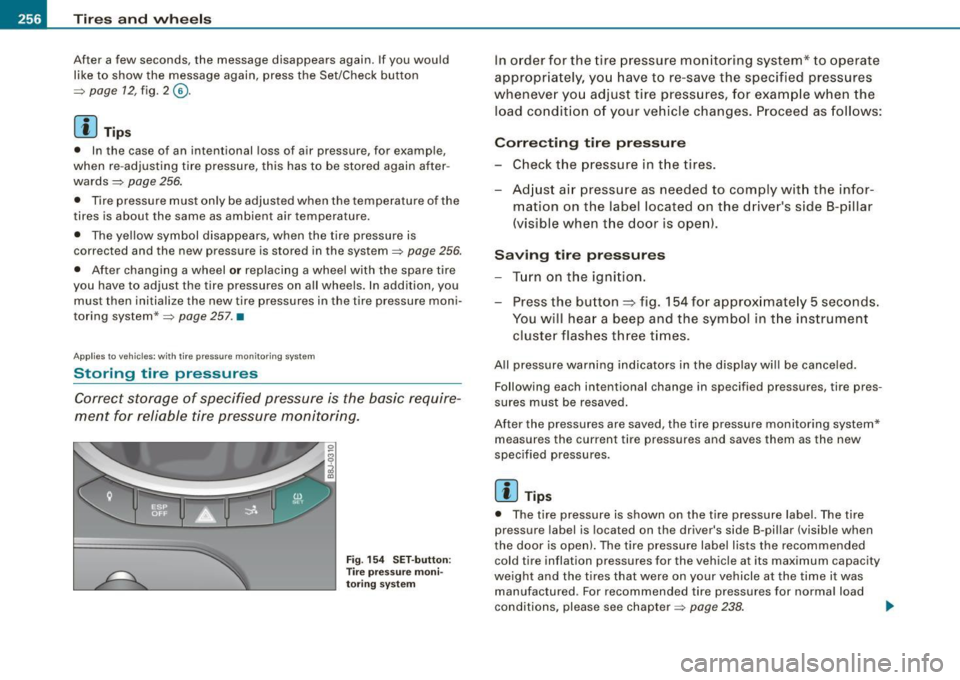
Fig. 154 SET-button :
Tire pressure moni
toring system
In order for the tire pressure monitoring system* to operate
appropriately, you have to re-save the specified pressures
whenever you adjust tire pressures, for example when the
load condition of your vehicle changes . Proceed as follows:
Correcting tire pressure
Check the pressure in the tires.
Adjust air pressure as needed to comply with the infor mation on the label located on the driver's side B -pillar
(vis ible when the door is open).
Saving tire pressures
Turn on the ignition.
Press the button=> fig. 154 for app roximately 5 seconds.
You will hear a beep and the symbol in the instrument
cluster flashes three times.
All pressure warning indicators in the display will be canceled.
Following each intentional change in specified pressures, tire pres
sures must be resaved.
After the pressures are saved, the tire pressure monitoring system* measures the current tire pressures and saves them as the new
specified pressures.
[ i J Tips
• The tire pressure is shown on the tire pressure label. The tire
pressure label is located on the driver's side B-pillar (visible when
the door is open). The tire pressure label lists the recommended cold tire inflation pressures for the vehicle at its maximum capacity
weight and the tires that were on your vehicle at the time it was
manufactured . For recommended tire pressures for normal load
conditions, please see chapter
=> page 238. .,_
Page 259 of 316

________________________________________________ T_ i _r_e _s_ a_n_ d_ w_ h_ e_e _ l_s __ !II
•
• The tire pressure monitoring system * helps the driver to keep an
eye on tire pressures. But the driver still has the responsibi lity for
maintaining the correct tire pressure .•
Applies to vehicles: with tire pressure mon itorin g system
Wheel change
If a wheel is changed, the wheels that were exchanged
have to be re-programmed .
- Turn on the ignition.
- Press the button~
page 256, fig. 154 for approximately 5
seconds. You will hear a beep and the symbol in the button flas hes three times.
Programming is necessary :
• after the tires have been rotated on the vehicle, or the spare tire
is used,
• if tires with new wheel sensors are used .
A ll pressure warning indicators in the display will be canceled. The
system malfunction error message wil l not disappear until the
vehicle is underway . With pressing the button~
page 256, fig. 154,
the re -programming of the new sensors and storing of ac tua l pres
sures starts. This learning phase can take up to 10 minutes driving
time .
During the learning process the tire pressure monitoring system* is
not avai lable. •
Applies to veh ic les: with tir e pressure monitoring system
Malfunctions •
A malfunction can have various causes.
F ig . 155 Display:
S yst e m m alfun ctio n
If the .J., warning light in the instrument cluster flashes for approxi
mately one minute and then remains continuously illuminated and
additional ly the T ~~ fig. 155 symbol appears in the display, the
tire pressure mon itoring system* is not available. This can have
various causes.
• If the message appears at the end of the lear ning process, the
system cannot recognize the wheels installed on the vehicle. This
can be because one or more wheels without a wheel sensor were
insta lled.
• A wheel sensor or other component may have failed .
• During initialization the system has detected more than 4 wheels
on the vehicle, for example whi le driving next to another car with a
tire pressure monitoring system*.
• A whee l change was made but the button
~ page 256 , fig. 154
was not pressed.
• Audi replacement parts were not used.
• I f snow chains are being used, system function can be compro
mised due to the shielding properties of the chains .
• The tire pressu re monitoring system* may not be available
because of a radio malfunction .
Vehicle care I t •
Page 268 of 316
1111...__W_ h_ a _ t_d_ o_ l _d _o_ n_ o_ vv_ ? ______________________________________________ _
[ i J Tips
• If sealant has run out, allow it to dry. Then you can peel it off .
• Have the tire sealant replaced every 4 years at a d ealership. •
Applie s to ve hicles: with T ire Mob ilit y Sy stem
Preliminary steps
Some preliminary steps ore necessary for tire repair.
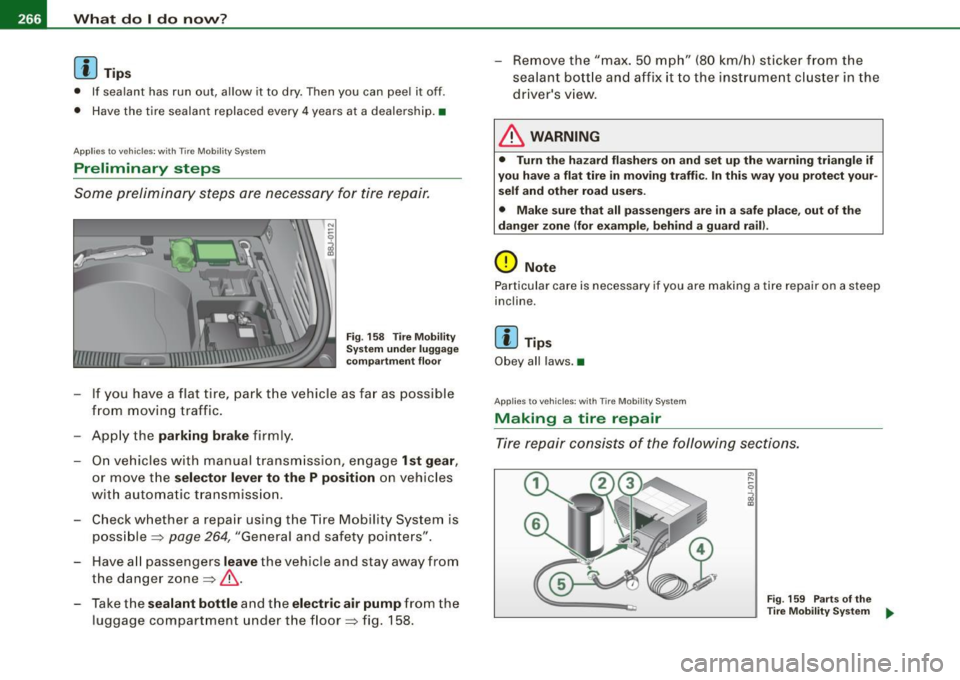
Fig . 158 Tire Mobility
System under luggage
compartment floor
- If you have a flat tire, park the vehicle as far as possible
from moving t raffic.
- Apply the
parking brake firmly.
- On vehicles w ith manual transmission, engage
1st gear,
or move the selector lever to the P position on vehicles
w ith automat ic transmission.
- Check whether a repair using the Tire Mob ility System is
possible ~
page 264, "General and safety po inters".
Have all passengers
leave the vehicle and stay away from
the danger zone~& .
- Take the
sealant bottle and the electric air pump from the
luggage compartment under the floor~ fig. 158. - Remove the "max. 50 mph"
(80 km/h) sticker from the
sealant bottle and affix it to the instrument cluster in the
driver's view.
& WARNING
• Turn the hazard flashers on and set up the warning triangle if
you have a flat tire in moving traffic. In this way you protect your
self and other road users.
• Make sure that all passengers are in a safe place, out of the
danger zone (for example, behind a guard raill.
(D Note
Particular care is necessary if you are making a tire repair on a steep
inc line .
[ i J Tips
Obey all laws. •
App lies to ve hicles: w ith T ire Mob ility System
Mak ing a tire repa ir
Tire repair consists of the following sections.
Fig. 159 Parts of the
Tire Mobility System ..