warning lights AUDI TT COUPE 2009 Owner's Guide
[x] Cancel search | Manufacturer: AUDI, Model Year: 2009, Model line: TT COUPE, Model: AUDI TT COUPE 2009Pages: 316, PDF Size: 71.16 MB
Page 223 of 316

___________________________________________ C_ h_e _c_ k_ i_n ...::g a....- a_n _d_ f_il _li _n --=g ------
•
Engine oil consumption
The engine in your vehicle depends on an adequate
am ount of oil to lubricate and c ool all of its moving parts.
In order to provide effective lubrication and cooling of internal
engine components, all internal combustion engines consume a
certain amount of oil. Oil consumption varies from engine to engine
and may change sign ificantly over the life of the engine . Typically,
engines with a specified break-in period (see~
page 190) consume
more oil during the break-in period than they co nsume after o il
consumption has stabilized .
Under normal conditions, the rate of oil consumption depends on
the quality and viscosity of the oil, the RPM (revo lutions per minute)
at which the engine is operated, the ambient temperature and road
conditions. Further factors are the amount of oil dilution from water
condensation or fue l residue and the oxidation level of the oil. As
any engine is subject to wear as mileage bu ilds up, the oil consump
tion may increase over time until rep lacement of worn components
may become necessary .
With all these variables coming into play, no standa rd rate of oil
consumption can be estab lished or specified. There is no a lternative
t o regula r and frequent checking of the oil level, see Note.
I f the yellow engine oil level warning symbol in the instrument
cluster _ lights up, y ou should check t he oi l level as soon as
possible
with the oil dipstick~ page 221. Top off the oil at your
earl iest co nvenience ~
page 222.
& WARNING
Before you check anything in the engine compartment , always
read and heed all WARNING S
~ & in "Working in the engine
c ompartment " on
page 217 .
0 Note
Driving with an insuff ic ie n t o il level is l ikely to cause severe damage
to the engine.
[ i ] Tip s
• The oil pressure w arning display ce,. is not an indi cator of the oil
level . Do not rely on it. Instead, check the oil level in your engine at
regular interv als , prefe rably ea ch time you refuel , and always before
going on a long trip.
• I f you have the impression your engine consumes excessive
amoun ts of oi l, we recommend tha t you consult your Audi dealer to
have the cause of your concern properly diagnosed . Keep in mind
that the accurate measureme nt of oil consumption requires great
care and may take some time. Your Audi dealer has instructions
about how t o measure oil consumption accurately. •
Checking the engine oil level
Vehicle care I t •
Fig. 13 9 Illu stra tion of
pri nciple 1 : Mar ker s on
oi l dip sti ck ...
Page 230 of 316

-~_C_ h_e _c _ k_ i_n ...:::g::;...._ a_n_d _ f_ i_ll _in -'g:::;.._ ___________________________________________ _
& WARNING
• Bra ke fluid i s poiso nou s. It must be stor ed only in the clo se d
original container out of the rea ch of children!
• Bra ke failure can re sult from old or inappropri ate br ake fluid .
Ob serve the se pre cauti ons:
- Use o nly br ake fluid th at m eets S AE spe cific ation
J 1703 and
co nform s to Fed era l Mo tor Vehic le Standard 11 6. Alway s check
w ith your authori zed Aud i de aler to mak e sure y ou are usi ng
the correc t brake fluid. The corre ct type of brake flu id i s also
indica ted on the br ake fl uid re se rvoi r.
- The brake fluid mu st be new . Heavy u se of the brake s can
ca use a vapor lock if th e bra ke fluid is left in the system too
long. Thi s can seriou sly affect the effic iency of the brake s as
w ell as y our safet y. T his c ould re s u lt in an a ccident .
0 Note
Brake fluid wil l damage the paint of your vehicle .
~ For the sake of the environment
Because of the problem of proper disposal of brake fluid as well as
the special tools required and the necessary expertise, we recom
mend that you have the brake fluid changed by your authorized Audi
dea ler. •
Battery
General information
Your vehicle is equipped with a specia l battery, an AGM battery. This
ba ttery is loca ted in the luggage compar tment and must be
replaced with an original equipment battery. Under normal oper
ating conditions, the battery is
ma inten anc e-free .
Have the battery checked when you take your vehicle in for service .
You a re well advised to replace a battery that is o lder than 5 years .
Disconn ecting th e batt ery te rmin als
Some vehicle functions (power w indow regulators, for example) are
lost if the battery terminals are disconnected. These functions have
to be relearned after the battery terminals are connected again. To prevent this, the battery should only be disconnected from the
vehic le electrical sys tem when abso lutely necessary for repairs .
Vehi cles not dri ven for lo ng p eriods
If you are going to let your vehic le stand for a long time and n ot
drive it, you should remember there are e lectrica l components
whic h are still functioning and they will draw energy from the
battery and drain it, for example, the engine immobilizer. To prevent
t his, you can eithe r charge the batte ry occasionally to keep it in
good working condition or you can disconnect the negative cable
on the battery.
W int er op erati on
During the winter months, batte ry capacity tends to decrease as
temperatures drop . This is because more power is also consumed
whi le starting, and the headlights, rear window defogger, etc ., are
used more often.
Avoid unnecessary power consumption, particularly in city traffic or
when trave ling o nly short distances . Let your authorized Audi dealer
check the capacity of the vehicle battery before winter sets in
~ page 232. A we ll charged battery will not only preven t starting
problems when the weather is cold, but will also last longer.
Repla cing batter y
The new battery must hav e the same capacity, voltage ( 12 volts),
amperage, construction and p lug sea ling, as the orig inal battery .
Specifications are listed on the battery housing. Batteries specia lly
developed by Aud i fulfill the main tenance, output, and safe ty
requirements. ...,
Page 232 of 316
-L~C~ h~ e~c ~k ~in ~ g~a~ n~d !._~ fi~ll ~in ~ g~ ------------------------------------------
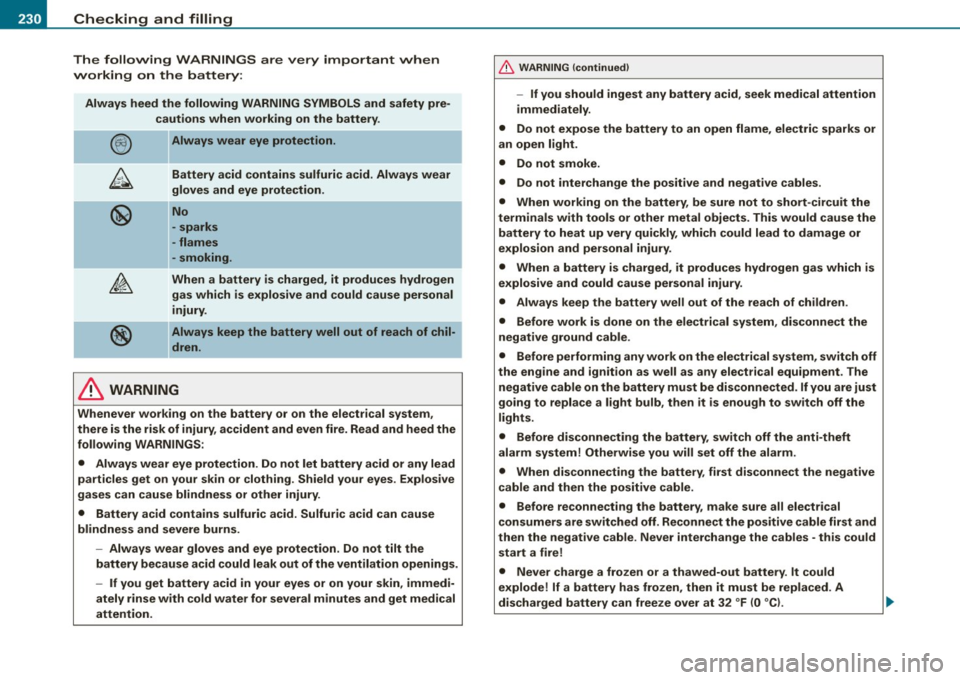
The following WARNINGS are very important when
working on the battery:
Always heed the following WARNING SYMBOLS and safety pre
cautions when work ing on the battery .
@
®
Always wear eye protection .
Battery acid contains sulfuric acid. Always wear
gloves and eye protection .
No
· sparks
- flames
· smoking .
When a battery is charged , it produces hydrogen
gas which is explosive and could cause personal
injury .
Always keep the battery well out of reach of chil
dren .
& WARNING
Whenever working on the battery or on the electrical system,
there is the risk of injury , accident and even fire. Read and heed the
following
WARNINGS :
• Always wear eye protection. Do not let battery acid or any lead
particles get on your skin or clothing . Shield your eyes . Explosive
gases can cause blindness or other injury.
• Battery acid contains sulfuric acid. Sulfuric acid can cause
blindness and severe burns.
-Always wear gloves and eye protection . Do not tilt the
battery because acid could leak out of the ventilation openings .
- If you get battery acid in your eyes or on your skin, immedi
ately rinse with cold water for several minutes and get medi cal
attention .
& WARNING (continued)
- If you should ingest any battery acid , seek medical attention
immed iately.
• Do not expose the battery to an open flame , electric sparks or
an open light.
• Do not smoke.
• Do not interchange the positive and negative cables.
• When working on the battery, be sure not to short -circuit the
terminals with tools or other metal objects. This would cause the
battery to heat up very quickly , which could lead to damage or
explosion and personal injury.
• When a battery is charged , it produces hydrogen gas which is
explosive and could cause personal injury.
• Always keep the battery well out of the reach of children .
• Before work is done on the electrical system, disconnect the
negative ground cable .
• Before performing any work on the electrical system , switch off
the engine and ignit ion as well as any electri cal equipment . The
negative cable on the battery must be disconnected . If you are just
going to replace a light bulb , then it is enough to switch off the
lights.
• Before disconnecting the battery , switch off the anti-theft
alarm system! Otherwise you will set off the alarm.
• When disconnecting the battery, first disconnect the negative
cable and then the positive cable.
• Before reconnecting the battery , make sure all electrical
consumers are switched off. Reconnect the positive cable first and
then the negative cable . Never interchange the cables • this could
start a fire!
• Never charge a frozen or a thawed-out battery . It could
explode! If a battery has frozen , then it must be replaced. A
discharged battery can freeze over at 32 °F (0 °Cl. ..,_
Page 280 of 316
.,,___F_ u_ s _ e_s _ a_n _ d_ b_ u_lb _ s _______________________________________________ _
No. Equipment Amps
8 Ignition coils (4
-cylinderl/ignition coils (6-cylin -
20/30
der)
9 Engine (control unitl 25
Water pump delayed-off 10
1 1 Feed (clutch pedal, brake pedal) 5
12
Activated charcoal filter/charge pressure con-10 trol valve (4-cylinder)
-' -
Bulbs
Replacing light bulbs
For your safety, we recommend that you have your autho
rized Audi dealer replace burned out bulbs for you.
It is becoming increasingly more and more difficult to replace
vehicle light bulbs since in many cases , other parts of the car must
first be removed before you are able to get to the bulb. This applies
especially to the light bulbs in the front of your car which you can
only reach through the engine compartment.
Sheet metal and bulb holders can have sharp edges that can cause
serious cuts, and parts must be correctly taken apart and then prop
erly put back together to help prevent breakage of parts and long
term damage from water that can enter housings that have not been properly resealed.
For your safety , we recommend that you have your authorized Audi
dealer replace any bulbs for you, since your dealer has the proper
tools, the correct bulbs and the expertise.
Gas discharge lamps (Xenon lights)*:
•
Due to the high electrical voltage, have the bulbs replaced by a qual
ified technician. Headlights with Xenon light can be identified by the
high voltage sticker .
& WARNING
Contact with high-voltage components of the electrical system
and improper replacement of gas discharge (Xenon) headlight
bulbs can cause serious personal injury and death .
• Xenon bulbs are pressurized and can explode when being
changed.
• Changing Xenon lamps requires the special training, instruc
tions and equipment .
• Only an authorized Audi dealer or other qualified workshop
should change the bulbs in gas discharge lamps.
& WARNING
There are parts with sharp edges on the openings and on the bulb holders that can cause serious cuts .
• If you are uncertain about what to do, have the work performed
by an authorized Audi dealer or other qualified workshop. Serious
personal injury may result from improperly performed work.
[ i] Tips
• If you must replace the light bulbs yourself, always remember
that the engine compartment of any vehicle is a hazardous area to
work in. Always read and heed all WARNINGS=>
page 209, "Engine
compartment"=>
/A .
• It is best to ask your authorized Audi dealer whenever you need
to change a bulb .•
Page 283 of 316

________________________________________________ E _m_ e_r.:g :;,. e_ n_c ...: y:.- s_ i_ t _u _a_ t_ i_ o _ n_ s __ ffllll
•
7. Connect the other end of the black jumper cable to the
negative terminal (bolt head)
G) in the external starting
point @of your vehicle.
8. Route the jumper cables so that they cannot catch in any
rotating parts in the engine compartment.
Starting the engine
9. Start the engine of the vehicle providing assistance and
allow it to run at idle.
10. Now start the engine of the vehicle with the discharged
battery , wait for two to three minutes until the engine
"runs" smoothly.
11. If the engine does not start: Stop trying after 10 seconds
and then try again after about 30 seconds.
12. In the vehicle that has received start assistance, turn on
the heater blower and the rear window heating to elimi
nate any voltage peaks when disconnecting. Driving
lights must be switched off!
13. Disconnect the cable while the engine is running exactly
in
reverse order to that described in=> page 280,
"Connecting/disconnecting the jumper cable.". When
doing so, make sure that the cable cannot contact
rotating engine parts.
14. Close the cover on the posit ive terminal.
The battery is vented to the outside to prevent gases from entering
the vehicle interior. Make sure that the jumper clamps are well
connected with their
metal parts in full contact with the battery
terminals.
& WARNING
To avoid serious personal injury and damage to the vehicle, heed
all warnings and instructions of the jumper cable manufacturer.
If
in doubt, call for road service .
• Jumper cables must be long enough so that the vehicles do not
touch.
• When connecting jumper cables, make sure that they cannot
get caught in any moving parts in the engine compartment.
• Before you check anything in the engine compartment, always
read and heed all WARNINGS=>
page 209, "Engine compartment" .
0 Note
Improper hook-up of jumper cables can ruin the generator.
• Always connect POSITIVE(+) to POSITIVE (+l, and NEGATIVE(-) to
NEGATIVE( -) ground post of the battery manager control unit.
• Check that all screw plugs on the battery cells are screwed in
firmly. If not, tighten plugs prior to connecting clamp on negative
battery terminal.
• Please note that the procedure for connecting a jumper cable as
described above applies specifically to the case of your vehicle
being jump started. When you are giving a jump start to another
vehicle , do
not connect the negative(-) cable to the negative 1-1
terminal on the discharged battery ©-Instead, securely connect
the negative (-1 cable to either a solid metal component that is
firmly bolted to the engine block or to the engine block itself . If the
battery that is being charged does not vent to the outside, escaping
battery gas could ignite and explode! •
Do-it-yourself service
Page 302 of 316
___ A---" lp_ h_ a_b_ e_ t_ i_ c _ a_ l_ in_ d_ e_x ______________________________________________ _
A
A/C operation
Climate control ............ ....... 89
ABS See Anti -Lock Brake System . . . . . . . . 187
Accessories . . . . . . . . . . . . . . . . . . . . . . . . 295
Acoustic park assist rear . . . . . . . . . . . . . . . . . . . . . . . . . . . . . 95
Acoustic parking system .. .... ... .... . 95
Adaptive Light defective . . . . . . . . . . . . . . . . . . . . . . . . 37
Adaptive light . . . . . . . . . . . . . . . . . . . . . . . 54
Adding Engine coolant .. ... .... .... .... . 225
Engine oil ....................... 222
Windshield washer fluid . . . . . . . . . . 233
Additiona l accessories .. ........ .... . 295
Additives Engine oil ... ..... .... ... ... ... .. 222
Adjustable steering column .... .... ... 91
Adjusting front seats . ...... .... .... .. 69
Adjusting steering column ...... .. ... . 91
Adjusting the seats .... .... .... .... .. 71
Advanced Airbag System
Children ........................ 158
Components .. .... .... ......... . 142 Air distribution
Climate control ..... .. .... .... .... 87
Air recirculation mode Climate control ...... .... ... .. .... 88
Airbag Warning/indicator lights ......... .. 18
Airbag system .................. 135, 155
Care ............................ 149
Child restraints .... .... .... .... .. 159
Components (front airbags) .. ...... 142
Danger of fitting a chi ld safety seat on the
front passenger seat . . . . . . . . . . . . 137
Disposa I . . . . . . . . . . . . . . . . . . . . . . . . 149
Front airbags . . . . . . . . . . . . . . . . . . . . 139
How do the front airbags work? . . . . 144
How many airbags does my vehicle have?
142
Important safety instructions on the knee
airbag system . . . . . . . . . . . . . . . . . . 153
Important things to know . ... .. ... 135
Indicator light ....... .... ... .. ... 146
Knee airbags .... .... .... ... .... . 151
Monitoring . . . . . . . . . . . . . . . . . . . . . . 146
PASSENGER AIR BAG OFF light ... .. 147
Repairs . . . . . . . . . . . . . . . . . . . . . . . . . 149
Side airbags ... ...... ....... ..... 154
When must the system be inspected? ...
146 Anti-free
ze
See Engine coolant system ...... .. 224
Anti -glare inside day-night mirror .... .. 64
Anti-Lock Brake System .............. 187
Anti- lock brake system
Warning/indicator lights ............ 20
Anti -Slip Regulation System (ASR)
How the system works . . . . . . . . . . . . 184
Anti-theft systems Anti-Theft A larm System ...... ..... 47
Electronic immobilizer . .... .... .... 40
Ashtray ................... .......... 81
ASR How the Anti -S lip Regu lation System
works ... .... .... .... ... .... ... 184
Asterisk What does it mean when something is
marked with an asterisk? . .... ...... 6
Audi magnetic ride ......... .... ... 16, 98
Description ....................... 98
Indicator light ...... ..... ..... ... . 16
Audi Service Repair Manuals and Literature . 293
Auto Safety Hotline ... ..... .. ... ..... 123
Automatic belt retractor 129
Automatic car wash
See Washing .. ........ .... ...... 199
Front airbags ....... .... .... .... .
140 All Wheel Drive
......... ....... ..... 189 Automatic headlight control ........... 52
How the components work together 143 Alloy wheels ... .. ...... .... ... .. ... 204 Automatic headlights
Monitoring .. .... .... .... ... .... . 146 All-whee l drive defective .
.... ... .... .... .... ..... 37
Weight -sensing mat . ... .. .... .... 158 Winter tires ..................... 250 Automatic Transmission
air conditioning Alternator Automatic Transmission
.......... 103
Temperature . . . . . . . . . . . . . . . . . . . . . 86 See Generator . . . . . . . . . . . . . . . . . . . . 18
Page 303 of 316

______________________________________________ A_ l.:.. p _h_ a_ b_e _t_ic _ a _ l _in _ d_e _ x __ _
Automatic transmission ..... ... .. .... . 99
Driving Notes ... .. .... ... .... .... 102
Emergency program .. .... ... .... . 105
Emergency release . . . . . . . . . . . . . . . 106
Ignition key safety lock ....... .... .. 92
Kick-down .. ... .. .... .... ...... .. 105
Launch Control Program ........... 105
Selector lever lock .. ...... ...... .. 101
Selector lever positions ........... 100
Tiptronic ... .. .... .... ........... 103
Tiptronic controls on the steering wheel
104
Average fuel mileage ... .... .... .... .. 26
Average speed . ... .. .... .... .... .... . 26
Avoid damaging the vehicle ......... . 192
B
Battery . ...... ..... ... .... .... . 228, 231
Battery location inside the engine compartment ... .... .... .... 218,219
Charging . .... .... .... ... .... .... 232
Checking battery acid level .... 231, 232
Connecting ... ... ..... ... .... ... . 228
Disconnecting ....... ....... .... . 228
Important warnings when working on the
battery ..... .... ....... ...... .. 229
Replacing the battery . ....... .... . 228
Winter operation . .... .... ... .... . 228
Working on the battery ... .... .... . 229
Battery voltage ......... .... ......... 36
Before driving .. ...... .. ....... ..... 114
Bi -Xenon headlights ........... .. .... . 57
Blended gasoline ... .... .... ... .... . 211
Controls and equip
ment Safety first
Body
cavity sealing .... .. ..... ... ... . 204
Booster seats .... .... .... .... .... ... 165
How do I properly install a booster seat in
my vehicle? . ... ... ....... .. .... 165
Safety instructions ..... .... ... .... 165
Brake fluid Changing the brake fluid .. .... .... 227
Checking the brake fluid level ...... 227
What is the correct brake f luid level? 227
What should I do if the brake fluid warning
light comes on? . ........ ... ..... 227
Brake fluid reservoir ..... .... .... .... 227
Brake system . ... ...... ......... .... 227
Anti-lock brake system ... .... ... .. . 20
Brake Assistan t .... . .. .. .. . ... ... 187
Brake fluid .... ... .... ...... ...... 227
Brake fluid specifications for refi ll and
replacement . ... ..... ... .... .... 227
Brake light defective . .... .... .... .. 37
Brake pads ... ... ..... ... .... ... . 191
General information . .... .. .. .. ... 186
How does the moisture or road salt affect
the brakes? ............... ...... 1 86
Malfunction .... ........... ...... . 33
Warning/indicator lights .. ..... .... . 19
Worn brake pads symbo l .... ...... . 36
Break -in period ........ ............. 190
Brake pads ...... ..... ....... .... 191
Tires .... . ... ... ... ... .... .... ... 190
Bulbs ..... .. .... ..... .. ... ... ...... 278 C
California Proposition 65 Warning . .... 218
Battery specific .... ... .... .... .... 231
Capacities ... .... .... .... ... .... .... 291
Car care ... ..... .. .. .... .... .... .. . . 198
Interior .... ... .. .. .... ........ ... 205
Plastic and vinyl .. ............... . 202
Weatherstrips ... .. .... .. . .... ... . 203
Care of exterior . ..... ....... ....... . 198
Cargo area
See Luggage compartment . ... .... . 121
Cargo net .. .... .. .. .... .... .... .... . 78
Catalytic converter .. .... .... .... ... . 191
CD changer .... ... .. .... .... .... .. .. . 84
Certification .. ....... ....... ..... ... 296
Changing a flat tire ......... .... ... .. 268
Changing engine oi l .. .... ... .... .. .. 223
Chassis Undercoating . ... .... .... .... ... . 205
See also Audi magnetic ride .... .... . 98
Checking Battery acid level .. ....... .... 231, 232
Engine coolant level ...... .... .... 225
Checking tire pressure ..... .... ...... 241
Child restraint Danger of using ch ild restraints in the
front seat ... .... .... .... ... ... . 137
Child restraints What types of child restraint anchors are
avai lable? ... .... .... .... ...... . 171
Where can I get additional information
about child restraints? ........... 171
Vehicle operation Vehicle care Do-it-yourself service Technical data
Page 304 of 316
___ A_l.:. p _h_ a_ b_e _t _ic _ a_l _in _ d_e _x ____________________________________________ _
Child safety ...... ... .... ...... . 157,162
Booster seats . . . . . . . . . . . . . . . . . . . . 165
Convertible child safety seats . . . . . . 163
Convertible locking retractor . . . . . . . 168
Guidance fixtures for lower anchorages
173
Important safety instructions for using child safety seats .... ....... .... 160
Important things to know when driving
with children ................... 157
Infant seats ..................... 162
Insta lling a child restraint using the
LATCH system . . . . . . . . . . . . . . . . . . 175
Lower anchorages . . . . . . . . . . . . . . . 173
Mounting and releasing the anchorage hook .. ...... .... ....... ....... 176
Older children and safety belts . . . . . 167
Safety belts and older children . . . . . 167
Tether strap . . . . . . . . . . . . . . . . . . . . . 176
Which restraint system should my older child wear? ................. ... 167
Child safety seat .. ........... ....... 162
Convertible locking retractor . . . . . . . 168
Installing . .... ... ..... ..... .. ... 168
child safety seat LATCH system . . . . . . . . . . . . . . . . . . . 175
Child safety seats How do I properly insta ll a chi ld safety
seat in my vehicle? ... .... ....... 160
Safety instructions . . . . . . . . . . . . . . . 160
Cigarette lighter ..................... 82
Cleaning Alcantara (synthetic suede) . . . . . . . . 208
Engine compartment ... .. .... .... 209 Fabrics and fabric c
,overings ....... 205
Instrument panel ... .... .... .... .. 206
Interior ......................... 205
Leather ......................... 207
Plast ic and vinyl ....... .... ...... 202
P lastic parts ............... ... ... 206
Safety belts . . . . . . . . . . . . . . . . . . . . . 209
Trim strips ... .... ... .. .... .. 201,202
Cleaning and protection .. ........ ... 198
Climate control A/C operation . . . . . . . . . . . . . . . . . . . . . 89
Air distribution .... ........ ....... 87
Automatic mode . . . . . . . . . . . . . . . . . . 88
Defrost ............. ...... ....... 88
Economical use ... ...... ..... ... .. 89
Fan ............................. 87
Heated seats . . . . . . . . . . . . . . . . . . . . . 90
Rear window defogger . . . . . . . . . . . . . 89
Switching on and o ff ...... .... .... 87
Climate controls ........ ........... .. 85
Air recirculation mode . ...... ...... 88
Controls . . . . . . . . . . . . . . . . . . . . . . . . . 85
Dust filter ..... ....... ............ 85
Heating .. .... .... ... .. .... .... ... 85
Pollen fi lter ... ....... ...... .... ... 85
Venti lation ... ... .. .... .... ....... 85
Clock ....... ....... ... .............. 13
Coat hooks ............... .... ... .... 84
Co ld tire inflation pressure ........... 238
Coming -home -function ... .... ....... . 55
Compass mirror ............... ...... 67
Compliance .. .... ... .... ... ... .. ... 296
Consumer Information .... ....... 123, 293 Contacting NHTSA
... .. .. .... .... ... 123
Controls and disp lays ...... ...... .... . 11
Convenience close/open feature Windows ... ... .... .... ... .... .... 49
Convertible child seats How do I properly install a convertible chi ld seat in my vehicle? ......... 163
Safety instructions .... .... .... ... 163
Convertible locking retractor Activating ............. .... ...... 170
Deactivating ... .... ....... .... ... 170
Using to secure a child safety seat .. 168,
170
Coolant System Expansion tank ... .... .... .... ... 225
Coolant system .. .... .... .... ....... 224
Cornering light ...................... 54
Cruise contro l ........ ... .... .... .... 96
Changing speed . ...... .... .... ... 97
Presetting your speed .......... .... 97
Switching off ... .. .... .... .... .... 97
Switching on ...... .... ... .... .... 96
Warning/indicator lights .... ....... . 18
Cup holder ... .... .... ....... .... .... 81
Current fuel mileage .................. 26
D
Damping
See Audi magnetic ride .... ... .. .... 98
Data .............................. 291
Data recorder ...................... 182
Datedisplay . ......... .... ... .... .... 13
Page 305 of 316

______________________________________________ A_ l_,_ p _h_ a_ b_e _ t_i c_ a_l _in _ d_e _ x __ lllll
Daytime running lights .. ..... .. .... ... 53
Daytime running lights (Canada) . .... .. 53
Declaration of compliance Cell phone package ............... 296
Electronic immob ilizer . .... ... .... 296
Homelink® universal remote control 296
Remote control key . ... .. .... .... . 296
Tire pressure monitoring sys tem ... 296
de f
What does this mean when it appears in
the trip odometer display? .. ....... 14
Defect ive light bulb warning ...... .... . 36
Defrosting the windows .. .......... ... 88
Determining correct load lim it ... ... .. 243
Digital clock .... .... .... .... ... .... .. 13
Setting the time ................... 13
D igital compass . ...... ... ...... .... .. 67
Dimensions ... .. .... .... ... .... .... 290
Dipstick Reading the dipstick properly
Di rect Shift Gearbox 221
Emergency release . . . . . . . . . . . . . . . 106
Distance .. ...... .... .... ... .... .... . 26
Driver information ..... ... .. .... ..... . 33
Driver information system
Gearshift indicator ... .... .... .... .. 23
Menu button ..................... 28
Menu display . ... .... ...... .... ... 27
Open door or front lid warning ...... 22
Outside temperature display ....... . 22
Red symbols .. .... .... ... ... ... .. . 32
Service interval disp lay .... .... ..... 23
Setting .......................... 29
Controls and equip
ment Safety first
Sound system display
.... .. ..... .. . 22 Emergency starting . ... .. .... .... .... 279
Trip computer ............ ..... .. . 25
Emerge ncy towing ...... .... .... ... . 282
yellow symbo ls ................... 32
Engine
Driver seat Cecking and fil ling locations .. .... . 219
See Seating position .. ..... .... ... 116
Checking and fi lling locations .. ... . 218
Dr iving Coolant ...... .... ... .... .... .... 224
Run-flat tires ..... ... .. ...... .... . 259 Hood .. ...... .... .... ... .... .. .. 216
Dr iving safely .......... ............ . 114 Start
ing ...... .... .... ... .... .. 92, 93
Duplicate key .... ...... ... .. .... .... . 38 Start
ing with jumper cables .... .... 279
Dust filter ........................... 86 Stopping
...... .... ... .... .... .... 93
Engine compart ment .. ...... .... .... 218
E Safety instruc tions .. ...... .... ... . 217
Working in the engine compa rtment . 217
Elapsed time .... .... ........ ....... . 26
Engine coolant system ......... ...... 224
Electro -mecha n ica I power assist .. .. 20, 188 Adding coo
lant ..... ........ ...... 225
Electron ic different ial lock (EDU Check
ing the eng ine coolant level ... 225
How the sys te m works .. ...... .... 184 Radiator fan ..
.... ....... .... .... 226
Warning/indicator lights ...... ...... 20 Te
mpe rature gauge ...... .... .... .. 13
Electronic immobilizer .... ..... .. .. 14, 40 Engine cooling system
Electronic power cont ro l Malfunction
............ ... .. ..... 34
EPC warning/indicator light ......... 17 Engine data
... .. .... .... .... .... ... 29 1
E lectron ic speed limiter . ...... .... .... 25 E
ngine hood
Electronic Stability Program .. .... .... 182 Closing
... .... .... ... .... ...... . 217
Electronic stabilization program (ESP) How to release
the hood . ...... .... 216
Warning/indicator lights .. .... .... .. 17 Engine oil
..... .. .......... ... .. .... 219
Emergency flasher Warning/indicator lights ...... .... .. 18
Emergency flashers .................. 57
Emergency locking .. .... ........ ... .. 45
Emergency operation Adding
......... .... ........ ..... 222
Additives .. .... .... ......... ..... 222
Changing . ..... ... .... .... ... ... . 223
Checking the eng ine oi l leve l ....... 221
Indica tions and condit ions requiring ext ra
checking ....................... 221
Rear lid ...... ... .... .... .... .... . 46
Oil consumption ... ... ...... ...... 221
Emergency release for selector lever ... 106
Oil grades .... .... .... ..... .. .... 2 19
Vehicle operation Vehicle care Do-it-yourself service Technical data
Page 306 of 316

-Alphab eti ca l ind ex ----=------...:..:...::... ___________________________ _
Recommended oil check intervals .. 221
Specification and viscosity .. .. .. .. 219
Engine oil leve l .... .... ... ...... .... . 35
Engine oil pressure (malfunction) ... ... 35
Engine oil sensor defective ... .... .... . 35
Environment Break -in period . . . . . . . . . . . . . . . . . . 190
Catalytic converter . . . . . . . . . . . . . . . 191
Disposing of your vehicle battery . .. 228
Driving at high speeds ............ 192
Driving to minimize pollution and noise . 192
Fuel .... .... ... .. .... .... ...... . 213
Fuel economy . . . . . . . . . . . . . . . . . . . 192
Leakage from your vehicle . . . . . . . . . 217
Letting the vehicle stand and warm up . .
193
Proper disposal of drained brake fluid ... 227
Proper disposal of drained engine coolant ... .... .... .... .... .... . 225
Proper disposal of drained engine oil 222,223
Recycling used engine oil . .... .... 222
Un leaded fuel ... ... ..... .... .... 211
What should I do with an old battery? 228
EPC
See E lectronic power control . . . . . . . . 17
ESP
See Electronic Stability Program . ... 182
Event Data Recorder (EDR) . . . . . . . . . . . 182
Expansion tank .... .... .... .... ... .. 225
F
Fan .. ... .... .... ...... .... ... .. .... 87
Radiator . . . . . . . . . . . . . . . . . . . . . . . . 226
Fastening eyelets . .... .... .... .... ... 77
Flat t ire
Changing .... ....... .. ...... .... 268
Floor mats . . . . . . . . . . . . . . . . . . . . . . . . . 121
Fog lights, front ... .. ...... .... ... .. . 55
Fold ing master key with remote control . 38
Foot pedals . . . . . . . . . . . . . . . . . . . . . . . . 120
For the sake of the e nv ironment
Gasoline fumes and l the environment 213
Letting your engine warm up . .... .. 93
Reducing engine noise by early upshif ting ... ... ..... ... .... .... 12
Refue ling ... .. ...... ........ .... 213
Saving fuel by early upshifting .... .. 12
Front airbags Description . . . . . . . . . . . . . . . . . . . . . . 139
How they work . . . . . . . . . . . . . . . . . . . 144
Front seats . . . . . . . . . . . . . . . . . . . . . . . . . . 69
Ad ' .
Justing ...... .... ... .... .... .. 117
Adjusting the manual seats .. .... ... 71
Child restraints in the front seat .. .. 137
Fronta l collisions and the laws of physics .. .
126
Fuel Additives ...... ....... .... .... .. 211
Blended gasoline ........... .... .. 211
Current fuel mileage .. ... .... ..... . 26
Fi ller neck . .... ..... .. .... .... ... 212
Fuel gauge .............. .... ..... 14 Fuel supply too
low ..... .. . ... ... . . 35
Gaso line ... .... .... ... .... .... .. 211
Gasoline additives ................ 212
Octane rating .. .... .... .... .... .. 211
Recommendation .. ....... .... ... 211
Refue lling ... .. .... .... .... .... .. 213
Reserve ... ..... ... .... ... .... .... 14
Tank capacity ... .. .... .... .... ... 291
Un locking the fuel fi ller flap by hand 215
Fuel range ... ...... ... .. .... .... .... 26
Fuse arrangement ... .... ........ .... 275
G
Garage door opener . ...... ...... .... 107
Gas discharge lamps .... .. ... ... ... . 278
Gauges
Engine coolant temperature .... .. .. 13
Fuel gauge ............. ...... .... 14
Tachometer .... ....... ....... .... 12
Gear recommendation ........ ....... . 23
Gearshift indicator ... ...... ...... ... . 23
Gearshift lever
6 -speed manual transmission ... ... . 99
Generator Warning/indicator lights ........... . 18
G lossary of tire and loading terminology .. .
235
G love compartment ...... .... .... .... 8 4
Gross Vehicle Weight Rating (GVWR) ... 289