ECU AUDI TT COUPE 2014 User Guide
[x] Cancel search | Manufacturer: AUDI, Model Year: 2014, Model line: TT COUPE, Model: AUDI TT COUPE 2014Pages: 284, PDF Size: 34.42 MB
Page 148 of 284
Downloaded from www.Manualslib.com manuals search engine Audi
connect
- Whether Audi connect services can be used
depends on the availability of services provi
ded by third parties.
- Please also observe the notes in the chapter
¢ page 123, Telephone.
- Further information on Audi connect is also
available on the Internet at www.audi.com/
connect. For information on the conditions
of your mobile phone contract, please con
tact your mobile network service provider.
Data protection
Applies to vehicles: with Audi connect
@ Note
- AUDI AG collects, processes, transmits and
uses the personal data you provide in ac
cordance with legal requirements to ensure
that the individual Audi connect services are
provided and function properly. You can use
our myAudi platform, for example, to acti
vate further Audi connect services and to
transfer data to and from your vehicle. You
must register once in order to be able to
connect your vehicle to the platform. AUDI
AG collects, processes, transmits and uses
the personal data you must provide for the
registration as is necessary to ensure that
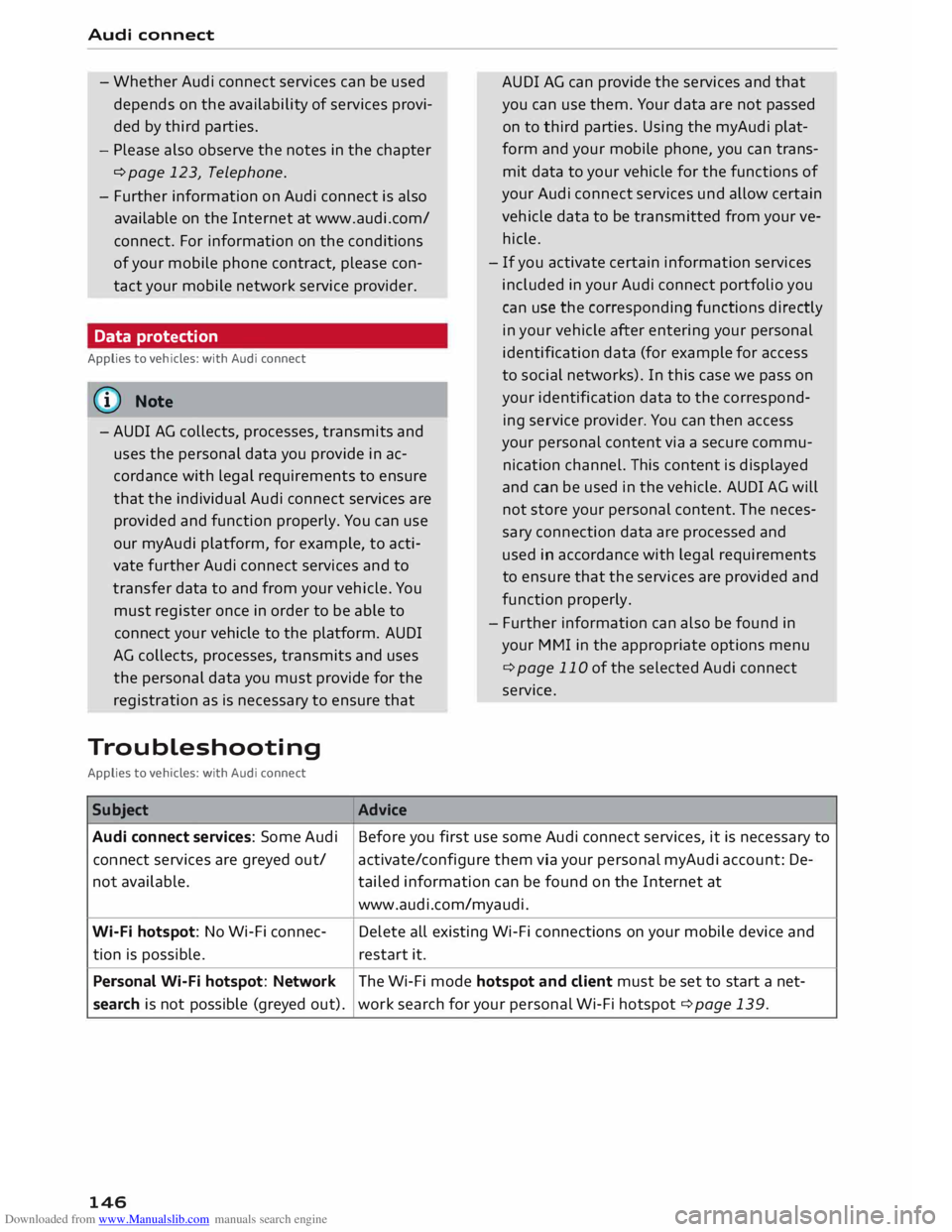
Troubleshooting
Applies to vehicles: with Audi connect
Subject Advice AUDI
AG can provide the services and that
you can use them. Your data are not passed
on to third parties. Using the myAudi plat
form and your mobile phone, you can trans
mit data to your vehicle for the functions of
your Audi connect services und allow certain
vehicle data to be transmitted from your ve
hicle.
- If you activate certain information services
included in your Audi connect portfolio you
can use the corresponding functions directly
in your vehicle after entering your personal
identification data (for example for access
to social networks). In this case we pass on
your identification data to the correspond
ing service provider. You can then access
your personal content via a secure commu
nication channel. This content is displayed
and can be used in the vehicle. AUDI AG will
not store your personal content. The neces
sary connection data are processed and
used in accordance with legal requirements
to ensure that the services are provided and
function properly.
- Further information can also be found in
your MMI in the appropriate options menu
¢ page 110 of the selected Audi connect
service.
Audi connect services: Some Audi Before
you first use some Audi connect services, it is necessary to
connect services are greyed out/ activate/configure them via your personal
myAudi account:
De-
not available. tailed
information can be found on the Internet at
www.audi.com/myaudi.
Wi-Fi hotspot: No Wi-Fi connec-
Delete all existing Wi-Fi connections on your mobile device and
tion is possible.
restart it.
Personal Wi-Fi hotspot: Network
The Wi-Fi mode hotspot and client must be set to start a net-
search is not possible (greyed out). work
search for your personal Wi-Fi hotspot ¢ page 139.
146
Page 174 of 284
Downloaded from www.Manualslib.com manuals search engine Media
@ Note
- Pay attention to any connection queries on
your Bluetooth device.
- Bluetooth devices only have to be bonded
once. Any Bluetooth devices that have al
ready been bonded to the M MI system once
are connected automatically when they are
within range.
- You can bond several Bluetooth audio play
ers to the MMI system; however only one
connection can be active at a time.
- The system supports the Bluetooth proto
cols AVRCP (1.0/1.3) and A2DP .
- Please consider the volume control on your
Bluetooth device. Audi recommends setting
the volume of mobile devices to maximum
when they are being used as Bluetooth au
dio players.
- Which media functions (e.g. random play
back) are supported depends on the Blue
tooth device you are using.
- For more information on which
devices
are
supported, please go to www.audi.c om/
bluetooth or contact an Audi dealer.
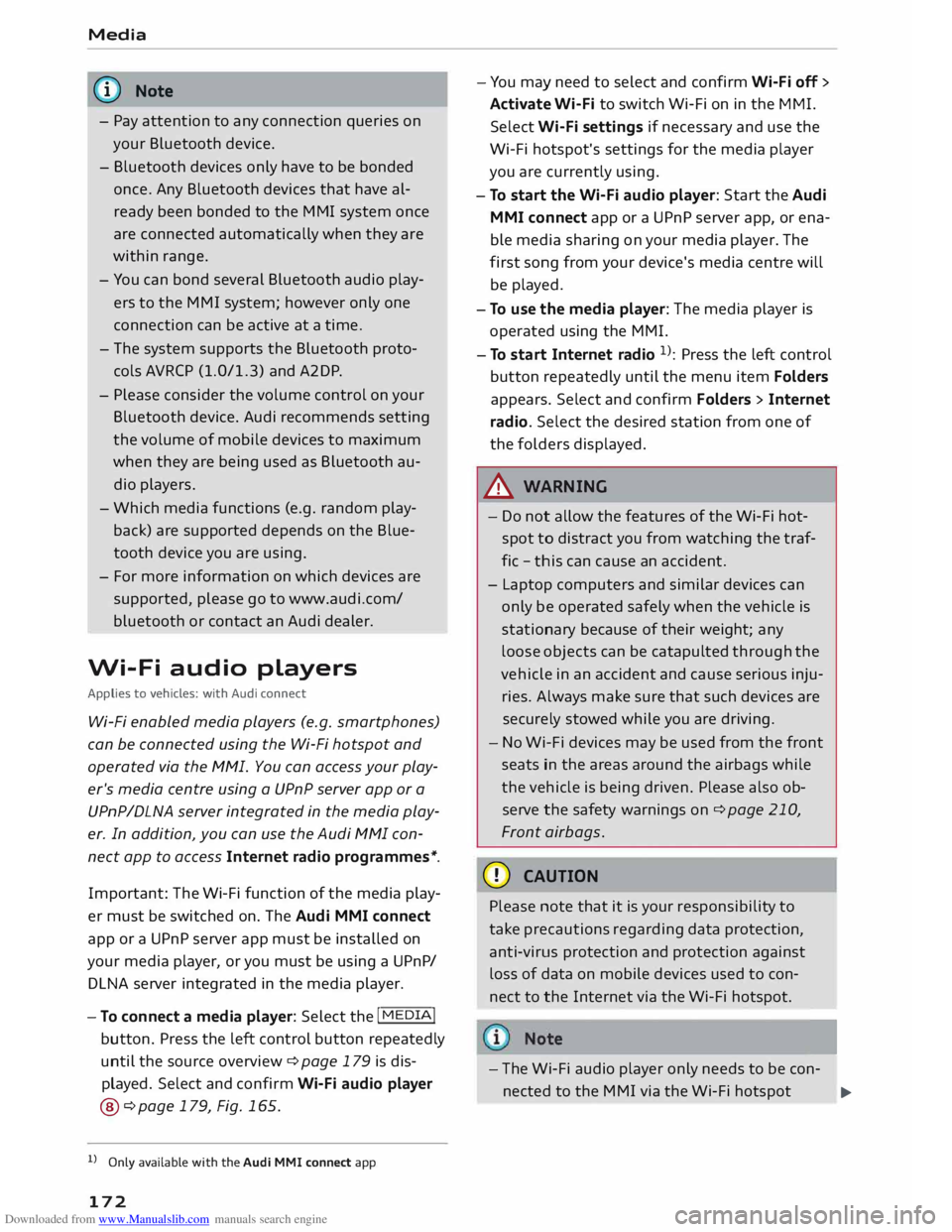
Wi-Fi audio players
Applies to vehicles: with Audi connect
Wi-Fi enabled media players (e.g. smartphones)
can be connected using the Wi-Fi hotspot and
operated via the MMI. You can access your play
er's media centre using a UPnP server app or a
UPnPIDLNA server integrated in the media play
er. In addition, you can use the Audi MMI con
nect app to access Internet radio programmes*.
Important: The Wi-Fi function of the media play
er must be switched on. The Audi MMI connect
app or a UPnP server app must be installed on
your media player, or you must be using a UPnP/
DLNA server integrated in the media player.
- To connect a media player: Select the I
MEDIA!
button. Press the Left control button repeatedly
until the source overview ¢ page 179 is dis
played. Select and confirm Wi-Fi audio player
@ ¢page 179, Fig. 165.
l l
Only available with the Audi MMI connect app
172 -
You may need to select and confirm Wi-Fi off>
Activate Wi-Fi to switch Wi-Fi on in the MMI.
Select Wi-Fi settings if necessary and use the
Wi-Fi hotspot's settings for the media player
you are currently using.
- To start the Wi-Fi audio player: Start the Audi
MMI connect app or a UPnP server app, or ena
ble media sharing on your media player. The
first song from your device's media centre will
be played.
- To use the media player: The media player is
operated using the MMI.
- To start Internet radio 1
>: Press the Left control
button repeatedly until the menu item Folders
appears. Select and confirm Folders> Internet
radio. Select the desired station from one of
the folders displayed.
.&_ WARNING
- Do not allow the features of the Wi-Fi hot
spot to distract you from watching the traf
fic -this can cause an accident.
- Laptop computers and similar devices can
only be operated safely when the vehicle is
stationary because of their weight; any
loose objects can be catapulted through the
vehicle in an accident and cause serious inju
ries. Always make sure that such devices are
securely stowed while you are driving.
- No Wi-Fi devices may be used from the front
seats in the areas around the airbags while
the vehicle is being driven. Please also ob
serve the safety warnings on¢ page 210,
Front airbags.
CD CAUTION
Please note that it is your responsibility to
take precautions regarding data protection,
anti-virus protection and protection against
Loss of data on mobile devices used to con
nect to the Internet via the Wi-Fi hotspot.
- The Wi-Fi audio player only needs to be con-
nected to the MMI via the Wi-Fi hotspot
.,.
Page 175 of 284
Downloaded from www.Manualslib.com manuals search engine once.
Depending on the device, a media
player that has already been bonded will au
tomatically be reconnected to the Wi-Fi hot
spot of the MMI when it is within range.
- Inserting or removing a SIM card from the
SIM card reader* causes the Wi-Fi connec
tion to be reconfigured. This may cause a
short interruption in the audio playback of
some media players.
- Please observe the notes in the chapter
Notes on Audi connect ¢ page 145.
- Please note that the Wi-Fi connection does
not automatically enable you to use the In
ternet. Further information can be found
from ¢page 137onwards.
- To avoid interruptions in audio playback, de
activate the energy saving function on your
media player, or connect the player to a
charger.
- The time it takes to load audio files depends
on the media player in use and on the num
ber of fi Les stored.
-A maximum of 2,000 entries per directory
are shown on the MMI.
- Audi dealerships will be able to provide you
with further information on Wi-Fi audio
players.
Online media
Applies to vehicles: with Audi connect
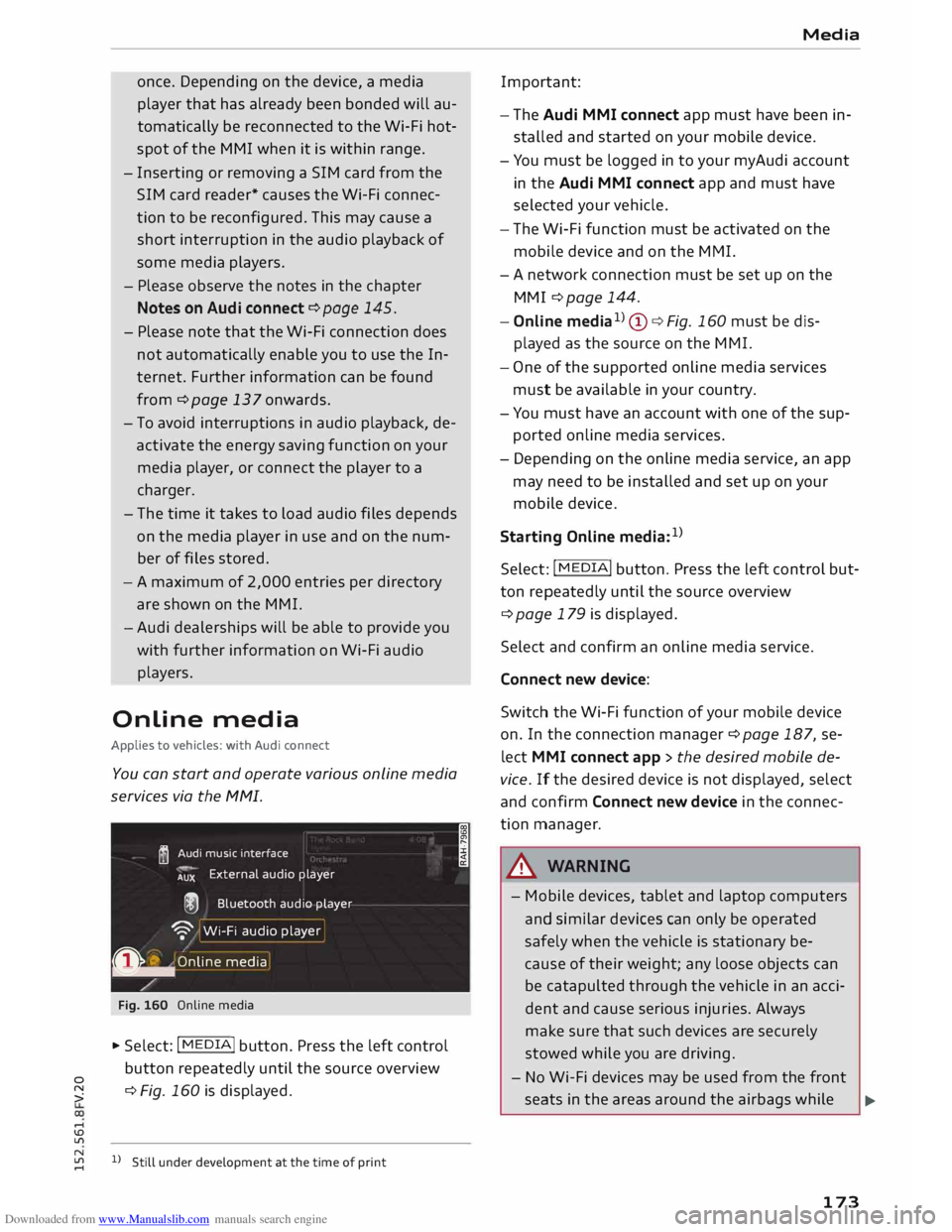
You can start and operate various online media
services via the MMI.
� Audi
music interface
AUX External
audio player
@ Bluetooth audio player
'9' Wi-Fi audio player
0 �
.
O nlin e media
Fig. 160 Online media
... Select: I MEDIA
!
button. Press the left control
button repeatedly until the source overview
� ¢
Fig. 160 is displayed.
....
\D L/'l
� 1)Still under development at the time of print
.... I Media
Important:
- The Audi MMI connect app must have been in
stalled and started on your mobile device.
- You must be logged in to your myAudi account
in the Audi MMI connect app and must have
selected your vehicle.
- The Wi-Fi function must be activated on the
mobile device and on the MMI.
- A network connection must be set up on the
MMI ¢ page 144.
- Online media1
)
(!) ¢Fig. 160 must be dis
played as the source on the MMI.
- One of the supported on line media services
must be available in your country.
- You must have an account with one of the sup
ported online media services.
- Depending on the online media service, an app
may need to be installed and set up on your
mobile device.
Starting Online media:1
)
Select: I MEDIA
! button. Press the Left control but
ton repeatedly until the source overview
¢page 179 is displayed.
Select and confirm an online media service.
Connect new device:
Switch the Wi-Fi function of your mobile device
on. In the connection manager¢ page 187, se
lect MMI connect app > the desired mobile de
vice. If the desired device is not displayed, select
and confirm Connect new device in the connec
tion manager .
.&_ WARNING
- Mobile devices, tablet and laptop computers
and similar devices can only be operated
safely when the vehicle is stationary be
cause of their weight; any loose objects can
be catapulted through the vehicle in an acci
dent and cause serious injuries. Always
make sure that such devices are securely
stowed while you are driving.
- No Wi-Fi devices may be used from the front
seats in the areas around the airbags while .,..
173
Page 195 of 284
Downloaded from www.Manualslib.com manuals search engine Before
every trip
The driver is responsible for the safety of the
passengers and the safe operation of the vehicle
at all times.
For your own safety and the safety of your pas
sengers, always note the following points before
every trip:
.,. Make sure that all lights and turn signals are
working properly.
.,. Check the tyre pressures.
.,. Make sure that all windows are clean and give
good visibility to the outside.
.,. Secure all luggage and other items carefully
¢page 201.
.,. Make sure that no objects can interfere with the
pedals.
.,. Adjust
the mirrors and the front seat according
to your body height.
.,. Make sure that children are protected with suit
able safety seats and properly worn seat belts
¢page 195.
.,. Sit in the correct position in your seat. Make
sure that your passengers are sitting in the cor
rect positions ¢ page 46 .
.,. Fasten your seat belt correctly. Make sure that
your passengers do the same ¢page 204.
What factors can impair your safety?
Safety on the road is directly related to how you
drive, and can also be affected by the passengers
in the vehicle.
The driver is responsible for the safety of the ve
hicle and all its occupants. If your ability to drive
is impaired in any way, you endanger yourself and
other road users ¢& . Therefore:
.,. Do not let yourself be distracted by passengers
or by using a mobile phone, etc.
.,. Never drive when your driving ability is im
paired (by medication, alcohol, drugs, etc.).
.,. Obey all traffic regulations and speed limits
and always maintain a safe distance to the vehi-
� de
in front.
� .,.
Always adjust your speed to suit the road, traf-
� fie
and weather conditions.
U'l
N
U'l
.-1 Safe
driving
.,. Take frequent breaks on long trips. Do not drive
for more than two hours without a stop.
.,. If possible, avoid driving when you are tired or
stressed.
A WARNING
- Distractions while driving or any kind of im
pairment to your driving ability increase the
risk of accident and injury .
- Do not place loose objects on the dash pan
el. These objects could fly around the interi
or when the vehicle is moving (under accel
eration or whilst cornering) and distract the
driver -risk of accident!
Correct sitting positions
Correct driving position
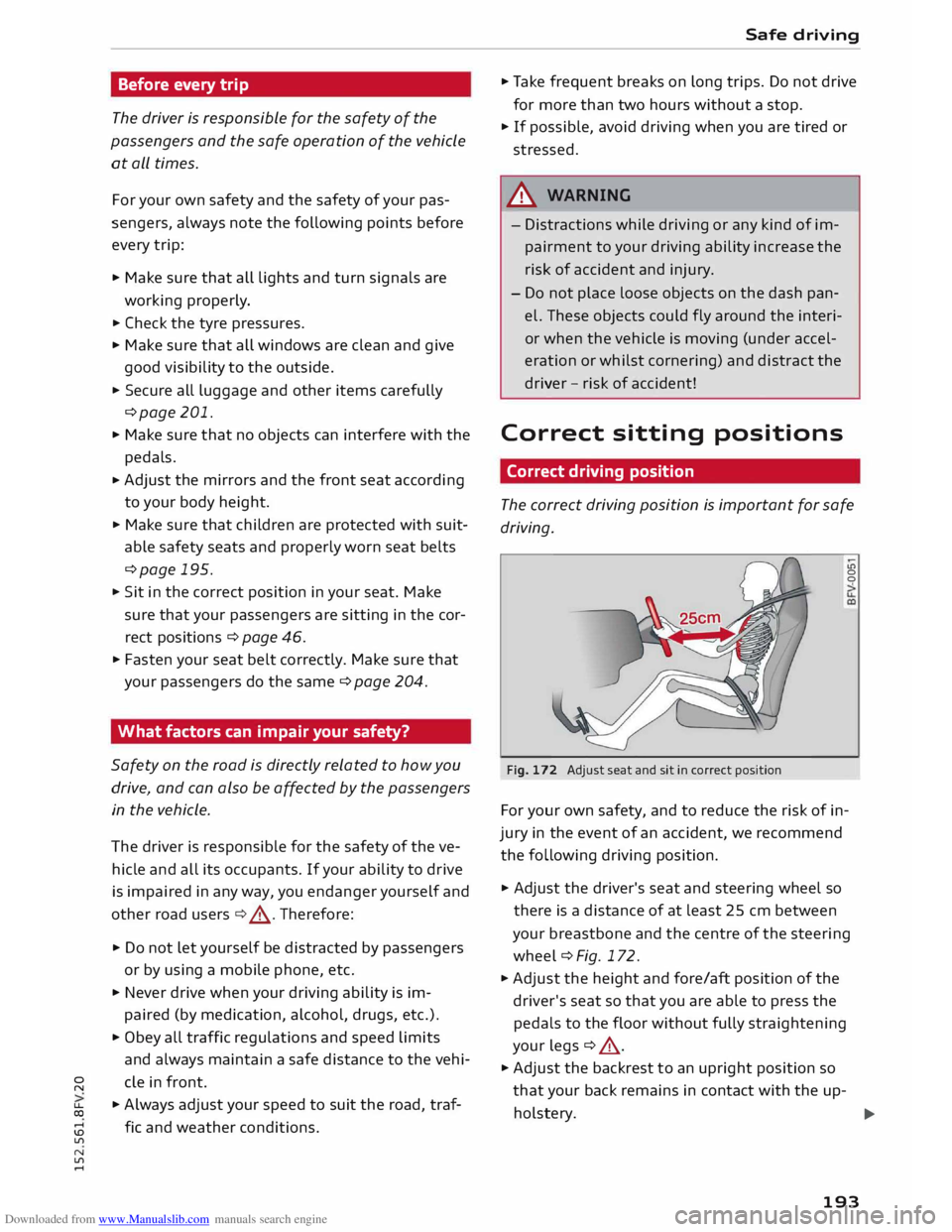
The correct driving position is important for safe
driving.
Fig. 172 Adjust seat and sit in correct position LO
0
0
For your own safety, and to reduce the risk of in
jury in the event of an accident, we recommend
the following driving position.
.,. Adjust the driver's seat and steering wheel so
there is a distance of at least 25 cm between
your breastbone and the centre of the steering
wheel¢ Fig. 172.
.,. Adjust the height and fore/aft position of the
driver's seat so that you are able to press the
pedals to the floor without fully straightening
your legs ¢ .&_ .
.,. Adjust the backrest to an upright position so
that your back remains in contact with the up-
holstery. ...,
193
Page 200 of 284
Downloaded from www.Manualslib.com manuals search engine Safe
driving
Group 3 child seats (rear seat)
Applies to vehicles: with rear seat approved as a Group 3 child
seat
Fig. 175 Label on the rear seat
Fig. 176 Child in the rear seat
Rear seat
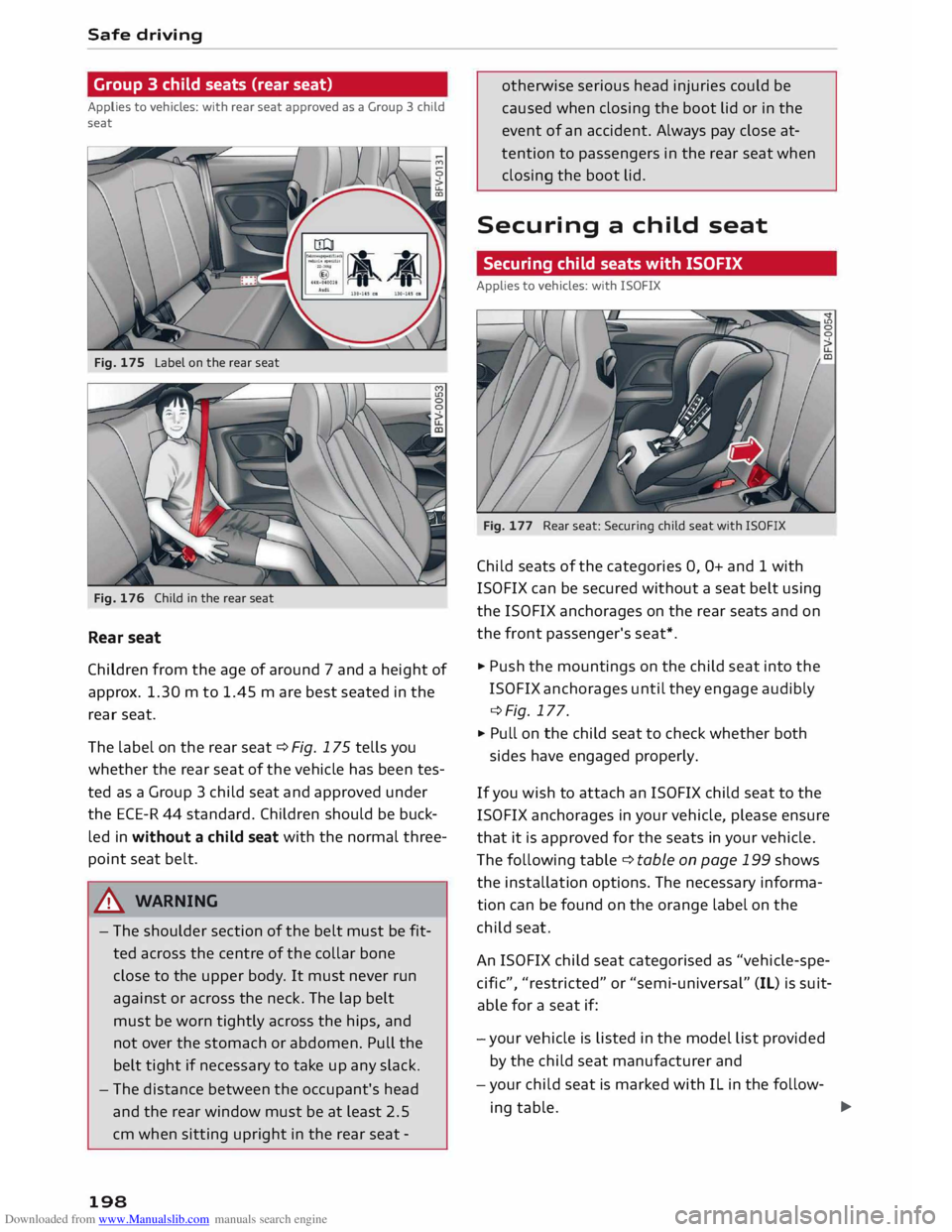
Children from the age of around 7 and a height of
approx. 1.30 m to 1.45 mare best seated in the
rear seat.
The label on the rear seat c::> Fig. 175 tells you
whether the rear seat of the vehicle has been tes
ted as a Group 3 child seat and approved under
the ECE-R 44 standard. Children should be buck
led in without a child seat with the normal three
point seat belt.
.&_ WARNING
- The shoulder section of the belt must be fit
ted across the centre of the collar bone
close to the upper body. It must never run
against or across the neck. The lap belt
must be worn tightly across the hips, and
not over the stomach or abdomen. Pull the
belt tight if necessary to take up any slack.
- The distance between the occupant's head
and the rear window must be at least 2.5
cm when sitting upright in the rear seat -
198 otherwise
serious head injuries could be
caused when closing the boot lid or in the
event of an accident. Always pay close at
tention to passengers in the rear seat when
closing the boot lid.
Securing a child seat
Securing child seats with ISOFIX
Applies to vehicles: with ISO FIX
Fig. 177 Rear seat: Securing child seat with ISO FIX
Child seats of the categories 0, O+ and 1 with
ISOFIX can be secured without a seat belt using
the ISOFIX anchorages on the rear seats and on
the front passenger's seat*.
� Push the mountings on the child seat into the
ISOFIX anchorages until they engage audibly
c::>Fig. 177.
� Pull on the child seat to check whether both
sides have engaged properly.
If you wish to attach an ISO FIX child seat to the
ISOFIX anchorages in your vehicle, please ensure
that it is approved for the seats in your vehicle.
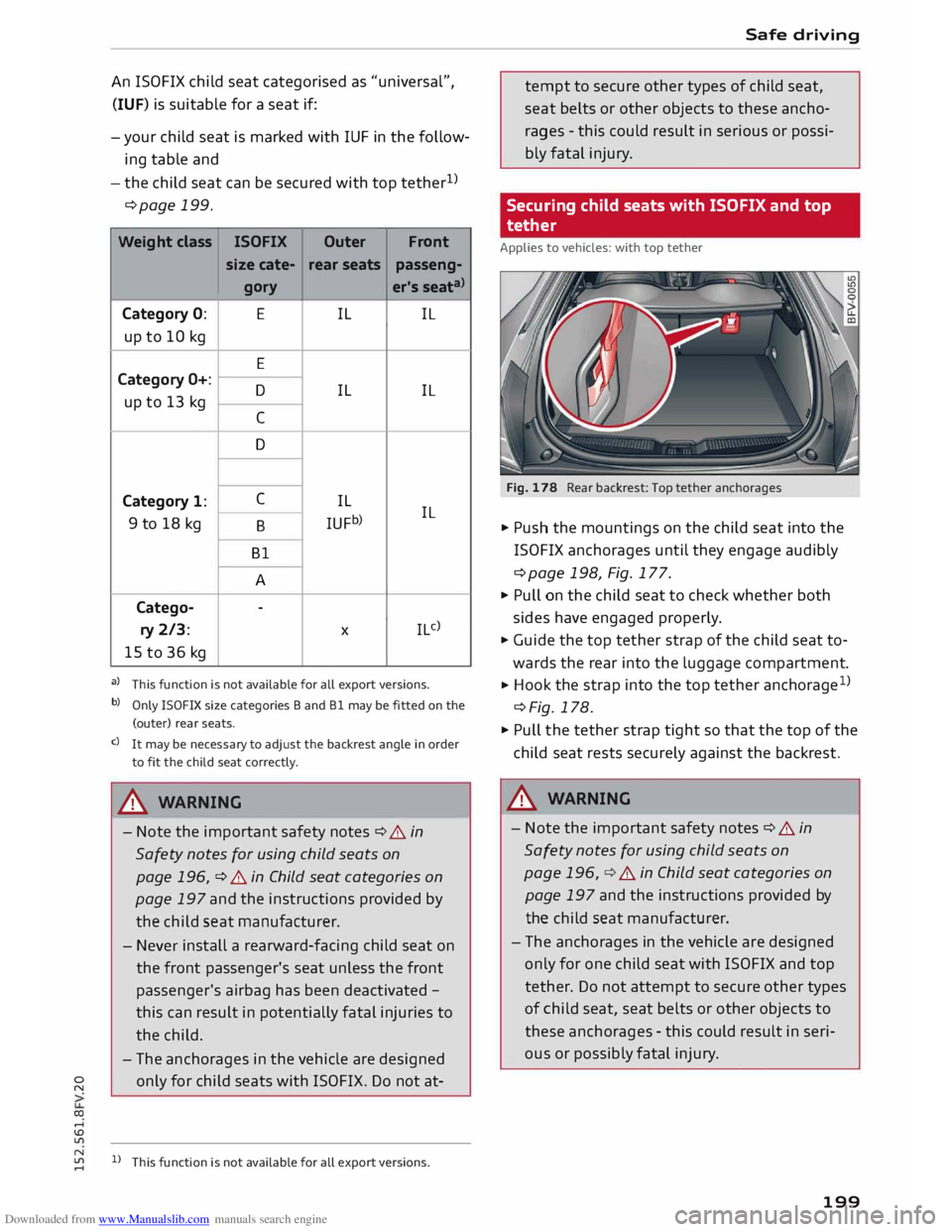
The following table ¢ table on page 199 shows
the installation options. The necessary informa
tion can be found on the orange label on the
child seat.
An ISOFIX child seat categorised as "vehicle-spe
cific", "restricted" or "semi-universal" (IL) is suit
able for a seat if:
- your vehicle is listed in the model list provided
by the child seat manufacturer and
-your child seat is marked with IL in the follow-
ing table. ..,.
Page 201 of 284
Downloaded from www.Manualslib.com manuals search engine 0
N
co
....
\D Lfl An
ISOFIX child seat categorised as "universal",
(IUF) is suitable for a seat if:
-your child seat is marked with IUF in the follow
ing table and
- the child seat can be secured with top tether 1
>
¢page 199.
Weight class
ISOFIX
Outer Front
size cate- rear
seats
passeng-
gor y er's
seat"'>
Category 0: E
IL IL
up to 10 kg
E
Category O+:
D IL IL
up to 13 kg
C
D
Category 1: C
IL
9 to 18 kg ILJFb) IL
B
Bl A
Catego- -
ry 2/3: X
IL c)
15 to 36 kg
a) This function is not available for all export versions.
b) Only ISO FIX size categories Band Bl may be fitted on the
(outer) rear seats.
c) It may be necessary to adjust the backrest angle in order
to fit the child seat correctly.
A WARNING
- Note the important safety notes¢ A in
Safety notes for using child seats on
page 196, ¢ A in Child seat categories on
page 197 and the instructions provided by
the child seat manufacturer.
- Never install a rearward-facing child seat on
the front passenger's seat unless the front
passenger's airbag has been deactivated -
this can result in potentially fatal injuries to
the child.
- The anchorages in the vehicle are designed
only for child seats with ISOFIX. Do not at-
N
� l)
This function is not available for all export versions. Safe
driving
tempt to secure other types of child seat,
seat belts or other objects to these ancho
rages -this could result in serious or possi
bly fatal injury.
Securing child seats with ISOFIX and top
tether
Applies to vehicles: with top tether
Fig. 178 Rear backrest: Top tether anchorages
.. Push the mountings on the child seat into the
ISOFIX anchorages until they engage audibly
¢page 198, Fig. 177.
.. Pull on the child seat to check whether both
sides have engaged properly.
.. Guide the top tether strap of the child seat to
wards the rear into the luggage compartment.
.. Hook
the strap into the top tether anchorage 1
>
¢Fig. 178.
.. Pull the tether strap tight so that the top of the
child seat rests securely against the backrest.
A WARNING
- Note the important safety notes¢ A in
Safety notes for using child seats on
page 196, ¢ A in Child seat categories on
page 197 and the instructions provided by
the child seat manufacturer.
- The anchorages in the vehicle are designed
only for one child seat with ISOFIX and top
tether. Do not attempt to secure other types
of child seat, seat belts or other objects to
these anchorages -this could result in seri
ous or possibly fatal injury.
199
Page 202 of 284
Downloaded from www.Manualslib.com manuals search engine Safe
driving
Securing child seats with seat belt
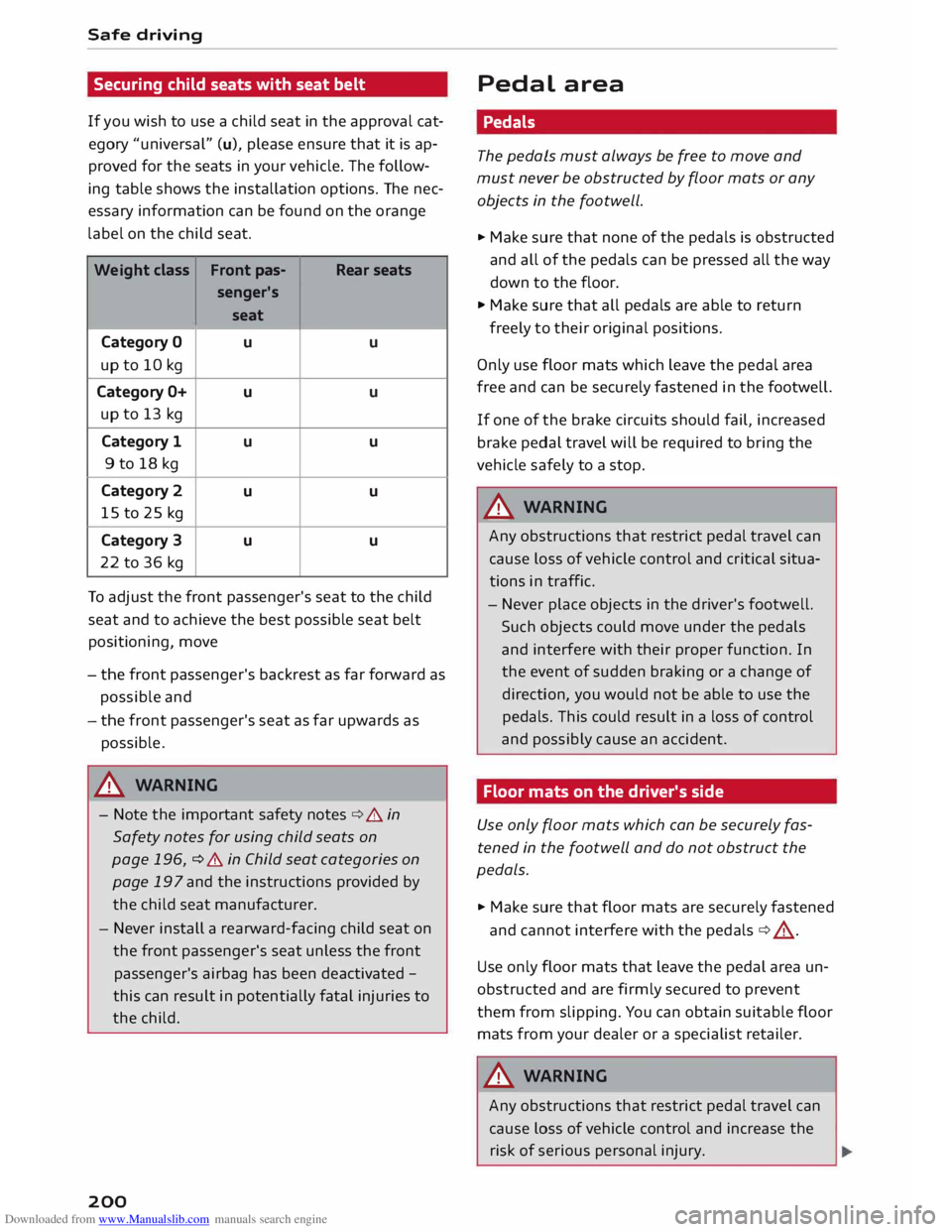
If you wish to use a child seat in the approval cat
egory "universal" (u), please ensure that it is ap
proved for the seats in your vehicle. The follow
ing table shows the installation options. The nec
essary information can be found on the orange
label on the child seat.
Weight class Front
pas-
Rear seats
senger's
seat
Category 0 u u
up to 10 kg
Category O+ u u
up to 13 kg
Category 1
u u
9 to 18 kg
Category 2 u u
15 to 25 kg
Category 3
u u
22 to 36 kg
To adjust the front passenger's seat to the child
seat and to achieve the best possible seat belt
positioning, move
- the front passenger's backrest as far forward as
possible and
- the front passenger's seat as far upwards as
possible.
_& WARNING
- Note the important safety notes¢.&. in
Safety notes for using child seats on
page 196, ¢ .&. in Child seat categories on
page 197 and the instructions provided by
the child seat manufacturer.
- Never install a rearward-facing child seat on
the front passenger's seat unless the front
passenger's airbag has been deactivated -
this can result in potentially fatal injuries to
the child.
200 Pedal
area
Pedals
The pedals must always be free to move and
must never be obstructed by floor mats or any
objects in the footwell.
... Make sure that none of the pedals is obstructed
and all of the pedals can be pressed all the way
down to the floor.
... Make sure that all pedals are able to return
freely to their original positions.
Only use floor mats which leave the pedal area
free and can be securely fastened in the footwell.
If one of the brake circuits should fail, increased
brake pedal travel will be required to bring the
vehicle safely to a stop.
_& WARNING
Any obstructions that restrict pedal travel can
cause loss of vehicle control and critical situa
tions in traffic.
- Never place objects in the driver's footwell.
Such objects could move under the pedals
and interfere with their proper function. In
the event of sudden braking or a change of
direction, you would not be able to use the
pedals. This could result in a loss of control
and possibly cause an accident.
Floor mats on the driver's side
Use only floor mats which can be securely fas
tened in the footwell and do not obstruct the
pedals.
... Make sure that floor mats are securely fastened
and cannot interfere with the pedals ¢.&_ .
Use only floor mats that leave the pedal area un
obstructed and are firmly secured to prevent
them from slipping. You can obtain suitable floor
mats from your dealer or a specialist retailer.
_& WARNING
Any obstructions that restrict pedal travel can
cause loss of vehicle control and increase the
risk of serious personal injury.
Page 203 of 284
Downloaded from www.Manualslib.com manuals search engine 0
N
co
....
\D Lfl
N
Lfl
.... -Always
make sure that floor mats are prop
erly secured.
- Never lay or install additional floor mats or
other floor coverings over the existing floor
mats; this would restrict the pedal area and
possibly obstruct the pedals, which could
cause an accident.
Stowing luggage safely
Luggage compartment
Fig. 179 Heavy items should be placed as far forwards as
possible.
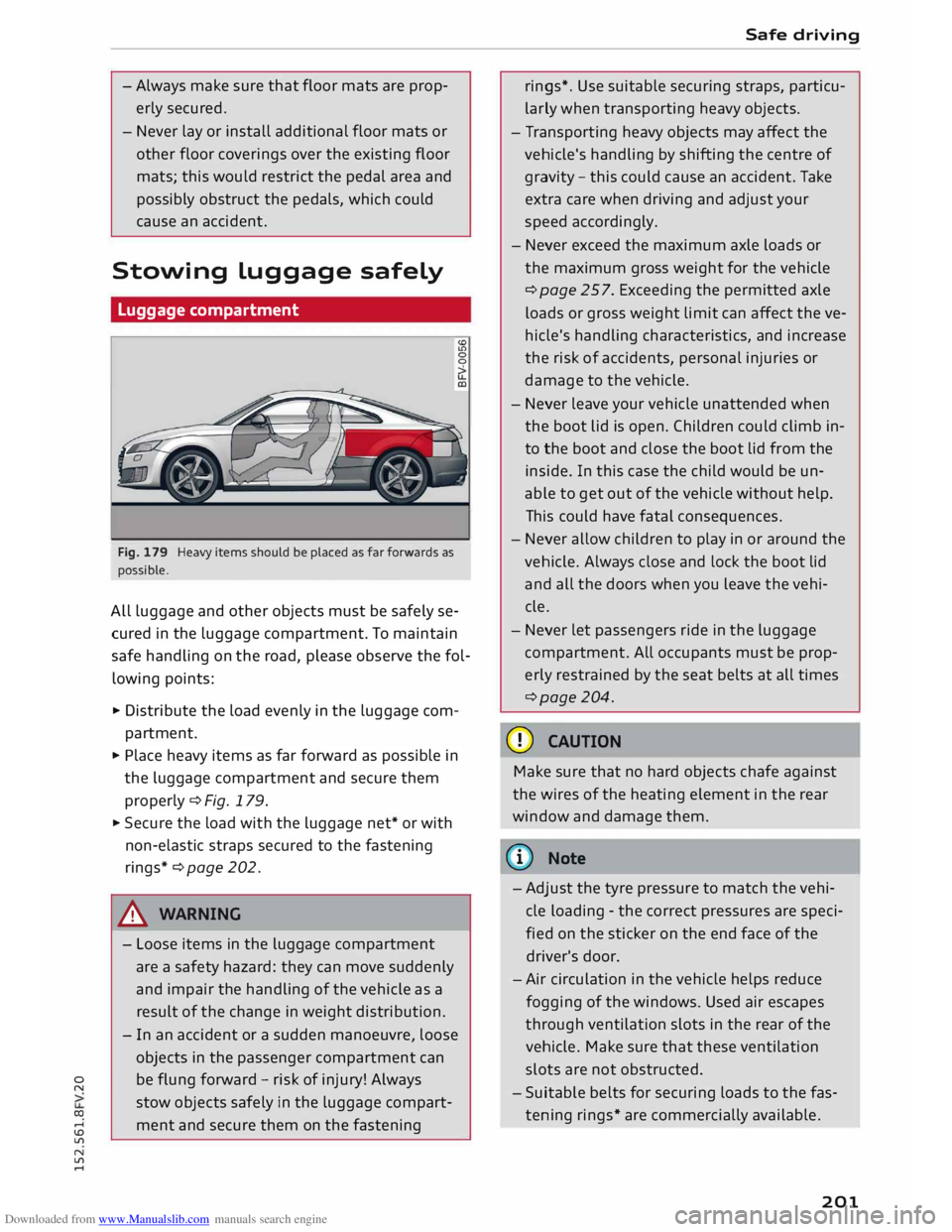
All luggage and other objects must be safely se
cured in the luggage compartment. To maintain
safe handling on the road, please observe the fol
lowing points:
� Distribute the load evenly in the luggage com
partment.
� Place heavy items as far forward as possible in
the luggage compartment and secure them
properly ¢Fig. 179.
� Secure the load with the luggage net* or with
non-elastic straps secured to the fastening
rings*¢ page 202.
A WARNING
- Loose items in the luggage compartment
are a safety hazard: they can move suddenly
and impair the handling of the vehicle as a
result of the change in weight distribution.
- In an accident or a sudden manoeuvre, loose
objects in the passenger compartment can
be flung forward -risk of injury! Always
stow objects safely in the luggage compart
ment and secure them on the fastening Safe
driving
rings*. Use suitable securing straps, particu
larly when transporting heavy objects.
- Transporting heavy objects may affect the
vehicle's handling by shifting the centre of
gravity -this could cause an accident. Take
extra care when driving and adjust your
speed accordingly.
- Never exceed the maximum axle loads or
the maximum gross weight for the vehicle
¢ page 257. Exceeding the permitted axle
loads or gross weight limit can affect the ve
hicle's handling characteristics, and increase
the risk of accidents, personal injuries or
damage to the vehicle.
- Never leave your vehicle unattended when
the boot lid is open. Children could climb in
to the boot and close the boot lid from the
inside. In this case the child would be un
able to get out of the vehicle without help.
This could have fatal consequences.
- Never allow children to play in or around the
vehicle. Always close and lock the boot lid
and all the doors when you leave the vehi
cle.
- Never let passengers ride in the luggage
compartment. All occupants must be prop
erly restrained by the seat belts at all times
¢page 204.
CD CAUTION
Make sure that no hard objects chafe against
the wires of the heating element in the rear
window and damage them.
(D} Note
- Adjust the tyre pressure to match the vehi
cle loading -the correct pressures are speci
fied on the sticker on the end face of the
driver's door.
- Air circulation in the vehicle helps reduce
fogging of the windows. Used air escapes
through ventilation slots in the rear of the
vehicle. Make sure that these ventilation
slots are not obstructed.
- Suitable belts for securing loads to the fas
tening rings* are commercially available.
201
Page 204 of 284
Downloaded from www.Manualslib.com manuals search engine Safe
driving
Fastening rings
Unsecured loads are a hazard to all vehicle occu
pants.
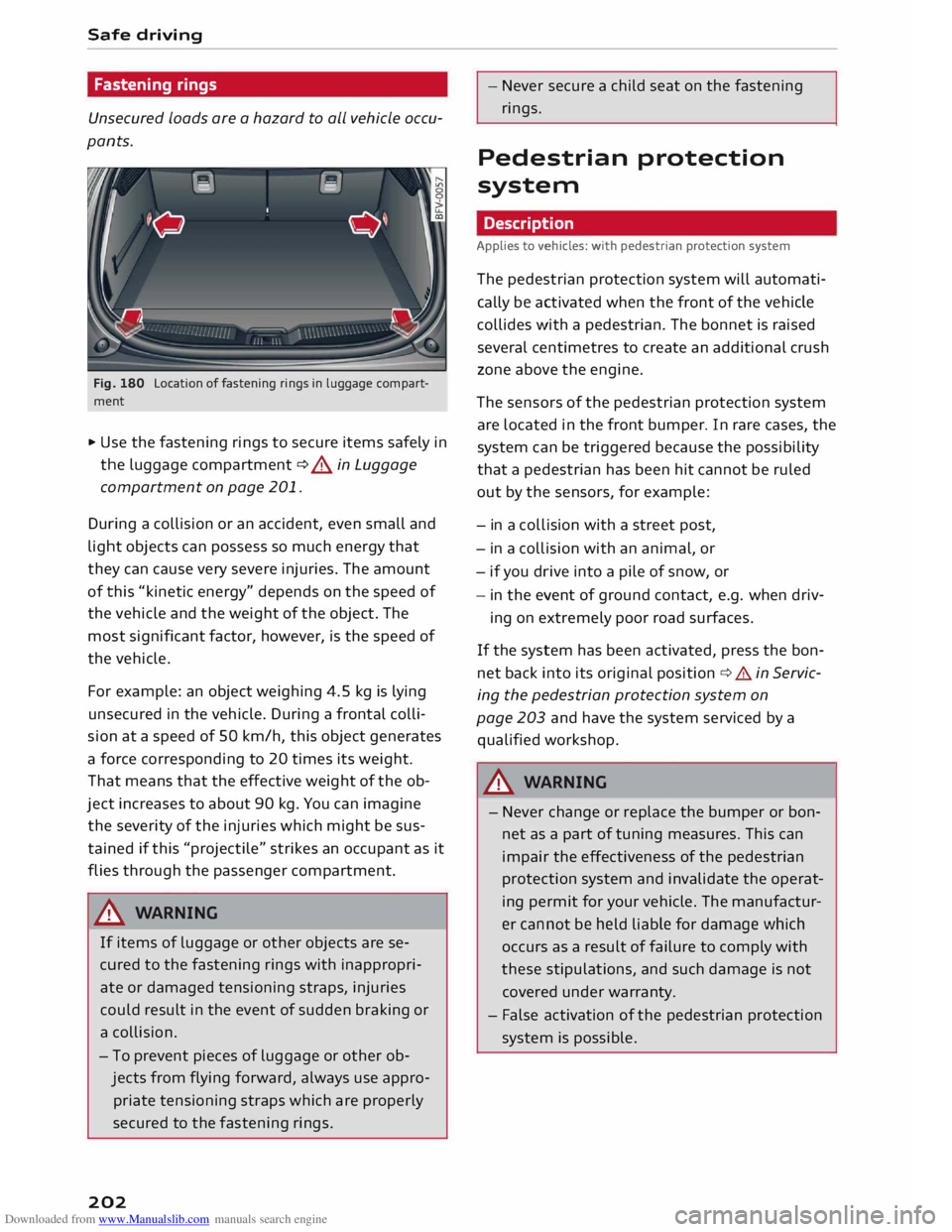
Fig. 180 Location of fastening rings in luggage compart
ment
.,. Use the fastening rings to secure items safely in
the luggage compartment ¢ A in Luggage
compartment on page 201.
During a collision or an accident, even small and
light objects can possess so much energy that
they can cause very severe injuries. The amount
of this "kinetic energy" depends on the speed of
the vehicle and the weight of the object. The
most significant factor, however, is the speed of
the vehicle.
For example: an object weighing 4.5 kg is lying
unsecured in the vehicle. During a frontal colli
sion at a speed of SO km/h, this object generates
a force corresponding to 20 times its weight.
That means that the effective weight of the ob
ject increases to about 90 kg. You can imagine
the severity of the injuries which might be sus
tained if this "projectile" strikes an occupant as it
flies through the passenger compartment.
A WARNING
If items of luggage or other objects are se
cured to the fastening rings with inappropri
ate or damaged tensioning straps, injuries
could result in the event of sudden braking or
a collision.
- To prevent pieces of luggage or other ob
jects from flying forward, always use appro
priate tensioning straps which are properly
secured to the fastening rings.
202 -
Never secure a child seat on the fastening
rings.
Pedestrian protection
system
Description
Applies to vehicles: with pedestrian protection system
The pedestrian protection system will automati
cally be activated when the front of the vehicle
collides with a pedestrian. The bonnet is raised
several centimetres to create an additional crush
zone above the engine.
The sensors of the pedestrian protection system
are located in the front bumper. In rare cases, the
system can be triggered because the possibility
that a pedestrian has been hit cannot be ruled
out by the sensors, for example:
- in a coll ision with a street post,
- in a collision with an animal, or
- if you drive into a pile of snow, or
- in the event of ground contact, e.g. when driv-
ing on extremely poor road surfaces.
If the system has been activated, press the bon
net back into its original position¢&. in Servic
ing the pedestrian protection system on
page 203 and have the system serviced by a
qualified workshop.
.&_ WARNING
- Never change or replace the bumper or bon
net as a part of tuning measures. This can
impair the effectiveness of the pedestrian
protection system and invalidate the operat
ing permit for your vehicle. The manufactur
er cannot be held liable for damage which
occurs as a result of failure to comply with
these stipulations, and such damage is not
covered under warranty.
- False activation of the pedestrian protection
system is possible.
Page 208 of 284
Downloaded from www.Manualslib.com manuals search engine Seat
belts
Even at urban speeds of 30 km/h to 50 km/h, the
forces acting on the occupants in a collision can
reach the equivalent of 1 ton (1000 kg) or more.
At greater speed these forces are even higher.
Again: if the speed doubles, the forces increase
by a factor of four.
Passengers who do not wear seat belts are not
"attached" to the vehicle. In a frontal collision
they will continue to move forward at the speed
their car was travelling just before the impact.
What happens to passengers not wearing
seat belts?
Passengers not wearing seat belts risk fatal inju
ries in the event of an accident.
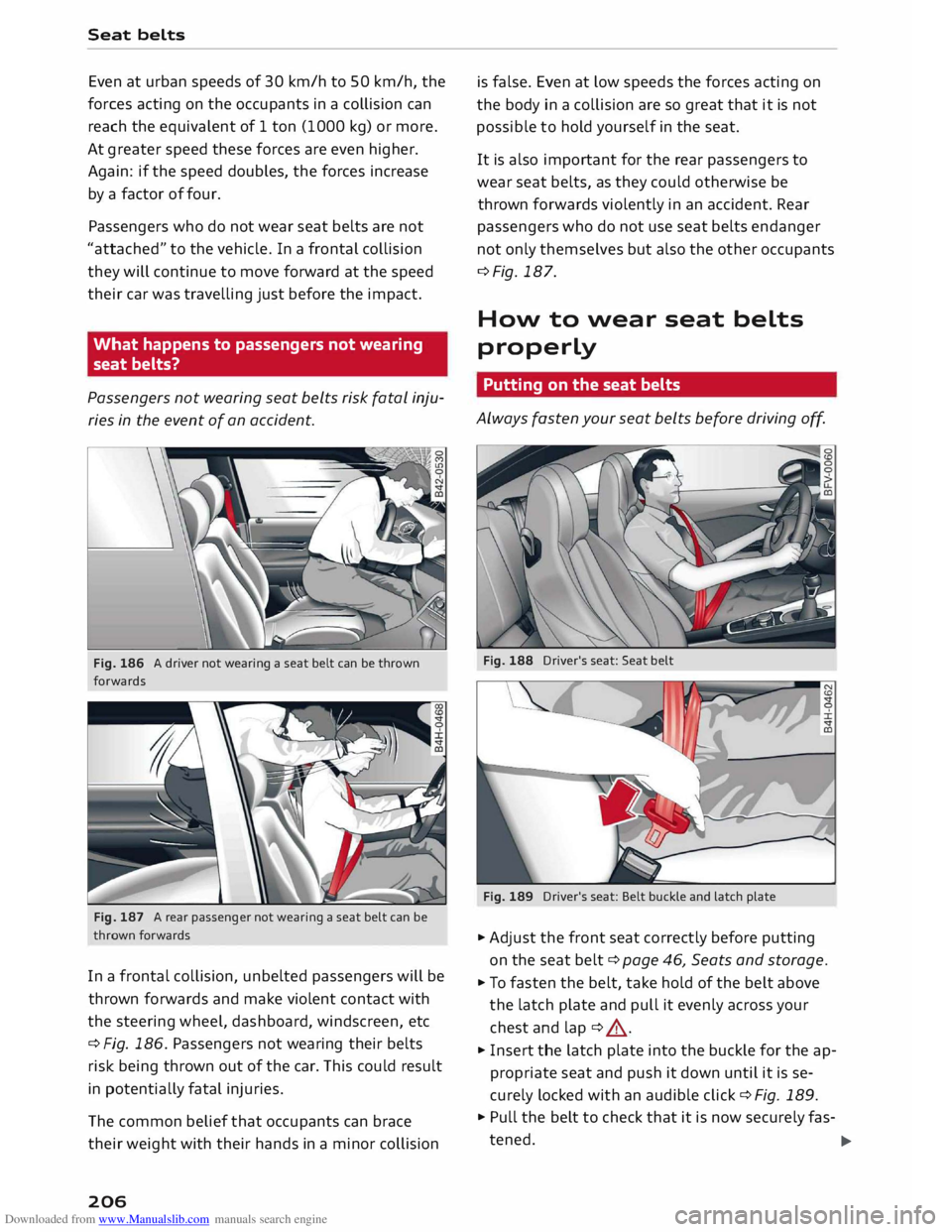
Fig. 186 A driver not wearing a seat belt can be thrown
forwards
Fig. 187 A rear passenger not wearing a seat belt can be
thrown forwards
In a frontal collision, unbelted passengers will be
thrown forwards and make violent contact with
the steering wheel, dashboard, windscreen, etc
¢ Fig
. 186.
Passengers not wearing their belts
risk being thrown out of the car. This could result
in potentially fatal injuries.
The common belief that occupants can brace
their weight with their hands in a minor collision
206 is
false. Even at low speeds the forces acting on
the body in a collision are so great that it is not
possible to hold yourself in the seat.
It is also important for the rear passengers to
wear seat belts, as they could otherwise be
thrown forwards violently in an accident. Rear
passengers who do not use seat belts endanger
not only themselves but also the other occupants
¢Fig. 187.
How to wear seat belts
properly
Putting on the seat belts
Alwa ys
fasten
your
seat belts before driving o
ff .
Fig. 188 Driver's seat: Seat belt
Fig. 189 Driver's seat: Belt buckle and latch plate
.,. Adjust the front seat correctly before putting
on the seat belt¢ page 46, Seats and storage.
.,. To fasten the belt, take hold of the belt above
the latch plate and pull it evenly across your
chest and lap¢ A.
.,. Insert the latch plate into the buckle for the ap
propriate seat and push it down until it is se
curely locked with an audible click¢ Fig. 189 .
.,. Pull the belt to check that it is now securely fas-
tened. liJI,,