ignition AUDI TT COUPE 2014 User Guide
[x] Cancel search | Manufacturer: AUDI, Model Year: 2014, Model line: TT COUPE, Model: AUDI TT COUPE 2014Pages: 284, PDF Size: 34.42 MB
Page 26 of 284
Downloaded from www.Manualslib.com manuals search engine Driver
information system
Controls
Applies to vehicles: with camera-based traffic sign recognition
')· ·.
I
,
,··· .. ,
,· Date
&time
12: 11 AM (.
�1\
.
I
..
' Tuesday
2014-1-21 ...
/ 223450,,,,
11:30-.i �
-- .
1009.0,m ?® Y
13.0"C �
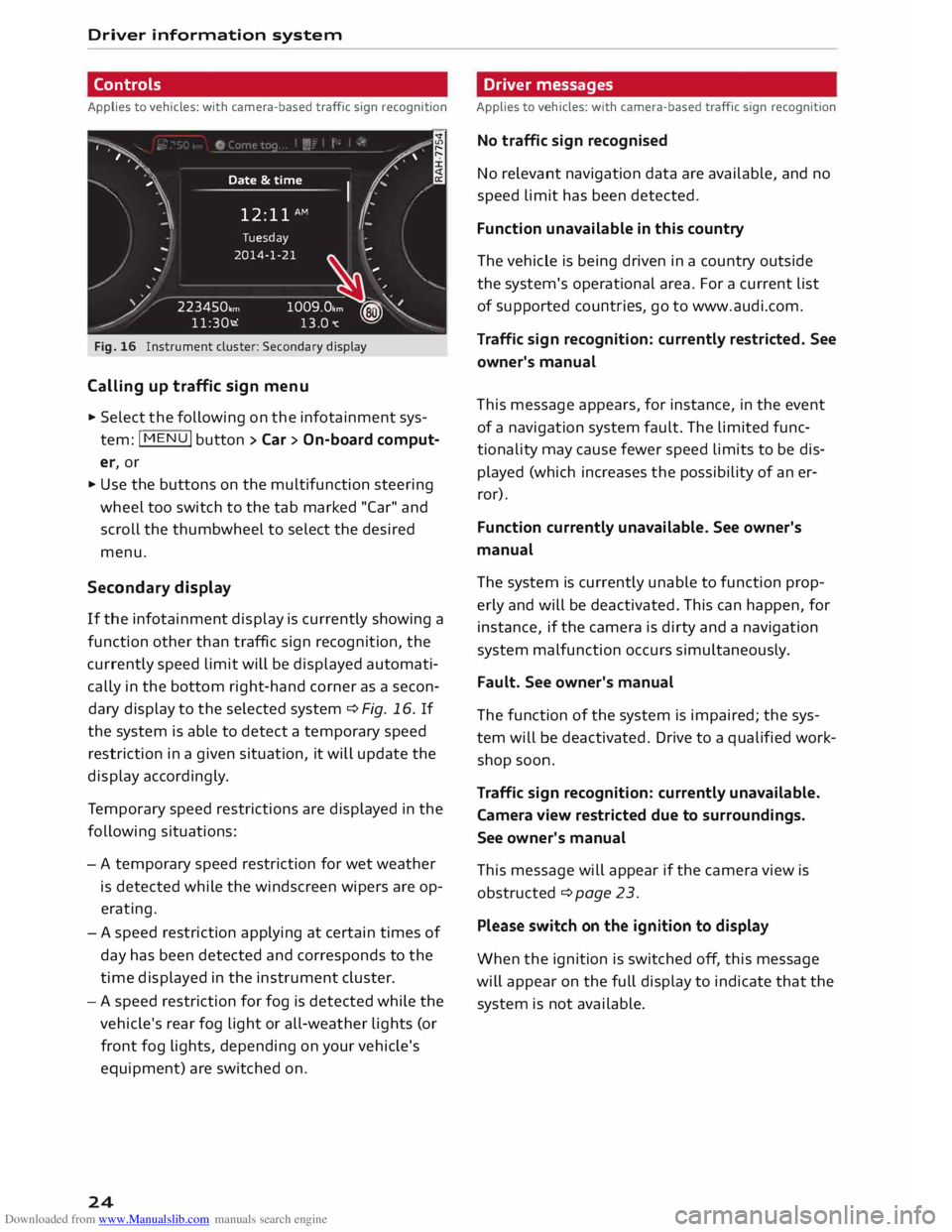
Fig. 16 Instrument cluster: Secondary display
Calling up traffic sign menu
.,. Select the following on the infotainment sys
tem: jMENUj button> Car > On-board comput
er, or
.,. Use the buttons on the multifunction steering
wheel too switch to the tab marked "Car" and
scroll the thumbwheel to select the desired
menu,
Second ary display
If the infotainment display is currently showing a
function other than traffic sign recognition, the
currently speed limit will be displayed automati
cally in the bottom right-hand corner as a secon
dary display to the selected system ¢ Fig, 16, If
the system is able to detect a temporary speed
restriction in a given situation, it will update the
display accordingly.
Te mporary speed restrictions are displayed in the
following situations:
- A temporary speed restriction for wet weather
is detected while the windscreen wipers are op
erating.
- A speed restriction applying at certain times of
day has been detected and corresponds to the
time displayed in the instrument cluster.
- A speed restriction for fog is detected while the
vehicle's rear fog light or all-weather lights (or
front fog lights, depending on your vehicle's
equipment) are switched on.
24 Driver
messages
Applies to vehicles: with camera-based traffic sign recognition
No traffic sign recognised
No relevant navigation data are available, and no
speed limit has been detected.
Function unavailable in this country
The vehicle is being driven in a country outside
the system's operational area. For a current list
of supported countries, go to www.audi.com.
Traffic sign recognition: currently restricted. See
owner's manual
This message appears, for instance, in the event
of a navigation system fault. The limited func
tionality may cause fewer speed limits to be dis
played (which increases the possibility of an er
ror).
Function currently unavailable. See owner's
manual
The system is currently unable to function prop
erly and will be deactivated. This can happen, for
instance, if the camera is dirty and a navigation
system malfunction occurs simultaneously.
Fault. See owner's manual
The function of the system is impaired; the sys
tem will be deactivated. Drive to a qualified work
shop soon.
Traffic sign recognition: currently unavailable.
Camera view restricted due to surroundings.
See owner's manual
This message will appear if the camera view is
obstructed ¢ page 23.
Please switch on the ignition to display
When the ignition is switched off, this message
will appear on the full display to indicate that the
system is not available.
Page 28 of 284
Downloaded from www.Manualslib.com manuals search engine Doors
and windows
check regularly that the emergency key is still
present in the remote control key casing.
@ Spare key
This key is intended for temporary use only and
should be used only in an emergency. Keep it in a
safe place and do not carry it on the keyring.
Replacing a key
If you should lose a key, please contact an Audi
dealer. Have the remote control coding for that
key deactivated. For this purpose you should
bring all available keys with you. It is also impor
tant to notify your insurance company if a key has
been lost.
Number of keys
You can check how many keys are initialised for
your vehicle using the infotainment system. Se
lect the following on the infotainment system:
I MENU I
button >Car> left control button > Serv
icing & checks > Initialised keys. This feature en
ables used car buyers to make sure they have re
ceived all of the keys.
Electronic immobiliser
The immobiliser is designed to prevent unauthor
ised persons from driving the vehicle.
It may not be possible to start the engine with
the key if there is another ignition key from a dif
ferent make of vehicle on the same key ring.
Data stored on remote control key
Data related to the service and maintenance of
the vehicle are stored continuously on your re
mote control key while you are driving. Your Audi
dealer can read out the data and will then be able
to tell you what service work is required. This also
applies to vehicles with convenience key*.
Personal convenience settings
If two people use the same car regularly, it is a
good idea for each person to have his or her
"own" remote control key. When you switch off
the ignition or lock the vehicle, your personal set
tings for the following convenience features are
stored and assigned to the remote control key:
- Air conditioner
26 -
Central locking system
-Windows
- Background lighting*
- Parking aid*
- Active lane assist*
- Side assist*
- Drive select
The stored settings are then recalled automati
cally the next time the vehicle is unlocked, the
doors are opened or the ignition is switched on.
_& WARNING
Always take the key with you when leaving the
vehicle -even if you only intend to be gone for
a short time. This is especially important if
children are left in the car. They might other
wise be able to start the engine or use power
operated equipment such as the electric win
dows -this could lead to injuries.
The function of the remote control key may be
impaired by interference from other nearby
radio signals (for example from a mobile tele
phone or TV transmitter) if these are in the
same frequency range.
Page 31 of 284

Downloaded from www.Manualslib.com manuals search engine 0
N
co
....
\D L/'l
N
L/'l
.... key,
for instance whether it is in your jacket pock
et or in a briefcase.
The locking function may be affected if you grasp
the door handle while the vehicle is being locked.
Once the doors have been locked, they cannot be
opened again immediately. This will enable you
to check that the doors are properly closed.
The system will unlock either all the doors or only
one of the doors, depending on the settings you
have chosen on the infotainment system
¢page 30.
_& WARNING
On vehicles with an anti-theft alarm system*,
do not leave anyone (especially children) in
the car if it is locked from the outside and the
safelock mechanism* is activated: the doors
and windows cannot then be opened from the
inside ¢ page 31. Locked doors could delay
assistance in an emergency, potentially put
ting lives at risk.
((I)) Note
Please note the following points if the vehicle
is left parked for long periods:
- To save electrical power, the proximity sen
sors are switched off after a few days. You
will then need to pull the door handle once
to unlock the vehicle, and a second time to
open it.
- To prevent the battery from becoming dis
charged and thus maintain the vehicle's
starting ability for as long as possible, the
power management system will gradually
switch off convenience functions that are
not required. In this case you may not be
able to unlock the vehicle with this conven
ience function. Doors
and windows
Central locking switch
Fig. 24 Driver's door: Central locking switch
� To lock the vehicle, press the� button ¢.& -
� To unlock the vehicle, press the @J button.
Please note the following when you use the cen
tral locking switch to lock your vehicle:
- The doors and the boot lid cannot be opened
from the outside (for safety reasons, when
stopped at traffic lights, etc.).
- The LED in the central locking switch lights up
when all of the doors are closed and locked.
- You can open the doors individually from the in
side by pulling the inside door handle.
- In the event of an accident in which the airbags
inflate, doors locked from the inside will be au
tomatically unlocked to facilitate access and as
sistance.
_& WARNING
- The central locking switch is still operative
when the ignition is switched off and will
automatically lock the entire vehicle when
the @l button is pressed.
- The central locking switch inside the vehicle
is not operative if you lock the vehicle from
the outside .
- Locked doors could delay assistance in an
emergency, potentially putting lives at risk.
Do not leave anyone (especially children) in
the vehicle.
The doors and the boot lid are locked auto
matically when the vehicle reaches a speed of
about 15 km/h (Auto Lock) ¢page 25. You 1111>
29
Page 33 of 284

Downloaded from www.Manualslib.com manuals search engine 0
N
co
,-j
\D U'l
N
U'l
,-j rig
ht* side) or to the left (if the door is on the
left side).
Once the passenger's door has been closed it can
no longer be opened from the outside. The door
can be opened from the inside by pulling the
door handle.
A WARNING
On vehicles with an anti-theft alarm system*,
do not Leave anyone (especially children) in
the car if it is locked from the outside and the
safelock mechanism* is activated: the doors
and windows cannot then be opened from the
inside ¢page 31. Locked doors could delay
assistance in an emergency, potentially put
ting lives at risk.
Anti-theft alarm system
Applies to vehicles: with anti-theft alarm system
Fig. 27 End face of (open) driver's door: Button for interior
monitor/tow-away protection
If the anti-theft alarm system senses interfer
ence with the vehicle it triggers an audible and
visible alarm. The anti-theft alarm system is acti
vated when you lock the vehicle in the usual way
and is switched off again when you unlock the ve
hicle.
The anti-theft alarm system comprises the fol
lowing components:
Anti-theft alarm
The alarm is triggered if the bonnet, the boot lid
or any of the doors are forced open. The alarm
system is armed whenever the vehicle is locked.
l l
This function is not available on all export versions/equip
ment versions. Doors
and windows
If you unlock the vehicle by turning the key in the
driver's door lock, you should switch on the igni
tion within 15 seconds to prevent the alarm from
being triggered. On some export versions, the
alarm is triggered immediately when you open a
door.
To deactivate the alarm, switch on the ignition or
press the@J button on the remote control key.
Interior monitor and tow-away protection
When the vehicle is locked, the alarm will be trig
gered if movements are detected in the interior
(e.g. by animals) or if the vehicle's inclination is
changed (e.g. during transport). You can prevent
the alarm from being triggered accidentally by
switching off the interior monitor and/or tow
away protection. To do so, proceed as follows:
� Press the� button ¢ Fig. 27. The LED in the
button will light up.
� If you now lock the vehicle, the interior monitor
and tow-away protection will remain deactiva
ted until the vehicle is unlocked again.
Safelock 1
)
The doors can no longer be opened from the in
side. This makes it more difficult to break into
the vehicle ¢ ,A. The message Be aware of door
safelock. See owner's manual appears on the in
fotainment display when you switch off the igni
tion as a reminder that the safe lock mechanism*
will be activated. You can switch off the safelock
mechanism* by using one of the following op
tions:
� Press the� button on the remote control key a
second time within 2 seconds. Or:
� Touch the sensor on the door handle a second
time within 2 seconds (applies to vehicles with
convenience key). Or:
� Turn the emergency key in the door lock to the
lock position a second time within 2 seconds.
IJJI,-
31
Page 35 of 284

Downloaded from www.Manualslib.com manuals search engine 0
N
co
....
\D Lfl
N
Lfl
.... Releasing
the boot lid manually
The boot lid can be released manually from the
inside.
Fig. 29 Accessing manual release lever on left of luggage
compartment below rear window
Fig. 30 Manual release lever in luggage compartment
(from inside)
• Fold down the left backrest.
• Prise off the cover c::> Fig. 29 using the emergen
cy key c::> page 2 7.
• Pull the plastic cord in the direction indicated
by the arrow c::> Fig. 30.
Electric windows
Controls
The driver can operate all the electric windows.
Fig. 31 Detail of the driver's door: Controls Doors
and windows
All electric windows have two-stage switches:
Opening a window
• Press the switch as far as the first stop and
hold it until the window has moved to the de
sired position.
• Press
the switch briefly to the second stop: the
window will automatically open all the way.
Closing a window
... Pull the switch as far as the first stop and hold
it until the window has moved to the desired
position.
• Pull the switch briefly to the second stop: the
window will automatically close all the way.
Switches for electric windows
@ Driver's window
@ Front passenger's window
A WARNING
- Always take the key with you when leaving
the vehicle -even if you only intend to be
gone for a short time. This is especially im
portant if children are left in the car. They
might otherwise be able to start the engine
or use power-operated equipment such as
the electric windows -this could Lead to in
juries. The window switches are only deacti
vated when the driver's door or the front
passenger's door is opened.
- Always be careful when closing the win
dows. Careless use of the electric windows
can cause severe injuries.
- When Locking the vehicle from the outside,
make sure that nobody is inside the vehicle,
as the windows cannot be opened from the
inside in an emergency.
@ Note
- The windows can be operated for about ten
minutes after the ignition has been switch
ed off. The window switches are only deacti
vated when the driver's door or the front
passenger's door is opened.
- When the doors are opened the windows
will automatically come down approximate
ly 10 mm.
33
Page 38 of 284

Downloaded from www.Manualslib.com manuals search engine Doors
and windows
with the 3rd step, or try holding the trans
mitter nearer or further away from the radia
tor grille.
9. If the garage door or other system still fails
to be activated using the buttons in the head
liner after programming is completed, it is
possible that the system might be working
with a rolling code instead of the normal
fixed security code. If this is the case, a roll
ing code programming is required in addi
tion to the steps described above
¢page 36.
Follow the instructions above to program the
other two buttons in the headliner. Start with the
3rd step.
Erasing the button programming
Programmed buttons can only be erased all at
once; it is not possible to erase them individually.
Reprogram the buttons if necessary.
.. Switch on the ignition.
.. Press and hold down the two outer buttons in
the headliner until the yellow LED@ goes out
and the green LED@ lights up.
Reprogramming the buttons
.. Switch on the ignition.
.. To
reprogram an individual button, press and
hold the desired button until the LED@ begins
to flash rapidly (after about 20 seconds). Then
release the button immediately. The program
ming mode is then activated for 5 minutes.
.. Continue with the 5th step.
@ Note
- The required distance between the hand
held transmitter and the HomeLink module
inside the radiator grille¢ Fig. 34 depends
on the system you are programming.
- Wi th some types of systems, you may need
to briefly release the button during pro
gramming and then press it again. When
programming a new device, keep the button
pressed for at least 15 seconds before try
ing again with the transmitter in a different
position. Watch out for your vehicles's haz
ard light signals during that time.
36 Rolling
code programming
Applies to vehicles: with garage door opener (Homelink)
Some devices require rolling code programming.
Identifying a rolling code
.. Press a programmed button in the headliner
again and hold it down.
.. Watch the LED@¢page 35, Fig. 33. If the
LED starts flashing rapidly, this indicates that
the system you wish to operate, such as a ga
rage door, is equipped with a rolling code.
.. Program the rolling code as follows:
Activating a system's drive unit
.. Locate the programming button on the sys
tem's drive unit. The exact location and colour
of the button may vary depending on the type
of system.
.. Press the programming button on the system's
drive unit (this will normally cause an indicator
lamp on the unit to light up). You now have
about 30 seconds to start and complete the
programming process for the button in the
headliner.
Programming the button in the headliner
.. Press the previously programmed button in the
headliner for 2 seconds .
.. Press
the button for 2 seconds again to com
plete rolling code programming.
.. For some systems, the button may have to be
pressed a third time to complete the program
ming sequence
.
After programming, the system should recognise
the signal and respond when the button in the
headliner is pressed. Now the other control but
tons can be programmed as required.
ijJ) Note
- Having a second person assist you makes
programming of the rolling code easier and
faster.
- If you encounter problems programming
the rolling code you may find helpful infor
mation in the operating instructions of the
system you wish to operate.
Page 39 of 284
Downloaded from www.Manualslib.com manuals search engine 0
N
co
....
\D L/'l
N
L/'l
.... Lights
and vision
Exterior lights
Switching lights on and off
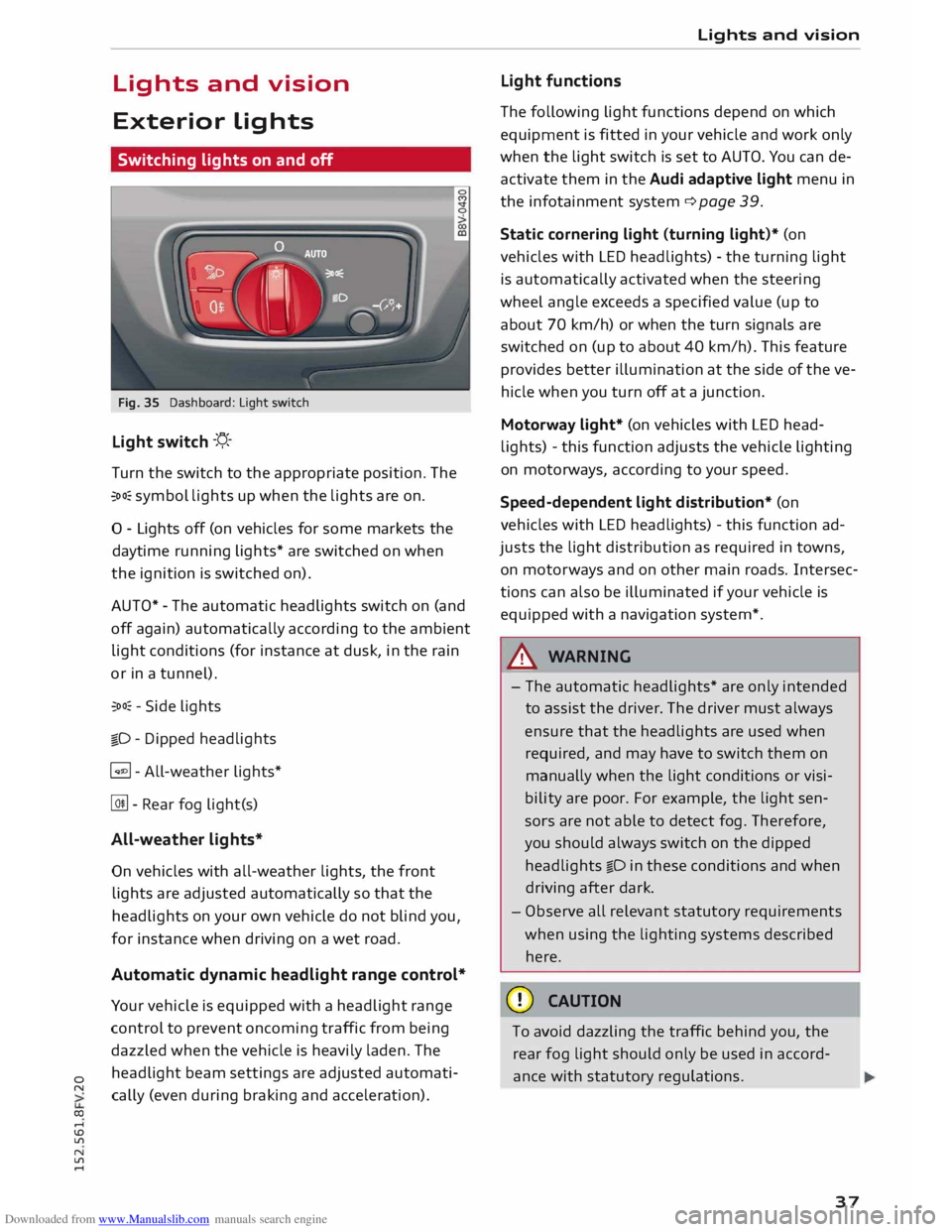
Fig. 35 Dashboard: Light switch
Light switch -'!;5.-
T urn the switch to the appropriate position. The
�oo: symbol lights up when the lights are on.
0 - Lights off (on vehicles for some markets the
daytime running lights* are switched on when
the ignition is switched on).
AUTO* -The automatic headlights switch on (and
off again) automatically according to the ambient
light conditions (for instance at dusk, in the rain
or in a tunnel).
�oo: -Side lights
�D -Dipped headlights
� - All-weather lights*
@!l - Rear fog light(s)
All-weather lights*
On vehicles with all-weather lights, the front
lights are adjusted automatically so that the
headlights on your own vehicle do not blind you,
for instance when driving on a wet road.
Automatic dynamic headlight range control*
Your vehicle is equipped with a headlight range
control to prevent oncoming traffic from being
dazzled when the vehicle is heavily laden. The
headlight beam settings are adjusted automati
cally (even during braking and acceleration). Lights
and vision
Light functions
The following light functions depend on which
equipment is fitted in your vehicle and work only
when the light switch is set to AUTO. You can de
activate them in the Audi adaptive light menu in
the infotainment system¢ page 39.
Static cornering light (turning light)* (on
vehicles with LED headlights) -the turning light
is automatically activated when the steering
wheel angle exceeds a specified value (up to
about 70 km/h) or when the turn signals are
switched on (up to about 40 km/h). This feature
provides better illumination at the side of the ve
hicle when you turn off at a junction.
Motorway light* (on vehicles with LED head
lights) -this function adjusts the vehicle lighting
on motorways, according to your speed.
Speed-dependent light distribution* (on
vehicles with LED headlights) -this function ad
justs the light distribution as required in towns,
on motor ways and on other main roads. Intersec
tions can also be illuminated if your vehicle is
equipped with a navigation system*.
A WARNING
- The automatic headlights* are only intended
to assist the driver. The driver must always
ensure that the headlights are used when
required, and may have to switch them on
manually when the light conditions or visi
bility are poor. For example, the light sen
sors are not able to detect fog. Therefore,
you should always switch on the dipped
headlights io in these conditions and when
driving after dark.
- Observe all relevant statutory requirements
when using the lighting systems described
here.
CD CAUTION
To avoid dazzling the traffic behind you, the
rear fog light should only be used in accord
ance with statutory regulations.
37
Page 40 of 284

Downloaded from www.Manualslib.com manuals search engine Lights
and vision
@ Note
- The light sensor for the automatic head
lights* is Located in the mounting for the in
terior mirror. Do not affix any stickers on
this section of the windscreen.
- Some of the settings for the exterior light
ing can be adjusted in the driver informa
tion system.
- A buzzer will sound if you remove the igni
tion key and open the door when the exteri
or Lighting is on.
- On vehicles for some markets, the rear
lights switch on together with the daytime
running lights.
- In cool or damp weather, the inside of the
headlights, turn signals or rear lights can
sometimes mist up, due to the temperature
difference between the interior and exterior
of the car. They should clear again partially
or completely soon after you switch on the
headlights. This phenomenon has no influ
ence on the life expectancy of the vehicle
lights.
Turn signal and main beam lever
The turn signal Lever also operates the main
beam headlights, parking Lights and headlight
flasher.
Fig. 36 Turn signal and main beam headlight lever
Turn signals ¢¢ and parking lights pE
The turn signals will flash if you move the Lever
while the ignition is switched on. The parking
Lights will be switched on if you do this with the
ignition switched off.
@ -Turn signals/parking lights (right side)
38 0 @
-Turn signals/parking lights (left side)
If you just tap the Lever, the turn signals will
flash three times (one-touch signalling).
Main beam and headlight flasher �D
Move the lever to the appropriate position:
@ -Main beam headlights on (vehicles with main
beam assist* � page 38)
@ -Main beam headlights off or headlight flash
er
The indicator Lamp Ill will light up in the instru
ment cluster.
A WARNING
The main beam can dazzle other drivers. Risk
of accident! Never use the main beam head
lights or the headlight flasher if they could
dazzle other drivers.
((D Note
A buzzer will sound if you open the door when
the parking light is on.
' Main beam assist
Applies to vehicles: with main beam assist
The main beam assist automatically switches
the main beam headlights on or off depending
on the surrounding Light conditions.
Fig. 37 Turn signal and main beam lever: Switching main
beam assist on/off 0
A camera (located in the mounting for the interi
or mirror) detects light sources from other road
users. The main beams are activated or deactiva
ted automatically depending on the position of
vehicles on either side of the road, on the road �
Page 42 of 284
Downloaded from www.Manualslib.com manuals search engine Lights
and vision
Main beam assist* -You can switch the main
beam assist* on and off.
Audi adaptive light* -You can switch the adap
tive light on and off.
Headlight dip settings for driving at home
and abroad
If you drive a right-hand drive vehicle in a left
hand drive country, or vice versa, it is not neces
sary to adjust the headlights, as they are de
signed for use when driving on the left or right.
Coming home/ leaving home
The coming home function lights up the area
round the vehicle after dark when the ignition
has been switched off and the driver's door
opened. To activate this function, select Entry/
exit lights.
The leaving home function lights up the area
round the vehicle after dark when the vehicle is
unlocked. To activate this function, select Entry/
exit lights.
The coming home and leaving home functions
are operational after dark when the light switch
is set to AUTO.
Hazard warning lights
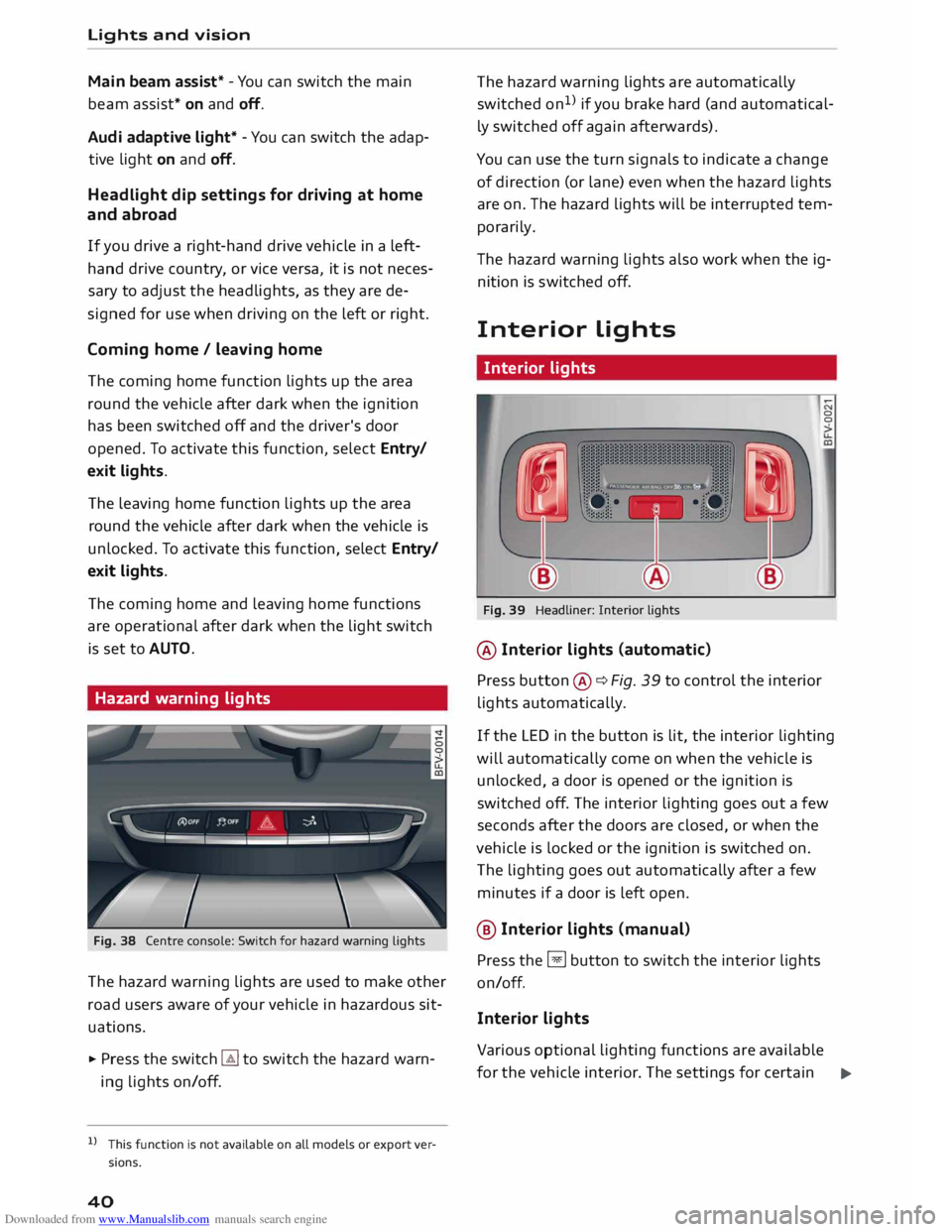
Fig. 38 Centre console: Switch for hazard warning lights
The hazard warning lights are used to make other
road users aware of your vehicle in hazardous sit
uations.
.,. Press the switch � to switch the hazard warn
ing lights on/off.
l l
This function is not available on all models or export ver
sions.
40 The
hazard warning lights are automatically
switched on1
>
if you brake hard (and automatical
ly switched off again afterwards).
You can use the turn signals to indicate a change
of direction (or lane) even when the hazard lights
are on. The hazard lights will be interrupted tem
porarily.
Th e hazard warning lights also work when the ig
nition is sw itched off.
Interior Lights
Interior lights
Fig. 39 Headliner: Interior lights
@ Interior lights (automatic)
Press button ®¢ Fig. 39 to control the interior
lights automatically. 0
0
If the LED in the button is lit, the interior lighting
will automatically come on when the vehicle is
unlocked, a door is opened or the ignition is
switched off. The interior lighting goes out a few
seconds after the doors are closed, or when the
vehicle is locked or the ignition is switched on.
The lighting goes out automatically after a few
minutes if a door is left open.
@ Interior Lights (manu al)
Press the §J button to switch the interior lights
on/off.
Interior lights
Various optional lighting functions are available
for the vehicle interior. The settings for certain .,.
Page 43 of 284
Downloaded from www.Manualslib.com manuals search engine 0
N
co
,-j
\D L/'l
N
L/'l
,-j functions
can be adjusted on the infotainment
system. Select the following on the infotainment
system: I MENU! button> Car > Left control button
> Vehicle settings > Background lighting.
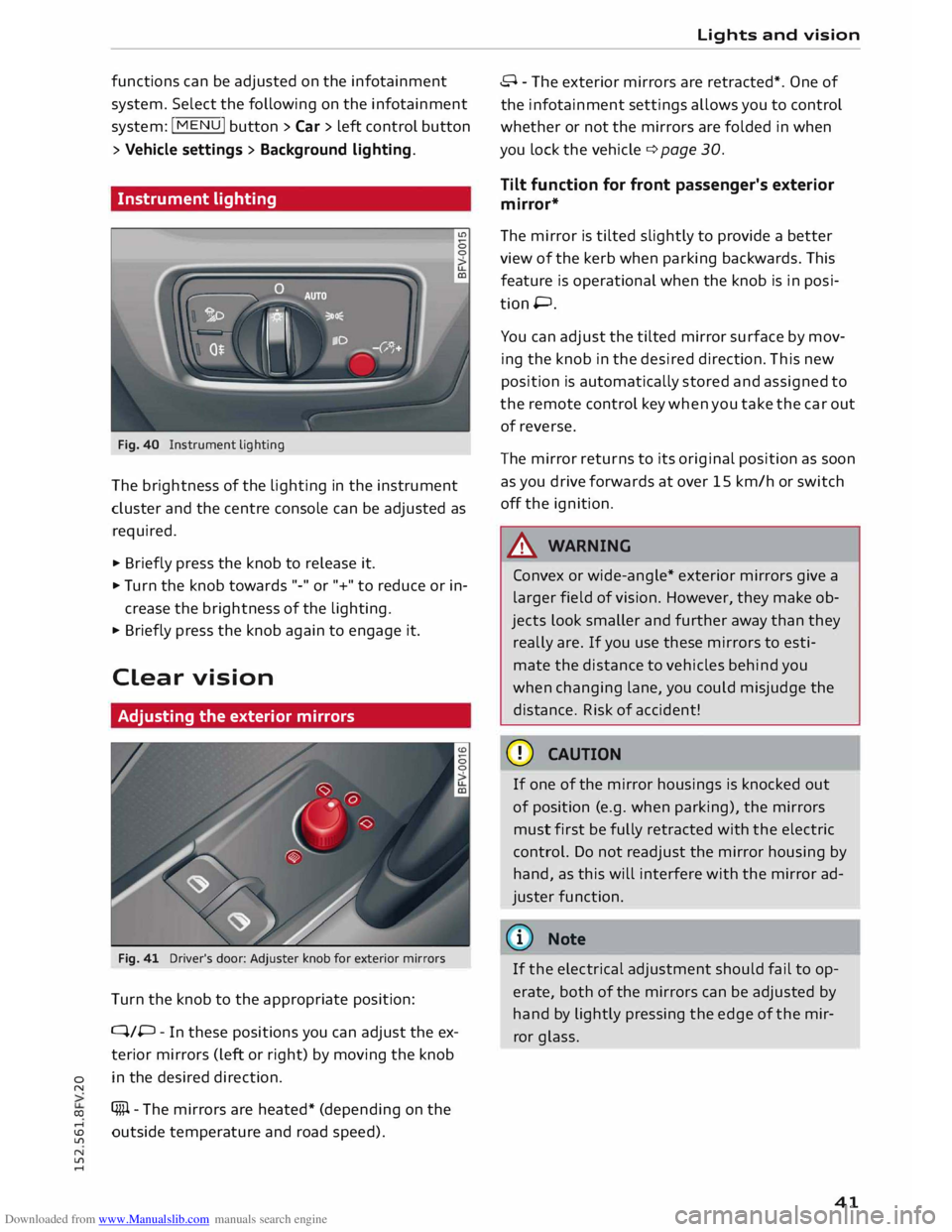
Instrument lighting
Fig. 40 Instrument lighting
The brightness of the Lighting in the instrument
cluster and the centre console can be adjusted as
required.
.,. Briefly press the knob to release it.
.,. Tu rn the knob towards "-" or"+" to reduce or in
crease the brightness of the lighting.
.,. Briefly press the knob again to engage it.
Clear vision
Adjusting the exterior mirrors
Fig. 41 Driver's door: Adjuster knob for exterior mirrors
Turn the knob to the appropriate position:
Q/P -In these positions you can adjust the ex
terior mirrors (Left or right) by moving the knob
in the desired direction.
(fill - The mirrors are heated* (depending on the
outside temperature and road speed). Lights
and vision
8 - The exterior mirrors are retracted*. One of
the infotainment settings allows you to control
whether or not the mirrors are folded in when
you Lock the vehicle q page 30.
Tilt function for front passenger's exterior
mirror*
The mirror is tilted slightly to provide a better
view of the kerb when parking backwards. This
feature is operational when the knob is in posi
tion P.
You can adjust the tilted mirror surface by mov
ing the knob in the desired direction. This new
position is automatically stored and assigned to
the remote control key when you take the car out
of reverse.
The mirror returns to its original position as soon
as you drive forwards at over 15 km/h or switch
off the ignition.
A WARNING
Convex or wide-angle* exterior mirrors give a
Larger field of vision. However, they make ob
jects Look smaller and further away than they
really are. If you use these mirrors to esti
mate the distance to vehicles behind you
when changing Lane, you could misjudge the
distance. Risk of accident!
CD CAUTION
If one of the mirror housings is knocked out
of position (e.g. when parking), the mirrors
must first be fully retracted with the electric
control. Do not readjust the mirror housing by
hand, as this will interfere with the mirror ad
juster function.
{CD) Note
If the electrical adjustment should fail to op
erate, both of the mirrors can be adjusted by
hand by Lightly pressing the edge of the mir
ror glass.
41