oil level AUDI TT COUPE 2014 User Guide
[x] Cancel search | Manufacturer: AUDI, Model Year: 2014, Model line: TT COUPE, Model: AUDI TT COUPE 2014Pages: 284, PDF Size: 34.42 MB
Page 226 of 284
Downloaded from www.Manualslib.com manuals search engine Checking
and topping up fluids
Oil level in area @
.. Oil
must be topped up. After topping up the oil
Level should be in area 0-
Depending on how you drive and the conditions
in which the car is used, oil consumption can be
up to 0.5 Ltr./1000 km. Oil consumption is Likely
to be higher for the first 5000 km. For this rea
son the engine oil Level must be checked at regu
lar intervals, preferably when filling the tank and
before a journey.
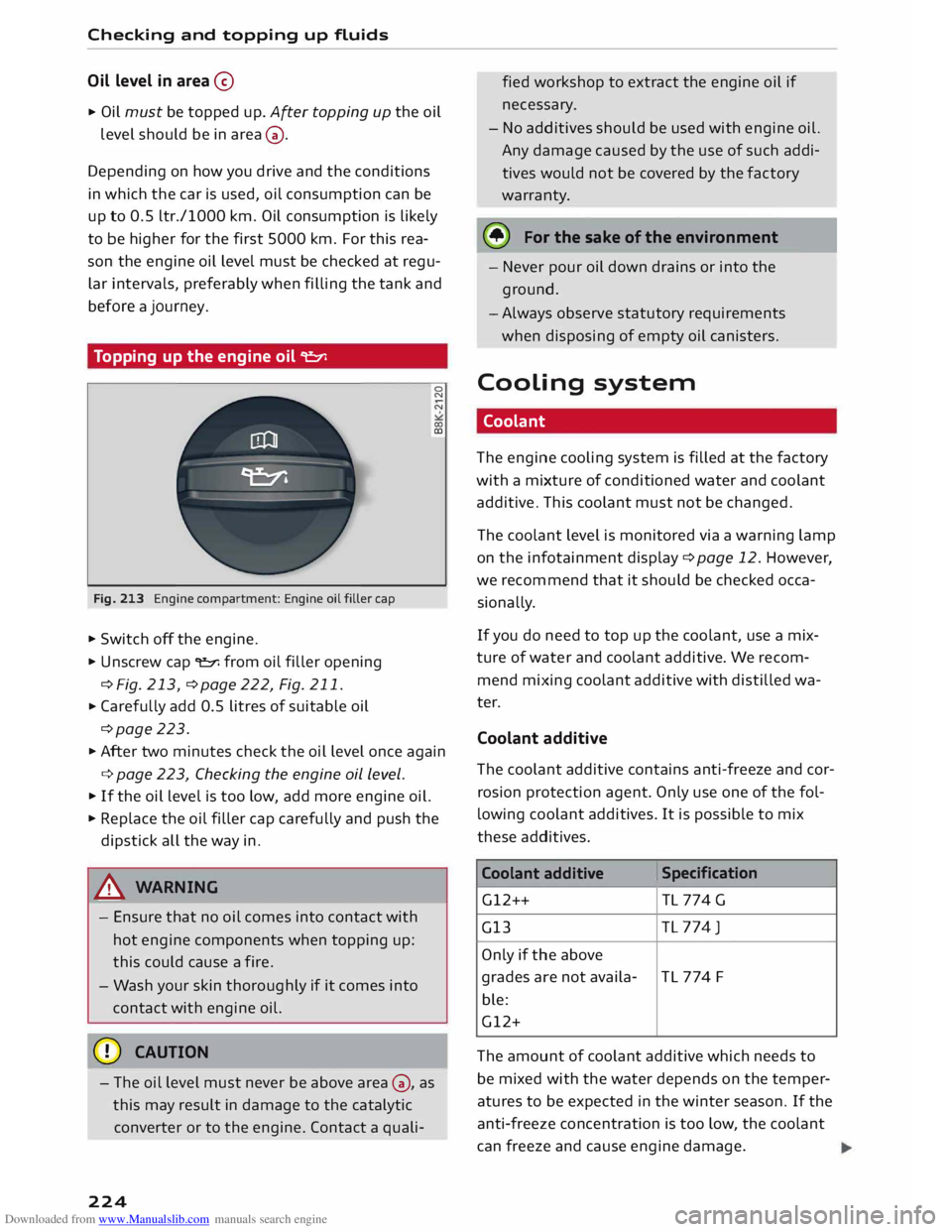
Topping up the engine oil "t::r.
Fig. 213 Engine compartment: Engine oil filler cap
.. Switch off the engine.
.. Unscrew cap� from oil filler opening
¢Fig. 213, ¢page 222, Fig. 211.
.. Carefully
add 0.5 Litres of suitable oil
¢page 223. 0
N
N
(X)
cc
.. After two minutes check the oil Level once again
¢ page 223, Checking the engine oil Level.
.. If
the oil Level is too Low, add more engine oil.
.. Replace the oil filler cap carefully and push the
dipstick all the way in.
_& WARNING
- Ensure that no oil comes into contact with
hot engine components when topping up:
this could cause a fire.
- Wash your skin thoroughly if it comes into
contact with engine oil.
CD CAUTION
- The oil Level must never be above area 0, as
this may result in damage to the catalytic
converter or to the engine. Contact a qua Li-
224 fied
workshop to extract the engine oil if
necessary
- No additives should be used with engine oil.
Any damage caused by the use of such addi
tives would not be covered by the factory
warranty.
@ For the sake of the environment
- Never pour oil down drains or into the
ground.
- Always observe statutory requirements
when disposing of empty oil canisters.
Cooling system
Coolant
The engine cooling system is filled at the factory
with a mixture of conditioned water and coolant
additive. This coolant must not be changed.
The coolant Level is monitored via a warning Lamp
on the infotainment display ¢page 12. However,
we re com mend that it shou Ld be checked occa
sionally.
If you do need to top up the coolant, use a mix
ture of water and coolant additive. We recom
mend mixing coolant additive with distilled wa
ter .
Coolant additive
The coolant additive contains anti-freeze and cor
rosion protection agent. Only use one of the fol
lowing coolant additives. It is possible to mix
these additives.
Coolant additive Specification
G12++ TL
774 G
G13 TL
774 J
Only if the above
grades are not availa- TL
774 F
ble: G12+
The amount of coolant additive which needs to
be mixed with the water depends on the temper
atures to be expected in the winter season. If the
anti-freeze concentration is too Low, the coolant
can freeze and cause engine damage.
Page 227 of 284
Downloaded from www.Manualslib.com manuals search engine 0
N
co
....
\D Lfl
N
Lfl
.... Coolant
addi-Frost protec-
tive tion
Countries with min. 40 %,
min. -25 °C
warm climate max. 45 %
Countries with min.
50 %,
max. -40 °C
cold climate max.
60 %
CD CAUTION
- Have your qualified workshop check the
cooling system before the winter season to
make sure that the anti-freeze concentra
tion is adequate for the conditions to be ex
pected. This applies particularly if you drive
into a colder climate zone.
- To prevent damage to the engine, do not
use a different type of anti-freeze additive if
the approved type of additive is not availa
ble. In this case use only water and bring
the coolant concentration back up to the
correct level as soon as possible by putting
in the specified additive.
- Always top up with fresh, unused coolant.
- Radiator sealants must not be added to the
coolant.
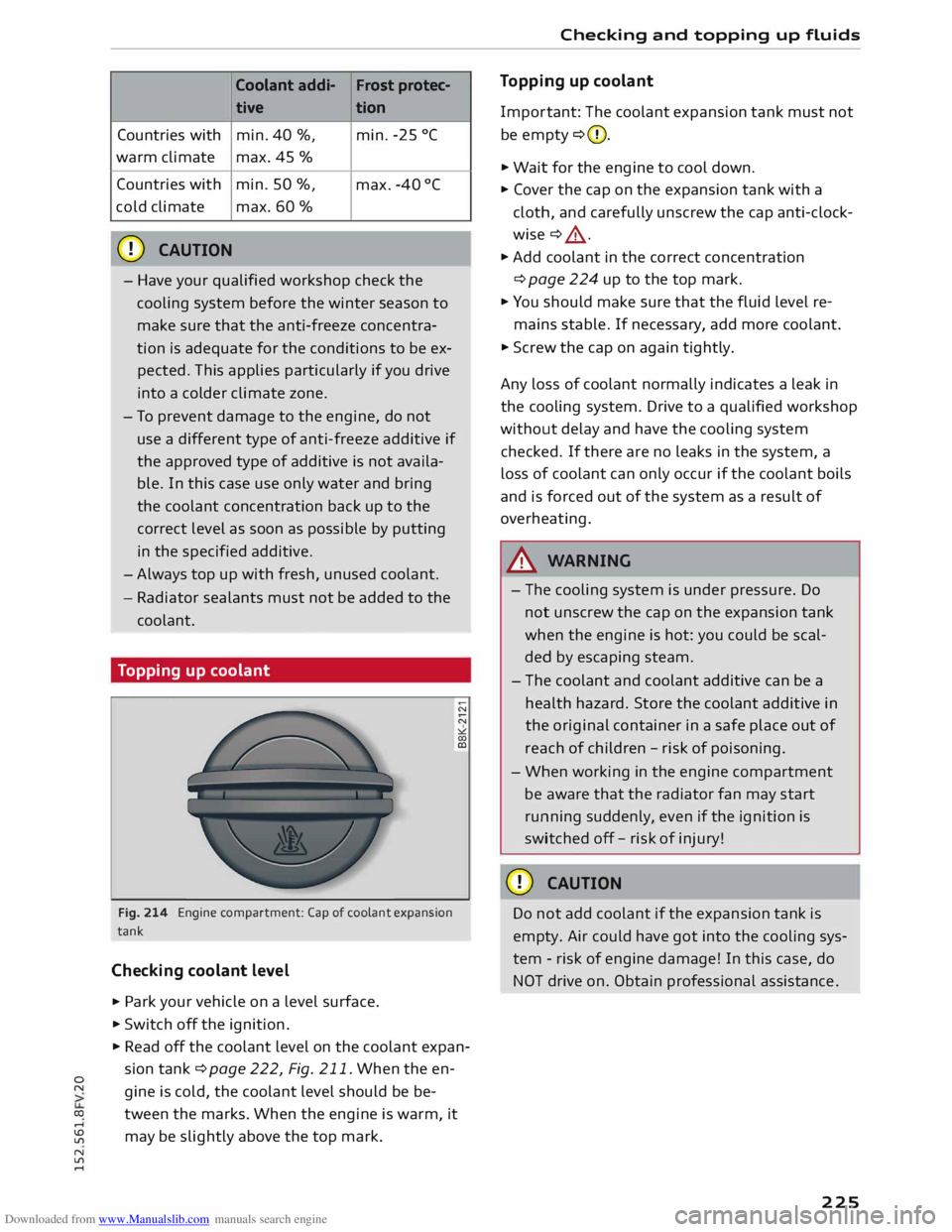
Topping up coolant
Fig. 214 Engine compartment: Cap of coolant expansion
tank
Checking coolant level
.. Park
your vehicle on a level surface .
.. Switch off the ignition .
.. Read off the coolant level on the coolant expan
sion tank ¢ page 222, Fig. 211. When the en
gine is cold, the coolant level should be be
tween the marks. When the engine is warm, it
may be slightly above the top mark. Checking
and topping up fluids
Topping up coolant
Impor tant: The coolant expansion tank must not
be empty ¢(D.
.. Wait for the engine to cool down.
.. Cover the cap on the expansion tank with a
cloth, and carefully unscrew the cap anti-clock
wise ¢ .&_ .
.. Add coolant in the correct concentration
¢ page 224 up to the top mark.
.. You should make sure that the fluid level re-
mains stable. If necessary, add more coolant.
.. Screw the cap on again tightly.
Any loss of coolant normally indicates a leak in
the cooling system. Drive to a qualified workshop
without delay and have the cooling system
checked. If there are no leaks in the system, a
loss of coolant can only occur if the coolant boils
and is forced out of the system as a result of
overheating.
A WARNING
- The cooling system is under pressure. Do
not unscrew the cap on the expansion tank
when the engine is hot: you could be scal
ded by escaping steam.
- The coolant and coolant additive can be a
health hazard. Store the coolant additive in
the original container in a safe place out of
reach of children -risk of poisoning.
- When working in the engine compartment
be aware that the radiator fan may start
running suddenly, even if the ignition is
switched off-risk of injury!
CD CAUTION
Do not add coolant if the expansion tank is
empty. Air could have got into the cooling sys
tem -risk of engine damage! In this case, do
NOT drive on. Obtain professional assistance .
225
Page 257 of 284
Downloaded from www.Manualslib.com manuals search engine 0
N
co
....
\D L/'l
N
L/'l
.... ,&.
WARNING
Never attempt to repair a fuse or replace a
blown fuse by fitting a fuse with a higher am
pere rating. This could damage the electrical
system -risk of fire!
CD CAUTION
If a newly replaced fuse blows again after a
short time, the electrical system must be
checked by a qualified workshop as soon as
possible.
@ Note
- Unassigned fuse locations are not shown in
the tables below.
- Some of the items of equipment listed in
the tables below are only fitted on certain
models or are optional extras.
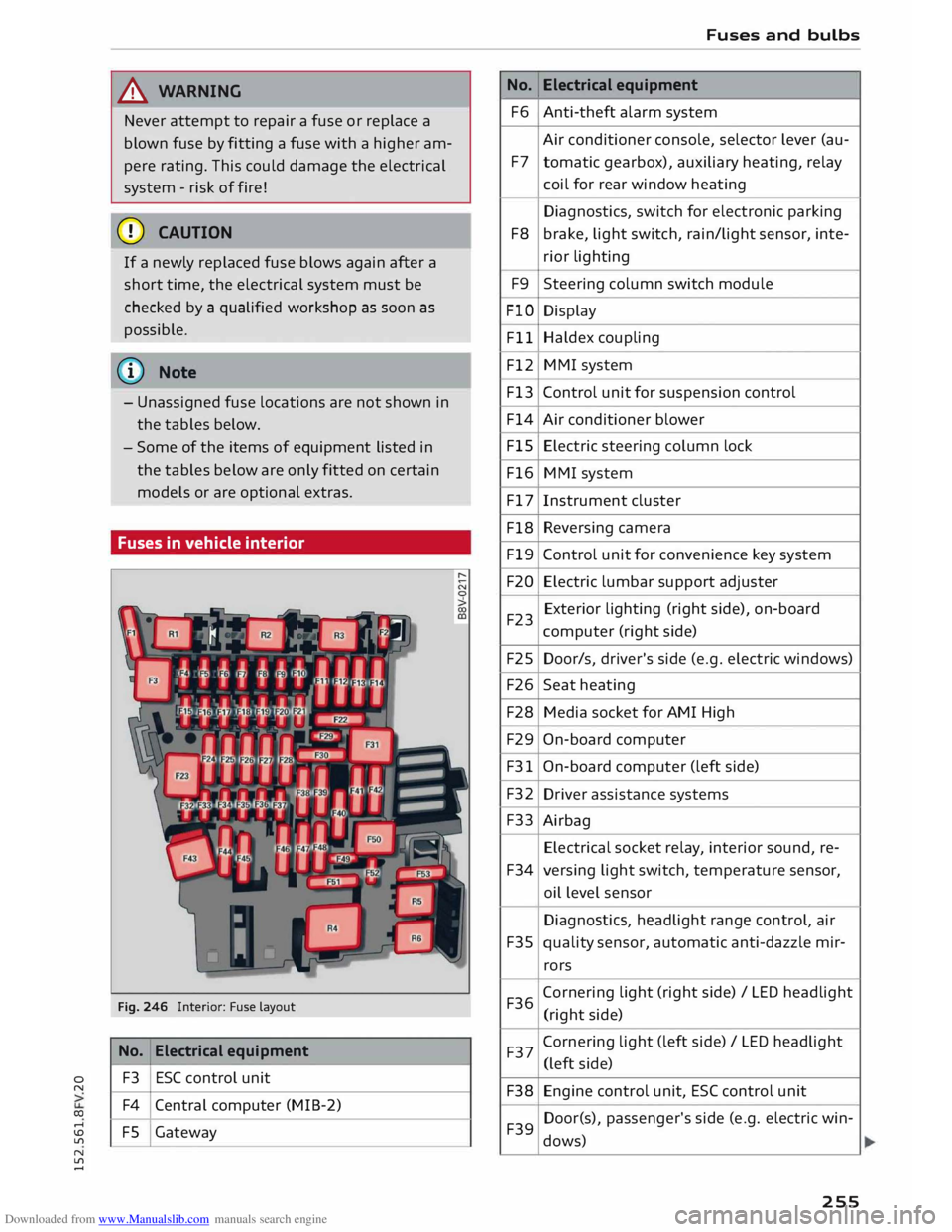
Fuses in vehicle interior
Fig. 246 Interior: Fuse layout
No. Electrical
equipment
F3 ESC
control unit
F4 Central computer (MIB-2)
FS Gateway No.
F6
F7
F8 F9
FlO Fll
F12
F13
F14
FlS
F16
F17
F18
Fl9
F20
F23
F25
F26
F28
F29
F31
F32 F33
F34
F35
F36 F37
F38 F39 Fuses
and bulbs
Electrical equipment
Anti-theft alarm system
Air conditioner console, selector lever (au-
tomatic gearbox), auxiliary heating, relay
coil for rear window heating
Diagnostics, switch for electronic parking
brake, light switch, rain/light sensor, inte-
rior lighting
Steering column switch module
Display
Haldex coupling
MMI system
Control unit for suspension control
Air conditioner blower
Electric steering column lock
MMI system
Instrument cluster
Reversing camera
Control unit for convenience key system
Electric lumbar support adjuster
Exterior lighting (right side), on-board
computer (right side)
Door/s, driver's side (e.g. electric windows)
Seat heating
Media socket for AMI High
On-board computer
On-board computer (left side)
Driver assistance systems
Airbag Electrical socket relay, interior sound, re-
versing light switch, temperature sensor,
oil level sensor
Diagnostics, headlight range control, air
quality sensor, automatic anti-dazzle mir-
rors
Corn ering light (right side)/ LED headlight
(right side)
Cornering light (left side) / LED headlight
(left side)
Engine control unit, ESC control unit
Door(s), passenger's side (e.g. electric win-
dows)
255
Page 270 of 284
Downloaded from www.Manualslib.com manuals search engine Index
MMI touch . . . . . . . . . . . . . . . . . . . . . . . . .
111
Speech dialogue system . . . . . . . . . . . . . . 121
Dynamic volume control
see Entertainment volume
E
ElO 190
see Ethanol (fuel) . . . . . . . . . . . . . . . . . . . .
217
ECO mode (automatic air conditioner) . . . . .
55
Economical driving . . . . . . . . . . . . . . . . . . . . .
58
Economical route . . . . . . . . . . . . . . . . . . . . . 155
EDL see Electronic differential lock . . . . . . . . .
102
Electrical socket . . . . . . . . . . . . . . . . . . . . . . .
48
Electric seat adjustment . . . . . . . . . . . . . . . . 46
Electric windows . . . . . . . . . . . . . . . . . . . . . . . 33
Convenience open/close . . . . . . . . . . . . . . .
34
Malfunction . . . . . . . . . . . . . . . . . . . . . . . . .
34
Electro-mechanical parking brake
see Parking brake . . . . . . . . . . . . . . . . . . . . . 66
Electro-mechanical power steering . . . . . . . 101
Indicator lamp . . . . . . . . . . . . . . . . . . . . . . 101
Electronic differential lock . . . . . . . . . . . . . . 103
Electronic immobiliser . . . . . . . . . . . . . . . . . . 25
Electronic stabilisation control (ES() . . . . . 102
Indicator lamp . . . . . . . . . . . . . . . . . . . . . . . 14
Sport mode . . . . . . . . . . . . . . . . . . . . . . . .
104
Emergency calls . . . . . . . . . . . . . . . . . . . . . .
131
Emergency key . . . . . . . . . . . . . . . . . . . . . 25, 27
Emission control systems
Catalytic converter . . . . . . . . . . . . . . . . . . .
220
Diesel particulate filter . . . . . . . . . . . . . . .
220
Emission control system (indicator lamp) . . . 15
Emissions . . . . . . . . . . . . . . . . . . . . . . . . . . . 257
Engine Coolant . . . . . . . . . . . . . . . . . . . . . . . . . . . .
224
Jump-starting . . . . . . . . . . . . . . . . . . . . . . .
248
Preheating (glow plugs) . . . . . . . . . . . . . . .
60
Start/stop system . . . . . . . . . . . . . . . . . . . .
63
Starting . . . . . . . . . . . . . . . . . . . . . . . . . . . .
60
Starting (driver messages for convenience
key) . . . . . . . . . . . . . . . . . . . . . . . . . . . . . . . . 62
Switching off . . . . . . . . . . . . . . . . . . . . . . . . 61
Switching off (driver messages for mechani-
cal ignition lock) . . . . . . . . . . . . . . . . . . . . . .
62
268 Engine
compartment
Closing bonnet . . . . . . . . . . . . . . . . . . . . . .
222
Layout.. ........................... 222
Opening bonnet . . . . . . . . . . . . . . . . . . . . .
221
Safety notes . . . . . . . . . . . . . . . . . . . . . . . .
220
Engine management (indicator lamp) . . . . . . 15
Engine oil . . . . . . . . . . . . . . . . . . . . . . . . . . . 223
Changing . . . . . . . . . . . . . . . . . . . . . . . . . . 223
Checking oil level . . . . . . . . . . . . . . . . . . . . 223
Consumption . . . . . . . . . . . . . . . . . . . . . . . 223
Indicator lamp . . . . . . . . . . . . . . . . . . . . 15, 16
Oil change service . . . . . . . . . . . . . . . . . . .
223
Service intervals . . . . . . . . . . . . . . . . . . . . .
223
Topping up . . . . . . . . . . . . . . . . . . . . . . . . .
224
Warning lamp . . . . . . . . . . . . . . . . . . . . . . . 12
Engine speed governing (indicator lamp)
15
Engine start/stop mode
see Star t/stop system . . . . . . . . . . . . . . . . .
65
Entering Using MMI touch . . . . . . . . . . . . . . . . . . . . 111
Using the speech dialogue system . . . . . .
116
Using the speller . . . . . . . . . . . . . . . . . . . . 113
Entertainment volume . . . . . . . . . . . . . . . . . 190
Environmental compatibility . . . . . . . . . . . . 262
Environmental tips Filling the tank .................. 218, 219
Leaks.. ............................ 221
Minimising pollution . . . . . . . . . . . . . . . . . .
58
Roof carrier . . . . . . . . . . . . . . . . . . . . . . . . . .
52
EPC (engine management) . . . . . . . . . . . . . . .
15
EPG see Programme guide . . . . . . . . . . . . . . . . 163
ESC Multicollision brake assist system . . . . . . 103
Sport mode . . . . . . . . . . . . . . . . . . . . . . . .
104
Ethanol (fuel) . . . . . . . . . . . . . . . . . . . . . . . . 217
Event data recorder . . . . . . . . . . . . . . . . . . . 107
Event memory . . . . . . . . . . . . . . . . . . . . . . . .
107
Exclude route . . . . . . . . . . . . . . . . . . . . . . . .
155
Exporting/ importing contacts . . . . . . . . . . . 133
Exterior lights . . . . . . . . . . . . . . . . . . . . . . . . . 37
Exterior mirrors
Adjusting . . . . . . . . . . . . . . . . . . . . . . . . . . .
41
Anti-dazzle setting . . . . . . . . . . . . . . . . . . .
42
Heating . . . . . . . . . . . . . . . . . . . . . . . . . . . . . 41