lock AUDI TT COUPE 2014 Workshop Manual
[x] Cancel search | Manufacturer: AUDI, Model Year: 2014, Model line: TT COUPE, Model: AUDI TT COUPE 2014Pages: 284, PDF Size: 34.42 MB
Page 192 of 284
Downloaded from www.Manualslib.com manuals search engine System
settings
Sound settings
You can adjust the sound and volume of the MMI
individually. The settings depend on the equip
ment fitted in your vehicle.
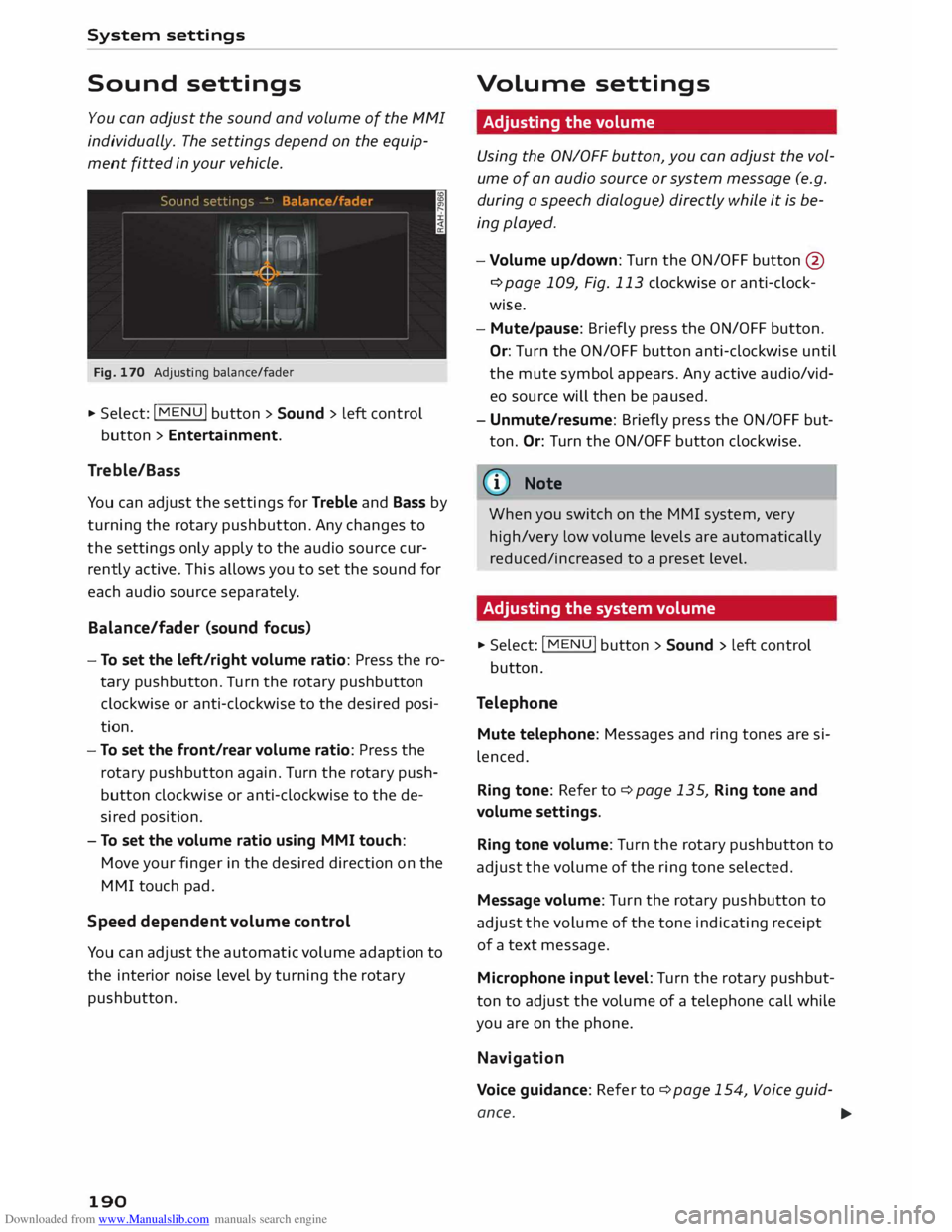
Fig. 170 Adjusting balance/fader
... Select: I MENU
I button
> Sound > Left control
button > Entertainment.
Treble/Bass
You can adjust the settings for Treble and Bass by
turning the rotary pushbutton. Any changes to
the settings only apply to the audio source cur
rently active. This allows you to set the sound for
each audio source separat ely.
Bal ance/fader (sound focus}
- To set the left/right volume ratio: Press the ro
tary pushbutton. Turn the rotary pushbutton
clockwise or anti-clockwise to the desired posi
tion.
- To set the front/rear volume ratio: Press the
rotary pushbutton again. Turn the rotary push
button clockwise or anti-clockwise to the de
sired position.
- To set the volume ratio using MMI touch:
Move your finger in the desired direction on the
MMI touch pad.
Speed dependent volume control
You can adjust the automatic volume adaption to
the interior noise level by turning the rotary
pushbutton.
190 Volume
settings
Adjusting the volume
Using the ON/OFF button, you can adjust the vol
ume of an audio source or system message (e.g.
during a speech dialogue) directly while it is be
ing played.
- Volume up/down: Turn the ON/OFF button@
¢page 109, Fig. 113 clockwise or anti-clock
wise.
- Mute/pause: Briefly press the ON/OFF button.
Or: Turn the ON/OFF button anti-clockwise until
the mute symbol appears. Any active audio/vid
eo source will then be paused .
- Unmute/resume: Briefly press the ON/OFF but
ton. Or: Turn the ON/OFF button clockwise.
� Note When you switch on the MMI system, very
high/very Low volume Levels are automatically
reduced/increased to a preset Level.
Adjusting the system volume
... Select: I MENU
! button > Sound > Left control
button.
Telephone Mute telephone: Messages and ring tones are si
lenced.
Ring tone: Refer to¢ page 135, Ring tone and
volume settings.
Ring tone volume: Turn the rotary pushbutton to
adjust the volume of the ring tone selected.
Message volume: Turn the rotary pushbutton to
adjust the volume of the tone indicating receipt
of a text message.
Microphone input level: Turn the rotary pushbut
ton to adjust the volume of a telephone call while
you are on the phone.
Navigation
Voice guidance: Refer to¢ page 154, Voice guid-
ance. ...,.
Page 196 of 284
Downloaded from www.Manualslib.com manuals search engine Safe
driving
.. Adjust the longitudinal position of the steering
wheel so that your arms are slightly bent and
you can read the dials and instruments easily.
.. Make sure that you can comfortably reach the
top of the steering wheel.
.. Fasten
your seat belt correctly ¢ page 204 .
.. Keep both feet in the footwell so that you are in
full control of the vehicle at all times.
For detailed information on how to adjust the
driver's seat, see¢ page 46, Seats and storage.
A WARNING
A driver who is not sitting in the correct posi
tion or who is not wearing a seat belt can be
fatally injured if the airbag is triggered.
- Adjust the driver's seat and steering wheel
so there is a distance of at least 25 cm be
tween your breastbone and the centre of the
steering wheel¢ Fig. 172.
- While driving, always hold the steering
wheel with both hands on the outside of the
rim at about the 9 o'clock and 3 o'clock posi
tion. This reduces the risk of injury if the
driver's airbag inflates.
- Never hold the steering wheel at the 12
o'clock position, or with your hands inside
the rim or on the steering wheel hub. This
could result in serious injuries to the arms,
hands and head if the driver's airbag in
flates.
- To reduce any risk of injury to the driver dur
ing a sudden brake application or in an acci
dent, never drive with the backrest tilted
too far back. The airbag system and seat
belts can only provide proper protection
when the backrest is in an upright position
and the driver is wearing the seat belt in the
correct position. The further the backrest is
tilted back, the greater the risk of injury due
to incorrect positioning of the belt webbing
or an incorrect sitting position.
194 Correct
position for the front passenger
The front seat passenger must sit at least 25 cm
away from the dash panel so that the airbag has
enough room to inflate and give maximum pro
tection in an accident.
For your own safety and to reduce the risk of in
jury in the event of an accident, we recommend
adjusting the front passenger's seat as follows:
.. Adjust the backrest to an upright position so
that your back remains in contact with the up
holstery .
.. Keep both feet in the footwell in front of the
seat.
.. Fasten your seat belt correctly ¢ page 206.
In exceptional cases you can disable the front
passenger's airbag via the key-operated switch*
¢page 211.
For detailed information on how to adjust the
front passenger's seat, see ¢ page 46, Seats and
storage.
A WARNING
A passenger who is not sitting in the correct
position or who is not wearing a seat belt can
be fatally injured if the airbag is triggered.
- Adjust the front passenger's seat so there is
a distance of at least 25 cm between your
breastbone and the dash panel.
- Always keep your feet on the floor when the
vehicle is moving; never rest them on the in
strument panel, out of the window or on the
seat. If you sit in an incorrect position, you
increase your risk of injury in the event of
sudden braking or an accident. If the airbag
is triggered, you could sustain potentially
fatal injuries by sitting out of position.
- To reduce the risk of injury to the front pas
senger in the case of sudden braking or an
accident, the passenger should never travel
in a moving vehicle with the backrest re
clined. The airbag system and seat belt can
only provide proper protection when the
backrest is in an upright position and the
passenger is wearing the seat belt in the
correct position. The further the backrest is
�
Page 203 of 284
Downloaded from www.Manualslib.com manuals search engine 0
N
co
....
\D Lfl
N
Lfl
.... -Always
make sure that floor mats are prop
erly secured.
- Never lay or install additional floor mats or
other floor coverings over the existing floor
mats; this would restrict the pedal area and
possibly obstruct the pedals, which could
cause an accident.
Stowing luggage safely
Luggage compartment
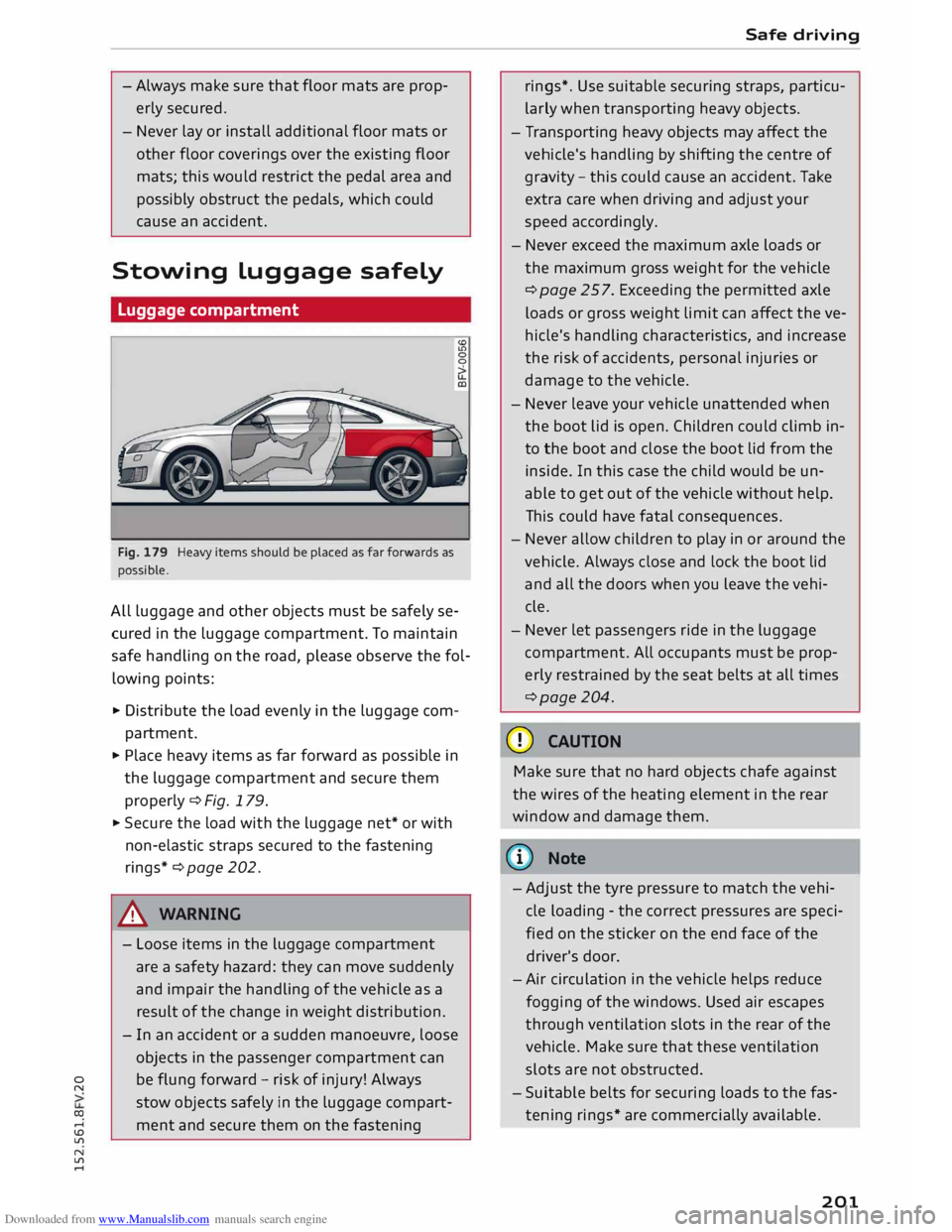
Fig. 179 Heavy items should be placed as far forwards as
possible.
All luggage and other objects must be safely se
cured in the luggage compartment. To maintain
safe handling on the road, please observe the fol
lowing points:
� Distribute the load evenly in the luggage com
partment.
� Place heavy items as far forward as possible in
the luggage compartment and secure them
properly ¢Fig. 179.
� Secure the load with the luggage net* or with
non-elastic straps secured to the fastening
rings*¢ page 202.
A WARNING
- Loose items in the luggage compartment
are a safety hazard: they can move suddenly
and impair the handling of the vehicle as a
result of the change in weight distribution.
- In an accident or a sudden manoeuvre, loose
objects in the passenger compartment can
be flung forward -risk of injury! Always
stow objects safely in the luggage compart
ment and secure them on the fastening Safe
driving
rings*. Use suitable securing straps, particu
larly when transporting heavy objects.
- Transporting heavy objects may affect the
vehicle's handling by shifting the centre of
gravity -this could cause an accident. Take
extra care when driving and adjust your
speed accordingly.
- Never exceed the maximum axle loads or
the maximum gross weight for the vehicle
¢ page 257. Exceeding the permitted axle
loads or gross weight limit can affect the ve
hicle's handling characteristics, and increase
the risk of accidents, personal injuries or
damage to the vehicle.
- Never leave your vehicle unattended when
the boot lid is open. Children could climb in
to the boot and close the boot lid from the
inside. In this case the child would be un
able to get out of the vehicle without help.
This could have fatal consequences.
- Never allow children to play in or around the
vehicle. Always close and lock the boot lid
and all the doors when you leave the vehi
cle.
- Never let passengers ride in the luggage
compartment. All occupants must be prop
erly restrained by the seat belts at all times
¢page 204.
CD CAUTION
Make sure that no hard objects chafe against
the wires of the heating element in the rear
window and damage them.
(D} Note
- Adjust the tyre pressure to match the vehi
cle loading -the correct pressures are speci
fied on the sticker on the end face of the
driver's door.
- Air circulation in the vehicle helps reduce
fogging of the windows. Used air escapes
through ventilation slots in the rear of the
vehicle. Make sure that these ventilation
slots are not obstructed.
- Suitable belts for securing loads to the fas
tening rings* are commercially available.
201
Page 207 of 284
Downloaded from www.Manualslib.com manuals search engine 0
N
co
....
\D Lfl
N
Lfl
.... -
Do not wear the belt over hard or fragile ob
jects (such as glasses or pens, etc.) because
this can cause injuries.
- Loose, bulky clothing (such as an overcoat
over a jacket) impairs the proper fit and
function of the belts.
- The belts must be kept clean, otherwise the
retractors may not work properly
¢ tab. Cleaning the interior on page 238.
- The slot in the seat belt buckle must not be
blocked with paper or other objects, as this
can prevent the latch plate from engaging
properly.
- The latch plate of the belt must always be
engaged in the correct buckle for that seat,
otherwise the belt will not be fully effective.
- Check the condition of the seat belts at reg
ular intervals. If you notice that the belt
webbing, fittings, retractor mechanism or
buckle of any of the belts is damaged, the
belt must be replaced by a qualified work
shop.
- The seat belts must not be removed or
modified in any way. Do not attempt to re
pair a damaged belt yourself.
- Seat belts which have been worn in an acci
dent and stretched must be replaced by a
qualified workshop. The belt anchorages
should also be checked. Seat
belts
Forces acting in a
collision
The physical principles involved in a frontal
impact
Very large forces are generated during a colli
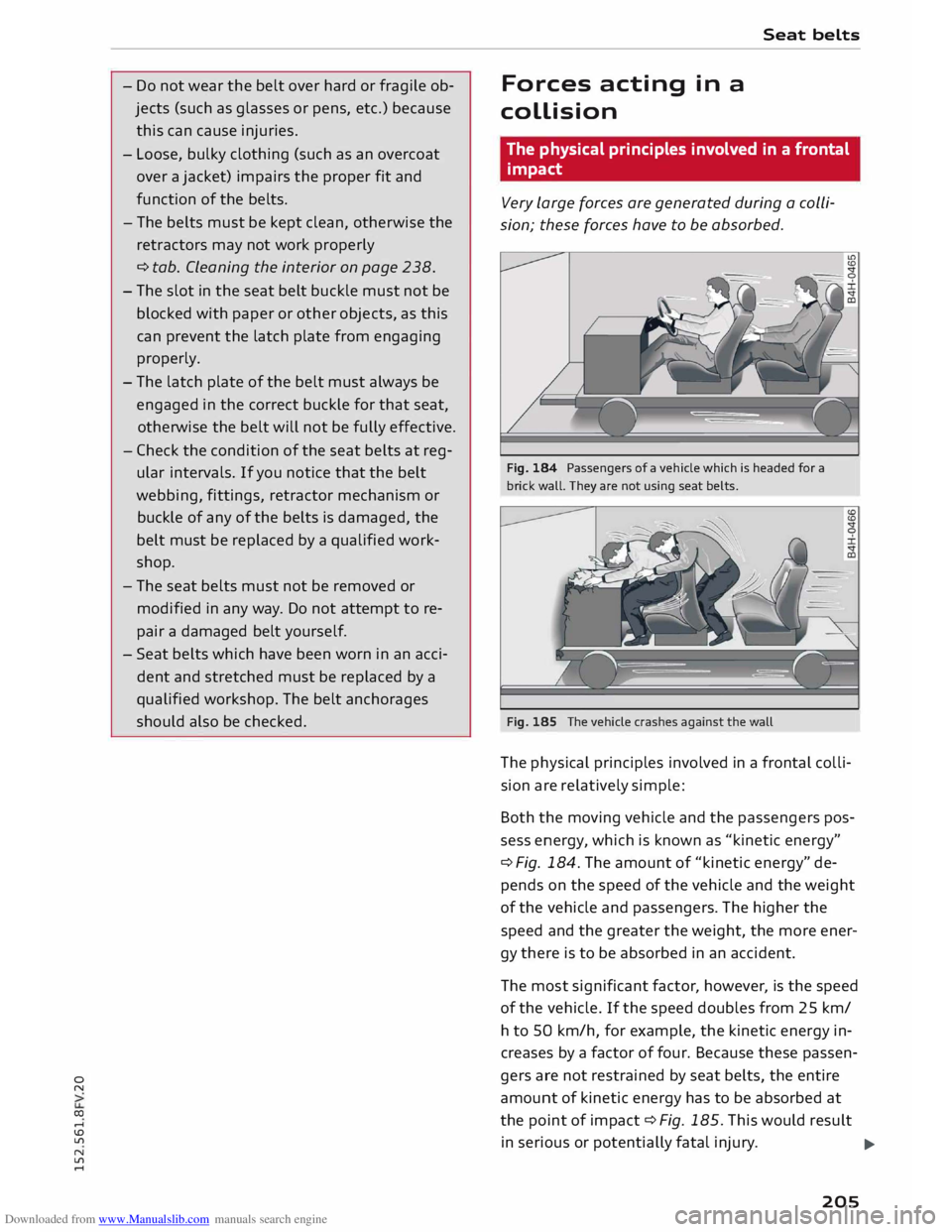
sion; these forces have to be absorbed.
Fig. 184 Passengers of a vehicle which is headed for a
brick wall. They are not using seat belts.
Fig. 185 The vehicle crashes against the wall
The phys ical principles involved in a frontal colli
sion are relatively simple:
Both the moving vehicle and the passengers pos
sess energy, which is known as "kinetic energy"
¢ Fig. 184. The amount of "kinetic energy" de
pends on the speed of the vehicle and the weight
of the vehicle and passengers. The higher the
speed and the greater the weight, the more ener
gy there is to be absorbed in an accident.
The most significant factor, however, is the speed
of the vehicle. If the speed doubles from 25 km/
h to 50 km/h, for example, the kinetic energy in
creases by a factor of four. Because these passen
gers are not restrained by seat belts, the entire
amount of kinetic energy has to be absorbed at
the point of impact ¢ Fig. 185. This would result
in serious or potentially fatal injury.
..,.
205
Page 208 of 284
Downloaded from www.Manualslib.com manuals search engine Seat
belts
Even at urban speeds of 30 km/h to 50 km/h, the
forces acting on the occupants in a collision can
reach the equivalent of 1 ton (1000 kg) or more.
At greater speed these forces are even higher.
Again: if the speed doubles, the forces increase
by a factor of four.
Passengers who do not wear seat belts are not
"attached" to the vehicle. In a frontal collision
they will continue to move forward at the speed
their car was travelling just before the impact.
What happens to passengers not wearing
seat belts?
Passengers not wearing seat belts risk fatal inju
ries in the event of an accident.
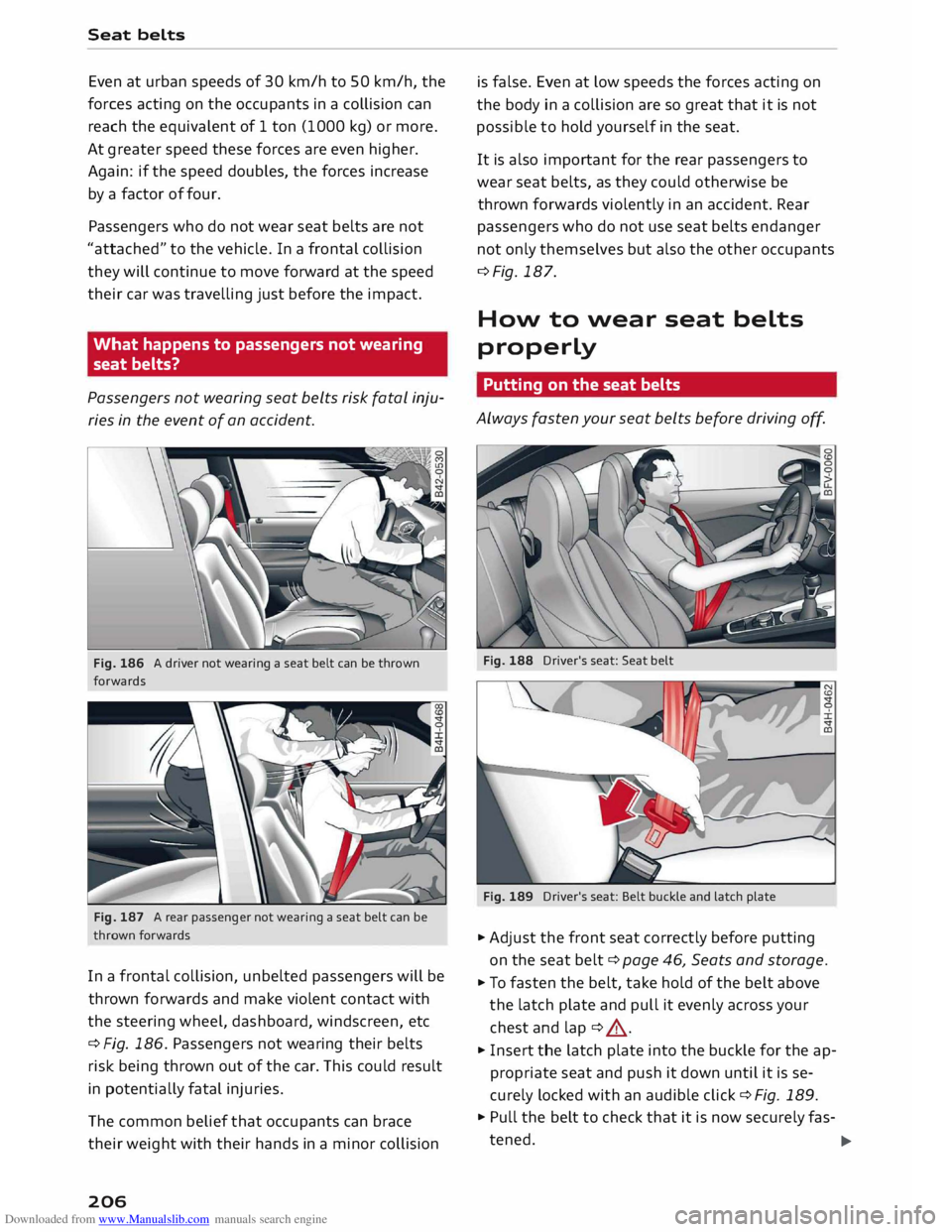
Fig. 186 A driver not wearing a seat belt can be thrown
forwards
Fig. 187 A rear passenger not wearing a seat belt can be
thrown forwards
In a frontal collision, unbelted passengers will be
thrown forwards and make violent contact with
the steering wheel, dashboard, windscreen, etc
¢ Fig
. 186.
Passengers not wearing their belts
risk being thrown out of the car. This could result
in potentially fatal injuries.
The common belief that occupants can brace
their weight with their hands in a minor collision
206 is
false. Even at low speeds the forces acting on
the body in a collision are so great that it is not
possible to hold yourself in the seat.
It is also important for the rear passengers to
wear seat belts, as they could otherwise be
thrown forwards violently in an accident. Rear
passengers who do not use seat belts endanger
not only themselves but also the other occupants
¢Fig. 187.
How to wear seat belts
properly
Putting on the seat belts
Alwa ys
fasten
your
seat belts before driving o
ff .
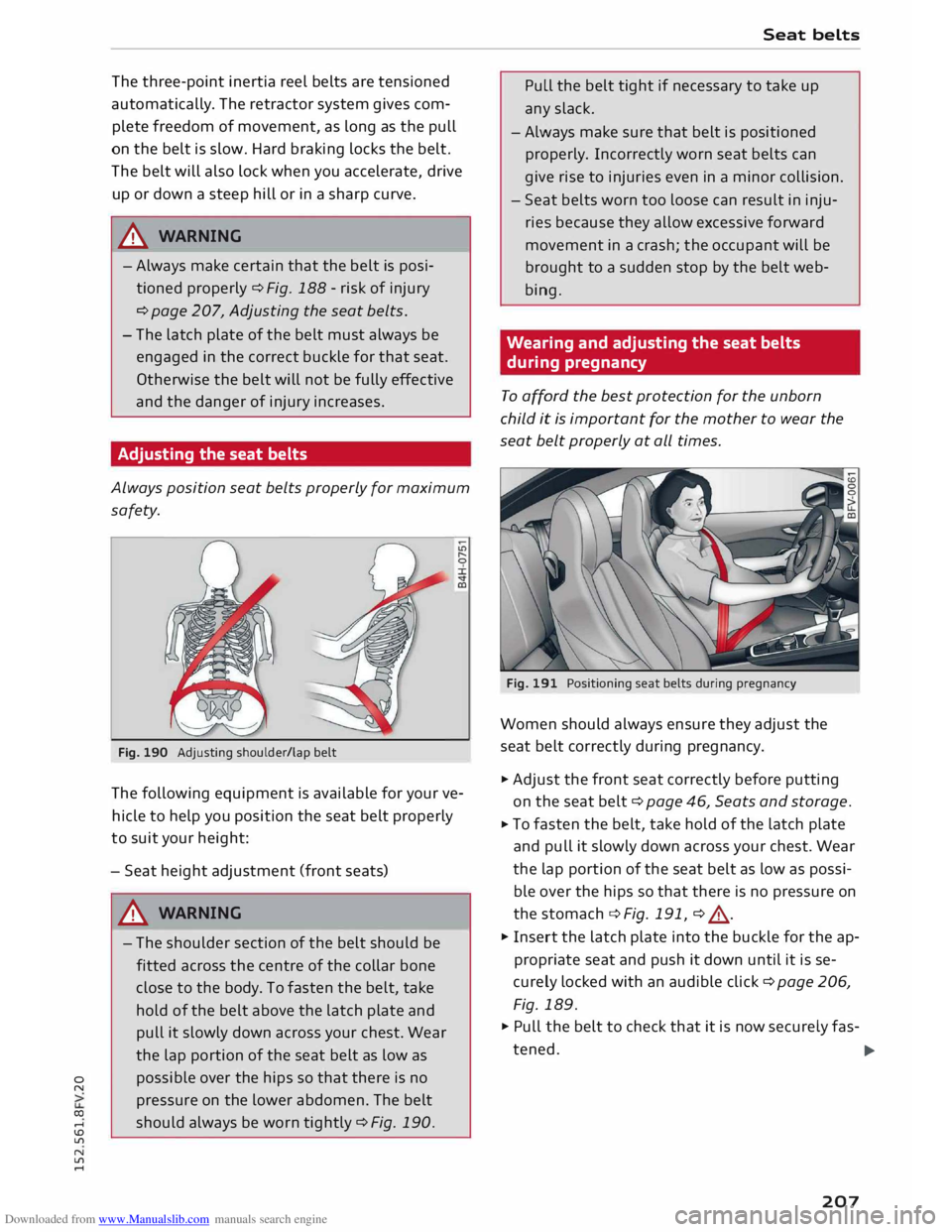
Fig. 188 Driver's seat: Seat belt
Fig. 189 Driver's seat: Belt buckle and latch plate
.,. Adjust the front seat correctly before putting
on the seat belt¢ page 46, Seats and storage.
.,. To fasten the belt, take hold of the belt above
the latch plate and pull it evenly across your
chest and lap¢ A.
.,. Insert the latch plate into the buckle for the ap
propriate seat and push it down until it is se
curely locked with an audible click¢ Fig. 189 .
.,. Pull the belt to check that it is now securely fas-
tened. liJI,,
Page 209 of 284
Downloaded from www.Manualslib.com manuals search engine 0
N
co
....
\D L/'l
N
L/'l
.... The
three-point inertia reel belts are tensioned
automatically. The retractor system gives com
plete freedom of movement, as long as the pull
on the belt is slow. Hard braking locks the belt.
The belt will also lock when you accelerate, drive
up or down a steep hill or in a sharp curve.
A WARNING
- Always make certain that the belt is posi
tioned properly ¢ Fig. 188 -risk of injury
¢ page 207, Adjusting the seat belts.
- The latch plate of the belt must always be
engaged in the correct buckle for that seat.
Otherwise the belt will not be fully effective
and the danger of injury increases.
Adjusting the seat belts
Always position seat belts properly for maximum
safety.
Fig. 190 Adjusting shoulder/lap belt
The following equipment is available for your ve
hicle to help you position the seat belt properly
to suit your height:
- Seat height adjustment (front seats)
A WARNING
- The shoulder section of the belt should be
fitted across the centre of the collar bone
close to the body. To fasten the belt, take
hold of the belt above the latch plate and
pull it slowly down across your chest. Wear
the lap portion of the seat belt as low as
possible over the hips so that there is no
pressure on the lower abdomen. The belt
should always be worn tightly¢ Fig. 190 . Seat
belts
Pull the belt tight if necessary to take up
any slack.
- Always make sure that belt is positioned
properly. Incorrectly worn seat belts can
give rise to injuries even in a minor collision.
- Seat belts worn too loose can result in inju
ries because they allow excessive forward
movement in a crash; the occupant will be
brought to a sudden stop by the belt web
bing.
Wearing and adjusting the seat belts
during pregnancy
To afford the best protection for the unborn
child it is important for the mother to wear the
seat belt properly at all times.
Fig. 191 Positioning seat belts during pregnancy
Women should always ensure they adjust the
seat belt correctly during pregnancy.
� Adjust the front seat correctly before putting
on the seat belt¢ page 46, Seats and storage.
� To
fasten the belt, take hold of the latch plate
and pull it slowly down across your chest. Wear
the lap portion of the seat belt as low as possi
ble over the hips so that there is no pressure on
the stomach ¢ Fig. 191, ¢ ,&. .
� Insert the latch plate into the buckle for the ap
propriate seat and push it down until it is se
curely locked with an audible click¢ page 206,
Fig. 189.
� Pull the belt to check that it is now securely fas-
tened. IJJJ.
207
Page 220 of 284
Downloaded from www.Manualslib.com manuals search engine Checking
and topping up fluids
Diesel can thicken at very low temperatures,
which can result in problems starting the engine
or prevent the engine from running smoothly. For
this reason, filling stations in some countries of
fer winter-grade diesel fuel during the cold
months so that you can continue to operate your
vehicle reliably. Ask at your filling station wheth
er the diesel fuel available there is suitable for
the current conditions and for the temperatures
which could potentially occur.
CD CAUTION
- Never use FAME fuels (biodiesel), petrol,
heating oil, thinners or any other fuels or
additives, as these could cause serious dam
age to the fuel system and the engine.
- Never start the engine if you fill up with the
wrong type of fuel, as this could damage
the fuel system and the engine. Obtain pro
fessional assistance.
Filling the tank
Procedure for filling the tank
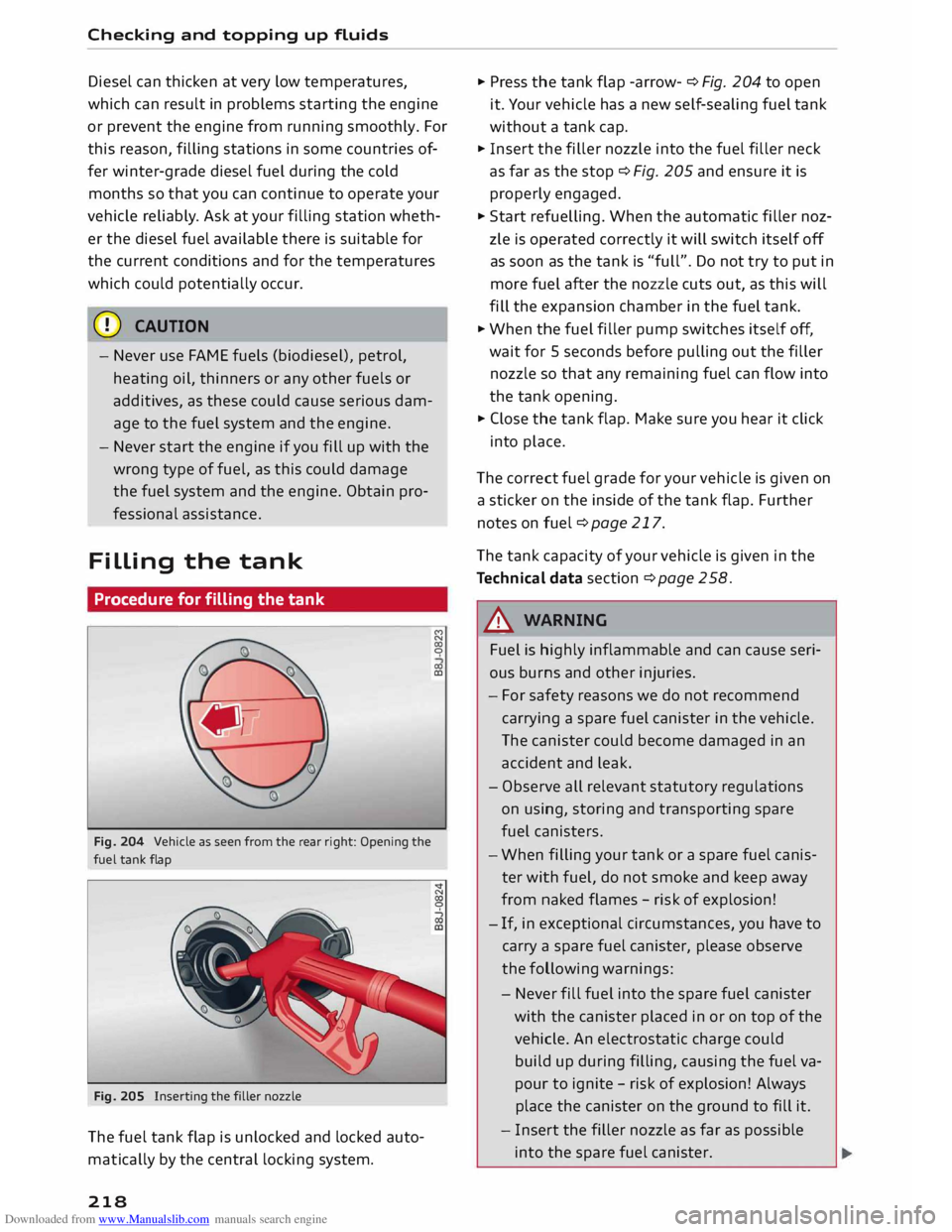
Fig. 204 Vehicle as seen from the rear right: Opening the
fuel tank flap
Fig. 205 Inserting the filler nozzle
The fuel tank flap is unlocked and locked auto
mati cally by the central locking system.
218 "'
N
00
0
00
ca �
Press the tank flap -arrow- ¢ Fig. 204 to open
it. Your vehicle has a new self-sealing fuel tank
without a tank cap.
� Insert the filler nozzle into the fuel filler neck
as far as the stop ¢ Fig. 205 and ensure it is
properly engaged.
� Start refuelling. When the automatic filler noz
zle is operated correctly it will switch itself off
as soon as the tank is "full". Do not try to put in
more fuel after the nozzle cuts out, as this will
fill the expansion chamber in the fuel tank.
� When the fuel filler pump switches itself off,
wait for 5 seconds before pulling out the filler
nozzle so that any remaining fuel can flow into
the tank opening.
� Close the tank flap. Make sure you hear it click
into place.
The correct fuel grade for your vehicle is given on
a sticker on the inside of the tank flap. Further
notes on fuel ¢page 217.
The tank capacity of your vehicle is given in the
Technical data section ¢ page 258.
& WARNING
Fuel is highly inflammable and can cause seri
ous burns and other injuries.
- For safety reasons we do not recommend
carrying a spare fuel canister in the vehicle.
The canister could become damaged in an
accident and leak.
- Observe all relevant statutory regulations
on using, storing and transporting spare
fuel canisters.
- When filling your tank or a spare fuel canis
ter with fuel, do not smoke and keep away
from naked flames -risk of explosion!
- If,
in exceptional circumstances, you have to
carry a spare fuel canister, please observe
the following warnings:
- Never fill fuel into the spare fuel canister
with the canister placed in or on top of the
vehicle. An electrostatic charge could
build up during filling, causing the fuel va
pour to ignite -risk of explosion! Always
place the canister on the ground to fill it.
- Insert the filler nozzle as far as possible
into the spare fuel canister.
Page 221 of 284
Downloaded from www.Manualslib.com manuals search engine 0
N
co
....
\D Lfl
N
Lfl
.... -
If the spare fuel canister is made of metal,
the filler nozzle must be in contact with
the canister during filling. This helps pre
vent an electrostatic charge building up.
- Make sure you never spill fuel in the vehi
cle or in the Luggage compartment. Fuel
vapour is explosive -danger to Life!
CD CAUTION
- Remove any fuel spills from the paintwork
immediately.
- Never run the tank completely dry. If there
is an irregular fuel supply, misfiring can oc
cur. As a result unburnt fuel can enter the
exhaust system and cause damage to the
cata Lytic converter(s).
- When filling the fuel tank after having run it
completely dry on a vehicle with a diesel en
gine the ignition must be switched on for at
Least 30 seconds without starting the en
gine. When you then start the engine it may
take Longer than normal (up to one minute)
for the engine to start firing. This is because
air needs to be bled from the fuel system
while starting.
(® For the sake of the environment
Do not overfill the fuel tank -this may cause
the fuel to overflow if it becomes warm.
(1j) Note
Should the fuel tank flap become frozen stuck
during inclement weather, press the middle
of the flap with the palm of the hand and try
again.
@ Note
To prevent the tank from being filled with the
incorrect type of fuel (petrol or diesel), only
suitable filler nozzles can be inserted in the
fuel filler on your vehicle.
- If the filler nozzle is old, damaged or too
small, it may not be able to open the pro
tection mechanism on the fuel tank. In this
case, try turning the filler nozzle before in
serting it in the fuel filler neck, use a differ- Checking
and topping up fluids
ent filling pump or seek professional assis
tance.
- The protection mechanism will not open if
you try to add fuel from a spare fuel canis
ter. If you need to fill the tank from a spare
fuel canister, you must use the special fun
nel stowed in the Luggage compartment
¢page 219, Fig. 206.
Filling the tank using a spare fuel canister
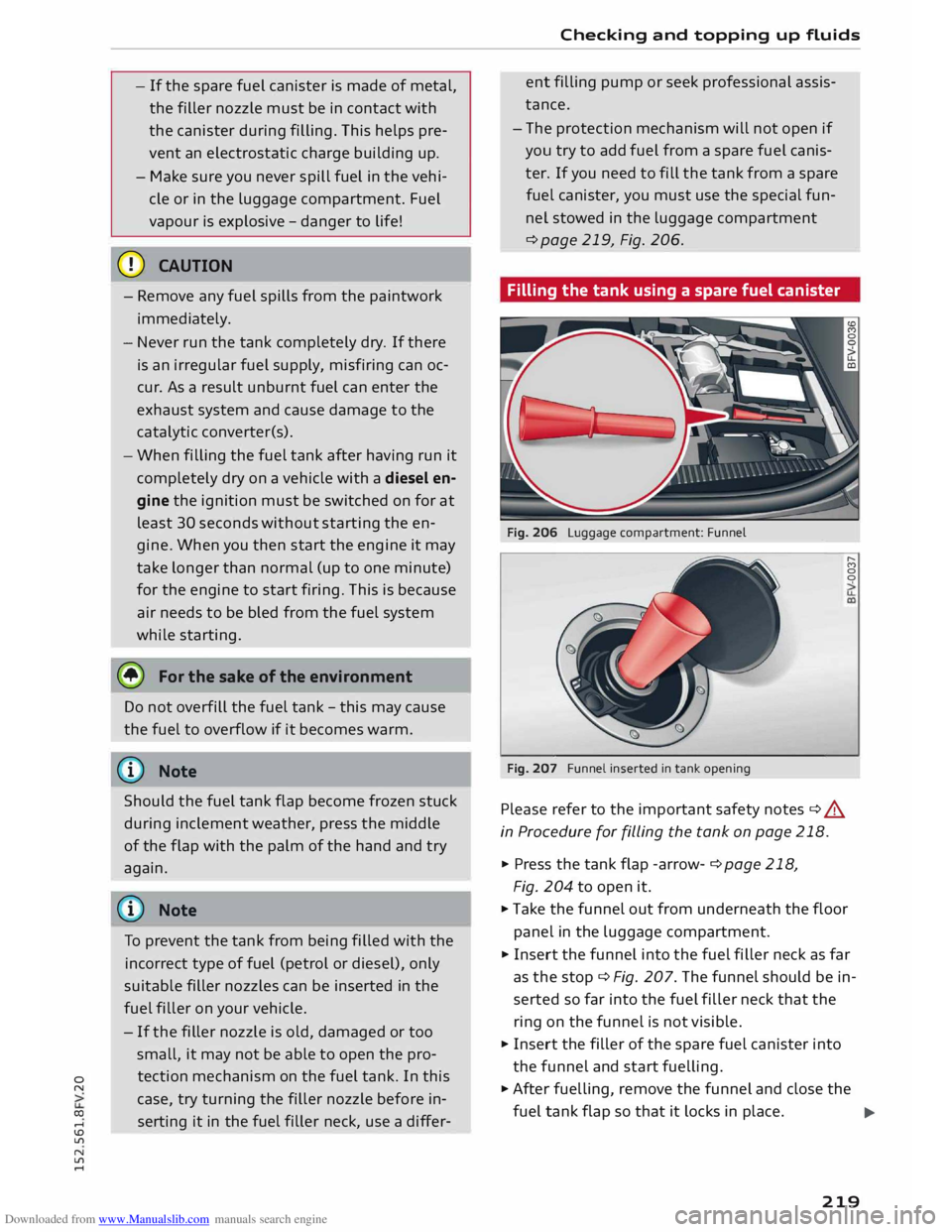
Fig. 206 Luggage compartment: Funnel
Fig. 207 Funnel inserted in tank opening
Please refer to the important safety notes¢ A
in Procedure for filling the tank on page 218.
... Press the tank flap -arrow- ¢page 218,
Fig. 204 to open it. .....
(')
0
0
... Take the funnel out from underneath the floor
panel in the Luggage compartment.
... Insert the funnel into the fuel filler neck as far
as the stop ¢ Fig. 207. The funnel should be in
serted so far into the fuel filler neck that the
ring on the funnel is not visible.
... Insert the filler of the spare fuel canister into
the funnel and start fuelling.
... After fuelling, remove the funnel and close the
fuel tank flap so that it Locks in place.
llJl,,
219
Page 222 of 284
Downloaded from www.Manualslib.com manuals search engine Checking
and topping up fluids
CD CAUTION
Remove any fuel spills from the paintwork im
mediately.
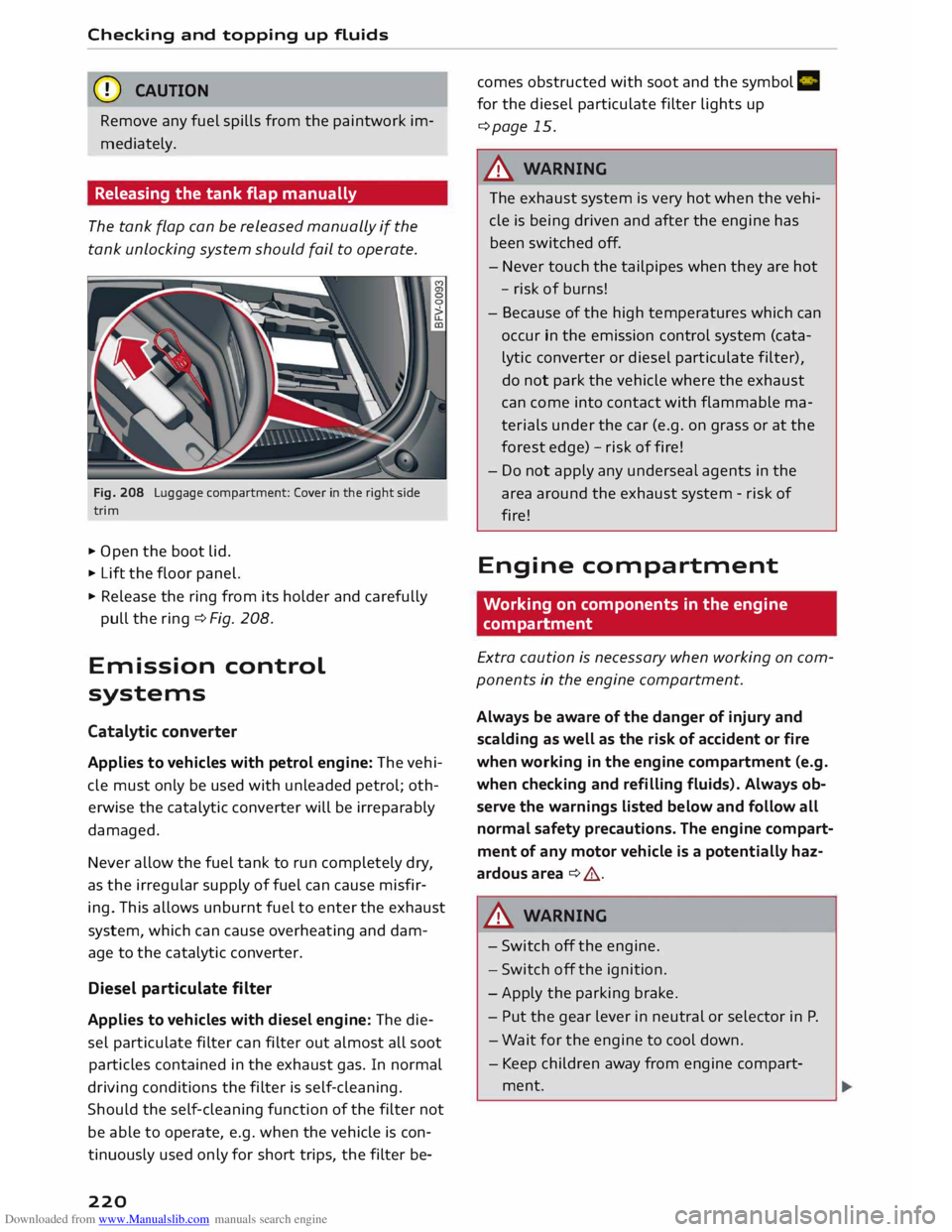
Releasing the tank flap manually
The tank flap can be released manually if the
tank unlocking system should fail to operate.
Fig. 208 Luggage compartment: Cover in the right side
trim
.. Open the boot lid.
.. Lift the floor panel.
.. Release the ring from its holder and carefully
pull the ring ¢ Fig. 208.
Em ission control
systems
Catalytic converter
Applies to vehicles with petrol engine: The vehi
cle must only be used with unleaded petrol; oth
erwise the catalytic converter will be irreparably
damaged.
Never allow the fuel tank to run completely dry,
as the irregular supply of fuel can cause misfir
ing. This allows unburnt fuel to enter the exhaust
system, which can cause overheating and dam
age to the catalytic converter.
Diesel particulate filter
Applies to vehicles with diesel engine: The die
sel particulate filter can filter out almost all soot
particles contained in the exhaust gas. In normal
driving conditions the filter is self-cleaning.
Should the self-cleaning function of the filter not
be able to operate, e.g. when the vehicle is con
tinuously used only for short trips, the filter be-
220 comes
obstructed with soot and the symbol Cl
for the diesel particulate filter lights up
¢page 15.
A WARNING
The exhaust system is very hot when the vehi
cle is being driven and after the engine has
been switched off.
- Never touch the tailpipes when they are hot
- risk of burns!
- Because of the high temperatures which can
occur in the emission control system (cata
lytic converter or diesel particulate filter),
do not park the vehicle where the exhaust
can come into contact with flammable ma
terials under the car (e.g. on grass or at the
forest edge) -risk of fire!
- Do not apply any undersea[ agents in the
area around the exhaust system -risk of
fire!
Engine compartment
Working on components in the engine
compartment
Extra caution is necessary when working on com
ponents in the engine compartment.
Always be aware of the danger of injury and
scalding as well as the risk of accident or fire
when working in the engine compartment (e.g.
when checking and refilling fluids). Always ob
serve the warnings listed below and follow all
normal safety precautions. The engine compart
ment of any motor vehicle is a potentially haz
ardous area ¢ .,&.
A WARNING
- Switch off the engine.
- Switch off the ignition.
- Apply the parking brake.
- Pu t the gear lever in neutral or selector in P.
- Wait for the engine to cool down.
- Keep children away from engine compart-
ment.
Page 223 of 284
Downloaded from www.Manualslib.com manuals search engine 0
N
co
....
\D L/'l
N
L/'l
.... -
Never spill fluids on a hot engine. These flu
ids can cause a fire (e.g. radiator anti
freeze).
- Take care not to cause short circuits in the
electrical system, especially when working
on the battery.
- When working in the engine compartment
be aware that the radiator fan may start
running suddenly, even if the ignition is
switched off-risk of injury!
- Do not unscrew the cap on the expansion
tank when the engine is hot. The cooling
system is under pressure.
- Protect face, hands and arms by covering
the cap with a large, thick rag to protect
against escaping coolant and steam.
- Never remove the engine cover panel -risk
of burns!
- If any tests have to be performed with the
engine running, there is an extra safety risk
from the rotating parts, such as the drive
belts, alternator and radiator fan, etc., and
from the high-voltage ignition system.
- Vehicles with automatic gearbox: Never
open the throttle inadvertently (for instance
by hand from the engine compartment) if a
gear is engaged while the vehicle is station
ary with the engine running. The vehicle
could otherwise start moving immediately
and possibly cause an accident.
- Observe the following additional warnings if
work on the fuel system or the electrical
system is necessary:
- Always disconnect the battery.
- Do not smoke.
- Never work near naked flames.
- Always keep an approved fire extinguisher
immediately available.
CD CAUTION
When topping up fluids make sure the correct
fluid is put into the correct filler opening. This
can otherwise cause serious malfunctions or
engine damage. Checking
and topping up fluids
® For the sake of the environment
Inspect the ground underneath your vehicle
regularly so that any leaks are detected at an
early stage. If you find spots of oil or other
fluids, have your vehicle inspected in the
workshop.
{D) Note
On right-hand drive vehicles* some of the
containers/ reservoirs mentioned below are
located on the other side of the engine com
partment.
Opening the bonnet
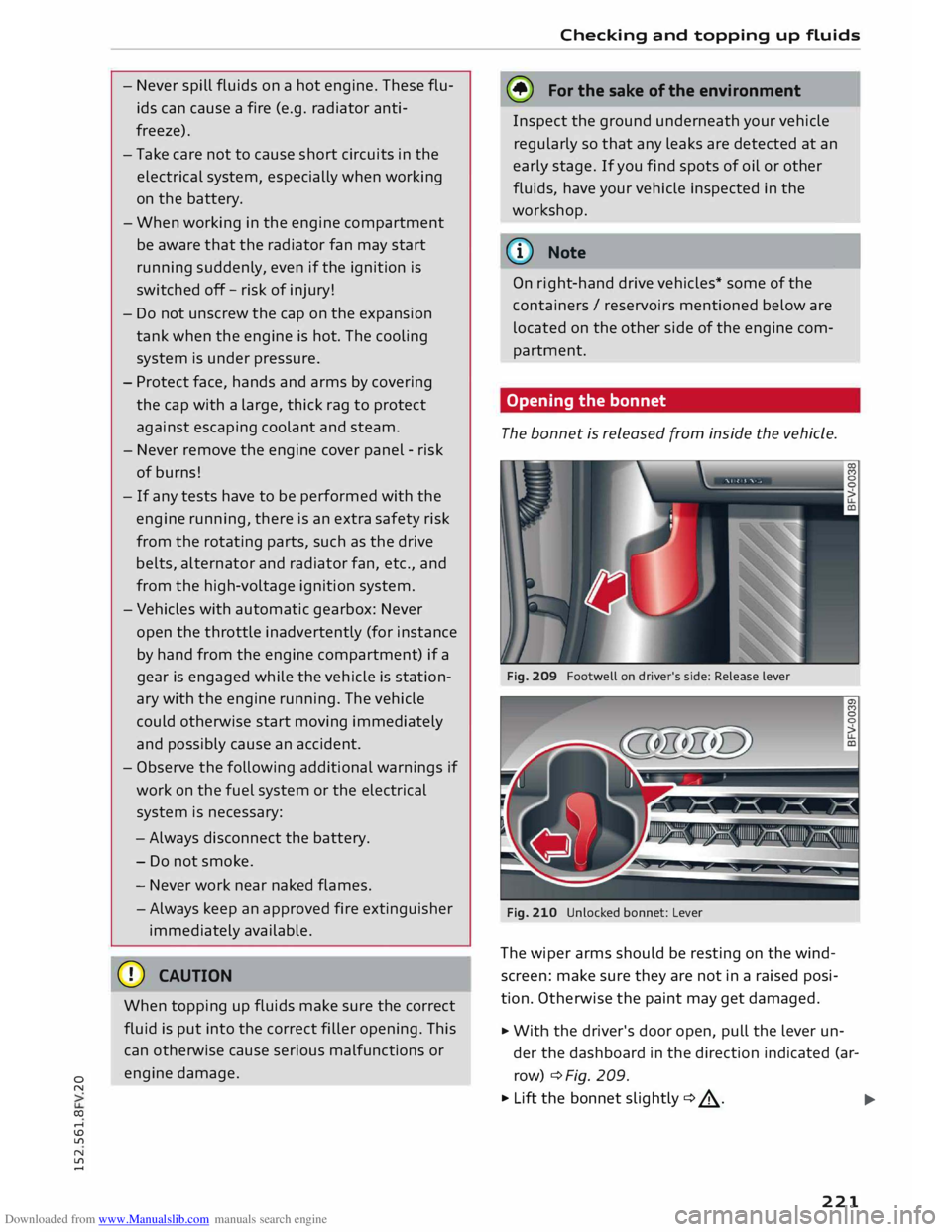
The bonnet is released from inside the vehicle.
Fig. 209 Footwell on driver's side: Release lever
Fig. 210 Unlocked bonnet: Lever
The wiper arms should be resting on the wind
screen: make sure they are not in a raised posi
tion. Otherwise the paint may get damaged.
� With the driver's door open, pull the lever un
der the dashboard in the direction indicated (ar
row) ¢ Fig. 209.
� Lift the bonnet slightly¢.&_.
11111>
221