tire pressure AUDI TT COUPE 2016 User Guide
[x] Cancel search | Manufacturer: AUDI, Model Year: 2016, Model line: TT COUPE, Model: AUDI TT COUPE 2016Pages: 322, PDF Size: 52.86 MB
Page 264 of 322
Downloaded from www.Manualslib.com manuals search engine Wheels
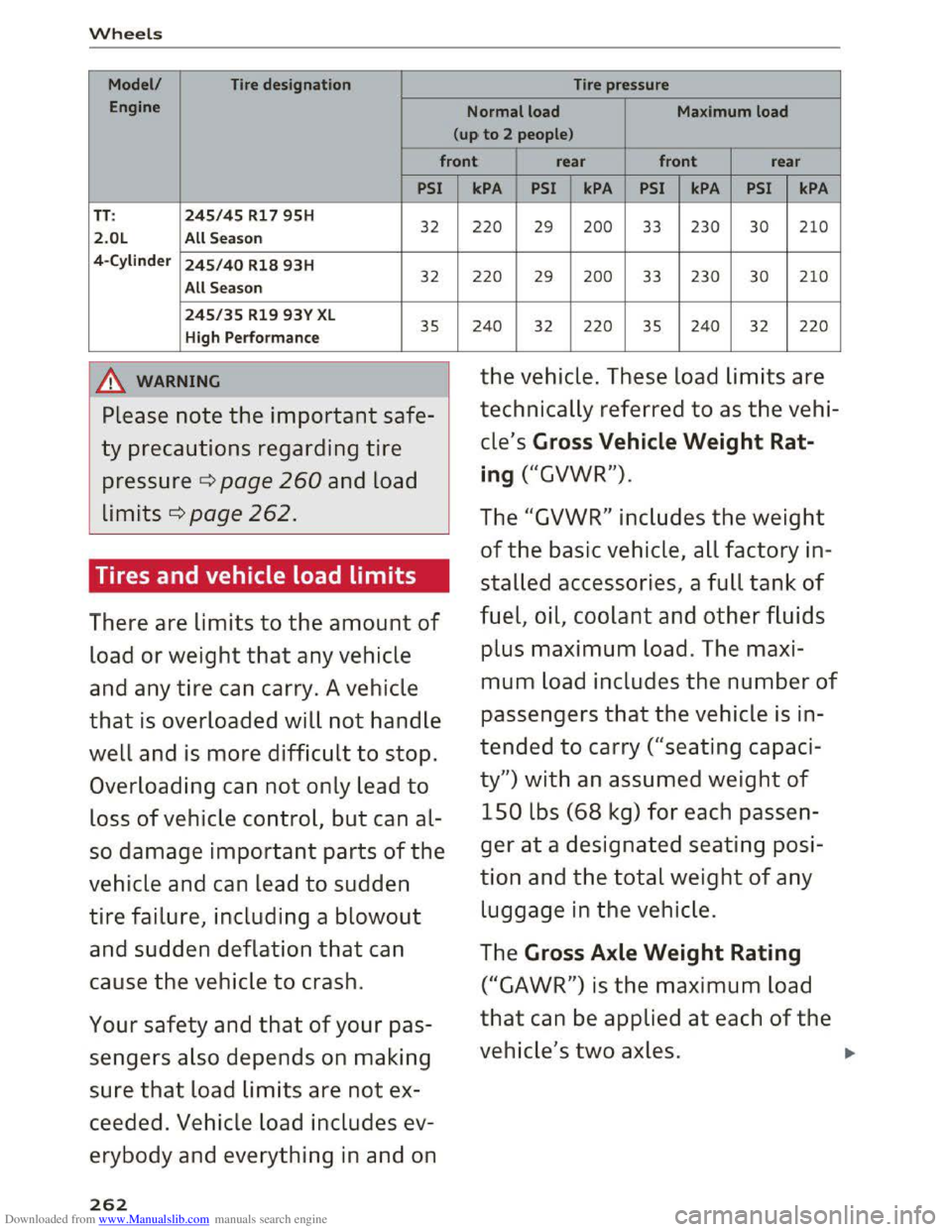
Model/ Tire designation Tire pressure
Engine Normal load Maximum load
(up to 2 people)
front rear front rear
PSI
TT: 245/45 R17 95H
2.0L All Season 32
4-Cylinder 245/40 R18 93H
All
Season 32
245/35 R19 93Y XL
High Performance 35
A WARNING
Please
note the important safe
ty precautions regarding tire
pressure¢ page 260 and load
limits
¢page 262.
Tires and vehicle load limits
There are limits to the amount of
load or weight that any vehicle
and any tire can carry. A vehicle
that is overloaded will not handle
well and
is more difficult to stop.
Overloading can
not only lead to
loss of vehicle control, but can al
so
damage important parts of the
vehicle and can lead to sudden
tire failure, including a blowout
and sudden deflation
that can
cause
the vehicle to crash.
Your safety and
that of your pas
sengers also depends on making
sure that load limits are not ex
ceeded. Vehicle load includes ev
erybody and everything
in and on
262
kPA PSI kPA PSI kPA PSI kPA
220 29 200 33 230 30 210
220 29 200 33 230 30 210
240 32 220 35 240 32 220
the vehicle. These load limits are
technically referred
to as the vehi
cle's Gross Vehicle
Weight Rat
ing
("GVWR").
The "GVWR" includes the weight
of the basic vehicle, all factory in
stalled accessories, a full tank of
fuel, oil, coolant and other fluids
plus maximum load. The maxi
mum load includes
the number of
passengers that the vehicle is in
tended to carry ("seating capaci
ty") with an assumed weight of
150 lbs (68 kg) for each passen
ger
at a designated seating posi
tion and
the total weight of any
luggage
in the vehicle.
The Gross Axle
Weight Rating
("GAWR") is the maximum load
that can be applied at each of the
vehicle's two axles.
Page 265 of 322
Downloaded from www.Manualslib.com manuals search engine The fact that there is an upper
limit
to your vehicle's Gross Vehi
c le Weight Rating
means that the
total weight of whatever is being
carried
in the vehicle is Limited.
The more passengers
in the vehi
c le or passengers who are heavier
than the standard weights as
sumed mean
that Less weight can
be carried as Luggage .
The Gross Vehicle Weight Rating
and
the Gross Axle Weight Rating
are listed on the safety compli
ance sticker
Label Located on the
driver 's side B-pillar ¢page 260,
fig. 194.
.&_WARNING
Overloading a vehicle can cause
Loss of vehicle control, a crash
or
other accident, serious per
sonal injury, and even
death.
- Carrying more weight than
your vehicle was designed
to
carry will prevent the vehicle
from handling properly and
increase
the risk of the Loss of
vehicle control.
-The brakes on a vehicle that
has been overloaded may not
be able to stop the vehicle
within a safe distance.
Wheels
-Tires on a vehicle that has
been overloaded can fail sud
denly, including a blowout and
sudden deflation, causing
Loss
of control and a crash.
-Always make sure
that the to
tal Load being transported
does not make the vehicle
heavier
than the vehicle's
Gross
Vehi cle Weight Rating.
Determining correct load
limit
Use the example below to calcu
late
the total weight of the pas
sengers and Luggage or
other
things that you plan to transport
so that you can make sure that
your vehicle will not be overload
ed.
Steps for Determining Correct
Load Limit
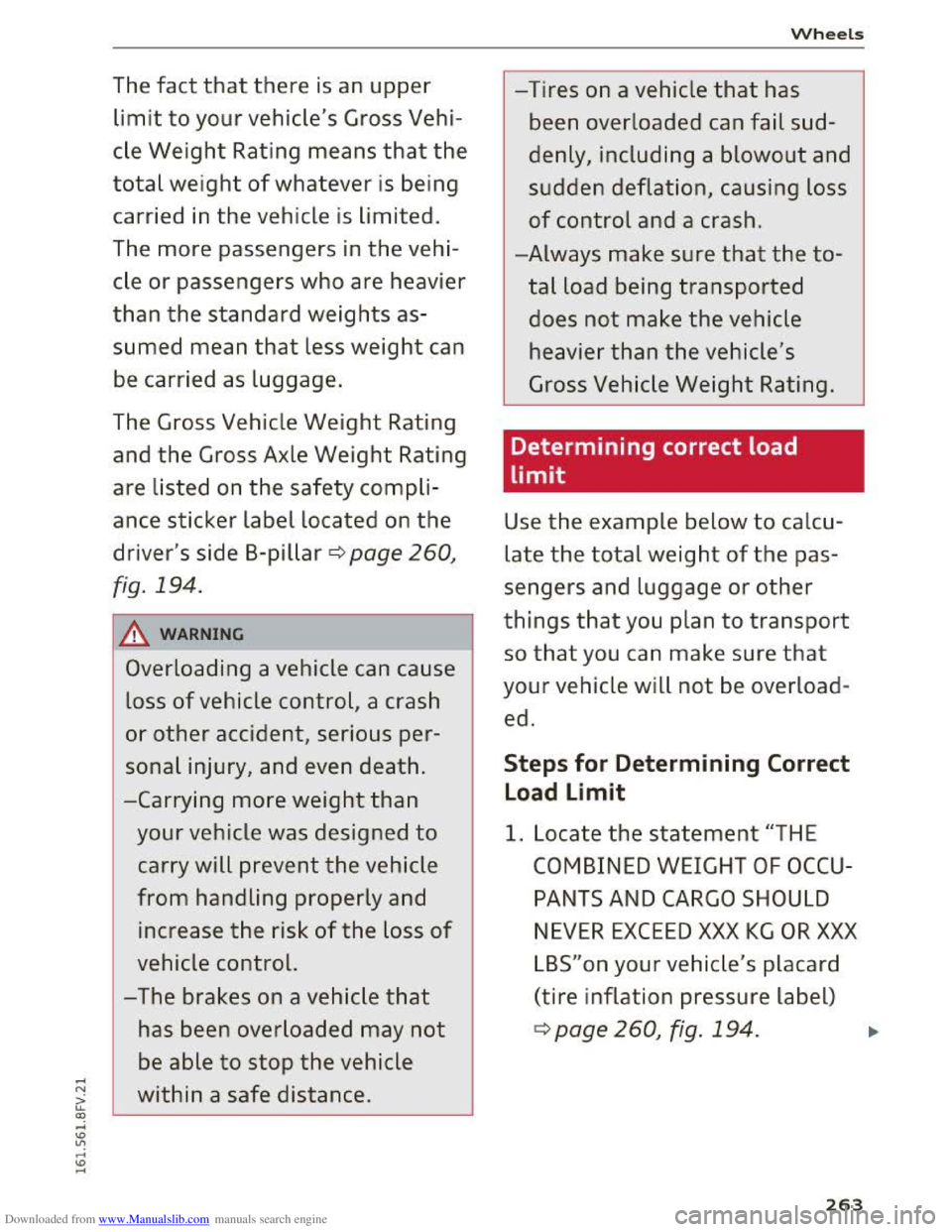
1. L ocate the statement "THE
COMBINED WEIGHT OF OCCU
PANTS AND CARGO SHOULD
NEVER EXCEED XXX KG OR XXX
LBS" on your vehic le's placard
(tire inflation pressure
Label)
¢page 260, fig. 194. .,..
263
Page 267 of 322
Downloaded from www.Manualslib.com manuals search engine ~Only use winter tires that are approved for your
vehicle.
~Please note that the maximum permitted
speed may be lower with winter tires q ,&.. An
authorized Audi dealer or authorized Audi Serv
ice Facility
can inform you about the maximum
permitted speed for your tires.
~Check the tire pressure after installing wheels
qpage260.
The effectiveness of winter tires is reduced great
ly when
the tread is worn down to a depth of
0.157 in (4 mm). The characteristics of winter
tires also decrease greatly as the tire ages, re
gardless
of the remaining tread.
A WARNING
1-=---Never drive faster than the maximum per-
mitted speed for your tires. This could cause
the tires to heat up too much. This increases
the risk
of an accident because it can cause
the
tire to burst.
- Always
adapt your driving to the road and
traffic conditions. Drive carefully and reduce
your speed on icy or slippery roads.
Even
winter tires can lose traction on black ice.
@ For the sake of the environment
Reinstall summer tires at the appropriate
time, because they provide better handling
when roads are free
of snow and ice. Summer
tires cause
Less road noise, tire wear and fuel
consumption.
(j) Tips
You can also use all season tires instead of
winter tires. Please note that in some coun
tries where
winter tires are required, only
winter tires with the & symbol may be per
mitted.
Snow chains
Snow chains not only improve the driving in win
ter road conditions, but also the braking.
~Only install snow chains on the front wheels.
This applies also
to vehicles with all wheel
drive*.
Wheels
~Check and correct the seating of the snow
chains
after driving a few feet, if necessary. Fol
low
the instructions from the manufacturer.
~Note the maximum speed of 30 mph (50 km/
h). Note the Local regulations.
Use of snow chains is only permitted with certain
rim/tire combinations due to technical reasons.
Check with an authori zed Audi dealer or author
ized Audi Service Facility
to see if you may use
snow chains .
You must remove the snow chains on roads with
out snow . Otherwise, you could impair driving
ability and damage the tires.
A WARNING
Using incorrect snow chains or installing snow
chains incorrectly
can result in loss of vehicle
control, which increases
the risk of an acci
dent.
CD Note
- Snow chains can damage the rims/wheel
covers* if the chains come into direct con·
tact with them. Remove the wheel covers*
first. Use coated snow chains.
-
Using snow chains that add more than 0.53
in (0.53 in) of height can severely damage
the wheel housings and
other vehicle com
ponents.
(D Tips
When using snow chains, it may be useful to
switch on sport mode ~page 88.
Low aspect ratio tires
Your Audi is factory-equipped with low aspect ra
tio tires. These tires have been thoroughly tested
and been selected specifically
for your model for
their superb performance, road feel and handling
under a variety
of driving conditions. Ask your au
thorized Audi dealer
for more details .
The
Low aspect ratio of these tires is indicated by
a numeral
of SS or less in the tire's size designa
tion. The numeral represents the ratio of the
tire's sidewall height in relation to its tread width..,.
265
Page 268 of 322
Downloaded from www.Manualslib.com manuals search engine Wheels
expressed in percentage. Conventional tires have
a heig h
t/width ratio of 60 or more.
The performanc e o f lo w-a spect-ratio tires is par·
t icularly sensitive t o improper inflation pres·
sure. It is therefo re important that low aspect
ratio tires are inflated to the specified pressure
and that t h e inflation pressure is re g ula rly
chec k
ed and maintained. T ire pressure s should
be checked at least once a month and alway s
b efo re a l
ong trip Q page 260.
What you can do to avoid tire and rim
damage
L o w aspect ratio tires can be damaged more easi·
ly by impact with potholes, cu rbs, gull ies or
r i
dges o n th e roa d, pa rt ic u la rly ifthe tir e is un·
d e rinflated .
In order to minim ize the occu rrence of impact
damage to the ti res of your vehicle, we recom·
mend that you observe the fo llowi ng p recau ·
tions:
- Always
maintain recommended inflation p res·
sures. Check your tire pressure every 2,000
miles (3,000 km) and add air if necessary.
- Drive carefully on
roads with potholes, deep
gullies or ridges. The impac t from driving
through or over such obstacles can damage
your tires. Impact with a curb may also cause
damage to your tires.
- Af t
er any impact, immediately inspec t your
tires o r have them inspected by the nearest au
thorize d Audi dealer. Replace a da maged t ir e as
soo n a s possib le.
- In sp e
ct yo ur tires e v ery 2 ,000 m iles (3 ,000 km)
fo r d
amage and wear. Damage is not always
e a sy to
see. Damage can lead to loss of air and
un
deri n flation, which could eventually cause
tire failure. If you believe that a tire may have
been damaged, replace the tire as soon as pos
sible.
- These
tires may wear more quickly than others.
-Please also remember that, while these tires
deliver responsive handling, they may ride less
comfortably and make more no ise than other
choices.
266
Reduced performance in winter/co ld season
conditions
All ti res are designed fo r certain purposes. The
low
aspect ra tio, ultra high performance tires
originally installed on your vehicle are intended
for maximum dry and wet road performance and
handling. They are not suitable for cold, snowy or
icy weather conditions. If you drive under those
circumstances, you should equip your vehicle
with all-season
or winter tires, which offer better
tract ion under those conditions. We suggest you
use the re commended snow or all-season tires
spe cified for your vehicle, or their equiva lent.
Refer to~ page 264 for more detailed informa
tion regard in g w in
ter tires.
Uniform tire quality grading
- T re ad wear
- T rac tion
AA ABC
- Temperatur e ABC
Quality grades can be found where applicable on
the tire side wall between tread shoulder and
maximum section width Q page 250, fig. 192.
Fo r e xample: Tread wear 200, Traction AA, Tem
perature A.
All
passenger car t ires must conform to Federal
Sa f
ety Requirements in addi tion to these grades.
Tread wear
The tread w ear grade is a comparative rating
b
ase d on the wear rate of th e tire w hen tested
u nd er c
ontro ll ed cond iti ons o n a specified go v·
ernment test course.
For ex
ample, a tire graded 150 would wear o ne
and o ne ha lf (1 1/2) times as well on the govern
ment course as a tire graded 100.
The relative performance of tires depends upon
the a ctual conditions of their use, however, and
may depart significant ly from the norm due to
varia tions in driving habits, service practices and
differences in road characteristics and cl imate.
Traction
The traction grades, from highest to lowest, are
AA, A, Band C. Those grades represent the tire's ~
Page 269 of 322
Downloaded from www.Manualslib.com manuals search engine ...... N
> u. CX> ...... u:>
"' ...... u:> ......
ability to stop on wet pavement as measured un
der controlled conditions on specified govern
ment test surfaces of asphalt and concrete. A tire
marked
C may have poor traction performance
c) .&..
Tempera ture
The temperature grades are A (the highest), B,
and C, representing the tire's resistance to the
generation of heat and its ability to dissipate
heat when tested under controlled conditions on
a specified indoor laboratory
test wheel.
Sustained high temperature can cause
the mate
r ial of
the tire to degenerate and reduce tire life,
and excess i
ve temperature can lead to sudden
tire failur e
c) .&..
The grade C corresponds to a leve l of perform
ance which all passenger car tires
must meet un
der
the Federal Motor Vehicle Safety Standard
No. 109. Grades Band A represent higher levels
of performance on
the laboratory test wheel than
the minimum required by law.
A WARNING
The traction grade assigned to this tire is
based on straight-ahead braking traction
tests, and does not include acceleration, cor
nering, hydroplaning or peak traction charac
teristics.
&_WARNING
-1
The temperature grade for this tire is estab-
lished for a t
ire that is properly inflated and
not overloaded. Excessive speed, underinfla
tion, or excessive loading, either separately or
in combination, can cause heat buildup and
possible t
ire failure.
&_WARNING
Temperature grades apply to tires that are
properly inflated and not over or under inflat
ed.
Wheel s
Tire pressure monitoring
system
CD General notes
Each tire, including the spare (if provided),
should be checked monthly when cold and inflat
ed to
the inflation pressure recommended by the
vehicle manufacturer on the vehicle placard or
tire inflation pressure label. (If your vehicle has
tires
of a different size than the size indicated on
the vehicle placard or tire inflation pressure la
bel, you shou ld determine
the proper tire infla
tion pressure for those tires).
As an added safety feature, your vehicle has been
equipped with a tire pressure monitoring system
(TPMS) that illuminates a low tire pressure tell
tale when one or more of your tires
is significant
ly under-inflated. Accordingly, when the low tire
pressure telltale illuminates, you should stop and
check your tires as soon as possible, and inflate
them
to the proper pressure. Driving on a signifi
cantly under-inflated tire causes
the tire to over
heat and can lead to tire failure . Under-inflation
also reduces fuel efficiency and tire tread life,
and may affect
the vehicle's handling and stop
ping ability .
Please note that the TPMS is not a substitute for
proper tire maintenance, and it
is the driver's re
spo nsibility
to maintain correct tire pressure,
even if under-inflation has
not reached the level
to trigger
illumination of the TPMS low tire pres
sure telltale.
Your vehicle has also been equipped with a TPMS
malfunction indicator to indicate when the sys
tem is not operating properly. The TPMS mal
function
indicator is combined with the low tire
pressure telltale. When the system detects a
malfunction,
the telltale will flash for approxi
mately one minute and then remain continuously
illuminated. This sequence
will continue upon
subsequent vehicle start-ups as long as the mal
function exists.
When
the malfunction indicator is illuminated,
the system may not be able to detect or signal
low tire pressure as intended.
TPMS malfunctions
may occur for a variety of reasons, including
the ""'
267
Page 270 of 322
Downloaded from www.Manualslib.com manuals search engine Wheels
installation of replacement or alternate tires or
wheels on the vehicle that prevent the TPM S
from functioning properly. Always check the
TPMS malfunction telltale after replacing one or
more ti
res or whee ls on your veh icle to ensure
that the replacement or alternate tires and
wheels
allow the TPMS to conti nue to functi on
p roper ly .
If the Tire Pressure Monitoring System
indicator appears
The tire pressure indicator in the instrument
cluster informs you if the tire pressure is too low
or
if there is a system malfunction.
Using the ABS sensors, th e tire p ressure monitor
i n g
system compares the tire tread circumfer
ence and vibra tion char
acteristi cs of the individ u
al tires.
If the pressure changes in one or more
tires,
this i s indicated in the Infotainment system
d isp lay
with an ind icator light RI and a message .
If only one tire is affected , the location of that
tire will be ind icated.
The tire pressures must be stored in the Infotain
ment system again each time the pressu res
change (switching between partial and full load
pressure) or
after changing or replacing a tire on
your veh icle ¢ page 269. The tire pressure moni
toring system only monitors the tire pressure you
have stored. Refe r
to the tire pressure label for
the recommended tire pressure for your veh icl e
¢page260, fig.195.
Tire tread circumference and vibration character
istics
can change and cause a tire pressure warn
i n g if:
-
the tire p ressure in one or more tires is too low.
-
the tire has structural damage .
-
the tire was replaced or the tire pressure was
changed and
it was not stored¢ page 269.
-the spare tire* is installed .
Indicator lights
RI-Loss of pressure in at l east one tire ¢,&.
Check
t h e tires and rep lace or r epair if necessary.
Check/correct
the p ressures of all four tires and
store
the pressure again in the Infotainment sys
tem ¢ page 269.
268
ffim (T ire Pressure Mon itoring System) Tire
pressure: malfunction!
See owner's manual -if
m appears after switching on the ignition or
while driving and then the RI indicator light in
the instrument cluster also starts to blink for
about one minute and then stays on permanent
ly, there
is a system malfunction . T ry to store the
cor rect tire p ressures ¢ page 269. If the indica
tor light does turn off or turns on again after a
sho
rt per iod of time, d rive to an authori zed Aud i
dealer or
authorized Audi Servi ce Facility immedi
ate ly
to have the ma lfunction corrected .
.&. WARNING
-If the tire pressure indicator appears in the
display, reduce your speed immediately and
avoid any hard steering or brak ing maneu
vers.
Stop as soon as poss ible and check the
tires and
their pressure .
- The driver is responsible
for maintain ing the
correct tire pressures . You must check the
tire pressures regularly .
-
Under certain condit ions (such as a sporty
driving style, wi
nter condit ions or unpaved
roads), the pressure
monitor indica tor may
be delayed.
-
Do not use run-flat tires on your vehicle . Us
ing them when not perm itted can lead to
veh icle damage or accidents.
(D Tips
- The tire pressure monitoring system can al
so stop working when there
is an ESC mal
func tion.
-
Usi ng snow chains may result in a system
ma lfunction .
- The
tires wit h the identification "AO" or
"RO" ¢ page 2 5 7 have been matched with
your Audi tire pressu re monitor ing system .
We rec om mend that you use these tires.
Page 271 of 322
Downloaded from www.Manualslib.com manuals search engine Storing tire pressures
If the tire pressure changes or a tire is replaced,
it must be confirmed in the Infotainment sys
tem .
.,. Make sure before storing that the tire pressures
of all four tires meet the specified values and
are adapted to the load~ page 258 .
.,. Switch on the ignition .
.,. Select in the I nfo tainment system: the I MENU I
button > Vehicle > left control bu tton > Service
& checks > Tire pressure monitor.
(D Tips
Do not store the tire pressures if snow chains
are installed .
Wheels
269
Page 272 of 322
Downloaded from www.Manualslib.com manuals search engine Care and cleaning
Care and cleaning
General information
Regular, proper care helps to maintain your vehi
cle's value.
It can also be a requirement when
submitting warranty claims for corrosion damage
and
paint defects on the body .
The necessary care products
can be obtained
from your authorized Audi dealer. Read and fol
low the instructions for use on the packaging.
A WARNING
-Using cleaning and care products incorrectly
can be dangerous to your health.
-Always store cleaning and care products out
of reach of children to reduce the risk of po i
so
ning.
@ For the sake of the environment
- Preferably use environmentally-friendly
products when buying cleaning agents.
-
Do not dispose of leftover cleaning and care
products
with household trash.
Car washes
The longer that deposits remain on the vehicle,
the more the surface may be damaged. High
temperatures such
as those caused by sunlight
increase the damag ing effect.
Before washing, ri
nse off heavy deposits with
plenty of water.
Stubb orn depos its such
as bird droppings or tree
sap are best removed with plenty of water and a
microfiber cloth.
Also, wash
the underside of your vehicle once
road
salt stops being used for the season.
Pressure washers
When washing your vehicles with a pressure
washer, always
follow the operating instructions
provided
with the pressure washer. This is espe
cially
important in regard to the pressure and
spraying distance.
Do not direct the stream of
cleaning solution directly onto the side window
seals, doors, luggage
compartment lid or hood,
270
tires, rubber hoses, insulating material or sen
sors *.
Keep a distance of at least 16 in (40 cm).
Do not remove snow and ice with a pressure
washer.
Never use rotary nozzles
or high pressure noz
zles.
The
water temperature must not be above 140 °F
(60 °().
Automatic car washes
Spray off the vehicle before washing.
M a
ke su re that the windows are closed and the
windshield wipers a re off. Follow instructions
from the car was h operato r, espec ially if there
a re accessories attached
to your vehicle.
If possible, use car washes that do not have
b rushes.
Washing by hand
Clean the vehicle starting from the top and work
ing down using a soft sponge or cleaning brush.
Use solvent-free cleaning products.
Washing vehicles with matte finish paint by
hand
To avoid damaging the paint when washing, first
remove dust and large particles from your vehi
cle. Insects, grease spots and fingerprints are
bes t removed
with a special cleaner for matte
finish paint.
Apply th e p roduct using a microfiber cloth. To
avoid damagin g t he paint surface, do not use too
much pressu re.
Rinse the vehicle thorough ly with water. Then
cl e
an using a neutral shampoo and a soft micro
fiber cloth .
R i
nse the vehicle thoroughly again and let it air
dry. Remove any water residue using a shammy.
A WARNING
-Only wash the vehicle when the ignition is
off and follow the instructions from the car
wash operator
to reduce the risk of acci
dents.
Page 278 of 322
Downloaded from www.Manualslib.com manuals search engine Emergency assistance
The tire repair is only meant for temporary use.
Change the spare tire as soon as possible ¢.&..
If the tire is pierced by an object such as a nail ,
do not remove the object from the tire.
The
tire mobility kit is able to be used at temper
atures as low as - 4 °F (-20 °C).
The tire mobility kit may not be used:
-
If the t ire has cuts or punctures that are larger
than 0 .1 6 in (4 mm) CD¢ fig. 197.
-if the rim is damaged@ .
- if you drove
with very Low tire pressure or with-
out air in the tire@.
See an authorized Audi dealer or authorized Audi
Service Facility for
assistance in these situations.
& WARNING
- Please
note that the tire mobility kit cannot
be used i n all situations, and that it may on
ly be used temporarily.
- The
tire sealant must not come in contact
with skin, eyes, or clothes.
-If tire sealant gets in your eyes or on your
skin, thoroughly rinse the affected area im
mediately w ith clean water.
-Do not inhale the fumes.
-If you swallow any of the tir e sealant, thor-
oughly rinse your mouth immediately and
drink a lot of water. Do not induce vomiting.
Seek medical attention immediately.
-
Change your clothes immediately if they get
tire sealant on them.
-If an allerg ic reaction occurs, seek immedi
ate medical attention.
-Keep the tire sealant away from children .
@ Tips
-
If sealant Leak s, allow it to dry in place. You
can then peel it off like a sticker.
- Note
the expiration date on the sealant bot
tle. Replace the tire sealant at an author
ized Audi dealer or authorized Aud i Service
Facility.
- Radio reception
can be interrupted when
operating the compressor*.
-
Obey all laws.
276
Repairing tires
Applies to: vehicles with tire mobility kit
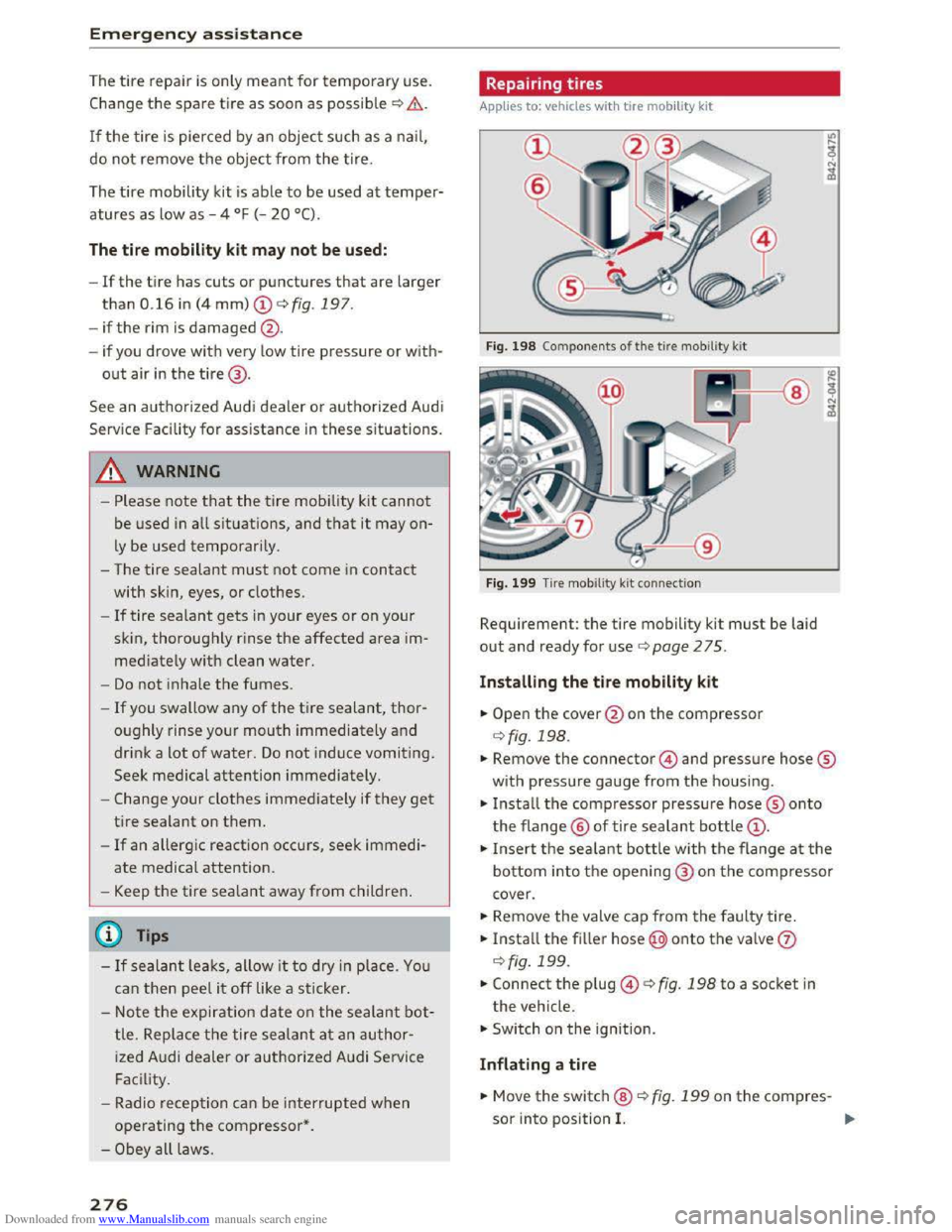
Fig. 198 Compo nents of the tire mobility kit
Fig. 199 Tire mobility ki t connection
Requirement: the tire mobility kit must be laid
out and ready for use ¢page 2 75.
Installing the tire mobility
kit
... Open the cover @ on the compressor
¢fig. 198.
... Remove the connector© and pressure hose®
with
pressure gauge from the housing.
... Install the compressor pressure hose® onto
the flange@ of tire sealant bottle@ .
.,. Insert the sealant bottle with the flange at the
bottom into the opening @ on the compressor
cover .
... Remove the valve cap from the faulty tire.
... Install th e fille r hose@onto the valve (j)
¢ fig. 199.
... Connect the plug ©<=> fig. 198 to a socket in
the vehicle .
.,. Switch on the ignition .
Inflating a tire
... Move the switch @ ¢fig. 199 on the compres-
sor into position I. ..,.
Page 279 of 322
Downloaded from www.Manualslib.com manuals search engine ...... N
G'. CX)
..... ID IJ' ..... ID .....
.,. Inflate the tire to between 29 psi (200 kPA)
and 36 psi (2SO kPA) and read the pressure on
the gauge.
... If this tire pressure is not reached, remove the
filler hose. Drive slowly approximately 33 ft
(!Om) forward or in reverse so that the sealant
can be distributed in the tire. Pump up the tire
again Q ,&..
A WARNING
-Read and follow the manufacturer's safety
precautions on the compressor and in
the
instructions on the bottle of sealant.
-If a tire pressure of 29 psi (200 kPA) cannot
reached
after inflating for 6 minutes, then
the
tire i s too severely damaged . Do not
continue driving.
-If the tire cannot be repaired with the tire
sealant, see an authorized Audi dealer or au
thorized Audi Service Facility
for assistance .
(D Tips
Do not operate the compressor for more than
6 minutes continuously, or it can overheat.
Once the compressor has cooled, you can con
tinue
to use it.
Completing
Applies to: vehicles with tire mobility kit
.,. Adhere the sticker that says "max. SO mph
(max. 80 km/h)" that is provided with the tire
mobility kit within the driver's field of vision .
.,. Stop the vehicle after driving for about 10 mi
nutes and check th e tire pressure.
.,. If the ti re pressure is lower than 19 psi (130
kPA), then the tire is too severely damaged. Do
not continue driving.
A WARNING
If the tire pressure is less than 19 psi
(130 kPA) after 10 minutes of driving, then
the tire is too severely damaged. Do not con
tinue driving.
See an authorized Audi dealer
or authorized Audi Service Facility for assis
tance.
Emergency assistance
A WARNING
"" Pay attention to the following after repairing
the tire:
-Do not drive faster than SO mph (80 km/h).
- Avoid hard acceleration, braking sharply,
and
fast cornering.
- The vehicle may become more
difficult to
control.
-
If the tire is too severely damaged, see an
authorized Audi dealer or authorized Audi
Service Facility
for assistance.
@ For the sake of the environment
You can give the used tire sealant bottle to an
authorized Audi deale r or authorized Audi
Service
Facility for disposal.
(D Tips
Remember to obtain a new bottle of sealant
from an authorized Audi dealer or authorized
Audi Service Facility
after repairing a tire.
Replacing wheels
Before changing a wheel
Observe the following precautions for your own
and
your passenger 's safety when changing a
wheel.
.,. After you experience a tire failure, pull the car
well away from moving traffic and try to reach
level ground before you stop Q .&_.
.,. All passengers should leave the car and move
to a safe location (for instance, behind the
guardra il)
Q & .
... Engag e the parking brake to prevent your vehi
cle
from rolling unintentionally Q ,&..
... Move selector lever to position P Q ,&..
.,. Take the jack Q page 2 75 and the spare tire
Q page 283 out of the luggage compartment.
A WARNING
You or your passengers could be injured while
changing a wheel
if you do not follow these
safety precautions:
-
277