light AUDI TT COUPE 2017 Owners Manual
[x] Cancel search | Manufacturer: AUDI, Model Year: 2017, Model line: TT COUPE, Model: AUDI TT COUPE 2017Pages: 322, PDF Size: 79.73 MB
Page 252 of 322
Check ing and F illing
Cooling system
Coolant
The engine coo ling system is filled with a mixture
of pur ified wate r and coolan t addit ive at the fa c
t ory . T his coo la nt must not be not changed .
The coolant leve l is monito red throug h the . in
d icator light
c::> page 12. Howeve r, we do recom
mend occasionally chec king the coo la nt level
manually.
If you must add coolant, use a m ixt ure of wa ter
a nd coo lant add it ive. Mixing the coolant additive
with d istilled water is recommended.
Coolant additive
The coolant additive is made of ant i-freezing and
corros ion protection agents. Only use the fo llow
ing coolant add it ives. These addit ives may be
m ixed w it h each other.
Coolant additive Specification
G13
TL 774 J
G12++ TL 774 G
The amount of coo lant add itive that needs to be
mixed wit h water depends on the climate where
the vehicle will be operated . If the coolant addi
tive percentage is too low, the coolant can free ze
and damage the engine.
Coolant addi- Freeze protec-
tive tion
Warm regions min . 40%, m in. -13 °F
max . 45% (
- 25 °C)
Co ld regions min. 50%, max. -40 °F
max. 55% (-40 °C)
CJ) Note
-Befo re the start of winter, have your author
i zed Audi dealer or authorized A udi Service
Fac ility check if the coolant additive in yo ur
vehicle matc hes the percentage approp riate
for the climate . Th is is especially important
whe n driving in co lde r clima tes.
- If the approp riate coolant additive is not
available in an emergency, do no t add any
other addi tive . You cou ld damage the en-
250
gine . If this h appens, on ly use wa ter and re
store the correct m ixt ure ratio with t he
specified coo lant ad ditive as soon as poss i
ble.
- Only refill w ith new coolant .
- Radiator sealant mus t not be mixed wi th
the coolant .
Adding coolant
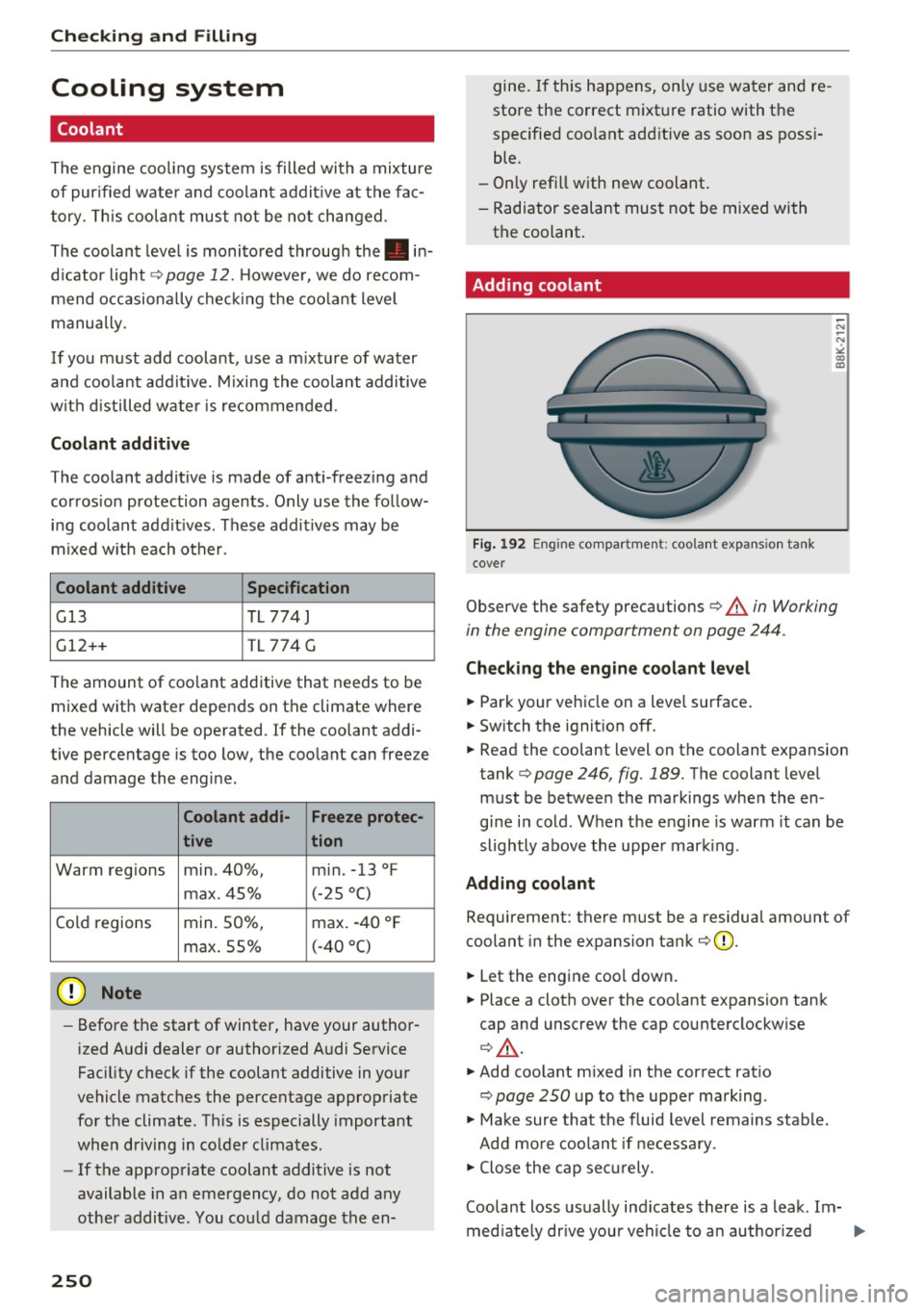
Fig. 192 En gine co mpar tm ent: coo la nt expans io n ta nk
cove r
-"' -"' •
"" co a,
Observe the safety precautions c::> A in Working
in the engine compartment on page 244 .
Checking the eng ine coolant level
.,. Park your veh icle on a level s urface .
.,. Switch the ignit ion off.
.,. Read the coolant level on the coolant expansion
tank
c::> page 246, fig. 189. The coolant leve l
must be betwee n the markings when the en
gi ne i n cold . When t he e ng ine is warm it can be
slightly above the uppe r mar king .
Adding coolant
Requirement: there must be a residual amount of
coolant in the expansion ta nk
c::> (D .
.,. Let the engine coo l down.
.,. Place a clot h over the coolant expansion tan k
cap and unscrew the cap counterclockw ise
¢ .&, .
.,. Add coo lant m ixed in the cor rect rat io
c;, page 250 up to t he up per ma rk ing .
.,. Make sure that the fluid level remains stab le.
Add mo re coolan t if necess ary.
.,. Close the cap sec urely .
Coo lant loss usually ind icates there is a lea k. Im-
med iate ly dr ive you r ve hicl e to a n author ized .,.
Page 253 of 322
CD
CD
.... N
" N .... 0
0
Ill co
Audi dealer or authorized Audi Service Facility
and have the cooling system inspected. If the
cooling system is not leaking, a loss can come
from the coolant boiling through overheating
and being pushed out of the cooling system.
A WARNING
The cooling system is pressurized and can be
come very hot . To reduce the risk of burns
from hot coolant:
- Do not open the coolant expansion tank cap when the eng ine is hot. This increases the
risk of burns.
- Stop the engine and allow it to cool.
- Protect your face, hands and arms from es-
caping coolant and steam by covering the
coolant tank cap with a large, thick cloth .
- Turn the coolant tank cap counterclockwise
slowly and keep light pressure on the cap .
- To reduce the risk of burns, do not allow any
antifreeze or coolant to drip onto the ex
haust system or hot engine components .
The ethylene g lycol in engine coolant can
catch fire under certain circumstances.
- The coolant add itive and the coolant can be
dangerous to your health. For this reason,
keep the coolant in the original container
and away from children. There is a risk of
poisoning.
- When working in the engine compartment,
remember that the radiator fan can sw itch
on even if the ignition is switched off, which
increases the risk of injury.
(D Note
Do not add coolant if the expansion tank is
empty . Air could enter the cooling system and
damage the engine. If this is the case, do not
cont inue driving. See an authorized Audi deal
er or authorized Audi Service Facility for assis
tance.
Checking and Filling
Brake fluid
Fig. 193 En gi ne compartment: cover on the b rake fluid
rese rvoir
Observe the safety precautions QA in Working
in the engine compartment on page 244 .
Checking the brake fluid level
.,. Read the brake f luid level on the brake fluid
reservoir
Q page 246, fig . 189. The brake fluid
level must be between the MIN and MAX mark
ings
Q A .
The brake fluid level is monitored automatically.
Changing the brake fluid
Have the brake fluid changed regularly by an au
thorized Audi dealer or authorized Audi Service Facility.
.&_ WARNING
- If the brake fluid level is below the MIN
marking, it can impair the brak ing effect
and driving safety, which increase the risk of
an accident. Do not continue driving. See an
authorized Audi dealer or authorized Audi
Serv ice Facility for assistance.
- If the brake fluid is old, bubbles may form
in the brake system during heavy braking.
This would impair braking performance and
driving safety, which increases the risk of an
accident .
- To ensure the brake system functions cor
rectly, only use brake fluids that comply
with VW standard 501 14 or
FMVSS-116 DOT 4.
251
Page 254 of 322
Check ing and F illing
CJ) Note
- If the brake fluid level is above the MAX
mark ing, brake fluid may leak out over the
edge of the reservoir and result in damage
to the veh icle.
- Do not get any brake fluid on the vehicle paint, because it will corrode the paint.
Battery
General warn ings about batteries
All of the ba tteries in yo ur vehicle a re pr actically
maintenance-free and are checked dur ing a ve hi
cle inspection . Because of the complex power
supp ly, all wo rk on batter ies such as d isconnect
ing, replacing, etc. should
only be performed by
an author ized Audi dealer or authorized Audi
Serv ice Facility
c::> .&. .
The te rm "vehicle battery" refers to the 12 Vo lt
battery in your vehicle.
Detailed warning s for the vehicle battery:
®
W ear eye p rotection .
~
Battery acid is high ly co rrosive. We ar p ro-
tective gloves and eye pro tection.
@
Fire, sparks, open flame and smok ing a re
forb idden.
~
A highly explosive mixtu re of gases can
form when charging batteries.
®
Keep c hildre n away from battery acid and
ba tteries.
8_ WARNING
-All work on the ba tte ry o r electrica l sys tem in
your vehicle can result in injuries, chemical
burns, accidents o r burns. Because of this, a ll
work m ust be perfo rmed
only by an a uthor
ized Aud i dea le r or aut horized Audi Serv ice
Facility .
8_ WARNING
California P roposit ion 65 Warning:
- Battery posts, termina ls and re lated acces
so ries contain lead and lead compounds,
252
chemicals known to the State of California
to cause cancer and reproductive problems.
Wash hands after handling.
(D Note
Protect the vehicle battery aga inst freezing if
the veh icle wi ll be par ke d for long periods of
time so that it is not destroyed by "free zing"
c::> page253.
Vehicle battery
The term "vehicle battery" refers to the 12 Volt
ba ttery in your vehicle.
Not running the vehicle for long periods of
time
If you do not d rive your vehicle for severa l days o r
weeks, e lectrical equ ipment is g radually sca led
back or sw itched off. Th is reduces energy use and
ensures the vehicle will be ab le to start after long
per iods of t ime
c::> page 93. Some convenience
funct ions, such as interio r light ing o r power seat
adjustment, may no t be avai lab le unde r ce rtain
c ir cu ms tances . These co nvenience func tions will
be available again once you switch t he igni tion on
and sta rt the eng ine .
E ven when elect rical eq uipmen t is switched off,
t h e eq uipme nt can still drai n the vehicle ba tte ry
if the ve hicle is not dr iven for long periods of
time . Deep drai ning results in a chem ica l reaction
that destroys the i nside of the vehicle batte ry.
The vehicle battery must be charged every month
to reduce the risk of this happening
c::> page 253.
Contact an authori zed Aud i dea ler or authori zed
Audi Service Facility for more information.
Winter operat ion
Co ld weather places higher demands on the vehi
cle battery. Th is res ults in reduced starting abili
ty. Have the vehicle batte ry checked by an au
thorized Audi dea ler or authorized Audi Service
Fac ility befo re t he cold time of year .
Page 255 of 322
CD
CD
.... N
" N ...... 0
0
Ill co
Charging the vehicle battery
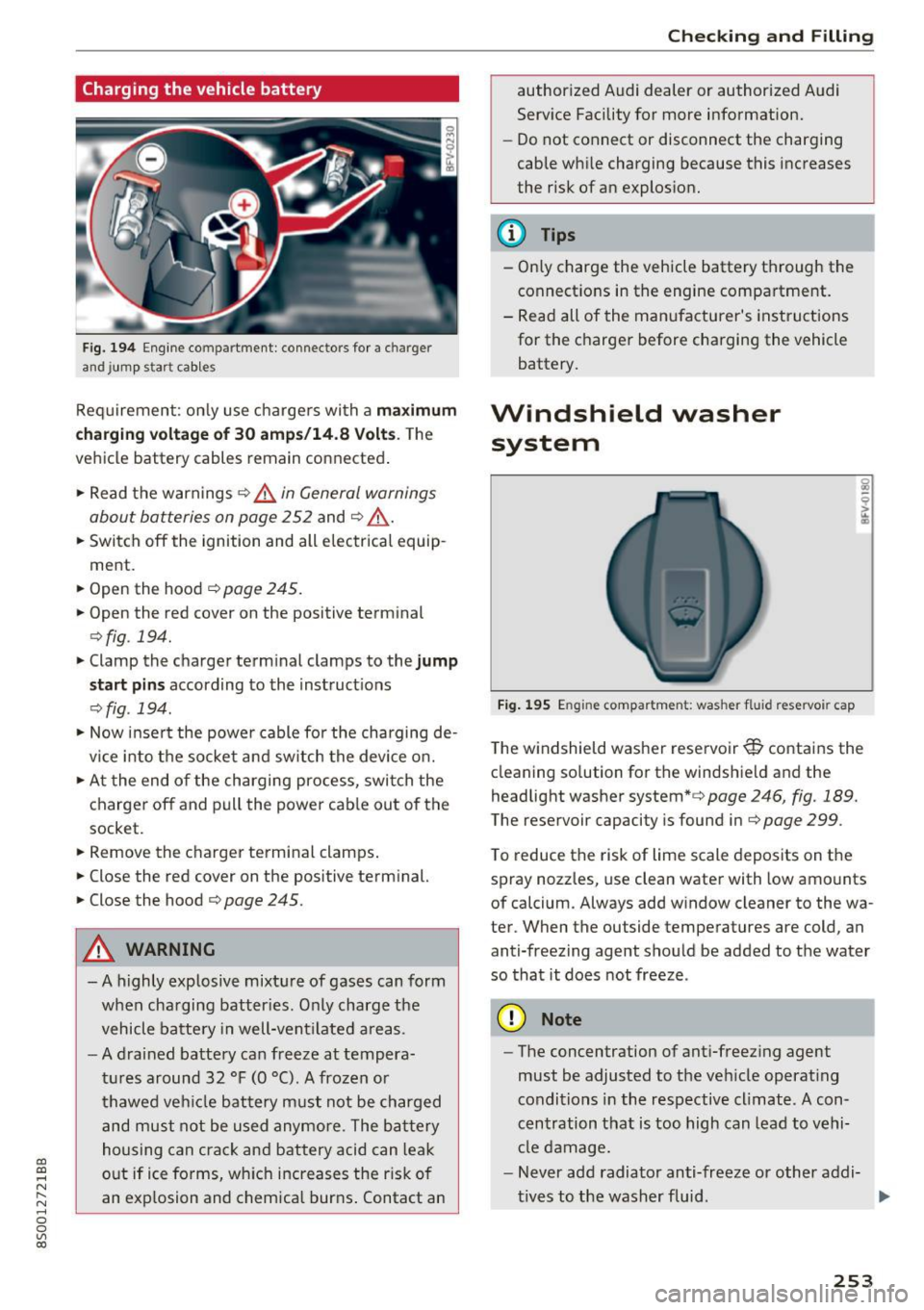
Fig. 194 Engine compartment: connectors for a charger
and jump start cables
Requirement: only use chargers with a maximum
charging voltage of 30 amps/14.8 Volts.
The
vehicle battery cables remain connected .
.,. Read the warn ings¢
& in General warnings
about batteries on page 252
and ¢ ,& .
.,. Switch off the ignition and all electrical equip
ment .
.,. Open the hood¢
page 245 .
.,. Open the red cover on the positive terminal
¢fig. 194 .
.,. Clamp the charger terminal clamps to the jump
start pins
according to the instructions
¢fig. 194 .
.,. Now insert the power cable for the charging de
vice into the socket and sw itch the device on.
.,. At the end of the charging process, switch the
charger off and pull the power cable out of the
socket .
.,. Remove the charger terminal clamps.
.,. Close the red cover on the positive terminal.
.,. Close the hood¢
page 245.
A WARNING
-A highly explosive mixture of gases can form
when charging batteries. Only charge the
vehicle battery in well-ventilated areas.
- A drained battery can freeze at tempera
tures around 32 °F (0 °C). A frozen or
thawed vehicle battery must not be charged
and must not be used anymore. The battery
housing can crack and battery acid can leak
out if ice forms, which increases the risk of
an explosion and chemical burns . Contact an
Checking and Filling
authorized Audi dealer or authorized Audi
Service Facility for more information.
- Do not connect or disconnect the charging
cable while charging because this increases
the risk of an explosion.
@ Tips
- Only charge the vehicle battery through the
connections in the engine compartment.
- Read all of the manufacturer's instructions
for the charger before charging the vehicle
battery.
Windshield washer system
Fig. 19S Engine compartment: washer fluid reservoir cap
The windshield washer reservoir{!} contains the
cleaning solution for the windshield and the
headlight washer system*¢
page 246, fig. 189.
The reservoir capacity is found in ¢ page 299.
To reduce the risk of lime scale deposits on the
spray nozzles, use clean water with low amounts
of calcium. Always add window cleaner to the wa
ter. When the outside temperatures are cold, an
ant i-freezing agent should be added to the water
so that it does not freeze.
(D Note
-The concentration of anti-freezing agent
must be adjusted to the vehicle operating
conditions in the respective cl imate. A con
centration that is too high can lead to vehi-
cle damage.
- Never add radiator anti-freeze or other addi-
tives to the washer fluid. .,.
253
Page 257 of 322
"'
"' ... N
" N ... 0 0
"' CX)
Wheels
Wheels and Tires
General information
.,.Check your tires regularly for
damage (punctures, cuts, cracks
and bulges). Remove foreign ob
jects from the tire tread.
.,. If driving over curbs or similar
obstacles, drive slowly and ap
proach the curb at an angle.
.,.Have faulty tires or rims re
placed immediately.
"'Protect your tires from oil,
grease and fuel.
.,.M ark tires before removing
them so that the same running
direction can be maintained if
they are reinstalled.
"'Lay tires flat when storing and
store them in a cool, dry location
with as little exposure to light as
possible.
(D Note
-Please note that summer and
winter tires are designed for
the conditions that are typical in those seasons. Audi recom
mends using winter tires dur
ing the winter months. Low
temperatures significantly de crease the elasticity of summ
er tires, which affects traction
Wheels
and braking ability. If summer
tires are used in very cold
temperatures, cracks can form
on the tread bars, resulting in
permanent tire damage that
can cause loud driving noise
and unbalanced tires.
-Burnished, polished or
chromed rims must not be
used in winter driving condi
tions. The surface of the rims
does not have sufficient corro
sion protection for this and
could be permanently dam aged by road salt or similar
substances.
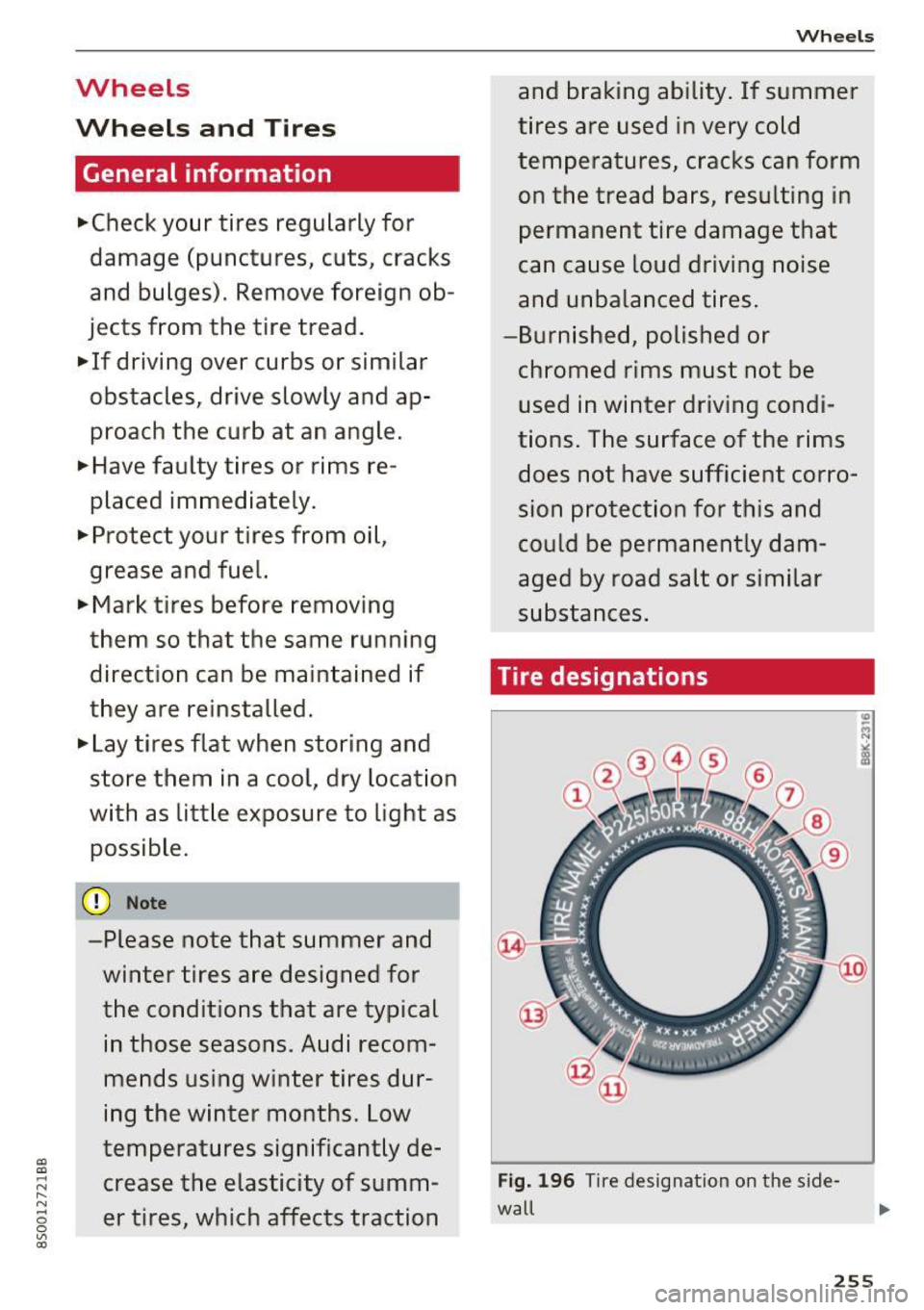
Tire designations
Fig. 196 T ir e designation on the side
wall
255
Page 275 of 322

co
co
.... N
" N .... 0
0
Vl c:o
Your vehicle has also been equipped with a TPMS
malfunction indicator to indicate when the sys
tem is not operating properly. The TPMS mal
function indicator is combined with the low tire pressure telltale. When the system detects a
malfunction, the telltale will flash for approxi
mately one minute and then remain continuously
illuminated . This sequence will continue upon
subsequent vehicle start-ups as long as the mal
function exists .
When the malfunction indicator is illuminated,
the system may not be able to detect or signal low tire pressure as intended. TPMS malfunctions
may occur for a variety of reasons, including the
installation of replacement or alternate tires or
wheels on the vehicle that prevent the TPMS
from functioning properly . Always check the
TPMS malfunction telltale after replacing one or
more tires or wheels on your vehicle to ensure
that the replacement or alternate tires and
wheels allow the TPMS to continue to function properly.
If the Tire Pressure Monitoring System
indicator appears
The tire pressure indicator in the instrument
cluster informs you if the tire pressure is too low
or if there is a system malfunction .
Using the ABS sensors, the tire pressure monitor
ing system compares the tire tread circumfer
ence and vibration characteristics of the individu
al tires. If the pressure changes in one or more
tires, this is indicated in the Infotainment system
display w ith an indicator light
RE and a message.
If only one tire is affected, the location of that
tire will be indicated.
The tire pressures must be stored in the Infotain
ment system again each time the pressures
change (switching between partial and full load
pressure) or after changing or replacing a tire on
your vehicle
c::;, page 274 . The tire pressure moni
toring system only monitors the tire pressure you have stored. Refer to the tire pressure label for
the recommended tire pressure for your vehicle
¢ page 265, fig. 199.
Wheels
Tire tread circumference and vibration character
istics can change and cause a tire pressure warn
ing if :
- the tire pressure in one or more tires is too low.
- the tire has structural damage.
- the tire was replaced or the tire pressure was
changed and it was not stored
c::;, page 274.
- the spare tire* is installed .
Indicator lights
RE-Loss of pressure in at least one tire c::;, &,.
Check the tires and replace or repair if necessary.
Check/correct the pressures of all four tires and
store the pressure again in the Infotainment sys
tem
¢ page 274.
mm (Tire Pressure Monitoring System) Tire
pressure: malfunction! See owner's manual -If
mm appears after switching on the ignition or
while driving and then the indicator light
RE in
the instrument cluster also starts to blink for
about one minute and then stays on permanent
ly, there is a system malfunction. Try to store the
correct tire pressures
c::;, page 2 74 . If the indica
tor light does turn off or turns on again after a short period of time, drive to an authorized Audi
dealer or authorized Audi Service Facility immedi
ately to have the malfunction corrected.
A WARNING
..-
- If the tire pressure indicator appears in the
display, reduce your speed immediately and
avoid any hard steering or braking maneu
vers. Stop as soon as possible and check the
tires and their pressure.
- The driver is responsible for maintaining the
correct tire pressures . You must check the
tire pressures regularly .
- Under certain conditions (such as a sporty
driving style, winter conditions or unpaved
roads), the pressure monitor indicator may
be delayed.
- Do not use run-flat tires on your vehicle . Us
ing them when not permitted can lead to
vehicle damage or accidents.
273
Page 277 of 322
Care and cleaning
General information
Regular, proper care helps to maintain your vehi
cle's value.
It can a lso be a requirement when
submitting warranty claims for corrosion damage
and paint defects on the body.
The necessary care products can be obtained
from an authorized Audi dealer or authorized
Audi Service Facility . Read and follow the instruc
tions for use on the packaging.
A WARNING
- Us ing clean ing and care products incorrectly
can be dangerous to your health.
- Always store clean ing and care products out
of reach of children to reduce the r isk of po i
son ing .
@ For the sake of the environment
- Preferably purchase env ironmenta lly-friend
l y cleaning products.
- Do not d ispose of leftover cleaning and care
products with household trash.
Car washes
T he longer that deposits remain on the vehicle,
the more the surface may be damaged. High
temperatures such as those caused by sunlight
increase the damag ing effect.
Befor e washing, rinse
off heavy depos its with
p lenty of water.
S tubborn depos its such as bird droppings or tree
sap are best removed with plenty of water and a
microfiber cloth.
A lso, wash t he un derside of yo ur vehicle once
road sa lt stops being used for the season .
Pressure washers
When washi ng your ve hicles w ith a pressure
washer, always follow t he ope rating inst ructions
~ p rovided w ith the pressure washe r. This is espe -
;:::: cially important in regard to the pressu re and
" ~ sp raying distance. Do not d irect the stream of 0
~ water directly onto seals for the side windows, c:o
Ca re and cleaning
doo rs, luggage compartment lid or hood or onto
the tires, rubber hoses, insulating materia l, sen
sors * or camera lenses*. Keep a distance of at
l east 16 in (40 cm).
Do not remove snow and ice with a pressure
washer.
Never use cone nozz les o r high press ure nozzles .
T he water temperatu re must not be above 140 °F
(60 °().
Automatic car washes
Spray off the vehicle before washing.
Make s ure that the windows are closed and the
windshield wipers a re
off. F o llow instructions
f rom the car wash operator, espec ia lly if there
are accessories attached to your veh icle.
If possible, use car washes that do not have
brushes .
Washing
by hand
Clean the ve hicl e starting from the top and wor k
i ng down using a soft sponge o r cleaning br ush.
U se solven t-free cleaning produ cts.
Washing vehicles with matte finish paint
by
hand
T o avo id damag ing the pa int w hen washi ng, fi rst
remove dust and large pa rticl es from you r vehi
cle . Insects, grease spots and fingerprints are
best removed w ith a special cleaner for matte
finish paint.
Apply t he product using a microf iber cloth . To
avoid damaging the paint surface, do not use too
much pressure.
Rinse the ve hicl e thoroug hly w ith wate r. Then
cl ean usi ng a neutral shampoo and a soft micro
fiber cloth .
Rinse the ve hicl e thorough ly aga in and let it air
dry. Remove any wate r residue using a chamois .
WARNING
- On ly wash the vehicle when the ign ition is
off and follow the instr uctions from the car
275
Page 278 of 322

Care and cleaning
wash operator to reduce the risk of acci
dents.
- To reduce the risk of cuts, protect yourself
from sharp metal components when wash ing the underbody or the inside of the wheel
housings.
- After washing the vehicle, the braking effect
may be delayed due to moisture on the
brake rotors or ice in the winter. This in
creases the risk of an accident. The brakes
must be dried first with a few careful brake
applications.
(D Note
- If you wash the vehicle in an automatic car
wash, you must retract the extendable rear
spoi ler* if necessary, and fold the exterior
mirrors in to reduce the risk of damage.
Power folding exterior mirrors* must only
be folded in and out using the power folding
function .
- To reduce the risk of paint damage, do not
wash the vehicle in direct sunlight. -
To reduce the risk of damage to the surface,
do not use insect removing sponges, kitchen
sponges or similar items.
- Matte finish painted vehicle components:
- To reduce the risk of damage to the sur-
face, do not use polishing agents or hard
wax.
- Never use protective wax. It can destroy
the matte finish effect.
- Do not place any stickers or magnetic
signs on vehicle parts painted with matte
finish paint. The paint could be damaged
when the stickers or magnets are re
moved.
@ For the sake of the environment
Only wash the veh icle in facilities spec ially de
signed for that purpose. This will reduce the
risk of dirty water contaminated with oil from
entering the sewer system.
Cleaning and care information
When cleaning and caring for individual vehicle
components, refer to the following tables. The
information contained there is simply recom
mendations. For questions or for components that
are not listed, consult an authorized Audi
dealer or authorized Audi Service Facility. Also
follow the information found in¢.&. .
Exterior cleaning
Component Situation Solution
Windshield wiper
Deposits ¢ page42
blades
Headlights/
Deposits Soft sponge with
a m ild soap solution a>
Tail lights
Sensors/
Deposits Sensors: soft cloth with solvent-free cleaning solution
Camera lenses Camera lenses: soft cloth with alcohol -free cleaning solu-
tion
Snow/ice Hand brush/solvent-free de-icing spray
Wheels Road salt
Water
Brake dust Acid-free special cleaning solution
Exhaust tail pipes Road salt Water, cleaning solution suitab le for stainless steel, if nee-
essary
276
Page 280 of 322

Care and cleaning
Component Situation Solution
Te xtil es
Deposits adhering to the Vacuum cleaner
artificial le ather, surface
A lcan tara Water-based deposits such Absorbent cloth and mild soap solution3>
as coffee, tea, blood, etc.
Oil-based depos its such as Apply a mild soap solution a>, blot away the dis-
oil, make-up, etc. sol.ved oil or dye, treat afterward with water, if nee-
essary
Special deposits such as ink, Special stain remover, blot with absorbent materi- nai l polish, latex paint, shoe al, treat afterward with mild soap solution, if neces-
polish, etc. sary
a)
Natural le ather Fr esh sta ins Wool cloth w
ith a mi ld soap solutiona l
Water-based deposits such Fresh stains: absorbent cloth
as coffee, tea, blood, etc . dried stains: stain remover suitable for leather
Oi l-based deposits s uch as Fresh stains: absorbent cloth and stain remover
oil, make-up , etc. suitable for leather
dried stains: oil cleaning spray
Special deposits such as ink, Spot remover suitable for leather
na il polish, latex pain t, shoe
polish, etc.
Care Regularly apply conditioning cream that protects
from light and penetrates into the material. Use
specially-colored conditioning cream, if necessa ry .
Carbon parts Deposits clean the same way as plastic parts
al M ild soap sol ution: maxim um two tablesp oons of neutral s oap in 1 quar t (1 liter) of wate r
A WARNING
The windshie ld may not be treated with wa
ter-repell ing windshield coating agents . Un
favorable cond itions s uch as wetness, dark
ness, or low sun can result i n increased glare.
Wipe r blade chatter is also possible.
([) Note
-Headlights /tail lights
- N ever clean headlights or ta il lights with a
dry cloth or sponge .
- Do not use any cleaning p rodu ct that con
tains alcohol, because they co uld cause
cracks to form .
-Wheels
-Never use any paint po lish or other abra-
sive mater ials.
278
-
- Damage to the protective laye r on the
rims such as stone chips or sc ratches must
be repaired immediately.
- Sensors/camera lenses
- Never use warm or hot water to remove
snow or ice from the camera lens . This
could cause the lens to cra ck.
- Never use abrasive cleaning materials or
a lcohol to clean the camera lens. This
could cause s cratches and cracks.
- Door w indow s
- Remove snow and ice on windows and ex -
terior mirrors with a plastic sc rape r. To
avoid scratches, move the scraper only in
one direct ion and not back and forth.
- Neve r remove snow or ice from door win
dows and mirrors us ing warm or hot water
because this could cause cracks to form . ..,.
Page 281 of 322
co
co
.... N
" N .... 0
0
Vl c:o
-To avoid damage to the rear window de
fogger, do not apply any stickers on the
heating wires on the inside of the window.
- Decorative part .s/trim
- Never use chrome care or cleaning prod-
ucts .
-Paint
-To reduce the risk of scratches, the vehicle
must be free of dirt and dust before pol
ishing or waxing.
- To prevent paint damage, do not polish or
wax the vehicle in direct sunlight .
- To reduce the risk of paint damage, do not
polish away rust spots .
- Remove cosmetics and sunscreen immedi
ately- these could damage the paint.
-Instrument cluster
- Make sure that the instrument cluster is
switched
off and has cooled off before
cleaning it.
- The instrument cluster and the trim sur
rounding it must not be cleaned with dry
cleaning methods because they could get
scratched.
- Make sure no fluids enter the spaces be
tween the instrument cluster and the
trim, because that could cause damage.
-Controls
- Make sure that no fluids enter the con-
trols, because this could cause damage.
-Safety belts
- Do not remove the safety belts to clean
them.
- Never clean safety belts or their compo
nents chemically or with corrosive fluids
or solvents and never allow sharp objects
to come into contact with the safety belts.
This could cause damage to the belt web bing.
- If there is damage to the webbing, the
connections, the retractors or the buckles
,
have them replaced by an authorized Audi
dealer or authorized Audi Service Facility.
-Textiles/artificial leather/ Alcantara
- Never treat artificial leather/ Alcantara
with leather care products, solvents, floor
Care and cleaning
polish, shoe polish, spot remove or similar
products.
- Have a specialist remove stubborn stains
to prevent damage.
- Never use steam cleaners, brushes, hard
sponges, etc. when cleaning.
- Do not turn on the seat heating* to dry the
seat.
- Objects with sharp edges, such as zippers
or rivets on clothing or belts, can cause
damage to the surface.
- Open hook and loop fasteners, for exam
ple on clothing, can damage seat covers.
Make sure hook and loop fasteners are
closed.
- Natural leather
- Never treat leather with solvents, floor
polish, shoe polish, spot remover or simi
lar products .
- Objects with sharp edges, such as zippers
or rivets on clothing or belts, can cause
damage to the surface.
- Never use steam cleaners, brushes, hard
sponges , etc . when cleaning .
-Do not turn on the seat heating* to dry the
seat .
- To help prevent the leather from fading,
do not leave the vehicle in direct sunlight
for long periods of time. If leaving the ve
hicle parked for long periods of time, you
should cover the leather to protect it from
direct sunlight.
(D Tips
-Insects are easier to remove from paint that
has been freshly waxed.
- Regular waxing can prevent rust spots from
forming .
Placing your vehicle out
of service
If you would like to take your vehicle out of serv-
ice for a longer period of time, contact an author
ized Audi dealer or authorized Audi Service Facili
ty. They will advise you of important measures,
such as corrosion protection, service and storage ""
279