fuel AUDI TT COUPE 2017 Owner's Manual
[x] Cancel search | Manufacturer: AUDI, Model Year: 2017, Model line: TT COUPE, Model: AUDI TT COUPE 2017Pages: 322, PDF Size: 79.73 MB
Page 246 of 322
Check ing and F illing
Engine compartment
Working in the engine compartment
Special care is required if you are working in the
engine compartment
Fo r wo rk in th e engine compa rtmen t su ch as
c h ec kin g and filli ng flu id s, th ere is a risk of in
j u ry, sc aldin g, ac cide nts, a nd b urn s. For this
rea son, foll ow all the warning s and gener al
s a fe ty p recaution s pr ov ided in the f ollow ing in·
f o rm ation . Th e en gine c omp artmen t is a dan
ger ous are a.
¢ ,&.
_& WARNING
- T urn the engine off.
- Switch the ign ition off .
- Set the parking brake .
- Place the selector lever in the P pos ition.
- let the engine cool down.
- Never open the hood when there is steam or coolant escaping from the engine compart
ment, because there is a risk that you could
be burned . Wait until no steam or coolant is
escaping .
- Keep ch ildren away from the engine com
partment .
- Never spill flu ids on a hot engine. These flu
ids (such as the freeze protection contained
in the coolant) can catch fire .
- Avoid short circu its in the electrical system,
especially to the battery .
- When working in the engine compartment,
remember that the rad iator fan can sw itch
on even if the ign ition is switched off, which
increases the risk of pe rsonal injury .
- Never open the cap on the coolant expan sion tank when the eng ine is warm. The
cooling system is under pressu re .
- To protect your face, hands, and arms from
hot steam or coolant, cover the cap with a
large cloth when opening.
- Do not remove the engine cover under any
circumstances. This increases the risk of
burns.
- If tests need to be performed w ith the en
gine running, there is additional danger d ue
244
to moving components (such as the ribbed
be lt, alternator and rad iator fan) and from
the high voltage ignition system.
- Do not press the acce lerator pedal inadver
tently if a gear is selected when the vehicle
is stationary and the engine is running. Oth
erwise, the vehicle will start to move imme
diately and this could result in an accident .
- Pay attent ion to the following warnings list
ed when work on the fuel system or on the
electrical equipment is required.
- Do not smoke .
- Never work near open flames .
- Always have a working fire extinguisher
nearby
- All work on the battery or elect rical system
in your vehicle can result in injuries, chemi
cal b urns, acc idents or burns . Because of
this, all work must be performed
onl y by an
authorized Audi dealer or authorized Audi
Service Facility.
- To reduce the risk o f electric shock and in
jury, never touch the following components
when the engine is running or is being start•
ed:
- Ign ition cable
- Other components in the electronic high -
vo ltage ign ition system
- If you must check or perform work on the
engine while it is running:
- Set the parking brake and place the selec
tor lever in the P (park) position first .
- Always proceed w ith extreme caution so
that clothing, jewelry or long hair do not
become caught in the radiator fan, fan
belt or other moving components or do
not come into contact with hot compo
nents. Tie back long hair before beginn ing
work and do not wear clothing that can hang down into the engine .
- Lim it your exposure to exhaust and chemi
cals to as short a time as possible
¢ .&. .
A WARNING
California Proposition 65 Warning:
Page 249 of 322
Using the proper engine oil is important for the
functionality and s ervice life of the engine. Your
engine was factory-filled with a high -quality oil
which can usually be used throughout the entire
year .
Note
Your Limited New Vehicle Warranty does not
cover damage or malfunctions due to failure
to follow recommended maintenance and use
requirements as set forth in the Audi Owner's Manual and Warranty & Maintenance booklet .
- Use only a high quality engine oil that ex-
pressly complies with the Aud i oil quality
standard specified for your vehicle's engine.
Using any o ther oil can cause serious engine
damage.
- Do not mix any lubricants o r other additives
into the engine oil. Doing so can cause en
gine damage.
@ Tips
If you need to add oil and there is none availa
ble that meets the Audi o il quality standard
your eng ine requ ires, you may add a total of
no more than 0 .5 qt (0,5 l) of a h igh-quali ty
"synthet ic"oil that meets the following speci
fications.
- ACEA A3 or API SM with a v iscosity grade o f
SAE OW-30, SAE SW -30 or SAE SW-40.
- Fo r more information abou t engine o il t ha t
has been approved for your vehicle, please
contact either your authorized Audi dea ler
or Audi Custome r Relat ions at
1 (800) 822-2834 or visit our web site at
www.audiusa.com or www.audican ada.ca .
Engine oil consumption
T he engine in your vehicle depends on an ade
qua te amoun t of oil to lubricate and cool all of
i t s moving par ts.
In order to provide effective lub rication and coo l
ing of in te rnal engine components, a ll internal
~ combustion engines consume a cer tain amount
;:::: of oil. Oil consumption varies from engine to en-
" ~ gine and may change sign ificantly over the life of 0
~ the eng ine . Typically, eng ines with a spec ified c:o
Ch eck ing and Filling
break-in period (see ¢ page 55) consume more
oi l during th e break-in period than they consume
after oil consumption has stabilized.
Under normal cond itions, the rate of oil con
sumption depends on the q uality and viscos ity o f
the oil , the RPM (revolutions per minut e) at
which the engine is operated, the amb ient tem
perature and road condit ions. Further factors are
the amount of oil dilution from w ater condensa
tion or fuel resid ue and the oxidation level of the
o il. As any engine is subject to wear as mileage
builds up, the oi l consumption may increase ove r
t ime unt il repla cement of worn components may
become necessary.
With al l these variables coming into play, no
standard rate of o il consumption can be estab
l ished or spec ified . T he re is no alte rnative to reg
u la r and fre quent chec king of the o il level , see
Note .
If the yellow engine oil level warning symbo l II
in the instrument cluster lights up , you sho uld
check the o il level as soon as possible
¢
page 248 . Top off the o il at your earliest con
venience ¢
page 248.
A WARNING
Before you check anything in the engine com
partment, always read and heed all WARN
INGS¢
page 244 .
(D Note
Driving with an insufficient oil level is likely to
cause severe damage to the engine.
(D Tips
- The oil pressure warning display. is not
an indicator of the oil le vel. Do not rely on
it . Instead, check the oil level in your en·
gine at regular intervals , preferabl y each
time you refuel, and always befo re going
on a long trip.
- If you have the impression your engine con
sumes excessive amounts of oil, we recom
mend that you consult an author ized Audi
dea ler to have the cause of your concern
prope rly diagnosed . Keep in mind that the .,,.
247
Page 257 of 322
"'
"' ... N
" N ... 0 0
"' CX)
Wheels
Wheels and Tires
General information
.,.Check your tires regularly for
damage (punctures, cuts, cracks
and bulges). Remove foreign ob
jects from the tire tread.
.,. If driving over curbs or similar
obstacles, drive slowly and ap
proach the curb at an angle.
.,.Have faulty tires or rims re
placed immediately.
"'Protect your tires from oil,
grease and fuel.
.,.M ark tires before removing
them so that the same running
direction can be maintained if
they are reinstalled.
"'Lay tires flat when storing and
store them in a cool, dry location
with as little exposure to light as
possible.
(D Note
-Please note that summer and
winter tires are designed for
the conditions that are typical in those seasons. Audi recom
mends using winter tires dur
ing the winter months. Low
temperatures significantly de crease the elasticity of summ
er tires, which affects traction
Wheels
and braking ability. If summer
tires are used in very cold
temperatures, cracks can form
on the tread bars, resulting in
permanent tire damage that
can cause loud driving noise
and unbalanced tires.
-Burnished, polished or
chromed rims must not be
used in winter driving condi
tions. The surface of the rims
does not have sufficient corro
sion protection for this and
could be permanently dam aged by road salt or similar
substances.
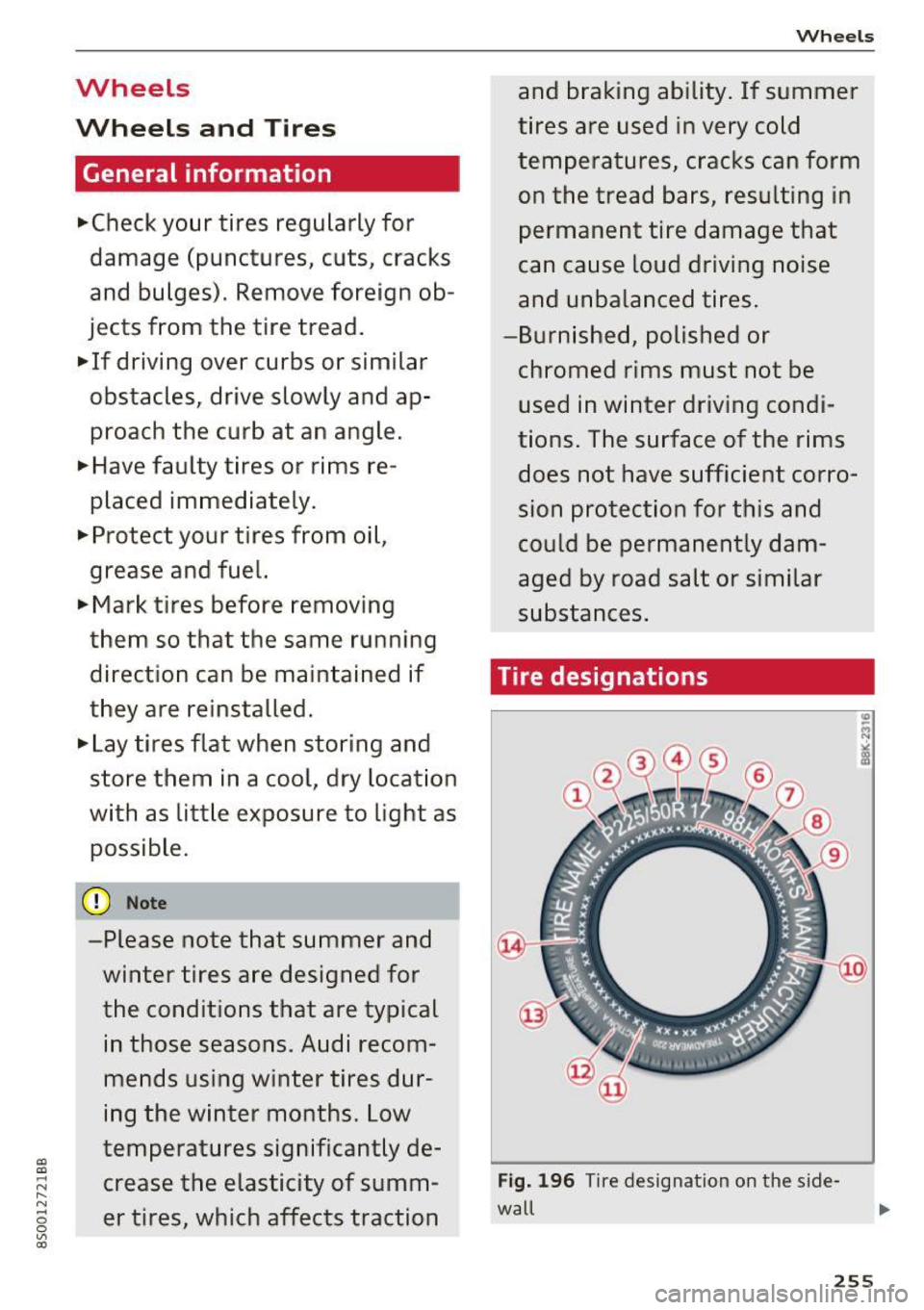
Tire designations
Fig. 196 T ir e designation on the side
wall
255
Page 260 of 322
Wheels
reinforced by ply cords and that is
shaped to fit the rim .
Bead separation
means a breakdown of the bond
between components in the bead.
Cord
means the strands forming the
plies in the tire.
Cold tire inflation pressure
means the tire pressure recom
mended by the vehicle manufac
turer for a tire of a designated
size that has not been driven for more than a couple of miles (kilo
meters) at low speeds in the
three hour per iod before the tire
pressure is measured or adjusted .
Curb weight
means the weight of a motor ve
hicle with standard equipment in
c lud ing the maximum capacity of
fuel, oil, and coolant, air condi
tioning and additional weight of
optiona l equipment .
Extra load tire
means a tire designed to operate
at highe r loads and at h igher in
flation p ressures than the corre
sponding standard t ire. E xtra load
tires may be identified as "XL",
2 58
"xl" "EXTRA LOAD" or "RF" on , ,
the sidewall.
Gross Axle Weight Rating
("GAWR")
means the load-carrying capacity
of a s ingle axle system, measured
at the tire-ground interfaces.
Gross Vehicle Weight Rating ("GVWR")
means the max imum total loaded
weight of the vehicle.
Groove
means the space between two ad
jacent tread ribs.
Load rating (code)
means the maximum load tha t a
tire is rated to carry for a given in
flation pressure . You may not find
this informat ion on all tires be
ca use it is not requi red by law .
Maximum load rating
means the load rating for a tire at
the maximum permiss ible infla
tion p ressure for that tire.
Maximum loaded vehicle
weight
means the sum of:
(a) Curb weight
(b) Accessory weight
...
Page 268 of 322
Wheels
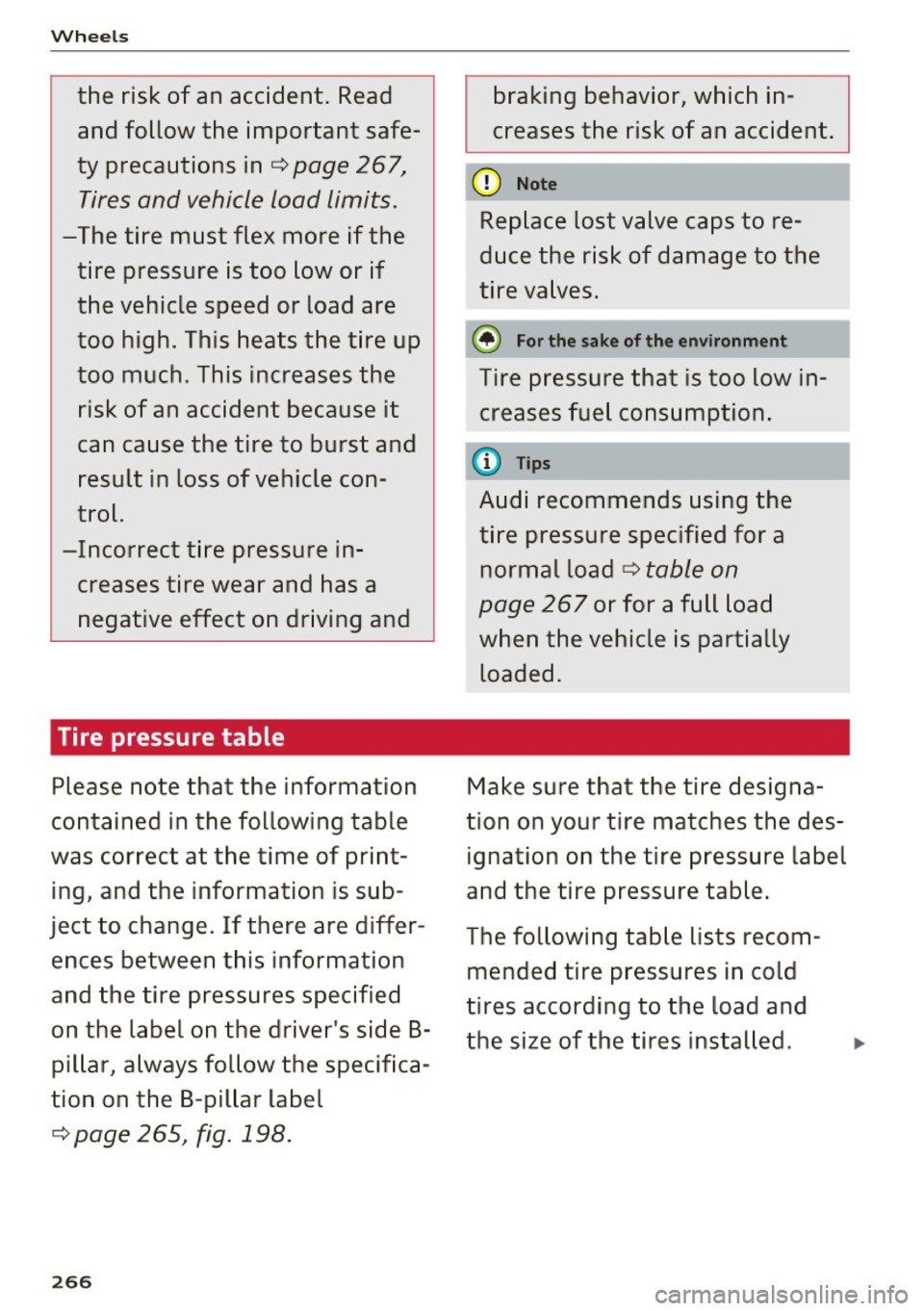
the risk of an accident. Read and follow the important safe
ty precautions in ¢ page 267,
Tires and vehicle load limits.
-The tire must flex more if the tire pressure is too low or if
the vehicle speed or load are
too high. This heats the tire up
too much. This increases the risk of an accident because it
can cause the tire to burst and
result in loss of vehicle con
trol.
- Incorrect tire pressure in
creases tire wear and has a
negative effect on driving and
Tire pressure table
Please note that the information
contained in the following table
was correct at the time of print ing, and the information is sub
ject to change. If there are differ
ences between this information
and the tire pressures specified
on the label on the driver's side B
p illar, always follow the spec ifica
tion on the B-pillar label
¢ page 265, fig. 198.
266
braking behavior, which in
creases the risk of an accident.
(D Note
Replace lost valve caps to re
duce the risk of damage to the
tire valves.
@ For the sake of the environment
Tire pressure that is too low in
creases fuel consumption.
(D Tips
Audi recommends using the
tire pressure specified for a normal load
¢ table on
page 267
or for a full load
when the vehicle is partially
loaded.
Make sure that the tire designa
tion on your tire matches the des
ignation on the tire pressure label
and the tire pressure table.
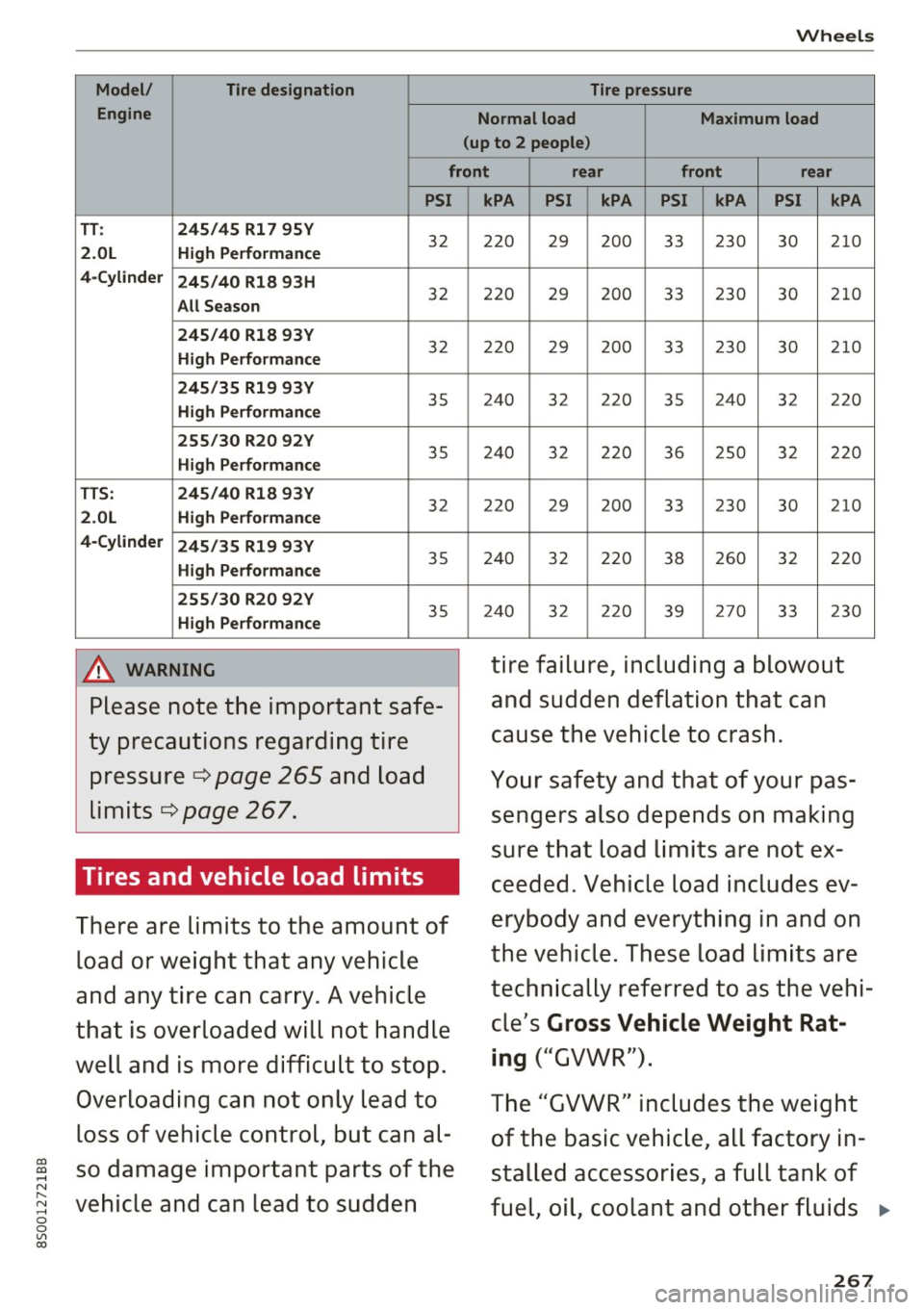
The following table lists recom
mended tire pressures in cold
tires according to the load and
the size of the tires installed.
Page 269 of 322
co
co
.... N
" N .... 0
0
Vl c:o
Wheels
Model/ Tire designation Tire pressure
Engine Normal load Maximum load
(up to 2 people)
front rear front rear
PSI
TT: 245/45 R17 95V
32 2.0L High Performance
4-Cylinder 245/40 R18 93H
All Season
32
245/40 R18 93V 32 High Performance
245/35 R19 93V
35 High Performance
255/30 R20 92V
35 High Performance
TTS: 245/40 R18 93V
32
2.0L High Performance
4-Cylinder 245/35 R19 93V
High Performance
35
255/30 R20 92V
35 High Performance
A WARNING
Please note the important safe
ty precautions regarding tire pressure
¢ page 265 and load
limits
¢ page 267.
Tires and vehicle load limits
There are limits to the amount of
load or weight that any vehicle
and any tire can carry. A vehicle
that is overloaded will not handle
well and is more difficult to stop. Overloading can not only lead to
loss of vehicle control, but can al
so damage important parts of the
vehicle and can lead to sudden
kPA PSI kPA PSI kPA PSI kPA
220 29 200 33 230 30 210
220 29 200 33 230 30 210
220 29 200 33 230 30 210
240
32 220 35 240
32 220
240 32 220 36 250 32 220
220 29 200 33 230
30 210
240 32 220 38 260 32 220
240 32 220 39 270 33 230
tire failure, including a blowout
and sudden deflation that can
cause the vehicle to crash.
Your safety and that of your pas
sengers also depends on making
sure that load limits are not ex
ceeded. Vehicle load includes ev
erybody and everything in and on
the vehicle. These load limits are
technically referred to as the vehi cle 's
Gross Vehicle Weight Rat
ing
("GVWR").
The "GVWR" includes the weight of the basic vehicle, all factory in
stalled accessories, a full tank of
fuel, oil, coolant and other fluids ..
267
Page 272 of 322
Wheels
rims yourse lf, because this increases the risk
of an accident.
Winter tires
W inter tire s significan tly improve the vehicle 's
handling when driving in w inter condi tions. Be
cause of the ir construction (width, compound,
tread pattern) , summe r tires p rovide less trac
tion o n ice and snow.
.. Use w inter t ires o n all four wheels .
.. Only use w inter t ires that are approved for your
vehicle .
.. Please note that the maximum permitted
speed may be lower with winter tires
¢ & -An
a utho riz ed Aud i dea le r o r authorized Audi Serv
ice Facility can inform you about the maximum
permitted speed fo r you r tires.
.. Check the tire pr essu re after installing whee ls
¢ page 265.
The effectiveness of winter tires is reduced great
ly whe n the tread is wor n down to a depth of
0 .157 in (4 mm). The character istics of winter
tires also decrease great ly as the tire ages, re
gardless of the remaining tread.
A WARNING
- Never dr ive faste r than the maxim um per
mitted speed for your t ires . This cou ld cause
the tires to heat up too much. This increases
t h e risk of an a cciden t be ca use i t can c ause
t h e tire to burst.
- Always adapt yo ur driv ing to t he r oad and
t ra ffic conditions. Drive ca refully and red uce
yo ur sp eed on icy or slippery roads. Even
winte r tires can lose traction on black ice .
@ For the sake of the environment
Reinstall su mme r tir es at the approp ria te
t ime, because they provide bet ter ha ndling
when ro ads are free of snow a nd ice. S ummer
t ires cause less road noise, ti re wea r and fuel
consumption.
270
(D Tips
You can also use a ll season tires instea d of
winter tires . Please note that in some coun
tries where winter tires are required, on ly
winter tires w it h the
& symbol may be per
mitted.
' Snow chains
S now cha ins not on ly improve the driv ing in win
te r road cond it io ns, but a lso the b raking .
.. On ly install snow chai ns on the front wheels .
T his applies also to vehicles with all wheel
dr ive*.
.. Check and co rrect t he seating of the snow
chains after driving a few feet, if nece ssary. Fol
low t he inst ructions from the m anufac turer.
.. Note the max imum speed of 3 0 mph (50 km/
h). Note the local regulations.
U se of snow c hains is only permitte d wit h cert ain
rim/ tire comb inat ions due to technical reasons.
Check with a n authorized Audi dealer or author
i zed Audi Service Facility to see if you may use
snow chains.
You m ust remove the snow chains on roads wi th
out snow . Otherwise, you co uld impair driving
ability and damage the t ires .
A WARNING
Using incor rect snow chains or installing snow
cha ins incor rectly can result in loss of vehicle
control, which increases the risk of an acci
dent .
(D Note
-Snow chains can damage the rims/wheel
covers* if the c hains come into direct con
tact with them. Remove the w heel covers *
first . Use coated snow cha ins .
- Us ing snow c hains that add more tha n 0.53
in (13,5 mm) of height can seve rely damage
the whee l housings and o ther vehicle com
ponents .
Page 279 of 322
co
co
.... N
" N .... 0
0
Vl c:o
Care and cleaning
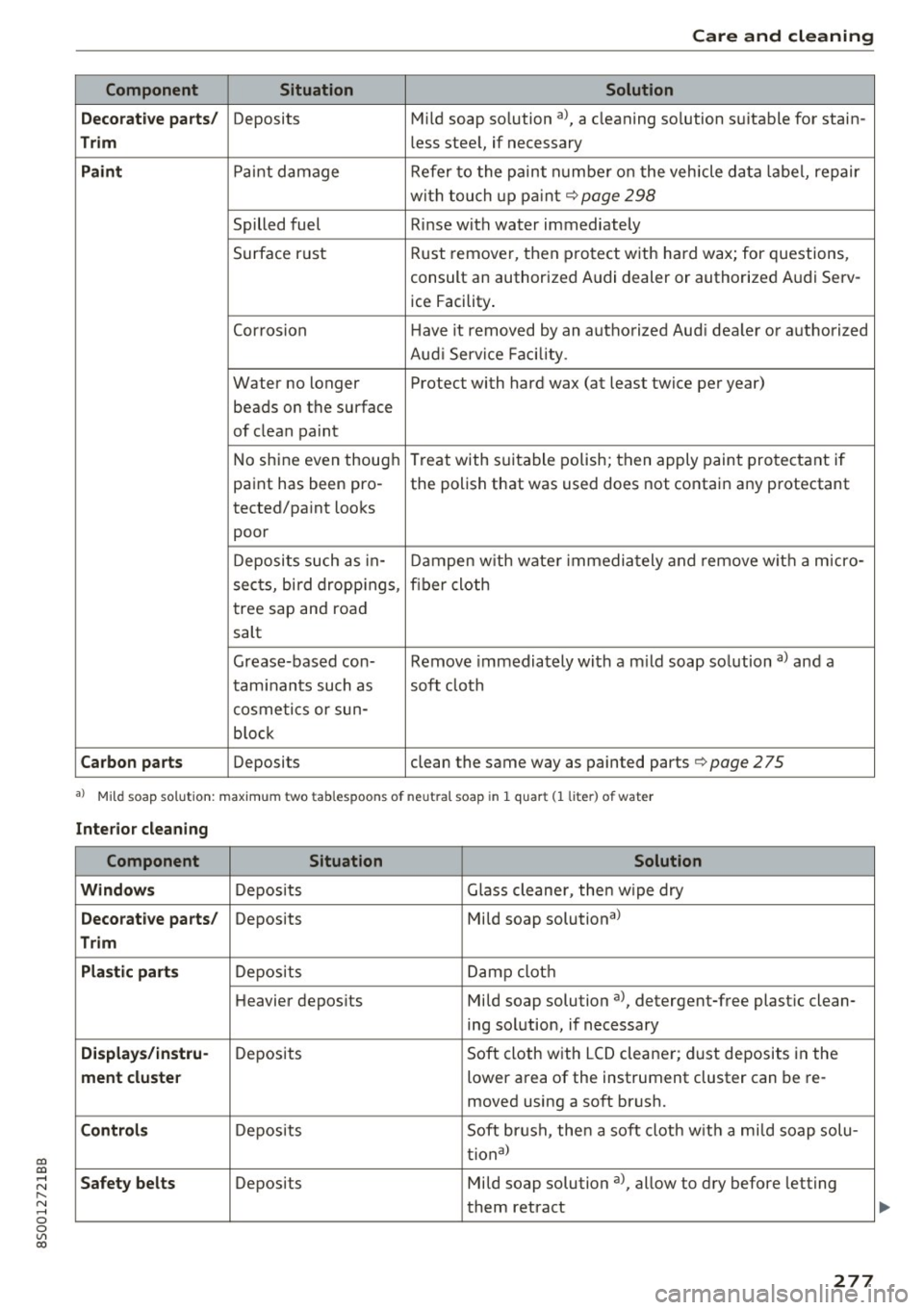
Component Situation Solution
De corat ive p art s/
Deposits Mild
soap so lution al, a cleaning solution suitable for stain-
Tr im less stee l, if necessary
Paint Paint damage Refer to the paint number on the veh icle data label, repair
with touch up pa int
Q page 298
Spilled fuel Rinse with water immediately
Surface rust Rust remover, then protect
with hard wax; for questions,
consult an authorized Audi dealer or authorized Audi Serv- ice Facility .
Corrosion Have it removed by an authorized Aud i dealer or a uthorized
Aud i Service Fac ility .
Water no longer Protect with hard wax (at least twice per year)
beads on the surface
of clean paint
No shine even though Treat with suitable polish; then
apply paint protectant if
paint has been pro -the polish that was used does not contain any protectant
tected/paint looks
poor
Deposits such as in- Dampen w ith wate r immediately and remove w ith a micro-
sects, bird dropp ings, fiber cloth
tree sap and road
salt
Grease-based con- Remove immediately with a m ild soap solution a) and a
tam inants such as soft cloth
cosmetics or sun-
b loc k
Ca rb on p art s Deposits clean the same way as painted parts Q page 2 75
a) Mild soap solution: maximu m two tablespoons of neutral soap in 1 quar t (1 liter) of water
Interio r cle an ing
Component Situation Solution
W indow s
Deposits Glass cleaner, then wipe dry
De corati ve part s/ Deposits Mild soap solutional
Trim
Pla stic part s
Deposits Damp cloth
Heavier depos its Mild soap solution a), detergent-free plastic clean-
ing solution, if necessary
Displa ys/i nstru-Deposits Soft cloth with LCD cleaner; dust deposits in the
ment clust er lower area of the instrument cluster can be re-
moved using a soft brush.
Co ntro ls Deposits Soft brush, then a soft cloth w it h a mi ld soap solu-
tional
S af ety belts Deposits Mild soap solution al, allow to dry before letting
them retract
277
Page 293 of 322

CD
CD
.... N
" N .... 0
0
Ill co
Left engine compartment fuse assignment
Fig. 216 Engine compartment: fuse ass ignment
No. Equipment
Fl ESC control module
F2 ESC control module
F3 Engine control module
Engine cooling, engine components, auxili -
F4 ary heater coil re lay ( 1+2), secondary air
injection pump relay
FS E
ngine components, tank system
F6 Brake light sensor
F7 Engine components
F8 Oxygen sensor
F9 Engine components, exhaust door, glow
time control module
FlO Fuel injectors, fuel control module
Fll Auxiliary heater heating element 2
F 12 Auxiliary heater heating e
lement 3
F13 Automatic transmission cont rol module
FlS Horn
F16 Ignition coil
F17 ESC control module
, engine control mod-
ule
F18 Term inal 30 (reference voltage)
Fuses and bulbs
No . Equipment
Fl9 Windshield wipers
F20 Horn
F22 Terminal SO diagnos
is
F23 Starter
F24 Auxiliary heater heating element 1
F3 2 LED headlights
Bulbs
Message
Your vehicle is equ ipped with maintenance-free
headlights and tail lights . However, if a light bulb
needs to be replaced, p lease contact yo ur author
ized Audi dea ler or authorized Audi Service Facili
ty.
291
Page 300 of 322
Technical data
Technical data
Vehicle specifications
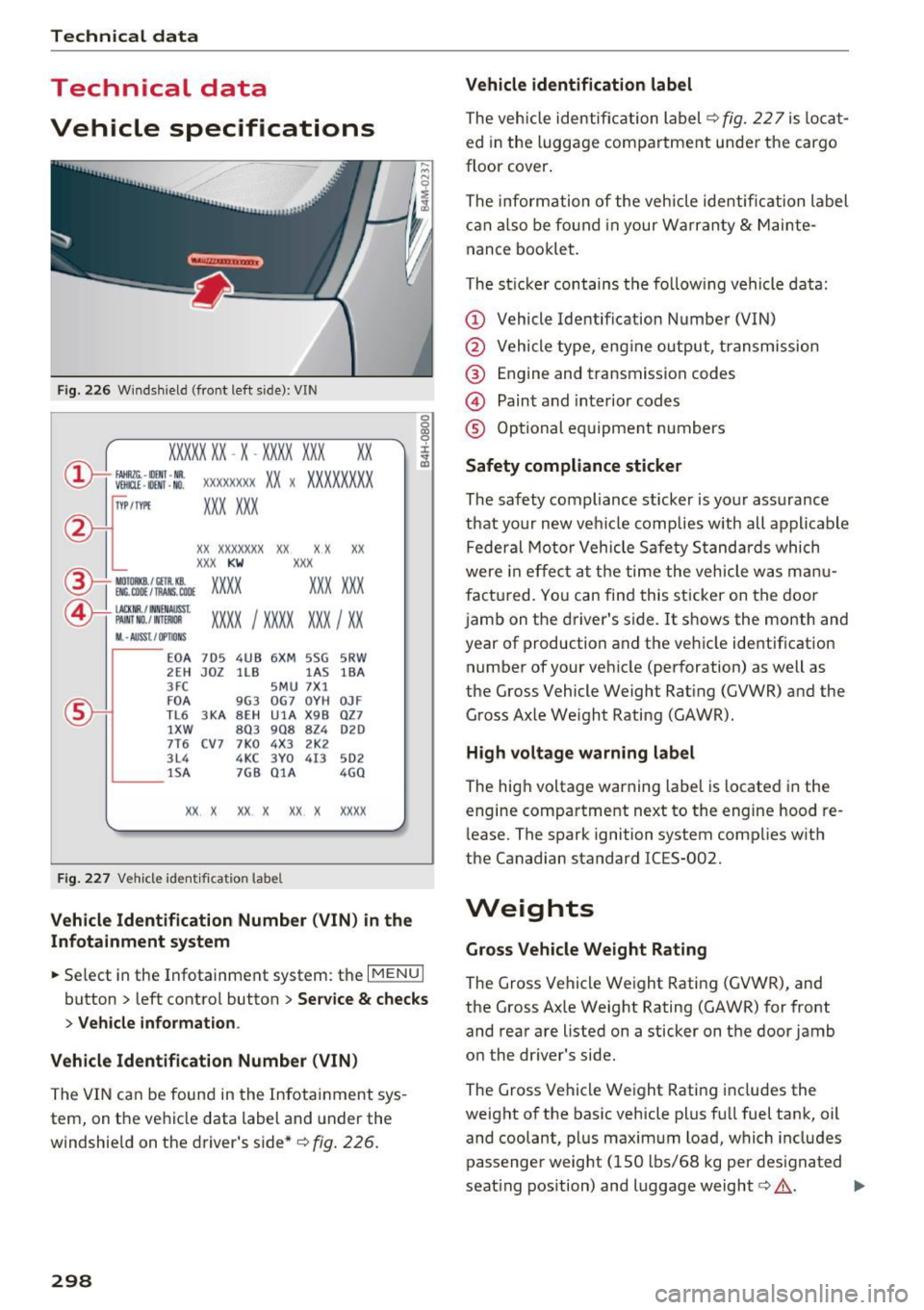
Fig. 226 Windsh iel d (fro nt left s ide): V IN
XXXXX XX -X -XXX X XX X xx
®--+ f AHRZC . - ll)[jj f -Nil . Vlll[l£ • OOIT • NO. XX XXXXXX XX X XX XX XXX X
1YP /rtl'! XXX XXX
xx xxxxxxx
xx xx xx
XXX KW XXX
OC. OOll / lll AMS . lllO! xxxx XXX XXX ®-t Ml) TORKB./ CETll kS.
©+ IACl( flR./ INNENAIJSS t
XXXX I XXXX XXX I XX PAI NT NO. / WlllllOfl
II. -AUSST . / OPTIO NS
E 0 A 7D 5 4U B 6XM 5SG 5RW
2 EH JO Z l lB lA S lBA
3 FC 5M U 7X1
F0A 9G3 0G7 0 YH 0JF
TL 6 3 KA 8EH UlA X 9B OZ 7
lXW 8 0 3 908 8Z4 020
7T6 C V7
7K0 4
X3 2 K2
3 L4 4 KC 3 Y0 413 5 02
1 SA 7GB 0 1A 4GO
XX X XX X X X X xxxx
F ig . 227 Vehicle id entifica tion labe l
Vehicle Identification Number (VIN) in the
Infotainment system
0
0
0:, 0 ' J: .. a:,
~ Select in the Infotainment system: the I MENU I
button > left control button > Service & checks
> Vehicle information .
Vehicle Identification Number (VIN)
The VIN can be found in the Infotainment sys
tem, on the vehicle data label and under the
windshield on the driver's side*
¢ fig. 226.
298
Vehicle identification label
The vehicle identification label¢
fig. 22 7 is locat
ed in the luggage compartment under the cargo
floor cover.
The information of the vehicle identification label
can also be found in your Warranty
& Mainte
nance booklet.
The st icker contains the follow ing vehicle data:
(D Vehicle Identifica tion Number (VIN)
@ Vehicle type, eng ine output, transmission
® Engine and transmission cod es
@ Paint and interior codes
® Optional equipment numbers
Safety compliance sticker
The safety compliance sticker is your assurance
that your new veh icle complies with all applicable
Federal Motor Vehicle Safety Standards which
were in effect at the time the vehicle was manu
factured. You can find this sticker on the door
jamb on the driver's side. It shows the month and
year of production and the vehicle identification
number of your vehicle (perforation) as well as
the Gross Vehicle Weight Rating (GVWR) and the Gro ss Axle We ight Rating (GAWR).
High voltage warning label
The high voltage warn ing label is located in the
engine compartment next to the engine hood re
lease. The spark ignition system complies w ith
the Canadian standard IC ES-002.
Weights
Gross Vehicle Weight Rating
The Gross Vehicle Weight Rating (GVWR), and
the Gross Axle Weight Rat ing (GAWR) for front
and rear are li sted on a sticker on the door jamb
on the driver 's side.
The Gross Vehicle Weight Rating includes the
weight of the basic vehicle plus full fuel tank, oil
and coolant, plus maximum load, which includes
passenger weigh t (150 lbs/68 kg per designated
seat ing position) and luggage weight
c::> ,&.. ..,.