sport AUDI TT COUPE 2017 Owner's Manual
[x] Cancel search | Manufacturer: AUDI, Model Year: 2017, Model line: TT COUPE, Model: AUDI TT COUPE 2017Pages: 322, PDF Size: 79.73 MB
Page 210 of 322

Airbag syste m
-Always install rear -facing child seats on the
rear seat.
- If you must install a rearward facing chi ld
seat on the front passenger seat because of
exceptional c ircumstances and the
PA SSEN
G ER AIR BAG OFF ~;
light does not come
on and stay on, immediately install the rear
facing child seat in a rear seating position and have the airbag system inspected by
you r Audi dealer.
_& WARNING
Objects between you and the a irbag w ill in
crease the risk of in jury in a crash by interfer
ing with the way the airbag unfo lds or by be
ing pushed into yo u as the airbag inflates.
-
- Never hold th ings in your hands or on your
lap when the vehicle is in use.
- Never transport items on or in the area of
the front passenger seat . Objects could
move into the area of the front airbags du r
ing brak ing or other sudden maneuver and
become dangerous projectiles that can
cause serious personal injury if the a irbags
inflate.
- Never place or attach accessor ies or other
objects (such as cup holders, te lephone
brackets, large, heavy or bulky objects) on
the doors, over or near the area marked "AIRBAG" on the steering wheel, instru
ment pane l, seat backrests or between
those areas and yourself. These objects could cause injury in a crash, espe cially
when the airbags inflate.
- Never recline the front passenge r's seat to
t ransport objects . Items can also move into
the area of the side airbag or the front air bag during braking or in a sudden maneu
ver. Objects near the airbags can become projectiles and cause injury, particularly
when the seat is reclined .
- Never place or transport objects on the
front passenger seat. Objects on the front passenge r seat could cause the capac itive
sensor in t he seat to signal to airbag system
that the seat is occupied by a person when it in fact is not, or that the person on the seat
208
is heavier than he or she actually is. The
change in electric capacitance because of
such objects can cause the passenger front
airbag to be t urned on when it should be
off, or can cause the airbag to work in a way
that is different from the way it would have
wo rked without objects on the seat.
- Always make sure that there is noth ing o n
the front passenge r seat that will cause the
capacitive passenge r de tection system in
the sea t to signal to the Airbag System tha t
the seat is occup ied by a person when it is
not , or to signal that it is occupied by some
one who is heavier than the person act ually
sitt ing on the seat. The presence of an ob
ject could cause the passenger front airbag
to be turned on when it should be off , or
could cause the airbag to work in a way that is diffe rent from the way it would have
wo rked without the object on the seat.
- Never til t the front passenger seat backrest
forward when the vehicle is mov ing . An in
flating airbag wi ll force t he bac krest back
ward and can injure rear seat occup ants .
_& WARNING
The fine dus t created when airbags deploy can
cause breathing prob lems for people with a
h istory of asthma or other breathing condi
tions.
- To reduce the r isk of breathing problems,
those with asthma o r other respiratory con
ditions sho uld get fresh ai r right away by
getting out of the vehicle or opening win
dows or doors.
- If you are in a co llision in which airbags de
ploy, wash your hands and face with m ild
soap and water before eating.
- Be carefu l not to get the dust into your eyes,
or into any cuts or scratches .
-If the residue shou ld get into your eyes,
flush them w ith water .
Page 214 of 322
Airbag syste m
Make sure that the PASSENGER AIR BAG
OFF
11;; li ght comes on and stays on all t he
t ime whenever the ignition is switched on.
A WARNING
-
- If the PA SSEN GER AIR BAG OFF 11;; light
does not go out when an adult is si tting on
the front passe nger seat a fter ta king the
steps described above, make sure the adult is p roperly seated and restrained at one of
the rear seating positions.
- Have the airbag system inspected by your
Audi dealer befo re t ransporting anyone on
the front passenger seat.
@ Tips
If the capacitive passenger detection system
determines that the front passenger seat is
empty, the frontal airbag on the passenge r
side w ill be tu rned off, and the
PASSENGER
AIR BAG OFF
11;; light will stay on.
Repair , care and disposal of the airbags
Parts of the a irbag system are installed at many
different places on your Audi. Installing, remov ing, servic ing or repa iring a part in an area of the
ve hicle can damage a part of an airbag system
and prevent that system from working properly
i n a collision .
There are some important things you have to
know to make sure that the effectiveness of the
system w ill not be impaired and that discarded
components do not cause injury or pollute the
env ironment.
A WARNING
Improper care, serv icing and repai r proce
dures can increase the r is k of personal injury
and death by preventing an airbag from de
ploying when needed or dep loying an airbag
unexpectedly:
-
- Never cover, obstruct, or change the stee r
ing wheel horn pad or airbag cover or the in
strument pane l or modify them in any way.
212
- Never attach any objects s uch as c up ho lders
or telephone mountings to the surfaces cov
ering the a irbag un its.
- For cleaning the horn pad or instrument
panel, use only a soft, dry cloth or one mois
tened w ith plain water. Solvents or cleaners
could damage the airbag cover or change
the st iffness or strength of the material so
that the airbag canno t deploy and p rotect
properly.
- Never repair, adjust , or change any parts of
the airbag system.
- All work on the steering wheel, inst rument
panel, front seats or e lectr ica l system ( in
cluding the installation of a udio eq uipment,
cellular telephones and C B radios, etc.)
m ust be perfo rmed by a qualified techn ician
who has the training and specia l equipment
necessary.
- For any work on the airbag system, we strong ly recommend that you see your au
thorized A udi dealer or qualified workshop.
- Never modify the front b umper or parts of
the vehicle body.
- Always make sure that the side a irbag can
inflate w ithout interference:
- Never install seat covers or replacement
upholstery over the front seatbacks that
have not been specifically approved by
A udi.
- Never use additional seat c ushions that
cover the areas where the side airbags in
flate.
- Damage to the orig inal seat cove rs or to
the seam in the area of the s ide airbag
module mus t alway s be repaired immedi
ate ly by an autho riz ed Au di dealer.
- The a irbag system can deploy on ly once. Af
ter an airbag h as been deployed, i t m ust be
repla ced with new replacement parts de
signed and approved espec ia lly for your
Audi model version . Replacement of com
plete airbag systems or airbag components
must be perfo rmed by qua lified workshops
only. Make su re that any airbag service ac
tion is entered in your A udi Warranty
&
Ma intenance boo klet under AIRBAG RE-
PLAC EM EN T RECORD.
~
Page 223 of 322
co
co
.... N
" N .... 0
0
Vl c:o
Child safety
Important information
Introduction
The rear seat is generally the safest place in a
collision .
The physical principles of what happens when
your vehicle is in a crash apply also to children
c:> page 191, What happens to occupants not
wearing safety belts? .
But unlike adults and
teenagers, their muscles and bones are not fully
developed. In many respects children are at
greater r isk of serious injury in crashes than
adults .
Because children's bodies are not fu lly devel
oped, they requ ire restraint systems especially
des igned for their size, we ight, and body struc
ture. Many countr ies and all states of the United
States and provinces of Canada have laws requir
ing the use of approved child restraint systems
for infants and small children .
I n a frontal crash at a speed of 20- 3 5 mph
(30-56 km/h) the forces acting on a 13 lbs (6 kg)
infant will be more than 20 times the weight of
the child . This means the weight of the chi ld
would suddenly be more than 260 lbs (120 kg). Under these conditions, only an appropriate child
restraint properly used can reduce the risk of se
rious injury . Child restraints, l ike adult safety
belts, must be used properly to be effective .
Used imp roperly, they can increase the risk of se
rious injury in an accident.
All ch ildren, especially those 12 years and young
er must always ride in the back seat proper ly re
stra ined for their age and size. If you must install
a child restra int on the front passenger seat in
exceptional circumstances, be sure to read and
heed the important information and warnings
c:> page 198. Infants and other children who are
properly restrained in an appropriate child re
straint that is for their si ze and age can benefit
from the protection that supplemental side air
bags provide in some kinds of crashes.
For more information please see information
provided by the:
Ch ild safety
- National Highway Traffic Safety Administration
(NHTSA), currently at: http :/ /www.safe
rcar.gov (for the USA)
- Transport Canada Information Centre, current-
ly at: http://www.tc .gc.ca (for Canada)
Consult the chi ld safety seat manufacturer's in
structions in order to be sure the seat is right for
yo ur child's size
c:> page 225 , Important safety
instructions for using child safety seats .
Please
be sure to read and heed all of the important in
formation and WARNINGS about child safety,
Advanced Airbags, and the installation of child restra ints in this chapter .
There is a lot you need to know about the Ad
vanced Airbags in your vehicle and how they work
when infants and children in child restraints are on the front passenger seat . Because of the large
amount of important informat ion, we cannot re
peat it all he re . We urge you to read the detailed
information in this owner 's ma nual about airbags
and the Advanced Airbag System in your vehicle and the very important information about trans
porting children on the front passenger seat.
P lease be sure to heed the WARNINGS -they are
extremely important for your safety and the safe
ty of your passengers, especially infants and
small children .
A WARNING
-- Accident statistics have shown that children
are generally safer in the rear seat area than
in the front seat ing pos ition. Always restrain
any child age 12 and under in the rear.
- All vehicle occupants and especially children must be restrained prope rly whenever r iding
in a vehicle. An unrestra ined or improperly
rest rained child cou ld be inju red by striking
the interior or by being ejected from the ve hicle during a sudden maneuver or impact.
An unrestrained or improperly restrained
child is also at greater risk of injury or death
through contact w ith an inflating a irbag.
-A suitable ch ild restraint properly installed
and used at one of the rear seating positions
provides the h ighest degree of protection
for infants and small children in most acci
dent situat ions.
22 1
Page 226 of 322

Child safet y
applicab le WARN INGS . Make certain that the
chi ld and child restraint are correct ly recognized
by the capacit ive passenger detection system in
the front passenger seat, that the front passen
ger airbag is turned off, and that the airbag sta
tus is always correctly signaled by the
PA SS EN
GER AIR BAG OFF,;; ON @
light .
Many types and models of child restraints have
been available over the years, new models are in
troduced regularly incorporat ing new and im
proved designs and older models are taken out of
p roduct ion . Ch ild restraints are not standardized.
Ch ild rest raints of the same type typ ica lly have
d ifferent weights and s izes and differen t "foot
prints", the s ize and shape of the bottom of the
child restraint that sits on the seat, when they
are insta lled on a vehicle seat. These differences
make it virtually impossible to certify compliance
with the requirements for advanced airbags with
each and every ch ild restraint that has ever been
sold in the past or will be sold over the course of
the useful life of your veh icle .
For this reason, the Un ited States National High
way Traffic Safety Administration has published a list of specific type, makes and models of child
restraints that must be used to cert ify compli
ance of the Advanced Airbag System in your vehi
cle with the supp ression requ irements of Fede ral
Motor Vehicle Safety Standard 208. These child
rest raints are :
Subpart A - Car bed child restraints
Mod el Manufactured on or
after
Angel G uard Angel September 25, 200 7
Ride AA2403 FOF
Subpart B - Rear-facing child re straints
Model Manufactured on or
after
Century SmartFit 4543 December 1, 1999
Cosco Arriva September 25, 2007
22-0 13PAW and base
22-999WHO
Evenflo Discovery Ad- December 1, 1999
just Right 212
224 Model
Manufactured on or
after
Evenflo First Choice December 1, 1999
204
Graco Infan t 845 7 December 1, 1999
Graco Snugr ide September 25, 2007
Peg Perego Primo Viag- September 25, 2007
gio SIP IMUNOOUS
Subpart C - Forward-facing and convertible
child re str aint s
Model Manufactured on or
after
Br itax Roundabout September 25, 2007
E9L02xx
Cosco Touriva 025 19
December 1, 1999
Cosco Summit Deluxe September 25, 2007 H igh Back Booster
22-262
Cosco High Back Boos- September 25, 2007
ter 22-209
E venflo Tribu te V September 25, 2007
379xxxx
Evenflo Medallion 254 December 1, 1999
Evenflo Generations September 25, 2007
352xxxx
Graco ComfortSport September 25, 2007
Graco Todd ler Safety
September 25, 2007
Seat Step 2
Graco Plat inum Cargo September 25, 200 7
_&. WARNING
To reduce the risk of serious injury, ma ke sure
that the
PASSENGER AIR BAG OFF,;; light
comes on and stays on whenever a ch ild re
stra int is installed on the front passenger seat
and the ign ition is switched on.
-Take the child restra int off the front passen
ger seat and install it properly at one of the rear seat positions if the
PA SSENGER AIR
BAG OFF,;;
light does not stay on .
- Have the airbag system inspected by your
author ized Audi dealer immed iately.
Page 234 of 322
Child safet y
use the available th ree -point lap and shoulder
safety belts .
A WARNING
-The rear seat area is too small to safe ly
transport passengers taller than 4 ft 9 in
(57 in/1.45 m).
-
- Persons taller than 4 ft 9 in (57 in/1.45 m) as well as children in booster seats who are
too close to the rear window and roof can
suffer severe head and neck injur ies when
the rear lid is closed o r in a crash.
- The m inimum clearance betwee n the pas
sengers' heads and the rear window must
never - under any circumstances - be less
than 1 in ( 2.5 cm) whe n the passenge rs s its
f ully up right .
- Always make sure tha t the rear seat passen
gers canno t be str uck when the rear lid is
cl osed.
Booster seats on the front seat
Ch ild ren aged about 7 years and older and weigh
ing more than 55 lbs (25 kg) who are between
4 ft 3 in (5 1 in/1.30 m) and 4 ft 9 in (57 in/
1.45 m) tall may in exceptional circumstances
ride on the front passenger's seat. Children less
than 4 ft 9 in (57 in/1.45 m) tall must s it on a
certified booster seat and properly wear the vehi
cle 's three-poin t lap and shoulder safety be lt .
Always securely latch the passenger seat at t he
very rear of its fore and aft adjustment range.
The bac krest must be adjusted to an upr ight po
sition .
A WARNING
If you must insta ll a booster seat ch ild re
st raint o n the fro nt passenger sea t:
- Make s ure the booster seat has been de
s igned and certified by its manufa ctu rer for
use on a front seat wit h a pas senge r fr ont
and side air bag.
- Alw ays follow the m anuf act urer's instruc
ti on s prov ided with the boos ter sea t.
232
- Always move the passenger seat to the very
rear o f its fore and aft adjustment range, as
far away from the airbag as possib le.
- Always make sure that the passenger seat is
secure ly latched in place before instal ling
the booster seat. The backrest must be ad
justed to an upr ight position .
- If the passenger seat cannot be secu rely
latched in the very rear of its fore and aft
ad justment range , then t he passenger front
airbag must be turned off with the ON / OFF
s w itch.
Securing child seats
Securing a child safety seat using a safety
belt
Safety belts for the rear seats and the front pas
senger can be locked with the convertible locking
retractor to properly secure child safety seats.
The safety belts emergency lock ing retractors for
the rear seats safety be lts and for the front pas
senger's seat safety be lt have a convert ible lock
i ng retractor for child restra ints. The safety belt
must be locked so t hat be lt webb ing ca nnot un
r eel. The retractor ca n be act ivated to lock the
safe ty belt and prevent the safety belt webbing
from loosening up dur ing no rm al driv ing. A chi ld
s a fe ty se at can on ly be prope rly insta lled when
the safety be lt is locked so that the ch ild and
c hi ld safety seat will stay in place .
Always remembe r: E ven thoug h your veh icle is
equipped wi th an Advan ced Airba g system, all
c hi ldren, especially those 12 yea rs and younger,
shou ld always ride in the back seat proper ly re
strained for their age and size .
A WARNING
Improperly installed child safety seats in
crease the r isk of serious personal injury and
death in a co llision .
-
-Always make sure that the safety be lt re
tractor is locked when installing a c hild
safety seat. An unlocked safety be lt retrac
to r cannot hold the ch ild safety seat in place
during normal d riving or in a c rash.
Page 241 of 322
co
co
.... N
" N .... 0
0
Vl c:o
~ Guide the upper tether strap into the rear cargo
area
r::!>fig. 181.
~ Slide the tether strap hook over the anchor
bracket.
~Pullon the tether strap hook so that the spring
catch of the hook engages .
~ Tighten the tether strap firmly follow ing the
child restraint manufacturer's instruct ions .
Releasing the tether strap
~ Loosen the tension following the child restraint
manufacturer's instructions.
~ Depress the spring catch on the hook and re
lease it from the anchorage .
(D Note
If you leave the child restraint with the tether
strap firmly installed for several days, this
could leave a mark on the upholstery on the
seat cushion and backrest in the area where
the tethe r strap was installed. The upholstery
wou ld also be permanently stretched around
the tether strap. This applies especially to
leather seats.
Using tether straps on rearward-facing
child restraints
Currently, few rear -facing child restraint systems
come w ith a tether . Please read and heed the
child restraint system manufacturer's instruc
tions carefully to determine how to properly in
stall the tether.
_& WARNING
A child in a rearward -facing chi ld safety seat
installed on the front passenger seat will be
seriously injured and can be killed if the front
airbag inflates - even w ith an Advanced A irbag
System.
- The inflating airbag wi ll hit the child safety
seat or infant carrier with great force and
will smash the ch ild safety seat and chi ld
against the backrest, center armrest, or
doo r.
- If you must install a rearward fac ing ch ild
safety seat on the front passenger seat be
cause of except ional circumstances and the
Child safety
PASSENGER AIR BAG OFF~; light does not
come on and stay on, immediately install
the rear-facing child safety seat in a rear
seating position and have the a irbag system
inspected by your Audi dealer.
Additional information
Sources of information about child
restraints and their use
There are a number of sources of additional in
format ion about ch ild restraint selection, instal
lation and use :
NHTSA advises that the best child safety seat is
the one that fits your child and fits in your vehi cle, and that you will use correctly and consis
tently .
Try before yo u buy!
U.S National Highway Traffic Safety Administra
tion
Tel.: 1 (888) 327-4236 (TTY: 1 (800) 424-9153)
www .nhtsa .gov
National SAFE KIDS Campaign
T el.: 1 (202) 662-0600
www.safekids.org
Safety BeltSafe U.S .A
Tel.: 1 (800) 745-SAFE (English)
T el.: 1 (800) 747-SANO (Spanish)
www.carseat.org
Transport Canada Information Centre
Tel.: 1 (800) 333-0371 or call 1 (613) 998-8616
if you are in the Ottawa area
http://www.tc.gc.ca/ eng/ roadsafety/men u. htm
Audi Customer Relations
Tel.: 1 (800) 822-2834
239
Page 243 of 322
co
co
.... N
" N .... 0
0
Vl c:o
-If you are unable to determine whether or
not a particular fuel blend meets the speci
ficat ions, ask your service station or its fuel
supplier.
- Do not use fuel for which the contents can
not be identified.
- Fuel system damage and performance prob
lems resulting from the use of fue ls diffe r
ent from those specified are not the respon
s ibility of Audi and are not covered under
the New Veh icle or the Emiss ion Control
System Warrant ies .
- If you experience a loss of fue l economy or
driveability and pe rformance problems due
to the use of one of these fuel blends, we r ecommend that you switch to unblended
fuel.
Gasoline additives
A ma jor concern among many auto manufactur
ers is carbon deposit build-up ca used by the type
of gasoline yo u use.
A lt hough gasoline grades d iffer from one manu
facturer to another, they have cer tain things in
common . A ll gasoline grades contain substances
that can cause deposits to collect on vita l engine
parts, such as fue l injectors and intake valves. Al
though most gasoline brands include additives to
keep engine and fuel systems clean, they are not
equally effective .
Aud i recommends using TOP TIER Detergent Gas
oline. For more informat ion on TOP TIER Dete r
gent Gasoline, please go to the official website
(www.toptiergas .com) .
After an extended period of using inadequate
fuels, carbon deposit build-ups can rob your en
g ine of peak performance.
CD Note
Damage or malfunction due to poor fuel q ual
ity is not covered by the Aud i New Vehicle
Limited Warranty.
Ch eck ing and Filling
Refueling
Fuel filler neck
The fue l filler neck is located on the rig ht rea r
s ide panel behind the fuel fille r flap .
If the power lock ing system shou ld fail, yo u can
st ill open the flap manually -fo r detailed instruc
tio ns see
9 page 243.
You can find the fuel tank capacity of your vehicle
i n
c::;, page 299.
The label on the inside of the f uel fi ller flap tells
you the correct fuel for your vehicle. For more in
f ormat ion about fuel spec ificat ions, see
9 page 240.
Your vehicle fuel tank has an onboard refue lling
vapor recovery system. This feature helps to pre
vent fuel vapors from escaping from the tank and
polluting the environme nt wh ile you refue l yo ur
vehicle . In order to fill the tank p roper ly w hile
pro tect ing t he e nvir onment, p lease follow t his
r efue ling p rocedure ca refully.
_& WARNING
Un der normal opera ting co nd it io ns, neve r car
r y additional f uel con tainers in your car. Gas
canisters and other containers used to trans
port fue l can be dange rous. Such containe rs,
f ull or empty, may leak and could cause a fire
i n a co llision. If you must transpo rt fuel to
use for your lawn mower, snow blower, etc .,
be ve ry careful and always observe local and
sta te laws rega rding the use, transportation
and storage of su ch f uel con tainers. Make cer
t ai n t he co ntain er meets industry standards
(ANSI/AS TM F8S2 -86).
CD Note
Neve r drive your veh icle until the fue l tank is
complete ly empty. The irreg ular s upply of
f u el can cause misfiring. Gasol in e c ould enter
the e xhaust sys tem an d damage the cat aly tic
conve rter.
241
Page 244 of 322
Checking and Filling
Fueling procedure
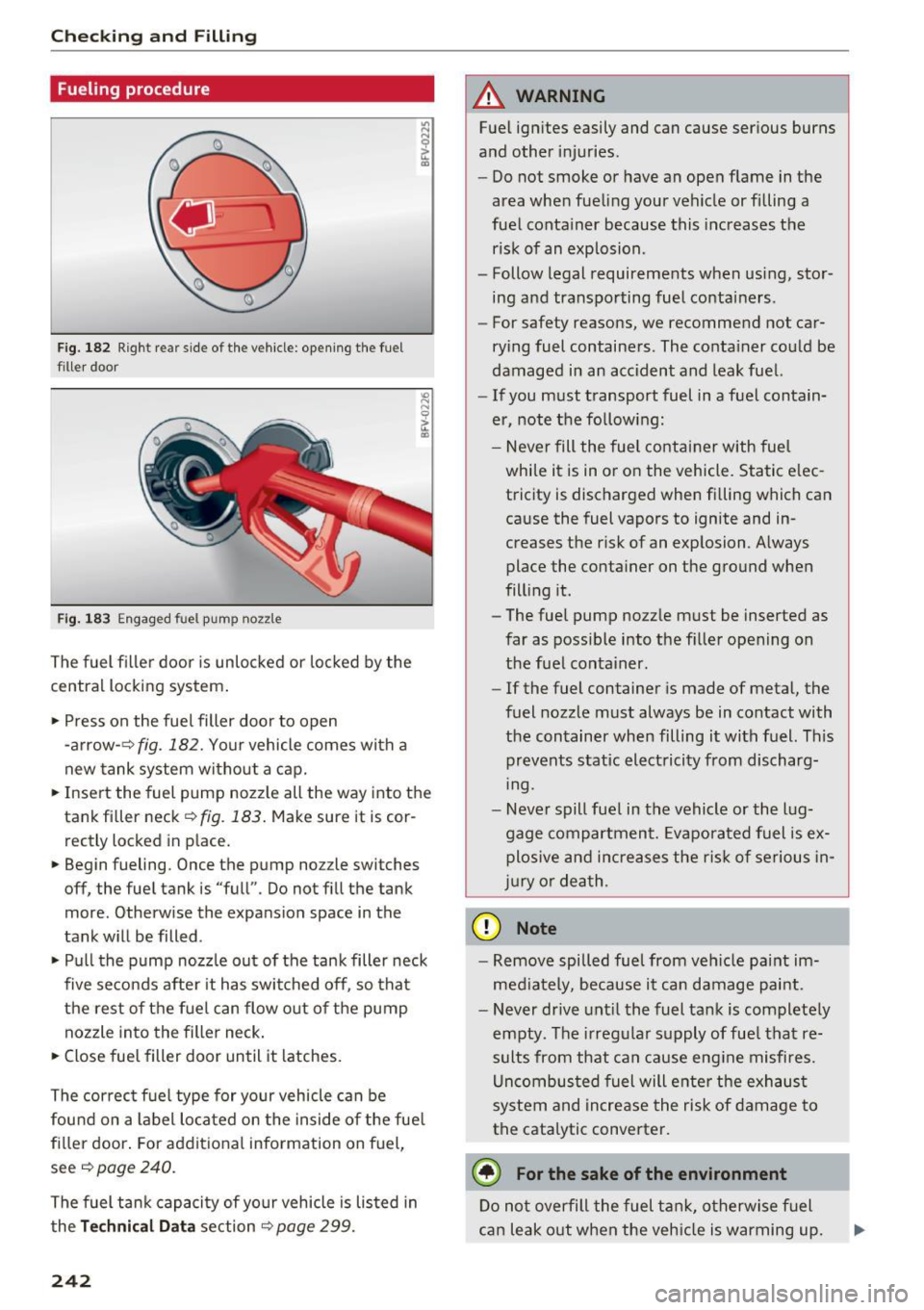
Fig. 182 Right rear side of the vehicle: opening the fue l
filler door
Fig . 183 Engaged f uel pu mp noz zle
The fuel filler door is unlocked or locked by the
central locking system .
• Press on the fue l filler door to open
-arrow- ~fig.182. Your vehicle comes with a
new tank system witho ut a cap.
• Inse rt the fuel pump nozz le all the way into the
tank fi ller neck
~ fig . 183. Make sure it is cor
rectly locked in place.
• Begin fueling. Once the pump no zzle switches
off, the fuel tank is "full" . Do no t fill the tank
more . Otherwise the expansion space in the
tank w ill be filled .
• Pu ll the pump nozz le out of the tank filler neck
five seconds after it has switched off, so that
the rest of the f uel can flow o ut of the pump
nozzle into the filler neck .
• Close fuel filler door until it latches.
The correct f uel type for your vehicle can be
found on a label located on the inside of the fue l
fi ller door. For additiona l info rmation on fuel,
see
~ page 240.
The f uel tank capacity of yo ur vehicle is listed in
the
Te chnical Data section ~ page 299.
242
A WARNING
Fuel ignites easily and can cause serious burns
and other injuries.
- Do not smoke or have an open flame in the
area whe n fueling your vehicle or filling a
fuel conta iner because this increases the
risk of an explosion .
- Follow legal requirements when using, stor
ing a nd transporting fuel containers .
- For safety reasons, we recommend not car
rying fuel containers. The conta iner could be
damaged in an accident and leak fuel.
- If you must transport fuel in a fuel contain
er, note the following:
- Never fill the fuel container with fue l
while it is in or on the vehicle. Static e lec
tricity is discharged when fi lling which can
cause the fuel vapors to ignite and in
creases the risk of an exp losion. A lways
place the conta iner on the ground when
fill ing it .
- The fuel pump nozzle must be inserted as
far as possible into the filler opening on
the fuel container .
- If the fuel container is made of metal, the
fuel nozzle must always be in contact with
the container when filling it with f uel. Th is
prevents static electricity from discharg
ing .
-Never spill fuel in the vehicle or the l ug
gage compartment. Evaporated fuel is ex
plosive and increases the ris k of se rious in
ju ry o r dea th .
(D Note
- Remove spilled fue l from veh icle pa int im
media tely, because it ca n damage paint .
- Never drive unt il the fuel tank is completely
empty . The irregular supply of fue l that re
sults from that can cause eng ine misfires.
Uncombus ted fuel will ente r the exh aus t
system and increase the risk of damage to
the cata lytic converter.
@) For the sake of the environment
Do not overfill the fuel tan k, otherwise f uel
can leak o ut when the veh icle is warming up.
Page 270 of 322
Wheels
plus maximum load. The maxi
mum load includes the number of
passengers that the vehicle is in
tended to carry ("seating capaci
ty") with an assumed weight of 150 lbs (68 kg) for each passen
ger at a designated seating posi
tion and the total weight of any luggage in the vehicle.
The
Gross Axle Weight Rating
("GAWR") is the maximum load
that can be applied at each of the
vehicle's two axles.
The fact that there is an upper limit to your vehicle's Gross Vehi
cle Weight Rating means that the
total weight of whatever is being
carried in the vehicle is limited.
The more passengers in the vehi cle or passengers who are heavier
than the standard weights as
sumed mean that less weight can
be carried as luggage.
The Gross Vehicle Weight Rating and the Gross Axle Weight Rating
are listed on the safety compli
ance sticker label located on the
driver's side B-pillar
c::> page 265,
fig. 198.
A WARNING
Overloading a vehicle can cause
loss of vehicle control, a crash
268
or other accident, serious per
sonal injury, and even death.
-Carrying more weight than your vehicle was designed to carry will prevent the vehicle
from handling properly and
increase the risk of the loss of
vehicle control.
-The brakes on a vehicle that has been overloaded may not
be able to stop the vehicle
within a safe distance.
-Tires on a vehicle that has been overloaded can fail sud
denly, including a blowout and
sudden deflation, causing loss
of control and a crash.
-Always make sure that the to
tal load being transported does not make the vehicle
heavier than the vehicle's
Gross Vehicle Weight Rating.
Determining correct load
limit
Use the example below to calcu
late the total weight of the pas
sengers and luggage or other
things that you plan to transport
so that you can make sure that
your vehicle will not be overload- ed . ..
Page 273 of 322
co
co
.... N
" N .... 0
0
Vl c:o
@ Tips
When using snow chains, it may be useful to
switch on sport mode¢
page 89.
Low aspect ratio tires
Your Aud i is factory-equipped with low aspect ra
tio tires. These t ires have been thoroughly tested
and been selected specifically for your model for
their supe rb performance, road feel and handling
u nder a va riety of d riving conditions. As k your au
thor ized Audi dealer for mo re details.
The low aspect ratio of these t ires is indicated by
a numeral of
55 or l ess in the tire's size designa
tion. The numera l rep resents the rat io of the
tire's sidewall he igh t in relat io n to its tread w idth
expressed in pe rcen tage. Conventional t ires have
a height/w idth rat io of 60 or more .
The performan ce of low -a spe ct-ratio tire s is par
ticular ly sen sit iv e to improper inflation pre s
s ur e. It i s therefore import ant that low a spect
ratio tire s are infl ate d to the specified pre ssure
and that the inflation pre ssure i s regularl y
c hecked and mai nta ined . Tir e pre ssure s should
b e che cked at least once a month and alw ay s
before a long tri p ¢
page 265.
What you can do to avoid tire and rim
damage
Low aspect ratio tires can be damaged more easi
ly by impact with potholes, curbs, gullies or
ridges on the road, particularly if the t ire is un
derinflated .
In order to minimize the occurrence of impact
damage to the tires of your vehicle, we recom
mend that you observe the follow ing precau
tions:
- Always maintain recommended inflation pres
sures. Check your tire pressure every 2,000
miles (3,000 km) and add a ir if necessary .
- Drive carefully on roads with potho les, deep
gul lies or ridges. The impact from driving
t h rough or ove r such obstacles can damage
you r tires. Impact w ith a curb may also cause
damage to your tires.
Wh eel s
- After any impac t, immed iate ly inspect your
tires or have them inspected by the nearest au thorized A udi dealer. Replace a damaged tire as
soon as possible.
- Inspect your tires every 2,000 mi les (3,000 km)
for damage and wear. Damage is not a lways
easy to see. Damage can lead to loss of air and
underinflation, wh ic h could eventually cause
tire fa ilure . If you believe that a t ire may have
been damaged, replace the tire as soon as pos
sible.
- These tires may wear more quickly than others.
- Please also remember that, while these tires
delive r responsive handling, they may ride less
comfortably and make mo re noise than other
choices.
Reduced pe rfo rmance in winter /cold season
conditions
All t ires are des igned for certai n purposes. The
low aspect ratio, ultra h igh performance tires
o rigi na lly installed o n your vehicle are intended
fo r m aximum d ry and wet road per formance and
handling . They are not sui table for co ld, snowy or
icy weather conditions . If you drive under those
circumstances, you should equip yo ur vehicle
with all-season or winter tires, which offer better
tract ion under those conditions. We suggest you
use the recommended snow or all-season tires
specified for your veh icle, or their equivalent.
Refer to¢
page 2 70 for more detailed informa
t ion regarding winter tires.
Uniform tire quality grading
-T read wear
- Traction AA A 8 C
- Temperature ABC
Quali ty g rades can be fo und whe re applicable o n
the tire side wall between tread sho ulder and
maximum section width
¢page 255, fig. 196 .
For exampl e: Tread wear 200, Traction AA, Tem
peratu re
A .
All passenger car t ires must conform to Fede ral
Safety Req uirements i n addit io n to these grades . .,,_
271