sport AUDI TT COUPE 2017 User Guide
[x] Cancel search | Manufacturer: AUDI, Model Year: 2017, Model line: TT COUPE, Model: AUDI TT COUPE 2017Pages: 322, PDF Size: 79.73 MB
Page 81 of 322

co
co
.... N
" N .... 0
0
Vl c:o
The display brightness adjusts automatically to
the brightness of the surroundings, both in the information and in the warning stage. In very
dark or very bright surroundings, the automatic
adjustment will set the display to the minimum
or maximum level. In such cases, you may notice no change when adjusting the brightness, or the
change may only be noticeable once the sur roundings change.
Adjust the brightness to a level where the display in the information stage will not disrupt your
view ahead .
If you change the brightness, the dis
play in the exter ior mirror will briefly show the
brightness level in the information stage. The
brightness of the warning stage is linked to the
brightness in the information stage and is adjust
ed along with the information stage.
(D Tips
- Side assist is not active while you are ma k
ing the adjustment.
- Your settings are automatically stored and
assigned to the remote control key being
used.
Messages
Applies to: veh icles with Audi side assist
If the side assist switches off automatically, a
message appears in the Infotainment system dis
play.
@j Audi side assist : cur rently unavailable.
Sensor vision restricted due to surroundings.
See owner's manual
The radar sensors' vision is affected. Do not cover
the area in front of the sensors with bike wheels,
stickers, dirt or other objects . Clean the area in
front of the sensors, if necessary~
page 77,
fig. 80.
@j Audi side assist: currently unavailable.
See owner's manual
Side assist cannot be switched on at this time be
cause there is a malfunction (for example, the
battery charge level may be too low).
Assist
@j Audi side assist: malfunction! Please
contact Service
The system cannot guarantee that it will detect
vehicles correct ly and it has switched off. The
sensors have been moved or are faulty . Have the
system checked by an authorized Audi dealer or authorized Audi Service Facility soon .
Audi drive select (drive
settings)
Introduction
Applies to : vehicles with Audi drive se lect
Drive select makes it possible to experience dif
ferent types of vehicle sett ings in one veh icle .
The driver can select from three modes,
Comfort,
Auto
and Dynamic , using the ~t.~, button in the
center console or by using the Infotainment sys
tem. This allows you to switch between a sporty
and a comfortable driving mode, for example. In
the
Individual mode, the settings can be adjust
ed to your persona l preferences . This makes it
possible to combine settings such as a sporty en
gine setting with light steering.
A WARNING
=
Using Audi drive select incorrectly can lead to
collis ions, other accidents and serious inju
ries .
Description
Applies to: vehicles with Audi drive se lect
The vehicle setup in each mode depends on the
vehicle's features. However, the engine and
steering are always affected .
Engine and automatic transmission
Depending on the mode, the engine and auto
matic transmission respond more quickly or in a
more ba lanced manner to accelerator pedal
movements.
Adaptive dampers (Audi magnetic ride)*
The adaptive dampers use sensors to record in
formation regarding steering movements, brak
ing and acceleration ope rations by the driver,
road surface, driving speed, and load. With d rive .,..
79
Page 82 of 322
Assist
select, you can adjust the adaptive dampers to
sporty (dynamic), comfortable (comfort) or bal
anced (auto).
Steering
The power steering adapts. Indirect steering that
moves easi ly as in comfort mode is especially
suited to long drives on a highway . The dynamic
mode provides sporty, direct steering.
Torque distribution
The sport different ial d istr ibutes the dr ive power
to the rear axle based on the situation. The distri
bution of power varies depending on the selected
mode from moderate
( Comfort ) to sporty (Dy
namic ).
The goal is a high level of agility and abil
ity to accelerate on curves. The vehicle is very re
sponsive to steering .
Engine sound*
The engine sound adapts to the current mode
and can be subtle to sporty .
(Di Tips
I n some models, the maximum vehicle speed
can only be reached in the auto and dynamic
modes.
Selecting the driving mode
Applies to: veh icles with Audi drive select
You can choose between comfort, auto, dynamic
and individual .
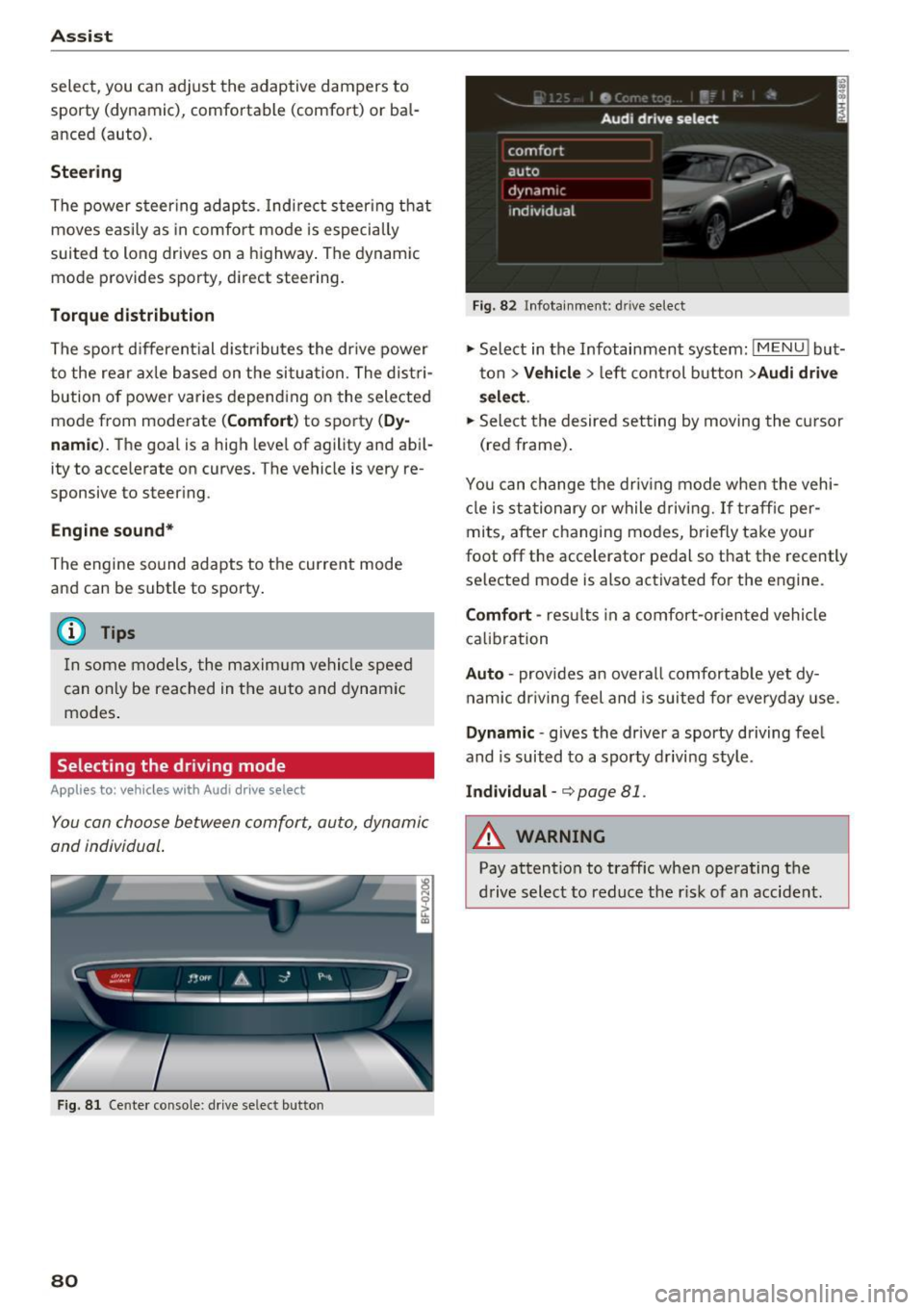
Fig. 81 Cente r console: drive select button
80
Fig. 82 Infota inment: dr ive select
.,. Select in the Infotainment system: IMENU ! but
ton
> Vehicle > left control button >Audi drive
select .
.. Select the desired setting by moving the cursor
(red frame) .
You can change the driving mode when the vehi
cle is stationary or while driving.
If traffic per
mits, after changing modes, briefly take your
foot off the accelerator pedal so that the recently
selected mode is also activated for the engine.
Comfort -results in a comfort-oriented vehicle
ca
Li bration
Auto -provides an overa ll comfortable yet dy
namic driv ing feel and is suited for eve ryday use.
Dynamic -gives the driver a sporty driving feel
and is suited to a sporty driving style.
Individual -¢ page 81.
A WARNING
Pay attention to traffic when operating the
drive select to reduce the risk of an accident .
Page 83 of 322
co
co
.... N
" N .... 0
0
Vl c:o
Assist
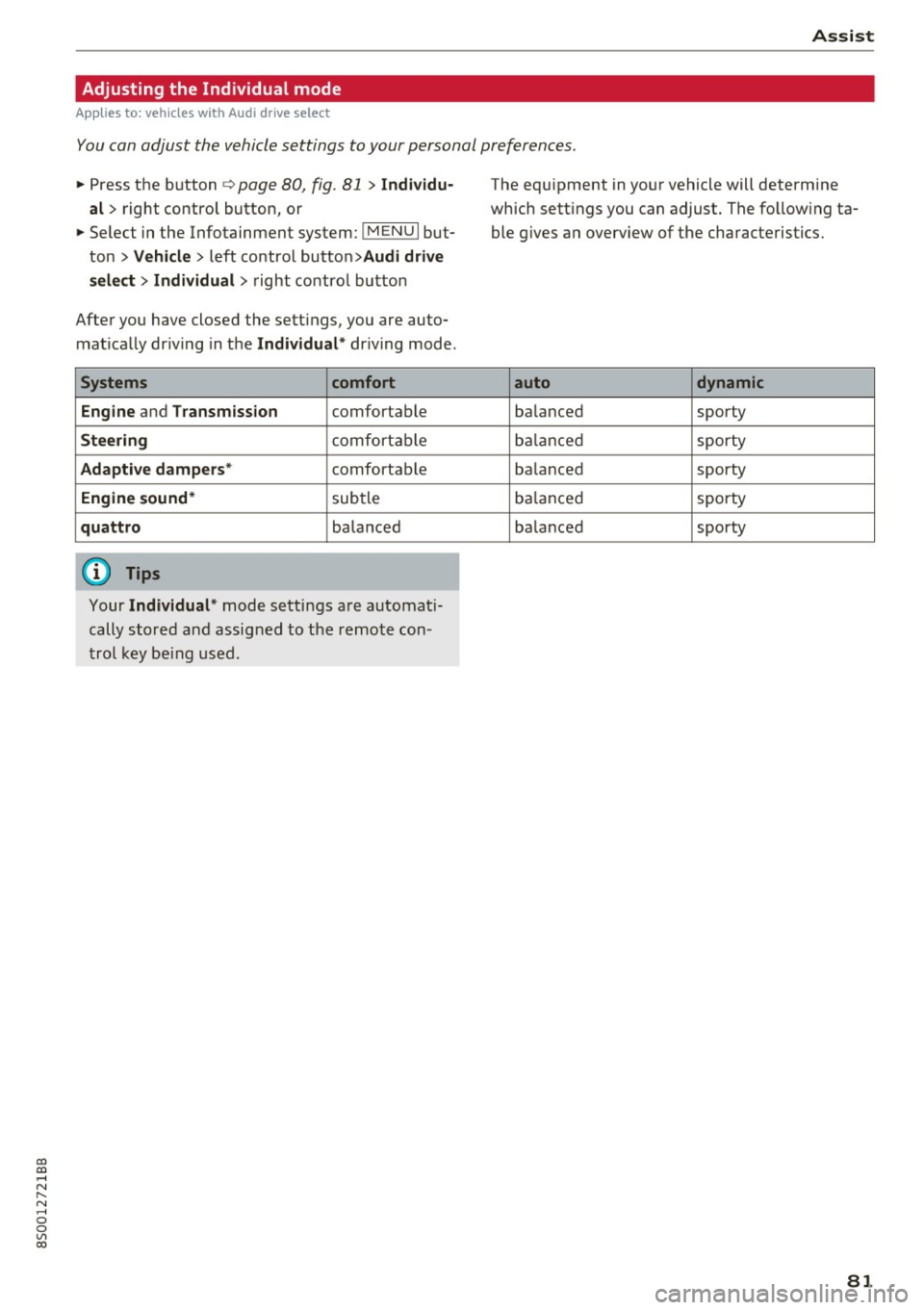
Adjusting the Individual mode
Applies to: vehicles with Audi drive select
You con adjust the vehicle settings to your personal preferences .
.. Press the button c> page 80, fig. 81 > Individu
al >
right control button, or
.. Select in the Infotainment system:
!MENUI but·
ton >
Vehicle > left control button> Audi drive
select> Individual >
right contro l button
After you have closed the sett ings, you are auto
mat ically dr iving in the
Individual * driving mode .
Systems comfort
Engine
and Transmission comfortable
Steering comfortab le
Adaptive dampers * comfortable
Engine sound* subtle
quattro balanced
(D Tips
Your Individual* mode settings are automat i
cally stored and assigned to the remote con
trol key being used.
The equipment in your vehicle will determine
which sett ings you can adjust. The follow ing ta
ble g ives an overview of the characteristics.
auto dynamic
balanced sporty
balanced sporty
ba lanced sporty
balanced sporty
balanced sporty
81
Page 91 of 322
CD
CD
.... N
" N ...... 0
0
Ill co
Intelligent Technology
Switching on and off
ESC turns on automatically when you start the engine.
Fig. 91 Upper center console, fj. OFF b utton
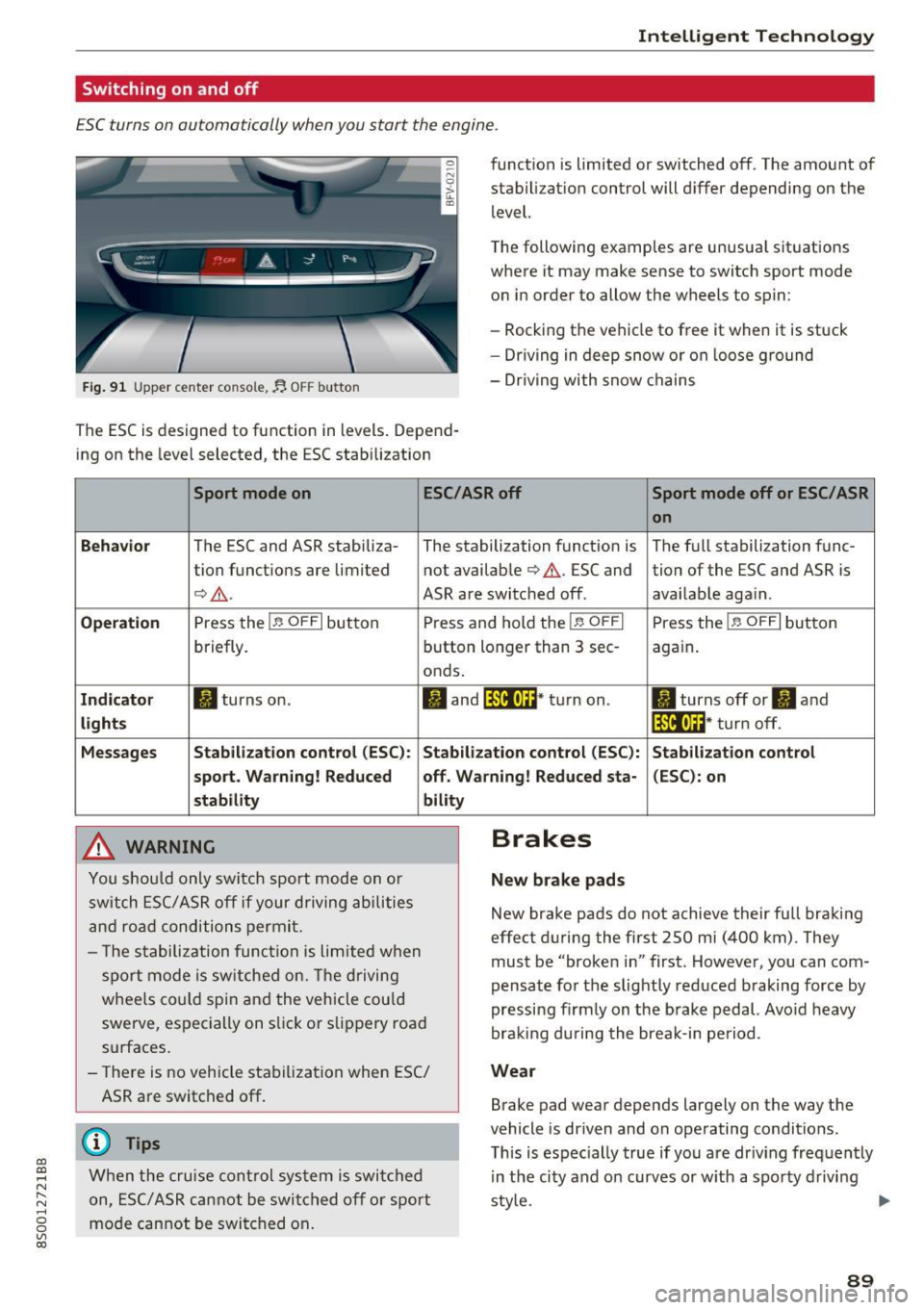
The ESC is designed to function in levels . Depend
ing on the level selected, the ESC stabilization funct
ion is limited or switched off. The amount of
stab ilizat ion control will d iffer depending on the
level.
T he following examples are unusua l situat ions
where it may make sense to switch sport mode
o n in order to allow the wheels to spin:
- Rocking the vehicle to free it when it is stuck
- Dr iving in deep snow or on loose g round
- Dr iving with snow chains
Sport mode on ESC/ASR off Sport mode off or ESC/ ASR
on
Behavio r
The ESC and ASR stabiliza- The stabilization funct ion is The f ull stabilization func-
tion funct ions are limited not availab le
¢ .&. . ESC and tion of the ESC and ASR is
¢ .&.. ASR are switched off. availab le aga in.
Operation Press the l.e OFFI but ton Press and hold the l.e OFFI Press the l .e OFFI but ton
briefly. button longer than 3 sec- aga in .
onds .
Indicator II turns on. II and l*JJ•U~* tu rn on. II turns off or II and
liil•IH * tu rn off. light s
Messages Stab
ilization control (ESC ): Stab ilization con trol (ESC ): Stab ilization cont rol
sport . Warning! Reduced off. Wa rning! Reduced sta -(ESC): on
stability
A WARNING
Y ou shou ld only swit ch spo rt m ode on or
switch ESC/ ASR off if your driving ab ilities
a n d roa d conditions permi t.
bility
- T he s tabiliz ation func tion is li mite d when
s por t mode is sw itched on. The driving
whee ls co uld spin and the vehicle cou ld
swerve, espec ially on s lick or s lippery roa d
surfaces.
- There is no vehicle stabi lization when ESC/
ASR are switched off.
(D Tips
Wh en the cruise cont rol sys tem is swi tched
on, ESC/ ASR can not be swi tched o ff or sport
mo de can not be swit ched on .
Brakes
New brake pads
New brake pads do not achieve their fu ll braking
effect duri ng the first 250 mi (400 km) . They
must be "broke n in" first. Howeve r, you can com
pensate fo r th e slightly reduced braking force by
pressing f irm ly on the b rake pedal. Avo id heavy
bra king du rin g the brea k-in pe riod .
Wear
Brake pad wear depends largely on the way the
vehicle is driven and on operating conditions.
T his is espec ially true if yo u are dr iv ing freq uently
in t he ci ty and o n curves or w ith a spo rty d rivi ng
sty le.
IJI,,
89
Page 116 of 322
Telephone
Telephone Introduction
Applies to: vehicles with telephone
To make phone coils in your vehicle using the
/11/111, connect your cell phone to the /11/111 via
Bluetooth.
Hand sfree
Afte r you have connected you r ce ll phone to the
MMI via Bluetooth , you can use the handsfree
system and operate telephone functions through
your MMI. You can make calls using the antenna
on your cell phone.
A WARNING
-Med ical experts warn that cell phones can
interfere w ith the funct ion of pacemakers .
Always mainta in a m inimum d istance of 20
c ent imeters between the cell phone anten
na and the pacemaker.
- Do not carry the cell phone in a pocket di
rectly over the pacemaker when the phone
is switched on.
- Sw itch the cell phone off immediately if
you suspect it may be interfering w ith the
pacemaker.
- Do not use the vo ice recognit ion sys-
tem* c>
page 108 in emergenc ies because
your vo ice may change in stressful situa
t ions. It may take longe r to dial the number
o r the system may not be able to dial it at
all. Dial the emergency n umbe r manually .
- Switch your cell phone off in areas where
there is a risk of an exp losion . These loca
tions are not always clea rly mar ked. This
may include gas stations, fuel and chemical
storage facilities or transport vehicles, or lo cations where fue l vapors (such as propane
or gaso line vapor in vehicles or bui ld ings),
chemicals or large quantities of dust parti
cles (such as flour, sawdust or metal) may
be present in the air. This also applies to all
other locations where you would normally
turn yo ur vehicle engine off .
- The demands of traffic requ ire yo ur full at
tent ion. Always read the chapter c>
page 96,
Traffic safety information.
114
-
(D Tips
- To learn which Bluetooth connections and
wh ich of the funct ions in your cell phone are
supported, check with your cell phone serv
ice provider or the database for mobile devi
ces at
www .audiu sa.com /bluetooth .
-The Bluetooth connection range is limited
to inside the vehicle . It can also be affected
by local condit ions and interference with
other devices .
Setup
Connecting a cell phone using Bluetooth
Applies to: vehicles with telephone
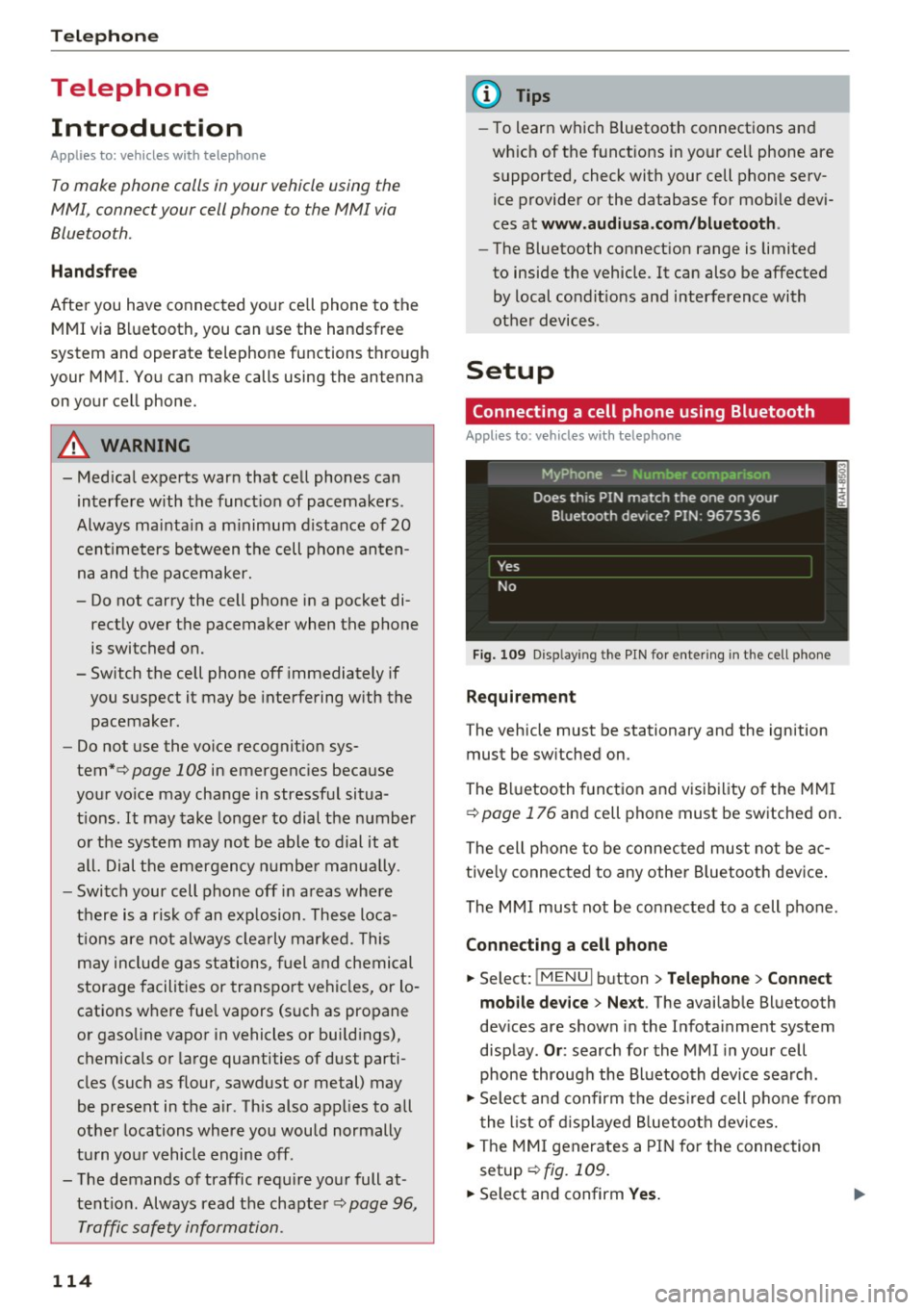
Fig. 109 D isp laying the PIN for entering in the cell phone
Requirement
The vehicle must be stationary and the ignition
must be sw itched on.
The Bluetooth funct ion and visibility of the MMI
c>
page 176 and cell phone must be switched on.
The cell phone to be connected must not be ac
tive ly connected to any othe r Bluetoot h dev ice .
The MMI must not be connected to a cell phone.
Connecting a cell phone
... Select: !MENUI button> Tel ephone > Connect
mob ile d ev ice > Ne xt .
The available Bluetooth
dev ices are shown in the Infotainment system
disp lay .
Or : search for the MMI in your cell
phone through the Bluetooth device search .
... Sele ct and confirm the des ired cell p hone from
the list of d isplayed B luetooth devices.
... The MMI generates a PIN for the connection
setup
c> fig. 109.
... Select and confirm Yes. .,..
Page 188 of 322
Safe dri ving
- Please observe information on safe driving
c>page 180.
A WARNING
To help prevent poisonous exhaust gas from
being drawn into the vehicle, always keep the
rear lid closed whi le driving.
- Never transport objects larger than those
fitting completely into the luggage area be cause the rear lid cannot be fully closed .
- If you absolutely must drive with the rear lid
open, observe the following notes to reduce
the risk of poisoning:
- Close al l w indows,
- Open all air outlets in the instrument pan-
el,
- Switch off the air recirculation,
- Set the fresh air fan to the highest speed.
A WARNING
Always make sure that the doors, all windows
and the rear lid are securely closed and locked
t o reduce the ris k of injury when the vehicle is
not be ing used.
- After closing the rear lid, always make su re
that it is properly closed and locked.
- Never leave yo ur vehicle unattended espe
cially with the rear lid left open. A chi ld
could crawl into the vehicle through the lug
gage compartment and close the rear lid be
coming trapped and unable to get out. Be
ing trapped in a vehicle can lead to serious
persona l injury.
- Never let children play in or around the ve hi
cle .
- Never let passengers ride in the luggage
compartment. Veh icle occupants must al
ways be properly restrained in one of the ve
hicle's seating positions.
@ Tips
- Air circulation helps to reduce window fog
ging. Stale air escapes to the outside
through vents in the trim panel, on the left
side of the luggage compartment. Be sure
to keep these slots free and open.
186
- Th e tire pressure must correspond to the
load. The tire pressure is shown on the tire
pressure label. The tire pressure label is lo
cated on the driver's side B-pillar. The tire
pressure label lists the recommended cold
tire inf lation pressures for the vehicle at its
maximum capac ity we ight and the tires that
were on your vehicle at the time it was man
ufactured. For recomme nded t ire pressures
for normal load condi tions, please see chap
ter
c> page 266.
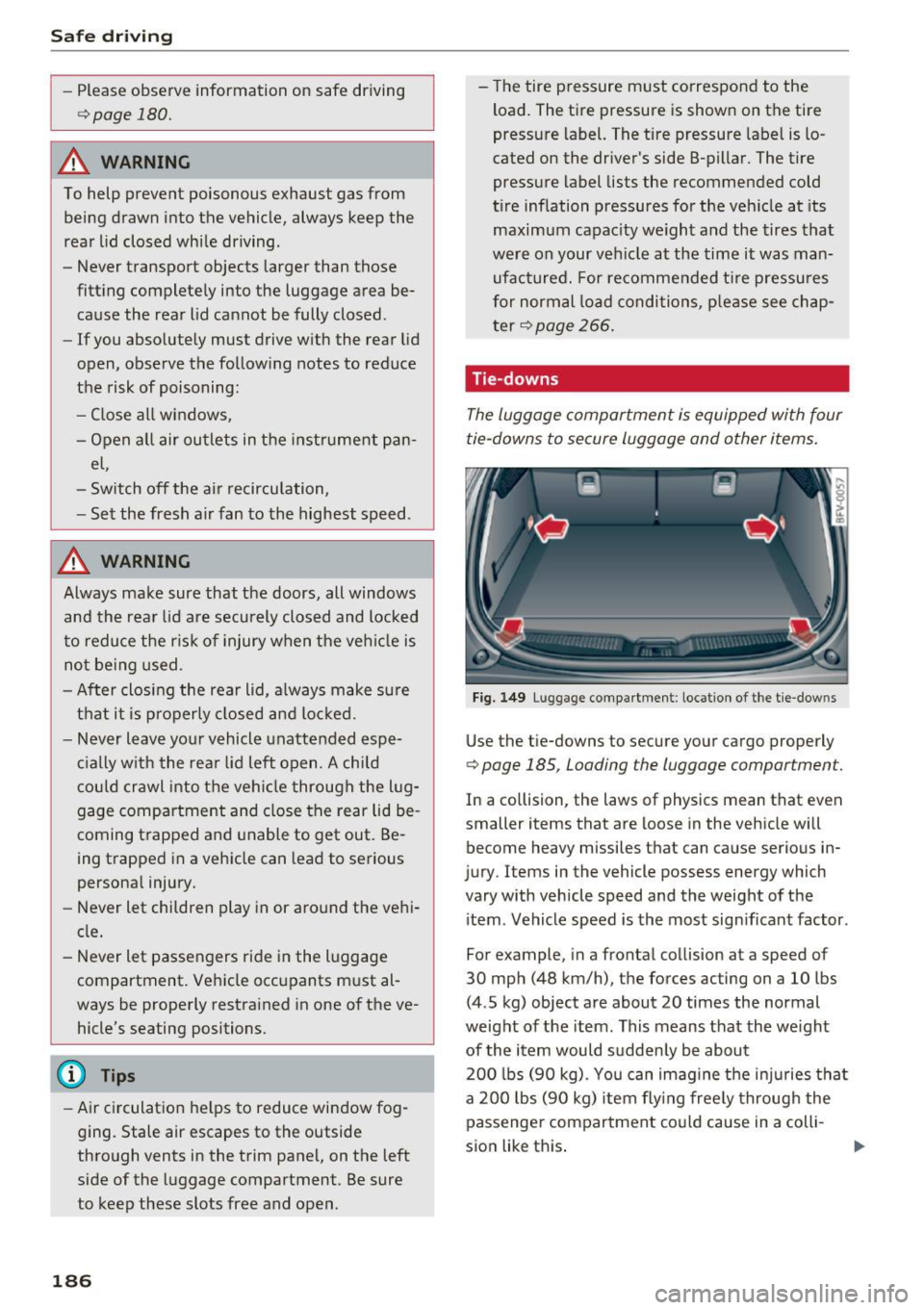
Tie-downs
The luggage compartment is equipped with four
tie -downs to secure luggage and other items.
Fig. 149 Luggage compartment : location of the tie- downs
Use the tie-downs to secure your cargo properly
c> page 185, Loading the luggage compartment.
In a co llision , the laws of physics mean that even
smaller items that are loose in the vehicle will
become heavy missiles that can cause serious in
jury . Items in the vehicle possess energy which
vary with vehicle speed and the weight of the i tem . Vehicle speed is the most significant factor.
For example, in a frontal collision at a speed of
30 mph (48 km/h), the forces acting on a 10 lbs
(4 .5 kg) object are about
20 times the normal
weight of the item. This means that the weight
of the item would sudden ly be about
200 lbs (90 kg) . You can imag ine the injuries that
a
200 lbs (90 kg) item flying freely through the
passenger compartment could cause in a colli
sion like th is .
Page 189 of 322
co
co
Safe driving
A WARNING your dealer, or Audi of America,
,~ -
Weak, damaged or improper straps used to Inc.
secure items to tie -downs can fail during hard
braking or in a collision and cause serious per
sonal injury.
-Always use suitable mounting straps and properly secure items to the tie-downs in
the luggage compartment to help prevent
items from shifting or flying forward as dan
gerous missiles .
- When the rear seat backrest is folded down,
always use suitable mounting straps and
properly secure items to the tie-downs in
the luggage compartment to help prevent
items from flying forward as dangerous
missiles into the passenger compartment.
- Never attach a child safety seat tether strap
to a tie-down.
Reporting Safety Defects
Applicable to U.S.A.
If you believe that your vehicle
has a defect which could cause a
crash or could cause injury or
death, you should immediately in
form the National Highway Traffic Safety Administration (NHTSA) in
addition to notifying Audi of
America, Inc.
If NHTSA receives similar com
plaints, it may open an investiga
tion, and if it finds that a safety
defects exists in a group of
vehicles, it may order a recall and remedy campaign. However, NHTSA cannot become involved in To contact NHTSA, you may call
the Vehicle Safety Hotline toll
free at:
Tel.: 1 (888) 327-4236 (TTY: 1
(800) 424-9153) or 1 (800)
424-9393
or you may write to:
Administrator NHTSA 1200 New Jersey Avenue, SE
Washington, D.C. 20590
You can also obtain other infor
mation about motor vehicle safe
ty from:
http:/ /www.safercar.gov
Applicable to Canada
If you live in Canada and you be
lieve that your vehicle has a de-
fect that could cause a crash, in
jury or death, you should immedi ately inform Transport Canada, Defect Investigations and Recalls.
You should also notify Volkswa- gen Group Canada, Inc.
Canadian customers who wish to
report a safety-related defect to ..,.
~ individual problems between you, N ...... 0
0
Vl c:o
187
Page 190 of 322

Safe driving
Transport Canada, Defect Investi
gations and Recalls, may either
call Transport Canada toll-free at :
Tel. : 1 (800) 333-0510 or
Tel.: 1 (819) 994-3328 (Ottawa
region and from other countries)
TTY for hearing impaired: Tel.: 1
(888) 675-6863
or contact Transport Canada by mail at:
Transport Canada Motor Vehicle Safety Investiga
tions Laboratory
80 Noel Street
Gatineau, QC
J8Z OAl
For additional road safety infor
mation, please visit the Road
Safety website at:
http:/ /www.tc.gc.ca/eng/ roadsafety/menu.htm
188
Page 200 of 322
Airbag syste m
impact, veh icle speed, etc. The front airbags will
also not inflate in side or rear co llisions, or in
roll -overs.
A lwa ys re memb er: Airbags will deploy only once,
and only in certain kinds of coll isions. Your safety
be lts are always there to offer protection in those
situations in which airbags are not supposed to
deploy, or when they have already deployed ; for
example, when your vehicle strikes or is struck by
another vehicle after the first collision .
This is just one of the reasons why an airbag is a
supp lementary restraint and is not a substitute
for a safety belt. The a irbag system works most
effectively when used with the safety belts.
Therefore, always properly wear your safety belts
c::> page 189 .
A WARNING
Sitting too close to the steering whee l o r i n
strument panel will decrease the effective
ness of the airbags and will increase the risk
of persona l injury in a co llision.
- Never sit closer than 10 in (25 cm) to the
steering wheel or instr ument pane l.
- If you cannot si t mo re than 10 in (25 cm)
from the steering wheel, inves tigate wheth
er adaptive equipment may be avai lab le to
held yo u reach the pedals and increase your
seating distance from the steering wheel.
- If you are unrestrained, leaning forward, s it
ting sideways or out of position in any way,
your risk of injury is much higher.
- Yo u will also receive serious injuries and
could even be killed if you are up aga inst the
airbag or too close to it when it inflates -
even with an Advanced Airbag.
- To reduce the risk of injury when an airbag inflates, always wear safety belts properly
¢ page 193, Safety belts .
-Always make certain that chi ldren age 12 or
younger always ride in the rear seat. If chil dren are not properly restra ined, they may
be severely injured or k illed when an airbag
inflates .
- Never let children ride unrestrained or im prope rly rest ra in ed in the vehicle . Adjust the
front seats properly .
198
-
-Never ride with the back rest recl ined.
-Always sit as far as possible from the steer -
ing wheel or the instrument panel
¢ page 181.
-Always sit upright with your back against
the backrest of your seat.
- Never p lace your feet on the instrument
panel or on the seat . Always keep both feet
on the floor in front of the seat to help pre
vent serious injur ies to the legs and hips if
the airbag inflates.
- Never recl ine the front passenger's seat to
transport objects. Items can also move into
the area of the s ide a irbag or the front air
bag during brak ing or in a sudden maneu
ver. Objects near the airbags can become proje cti les and cause injury when an airbag
inflates.
A WARNING
A irbags that have deployed in a crash m ust be
replaced.
- Use o nly orig inal eq uipment airbags ap
p roved by A ud i and inst alled by a trained
technician who has the ne cessary tools and
diagnostic equipment to properly replace
any airbag in yo ur vehicle and assure system
effectiveness in a crash.
'
- Never permit salvaged or recycled airbags to
be installed in your vehicle .
Child restraints on the front seat - some
important things to know
.,. Be sure to read the important informat ion and
head the WARNINGS fo r important details
about c hildren and Advanced A irbags
c::> page 221 .
Even though your veh icle is equipped w ith an Ad
vanced Airbag Sys tem, make certa in that a ll chil
dre n, especia lly those 12 yea rs and younger, al
ways ride i n the b ack seat prope rly res trained fo r
their age and size. The airbag on the passenger
s ide makes the front seat a potentially dange rous
place for a child to r ide . The front seat is not the
safest place for a chi ld in a forward-fac ing chi ld ...,.
Page 204 of 322
Airbag system
A WARNING
Objects between you and the airbag will in
crease the risk of injury in a crash by interfer
ing with the way the airbag unfolds and/or by
being pushed into you as the airbag inflates.
- Always make sure nothing is in the front air-
bag deployment zone that could be struck
by the airbag when it inflates.
- Objects in the zone of a deploying airbag
can become projectiles when the airbag de
ploys and cause serious personal injury.
- Never hold things in your hands or on your
lap when the vehicle is in use .
-
-Never place accessories or other objects
(such as cup holders, telephone brackets,
note pads, navigation systems, or things
that are large, heavy, or bulky) on the doors;
never attach then to the doors or the wind
shield; never place them over or near or at
tach them to the area marked .,AIRBAG" on
the steering wheel, instrument panel or the
seat backrests; never place them between
these areas and you or any other person in
the vehicle.
- Never attach objects to the windshield
above the passenger front airbag, such as
accessory GPS navigation units or music players. Such objects could cause serious in
jury in a collision, especially when the air bags inflate.
- Never recline the front passenger seat to transport objects. Items can also move into
the deployment area of the side airbags or
the front airbag during breaking or in a sud
den maneuver. Objects near the airbags can
fly dangerously through the passenger com
partment and cause injury, particularly
when the seat is reclined and the airbags in
flate.
A WARNING
A person on the front passenger seat, espe cially infants and small children, will receive
serious injuries and can even be killed by be
ing too close to the airbag when it inflates.
- Although the Advanced Airbag System in
your vehicle is designed to turn off the front
202
passenger airbag if an infant or a small child
is on the front passenger seat, nobody can
absolutely guarantee that deployment un
der these special conditions is impossible in
all conceivable situations that may happen
during the useful life of your vehicle.
- The Advanced Airbag System can deploy in accordance with the "low risk" option under
the U.S. Federal Standard if a child that is
heavier than the typical one-year old child is
on the front passenger seat and the other
conditions for airbag deployment are met.
- Accident statistics have shown that children
are generally safer in the rear seat area than
in the front seating position.
- For their own safety, all children, especially
12 years and younger, should always ride in
the back properly restrained for their age
and size .
Advanced front airbag system
Your vehicle is equipped with a front Advanced
Airbag System in compliance with United States
Federal Motor Vehicle Safety Standard (FMVSS)
208, as well as Canada Motor Vehicle Safety
Standard (CMVSS)
208 as applicable at the time
your vehicle was manufactured .
The front Advanced Airbag System supplements
the safety belts to provide additional protection
for the driver's and front passenger's heads and upper bodies in frontal crashes . The airbags in
flate only in frontal impacts when the vehicle de
celeration is high enough.
The front Advanced Airbag System for the front
seat occupants is not a substitute for your safety belts. Rather, it is part of the overall occupant re
straint system in your vehicle. Always remember
that the airbag system can only help to protect
you, if you are sitting upright, wearing your safe
ty belt and wearing it properly. This is why you
and your passengers must always be properly re
strained, not just because the law requires you to be.
The Advanced Airbag System in your vehicle has
been certified to meet the "low risk" require-
ments for 3 and 6 year-old children on the ..,.