warning light AUDI TT COUPE 2017 Service Manual
[x] Cancel search | Manufacturer: AUDI, Model Year: 2017, Model line: TT COUPE, Model: AUDI TT COUPE 2017Pages: 322, PDF Size: 79.73 MB
Page 137 of 322
CD
CD
.... N
" N ...... 0
0
Ill co
Navigation
Opening navigation
Applies to: vehicles with navigation system
Navigation
The navigation system directs you to your destination, around traffic incidents and on alternative
routes, if desired.
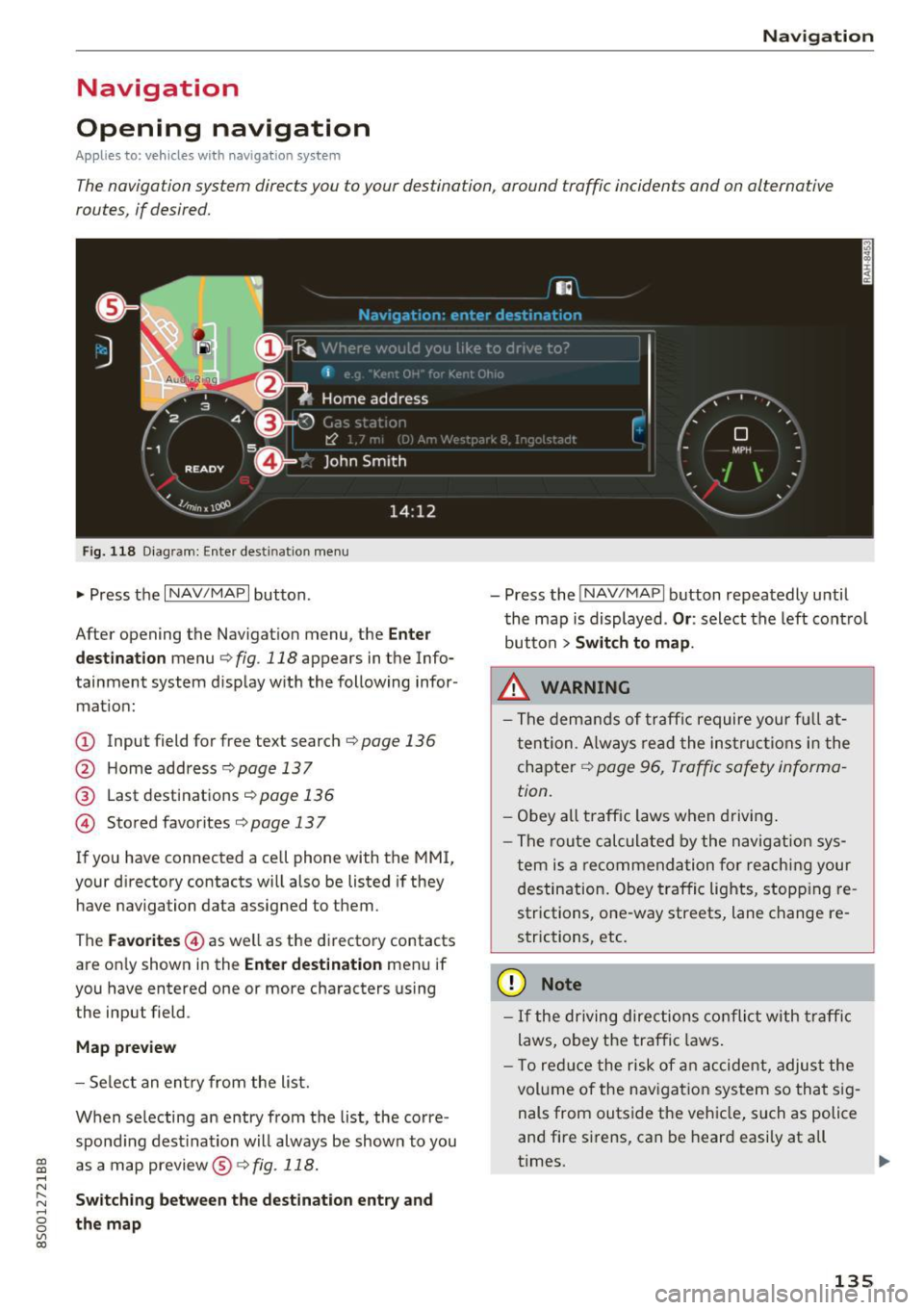
Fig . 118 Diag ram: Enter destination menu
• Press the I NAV/MAPI button.
After opening the Navigation menu, the
Enter
destination
menu c;, fig. 118 appears in the Info
tainment system display with the following infor mat ion:
(!) Input field for free text search c;, page 136
@ Home address <=;>page 137
® Last destinations c;, page 136
@ Stored favorites c;, page 13 7
If you have connected a cell phone with the MMI,
your directory contacts will also be listed if they
have navigation data assigned to them .
The
Favorites @) as well as the directory contacts
are on ly shown in the
Enter destination menu if
you have entered one or more characters using
the input field.
Map preview
- Select an entry from the list.
When se lecting an entry from the list, the corre
spond ing destination will always be show n to you
as a map preview@~
fig. 118.
Switching between the destination entry and
the map
- Press the INAV/MAPI button repeatedly until
the map is displayed .
Or: select the left control
button
> Switch to map .
_&. WARNING
- The demands of traffic require your fu ll at
tention . Always read the instructions in the
chapter
c;, page 96, Traffic safety informa
tion.
- Obey
all traffic laws when driving.
- The route calculated by the navigation sys-
tem is a recommendation for reaching your
destination. Obey traffic lights, stopp ing re
strictions, one-way streets, lane change re
strictions, etc.
(D Note
- If the driving directions conflict with traffic
laws, obey the traffic laws.
- T o reduce the risk of an accident, adjust the
volume of the navigation system so that sig
nals from outside the vehicle, such as police
and fire sirens, can be heard easily at all
times.
-
135
Page 182 of 322
Safe dri ving
Safe driving
Basics
Safe driving habits
Please remember -safe ty first!
This chapter contains important information,
tips, instructions and warnings that you need to
read and observe for your own safety, the safety
of your passengers and others. We have summar ized here what you need to know about safety
be lts, a irbags, child restra ints as well as child
safety. Your safety is for us
priority number 1 . Al
ways observe the info rmation and wa rn ings in
this section - for your own safety as well as that
of your passengers.
The information i n this section applies to all
model versions of yo ur vehicle . Some of the fea
tures descr ibed in t his sections may be s tanda rd
equipment on some models, or may be optional
equipment on others . If you are not sure, ask
your authorized Audi dealer.
A WARNING
- Always make sure that you follow the in
structions and heed the WARNINGS in th is
Manual.
It is in your interest and in the in
te rest of your passengers .
- Always keep the comp lete Owner's Litera
ture in your A udi when you lend or sell your
vehicle so that this important information
will always be available to the d river and
passenge rs.
- Always keep the Owner 's literature handy so
that you can find it easily if you have ques
t ions.
Safety equipment
The safety features are part of the occupant re
straint system and work together to help reduce
the risk of injury in a wide variety of occident si t
uations.
Your safety and the safety of your passenge rs
should not be left to chance. Advan ces i n tech
nology have made a var iety of features avai lab le
to help reduce the risk of injury in an accident .
180
The following is a list of just a few of the safety
features in your Audi :
- sophis tica ted safety be lts fo r drive r and all pas-
senge r seat ing pos itions,
- safety belt p retensioners,
- safety belt force lim ite rs fo r th e front seats,
- front airbags,
- knee airbags fo r the front seats*
- side airbags in the front seats,
- side curtain airbags with eject ion m itigat ion
features,
- special LATCH anchorages for child restraints,
- adj ustab le steering col umn.
These ind iv idual safety features, can work to
gether as a system to he lp protect you and your
passengers i n a wide range of acc idents. These
fea tures canno t wo rk as a sys tem if they a re not
a lways correc tly adjusted and correct ly used.
Safety is everybody' s responsibilit y!
Important things to do before driving
Safety is everybody's job! Vehicle and occupant
safety always depends on the informed and care
ful driver .
For your safety and the safety of your passen
gers,
before driving alway s:
.. Make sure that all lights and signals are operat
ing correctly .
.. Make sure that the tire pressure is correct .
.. Make sure that all windows are clean and afford
good visibility to the outs ide .
.,. Sec ure all luggage and othe r items ca refully
Q page 185, ~page 47.
.,. Make sure that noth ing can inter fere wi th the
peda ls .
.. Ad just front seat and mirrors cor rectly for your
height.
.. Make sure to use the right child restraint cor
rectly to protect children
Q page 221, Child
safety .
.. Sit p roperly in your seat and make sure t hat
your passenge rs do the same
Q page 44, Seats
and storage.
ll-
Page 183 of 322
CD
CD
.... N
" N .... 0
0
Ill co
.. Fasten your safety be lt and wear it properly. Al
so instruct your passengers to fasten their
safety belts properly ¢
page 189.
What impairs driving safety?
Safe driving is directly related to the condition of
the vehicle, the driver as well as the driver's abili
ty to concentrate on the road without being dis
tracted.
The driver is responsible for the safety of the ve
hicle and all of its occupants . If your ability to
drive is impaired, safety risks for everybody in the
veh icle increase and you also become a hazard to
everyone else on the road ¢,&. .Therefore:
.. Do not let yourself be distracted by passengers
or by using a cellular te lephone .
.. NEVER drive when your driv ing ability is im
paired (by medications, alcohol, drugs, etc.).
.. Observe a ll traffic laws, rules of the road and
speed limits and plain common sense.
.. ALWAYS adjust your speed to road, traffic and
weather cond itions.
.. Ta ke frequent breaks on long trips. Do not drive
for more than two hours at a stretch .
.. Do NOT drive when you are tired, under pres
sure or when you are stressed.
A WARNING
Impaired driving safety increases the risk of
ser ious personal injury and death whenever a
vehicle is being used.
Safe d riving
Correct passenger
seating positions
Proper seating position for the driver
The proper driver seating position is important
for safe, relaxed driving.
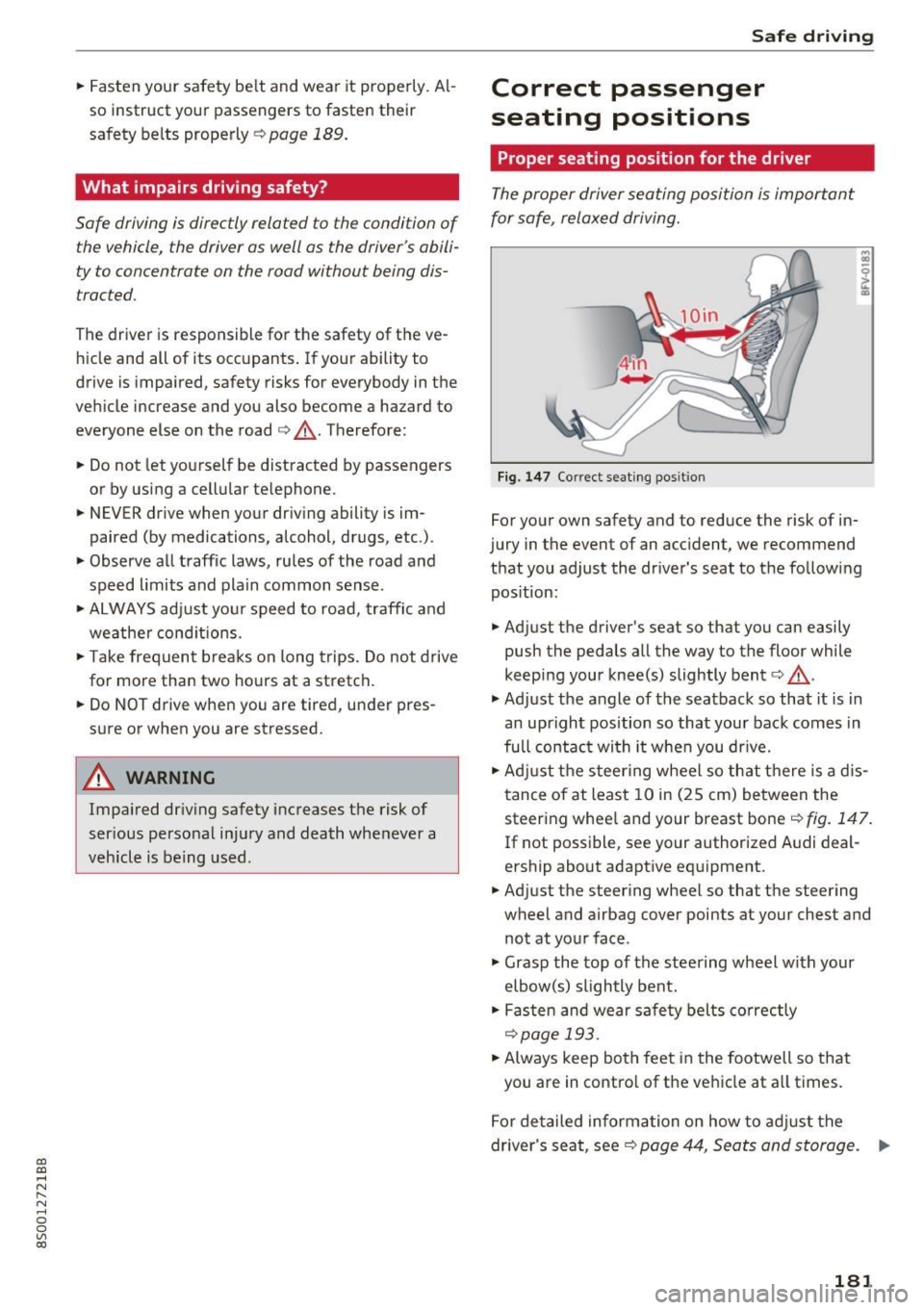
Fig. 147 Correct seating position
For your own safety and to reduce the risk of in
jury in the event of an accident, we recommend
that you adjust the driver's seat to the following position:
.. Adjust the driver's seat so that you can easily
push the pedals all the way to the floor while
keep ing your knee(s) slightly bent¢,&. .
.,. Adjust the angle of the seatback so that it is in
an upright position so that your back comes in
full contact wi th it when you dr ive.
.. Adjust the steering wheel so that there is a dis
tance of at least 10 in (25 cm) between the
steering whee l and your breast bone¢
fig. 147.
If not possible, see your author ized A udi deal
ership about adaptive equipment .
.. Adjust the steering wheel so that the steering
wheel and airbag cover points at your chest and
not at your face .
.,. Grasp the top of the steering wheel with your
elbow(s) slightly bent .
.. Fasten and wear safety belts correctly
¢page 193 .
.. Always keep both feet in the footwell so that
you are in contro l of the vehicle at all times.
For detailed information on how to adjust the
driver's seat, see¢
page 44, Seats and storage. ..,..
181
Page 191 of 322
co
co
.... N
" N .... 0
0
Vl c:o
Safety belts
General notes
Always wear safety belts!
Wearing safety belts correctly saves lives!
This chapter explains why safety belts are neces
sary, how they work and how to adjust and wear
them correctly. "' Read all the information that follows and heed
all of the instructions and WARNINGS.
A WARNING
Not wearing safety belts or wearing them im
properly increases the risk of serious personal
injury and death .
- Safety belts are the single most effective
means available to reduce the risk of serious
injury and death in automobile accidents.
For your protection and that of your passen
gers, always correctly wear safety belts
when the veh icle is moving.
- Pregnant women, injured, or physically im
paired persons must also use safety belts.
Like all vehicle occupants, they are more
likely to be seriously injured if they do not
wear safety belts. The best way to protect a
fetus is to protect the mother -throughout
the entire pregnancy.
Number of seats
Your Audi TT Coupe has two seating positions in
the front and two height-limited seating posi
tions in the rear . Each seating position has a safe
ty belt. The rear seat area in your Audi TT Coupe
does not have enough room for passengers of all
sizes. For reasons of safety , no person taller than
4 ft 9 in (S7 in/1.4S m) should ever r ide in the
r ear seat area.
A WARNING
Not wearing safety belts or wearing them im
properly increases the risk of serious personal
injury and death .
Safety belts
- Never strap more than one person, includ
ing small children, into any belt. It is espe
cially dangerous to place a safety belt over
a
child sitting on your lap .
- Never let more people ride in the vehicle
than there are safety belts available.
- Be sure everyone riding in the vehicle is
properly restrained with a separate safety
belt or child restraint .
- Persons taller than 4
ft 9 in (57 in/1.45 m)
as well as children in booster seats who are
too close to the rear window and roof can
suffer severe head and neck injuries when
the rear lid is closed or in a crash.
- The minimum clearance between the pas senger's heads and the rear window must
never -under any circumstances -be less
that lin (2.5 cm) when the passengers sit
fu lly upright.
- Always make sure that rea r seat passengers
cannot be struck when the rear lid is closed.
4 Safety belt warning light
Your vehicle has a warning system for the driver
and front seat passenger to remind you about the importance of buckling up.
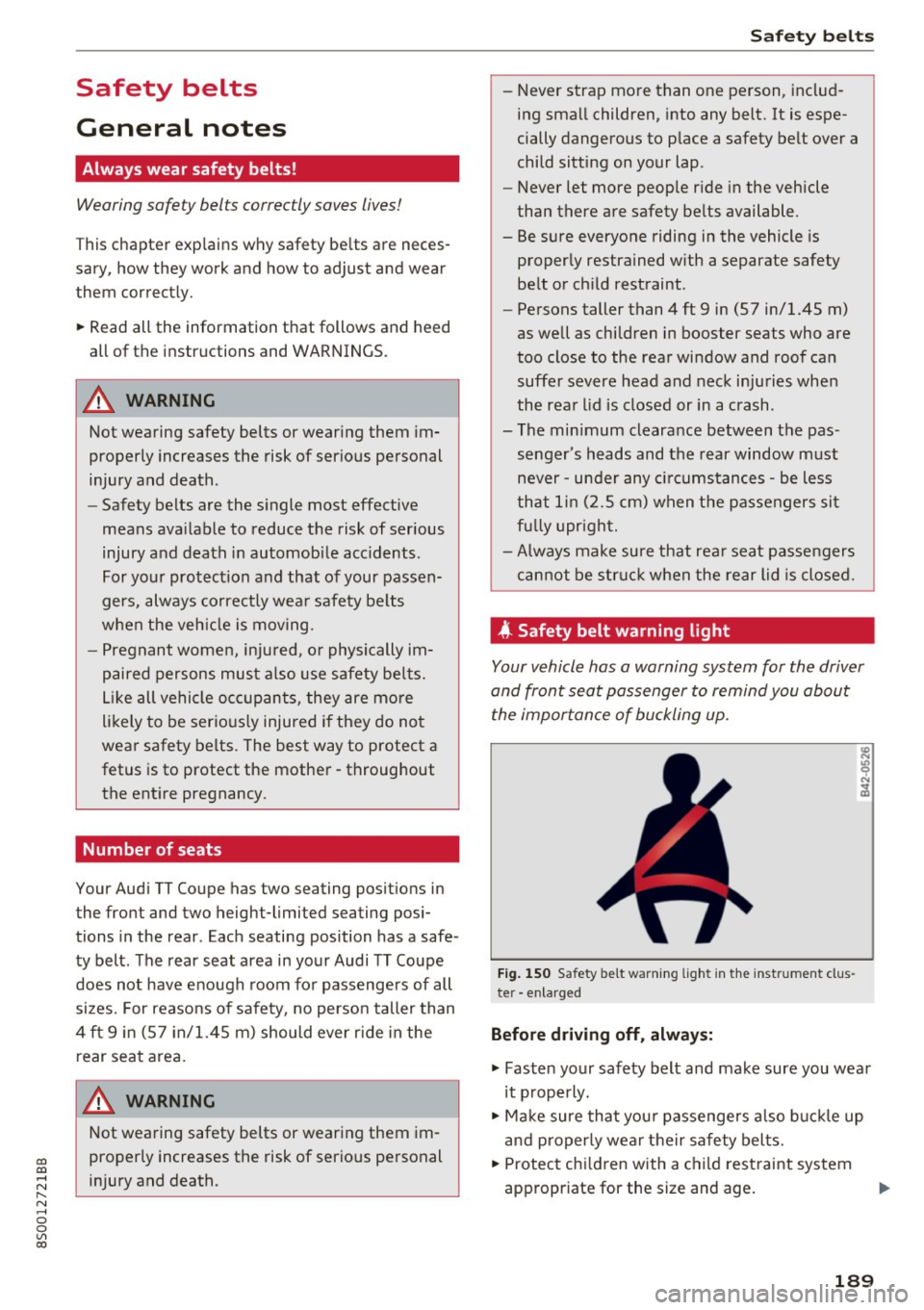
Fi g. 150 Safety belt warning light in the instrument clus
ter -enlarged
Before driving off , always:
"' Fasten your safety belt and make sure you wear
it properly.
"' Make sure that your passengers also buckl e up
and properly wear their safety belts.
"' Protect children with a child restraint system
appropriate for the size and age.
189
Page 192 of 322
Safe ty belts
The warning light . in the instrument cluster
lights up when the ignit ion is switched on as a re
minder to fasten the safety belts. In addition, a
warning tone w ill sound for a certain period of
time.
F a sten you r safet y be lt and make sure that your
pa sse nge rs also prope rly put on thei r safet y
belt s.
_&. WARNING
- Safety belts are the s ingle most effective
means ava ilable to reduce the risk of ser ious
i njury and death in automobile acc idents .
For yo ur protect ion and that of your passen
gers, always co rrectly wea r safety be lts
when the vehicle is moving .
- Failure to pay attention to t he war ning light
that comes on could lead to persona l injury.
Why safety belts?
Frontal collisions and the law of physics
Frontal crashes create very strong forces for peo
ple riding in vehicles.
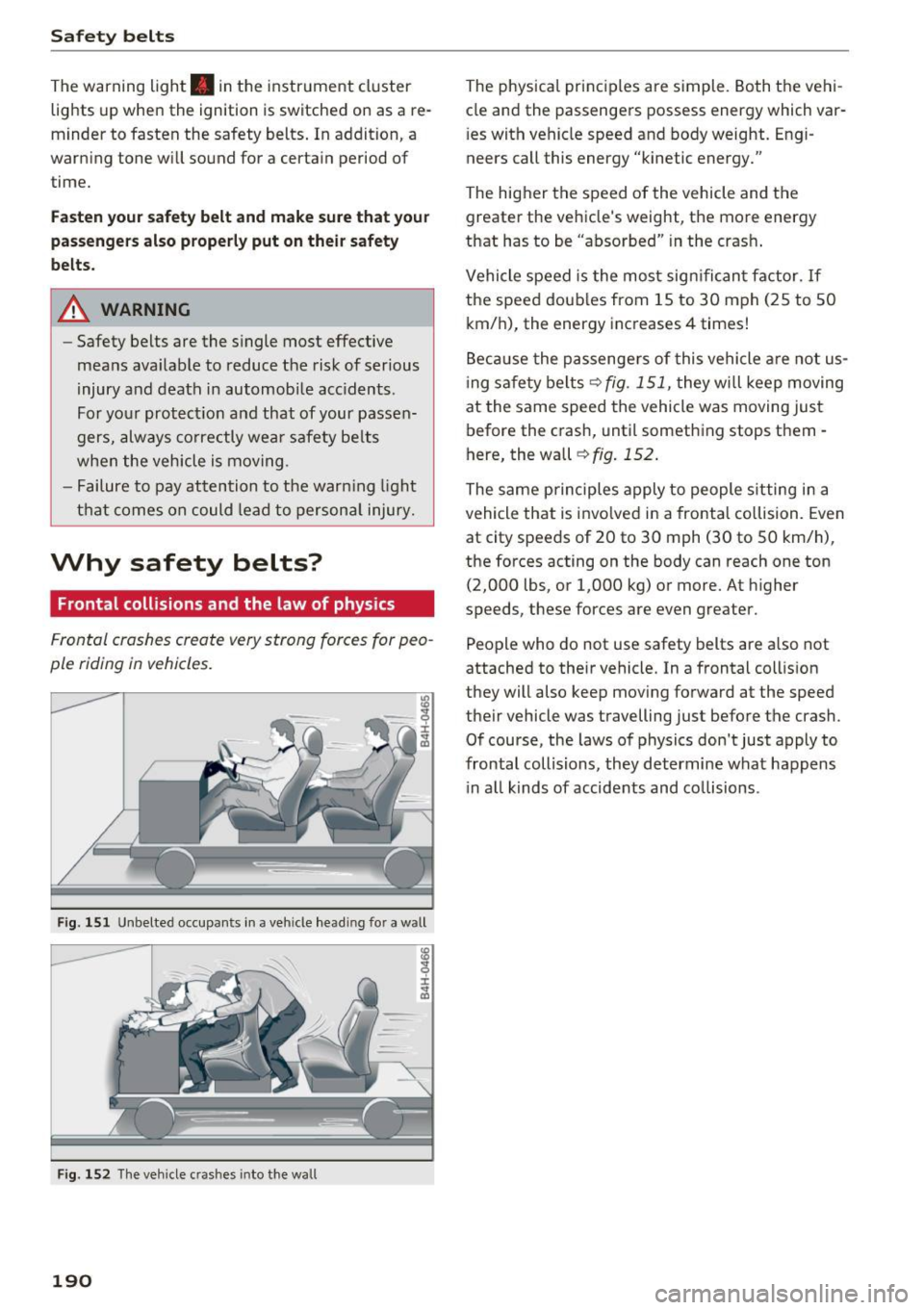
Fig. 151 Unbelte d occupa nts in a ve hicle head in g fo r a w all
I ± ..,. a,
F ig . 1 52 The veh icle c rashes into the w all
190
The physical princ iples are simple . Both the vehi
cle and the passengers possess energy which var
i es with vehicle speed and body weight. Engi
neers call this energy "kinetic energy."
The higher the speed of the vehicle and the greater the vehicle 's we ight, the more energy
that has to be "absorbed" in the crash .
Vehicle speed is the most sign ifican t factor. If
the speed doub les from 15 to 30 mph (25 to 50
km/h), the energy increases 4 times!
Beca use the passenge rs of this vehicle a re not us
i ng safety belts ¢
fig. 151, they w ill keep moving
at the same speed the vehicle was moving just before the crash, until something stops them -
here, the wall
¢ fig . 152 .
The same principles apply to people s itting in a
vehicle that is invo lved in a frontal collision. Even
at city speeds of 20 to 30 mph (30 to 50 km/h),
the forces acting on the body can reach one ton (2,000 lbs , or 1,000 kg) or more. At h igher
speeds, these forces are even greater.
People who do not use safety belts are a lso not
attached to their vehicle. In a frontal coll is ion
they will also keep mov ing forward at the speed
their vehicle was travelling just before the crash .
Of course, the laws of physics don 't just apply to
frontal collisions, they determine what happens i n a ll kinds of accide nts and co llisions .
Page 195 of 322
CD
CD
.... N
" N ...... 0
0
Ill co
-Always keep the belts clean . Dirty be lts may
not work properly and can impair the func
tion of the inertia reel ¢
table Interior
cleaning on page
277 .
Safety belts
Fastening safety belts
Seat first -everybody buckle up!
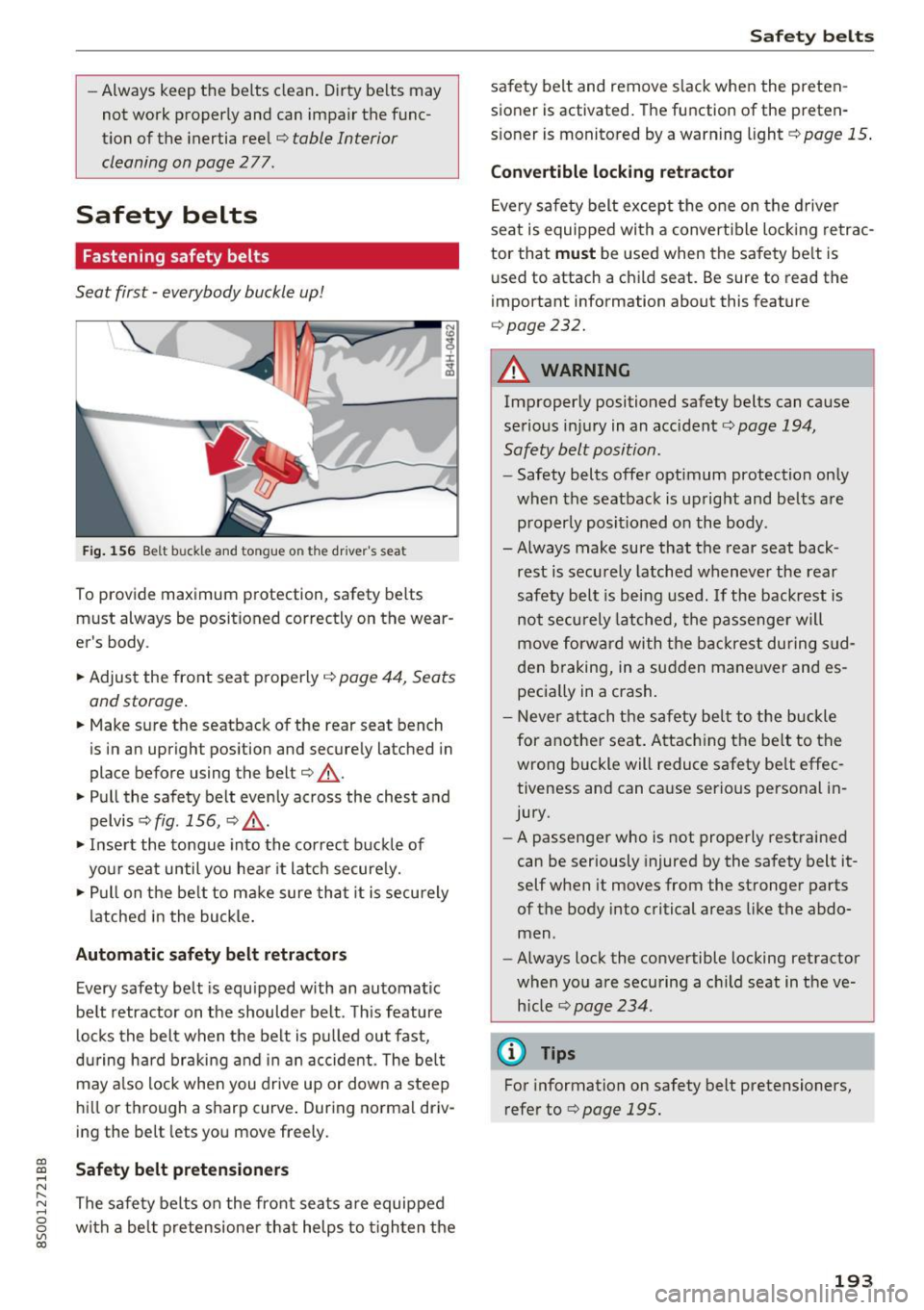
Fig . 156 B elt b uck le and tongue o n the drive r's sea t
To provide maximum protect ion, safety belts
must always be position ed correctly on th e wear
er's body .
.. Adjust the front seat properly
¢ page 44 , Seats
and storage.
.. Make sure the seatback of the rear seat bench
is in an upright pos ition and securely latched in
place before using the belt ¢
&_.
.. Pull the safety belt evenly across the chest and
pelvis ¢
fig. 156, ¢ ,&. .
.. Inse rt the tongue into the correct buckle of
your seat until you hea r it latch secure ly.
.,. Pull on the be lt to make sure that it is securely
latched in the bu ckle .
Automatic safety belt retractors
Every safety belt is equipped with an automatic
belt retractor on the shoulder belt . Th is feature
l ocks the belt when the be lt is p ulled out fast,
during hard braking and i n an accide nt. T he belt
may a lso lock when you drive up or down a steep
hi ll or through a sharp curve . During no rma l driv
ing the be lt lets you move freely.
Safety belt pretensioners
The safe ty belts on the front sea ts are equipped
with a be lt pretensione r that helps to t igh ten the
Safet y bel ts
safety belt and remove s lack when the preten
sioner is activated. The function of the preten
s ioner is monitored by a warn ing light ¢
page 15 .
Convertible locking retractor
Eve ry safe ty belt except the one on the drive r
seat is equipped with a convertible loc king retrac
tor that
must be used when the safety be lt is
u sed to attach a child seat. Be sure to read the
impo rtant information about this feature
¢ page 232.
A WARNING
-Improperly positioned safety belts can cause
serious injury in an accident¢
page 194,
Safety belt position.
- Safety belts offer optimum protection on ly
when the seatback is upright and belts are properly posit ioned on the body .
- Always make sure that the rear seat back
rest is secu rely latched whenever the rear
safety belt is being used . If the backrest is
not securely latched, the passenge r will
move forw ard with the backrest during s ud
den braking, in a sudden mane uver and es
pecia lly in a crash.
- Neve r attach the safety bel t to the buckle
for anot her seat . Attac hing the be lt to the
wrong buckle will reduce safety be lt effec
tiveness and can cause serious personal in
jury.
- A passenger who is not properly rest rained
can be seriously injured by the safety belt it
self when it moves from the stronger parts
of the body into critical areas like the abdo
men .
- Always lock the convertible locking retractor
when yo u are securing a c hild seat in the ve
h icle
¢ page 234.
@ Tips
For information on safety belt pretensioners,
refer to¢
page 195 .
193
Page 202 of 322
Airbag syste m
airbag cou ld g reatly reduce the effectiveness of
the child restraint and even serious ly injure the
child dur ing inflation.
F or this reason, and because the bac k seat is the
safest place for chi ldren -when properly restrain
ed according to their age and si ze -we strong ly
recommend that children a lways sit in the back
seat
¢ page 221 , Child safety.
A WARNING
A child in a rearward-facing chi ld seat instal
led on the front passenger seat will be ser i
ously injured and can be k illed if the front air
bag inflates -even with an Advanced Airbag
System.
- The inflating a irbag w ill hit the child seat or
infant carrier w ith great force and will
smash the ch ild seat and child against the
backrest, cente r arm rest, door or roof.
- Always install rear-facing child seats on the
rea r seat.
- If you must install a rearward fac ing ch ild
seat on the front passenger seat because of
exceptional circum$tances and the PASSEN
GER AIR BAG OFF,;;
light does not come
on and stay on, immediately install the rear
facing child seat in a rear seating position
and have the airbag system inspected by
your Audi dealer.
- Forward-facing chi ld seats installed on the
front passenge r's seat may interfere with
the deployment of the airbag and cause se rious persona l injury to the child .
A WARNING
If, in exceptional circumstances, you must in
stall a forward-facing chi ld restrain t on the
front passenger's seat :
- Always make sure the forward -facing seat
has been desig ned and ce rt ified by its man
ufact urer for use on a front seat with a pas
senger fron t and si de a irbag .
- Never put the forward-facing child restraint
up against or ve ry near the ins trumen t pan
el.
- Always move the front passenger seat to
the highest position in the up and down ad-
200
-
justment range and move it back to the
rearmost posit ion in the seat's fore and aft
adjustment range, as far away from the a ir
bag as poss ible, before installing the for
ward-facing chi ld restraint .
- Always make sure that the safety be lt upper
anchorage is behind the ch ild restraint and
not next to o r in front of the child rest raint
so that the safety be lt will be p roperly posi
tioned.
- Make sure that the
PASSENGER AIR BAG
OFF ,;;
light comes on and stays on all the
time wheneve r the ign it ion is swi tched on.
A WARNING
T o redu ce the ris k of serious injury, ma ke sure
that the
PASSENGER AIR BAG OFF,;; light
will be disp layed whenever a chi ld restraint is
installed on the front passenger seat and the
ignit ion is switched on.
- If the
PASSENGER AIR BAG OFF,;; light
does not stay on, perform the checks descri
bed
¢ page 209, Monitoring the Advanced
Airbag System .
-Take the child restra int off the front passen
ge r seat and install it prope rly at one of the
rear seat positions if the
PASSENGER AIR
BAG OFF~;
light does not stay on .
- Have the airbag system inspected by your
Aud i dea ler immediately.
-Always carefully follow instructions from child restraint manufacturers when instal
ling child restra ints.
A WARNING
If, in exceptional ci rcumstances, you must in
stall a forward or rearward-fac ing child re
stra int on the front passenger's seat:
- Improper installat ion of child restraints can
reduce the ir effectiveness or even prevent
them from provid ing any protect ion.
- An improperly installed child res tra int can
inte rfere with the airbag as it deploys and
serio usly injure or even kil l the child - even
w it h a n Advan ced Airb ag System .
Page 205 of 322
passenger side and very small adults on the driv
er side. The low risk deployment criteria are in
tended to help reduce the risk of injury through interaction with the front airbag that can occur,
for example, by being too close to the steer ing
wheel and instrument panel when the a irbag in
flates .
In addition, the system has been certified to
comply w ith the "suppression" requirements of
the Safety Standard, to turn off the front a irbag
for infants 12 months old and younger who are
restrained on the front passenger seat in child re
stra ints that a re listed in the Standa rd
q page 223, Child restraints and Advanced front
airbag system .
"Suppression" requ ires the front a irbag on the
passenger side to be turned off if:
- a ch ild up to about one year of age is restra ined
on the front passenger seat i n one of the rear
facing or forward-fac ing infant restra ints listed
in Federal Motor Vehicle Safety Standard 208
with wh ic h t he Advanced Airbag System in your
vehicle was certified . For a listing of the ch ild
restraints that were used to certify your vehi
cle's comp liance with the US Safety Standard
q page 223,
-When a person is detected on the front passen
ger seat that has an electrical capacitance that
is more than the tota l electrical capac itance of
a ch ild that is about 1 year old restra ined in one
of the rear-facing or forward-facing infant re
straints (listed in Federal Motor Veh icle Safety
Sta ndard 208 w ith wh ich the Advanced A irbag
System i n your ve hicle was certified), the front
airbag o n the passenge r side may o r may not
deploy.
The
PA SSENGER AIR BAG OFF~; light comes on
when the e lectron ic cont rol u nit detects a total
e lectrical capacitan ce on the front passenger seat
that requ ires the fron t ai rbag to be turned off. If
the
PASSENGER AIR BAG OFF~; light does not
come on, the front ai rbag on the passenger side
has not been turned off by the control unit and
~ can dep loy if the control unit senses an impact
;:::: that meets the conditions stored in its memory.
" N ...... 0
0
Vl c:o
Airb ag sys tem
If the total e lectr ica l capacitance reg istered on
the front passenger seat is more than that of a
typ ica l 1 year -o ld, but less than the weight of a
small adult, the front a irbag on the passenger
s ide may deploy (the
PASSEN GER AIR BA G OFF
~; light does not come on) .
For example, the airbag may deploy if :
-a small ch ild that is heav ier than a typica l 1
year -o ld child is on the front passenger seat
(regardless of whethe r the child is in one of the
child seats listed
¢ page 223),
- a child who has outgrown c hild restraints is on
the front passenge r seat .
If the front passenge r a irb ag is t urned off, the
PASSENGER AIR BAG OFF~; light in the head
liner wi ll come on and stay on .
If the front passenge r a irbag deploys, the Feder
al S tanda rd requi res the ai rbag to meet the "low
risk" deployment cri teria to he lp red uce the r isk
of inj ury through interaction with the airbag .
" Low risk" deployment occurs in those cras hes
that take p lace at lower decelerations as defined
in the electronic contro l unit
q page 209.
Always remember: Even tho ugh yo ur vehicle is
equipped with Advanced Airbags, the safest place
for children is properly restrained on the back
seat. Please be sure to read the important infor
mation in the sections that follow and be sure to
heed all of the WARNINGS .
A WARNING
To reduce the risk of injury when an airbag in
f lates, always wea r safety be lts prope rly.
- If you are u nrestra ined, leaning forward, si t
ting sideways or ou t of position in any way,
your r is k of injury is much highe r.
- You will a lso receive ser ious injuries and
could even be killed if yo u are up agains t the
a ir bag or too close to i t whe n it in flates -
even with an Advan ced Airb ag
Qpage 197.
203
Page 206 of 322

Airbag syste m
& WARNING
A child in a rearward-facing chi ld seat instal
led on the front passenger seat will be ser i
ously injured and can be k illed if the front air
bag inflates -even with an Advanced Airbag
System.
- Although the Advanced A irbag System in
you r vehicle is designed to tu rn off the front
airbag when a rea rwa rd-facing child re
straint has been insta lled on the fron t pas
senger seat, nobody can absolutely g uaran
tee that deployment is impossible in a ll con
ceivable situations that may happen during
the useful life of your vehicle.
- The inflating airbag w ill hit the child seat or
infant carrier w ith great force and will
smash the ch ild seat and child against the
backrest, center armrest, door, or roof.
- Always install rearward-facing ch ild re
straints on the rear seat.
- If you must install a rearward fac ing ch ild
seat on the front passenger seat because of
exceptional c ircumstances and the
PASSEN
G ER A IR BAG OFF,;; light does not come
on and stay on, immediately install the rear
facing child seat in a rea r seating pos ition
and have the a irbag system inspected by
yo ur Audi dealer.
& WARNING
If, i n ex cept ional circumstances, you must i n
sta ll a forward-facing chi ld restraint on the
front passenger's seat:
- Always make sure the forward-facing se at
has been designed and ce rtified by its man
ufacturer for use on a f ront seat with a pas
senger front and side a irbag .
- Never put the forward -facing child restraint
u p against or very near the instrument pan
el.
- Always move the front passenger seat to
the highest position in the up and down ad
justment range and move it back to the
rearmost position in the seat's fore and aft
adjustment range, as fa r away from the air
bag as possib le, before insta lling the for
ward-facing child restra int.
204
-
- lways make sure that t he safety belt upper
anchorage is behind the ch ild restraint and
not next to or in front of the child restraint
so that the safety be lt will be p roperly posi
tioned.
- Always make sure that there is noth ing o n
the front passenge r seat that will cause the
capacitive passenge r detection system in
the seat to signal to the Airbag System tha t
the sea t is occup ied by a perso n when it is
not, or to s ignal th at it is occupie d by some
one who is heavier than the person ac tually
sitting on the seat . The presence of addi
tional objects cou ld cause the passenger
front airbag to be turned on when it should
be off, or could cause the airbag to work in a
way that is d if f erent from the way it wou ld
have worked without the object on the seat.
- Make sure that the
PASSENGER AIR BAG
OFF "1; light comes on and stays on all the
time wheneve r the ig nitio n is swi tched on.
Advanced Airbag System components
The fro nt passenge r seat in your veh icle has a lot
of ve ry important parts of the Advanced A irbag
Syste m in it. These parts incl ude the capacitive
passenger detection system, wir ing, b racke ts,
and more . The con trol uni t monitors the system
on the front passenger seat when the ignition is
switched on and turns the airbag indicator light
on when a malfunction in the one of the system
components is detected<=>
page 209. Because
the front passenger seat contains important
parts of the Adva nced A irbag System, you must
take care to p revent it from being damaged.
Damage to the seat may prevent the Advanced
A irbag Sys tem for the front passenge r seat from
do ing its job in a crash .
The front Advanced Airbag System consists
of the following:
-Crash sensors in the front of the veh icle tha t
meas ure vehicle acce le ra tion/dece le ra tion to
prov ide in formation to the Advanced A irbag
System about the sever ity of the crash .
- An elect ronic contro l unit, with integ rated
crash sensors for front and side impacts. The
Page 207 of 322

co
co
.... N
" N .... 0
0
Vl c:o
control unit "decides" whether to fire the front
airbags based on the information received from
the crash sensors. The control unit also "de
cides" whether the safety be lt pretensioners
shou ld be activated.
- An Advanced Airbag with gas generator for the
driver inside the steering wheel hub.
- An Advanced Airbag with gas generator inside
the instrument panel for the front passenger.
- A capacitive passenger detection system under
neath the front passenger seat cover. This sys
tem measures the electrical capacitance of the
person in the seat. The information registered
is sent continuously to the electronic control
unit to regulate deployment of the front Ad
vanced Airbag on the passenger side.
- An airbag monitoring system and indicator
light
El in the instrument cluster.
- A sensor in each front seat registers the dis
tance between the respective seat and the
steering wheel or instrument panel. The infor
mation registered is sent continuously to the
electronic control unit to regulate deployment
of the front Adv a need Airbags.
- The
PASSENGER AIR BAG OFF~; light comes
on and stays on in the headliner¢
page 209,
fig. 163 and tells you when the front Advanced
Airbag on the passenger side has been turned
off.
-A sensor in the safety belt latch for the driver
and for the front seat passenger that senses
whether that safety belt is latched or not and
transm its this information to the electronic
contro l unit.
A WARNING
Damage to the front passenger seat can pre
vent the front airbag from working properly.
- Improper repair or disassembly of the front
passenger and driver seat will prevent the
Advanced Airbag System from functioning properly.
- Repairs to the front passenger seat must be
performed by qualified and properly trained
workshop personnel.
- Never remove the front passenger or driver
seat from the vehicle.
Airbag system
-Never remove the upholstery from the front
passenger seat.
- Never disassemble or remove parts from the
seat or disconnect wires from it.
- Never carry sharp objects in your pockets or
put them on the seat. The capacitive pas
senger detection mat in the front passenger
seat will not function properly if it is punc
tured.
- Never carry things on your lap or carry ob
jects on the front passenger seat. Such ob
jects can influence the capacitance regis
tered by the capacitive passenger detection
system, so that incorrect information is pro
vided to the airbag control unit.
- Never store items under the front passenger
seat. Parts of the Advanced Airbag System
under the passenger seat could be dam
aged , preventing them and the airbag sys
tem from working properly.
- Never place seat covers or replacement up
holstery that have not been specifically ap
proved by Audi on the front seats.
- Seat covers can prevent the Advanced Air
bag System from recognizing child re
straints or occupants on the front passenger
seat and prevent the side airbag in the seat
backrest from deploying properly.
- If a seat heater has been retrofitted or oth
erwise added to the front passenger seat,
never install any child restraint system on
this seat.
- Never use cushions, pillows, blankets, or
similar items on the front passenger seat.
The additional layers prevent the capacitive
passenger detection system from accurately
measuring the capacitance of the child safe
ty seat and/or the person on the seat and
thus keep the Advanced Airbag System from
working properly.
- Never place or use any electrical device
(such as a laptop, CD player, electronic
games device, power inverter or seat heater
for child seats) on the front passenger seat
if the device is connected to the 12-volt
socket or the cigarette lighter socket. Such
devices can influence the capacitance regis
tered by the capacitive passenger detection
205