remove seats AUDI TT COUPE 2017 Owners Manual
[x] Cancel search | Manufacturer: AUDI, Model Year: 2017, Model line: TT COUPE, Model: AUDI TT COUPE 2017Pages: 322, PDF Size: 79.73 MB
Page 195 of 322
CD
CD
.... N
" N ...... 0
0
Ill co
-Always keep the belts clean . Dirty be lts may
not work properly and can impair the func
tion of the inertia reel ¢
table Interior
cleaning on page
277 .
Safety belts
Fastening safety belts
Seat first -everybody buckle up!
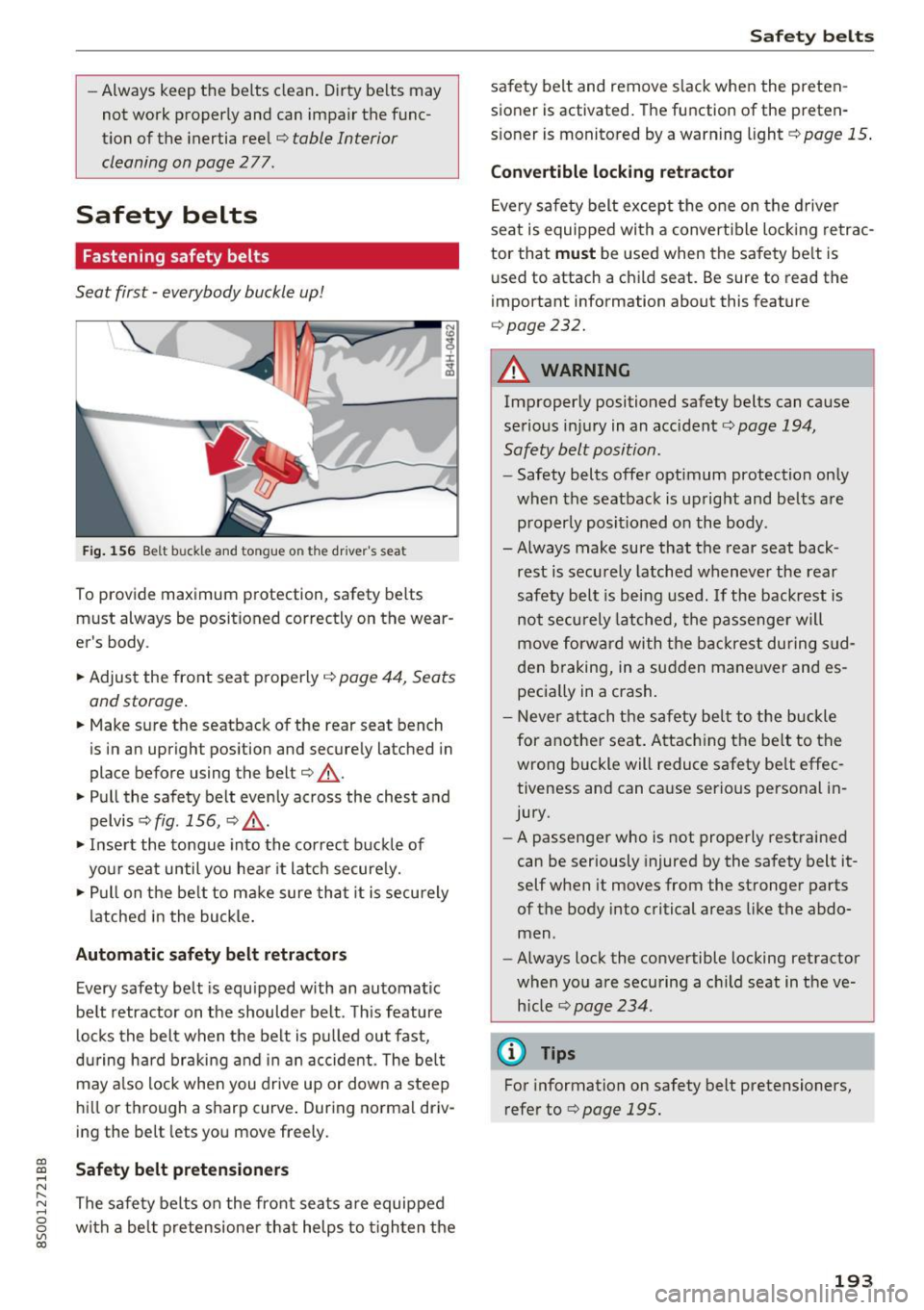
Fig . 156 B elt b uck le and tongue o n the drive r's sea t
To provide maximum protect ion, safety belts
must always be position ed correctly on th e wear
er's body .
.. Adjust the front seat properly
¢ page 44 , Seats
and storage.
.. Make sure the seatback of the rear seat bench
is in an upright pos ition and securely latched in
place before using the belt ¢
&_.
.. Pull the safety belt evenly across the chest and
pelvis ¢
fig. 156, ¢ ,&. .
.. Inse rt the tongue into the correct buckle of
your seat until you hea r it latch secure ly.
.,. Pull on the be lt to make sure that it is securely
latched in the bu ckle .
Automatic safety belt retractors
Every safety belt is equipped with an automatic
belt retractor on the shoulder belt . Th is feature
l ocks the belt when the be lt is p ulled out fast,
during hard braking and i n an accide nt. T he belt
may a lso lock when you drive up or down a steep
hi ll or through a sharp curve . During no rma l driv
ing the be lt lets you move freely.
Safety belt pretensioners
The safe ty belts on the front sea ts are equipped
with a be lt pretensione r that helps to t igh ten the
Safet y bel ts
safety belt and remove s lack when the preten
sioner is activated. The function of the preten
s ioner is monitored by a warn ing light ¢
page 15 .
Convertible locking retractor
Eve ry safe ty belt except the one on the drive r
seat is equipped with a convertible loc king retrac
tor that
must be used when the safety be lt is
u sed to attach a child seat. Be sure to read the
impo rtant information about this feature
¢ page 232.
A WARNING
-Improperly positioned safety belts can cause
serious injury in an accident¢
page 194,
Safety belt position.
- Safety belts offer optimum protection on ly
when the seatback is upright and belts are properly posit ioned on the body .
- Always make sure that the rear seat back
rest is secu rely latched whenever the rear
safety belt is being used . If the backrest is
not securely latched, the passenge r will
move forw ard with the backrest during s ud
den braking, in a sudden mane uver and es
pecia lly in a crash.
- Neve r attach the safety bel t to the buckle
for anot her seat . Attac hing the be lt to the
wrong buckle will reduce safety be lt effec
tiveness and can cause serious personal in
jury.
- A passenger who is not properly rest rained
can be seriously injured by the safety belt it
self when it moves from the stronger parts
of the body into critical areas like the abdo
men .
- Always lock the convertible locking retractor
when yo u are securing a c hild seat in the ve
h icle
¢ page 234.
@ Tips
For information on safety belt pretensioners,
refer to¢
page 195 .
193
Page 207 of 322

co
co
.... N
" N .... 0
0
Vl c:o
control unit "decides" whether to fire the front
airbags based on the information received from
the crash sensors. The control unit also "de
cides" whether the safety be lt pretensioners
shou ld be activated.
- An Advanced Airbag with gas generator for the
driver inside the steering wheel hub.
- An Advanced Airbag with gas generator inside
the instrument panel for the front passenger.
- A capacitive passenger detection system under
neath the front passenger seat cover. This sys
tem measures the electrical capacitance of the
person in the seat. The information registered
is sent continuously to the electronic control
unit to regulate deployment of the front Ad
vanced Airbag on the passenger side.
- An airbag monitoring system and indicator
light
El in the instrument cluster.
- A sensor in each front seat registers the dis
tance between the respective seat and the
steering wheel or instrument panel. The infor
mation registered is sent continuously to the
electronic control unit to regulate deployment
of the front Adv a need Airbags.
- The
PASSENGER AIR BAG OFF~; light comes
on and stays on in the headliner¢
page 209,
fig. 163 and tells you when the front Advanced
Airbag on the passenger side has been turned
off.
-A sensor in the safety belt latch for the driver
and for the front seat passenger that senses
whether that safety belt is latched or not and
transm its this information to the electronic
contro l unit.
A WARNING
Damage to the front passenger seat can pre
vent the front airbag from working properly.
- Improper repair or disassembly of the front
passenger and driver seat will prevent the
Advanced Airbag System from functioning properly.
- Repairs to the front passenger seat must be
performed by qualified and properly trained
workshop personnel.
- Never remove the front passenger or driver
seat from the vehicle.
Airbag system
-Never remove the upholstery from the front
passenger seat.
- Never disassemble or remove parts from the
seat or disconnect wires from it.
- Never carry sharp objects in your pockets or
put them on the seat. The capacitive pas
senger detection mat in the front passenger
seat will not function properly if it is punc
tured.
- Never carry things on your lap or carry ob
jects on the front passenger seat. Such ob
jects can influence the capacitance regis
tered by the capacitive passenger detection
system, so that incorrect information is pro
vided to the airbag control unit.
- Never store items under the front passenger
seat. Parts of the Advanced Airbag System
under the passenger seat could be dam
aged , preventing them and the airbag sys
tem from working properly.
- Never place seat covers or replacement up
holstery that have not been specifically ap
proved by Audi on the front seats.
- Seat covers can prevent the Advanced Air
bag System from recognizing child re
straints or occupants on the front passenger
seat and prevent the side airbag in the seat
backrest from deploying properly.
- If a seat heater has been retrofitted or oth
erwise added to the front passenger seat,
never install any child restraint system on
this seat.
- Never use cushions, pillows, blankets, or
similar items on the front passenger seat.
The additional layers prevent the capacitive
passenger detection system from accurately
measuring the capacitance of the child safe
ty seat and/or the person on the seat and
thus keep the Advanced Airbag System from
working properly.
- Never place or use any electrical device
(such as a laptop, CD player, electronic
games device, power inverter or seat heater
for child seats) on the front passenger seat
if the device is connected to the 12-volt
socket or the cigarette lighter socket. Such
devices can influence the capacitance regis
tered by the capacitive passenger detection
205
Page 212 of 322
Airbag syste m
front seat p assenge r's frontal Advanced Airbag.
Th e PAS SENGER AIR BAG OFF~; light:
-will come o n if the front pa ssenger seat is not
occupied;
- will come on if the e lectr ica l capacitance meas
u red by the c apac itive passenger detec tion sys
tem for the front passenger seat equals the
combined capacitance of an infant up to about
one year of age and one of the rearward-facing
or forward-facing child rest raints listed in Fed
eral Motor Vehicle Safety Standard 208 with
which the Advanced Ai rbag System in your veh i
cle was certif ied; Fo r a listing of the child re
straints that were used to cert ify your vehicle's
compliance with the U .S. Safety Standard
¢ page 223.
-will go out if the front passenger seat is occu
pied by an adult as reg istered by the capacitive
passenger detection system.
- T he
PAS SENG ER AIR BAG OFF~; light must
come on and s tay o n if the ignition is on and . ..
- a car bed has been insta lled on the front pas
senger seat, o r
-a rearward-fac ing ch ild restrai nt has been in
stalled on the front passenger seat , or
- a forward-facing child restra int has bee n in stal
led on the front passenger seat,
- and if the e lectrical capacitance registered on
the front passenger seat is equa l to or less than
the comb ined capac itance of a typical 1 year
o ld infant and one of the rearward-fac ing o r
fo rward -fa cing chi ld restrain ts lis ted in Federal
Motor Veh icle Safety Standard 208 with w hich
the Advanced Airbag System in yo ur vehicle was
certified .
I f the fron t passe nger seat is no t occ upied, the
front ai rbag w ill not dep loy, and the
PASSENGER
AIR BAG OFF~;
light wi ll stay on.
Never i nstall a rearward-facing child rest raint on
t he front passenge r sea t, the safes t place for a
chi ld in any kind of child restraint is at one o f the
seating positions on the rea r seat ¢
page 198,
Child restraints on the front seot -some impor
tant things to know
and ¢ page 221, Child safe
ty .
210
If the PASSENGER AIR BAG OFF~; light
com es on ...
If the PASSENGER AIR BAG OFF~; light comes
on when one of the condit ions listed above is
met, be sure to check the light regularly to make
certain t hat the
PASSENGER AIR BAG OFF~;
light stays on cont inuously whenever the ign ition
i s on . If the
PASSENGER AIR BAG OFF~; light
does not appear on and does not stay on all the
time, stop as soon as it is safe to do so a nd
- reactivate the system by tur ning the ignit ion
off for more than 4 seconds and then tur ning it
on again;
- remove and re install the ch ild restraint. Make
sure that the child restra int is prope rly insta l
led and that the safety belt for the front pas
senge r sea t has bee n corre ct ly rou ted th rough
t he child restraint as desc ribed in the ch ild re
straint man ufact urer's inst ruc tions;
- ma ke sure that the convert ible loc king retr ac
to r on the safety belt for the front passenge r
seat has been activated and that the safety belt has been pulled tight .
- ma ke sure that no e lectrica l device (s uch as a
laptop , CD p layer , e lectronic games device,
power inverte r or seat heater for chi ld seats) is
placed or used on the front passenger seat if
the device is connected to the 12-volt socket or
the c igarette lighter socket;
- make sure that no seat heater has been retro
fitted or otherw ise added to the front passen
ger seat;
- make sure that noth ing can interfere with the
safety belt buckles and that they are not ob
struc ted;
- make sure that there are no wet objects (such
as a wet towe l) and no water or other liquids on
the front passenger seat cushion .
If the PASSENGER AIR BAG OFF~; light still
does not come on ...
If the PASSENGER AIR BAG OFF~; light st ill
does not come on and does not stay on cont in u
ous ly (when the ign ition is switched o n),
- take the child restra int off the front passenger
seat and install it properly at one of the rear
ll-
Page 238 of 322
Child safety
-Always follow the instructions provided by
the manufacturer of the child restra int you
intend to install in your vehicle.
- Never install a child restraint without a
properly attached top tether strap if the
child restraint manufacturer's instruct ions
requ ire the top tether strap to be used.
- Improper use of child restraint LATCH lower
anchorage points can lead to injury in a colli
sion. The LATCH lower anchorage points a re
designed to withstand only those loads im
posed by correct ly fitted child rest raints.
- Never mount two ch ild restraint systems on
one LATCH lower a nchorage point.
- Never secure or attach any luggage or other
item to the LATCH lower anchorages .
(D Tips
-In Canada, the terms "top tether" with
"lower u niversal anchorages" (or "lower uni
ve rsal anchorage bars") are used to describe
the system.
- In other countries, the term "ISOFIX" is
u sed to describe the lower anchorages.
Location
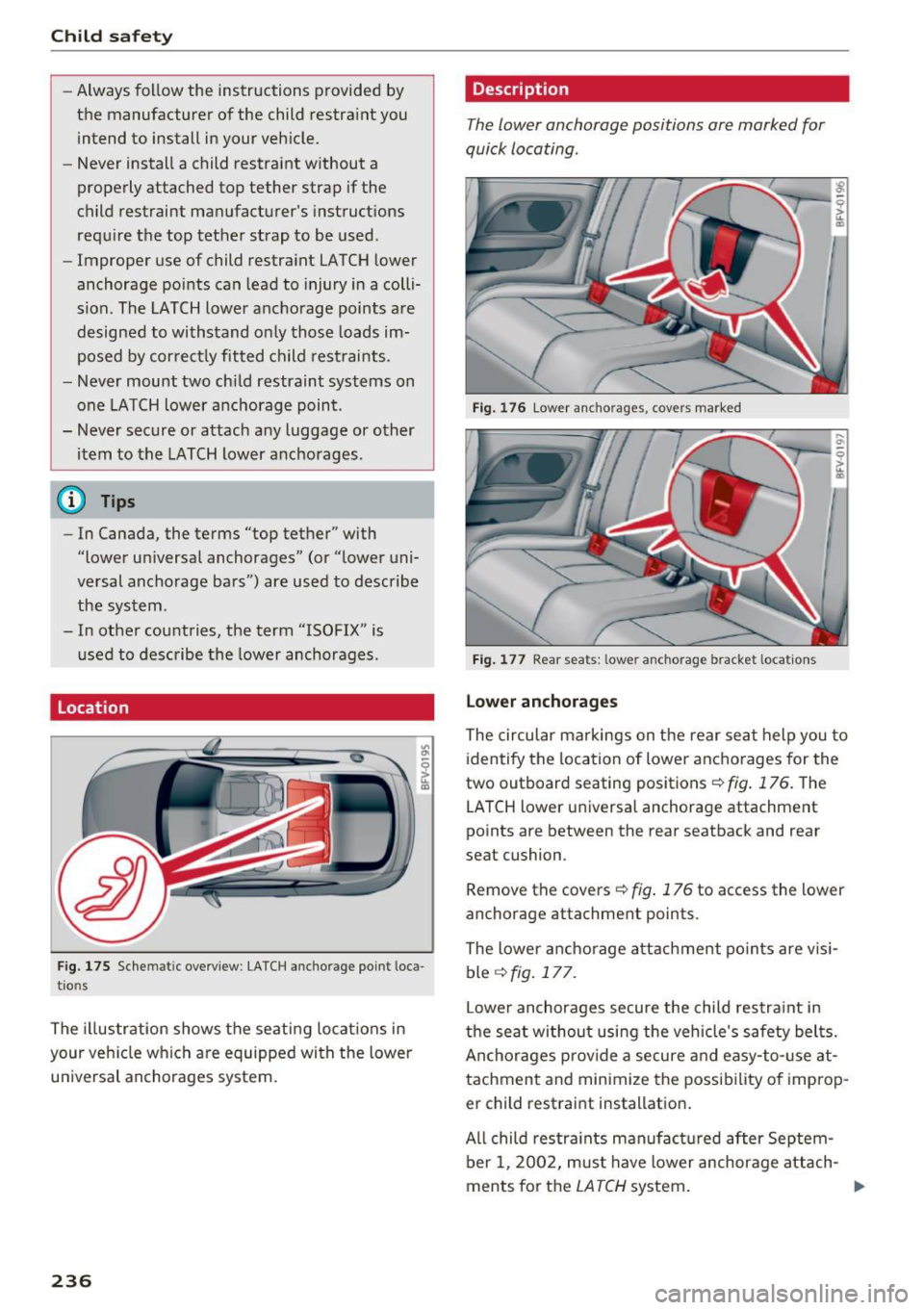
F ig. 175 Schemat ic overv iew: LA TCH anc horage point loca
tions
The illustration shows the seating locat io n s in
your veh icle which are equipped with the lower
universal anchorages system.
236
Description
The lower anchorage positions are marked for
quick locating .
Fig. 176 Lower anchorages, covers marked
F ig . 177 Rear seats: lowe r anchorage bracket locations
L o wer anch orag es
The circular markings on t he rear seat help you to
identify the location of lower anc horages for the
two outboard seating positions ¢
fig. 176 . The
LATCH lower universal anchorage attachment
points are between the rear seatback and rear
seat cushion .
Remove the covers ¢
fig. 176 to access the lower
anchorage attachment points.
The lower ancho rage attac hment po ints are v is i
ble ¢
fig. 177.
Lowe r anchorages secure the child restra int in
the seat wi thou t usi ng the vehicle's safety belts.
Anchorages p rov ide a secure and easy-to- use at
tachment and minimize the possibility o f improp
er child restraint installation.
All child restra ints man ufact ured after Septem
ber 1, 2002, must have lower anchorage attach -
ments for the
LATCH system. ..,.
Page 239 of 322
co
co
.... N
" N .... 0
0
Vl c:o
Please remember that the lower anchorage
points are only intended for installation and at
tachment of child restraints specifically cert ified
for use with
LATCH lower anchorages. Child re
straints that are not equipped with the lower an
chorage attachments can still be installed in
compliance w ith the child restra int manufactur
er 's instructions on using vehicle safety belts .
.8, WARNING
Improper use of LATCH lower anchorages can
cause serious personal injury in an accident.
- Always caref ully follow the child restra ints
man ufactu rer's inst ructions for proper in
sta llation of the child restr aint and proper
u se of the lower anchorages or safety be lts
in your vehicle.
- Never secure or attach any luggage or other
items to the
LATCH lower anchorages.
- Always read and heed t he important infor
mation about child restraints in this chapter
and WARNINGS
¢ page 221, Child safety .
Installing a child restraint with LATCH
lower anchorages
Whenever you install a child restraint always fol
low the child restraint manufacturer's instruc
tions.
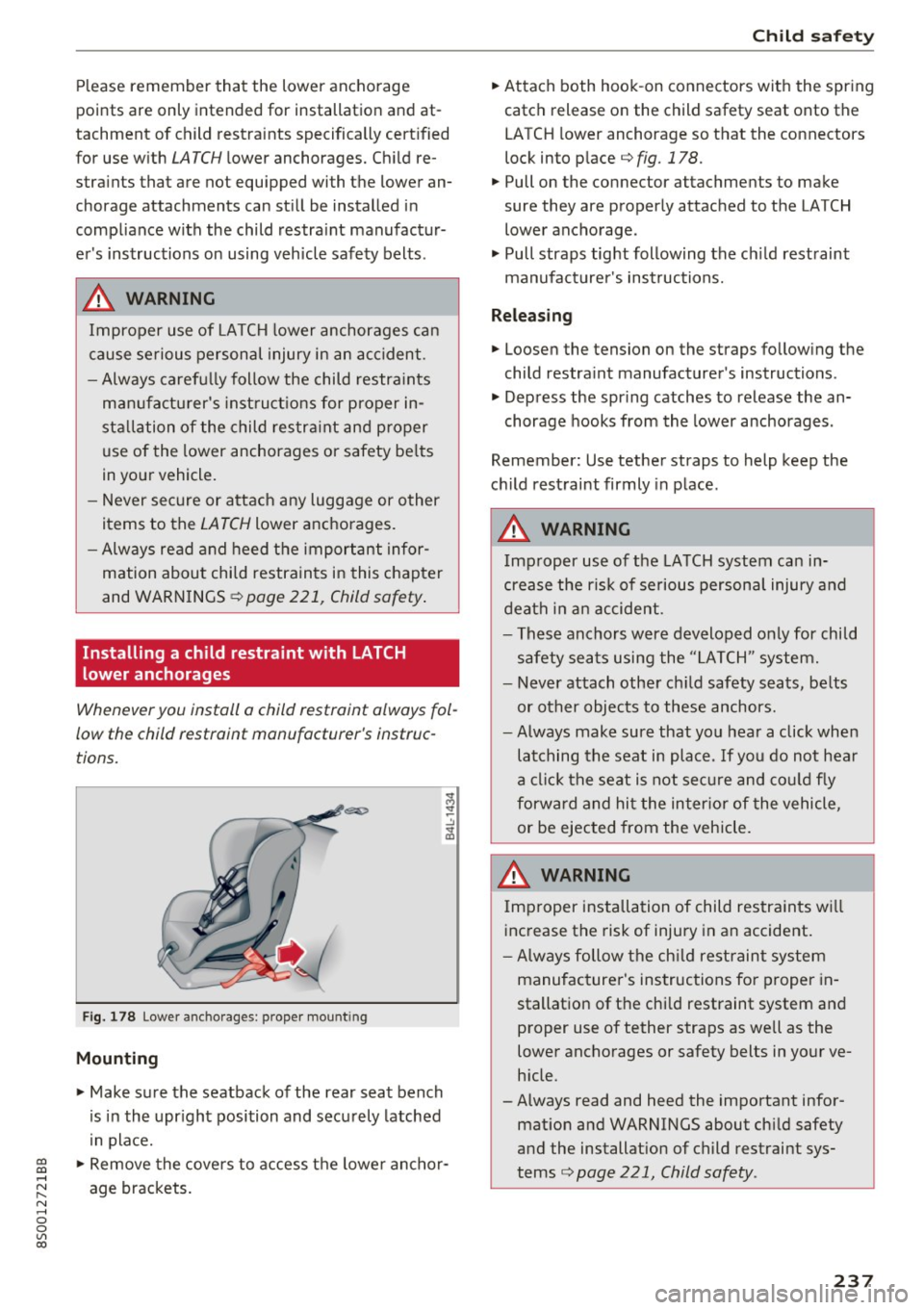
F ig . 178 Lower anchorages: proper mounting
Mounting
.,. Make sure the seatback of the rear seat bench
is in the upr ight position and sec urely latched
i n place.
.,. Remove the covers to access the lowe r anchor
age brackets.
Ch ild safety
.. Attach both hook-on connectors with the spring
catch release on the child safety seat onto the
LATCH lower anchorage so that the connectors
lock into place ¢
fig. 178 .
.. Pull on the connector attachments to make
sure they are properly attached to the LATCH
lower anchorage .
.. Pull straps tight following the ch ild rest raint
manufacturer 's instructions .
Releas ing
.. Loosen the tension on the straps fo llow ing the
child restra int manufacturer's instructions.
.. Depress the spr ing catches to release the an
chorage hooks from the lower anchorages.
Remember: Use tether straps to help keep the
child restraint firmly in place .
.8, WARNING
--Improper use of the LATCH system can in
crease the risk of se rious persona l injury and
death in an accident .
-
-These anchors were developed only for chi ld
safety sea ts using the "LATCH" system.
- Never attach othe r ch ild safety seats, be lts
or other objects to these anchors.
- Always make sure that you hear a click whe n
latching the seat in place.
If you do not hear
a cl ic k the seat is not se cure and co uld fly
forward and hi t the inter ior of the vehicle,
or be ejected from the vehicle .
.8, WARNING ~ -
I mp roper insta llation of child restra ints w ill
increase the risk of injury in an accident.
- Always fo llow the ch ild restraint system
manufacturer's instructions fo r proper in
stallation of the chi ld restraint system and
proper use of tether straps as well as the
lowe r anchorages or safety belts in yo ur ve
h icle .
-Always read and heed the important infor
mat ion and WARNINGS about ch ild safety
and the installation of child restraint sys
tems¢
page 221, Child safety .
237