lock AUDI TT COUPE 2020 Owner's Manual
[x] Cancel search | Manufacturer: AUDI, Model Year: 2020, Model line: TT COUPE, Model: AUDI TT COUPE 2020Pages: 280, PDF Size: 98.79 MB
Page 41 of 280

8S1012721BB
Lights and Vision
By Headlight range control: malfunction! See
owner's manual
There is a malfunction in the headlight range
control system, which may cause glare for other
drivers.
Drive to an authorized Audi dealer or authorized
Audi Service Facility immediately to have the
malfunction corrected.
High beam assistant: malfunction! See owner's
manual
Drive immediately to an authorized Audi dealer
or authorized Audi Service Facility to have the
malfunction repaired. You can still switch the
high beams on or off manually.
High beam assistant: currently unavailable.
Camera view limited due to surroundings. See
owner's manual
The camera view is blocked, for example by a
sticker or debris.
The sensor is located between the interior rear-
view mirror and the windshield. Do not place any
stickers in this area on the windshield.
— Light bulbs are pressurized and can explode
when they are replaced, which increases the
risk of injury.
— With HID headlights (xenon headlights), the
high-voltage component must be handled
correctly. Otherwise, there is a risk of fatal
injury.
Interior lighting
alee Colm Ue Last]
BFV-0181
Fig. 43 Headliner: interior lighting
J - Door contact switch. The interior lighting is
controlled automatically.
A switch is no longer needed to switch the read-
ing lights on. A swiping movement or a brief tap
on the light is all that is needed to switch the
light on or off. If you hold your finger on the
reading light when switching it on, this can dim
the light down to a certain level.
Interior lighting
There are other optional interior lighting func-
tions that are available. Several functions can be
set in the Infotainment system. Select in the In-
fotainment system: |MENU] button > Vehicle >
left control button > Vehicle settings > Interior
lighting.
Instrument illumination
2 S
| > c o
Fig. 44 Light switch: instrument illumination
The brightness of the instrument cluster and the
center console can be adjusted.
> Press the knob to release it.
39
Page 42 of 280
Lights and Vision
> Turn the knob toward "-" or "+" to reduce or in-
crease the brightness.
> Press the knob again to return it to its original
position.
Vision
rata ieee)
- 5
g z
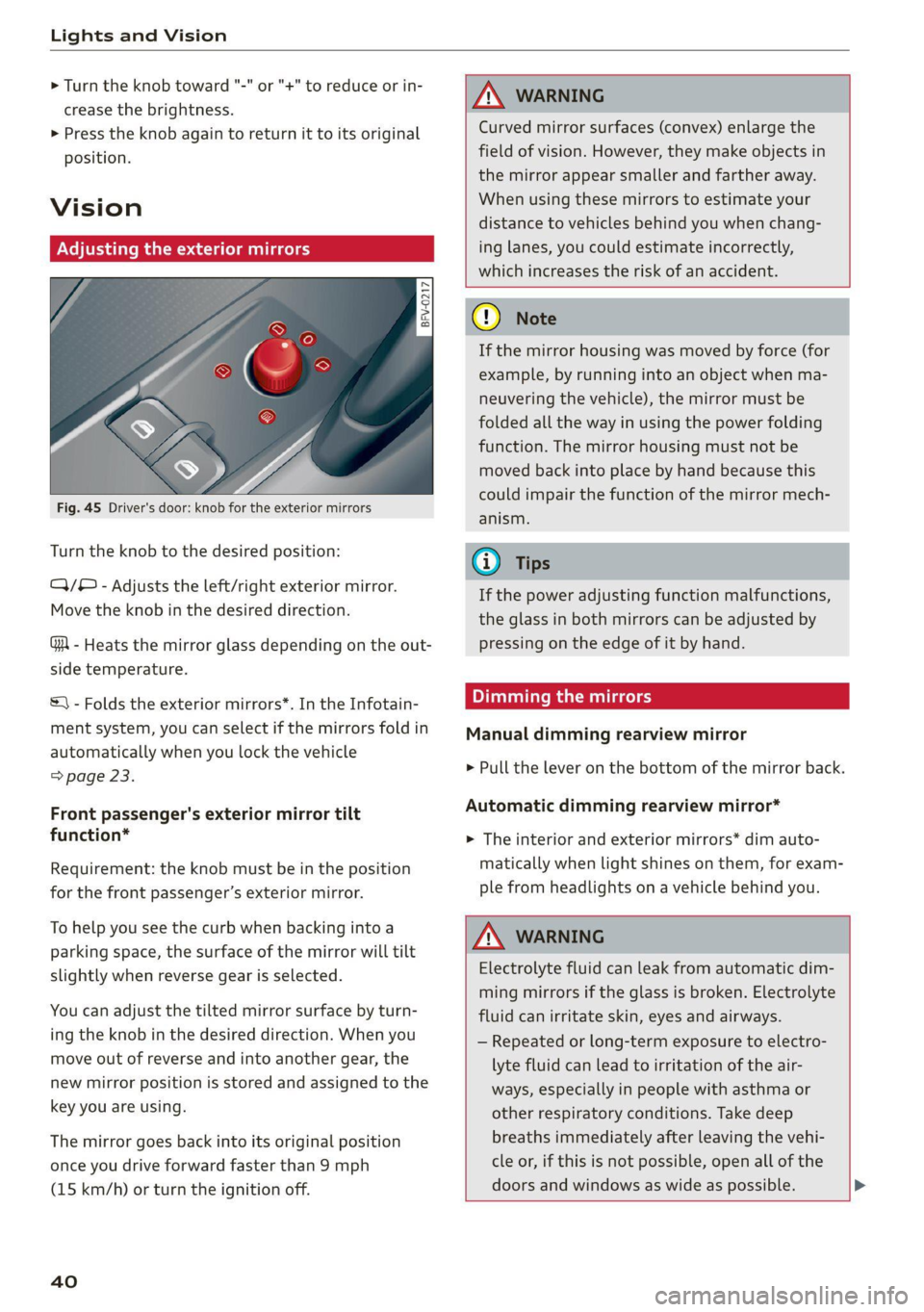
Fig. 45 Driver's door: knob for the exterior mirrors
Turn the knob to the desired position:
Q)/® - Adjusts the left/right exterior mirror.
Move the knob in the desired direction.
GA - Heats the mirror glass depending on the out-
side temperature.
A WARNING
Curved mirror surfaces (convex) enlarge the
field of vision. However, they make objects in
the mirror appear smaller and farther away.
When using these mirrors to estimate your
distance to vehicles behind you when chang-
ing lanes, you could estimate incorrectly,
which increases the risk of an accident.
C) Note
If the mirror housing was moved by force (for
example, by running into an object when ma-
neuvering the vehicle), the mirror must be
folded all the way in using the power folding
function. The mirror housing must not be
moved back into place by hand because this
could impair the function of the mirror mech-
anism.
@ Tips
If the power adjusting function malfunctions,
the glass in both mirrors can be adjusted by
pressing on the edge of it by hand.
Dimming the mirrors
Manual dimming rearview mirror
&) - Folds the exterior mirrors*. In the Infotain-
ment system, you can select if the mirrors fold in
automatically when you lock the vehicle
> page 23. > Pull the lever on the bottom of the mirror back.
a : og
Front passenger's exterior mirror tilt Automatic dimming rearview mirror
function* > The interior and exterior mirrors* dim auto-
Requirement: the knob must be in the position
for the front passenger’s exterior mirror.
To help you see the curb when backing into a
parking space, the surface of the mirror will tilt
slightly when reverse gear is selected.
You can adjust the tilted mirror surface by turn-
ing the knob in the desired direction. When you
move out of reverse and into another gear, the
new mirror position is stored and assigned to the
key
you are using.
The mirror goes back into its original position
once you drive forward faster than 9 mph
(15 km/h) or turn the ignition off.
40
matically when light shines on them, for exam-
ple from headlights on a vehicle behind you.
ZA WARNING
Electrolyte fluid can leak from automatic dim-
ming mirrors if the glass is broken. Electrolyte
fluid can irritate skin, eyes and airways.
— Repeated or long-term exposure to electro-
lyte fluid can lead to irritation of the air-
ways, especially in people with asthma or
other respiratory conditions. Take deep
breaths immediately after leaving the vehi-
cle or, if this is not possible, open all of the
doors and windows as wide as possible. >
Page 45 of 280

8S1012721BB
Lights and Vision
Removing the wiper blade
> Fold the windshield wiper arm away from the
windshield.
> Press the locking knob @ © fig. 48 on the wiper
blade. Hold the wiper blade firmly.
> Remove the wiper blade in the direction of the
arrow.
Installing the wiper blade
> Insert the new wiper blade into the mount on
the wiper arm @) until you hear it latch into
place.
> Place the wiper arm back on the windshield.
> Turn the service position off.
Z\ WARNING
For safety reasons, the windshield wiper
blades should be replaced once or twice each
year.
@) Note
— The windshield wipers must only be folded
up when in the service position! Otherwise,
you risk damaging the paint on the hood or
the windshield wiper motor.
— You should not drive your vehicle or press
the windshield wiper lever when the wiper
arms are folded away from the windshield.
The windshield wipers would move back in-
to their original position and could damage
the hood and windshield.
G) Tips
— You can also use the service position, for ex-
ample, if you want to protect the windshield
from icing by using a cover.
— You cannot activate the service position
when the hood is open.
Messages
If the & indicator light turns on, then there is a
windshield wiper malfunction. Drive to an au-
thorized Audi dealer or authorized Audi Service
Facility immediately to have the malfunction cor-
rected.
>} Automatic wipers: malfunction! See owner's
manual
The light/rain sensor is malfunctioning.
You can still control all functions that are not
controlled by the rain sensor using the wind-
shield wiper lever.
Drive immediately to an authorized Audi dealer
or authorized Audi Service Facility to have the
malfunction repaired.
Digital compass
Switching the compass on and off
Applies to: vehicles with digital compass
BFV-0288
@
Fig. 49 Rearview mirror: digital compass is switched on
> To turn the compass on or off, press the button
@ until the compass display in the mirror turns
on or off.
The digital compass only works when the ignition
is turned on. The directions are indicated with ab-
breviations: N (north), NE (northeast), E (east),
SE (southeast), S (south), SW (southwest), W
(west), NW (northwest).
@) Tips
To prevent inaccurate compass readings, do
not bring any remote controls, electrical devi-
ces or metallic objects near the mirror.
43
Page 49 of 280
8S1012721BB
Sitting correctly and safely
AN WARNING
The power front seats can also be adjusted
when the ignition is switched off. For this rea-
son, children should never be left unattended
in the vehicle because they could be injured.
Ittihad Celameleiacoya)
Applies to: vehicles with multifunction button
You can adjust the side bolsters using the multi-
function button.
> If you turn the multifunction button @
=> page 46, fig. 51 to the left or right, the side
bolsters on the seat backrests will increase or
decrease the lateral support.
@ Tips
The air in the side bolsters* is released as
soon as the driver's door opens. This makes is
possible to enter and exit the vehicle more
comfortably. As soon as you start driving the
vehicle, the side bolsters fill.
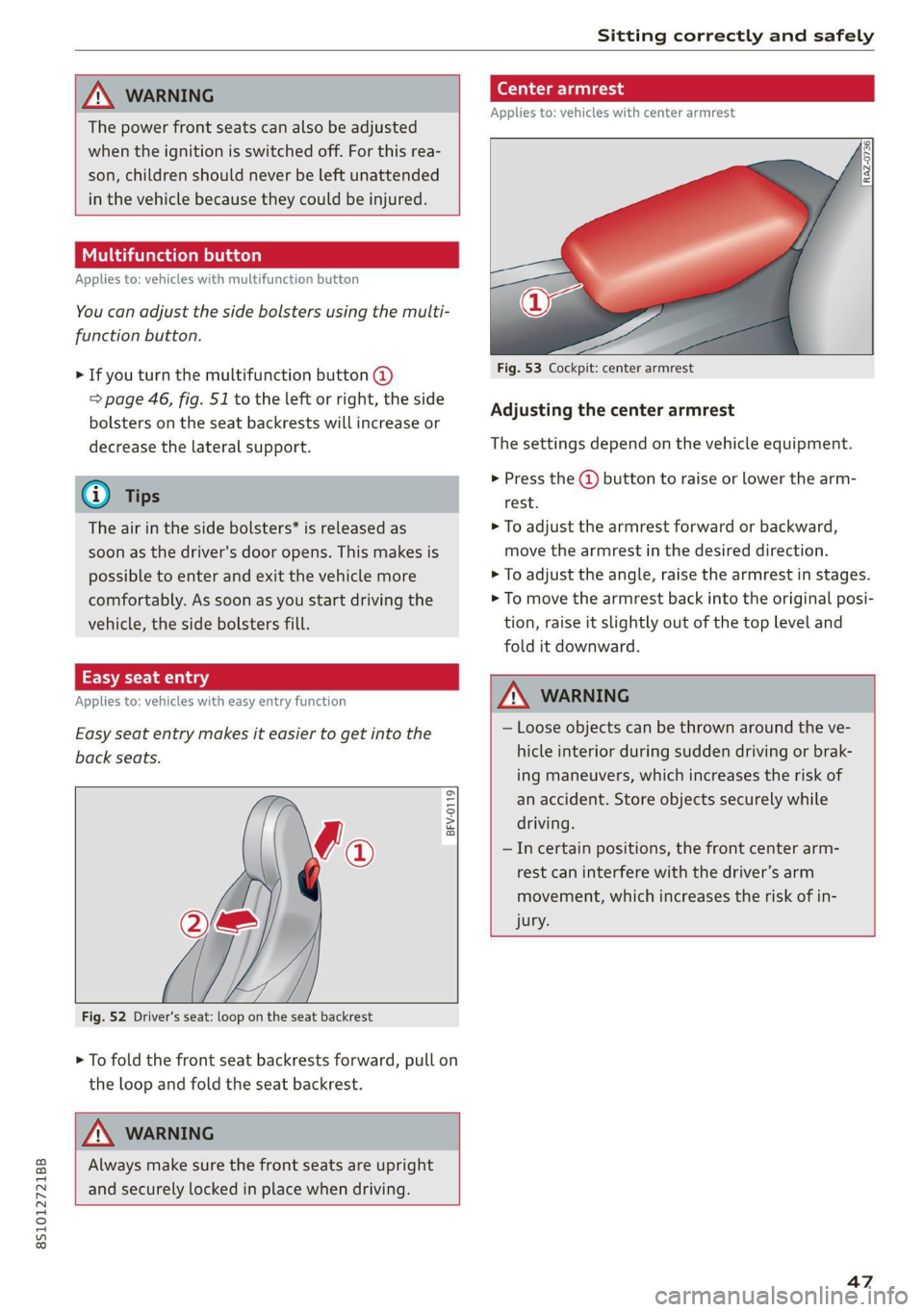
Easy seat entry
Applies to: vehicles with easy entry function
Easy seat entry makes it easier to get into the
back seats.
BFV-0119
Fig. 52 Driver's seat: loop on the seat backrest
> To fold the front seat backrests forward, pull on
the loop and fold the seat backrest.
A\ WARNING
Always make sure the front seats are upright
and securely locked in place when driving.
(ead
Applies to: vehicles with center armrest
Fig. 53 Cockpit: center armrest
Adjusting the center armrest
The settings depend on the vehicle equipment.
> Press the @ button to raise or lower the arm-
rest.
> To adjust the armrest forward or backward,
move the armrest in the desired direction.
> To adjust the angle, raise the armrest in stages.
> To move the armrest back into the original posi-
tion, raise it slightly out of the top level and
fold it downward.
ZA WARNING
— Loose objects can be thrown around the ve-
hicle interior during sudden driving or brak-
ing maneuvers, which increases the risk of
an accident. Store objects securely while
driving.
—Incertain positions, the front center arm-
rest can interfere with the driver’s arm
movement, which increases the risk of in-
jury.
47
Page 53 of 280

8S1012721BB
Sitting correctly and safely
rica mem eee mt Lila ell}
B4H-0462
.
\
B4H-0270
Fig. 59 Releasing the belt buckle from the belt latch
Follow the safety precautions > page 49.
Fastening the safety belt
> Pull the safety belt by the belt buckle evenly
across your chest and lap.
> Insert the belt buckle in the belt latch belong-
ing to the seat until it audibly engages
> fig. 58.
> Pull on the belt to make sure that the belt is se-
curely locked in the latch.
Unfastening the safety belt
> Press the red button on the belt latch > fig. 59.
The belt buckle will pop out.
> Guide the belt back by hand so that the safety
belt can roll up more easily.
Safety belt monitoring system
B- If the indicator light turns on or flashes, a
safety belt is not fastened or it has been unfas-
tened while the vehicle is in motion. Above cer-
tain speeds, additional warning tones will sound.
Additional safety belt functions
Belt retractor lock
Applies to: Coupe: The safety belts on the rear
seats and on the front passenger seat are equip-
ped with a belt retractor lock.
Applies to: Roadster: The safety belt on the front
passenger seat is equipped with a belt retractor
lock.
— If you secure a child safety seat with a safety
belt, the belt retractor lock on the safety belt
may need to be activated. Follow the instruc-
tions from the child safety seat manufacturer.
— When a vehicle passenger has fastened a safety
belt, the belt retractor lock should not be acti-
vated. If the belt retractor lock has been acti-
vated unexpectedly, deactivate it.
Deactivating or activating the belt retractor lock
=> page 60.
Safety belt retractor
The safety belts are equipped with an automatic
belt retractor. This automatic retractor allows the
safety belt to be pulled all the way out when the
belt is pulled slowly. However, the automatic re-
tractor locks during sudden braking maneuvers.
It also locks the belts when accelerating, driving
uphill, and driving around curves.
Belt force limiter
Safety belts with belt force limiters reduce the
force placed on the body by the safety belts dur-
ing a collision.
Safety belt pretensioners
In some collisions, pyrotechnic belt tensioners
may secure the safety belts so that they cannot
loosen. This reduces forward movement by the
vehicle passengers.
Z\ WARNING
The pyrotechnic system can only provide pro-
tection during one collision. If the pyrotechnic
belt tensioners deploy, the pretensioning sys-
tem must be replaced by an authorized Audi
dealer or authorized Audi Service Facility. >
51
Page 60 of 280
Sitting correctly and safely
Child safety seats
General information
When installing and using child safety seats, fol-
low the information in this Owner's Manual, the
applicable state and federal regulations, and the
manufacturer instructions for the child safety
seat.
You can also obtain useful and current informa-
tion from the following sources:
U.S. National Highway Traffic Safety Adminis-
tration
http://www.nhtsa.gov
http://www.safercar.gov
National SAFE KIDS Campaign
http://www.safekids.org
SafetyBeltSafe U.S.A.
http://www.carseat.org
Transport Canada Information Centre
http://www.tc.gc.ca/roadsafety
Audi Customer Experience Center
https://www.audiusa.com/help/contact-us
https://www.audi.ca/ca/web/en/models/layer/
contact.html
Z\ WARNING
To reduce the risk of serious or fatal injuries,
children must always be secured in the vehicle
with a child safety seat that is appropriate for
their body size, weight, and age.
— Children ages 12 and under must be trans-
ported using the appropriate child safety
seat. Note differences in regulations be-
tween states and countries. Applies to
Coupe: Also follow the information about
the correct seating position on the rear
bench seat > page 48.
— Child safety seats secured incorrectly in the
vehicle may cause serious or fatal injuries in
the event of an accident. Always secure the
child safety seat according to the manufac-
turer instructions.
— Children or babies must not under any cir-
cumstances be held on the lap of the driver
or other passengers while driving.
58
— Do not secure more than one child in a child
safety seat.
— Never allow a child to sit in a child safety
seat unsupervised.
— Never allow children to ride unsecured in the
vehicle or to stand or kneel on the seats
while driving. In the event of an accident, a
child could be propelled through the vehicle.
This can cause serious or fatal injuries for
the child and passengers.
If children use an incorrect seating position
while driving, they have a higher risk of in-
jury during a sudden braking maneuver or
accident. This especially applies to children
in the front passenger's seat or children who
have their head near the side airbag deploy-
ment area, if the airbag system is deployed
during an accident. This incorrect seating
position can cause severe or even fatal inju-
ries.
Applies to: Coupe: Make sure there is
enough space in front of the child in the
child safety seat. If necessary, adjust the an-
gle and position of the seat in front of the
child safety seat.
The rear side of a forward-facing child safety
seat should be positioned as close as possi-
ble to the backrest on the vehicle seat.
Applies to: Coupe:Always make sure that the
backrest on the seat where the child safety
seat is installed is securely locked in place
and cannot move forward. Otherwise, the
backrest where the child safety seat is se-
cured could move forward in the event of an
accident or other emergency situation.
NEVER use a rear-facing child safety seat on
a seat with an ACTIVATED FRONT AIRBAG;
this could cause DEATH or SERIOUS INJU-
RIES to a CHILD.
— Applies to: Coupe: Always secure child
safety seats on the rear seats.
— If you use a child safety seat on the front
passenger seat, then the front passenger’s
airbag must be deactivated. Always make
sure that
PASSENGER AIR BAG OFF %; remains
on while driving. If
PASSENGER AIR BAG OFF #¥; does not
Page 62 of 280
Sitting correctly and safely
the side airbags if the child is correctly se-
cured in a suitable child safety seat that is
attached correctly.
— Applies to: Coupe: The lower LATCH anchors
as well as the safety belt may be required to
correctly install some child safety seats. Us-
ing both at the same time is permitted, pro-
vided that the fastening systems or safety
belts do not impair those in an adjacent
seating position.
— All child safety seats are constructed so that
they can be secured using the lap safety belt
in the vehicle.
Trae e re MeComt Lia am OR MOLI
LATCH anchors
Applies to: Coupe
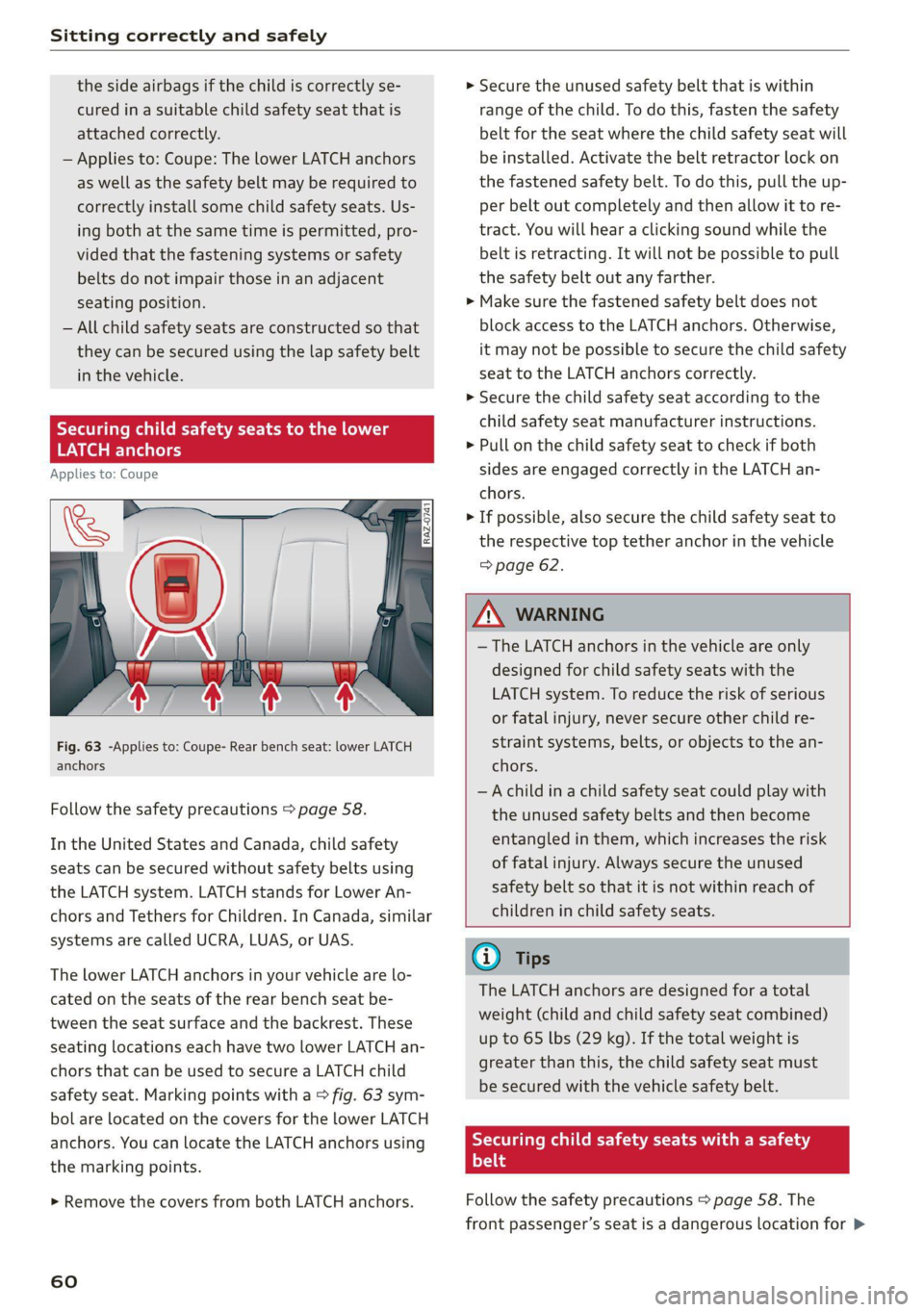
Fig. 63 -Applies to: Coupe- Rear bench seat: lower LATCH
anchors
Follow the safety precautions > page 58.
In the United States and Canada, child safety
seats can be secured without safety belts using
the LATCH system. LATCH stands for Lower An-
chors and Tethers for Children. In Canada, similar
systems are called UCRA, LUAS, or UAS.
The Lower LATCH anchors in your vehicle are lo-
cated on the seats of the rear bench seat be-
tween the seat surface and the backrest. These
seating locations each have two lower LATCH an-
chors that can be used to secure a LATCH child
safety seat. Marking points with a > fig. 63 sym-
bol are located on the covers for the lower LATCH
anchors. You can locate the LATCH anchors using
the marking points.
> Remove the covers from both LATCH anchors.
60
> Secure the unused safety belt that is within
range of the child. To do this, fasten the safety
belt for the seat where the child safety seat will
be installed. Activate the belt retractor lock on
the fastened safety belt. To do this, pull the up-
per belt out completely and then allow it to re-
tract. You will hear a clicking sound while the
belt is retracting. It will not be possible to pull
the safety belt out any farther.
> Make sure the fastened safety belt does not
block access to the LATCH anchors. Otherwise,
it may not be possible to secure the child safety
seat to the LATCH anchors correctly.
> Secure the child safety seat according to the
child safety seat manufacturer instructions.
> Pull on the child safety seat to check if both
sides are engaged correctly in the LATCH an-
chors.
> If possible, also secure the child safety seat to
the respective top tether anchor in the vehicle
=> page 62.
ZA WARNING
— The LATCH anchors in the vehicle are only
designed for child safety seats with the
LATCH system. To reduce the risk of serious
or fatal injury, never secure other child re-
straint systems, belts, or objects to the an-
chors.
—Achild ina child safety seat could play with
the unused safety belts and then become
entangled in them, which increases the risk
of fatal injury. Always secure the unused
safety belt so that it is not within reach of
children in child safety seats.
(i) Tips
The LATCH anchors are designed for a total
weight (child and child safety seat combined)
up to 65 lbs (29 kg). If the total weight is
greater than this, the child safety seat must
be secured with the vehicle safety belt.
Securing child safety seats with a safety
rita
Follow the safety precautions > page 58. The
front passenger’s seat is a dangerous location for >
Page 63 of 280
8S1012721BB
Sitting correctly and safely
a child, even with an advanced airbag system. If
you use a rear-facing child safety seat on the
front passenger’s seat, the front passenger’s air-
bag must be deactivated. Please note the impor-
tant information for this > page 59, Correct posi-
tioning for children and > page 55, Advanced air-
bag system.
Securing child safety seats
> If you secure a child safety seat to the front
passenger's seat, adjust the front passenger's
seat to the highest position.
> Secure the child safety seat according to the
child safety seat manufacturer instructions.
> If necessary, activate the belt retractor lock
=> page 61.
> If the child safety seat is secured on the front
passenger's seat, adjust the front passenger's
seat backrest until it rests flat against the child
safety seat. Also make sure that the upper safe-
ty belt fixture is behind the child safety seat.
» Applies to: Coupe: If you secure a child safety
seat on the rear seat, also secure it to the cor-
rect top tether anchor if possible > page 62.
Activating the belt retractor lock
If you secure a child safety seat using the vehicle
safety belt, you must activate the belt retractor
lock. Follow the child safety seat manufacturer
instructions.
The belt retractor lock prevents the safety belt
from becoming loose while driving, which could
result in the child safety seat no longer being ad-
equately secured.
>» Secure the child safety seat according to the
child safety seat manufacturer instructions.
While doing so, pull out the safety belt. Insert
the safety belt into the belt latch that belongs
to that seat until it audibly locks.
> Pull the upper belt out completely and then al-
low it to retract. You will hear a clicking sound
while the belt is retracting. It will not be possi-
ble to pull the safety belt out any farther.
> Push the child safety seat into the seat and al-
low the belt to retract more.
>» Make sure that the child safety seat cannot
move more than 1 inch (2.5 cm).
Deactivating the belt retractor lock
> Unbuckle the safety belt from the belt latch.
> Remove the child safety seat according to the
manufacturer instructions.
> Allow the safety belt to retract completely. The
belt retractor lock is deactivated.
ZX WARNING
—A safety belt that is not locked by the belt
retractor lock or a locking device cannot se-
cure a child safety seat while driving or in
the event of an accident, which increases the
risk of fatal injury. Always make sure the
belt retractor lock on the safety belt is acti-
vated if the child safety seat manufacturer
instructions require it.
— Due to the risk of fatal injury, never place a
rear-facing child safety seat on the front
passenger's seat when the front passenger's
airbag is switched on.
— For the child safety seat to offer the maxi-
mum protection, it is especially important
to route the vehicle safety belt correctly. Al-
ways follow the instructions from the child
safety seat manufacturer for routing the
safety belt correctly. Incorrectly fastened
safety belts can cause injuries, even during
minor accidents.
61
Page 66 of 280
Stowing and using
@) Note
Beverage containers in the cup holders should
always
have a lid. Otherwise, the liquid inside
could spill and cause damage to vehicle
equipment.
Add
nal storage compartments
Depending on the vehicle equipment, there may
be a variety of storage areas, compartments, and
retainers at various locations in the vehicle.
— Compartments in the doors
— Storage area in the glove compartment. The
glove compartment can be locked using the
mechanical key > page 20.
— Storage compartment under the center armrest
— Key compartment in the center console
— Storage compartment on the rear side of the
driver’s or front passenger's seat. The compart-
ment can hold a maximum weight of 2.2 lbs (1
kg).
— Coat hooks
ZA\ WARNING
—To reduce the risk of injury, make sure all
storage compartments are always closed
while driving.
— Loose objects can be thrown around the ve-
hicle interior during sudden driving or brak-
ing maneuvers, which increases the risk of
an accident. Store objects securely while
driving.
— Only use the storage compartments in the
door trim panels to store small objects that
will not stick out of the compartment and
impair the function of the side airbags.
— Make sure your view toward the rear is not
blocked, for example by hanging clothing or
objects in the vehicle.
— Applies to: Coupe: No heavy or hard objects
may be placed on the storage compartment
behind the rear seat backrest. There is a risk
of injuring the vehicle passengers when
braking suddenly.
— Applies to: Coupe: Only lightweight clothing
should be hung from the garment hooks in
the vehicle. Do not use clothes hangers to
64
hang clothing. The pockets of the clothing
must not contain any heavy, breakable, or
sharp-edged objects. This could impair the
effectiveness of the side curtain airbags.
@) Note
Applies to: Coupe
Make sure that the heating grid strips for the
rear window defogger are not damaged by
abrasive objects.
Luggage compartment
General information
All pieces of luggage or objects must be securely
fastened in the luggage compartment. Note the
following to maintain good vehicle handling:
> Distribute the load evenly in the luggage com-
partment.
> Stow heavy luggage as far forward in the lug-
gage compartment as possible.
> Use non-elastic cords attached to the tie-downs
to secure objects.
ZA WARNING
— Loose objects can be thrown around the ve-
hicle interior during sudden driving or brak-
ing maneuvers, which increases the risk of
an accident. Always stow objects securely in
the luggage compartment and secure them
at the tie-downs. Use straps suitable for
heavy objects.
— If pieces of luggage or objects are secured
to the tie-downs with unsuitable or dam-
aged straps, this can increase the risk of in-
jury during braking maneuvers or accidents.
— When transporting heavy objects, the vehi-
cle characteristics will change due to the
shift in the center of gravity, which increases
the risk of an accident. You may need to
adapt your driving style and speed to the
current conditions.
— The cargo net is only strong enough to se-
cure light objects. Heavy objects are not ade-
quately secured. Attempting to secure heavy
objects increases the risk of injury.
Page 67 of 280
8S1012721BB
Stowing and using
— Never exceed the permitted axle and load
and vehicle weight > page 263.
— Never secure a child safety seat to the tie-
downs.
— Never leave your vehicle unattended, espe-
cially if the luggage compartment lid is
open. Children could enter the luggage com-
partment and close the luggage compart-
ment lid from the inside. This creates the
risk of fatal injury, since the children would
be locked in and may not be able to escape
by themselves.
— Do not allow children to play in or on the ve-
hicle. Close and lock the luggage compart-
ment lid as well as all other doors when you
leave the vehicle.
— Never transport passengers in the luggage
compartment. Every passenger must be cor-
rectly secured with the safety belts in the
vehicle > page 49.
— Applies to: Coupe: The luggage compart-
ment cover must always be securely fas-
tened when in use to reduce the risk of an
accident.
— Applies to: Coupe: The luggage compart-
ment cover is not a surface for storing ob-
jects. Objects placed on the cover increase
the risk of injury to all vehicle occupants
during sudden driving or braking maneuvers
or in the event of an accident.
— Applies to: Coupe: Be careful when releasing
the backrest and folding it forward. To re-
duce the risk of being pinched, pay attention
and check when folding backrests forward.
— Applies to: Coupe: The backrest must be se-
curely latched so objects cannot slide for-
ward out of the luggage compartment dur-
ing sudden braking.
— Applies to: Coupe: Always pull forward on
the backrest to make sure it is check if it is
correctly locked in place.
@) Note
Applies to: Coupe
— If you move the front seat back when the
rear seat backrest is folded forward, you
could damage the head restraints on the
rear seat.
— When folding the backrest forward, make
sure the outer safety belts are in the belt
guide recess so that they do not get pinched
in the backrest lock and damaged. Other ob-
jects should be removed from the rear
bench seat to protect the backrest from
damage.
— Make sure that the heating grid strips for
the rear window defogger are not damaged
by abrasive objects.
G) Tips
— The tire pressure must be adapted to the
load > page 223.
— You can purchase suitable straps at special-
ty stores.
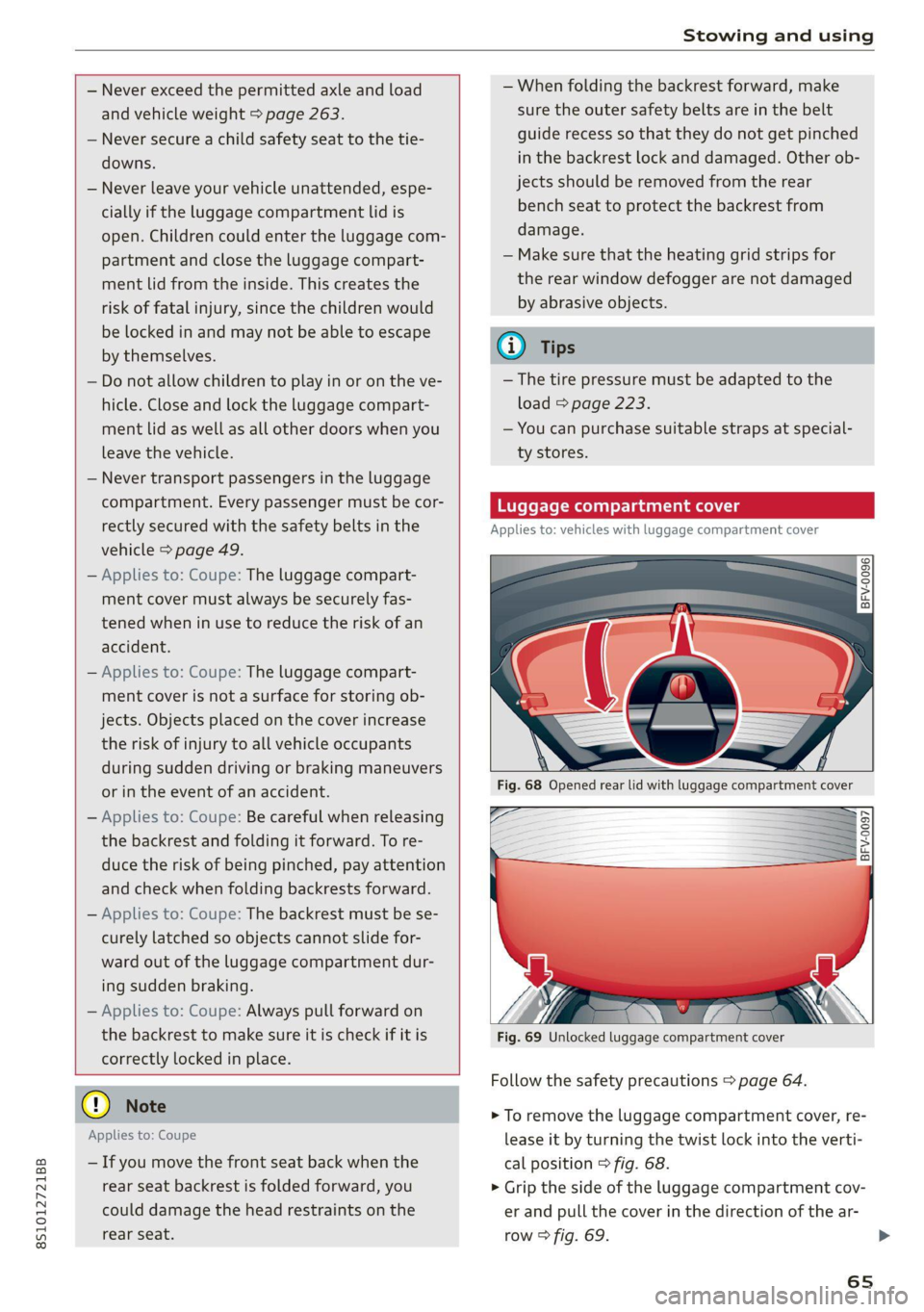
ggage compartment cover
Applies to: vehicles with luggage compartment cover
©) | S| g|
> z 0
=
=
BFV-0097
Fig. 69 Unlocked luggage compartment cover
Follow the safety precautions > page 64.
> To remove the luggage compartment cover, re-
lease it by turning the twist lock into the verti-
cal position > fig. 68.
> Grip the side of the luggage compartment cov-
er and pull the cover in the direction of the ar-
row > fig. 69.
65
>