warning light AUDI TT ROADSTER 2008 Owners Manual
[x] Cancel search | Manufacturer: AUDI, Model Year: 2008, Model line: TT ROADSTER, Model: AUDI TT ROADSTER 2008Pages: 316, PDF Size: 70.1 MB
Page 230 of 316
___ C_h_ e_ c_k _in --== g'-- a_n _d_ f_il _li _n ..:::g:::..- ___________________________________________ _
function and performance of your cooling system and could result
in damage not covered by your New Vehicle Limi ted Warranty .•
Checking the engine coolant level
The engine coolant level can be checked with a quick
g lance .
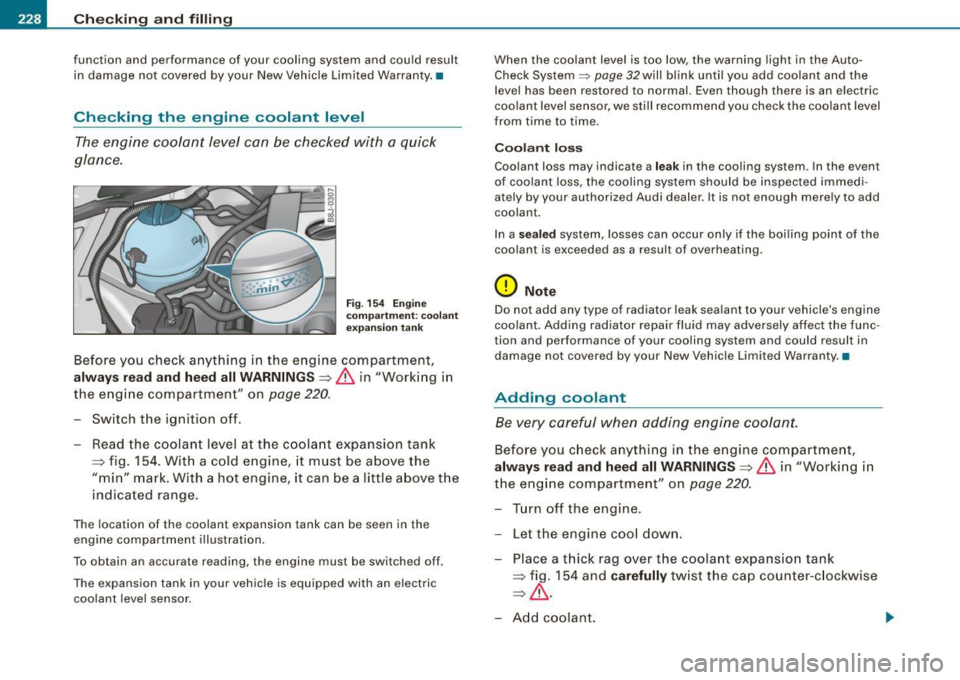
Fig. 154 Engin e
co mpartment : coo lan t
e xpansio n tank
Before you check anything in the engine compartment,
always read and heed all WARNINGS =>
& in "Working in
the engi ne compa rtment" on
page 2 20.
- Switch t he ignition off.
- Rea d the coo lan t leve l at th e co ola nt e xpansion tank
=> fig . 154. Wit h a c old engine , it must be a b ove the
"min" mark . With a hot engine, it can be a little a bove t he
indicated range .
The location of the coo lant expansion tank can be seen in the
engine compartment i llustration.
To obtain an accurate reading, the engine must be switched off .
The expans io n tank in your vehicle is equipped with an electric
coo lant level sensor . When the coolant leve
l is too low , the warning light in the Auto
Check System ~
page 32will blink un til you add coolant and the
level has been restored to normal. Even though there is an electric
coo lant level sensor, we still recommend you check the coolant level
from time to time .
Coolant los s
Coolant loss may indicate a leak in the cooling system . In the event
of coo lant loss, the cooling system should be inspec ted i mmedi
a tely by your authorized Audi dealer . It is no t enough mere ly to add
coolant.
In a
sealed system, losses can occur only if the boi ling point of the
coolant is exceeded as a result of overheating.
0 Note
Do not add any type of radiator leak sea lant to your vehicle's engine
coo lant. A dding ra diator repair fluid may adversely affec t the func
tion and performance of your cooling system and could result in
damage not cove red by your New Veh icle Limi ted War ranty. •
Adding coolant
Be very careful when adding en gine coolant.
Before you c heck anything in the engine compartment,
always read and heed all WARNINGS =>
& in "Working in
the eng ine compa rtment" on
page 220 .
-Turn off the engine.
- Let the engine coo l dow n.
- Place a t hick rag
over th e coola nt expansio n tank
=> fig . 154 and carefully twist the cap cou nter -c lockwise
=> & .
- Add coolant .
Page 231 of 316
___________________________________________ C_ h_e _c_ k_ i_n _g _ a_n _d_ f_il _li _n _g __ ffllll
•
- Twist the cap on again tightly.
Replacement engine coolant must conform to exact specifications
=>
page 227, "Coolant ". If in an emergency coolant additive G12 + is
not avai lab le, do
not use a d ifferen t addit ive. Use p lain water
instead until you can get the correct additive and can restore the
correct ratio . This should be done as soon as possib le .
If you have lost a considerable amoun t of coolant, then you should
add cold antifreeze and cold water only when the engine is cold.
Always use
new engine coolan t when refilling .
Do not fi ll coolant above the "MAX" mark. Excess coo lant will be
forced out through the pressure relief va lve in the cap when t he
engine becomes hot.
& WARNING
• The cooling system is under pres sure a nd can g et very hot.
Reduce the ri sk of scald ing from ho t co olant b y following the se
s tep s.
- Turn off the engine and allow it to cool d own .
- Prote ct your fa ce , hand s and arm s from e scaping fluid and
st eam b y covering the cap with a l arge , thick rag .
- Turn the cap slo wly and very carefully in a count er-c lockw ise
dire ction while applying light , do wnward pres sure on th e top
o f the cap.
- To avoid b eing burned , do not spill antifre eze or coolant on
th e ex haus t syste m or hot e ngine parts . Under cert ain co nd i
tion s, the eth yle ne gly col in en gine co ola nt can cat ch fire .
• Antifr ee ze is poison ous. Alw ay s s tore antifr ee ze in its origi nal
c ontainer and well out of the re ach of children.
• If you dr ain th e coola nt , it mu st be caught and safe ly stored in
a proper contain er cle arly m ark ed "p oison ".
0 Note
• Coolant po llutes the env ironment and could cause an engine
fire . Excess coo lant wil l be forced out through the pressure relief
valve in the cap when the engine becomes ho t.
• I f, in an emergency, only water can be added, the correct ratio
between water and antifreeze=>
page 227must be restored as soon
as possib le .
<£> For the sake of the environment
Drained coolant should not be reused . Always dispose of used
coolant while observi ng all environmental regulations. •
Radiator fan
The radiator fan switches on automatically by itself.
The electric radiator fan is controlled by thermoswitches that switch
on and off depending on coolant and engine compartment temper
atures.
An auxiliary electric radiator fan * switches on and off depending on
coolant temperature and other vehic le operation conditions .
After you switch the eng ine o ff, the aux iliary fan can continue
running for up to 10 minutes -even with the ignition off. It can even
switch on again later by itself=>& , if
• the temperature of the engine coolant rises due to the heat
build -up from the engine in the engine compar tment, or
• the engine compartment heats up because the vehicle is parked
in intense sunlight.
& WARNING
• To reduc e the ri sk of per sonal in jur y nev er t ouch t he radiato r
f a n . .,_
Vehicle care
I t •
Page 232 of 316
___ C_h_ e_ c_k _in --== g'-- a_n _d_ f_il _li _n ..:::g:::..- ___________________________________________ _
& WARNING (continued)
• The auxiliary electric fan is temperature controlled and can
switch on suddenly even when the engine is not running.
• The auxiliary radiator fan switches on automatically when the
engine coolant reaches a certain temperature and will continue to
run until the coolant temperature drops. •
Brake fluid
Checking brake fluid level
The brake fluid level can be checked with a quick glance.
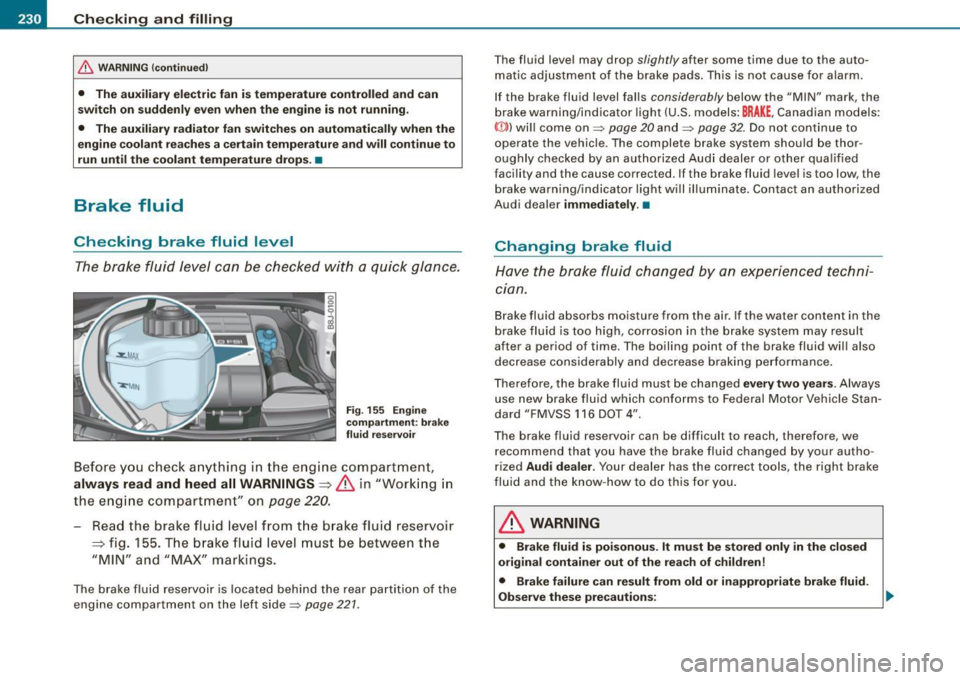
Fig. 155 Engine
compartment: brake
fluid reservoir
Before you check anything in the engine compartment,
always read and heed all WARNINGS =>
& in "Working in
the engine compartment" on
page 220.
- Read the brake fluid level from the brake fluid reservoir
~ fig. 155. The brake fluid level must be between the
"MIN" and "MAX" markings.
The brake fluid reservoir is located behind the rear partition of the
engine compartment on the left side~
page 221 .
The fluid level may drop slightly after some time due to the auto
matic adjustment of the brake pads. This is not cause for alarm.
If the brake fluid level falls
considerably below the "MIN" mark, the
brake warning/indicator light (U .S. models:
BRAKE , Canadian models:
ill) will come on~ page 20 and~ page 32. Do not continue to
operate the vehicle . The complete brake system should be thor
oughly checked by an authorized Audi dealer or other qualified
facility and the cause corrected. If the brake fluid level is too low, the
brake warning/indicator light will illuminate. Contact an authorized
Audi dealer
immediately .•
Changing brake fluid
Have the brake fluid changed by an experienced techni
cian.
Brake fluid absorbs moisture from the air. If the water content in the
brake fluid is too high, corrosion in the brake system may result
after a period of time. The boiling point of the brake fluid will als o
decrease considerably and decrease braking performance.
Therefore, the brake fluid must be changed
every two years. Always
use new brake fluid which conforms to Federal Motor Vehicle Stan
dard "FMVSS 116 DOT 4".
The brake fluid reservoir can be difficult to reach, therefore, we
recommend that you have the brake fluid changed by your autho
rized
Audi dealer . Your dealer has the correct tools, the right brake
fluid and the know -how to do this for you.
& WARNING
• Brake fluid is poisonous. It must be stored only in the closed
original container out of the reach of children!
• Brake failure can result from old or inappropriate brake fluid.
Observe these precautions : .,,_
Page 235 of 316
__________________________________________ C_ h _ e_c _k _in _ g =- a_ n __ df _i_ lli _n ___ g __ __
•
The following WARNINGS are very important when
working on the battery:
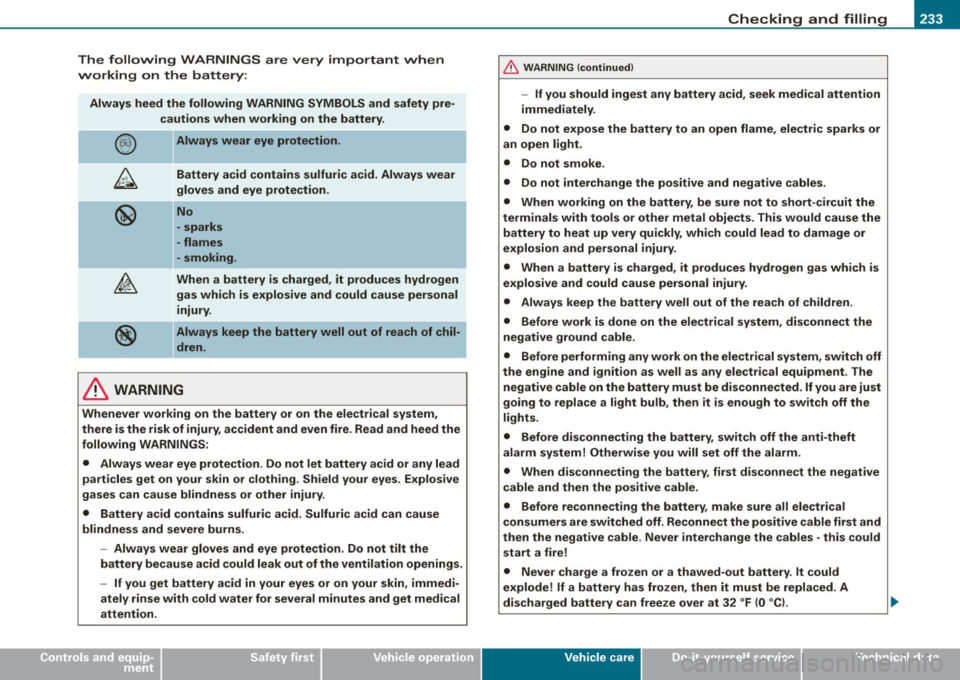
Always heed the following WARNING SYMBOLS and safety pre
cautions when working on the battery .
Always wear eye protection.
Battery acid contains sulfuric acid. Always wear
gloves and eye protection.
No
- sparks
- flames
- smoking.
When a battery is charged, it produces hydrogen
gas which is explosive and could cause personal
injury.
Always keep the battery well out of reach of chil
dren.
& WARNING
Whenever working on the battery or on the electrical system,
there is the risk of injury, accident and even fire. Read and heed the
following WARNINGS:
• Always wear eye protection. Do not let battery acid or any lead
particles get on your skin or clothing. Shield your eyes. Explosive
gases can cause blindness or other injury.
• Battery acid contains sulfuric acid. Sulfuric acid can cause
blindness and severe burns.
- Always wear gloves and eye protection. Do not tilt the
battery because acid could leak out of the ventilation openings.
- If you get battery acid in your eyes or on your skin, immedi
ately rinse with cold water for several minutes and get medical
attention.
& WARNING (continued)
-If you should ingest any battery acid, seek medical attention
immediately.
• Do not expose the battery to an open flame, electric sparks or
an open light.
• Do not smoke.
• Do not interchange the positive and negative cables .
• When working on the battery, be sure not to short -circuit the
terminals with tools or other metal objects. This would cause the battery to heat up very quickly, which could lead to damage or
explosion and personal injury.
• When a battery is charged, it produces hydrogen gas which is
explosive and could cause personal injury.
• Always keep the battery well out of the reach of children.
• Before work is done on the electrical system, disconnect the
negative ground cable.
• Before performing any work on the electrical system, switch off
the engine and ignition as well as any electrical equipment. The
negative cable on the battery must be disconnected.
If you are just
going to replace a light bulb, then it is enough to switch off the
lights.
• Before disconnecting the battery, switch off the anti-theft
alarm system! Otherwise you will set off the alarm.
• When disconnecting the battery, first disconnect the negative
cable and then the positive cable.
• Before reconnecting the battery, make sure all electrical
consumers are switched off. Reconnect the positive cable first and
then the negative cable . Never interchange the cables - this could
start a fire!
• Never charge a frozen or a thawed-out battery. It could
explode! If a battery has frozen, then it must be replaced. A
discharged battery can freeze over at 32 °F (0 °CI. .,,_
Vehicle care
I t •
Page 236 of 316
___ C_h_ e_ c_k _in --== g'-- a_n _d_ f_il _li _n ..:::g:::..- ___________________________________________ _
& WARNING (continued)
• Make sure the vent hose is always attached to the opening on
the side of the battery.
• Never use batteries which are damaged. Danger of explosion!
Always replace a damaged battery .
& WARNING
California Proposition 65 Warning :
• Battery posts, terminals and related accessories contain lead
and lead compounds, chemicals known to the State of California
to cause cancer and reproductive problems. Wash hands after
handling .
0 Note
• Do not disconnect the vehicle battery when the ignition is
switched on or when the engine is running, otherwise, you will
damage electronic components in the electrical system.
• When working on the engine, protect the battery housing from
ultraviolet (UV) rays by not parking the vehic le in direct sunlight.
• If your vehicle is going to stand for a long period of time without
being driven , protect the battery from "freezing", otherwise it will
be damaged and will then have to be replaced. •
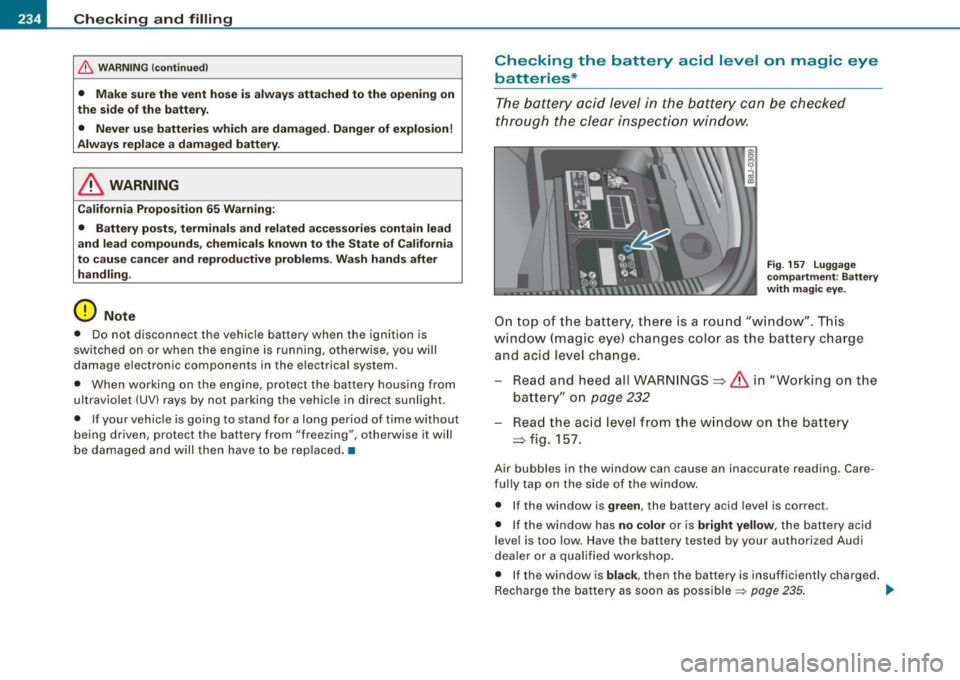
Checking the battery acid level on magic eye
batteries*
The battery acid level in the battery can be checked
through the clear inspection window.
I
Fig. 157 Luggage
compartment : Battery
with magic eye.
On top of the battery, there is a round "window". This
window (magic eye) changes color as the battery charge
and acid level change.
- Read and heed all WARNINGS=>
& in "Working on the
battery" on
page 232
- Read the acid level from the window on the battery
=> fig. 157.
Air bubbles in the window can cause an inaccurate reading. Care
fully tap on the side of the window.
• If the window is
green, the battery acid level is correct.
• If the window has
no color or is bright yellow, the battery acid
level is too low. Have the battery tested by your authorized Audi
dealer or a qualified workshop.
• If the window is
black , then the battery is insufficiently charged.
Recharge the battery as soon as possible =>
page 235. ...
Page 238 of 316
___ C_h_ e_ c_k _in --== g'-- a_n _d_ f_il _li _n ..:::g:::..- ___________________________________________ _
& WARNING (continued)
• To reduce the danger of explosion, never connect or disconnect
charger cables while the charger is operating.
• Fast charging a battery is dangerous and should only be
attempted by a competent technician with the proper equipment.
• Battery acid that may spill during charging should be washed
off with a solution of warm water and baking soda to neutralize
the acid.
0 Note
Never use a fast charger as a booster to start the engine. This will
seriously damage sensitive electronic components , such as control
units, relays, radio, etc., as well as the battery charger.
[ i ] Tips
The vehicle battery must not be charged with a standard small
charger that plugs into the cigarette lighter or outlet .•
Windshield /headlight washer
container
Using plain water is not adequate for filling the wind
shield washer system and the headlight washer system*.
Fig . 159 Fender, left:
Windshield washer
fluid reservoir
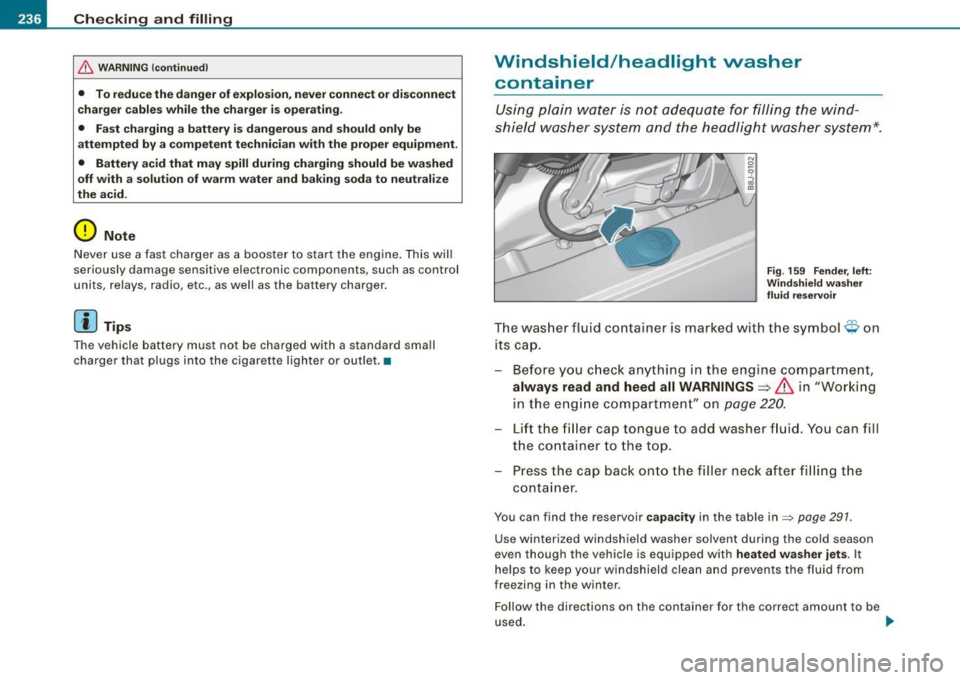
The washer fluid container is marked with the symbol e.;. on
its cap.
- Before you check anything in the engine compartment,
always read and heed all WARNINGS=> & in "Working
in the engine compartment" on
page 220.
-Lift the filler cap tongue to add washer fluid. You can fill
the container to the top.
- Press the cap back onto the filler neck after filling the
container .
You can find the reservoir capacity in the table in~ page 291.
Use winterized windshield washer solvent during the cold season
even though the vehicle is equipped with heated washer jets. It
helps to keep your windshield clean and prevents the fluid from
freezing in the winter.
Follow the directions on the container for the correct amount to be
used.
~
Page 247 of 316
________________________________________________ T_ i _r_e _s_ a_n_ d_ w_ h_ e_e _ l_s __ _
•
pressure for a trip - even one that you would not consider to be
"long." See=>
page 246, "Tires and vehicle load limits" for more
important information .
Always use an accurate tire pressure gauge when checking and adjus ting inflation pressures . Check all of the tires and be sure not
to forget the spare tire . If the pressure in any tire is too high when
the tire is "cold," let air out of the tire slowly with the edge of the tire gaug e and keep checking the pressur e until you reach the pressure
that is correct for the load (passengers and luggage) and kind of driving you plan to do.
I f the pressure in any tire is too low, note the difference between the
pressure in the cold tire and the pressure you need and add the air
that you need to reach the correct pressure for the vehicle load
(passengers and luggage) for the tires on your vehicle as listed on
the on your vehicle and in this manual and the kind of driving you
plan to do.
Ne ver e xceed the m aximum inflat ion pre ssure l isted on the tire
sid ewall for any rea son .
Remember that the veh ic le manufacturer, not the tire manufacturer ,
determin es the correct tire pressure for the tires on your vehicle .
It is important to check the tire pressure when the tires are cold .
• Read the required tire pressure from the tire pressure label
located on driver 's side 8 -pillar.
• T urn the va lve stem cap counter -clockwise to remove it from the
tire valve .
• Place the air pressure gauge on the valve .
• The tire pressures should only be checked and adjusted when
the tires are cold. The s lightly raised pressures of warm tir es mus t
not be reduced.
• Adjust the tire pressure to the load you are carrying .
• Reinstall the va lve stem cap on the valve .
When should I ch eck the tir e pr essu re?
The correct tire pressure is especially important a t high speeds . The
pressure should therefore be checked a t least once a month and
a lways before sta rting a journey.
Wh en sho uld I adjust the tire p re ss ure s?
Adjust the tire pressure to the load yo u are carrying . After changing
a wheel
o r replacing wheels you have to adjust the tire pressures on
a ll whee ls . In addition, you must then initia lize the new tire pres
sures in the tire pressure monitoring system=>
page 41.
& WARNING
Incorre ct t ir e pre ssures and /or underinfl ati on ca n lead sudden tire
failure , los s of contro l, colli sion , seriou s per sonal injury or even
death .
• Whe n the w arnin g sy mbol appear s in the instrument
cl uster , sto p and in spe ct the tire s.
• Inco rre ct tire pre ssure and /or underin flati on can cau se
in creased tire wear and can affe ct the ha ndling of the vehicle and
s topping ability.
• Incorre ct t ire pre ssures and /or underinfl atio n c an a ls o le ad to
s udden tire f ailure , including a blowout and sudden deflation ,
ca usi ng loss o f vehi cle co ntrol.
• The driv er i s re sp o nsible for the correct tire p re ss ure s for all
tire s on the vehicle . T he appl icable pre ssure v alu es are lo ca ted o n
a stic ker on th e driver 's side B -pillar.
• Onl y w hen all tire s on th e veh icle a re fi lled to the corre ct pre s
s ure , the tire pre ssure monitor ing sy ste m can work correctly .
• The u se of incorre ct t ire pr essure val ues can lead to accidents
or other d am age. The refo re it is esse ntial th at the dri ver ob serve
the spe cified tire pr essur e value s fo r the t ire s and the correc t pr es
s ures for the function of the tire pr essure monitoring sy stem.
• Always inflate t ires to the r ecom mended and corre ct tir e pr es -
su re bef ore dri ving off.
~
Vehicle care I t •
Page 261 of 316
________________________________________________ T_ i _r_e _s_ a_n_ d_ w_ h_ e_e _ l_s __ lfll
•
Handling characteristi cs change wh en dri ving with
low air pressure or with flat tires even with special run
flat tires
A low pressure or flat front tire affects vehicle hand lin g charac te ri s
t ics by pulling the vehic le slightly to the side where the tire is
mounted and reduces brak ing performance .
A low pressure or flat
rear tire also affec ts driving c haracteristics by
pul ling to the side where th e tire is mounted and also reduces
b raki ng per for mance . T he ef fec t o n ve hic le han dlin g is most n otice
able when driving around curves .
& WARNING
Changed vehicle handling characteristics when driv ing in the run
flat mode can cause lo ss of vehicle control , a crash and serious
personal injury .
• Driving on special run-flat tires in the run -flat mode will change
vehicle handling characterist ics during braki ng , when cornering
and under heavy acceleration .
• Never drive faster than the max imum rated speed of 50 mph
(80 km /h) when driving in the run -flat mode .
• Always adjust vehicle speed to traffic , road and weather condi
tions and drive slower than the maximum rated speed if nece ssary
weather and road conditions are taken into ac count .
• Always obey speed limits and other traffic laws .
0 Note
We always recommend driv ing with even more care when using
these special tires in the run -flat mode. A lways avoid sudden
m aneuvers. •
Applies to vehic les: with Run-f lat tires
Replacing run -flat tires and rims
Y our vehicle was especi ally des igned to use special run
fl at t ires.
You may use and c ombi ne o nly approved run -flat t ires a nd specia l
matching rims that have been designed for run -flat tires. Mounting
special run -fla t tires o n stan dard wheels w ill not work and wi ll not
provide the advantages fo the run -falt feature. Never us e special
run-flat tir es o n standard whee l rims.
After driving with a tire in the run -f lat mode, always have the vehicle
and affected tire(s) and rim(s) inspected by an a uthorized Audi
dea ler. T ires tha t have been driven i n the run -fla t mode mus t be
replaced.
& WARNING
Use of damaged run-flat tires and rims c an cause vehicle damage
that can lead to loss of vehicle control , a crash and serious
personal injury.
• Always have the vehi cle and affected tire (sl and rim(s )
inspe cted by an authorized Audi dealer after driving a tire in the
run -flat mode .
• Tires that have been driven in the run -flat mode must be
repla ced .•
Vehicle care
I t •
Page 267 of 316
_______________________________________________ W_ h_ a _ t_d_ o_ l _d _o_ n_ o_ w_ ? _ __.1111
- Remove the "max. 50 mph" (80 km/h) sticker from the
sealant bottle and affix it to the instrument cluster in the
driver's view.
& WARNING
• Turn the hazard flashers on and set up the warning triangle if
you have a flat tire in moving traffic . In this way you protect your
self and other road users.
• Make sure that all passengers are in a safe place, out of the
danger zone (for example, behind a guard rail).
0 Note
Particular care is necessary if you are making a tire repair on a steep
incline.
[ i] Tips
Obey all laws. •
Applies to vehicles: with T ire Mobil ity System
Making a tire repair
Tire repair consists of the following sections.
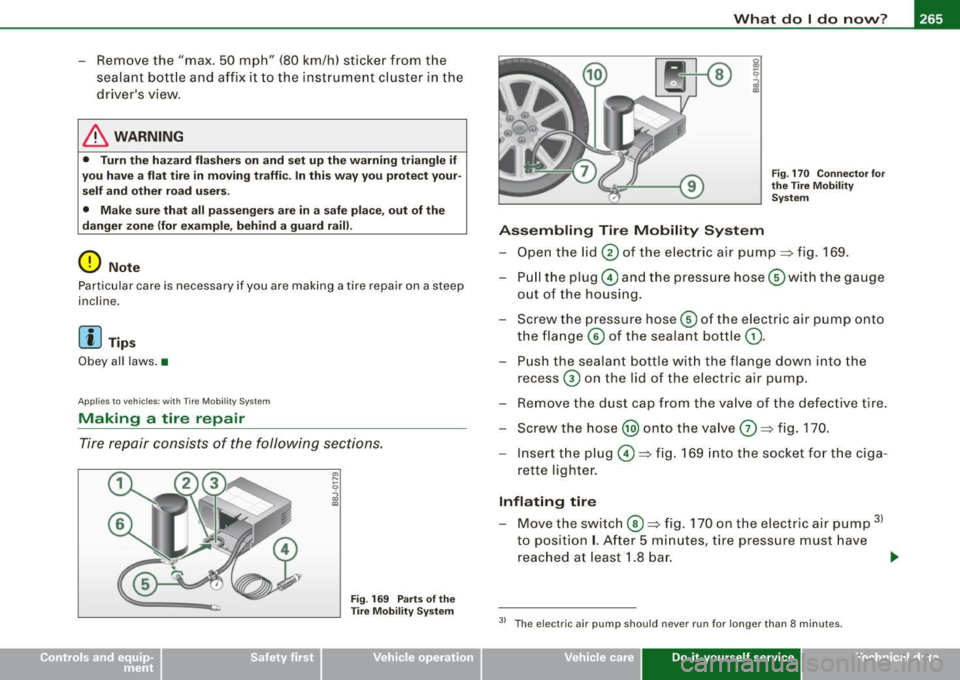
Fig. 169 Parts of the
Tire Mobility System Fig
. 170 Connector for
the Tire Mobility System
Assembling Tire Mobility System
- Open the lid 0 of the electric air pump~ fig. 169.
- Pull the plug© and the pressure hose G)with the gauge
out of the housing.
- Screw the pressure hose© of the electric air pump onto
the flange © of the sealant bottle
G).
- Push the sealant bottle with the flange down into the
recess
G) on the lid of the electric air pump.
- Remove the dust cap from the valve of the defective tire.
- Screw the hose @) onto the valve
G) ~ fig. 170.
- Insert the plug©~ fig. 169 into the socket for the ciga-
rette lighter.
Inflating tire
- Move the switch®~ fig. 170 on the electric air pump 31
to position I. After 5 minutes, tire pressure must have
reached at least 1.8 bar.
~
3> The e lectric air pump should never run for longer than 8 minutes.
Vehicle care Do-it-yourself service irechnical data
Page 268 of 316
11111.___W_ h_ a _ t_d_ o_ l _d _o_ n_ o_ w_ ? ______________________________________________ _
- Switch the electric air pump off - switch in position
0. If
the required tire pressure of at least 1.8 bar has not been
reached, follow the instructions in the section Re
inflating tire.
Re-inflating tire
-Remove the hose from the valve and pull the plug out of
the socket.
- Drive the vehicle slowly 10 meters backward or forward.
This helps to distribute the sealant better.
- Remove the empty inflation bottle and screw the hose
G)
=> page 265, fig. 169 from the electric pump directly onto
the valve.
- Insert the plug ©=>
page 265, fig. 169 into the socket for
the cigarette lighter.
- Move the switch
@ => page 265, fig. 170 on the electric
air pump
31 to position I. After 5 minutes, tire pressure
must have reached at least
1 .8 bar.
- Switch the electric air pump off - switch in position
0. If
the required tire pressure of at least 1.8 bar has not been reached, it is not possible to make a repair with the tire
sealant. Seek professional assistance.
Disassembling Tire Mobility System
- Remove the hose from the valve and pull the plug out of
the socket.
- Screw the dust cap onto the valve.
- Place the empty sealant bottle back in the original pack-
aging and cl ip it in place under the floor so that no tire
sealant can run out into t he vehicle. -
Place the electric air pump in the luggage compartment
for the time being.
- Start driving right away so that the sealant is distributed
in the tire.
& WARNING
• Follow the manufacturer's safety instructions on the decal for
the air pump and the sealant bottle.
• If a tire pressure of 1.8 bar cannot be achieved after pumping
for 5 minutes, the tire is too severely damaged. Do not continue to
drive.
• Seek professional assistance if it is not possible to repair the
tire with the tire sealant.
[ i] Tips
• Do not operate the electric air pump for more than 8 minutes
without stopping, otherwise it can overheat. When the air pump has
cooled down, you can continue to use it.
• If sealant has escaped, allow it to dry, then you can peel it off. •
Applies to vehic les : with Tire Mobil ity Sys tem
Final check
After driving for a short distance , tire pressure
must be checked
- After driving for about 10 minutes, stop and check the
tire pressure .
- If tir e pressure is still at least 1.3 bar, inflate the tire to
specified pressure (see driveas side B -pillarl, drive to the
next repair shop and have the tire and the sealant bottle
replaced.
~