warning light AUDI TT ROADSTER 2008 Repair Manual
[x] Cancel search | Manufacturer: AUDI, Model Year: 2008, Model line: TT ROADSTER, Model: AUDI TT ROADSTER 2008Pages: 316, PDF Size: 70.1 MB
Page 159 of 316
Monitoring the Advanced Airbag
System
Airbag monitoring indicator light t!
Two separate indicators monitor the function of the
Advanced Airbag System: the airbag monitoring indica tor
light and the
PASSENGER AIR BAG OFF light.
The Advanced Airbag System (including the e lectronic control unit ,
sensor circu its and system w iring) is monitored cont inuously to
make sure that it is functioning proper ly whenever the ignition is on.
Each time you turn on the ignition, the airbag monitoring in dicator
light
r~ will come on for a few seconds (self diagnostics) .
The sy stem mu st be in spe cted wh en the ind icat or
light ~:
• does not come on when the ignition is switched on ,
• does not go out a few seconds after you have switched on the
ignit ion , or
• comes on whi le driving.
I f an airbag system malfunction is detected, the indicator light will
f irst start flashing to catch the driver 's attention and then stay on
continuously to serve as a constant reminder to have the system
inspected immediately .
I f a malfunction occurs that turns the front airbag on the passenger
side off , the
PAS SEN GER AIR BAG OFF light will come on and stay on
whenever the igni tion is on .
& WARNING
An airbag system that is not fun ctioning properly cannot provide
s upplementa l p rotect ion in a front al cr ash.
• If the airbag ind icator light come s on , it mean s that ther e m ay
be something wr ong with the Adv anced Airb ag S ystem . It i s
Safety first
Airb ag sy ste m
& W ARNING !continued )
possible t hat the airbag will inflate when it is not suppo sed to , or
will not infl ate w hen it should.
• Have the airb ag sys tem in spe cted immedi ate ly b y your Aud i
de aler. •
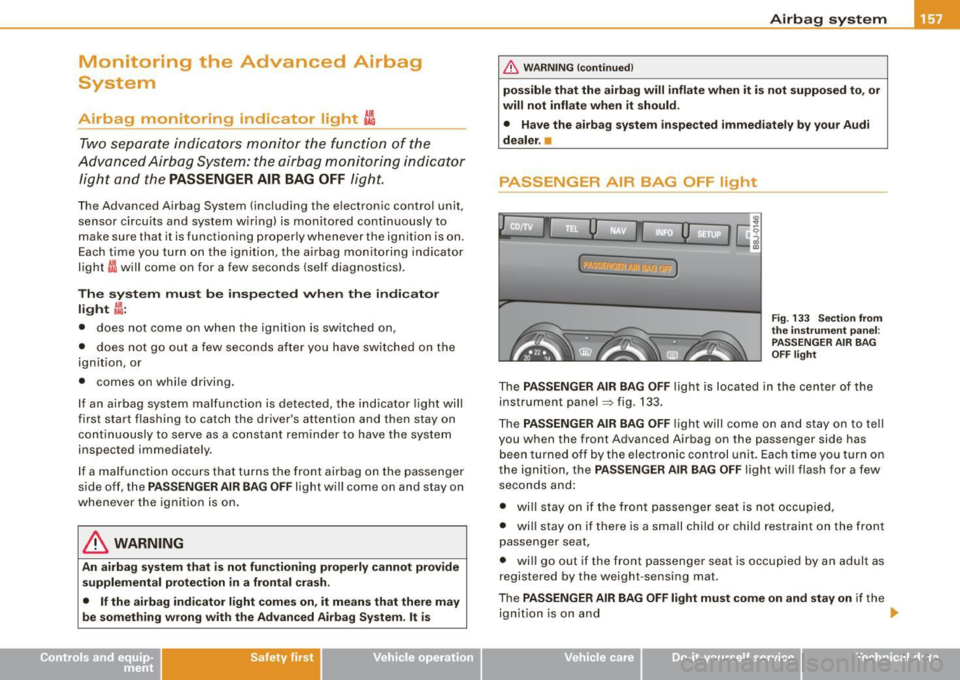
PASSENGER AIR BAG OFF light
)
Fig . 133 S ection from
th e instrum ent pa nel:
PASS ENGER AIR BAG
OFF light
The PASSENGER AIR BAG OFF ligh t is located in the center of the
ins trumen t panel
~ fig . 133.
The
PASSENGER AIR BAG OFF l ight will come on and stay on to tel l
you when the front Advanced Airbag on the passenger side has
been turned off by the electronic control unit. Each time you turn on
the ignition, the
PA SSE NGER AIR BAG OF F light wi ll flash for a few
seconds and :
• will stay on if the fron t passenger seat is not occupied,
• will stay on if there is a small child or child restraint on the front
passenger seat,
• will go out if the front passenger seat is occupied by an adult as
registered by the weigh t-sensing mat .
The
PA SSENGER AIR BAG OFF light mu st come on and stay on if the
ign ition is on and ._
Vehicle care I I irechnical data
Page 161 of 316
__________________________________________________ A_ i_ r _b _a...; g::- s_ y=--- s_t _e _m __ lffl!III
under the upho lstery of the seat have been removed from th e front
p assenge r sea t,
• a safety belt extender has not been left in the safety be lt latch for
the fr ont pass enge r se at .
I n addition to the PASSENGER AIR BAG OFF l ight in the center of the
instrument pane l, the message PASSENGER AIR BAG OFF or
PASSENGER AIR BAG ON will br iefly appear in the instrument c luster
display . Thi s is to inform the drive r of the current front passenger
a ir b ag status .•
Important safety instructions on monitoring
the Advanced Airbag System
& WARNING
An airbag system that is not functioning prope rly cannot prov ide
supplemental protection in a frontal crash.
• If the airbag ind icator light comes on , it means that there may
be something wrong with the Advanced Airbag System . It is
possible that the airbag will inflate when it is not supposed to , or
will not inflate when it should.
• Have the airbag system inspected immediately by your Audi
dealer.
& WARNING
If the front airbag inflates , a child without a child restraint, in a
rearward-facing child safety se at or in a forward-facing child
restraint that has not been properly installed will be seriously
injured and can be killed.
• Even though your vehicle is equipped with an Advanced Airbag
System , make certain that all ch ildren , especially 12 years and
younger, always ride on the back seat properly restrained for their age and size .
Controls and equip ment Safety first
Vehicle operation
& WARNING (continued )
• If you must in stall a rearward-facing child safety seat on the
front passenger seat because of exceptional circumstances and
the PASSENGER AIR BAG OFF light does not appear and stay on ,
immediately install the rear -facing child safety seat in a rear
seating posit ion and have the airbag system inspected by your
Audi dealer .
• A tight tether or other strap on a rearward-fa cing child restraint
attached to the front passenger seat can put too much pressure
on the weight-sensing mat in the seat and reg ister more weight
than is actually on the seat. The heavier weight registered can make the system work as though an adult were on the seat and
deploy the Advanced Airbag when it must be suppressed causing
serious or even fatal injury to the child .
• If, in exceptional circumstances, you must in stall a forward
fac ing child restra int on the front passenger seat , always move the
seat into its rearmost position in the seat's fore and aft adjust
ment range , as far away from the airbag as possible. The backrest
must be adjusted to an upright position . Make sure that the
PASSENGER AIR BAG OFF light comes on and stays on all the time
whenever the ignition is switched on .
& WARNING
• If the PASSENGER AIR BAG OFF light does not go out when an
adult is sitting on the front passenger seat after taking the steps
described above, have the airbag system inspected by your Audi
dealer before transporting anyone on the front passenger seat .
[ i ] Tips
I f the wei ght -sens ing mat in the front passenger seat detects an
empty seat, t he fron t airbag o n the pa ssenge r sid e wil l be tu rne d
o ff , and PASSENGER AIR BAG OFF will stay on .•
Vehicle care Do-it-yourself service Technical data
Page 164 of 316
___ A_ ir_ b_ a-g _ s_y _s_ t_ e_ m _________________________________________________ _
If the front airbags deploy, the knee airbags also deploy in frontal
collisions above a certain severity=:>
page 155, "More important
things to know about front airbags".
Besides their normal safety function, safety belts work to help keep
the driver or front passenger in position in case of a frontal collision
so that the airbags can provide protection.
The airbag system is not a substitute for your safety belt. Rather, it
is part of the overall occupant restraint system in your vehicle .
Always remember that the airbag system can only help to protect
you if you are wearing your safety belt and wearing it properly. This
is why you should always wear your safety belt, not just because the
law requires you to do so=:>
page 137, "Gene ral notes" .
The safety belt buckle for the driver and front seat passenger have
switches that tell the airbag control module if the safety belt is
being used or not. If the safety belt is being used, the front airbag
will deploy at a slightly higher rate of deceleration than if the belt is
not being used. Therefore, in a particular collision, it is possible that
an airbag will not deploy at a seating position where the safety belt
is being used but will inflate at the position where the safety belt is
not being used .
Remember too, airbags will deploy only once and only in certain
kinds of accidents -your safety belts are always there to offer
protection in those accidents in which airbags are not supposed to
deploy or when they have already deployed, for example when your
vehicle strikes or is struck by another after the first collision.
This is just one of the reasons why an airbag is not a substitute for
the safety belt . The airbag system works most effectively when used
with the safety belts. Therefore, always wear your safety belts
correctly.
It is important to remember that while the supplemental airbag
system is designed to reduce the likelihood of serious injuries, other
injuries, for example, swelling, bruising, and minor abrasions can
also be associated with airbags . The knee airbag system basically consists of:
• The electronic control module
• Two inflatable airbags (airbag and gas generator), one for the
driver and one for the front passenger
• Th e airbag indicator light in the instrument panel
The knee airbag system will not deploy:
• when the ignition is turned off
• in front-end collisions when the deceleration measured by the
control unit is too low
• in side collisions
• in rear-end collisions
• in rollovers
• in the event of a system malfunction (warning/indicator light illu
minated) =:>
page 19.
&, WARNING
• Safety belts and the airbag system can only provide protection
when occupants are in the proper seating position=:>
page 155.
• If the airbag indicator light comes when the vehicle is being
used, have the system inspected immediately by your authorized
Audi dealer. The airbag may not work properly when the vehicle
acceleration in a side collision is high enough to deploy the airbag.
See also =:>
page 19. •
Page 166 of 316
__ .....:.A..:..::..:. ir-=b :....:a=- g=- s= y-=s -=t -=e -=m.;._;_ ________________________________________________ _
& WARNING (con tinued )
-No persons (children ) or animals should ride in the footwell
in front of t he passenger s eat . If the airbag deploy s, thi s can
result in serious or fatal injuries .
- No objects of any kind should be carried in the footwell area
in front of the driver's or pa ssenger' s seat. Bulky objects (shop
ping bag s, for example ) can hamper or prevent p roper deploy
ment of the airbag . Small objects can be thrown through the
vehicle if the airbag deploys and injure you or your passenger s.
• Make sure there are no cra cks , deep scratches or other damage
in the area of the in strument panel where the knee airbags are
located .
• If ch ildren are incorrectly seated , their risk of injury increases in
the case of an accident =>
page 168, "Child Safety". •
Side airbags
Description of side airbags
The air ba g s ystem c an pro vid e sup plemen tal p ro tection
to p rope rly re straine d front seat occup ants.
Fig . 13 6 Side airbag
locat ion in the driver 's
seat
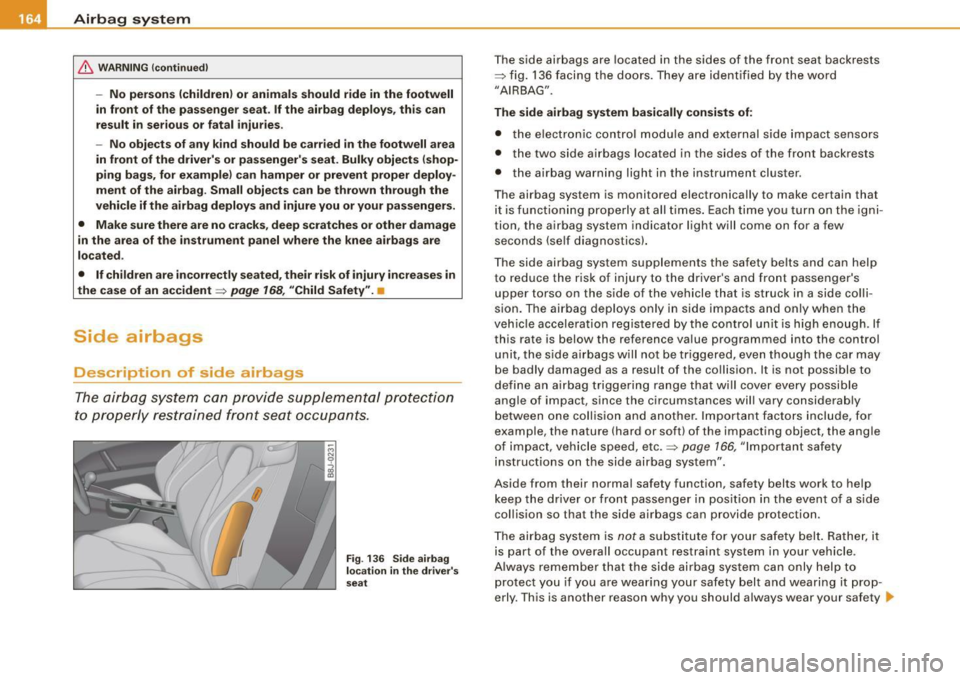
T he side airbags are located in the sides of the front seat backrests
=> fig . 136 facing the do ors. T hey ar e id en tified by the word
"AIRBAG ".
The side airbag system basically consists of :
• the e lec tro nic c ontrol m odule an d ex ternal sid e im pact sens ors
• the two side airbags located in the sides of the front backrests
• the airbag war ning light in the instrument clus ter .
T he airbag system is monitored electronicall y to make certain that
it is functioni ng properly at all times . Each time you turn on the igni
tion, the airbag system indicator light will come on for a few
se co nds (self diag nostics).
The side airbag system supplements the safety belts and can help
to reduce the risk of injury to the drive r's and fr ont passenger's
upper torso on the side of the vehicle that is struck in a side co lli
s ion. The ai rbag deploys only in side impacts and only when the
vehic le acc ele ration re gis te red by the control unit is high eno ugh . If
this rate is below the refe rence va lue programmed into the control
unit, the s ide airbags will no t be tr iggered, ev en thoug h the car may
be badly damaged as a resu lt of the co llision. It is not possible to
de fin e an ai rb a g trigge ring r ange t hat wi ll cov er ev er y possible
angle of impact , since the circumstances will vary considerab ly
bet ween one collision a nd an othe r. Importa nt fac tors include, fo r
example, the na ture (hard or soft) of the impacting object, the ang le
o f im pact, vehicle speed , et c.
=> p age 166, "Importan t safety
i nstructions on th e side airba g sys tem".
Aside from their normal safety function, safety belts wo rk to h elp
ke ep the drive r or front passenger i n pos ition i n th e ev ent o f a side
col lision so that the side ai rbags can provide pro tec tion .
T he airbag system is
not a su bstit ute for y our sa fety belt . Ra the r, it
is part of the overa ll occupa nt restrain t system in your vehicl e.
A lwa ys reme mber tha t the side ai rbag sys tem can only help to
pro tect you if you are w ear ing your sa fety bel t and wear ing it prop
e rly. Th is is another reason why you should always wear your safety .,
Page 167 of 316
belts, not just because the law requires you to do so=> page 137,
"General notes" .
It is important to remember that while the supplemental side airbag
system is designed to reduce the likelihood of serious injuries, other
injuries, for example, swelling, bruising, and minor abrasions can
also be associated with deployed side airbag .s. Remember too, side
airbags wil l deploy only once and on ly in certain kinds of accidents
- your safety belts are a lways there to offer protection.
Vehicle damage, repair costs or even the lack of vehicle damage are not necessarily an indication of over -sensitive or failed airbag acti
vation. In some collisions, both front and s ide airbags may inflate .
Remember too , that airbags will deploy only once and only in
certain kinds of collisions - your safety belts are always there to
offer protection in those accidents in which airbags are not
supposed to deploy or when they have already deployed .
The s ide a ir ba g sy stem will not dep loy:
• when the ignition is turned off
• in side coll isions when the acce leration measured by the sensor
is too low
• in front -end collisions
• in rear -end collisions
• in rollovers.
In some types of accidents the front airbags and side airbags may
be triggered together.
& WARNING
• Safet y belt s a nd the airbag sy stem will only provid e prote ct ion
w hen o ccupants ar e in the proper s eating p osition
=> page 16 6.
• If the airbag indicat or light come s on when the vehicle i s being
u sed , have the system in sp ec ted imm ediatel y by your authori zed
Audi de aler . Th e airb ag m ay not work properly when the vehicle
a ccel era tion in a side c olli sio n is high enough to a ctiv ate th e
airb ag .•
Safety first
Airbag sy ste m
How supplemental s ide airbags work
Side airbags deploy instantly and can help reduce the risk
of upper torso injuries for occupants who are properly
restrained .
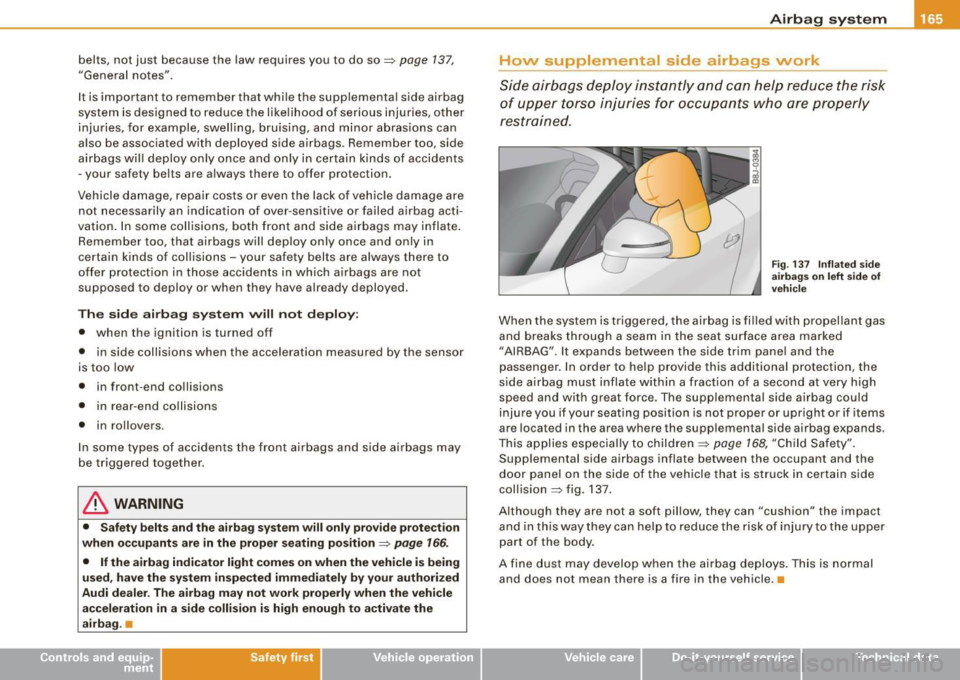
Fig. 137 Infl ate d side
airb ags on left sid e o f
ve hicle
When the system is triggered , the airbag is fi lled with propellant gas
and brea ks through a seam in the seat surface area marked
"AIRBAG" . It expands between the side trim pane l and the
passenger. In order to help provide this additional protection, the
s ide a irbag must inflate within a fraction of a second at very h igh
speed and with great force. The supp lemental side airbag could
injure you if your seat ing position is not proper or upright or if items
are located in the area where the supplemental side airbag expands.
This applies especially to children =>
page 168, "Child Safe ty" .
Supp lemental side airbags inflate between the occupant and the
door panel on the side of the vehicle that is struck in certain side
collision=> fig. 137.
Although they are not a soft pillow, they can "cushion" the impact and in this way they can help to reduce the risk of injury to the upper
part of the body .
A fine dust may develop when the airbag deploys . This is normal
and does not mean there is a fire in the vehicle. •
Vehicle care I I Technical data
Page 168 of 316
-Airbag system -----~~---------------------------------------------------------
Important safety instructions on the side
airbag system
Airbags are only supplemental restraints. Always prop
erly wear safety belts and ride in a proper seating posi
tion.
There is a lot that you and your passengers must know and act
accordingly to help the safety belts and airbags do their job to
provide supplemental protection.
& WARNING
An inflating side airbag can cause serious or fatal injury. Improp
erly wearing safety belts and improper seating positions increase
the risk of serious personal injury and death whenever a vehicle is
being used.
• In order to reduce the risk of injury when the supplemental side
airbag inflates:
- Always sit in an upright position and never lean against the
area where the supplemental side airbag is located.
- Never let a child or anyone else rest their head against the
side trim panel in the area where the supplemental side airbag
inflates.
- Always make sure that safety belts are worn correctly,
- Do not let anyone sitting in the front seat put their hand or
any other parts of their body out of the window.
• Always make sure that the side airbag can inflate without inter
ference.
-Never install seat covers or replacement upholstery over the
front seat backs that have not been specifically approved by
Audi.
- Never use additional seat cushions that cover the areas
where the side airbags deploy .
& WARNING (continued)
-Damage to the original seat covers or to the seam in the area
of the side airbag module must always be repaired immedi
ately by an authorized Audi dealer .
• Objects between you and the airbag can increase the risk of
injury in an accident by interfering with the way the airbag unfolds
or by being pushed into you as the airbag inflates. -Never place or attach accessories or other objects (such as
cup holders, telephone brackets, or even large, bulky objects)
on the doors, over or near the area marked "AIRBAG" on the
seat backrests.
- Such objects and accessories can become dangerous projec
tiles and cause injury when the supplemental side airbag deploys.
- Never carry any objects or pets in the deployment space
between them and the airbags or allow children or other
passengers to travel in this position.
• Always use the built-in coat hooks only for lightweight
clothing. Never leave any heavy or sharp-edged objects in the
pockets that may interfere with side airbag deployment and can
cause personal injury in an accident.
• Always prevent the side airbags from being damaged by heavy
objects knocking against or hitting the sides of the seatbacks.
• The airbag system can only be triggered once.
If the airbag has
been triggered, the system must be replaced by an authorized
Audi dealership.
• Damage (cracks, deep scratches etc.I to the original seat covers
or to the seam in the area of the side airbag module must always
be repaired immediately by an authorized Audi dealer.
• If children are seated improperly, their risk of injury increases
in the case of an accident ~
page 168, "Child Safety" .
• Never attempt to modify any components of the airbag system
in anyway. _.,
Page 170 of 316
___ C_h_ i_ ld _ S_ a_ f_ e_ t_y ____________________________________________ _
Child Safety
Important things to know
Introduction
The physical principles of what happens when your veh ic le is in a
crash apply also to children=>
page 139, "What happens to occu
pants no t wearing safety belts?" . But un like adu lts and teenagers,
their musc les and bones are not fully developed. In many respects
children are at g reater risk of serious injury in crashes than adul ts .
Because chi ldren's bodies are not fully developed, they require
restraint systems especial ly designed for their size, weight, and
body structure. Many countries and all s tates of the United States
and provinces of Canada have laws requiring the use of approved
chi ld restraint syste ms for in fants and sma ll children.
In a fronta l crash at a speed of 20 -35 mph (30 -56 km/h) the forces
acti ng on a 13 -p o und (6 kg) infant wil l be m ore tha n 20 times the
weight of the child. This means the weight of the child would suddenly be more than 260 pounds (120 kg). Under these condi
tions, on ly an appropriate child restraint properly used can reduce
the risk of serious injury . Child restraints, like adult safety belts,
m ust be used prope rly t o be e ffective. Used i mproper ly, they can
increase the risk of serious injury in an accident .
Co nsu lt the ch ild safety s eat manu fact ure r's ins truc tions to be su re
the seat is right for your child's size=>
page 171, "Important safety
instruct ions for using child safe ty seats" . Please be sure to read and
heed a ll of the important information and WARN INGS about chi ld
safety, Advanced Airbags, and the installation of child restraints in
this chap ter.
There is a lot you need to know about the Advanced Airbags in your
veh ic le and how they work when infants and chi ldre n in child
restra ints are on the front passenger seat. Because of the large
a m ount of impo rtant informati on, we can not repeat i t all here. We urge you to
read the detai led informat ion in this owner's manua l
about airbags and the Advanced Airbag System in your vehicle and
the very i mportant in formation about tra nsport ing chi ldren on the
front passenger seat. Please be sure to heed the WAR NINGS -they
are ext remely important for y our safe ty a nd the safe ty of you r
passengers, especia lly infants and small children.
& WARNING
All vehicle o ccupants and especially children must be restrained
properly wheneve r riding in a vehicle. An unrestrained or improp
erly restrained child could be injured by striking the interior or by
be ing e je cted from the vehicle during a sudden maneuver or
impa ct. An unrestrained or improperly restrained child i s also at
greater risk of injury or death through contact with an inflating
airbag .
& WARNING
Children on the front seat of any car even w ith Adv anced Airbags
can be seriously injured or even killed when an airbag infla tes. A
child in a rearward-fa cing child safety seat installed on the front
passenger seat will be seriously injured and can be killed if the
front airbag inflate s.
• The inflating airbag will hit the child safety seat or infant
c arrier with great fo rce and will smash the child safety seat and
child against the backrest, door or roof.
• Never install a rearward fa cing child safety seat on the front
pa ssenger seat unles s the PASSENGER AIR BAG OFF light comes
on and stays on . If the PASSENGER AIR BAG OFF light does not
come on and stay on , have the airbag system in spected immedi -
ately by your Audi dealer . _,.
Page 173 of 316
Child Safety -
--------------------''---
& WARNING
To reduce the risk of serious injury, make sure that the PASSENGER
AIR BAG OFF light comes on and stays on whenever a child restraint is installed on the front passenger seat and the ignition
is switched on.
• Never install a rearward facing child safety seat on the front
passenger seat unless the PASSENGER AIR BAG OFF light comes
on and stays on. If the PASSENGER AIR BAG OFF light does not
come on and stay on the inflating airbag will hit the child safety
seat or infant carrier with great force and will smash the child
safety seat and child against the backrest, door or roof. Have the
airbag system inspected immediately by your Audi dealer.
[ i] Tips
The child seats listed in categories A to C have been tested by Audi
only for the Advanced Airbag function. •
Important safety instructions for
using child safety seats
Correct use of child safety seats substantially reduces the
risk of injury in an accident!
As the driver, you are responsible for the safety of every
body in the vehicle, especially children:
- Always use the right child safety seat for each child and
always use it properly ::::>
page 173.
-Always carefully follow the child safety seat manufac
turer's instructions on how to route the safety belt prop
erly through the child safety seat.
Controls and equip ment Safety first Vehicle operation
-
When using the vehicle safety belt to install a child safety
seat, you must first activate the convertible locking retractor on the safety belt to prevent the child safety
seat from moving ::::>
page 177.
-Push the child safety seat down with your full weight to
get the safety belt really tight so that the seat cannot
move forward or sideways more than one inch (2.5 cml.
Always remember: Even though your vehicle is equipped with an
Advanced Airbag system, a child should always ride in the seat
properly restrained for its age and size.
& WARNING
Not using a child safety seat, using the wrong child safety seat or
improperly installing a child restraint increases the risk of serious
personal injury and death.
• All vehicle occupants and especially children must always be
restrained properly whenever riding in a vehicle.
-An unrestrained or improperly restrained child can be injured
or killed by being thrown against the inside of the vehicle or by
being ejected from it during a sudden maneuver or impact.
- An unrestrained or improperly restrained child is at much
greater risk of injury or death by being struck by an inflating
airbag.
• Commercially available child safety seats are required to
comply with U.S. Federal Motor Vehicle Safety Standard (FMVSS)
213 (in Canada CMVSS 213).
- When buying a child restraint, select one that fits your child
and the vehicle.
- Only use child restraint systems that fully contact the flat
portion of the seat cushion. The child restraint must not tip or
lean to either side. Audi does not recommend using child safety
seats that rest on legs or tube-like frames. They do not provide
adequate contact with the seat. ..
Vehicle care Do-it-yourself service Technical data
Page 174 of 316
-Child Safety
---=-------------------
& WARNING
(continued )
-Always heed all legal requirements pertaining to the installa
tion and use of child safety seats and carefully follow the instructions provided by the manuf acturer of the seat you are
using.
• Never let more than one child occupy a child safety seat .
• Never let babies or older children ride in a vehicle while sitting
on the lap of another passenger.
-Holding a child in your arms is never a substitute for a child
restraint system.
- The strongest person could not hold the child with the forces
that exist in an accident . The child will strike the interior of the
vehi cle and can also be struck by the passenger.
- The child and the passenger can also injure each another in an accident .
• Never install a rearward facing child safety seat on the front
passenger seat unless the PASSENGER AIR BAG OFF light comes
on and stays on. If the PASSENGER AIR BAG OFF light does not
come on and stay on the inflating airbag will hit the child safety
seat or infant carrier with great force and will smash the child
safety seat and child against the backrest , door or roof . Have the
airbag system inspected immediately by your Audi dealer.
• Forward-facing child safety seats installed on the front
passenger's seat can interfere with the airbag when it inflates and
cause serious injury to the child .
• If exceptional circumstances require the use of a forward
facing child restraint on the front passenger's seat , the child's
safety and well-being require that the following special precau
tions be taken :
- Make sure the forward -facing seat has been designed and
certified by its manufacturer for use on a front seat with a
passenger front and side airbag.
- Always carefully follow the manufacturer's instruct ions
provided with the child safety seat or carrier.
& WARNING (continued)
- Always move the front passenger seat into the rearmost
position of the passenger seat's fore and aft adjustment range ,
and as far away from the airbag as possible before installing
the child restraint .
- Always make sure that nothing prevents the front
passenger's seat from being moved to the rea rmost position in
its fore and aft adjustment range .
- Always make sure that the backrest is in the upright posi
tion.
• Always buckle the child safety seat firmly in pla ce even if a
child is not sitting in it . A loose child safety seat can fly around
during a sudden stop or in a collision .
• Always read and heed all WARNINGS whenever using a child
restrained in a vehicle is being used=>
page 137 , "Safety belts ",
=>
page 146, "Airbag system" and=> page 168 , "Child Safety".
& WARNING
To reduce the risk of serious injury , make sure that the PASSENGER
AIR BAG OFF light comes on and stays on whenever a child
restraint is installed on the front passenger seat and the ignition
is switched on .
• Never install a rearward facing child safety seat on the front
passenger seat unless the PASSENGER AIR BAG OFF light comes
on and stays on . If the PASSENGER AIR BAG OFF light does not
come on and stay on the inflating airbag will hit the child safety
seat or infant carrier with great force and will smash the child
safety seat and child against the backrest, door or roof. Have the
airbag system inspected immediately by your Audi dealer. •
Page 175 of 316
Child safety seats
Infant seats
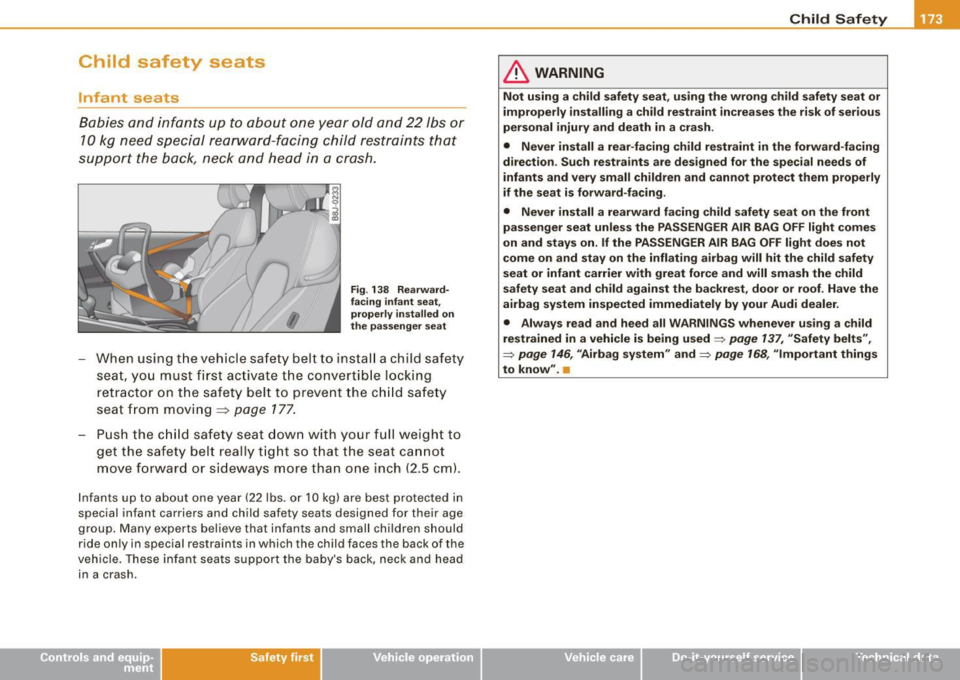
Babies and infants up to about one year old and 22 lbs or
10 kg need special rearward-facing child restraints that
support the back, neck and head in a crash.
Fig. 138 Rearward
facing infant seat,
properly installed on
the passenger seat
- When using the vehicle safety belt to install a child safety
seat, you must first activate the convertible locking
retractor on the safety belt to prevent the child safety
seat from moving ::::,
page 177.
-Push the child safety seat down with your full weight to
get the safety belt really tight so that the seat cannot
move forward or sideways more than one inch (2.5 cm).
Infants up to about one year (22 lbs. or 10 kg) are best protected in
special infant carriers and child safety seats designed for their age
group. Many experts believe that infants and small children should
ride only in special restraints in which the child faces the back of the
vehicle. These infant seats support the baby's back, neck and head
in a crash.
Safety first
Child Safety
& WARNING
Not using a child safety seat, using the wrong child safety seat or
improperly installing a child restraint increases the risk of serious
personal injury and death in a crash .
• Never install a rear-facing child restraint in the forward-facing
direction. Such restraints are designed for the special needs of
infants and very small children and cannot protect them properly
if the seat is forward-facing.
• Never install a rearward facing child safety seat on the front
passenger seat unless the PASSENGER AIR BAG OFF light comes
on and stays on. If the PASSENGER AIR BAG OFF light does not
come on and stay on the inflating airbag will hit the child safety
seat or infant carrier with great force and will smash the child
safety seat and child against the backrest, door or roof. Have the
airbag system inspected immediately by your Audi dealer.
• Always read and heed all WARNINGS whenever using a child
restrained in a vehicle is being used~
page 137, "Safety belts",
::::, page 146, "Airbag system" and::::, page 168, "Important things
to know". •
Vehicle care I I irechnical data