air condition AUDI TT ROADSTER 2008 User Guide
[x] Cancel search | Manufacturer: AUDI, Model Year: 2008, Model line: TT ROADSTER, Model: AUDI TT ROADSTER 2008Pages: 316, PDF Size: 70.1 MB
Page 101 of 316
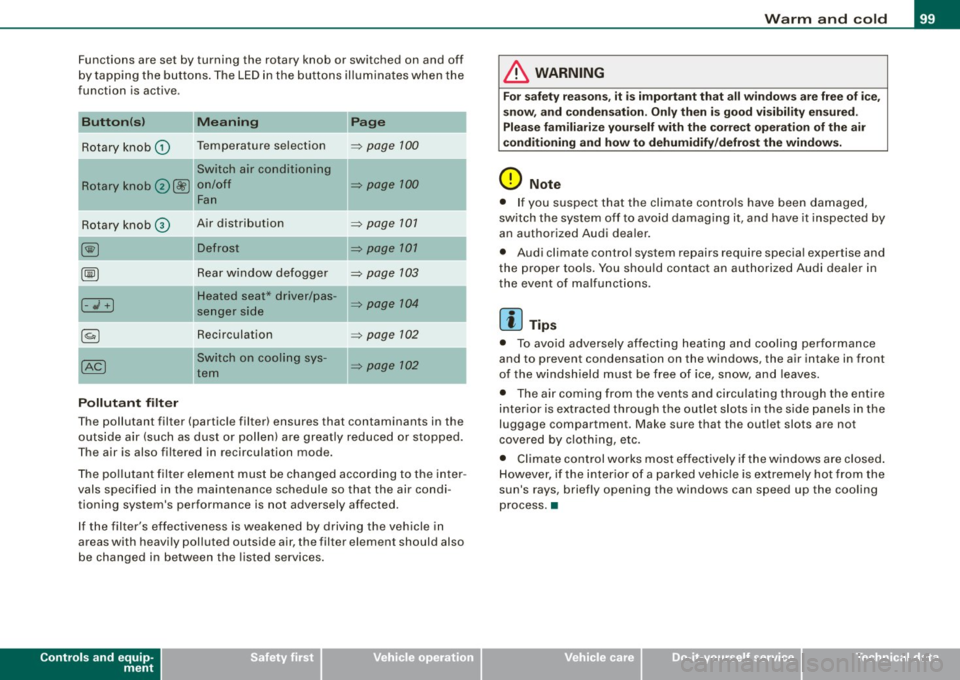
Functions are set by turning the rotary knob or switched on and off
by tapping the buttons. The LED in the buttons illuminates when the
function is active .
Button(sl
Rotary knob 0
Rotary knob 0 @
Rotary knob©
(- .,; +]
-
Po llutant f ilter Me
aning
Temperature selection
Switch ai r conditioning
on/o ff
Fan
Air distribution
Rear window defogger
Heated seat* driver/pas
senger side
Recirculation
Switch on cooling sys
tem
P age
~ page 100
~ page 100
~ page 701
~ page 101
~ page 103
~ page 104
~ page 102
~ page 102
The pollutant filter (particle filter) ensures that contaminants in the
outside air (such as dust or po llen) are grea tly reduced or stopped.
T he air is also filtered in recirculation mode.
The pollutant fil ter e lement must be changed according to the inter
vals specified in the maintenance schedu le so that the air condi
tioning system's performance is not adversely affected.
If the fil ter's effectiveness is weakened by driving the vehicle in
areas with heavi ly polluted outside air, the filter element should also
be changed in between the listed services .
Controls and equip
ment
W arm and cold
& WARNING
Fo r safet y rea sons , it is imp ort ant that all window s are free of ice,
snow , and condensati on . Only then i s good vi sibility en sured.
Pl eas e familiari ze yourself with the co rrect o peration of th e air
c ond itioning and how to dehum id ify /defro st the windows.
0 Note
• I f you suspect that the climate contro ls have been damaged ,
switch the system off to avoid damaging it , and have it inspected by
an authorized Audi dealer.
• Audi climate control system repairs require specia l expertise and
the proper tools. You shou ld contact an authorized Audi dealer in
the event of malfunct ions.
[ i ] Tip s
• To avoid adversely affecting heating and cooling performance
and to prevent condensation on the windows, the air intake in front
of the windsh ield must be free of ice, snow, and leaves.
• The air coming from the vents and circu lating through the en tire
interior is extracted through the out let slots in the side panels in the
luggage compartment. Make sure that the outlet slots are not
covered by clo th ing, etc.
• Climate control works most effectively if the windows are closed .
However , if the interior o f a parked vehicle is extremely hot from the
sun's rays, briefly opening the windows can speed up the cooling
process. •
I • •
Page 104 of 316
![AUDI TT ROADSTER 2008 User Guide • ..__w_ a_ r_m _ a_ n_d_ c_ o_ ld __________________________________________________ _
Manual air recirculation mode[~]
The recirculation mode prevents polluted outside air from
enteri](/img/6/57671/w960_57671-103.png "AUDI TT ROADSTER 2008 User Guide • ..__w_ a_ r_m _ a_ n_d_ c_ o_ ld __________________________________________________ _
Manual air recirculation mode[~]
The recirculation mode prevents polluted outside air from
enteri")
• ..__w_ a_ r_m _ a_ n_d_ c_ o_ ld __________________________________________________ _
Manual air recirculation mode[~]
The recirculation mode prevents polluted outside air from
entering the vehicle interior.
Switching on air recir culation
- Press the button [19.] ~ page 98, fig . 93 ~ & .
Swit ching off air recir culation
Press the butt on [19.] ag ain, o r
Press the
[AUTO I button, or
- Press the[@] button.
In recircu lation mode, air is drawn from the vehic le interior, filtered,
and recircu lated. We recommend that you se lect recircu lat ion mode
briefly ~ & under the fo llowing conditions:
When driving through a tunnel or i n a traffic jam so that exhaust
fumes and odors cannot enter the vehic le interior .
& WARNING
You should not u se the re circulat ion mode for an e xtended period
s ince no fre sh air i s drawn in , and with the air conditioning
s wit ched off the windows can fog up -this in crea se s the ris k of an
accident !•
A /C operation [AC)
Switching on A /C
- Press th e [AC] button~ page 98, fig. 93 .
Switching A /C off
- Press the [AC] button again.
The cooling system is switched on during A/C operation - the
heating and ven tilation system is controlled automatica lly.
I i ] Tips
If the LED in the switch stays on after A/C operation has been
switched off( = switching the A/C offl, there is a fau lt in an air condi
t ioning component. Please consult an authorized Audi dealer when
there is an operating prob lem .•
Air vents
Air d istribution determines the air flow fro m the indi
vi dual vents.
Fig . 97 Instrumen t pan el: Loc ation o f air vent s
Vents @and 0
- To open and close the outlets, t urn the adjusting ring.
Page 131 of 316
________________________________________________ D_r_iv _ i _n_ g~ S_ a_ fe_ ly __ lllll
- Make sure that all lights and signals are operating
correctly.
- Make sure that the tire pressure is correct.
- Make sure that all windows are clean and afford good
visibility to the outside.
- Secure all luggage and other items carefully =>
page 95.
-Make sure that nothing can interfere with the pedals.
- Adjust front seat, head restraint and mirrors correctly for
your height.
- Instruct passengers to adjust the head restraints
according to their height.
- Make sure to use the right child restraint correctly to
protect children =>
page 168, "Child Safety".
- Sit properly in your seat and make sure that your passen
gers do the same=>
page 87, "General recommenda
tions".
- Fasten your safety belt and wear it properly. Also instruct
your passengers to fasten their safety belts properly
=>
page 137. •
What impairs driving safety?
Safe driving is directly related to the condition of the
vehicle, the driver as well as the driver's ability to concen
trate on the road without being distracted.
The driver is responsible for the safety of the vehicle and all
of its occupants. If your ability to drive is impaired, safety risks for everybody in the vehicle increase and you also
Controls and equip ment Safety first Vehicle operation
become a
hazard to everyone else on the road =>&, .There
fore:
- Do not let yourself be distracted by passengers or by
using a cellular telephone.
- NEVER drive when your driving ability is impaired (by
medications, alcohol, drugs, etc .).
- Observe all traffic laws, rules of the road and speed limits
and plain common sense.
- ALWAYS adjust your speed to road, traffic and weather
conditions.
- Take frequent breaks on long trips. Do not drive for more
than two hours at a stretch.
- Do NOT drive when you are tired, under pressure or when
you are stressed.
in. WARNING
Impaired driving safety increases the risk of serious personal
injury and death whenever a vehicle is being used. •
Vehicle care Do-it-yourself service Technical data
Page 148 of 316
___ A_ ir_ b_ a-g _ s_y _s_ t_ e_ m _________________________________________________ _
Airbag system
Important things to know
Importance of wearing safety belts and
sitting properly
Airbags are only supplemental restraints. For airbags to
do their job, occupants must always properly wear their
safety belts and be in a proper seating position.
For your safe ty a nd the safety of your passengers, before
driving o ff, a lways:
- Adjust the driver's seat and steering wheel properly
~ page 130,
-Adjust the front passenger's seat properly~ page 88,
- Wear safety belts properly~ page 140,
-Always properly use the proper child restraint to pro tect
children~
page 168 .
In a collision airbags must inflate within the blink of an eye and with
considerable force. The supplemental airbags can cause injuries if
the driver or the front seat passenger are not seated proper ly . There
fore in order to help the airbag to do its job, it is important, both as
a driver and as a passenger to sit properly at a ll times.
By keep ing room between your body and the steering wheel and the
front of the passenger compartment, the airbag can inflate fu lly and
comp letely and prov ide supplementa l protection in certain frontal
collisions =>
page 130, "Proper occupant seating positions". For
detai ls on the operation of the seat adjustment controls =>
page 88
and=> page 89.
It's especially important that chi ldren are proper ly restrained
=>
page 168.
There is a lot that the dr iver and the passenger can and must do to
help the individual safety features installed in your Audi work
together as a system.
P roper seating position is important so that the front airbag on the
driver side can do its job. I f you have a physical impairment or
condition that prevents you from sitting properly on the driver seat
with the safety belt properly fastened and reaching the pedals, o r if
you have concerns with regard to the function or operation of the
Advanced Airbag System, p lease contact your authorized Audi
dea ler or qua lif ied workshop, or call Audi Customer CARE at 1-800-
822 -2834 for possib le modifications to your vehicle.
When the airbag system deploys, a gas generator wi ll fill the
airbags, break open the padded covers, and inflate between the
steering wheel and the driver and be tween the instrument panel
and the front passenger. The airbags wil l deflate immediate ly after
deployment so that the front occupants can see through the wind
shield again without interruption.
A ll of this takes p lace in the b link of an eye, so fast that many people
don't even rea lize that the airbags have dep loyed . The airbags also
inflate with a great deal of force and nothing should be in their way
when they dep loy. Fron t airbags in combination wi th properly worn
safety belts slow down and limit the occupant's forward movement.
T ogether they he lp to prevent the driver and passenger from hitting
parts of the inside the vehic le while reducing the forces acting on
the occupant during the crash. In this way they he lp to reduce the
r isk of injury to the head and upper body in the crash. Airbags do not
protect the arms or the lower parts of the body .
Both front airbags w ill not inflate in al l fro ntal col lisions . The trig
gering of the airbag system depends on the vehic le deceleration
r ate caused by the colli sion and registe red by the electronic contro l
unit. If this rate is below the reference value programmed into the
cont rol unit, the airbags w ill not be t riggered, even though the car
may be bad ly damaged as a result of the collision. Vehicle damage, .,,,.
Page 152 of 316
___ A_ ir_b _a_ g;:::;_ s--:.. y_s _t _e _m _________________________________________________ _
Front airbags
Description of front airbags
The airbag system can pro vid e supp lemen tal prot ection
to p roperly r es tra ined front seat occu pa nts.
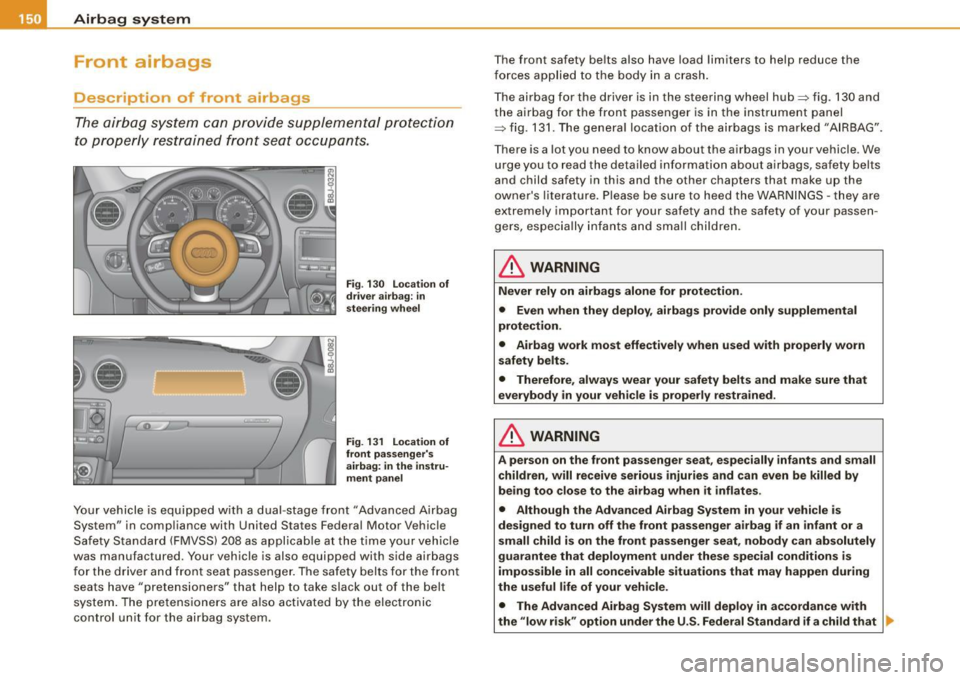
Fig . 130 Location of
driver airb ag: in
s te ering wheel
Fig . 13 1 Locat ion of
front p assenger 's
airbag: in the instru
ment panel
You r ve hicle is equipped w ith a dual -stage front "Adva nced Airbag
System" in comp liance with United States Federal Motor Vehicle
Sa fet y S tanda rd (F MVSS) 208 as app licable at the time your ve hicl e
was manufactu red. Your veh icle is also equipped with s ide airbags
fo r th e d river an d front seat passenge r. The safe ty bel ts for the fr ont
seats have "pretens ione rs" that help to take slac k out of the belt
sy stem. Th e pre tensio ners a re a ls o ac tiv ate d b y the elec tron ic
control un it for t he airbag system . T
he front saf ety be lts also have load limiters to help reduce the
f o rc es a pp lie d t o th e b ody in a cra sh .
T he airbag for the driver is in the steerin g wh eel hub~ fig. 13 0 and
t h e ai rbag fo r the front pas senge r is in the i nstrument panel
~ fig. 1 31. The gene ral loca tion of the airba gs is m arke d "AIR BA G".
T here is a lot you need to know about the airbags in your vehicle . We
u rge you t o rea d th e deta iled inf orma tion about a ir ba gs, s afe ty belts
and child safety in this and the other chapters that make up the
owne r's lite ra tu re. P lea se be s ure to hee d the WAR NINGS· th ey are
e xtremely important for your safety and the safety of your passen
ge rs, especia lly i nfa nts a nd sma ll children.
& WARNING
Never rely on airbags alone for protection.
• Even when they deploy, airbags provide only supplemental
protection .
• Airbag work most effectively when used with properly worn
safety belts.
• Therefore , always wear your safety belts and make sure that
everybody in your vehicle is properly restrained .
& WARNING
A person on the front passenger seat, especially infants and small
children , will receive serious injuries and can even be killed by
being too close to the airbag when it inflates.
• Although the Advanced Airbag System in your vehicle is
designed to turn off the front passenger airbag if an infant or a
small child is on the front passenger seat , nobody can absolutely
guarantee that deployment under these special conditions is
impossible in all conceivable situations that may happen during
the useful life of your vehicle .
• The Advanced Airbag System will deploy in accordance with
the "low risk " option unde r the U.S . Federal Standard if a child that .._
Page 153 of 316
Airbag syst em -----------------=~-
& WARN ING (co ntinued)
is he avier tha n the t ypi ca l o ne -yea r old child i s on the front
p asse nger seat and the othe r con dition s for airba g deploym ent
a re met .
• Accident stat istic s have shown that children are gen era lly safer
i n th e rea r seat ar ea th an in the front se ating posit ion .
• For its ow n sa fet y, a c hild should always ride pr operly
re str ai ned f or it s a ge a nd si ze . •
Advanced front airbag system
Your vehicle is equipped with a front Advanced Airbag System in
compliance with United States Federal Motor Vehicle Safety Stan
dard 208 as applicab le at the time your vehicle was manufactured.
Th e front Advanced Airbag System supplements the safety belts to
provide additional protection for the driver's and front passenger 's
heads and upper bodies in frontal crashes. The airbags inflate only
in frontal impacts when the vehicle deceleration is high enough .
The front Advanced Airbag System for the front seat occupants is not a substitute for your safety be lts. Rather, it is part of the overa ll
occupant restraint system in your vehicle. A lways remember that
the airbag syste m can only help to protect you, if you a re sitting
upright, wearing your safety be lt and wearing it proper ly. This is why
you and your passengers must a lways be proper ly restrained, not
just because the law requires you to be .
The Advanced Airbag System in your vehicle has been certified to meet the " low risk" requirements for 3 and 6 year-old children on the
passenger side and very small adults on the driver side . The low risk
deployment cr iteria are intended to help reduce the risk of injury
through interaction with the front airbag that can occur, for
examp le, by being too c lose to the steering wheel and instrument
panel when the airbag inflates .
Controls and equip
ment Safety first Vehicle operation
I
n addition, the system has been certified to comply with the
"suppression" requirements of the Safe ty Standard, to turn off the
front airbag for infants 12 months old and younger who are restrained on the front passenger seat in child restraints that are
listed in the Standard=>
page 170, "Child restraints and Advanced
Airbags" .
"Suppression" requires the front airbag on the passenger side to be
turned off if:
• a child up to about one year of age is restrained on the front
passenger seat in one of the rear-facing or forward-facing infant
res traints listed in Federal Motor Vehicle Safety Standard 208 with
wh ich the Advanced Airbag System in your vehicle was certified. For
a listing of the child rest raints that were used to certify your
vehic le's compliance with the US Safety Standard=>
page 170,
• weight less than a threshold leve l stored in the cont rol unit is
detected on the front passenger seat.
When a person is detected on the front passenger seat, weighing more than the total weight of a child that is about 1 year old
restrained in one of the rear-facing or forward -facing infant
restraints (lis ted in Federal Motor Vehicle Safety Standard 208 with
which the Advanced Airbag System in your vehicle was certified),
the front airbag on the passenger side may or may not deploy .
The
PA SS EN GER AIR BA G OFF light comes on when the e lectronic
control unit detects a total weight on the front passenger seat that
requires the front airbag to be turned off. If the
PAS SEN GER AIR BAG
OFF
light does not come on, the front airbag on the passenger side
has no t been turned off by the con trol un it and can deploy if the
control unit senses an impact that meets the conditions stored in its
memory .
If the total weight on the front passenger seat is more than that of
a typical 1 year -o ld, but less than the weight of a small adult, the
front a irbag on the passenger side may dep loy (the
PA SS ENGER AIR
BAG OFF
light does not come onl.
For e xample , the airb ag may deplo y if:
Vehicle care Do-it-yourself service Technical data
Page 158 of 316
-Airbag system ----=---'---------------------------------------------
& WARNING (continued)
• To reduce the risk of injury when the airbags inflate, the driver
and passengers must always sit in an upright position, must not
lean against or place any part of their body too close to the area
where the airbags are located .
• Occupants who are unbelted, out of position or too close to the
airbag can be seriously injured by an airbag as it unfolds with
great force in the blink of an eye~ page
147.
& WARNING
A child in a rearward -facing child safety seat installed on the front
passenger seat will be seriously injured and can be killed if the
front airbag inflates -even with an Advanced Airbag System .
• The inflating airbag will hit the child safety seat or infant
carrier with great force and will smash the child safety seat and
child against the backrest, center arm rest, door or roof.
• If you must install a rearward facing child safety seat on the
front passenger seat because of exceptional circumstances and
the PASSENGER AIR BAG OFF light does not come on and stay on ,
immediately install the rear -facing child safety seat in a rear
seating position and have the airbag system inspected by your
Audi dealer .
& WARNING
Objects between you and the airbag will increase the risk of injury
in a crash by interfering with the way the airbag unfolds or by
being pushed into you as the airbag inflates .
• Never hold things in your hands or on your lap when the vehicle
is in use .
• Never transport items on or in the area of the front passenger
seat . Objects could move into the area of the front airbags during
& WARNING (continued)
braking or other sudden maneuver and become dangerous projec
tiles that can cause serious personal injury if the airbags inflate.
• Never place or attach accessories or other objects (such as cup
holders, telephone brackets, large , heavy or bulky objects) on the
doors , over or near the area marked "AIRBAG" on the steering
wheel, instrument panel , seat backrests or between those areas
and yourself . These objects could cause injury in a crash, espe
cially when the airbags inflate .
• Never recline the front passenger's seat to transport objects .
Items can also move into the area of the side airbag or the front
airbag during braking or in a sudden maneuver . Objects near the
airbags can become projectiles and cause injury, particularly when
the seat is reclined.
& WARNING
The fine dust created when airbags deploy can cause breathing
problems for people with a history of asthma or other breathing
conditions.
• To reduce the risk of breathing problems , those with asthma or
other respiratory conditions should get fresh air right away by
getting out of the vehicle or opening windows or doors .
• If you are in a collision in which airbags deploy, wash your
hands and face with mild soap and water before eating .
• Be careful not to get the dust into your eyes, or into any cuts or
scratches .
• If the residue should get into your eyes , flush them with
water. •
Page 160 of 316
___ A_ ir_ b_ a-g _ s_y _s_ t_ e_ m _________________________________________________ _
• a car bed has been installed on the front seat, or
• a rearward-facing child restraint has been installed on the front
passengerseat,or
• a forward-facing child restraint has been insta lled on the front
passenger seat, or
• the weight registered on the front passenger seat is equal to or
less than the combined weight of a typical 1 year -old restrained in
one of the rear-facing or forward-facing infant restraints listed in Federal Motor Vehicle Safety Standard 208 with which the Advanced
Airbag Sys tem in your vehicle was certified.
If the front passenger seat is not occupied, the front airbag wi ll not
deploy, and the
P ASS ENGER AIR B AG OFF light will stay on. Never
install a rearward -facing child restraint on the front passenger seat,
the safest place for a chi ld in any kind of child restraint is at one of
the seating positions on the rear seat=>
page 147, "Child restraints
on the front seat -some important things to know" and=>
page 168,
"Chi ld Safety" .
If the PA SS ENG ER A IR BAG OFF l ight com es on when one of the
conditions listed above is met, be sure to check the light regularly
to make certain that the
P ASSE NG ER AIR BAG OFF light stays on
continuously whenever the ignition is on. If the
PASSENGER AIR
B AG OFF
light does not appear and not stay on all the time, stop as
soon as it is safe to do so and
• reactivate the system by turning the ignition off and then turning
it on again;
• remove and re install the child restraint. Make sure that the chi ld
restraint is properly insta lled and that the safety belt for the front
passenger seat has been correct ly routed around the ch ild restraint
as described in the child restraint manufacturer's instructions;
• make sure that the convertible locking feature on the safety belt
for the front passenger seat has been activated and that the safety
belt has been pulled tight. The be lt must not be loose or have loops
of slack so that the sensor below the safety belt latch on the seat can
do its job=>
page 177 .
• make sure that things that may increase the weight of the child
and child safety seat are not being t ransported on the front
passenger seat;
• make sure that the safety belt tension sensor is no t blocked.
Shake the safety belt latch on the front passenger seat back and
forth;
• If a strap or tether is being used to tie the chi ld safety seat to the
front passenger seat, make sure that it is no t so tigh t that it causes
the weight -sensing mat to measure more weight than is actually on
t he seat .
If the PA SSEN GER AIR BAG OFF lig ht still doe s no t c om e on and does
not stay on continuously (when the ignition is switched on),
• t ake the child restraint off the front passenger seat and install it
proper ly at one of the rear seat positions. Have the airbag system
inspected by your Audi dealer immediately.
• move the child to a rear seat position and make sure that the
child is properly restrained in a child restra int that is appropriate for
its size and age .
T he
PASSENGER AIR BAG OFF light shou ld NOT come on when the
ignition is on and an adult is sitting in a proper seating position on
the front passenger seat . If the
PASSENGER AIR BAG O FF light
comes on and stays on or flashes for about 5 seconds wh ile driving,
under these circumstances, make sure that:
• the adu lt on the front passenger seat is properly seated on the
center of the seat cushion with his or her back up against the back
rest and the backrest is not reclined=>
page 130, "Proper occupant
seating positions",
• t he adu lt is not taking weight off the seat by holding on to the
passenger assist handle above the front passenger door or
supporting their weight on the armrest,
• the safety belt is being proper ly worn and that there is not a lot
of slack in the safety belt webbing,
• accessory seat covers or cushions or other things that may cause
an incorrect reading or impress ion on the weight-sensing mat ...
Page 186 of 316
_1--_l_ n _t _ e _ll _,ig ,_,_ e_n _t _ t_ e_ c_ h_n _o_ l_ o ~g""- y.e- __________________________________________ _
Intelligent technology
Notice about data recorded by
vehicle control modules
Your vehicle is not equipped with an Event Data Recorder (EDR),
installed by some manufacturers for the express purpose of
capturing data for retrieval after an accident or crash event . EDR's
are sometimes called "crash recorders".
Some state laws restrict the retrieval or downloading of data stored
by EDR's that were installed in a vehicle for the express purpose of
retrieving data after an accident or crash event w ithout the owner's
consent.
Although your vehicle is not equipped with an EDR, it is equipped
with a number of electronic control modules for various vehicle systems such as, for example, engine function, emission control, as
well as for the airbags and safety belts.
These electronic control modules also record vehic le-related data
during norma l vehicle opera tion for diagnostic and repair purposes .
The recording capacity of the electronic control modules is limited
to data (no sound is recorded) and only a small amount of data is
actually recorded over a very limited period of time and stored when
a system fault or other condition is sensed by a control unit. Some
of the data then stored may relate to vehic le speed, direction,
braking as well as restraint system use and performance in the
even t of a crash or other condition . Stored data can only be read and
downloaded with special equipment.
Electronic Stabilization Program (ESP)
Genel'61
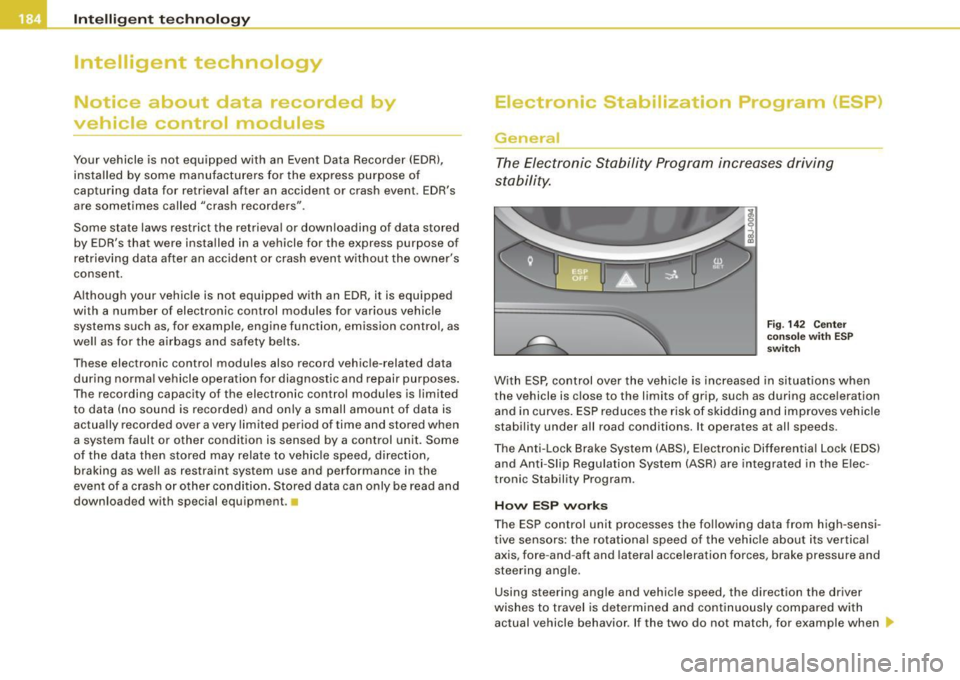
The Electronic Stability Program increases driving
sta bility.
Fig . 142 Cente r
cons ole with ESP
sw itch
With ESP, control over the veh icle is increased in situations when
the vehicle is close to the limits of grip, such as during acce leration
and in curves. ESP reduces the risk of skidding a nd improves vehicle
stability under all road conditions . It operates at all speeds .
The Anti-Lock Brake System (ABS), E lec tronic Differentia l Lock (EDS)
and Anti-Slip Regulation System (ASR) are integrated in the Elec
tronic Stability Program .
H ow ESP work s
The ESP control unit processes the following data from high-sensi
tive sensors: the rotational speed of the vehicle about its vertica l
axis, fore -and -aft and lateral acceleration forces, brake pressure and
steering angle.
Using steering ang le and vehicle speed, the direction the driver
wishes to travel is determined and continuously compared with
actual vehicle behavior . If the two do not match, for example when
Page 190 of 316
-Intelligent t echnology
--- =---- ----"-!...!-------------------------------
After 15 cycles (deploy and retract), manual operation is suspended
fo r up t o 2.5 minutes . Above 75 mph (120 km/h), operation swi tches
to automatic mode .
& WARNING
Driving at higher speeds witho ut the re ar spoiler deployed can
impair handling characteri stics, making the vehicle harder to
c ontrol.
• Always make sure that the spoiler i s deployed when driving at
speeds over 85 mph (140 k m/h). If the rear spoiler warning /ind i
c ator light in the in strument clu ster come s on , the rear spoiler
may not have deployed .
• Never drive at speed s higher than 85 mph (140 km /h ) if the
spoiler is not deployed . Have the spoiler inspe cted as soon as
po ssible by an authorized Audi dealer or qualified workshop.
• Always obey speed limits and other traff ic law s.
& WARNING
Improper operation of the rear spoiler can cause crushing injuries.
• Always make su re that nobody , especially children , is in the
way when the rear spoiler is deployed or retracted.
0 Note
Never push the vehicle or a pply force to the rear spoi ler -it cou ld be
damaged .
[ i ] Tips
Clean the spoi ler compartment every 2 to 3 months . The spoiler
compa rtment must always be free of ice, snow, leaves or other
debris. •
Braking
General "nformation
What aff ects braking effi cie ncy?
Operating condition s and driving habits
The brakes on today's automob iles a re sti ll sub ject to wea r,
depending large ly o n operati ng co nditions and driving habits~&.
On vehicles which are driven mostly in stop -and -go city traffic or
whic h are driven hard, the brake pa ds shou ld be checked by your
authorized Audi dea ler more often than specified in the
Mainte
nance
& Warranty booklet.
On steep slopes, you should use the braking effect of the en gine.
Th is way, you prevent u nneces sary wea r on the brake syste m. If you
must use your brakes, do not ho ld the brakes down continuous ly.
P ump the brakes at interva ls.
Moisture or road salt
U nde r certain co nditi ons, for example, when driving th rough water
or v ery heavy rain, or eve n after washing your vehicle, the braking
effec t can be red uced d ue to mo isture (o r in freezing c onditions ice)
o n the brake pads . A few cautious brake appl ica tions should dry off
the brake pads or remove any ice coat ings.
T he effe ctiveness of the brakes can be reduced when the ve hicle is
driven on a sa lt -covered road and the brakes are not used. Li kewise,
you clean off accu mulated sa lt co atin g fr om bra ke discs a nd pads
with a few cautious applications of the brake~&.
Corrosion
There may be a tendency for dirt to build up on the brake pads and
corr osi on to for m on the d iscs if the ca r is no t driven regu lar ly or
only for short trips with litt le use of the brakes .
I f the b ra kes a re not used frequently, or if co rros ion ha s formed on
the d iscs, it is adv isable to clean off the pads a nd discs by braking
firm ly a few times from a moderately high speed~& . .,_