change time AUDI TT ROADSTER 2008 User Guide
[x] Cancel search | Manufacturer: AUDI, Model Year: 2008, Model line: TT ROADSTER, Model: AUDI TT ROADSTER 2008Pages: 316, PDF Size: 70.1 MB
Page 217 of 316
Fuel supply and filling your fuel tank -___________ ...:._:......:,_______;::;...a,__ __
•
Blend of gasoline and ethanol (grain alcohol or ethyl alcohol)
• Anti -knock index must be 87 AKI or higher.
• Blend must not contain more than
10% ethanol.
Blend of gasoline and MTBE
• Anti-knock index must be 87 AKI or higher.
• Blend must contain not more than
15% MTBE.
Seasonally adjusted gasoline
Many gasoline grades are blended to perform especially well for
winter or summer driving . During seasona l change -over, we suggest
that you fil l up at busy gas stations where the seasonal adjustment
is more likely to be made in time.
0 Note
• Methanol fuels which do not meet these requirements may
cause corrosion and damage to p lastic and rubber components in
the fue l system.
• Do not use fue ls that fail to meet the specified criteria in this
chapter .
• If you are unable to determine whether or not a particu lar fuel
blend meets the specifications, ask your service station or its fuel
suppl ier.
• Do not use fue l for which the contents cannot be identified.
• Fuel system damage and performance problems resu lting from
the use of fuels different from those specified are not the responsi
bility of Audi and are not covered under the New Vehicle or the
Emission Control System Warranties.
• If you experience a loss of fuel economy or driveability and
performance problems due to the use of one of these fuel blends,
we recommend that you switch to unblended fuel. •
Gasoline additives
A major concern among many auto manufacturers is carbon
depos it build -up caused by the type of gasoline you use.
Although gasoline grades differ from one manufacturer to another,
they have certain things in common. All gaso line grades contain
substances that can cause deposits to collect on vita l engine parts,
such as fue l injectors and intake valves. Although most gasoline
brands include additives to keep engine and fue l systems clean,
they are not equally effective.
Audi recommends using TOP TIER Detergen t Gasoline. For more
information on TOP TIER Detergent Gasoline, please go to the offi
cial website (www.toptiergas .coml.
A ft er an extended period of using inadequate fuels, built-up carbon
deposits can rob you r engine of peak performance.
(D Note
Damage or malfunction due to poor fuel qua lity is not covered by
the Audi New Vehicle Limited Warranty .•
Fuel tank
Fuel filler neck
The fuel filler neck is located on the right rear side panel behind the
fue l filler f lap.
If the unlocking system should fai l, you can stil l open the flap manu
a lly -for detai led instructions see=>
page 218.
You can find the fuel tank capacity of your vehicle in Technical Data
=> page 291. _.,
Vehicle care I t •
Page 225 of 316
Checkin g and fillin g -
--------------~-
•
At the time of printing, engine oils available in the U.S . and Canada
t hat meet the exacting specifications of Audi oil standard VW 502 00
are synthetic engine oils . This does not mean, however, that every
synthetic engine oil will meet Audi oil standard VW 502 00. So
always be sure that you use an approved oil.
To help prevent the formation of harmful deposits use only oil with
the follow ing spec ifica tions pr inted on the oil container:
Au di oi l stan dar d VW 502 00
Oil container labels may carry the specification singly or in combi
nation with other designations and o il quality standards.
V isc osit y
Engine oils are graded according to their viscosity . The proper
viscosity grade oi l for your engine depends on climactic or seasona l
conditions where you drive . You can use oil with a v iscosity grade of
SAE 5W40 across all temperature ranges for normal driving condi
tions.
However, if eng ine oil viscosity grade SAE 5W40 is not available, you
can a lso use viscosity grade SAE 5W-30 or SAE 0W-40 as long as it
meets Audi oil qua lity standard VW 502 00 specifications .
Because engine oil that meets the Audi oil standard may not be
available everywhere when you need it, we s trong ly recommend
that you a lways carry with you an extra quart ( liter) of oil that
expressly conforms to the VW 502 00 specification, in case you have
to top off the o il while on the road.
On ly if the level of the oil is at or below the minimum mark on the
oi l dipstick -and no oil that express ly conforms to Audi oi l standa rd
VW 502 00 specifications is available -may you top off with a high
qual ity engine oi l, preferably synthetic -based, t hat meets ACEA A3,
ACEA A5 or ACEA 85, API SL or ILSAC GF -3 specifications, but even
then, only in viscosity grades SAE 5W -40, SAE 5W -30, or SAE 0W -40.
However, dur ing the entire time between oi l change intervals, never
top off w ith more than a total of 0.5 qt/liter engine oil that does not
confo rm to Audi oil specificat ion VW 502 00. For more information about engine oil that has been approved for
your vehicle, p lease con tac t ei the r your authorized Audi dea ler or
Aud i Customer Relations at 1 (800) 822-2834 or visit our web site at
www .audiusa .com or www .audicanada.ca. Here you will a lso find a
current list of oils (manufacturers, brand names etc.l that conform
to Audi oi l standard VW 502 00 .
Changing the engine oil
The engine oil and oil filter must be changed according to the
mi leage (k ilometers) and time intervals specified in your vehic le's
Maintenance
& Warranty booklet. Do not exceed these intervals -
harmfu l deposits from old engine oil can reduce engine perfor
mance and can lead to expens ive eng ine repairs.
Changing the oil at the recommended interva ls is so very important
because the lub ricating properties of oi l decrease gradua lly during
normal vehicle use. If you are not sure when you have your oil
changed, ask you r authorized Audi Service Advisor .
Under some circumstances the engine oil should even be changed
more frequently. Change oi l mo re often if you drive mostly short
distances, operate the vehicle in dusty areas o r mostly under stop
and -go traffic conditions, or when you use your vehicle where
temperatures stay below freezing point for long per iods.
Detergent additives in the oil will make fresh oi l look dark after the
engine has been running for a sho rt time. Th is is normal and is not
a reason to change the oil more often than recommended.
D amag e or malfun ctions due to la ck of mai nten ance
It is essential that you change your oi l at the recommended interva ls
using on ly engine oil that complies with Audi oil standard
VW 502 00. Your Limited New Vehicle War ranty does not cover
damage or malfunctions due to failure to fol low recommended
maintenance and use requirements as set forth in the Audi Owner's
Manual and Maintenance
& Warranty booklet . Your dealer wi ll have
to deny warranty coverage unless you present to the dealer proof in
the form of Service or Repair Orders that all scheduled maintenance
was performed in a timely manner. •
Vehicle care I t •
Page 226 of 316
-L~C~ h~ e~c ~k ~in ~ g~a~ n~d ~ f ~i~ ll ~in ~ g~------------------------------------------
Engine oil consumption
The engine in your vehicle de pen ds on an ade quate
amount of oil to lubric ate and co ol all of its moving parts.
In order to provide effective lubrication and cooling of interna l
engine components, al l internal co mbustion engines consume a
certain amount of oil. Oil consumption varies from engine to engine
and may change sign ificant ly over the life of the engine . Typ ical ly,
engines with a specified break -in period (see=>
page 192) consume
more oil duri ng the brea k-in period than they consume afte r oil
consumption has stabi liz ed.
Unde r no rmal conditions, the rate of oil consumption depends on
the quality and viscosity of t he oil, the RPM ( revo lutions per m inute)
at which the engine is operated, the ambient temperature and road
co nd itions. Further factors are the amount of oi l dilut io n from water
condensation or fue l residue and the oxidation leve l of the oil. As
any e ng ine is subject to wear as mil eage builds up, the o il consump
tion may increase over time until replacement of worn components
may become necessary .
With all these var iables com ing into p lay, no standard rate of oil
consu mption can be es tab lished or speci fied. There is no a lternative
t o regular and frequent checking of the oi l leve l, see Note.
If the yellow engine oi l level warning symbol in the instrumen t
cluster _ lights up, y ou should check the oil level as soon as
possible
with the oil dipstick=> page 224. Top off the oil at your
ea rlies t conve nience =>
page 225.
ln. WARNING
Before you check anything in the engine compartment , alway s
re ad and heed all WARNINGS =>
& in "Working in the engine
c ompartment" on
page 220.
0 Note
D riving with an insufficient o il level is lik ely to cause seve re damage
to the engine .
[ i ] Tips
• The oil pressure warning display 't!:r. is not an indicator of the oil
level. Do not rely on it. Instead , check the oil level in your engine at
regular intervals , preferab ly ea ch time you refuel , and alw ays before
going on a long trip.
• I f you have the impression your engine consumes excessive
a m oun ts o f oi l, we recommend tha t you consu lt your Audi dealer to
have the cause of your concern properly diagnosed . Keep in mind
that the acc urate measure ment o f oil co nsum ptio n requires grea t
care and may take some time . Your Audi dea ler has instructions
about how to measu re oil consump tion accurately. •
Checking the engine oil level
Fig . 151 Illust rat ion of
principle 1 : Marker s on
oil dip stic k
~
Page 228 of 316
llffll,.___C_ h_e _c_ k_ i_ n ...:::g::;...._ a_ n_ d_ f_ i_ll _in -'g=- --------------------------------------------
& WARNING
• While topp ing off , the oil mu st not come in c ont act with hot
engine part s -fire h azard!
• The oil filler cap mu st be p rope rly se cured to prevent o il from
be ing spra yed on the hot engine and exhau st sy stem when the
engine is running -fire ha zard!
• If your skin has come in conta ct w ith the engine oil , you mu st
su bse quentl y cleanse it th oroughly .
0 Note
• The oil level must not be above range @-danger of converter or
engine damage! Contact an authorized dealership to draw off oi l, i f
necessary .
• Audi does not recommend the use of o il additives. They ma y
damage the engi ne and adver sel y affe ct yo ur Ne w Vehi cle W arra nty.
sewage network or the soil.
• Observe and fol low legal regulations when disposing of empty
o il containers .•
Changing the engine oil
We recommend that have your oil changed by an autho
rized Audi dealer or a qualified service s tation.
Before you check anything in the engine compartment, alway s read
and heed all WARNINGS=>
& in "Working in the engine compart
ment" on
page 220.
The engine oil must be changed according to the intervals specified in your Maintenance
& Warranty book let. This is very important because the lubricating properties of oil diminish gradually during
n
ormal vehicle use .
Under some circumstances the engine oil should be changed more
frequently. Change oil more often if you drive most ly short
distances, operate the vehicle in dusty areas or unde r predomi
nant ly stop -and -go traffic conditions, or have your vehic le where
t emperatures remain below freezing for extended per iods .
Detergent additives in the oi l wi ll make fresh oil look dark after the
engine has been running for a short time . This is normal and is not
a reason to change the oi l more often than recommended.
Because of the problem of proper disposal, along with the special
t ools and necessary expertise required, we strong ly recommend
that you have your oil changed by an authorized
Aud i de aler or a
qualified serv ice stat ion.
If you choo se to change your oil your self , please note the fo llowing
i m portan t information:
& WARNING
To reduce the ri sk of personal injury if you m ust change th e engine
oil in y our v eh ic le you rself:
• Wear eye protection.
• To reduce the risk of burns from hot engine oil , let the engine
cool down to the touch.
• Wh en removing the oil dra in plug with your fingers , st ay as far
away as possible . Al way s keep your fore arm p ara llel to the ground
to help pre vent hot oil from running down your arm.
• Drain the oil into a contain er de signed for thi s purpo se , o ne
large enough to hold at lea st the total amount of oil in your engine .
• Engine oil is pois onou s. Keep it well o ut of the reach of children .
• Con tinuou s contact with used engine oil i s harmful to your
s kin. Al ways pr ote ct your s kin b y was hing oil off th oroughl y with
s oap and w ater . .,_
Page 232 of 316
___ C_h_ e_ c_k _in --== g'-- a_n _d_ f_il _li _n ..:::g:::..- ___________________________________________ _
& WARNING (continued)
• The auxiliary electric fan is temperature controlled and can
switch on suddenly even when the engine is not running.
• The auxiliary radiator fan switches on automatically when the
engine coolant reaches a certain temperature and will continue to
run until the coolant temperature drops. •
Brake fluid
Checking brake fluid level
The brake fluid level can be checked with a quick glance.
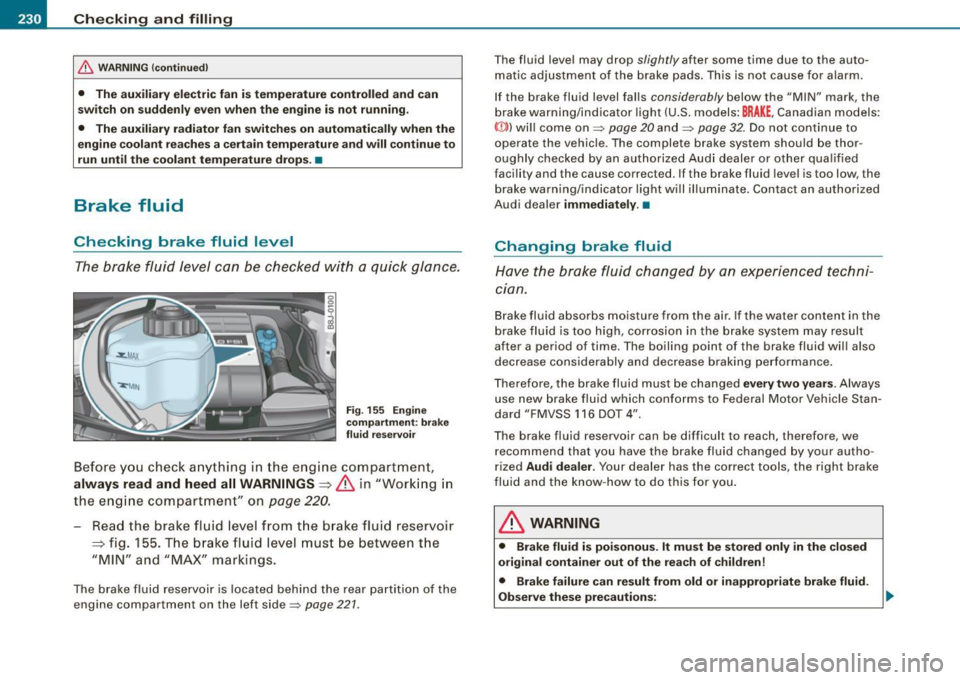
Fig. 155 Engine
compartment: brake
fluid reservoir
Before you check anything in the engine compartment,
always read and heed all WARNINGS =>
& in "Working in
the engine compartment" on
page 220.
- Read the brake fluid level from the brake fluid reservoir
~ fig. 155. The brake fluid level must be between the
"MIN" and "MAX" markings.
The brake fluid reservoir is located behind the rear partition of the
engine compartment on the left side~
page 221 .
The fluid level may drop slightly after some time due to the auto
matic adjustment of the brake pads. This is not cause for alarm.
If the brake fluid level falls
considerably below the "MIN" mark, the
brake warning/indicator light (U .S. models:
BRAKE , Canadian models:
ill) will come on~ page 20 and~ page 32. Do not continue to
operate the vehicle . The complete brake system should be thor
oughly checked by an authorized Audi dealer or other qualified
facility and the cause corrected. If the brake fluid level is too low, the
brake warning/indicator light will illuminate. Contact an authorized
Audi dealer
immediately .•
Changing brake fluid
Have the brake fluid changed by an experienced techni
cian.
Brake fluid absorbs moisture from the air. If the water content in the
brake fluid is too high, corrosion in the brake system may result
after a period of time. The boiling point of the brake fluid will als o
decrease considerably and decrease braking performance.
Therefore, the brake fluid must be changed
every two years. Always
use new brake fluid which conforms to Federal Motor Vehicle Stan
dard "FMVSS 116 DOT 4".
The brake fluid reservoir can be difficult to reach, therefore, we
recommend that you have the brake fluid changed by your autho
rized
Audi dealer . Your dealer has the correct tools, the right brake
fluid and the know -how to do this for you.
& WARNING
• Brake fluid is poisonous. It must be stored only in the closed
original container out of the reach of children!
• Brake failure can result from old or inappropriate brake fluid.
Observe these precautions : .,,_
Page 236 of 316
___ C_h_ e_ c_k _in --== g'-- a_n _d_ f_il _li _n ..:::g:::..- ___________________________________________ _
& WARNING (continued)
• Make sure the vent hose is always attached to the opening on
the side of the battery.
• Never use batteries which are damaged. Danger of explosion!
Always replace a damaged battery .
& WARNING
California Proposition 65 Warning :
• Battery posts, terminals and related accessories contain lead
and lead compounds, chemicals known to the State of California
to cause cancer and reproductive problems. Wash hands after
handling .
0 Note
• Do not disconnect the vehicle battery when the ignition is
switched on or when the engine is running, otherwise, you will
damage electronic components in the electrical system.
• When working on the engine, protect the battery housing from
ultraviolet (UV) rays by not parking the vehic le in direct sunlight.
• If your vehicle is going to stand for a long period of time without
being driven , protect the battery from "freezing", otherwise it will
be damaged and will then have to be replaced. •
Checking the battery acid level on magic eye
batteries*
The battery acid level in the battery can be checked
through the clear inspection window.
I
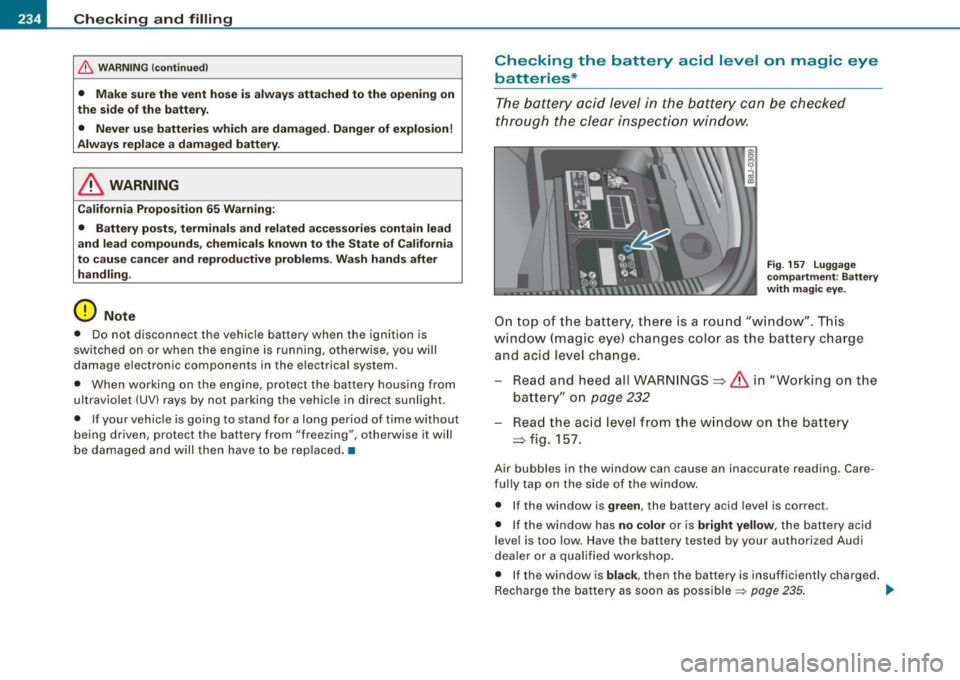
Fig. 157 Luggage
compartment : Battery
with magic eye.
On top of the battery, there is a round "window". This
window (magic eye) changes color as the battery charge
and acid level change.
- Read and heed all WARNINGS=>
& in "Working on the
battery" on
page 232
- Read the acid level from the window on the battery
=> fig. 157.
Air bubbles in the window can cause an inaccurate reading. Care
fully tap on the side of the window.
• If the window is
green, the battery acid level is correct.
• If the window has
no color or is bright yellow, the battery acid
level is too low. Have the battery tested by your authorized Audi
dealer or a qualified workshop.
• If the window is
black , then the battery is insufficiently charged.
Recharge the battery as soon as possible =>
page 235. ...
Page 242 of 316
-~_T_ ir_e_ s_ a_ n_d _ w_ h_ e_e _l_s _________________________________________________ _
Groove
means the space between two adjacent tread ribs.
Load rating (code)
means the maximum load that a tire is rated to carry for a given
inflation pressure . You may not find this information on all tires
because it is not required by law.
Maximum load rating
means the load rating for a tire at the maximum permissible infla
tion pressure for that tire.
Maximum loaded vehicle weight
means the sum of:
(a) Curb weight
(b) Accessory weight
(c) Vehicle capacity weight, and
(d) Production options weight
Maximum (permissible) inflation pressure
means the maximum cold inflation pressure to which a tire may be
in flated. Also called "maximum inflation pressure ."
Normal occupant weight
means 150 lbs. (68 kilograms) times the number of occupants
seated in the vehicle up to the total seating capacity of your vehicle.
Occupant distribution
means distribution of occupants in a vehicle .
Outer diameter
means the overall diameter of an inflated new tire.
Overall width
means the linear distance between the exteriors of the sidewalls of
an inflated tire, including elevations due to labeling, decorations, or
protective bands or ribs .
Ply
means a layer of rubber -coated parallel cords.
Production options weight
means the combined weight of those installed regular production
options weighing over 5 lbs. (2.3 kg) in excess of those standard
items which they replace, not previously considered in curb weight
or accessory weight, including heavy duty brakes, ride levelers,
heavy duty battery, and special trim.
Radial ply tire
means a pneumatic tire in which the ply cords that extend to the
beads are laid at substantially 90 degrees to the centerline of the
tread.
Recommended inflation pressure
see =:> page 239, "Cold tire inflation pressure".
Reinforced tire
means a tire designed to operate at higher loads and at higher infla
tion pressures than the corresponding standard tire. Reinforced
tires my be identified as "XL", "xi", "EXTRA LOAD", or "RF" on the
sidewall.
Rim
means a metal support for a tire or a tire and tube assembly upon
which the tire beads are seated .
Rim diameter
means nominal diameter of the bead seat. If you change your wheel
size, you will have to purchase new tires to match the new rim diam
eter.
Rim size designation
means rim diameter and width.
Rim width
means nominal distance between rim flanges .
Page 245 of 316
__________________________________________________ T_ ir_e_ s_ a_ n_d _ w_ h_ e_ e_l_s __ __
•
ating the vehicle at ma ximum load , you must increase the t ire pre s
sures to those specified for maximum vehi cle load
~ & .
Bear in mind that the t ire pressure mo nitoring system can only
monitor the tire pressures you have stored . The system does not
reco gnize the load cond itio n of your vehicle.
T he effectiveness of the tire pressure monitoring system will be
impaire d if you stor e nor mal loa d pressures but then operate the
vehic le at its maximum load~&. See the
illustration~ page 242, fig. 160 for the location of the label
on driver's si de B -pillar (co lor of the ac tual label a nd exact loca tion
on the veh ic le will vary slightly).
N ote that the following tab le is accu rate at the time of going to
press and is subject to cha nge . In t he event o f discrepancies, the t ire
pressure label (on driver's side B -pillar) a lways takes precedence .
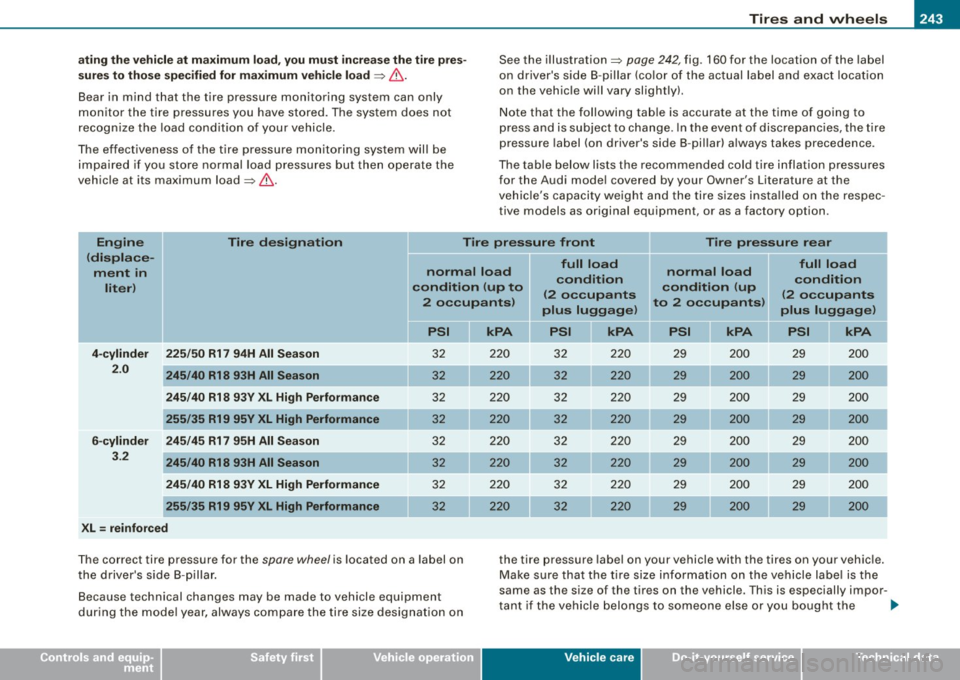
The table belo w lists t he r ecom mend ed cold tire i nflatio n pressures
for the Audi mode l covered by your Owner's Literature at the
vehic le' s capacity weigh t and the tire size s insta lled o n the respec
tive models as original equipment , or as a factory option .
Engine Tire designation
Tire pressure front II Tire pressure rear
(displace -
= " full load full load
ment in normal load
condition normal
load
condition
liter ) condition
(up to condition (up
( 2 oc cupants (2 occupants
2 o ccupants ) to 2 occupants)
plus luggage) plus luggage)
I
PSI II kPA PSI II kPA II PSI II kPA
PSI I[ kPA I
I
4-cylinder
225/50 R17 94H All Season 32 220 3 2 220 29 200 29 200
2.0
245/40 R18 93H All Season 32 220 32 220 29 200 29 200
245 /40 R18 93Y XL High Performance 32 220 32 220 29 200 29 200
255 /35 R19 95Y XL High Performance 32 220 32 220 29 200 29 200
6 -cylinder 245/45 R17 95H All Season 3 2 220 32 2 20 29 200 29 2 00
3.2
245/40 R18 93H All Season 32 220 32 220 29 200 29 200
245 /40 R18 93V XL High Performance 32 220 3 2 220 29 200 29 200
255/35 R19 95V XL High Performance 32 2 20 32 220 29 200 29 200
XL = reinforced
T he correct tire pressure for the spare wheel is located on a label on the tire p ressure label on your vehicle with the tires on your vehic le.
t he d river's s ide B -pilla r. Make sure that the tire s ize inf ormat ion on t he veh icle labe l is t he
Because technical changes may be made to vehicle equipment same as the si
ze of the tires on the vehicle. This is especially impor -
t ant if the ve hicle belongs to so meo ne else or you bought the
dur ing th e mode l year, always co mpare the tire size designa tion on
Vehicle care
I t •
.,
Page 260 of 316
-Tires and wheels
---------------------------------------------
& WARNING
Improper use of run-flat tires can cause vehicle damage that can
lead to loss of vehicle control, a crash and serious personal injury.
• Run-flat tires can only be used with special rims.
• Run -flat tires must always be monitored with a properly
programmed Tire Pressure Monitoring System.
• Always inspect a tire that has lost air to make sure it is safe to
drive with the tire in the run-flat mode .
• Never drive with run-flat tires that have been damaged in a
collision.
• Never drive with run-flat tires if heat build-up causes the tire to
give off smoke.
• Never drive with run-flat tires if the vehicle shakes or vibrates
severely.
• Never drive with a run-flat tire that develops sidewall cracks or
other damage while in use.
0 Note
Run -flat tires have special characteristics and requirements, that are
very different from conventional tires . Run-flat tires require special
rims for run -flat use and cannot be used on conventional wheel
rims .
[ i] Tips
• If you are not able to continue driving with run-flat tires, please
seek professional assistance.
• Please contact your authorized Audi dealer or Audi of America,
Inc. if you have questions about tires and rims. •
Applie s t o vehic le s: wi th Run -flat tires
Driving with run-flat tires
Handling characteristics change when tire pressure is
low.
Driving on tires with low tire pressure changes the way a
vehicle handles, particularl y when cornering and braking.
The handling characteristics of run-flat tires do not seem to
change a lot even when driving on low pressure or in the
run -flat mode . Nevertheless you must still take special
precautions when operating a vehicle on run-flat tires when
tire pressure is low o r the tire(s) is flat:
- The Electronic Stabilization Program (ESP) must be
switched on.
- Never drive faster than 50 mph (80 km/h)~ &.
- Plan ahead when driving and anticipate what you will
have to do considering traffic and road conditions up
ahead.
- Accelerate carefully.
- Avo id unnecessary and sudden steering and braking
maneuvers .
- Reduce your speed in plenty of time before intersections,
curves and other places where you may have to react
quickly.
P lease see:=:, page 257, "When it is not possible to continue driving,
even with run-flat tires?" ..,_
Page 276 of 316
llffl.,___F_ u_ s_ e_s _ a_n _ d_ b_ u_lb _ s _______________________________________________ _
The various electrical circuits are protected by fuses . The fuses are
clustered in a central ized unit. The unit is located behind the face
panel at the end of the instrument panel.
Two spare fuses and a sticker identifying the fuses are located on
the inside of the fuse box cover.
You are wel l advised to keep a supply of spare fuses in your vehicle .
Fuses with the proper ampere ratings are availab le at your autho
rized Audi dealer .
& WARNING
Never replace a fuse with one that has a higher amperage rating .
• A fuse with a too high amperage could damage the electrical
part and cause a fire.
0 Note
• On no account should fuses be repaired (e.g. patched up with tin
foil or wire) as this may cause serious damage elsewhere in the elec
trical circuit or cause fire.
• If a fuse blows repeatedly, do not keep replacing it. Instead, have
the cause for the repeated short circuit or overload tracked and
fixed. •
Fuse Location , Instrument Panel left
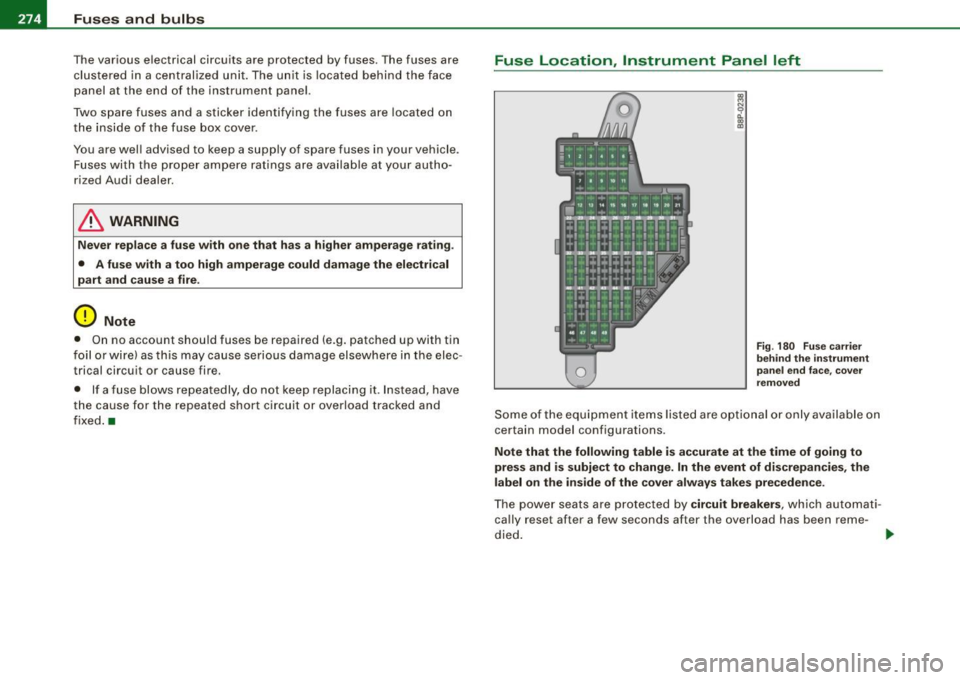
Fig. 180 Fuse carrier
behind the instrument
panel end face, cover
removed
Some of the equipment items listed are optional or only available on
certain model configurations .
Note that the following table is accurate at the time of going to
press and is subject to change. In the event of discrepancies , the
label on the inside of the cover always takes precedence.
The power seats are protected by circuit breakers , which automati
ca lly reset after a few seconds after the overload has been reme-
died. _,.