airbag off AUDI TT ROADSTER 2008 Owners Manual
[x] Cancel search | Manufacturer: AUDI, Model Year: 2008, Model line: TT ROADSTER, Model: AUDI TT ROADSTER 2008Pages: 316, PDF Size: 70.1 MB
Page 21 of 316
Additional information about the electrically retractable rear spoiler
=:> page 187 . •
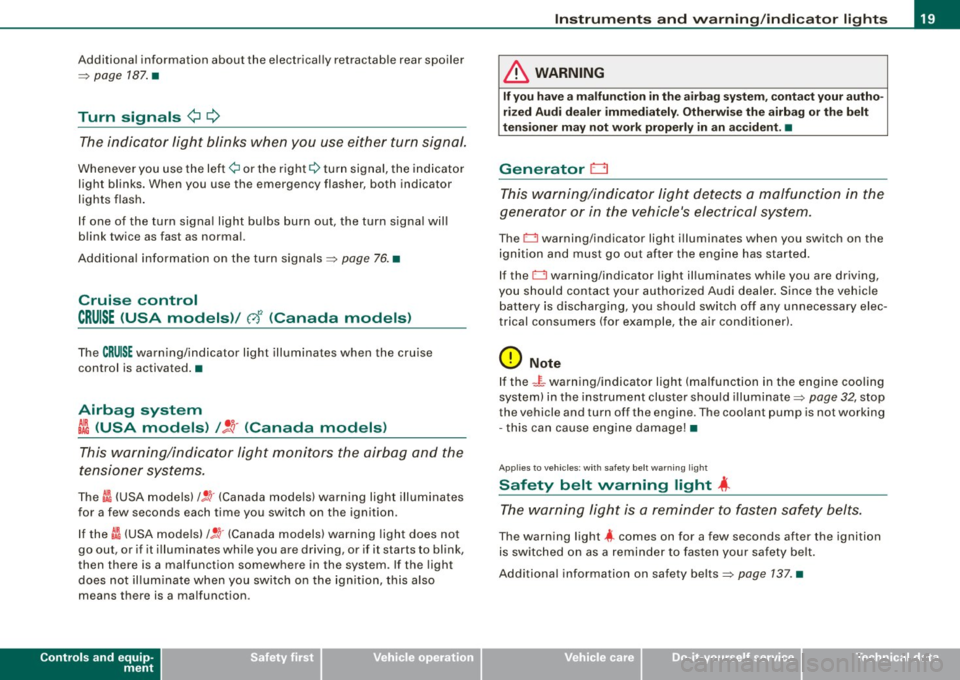
Turn signals ¢ Q
The indicator light blinks when you use either turn signal.
Whenever you use the left¢ or the right c::::> turn signal, the indicator
light blinks. When you use the emergency flasher, both indicator
lights flash .
If one of the turn signa l light bu lbs burn out, the turn signal will
blink twice as fast as normal.
Additiona l information on the turn signals :::::>
page 76. •
Cruise control
CRUISE (USA models )/ (')<> (Canada models)
The CRUISE warning/indicator light illuminates when the cruise
control is activated. •
Airbag system
~~ (USA models) / !_~· (Canada models)
This warning/indicator light monitors the airbag and the
tensioner systems .
The ti (USA models) !! 'tr (Canada models) warning light illuminates
for a few seconds each time you switch on the ignition .
If the m (USA mode ls)
/ J q· (Canada models) warning light does not
go out, or if it i lluminates whi le you are driving, or if it starts to blink,
then there is a malfunction somewhere in the system. If the light
does not illuminate when you switch on the ignition, this also
means there is a malfunction.
Controls and equip
ment
Instruments and warning /indi cator lights
& WARNING
If you have a malfunction in the airbag system, contact your autho
rized Audi dealer immediately. Otherwise the airbag or the belt
tensioner may not work properly in an accident. •
Generator 0
This warning/indicator light detects a malfunction in the
generator or in the vehicle's electrical system.
The D warning/indicator light illuminates when you switch on the
ignition and must go out after the engine has started.
If the D warning/indicator light illuminates while you are driving,
you should contact your authorized Audi deale r. Since the vehicle
battery is discharging, you should switch off any unnecessary elec
trical consumers (for example, the air conditioner).
0 Note
If the -~- warning/indicator light (malfunction in the engine cooling
system) in the instrument cluster shou ld illuminate :::::>
page 32, stop
the vehicle and turn off the engine . The coolant pump is not working
- this can cause engine damage!•
Applies to veh ic les : w ith safety belt warning l ight
Safety belt warning light 4
The warning light is a reminder to fasten safety belts.
The warning light 4 comes on for a few seconds after the ignition
is switched on as a reminder to fasten your safety belt.
Additional information on safety belts:::::>
page 137. •
I • •
Page 77 of 316
Ignition ON , light swit ch at @ .
With the ignition switched ON, the g low of instrument needles can
be adjusted to appear brighter or dimmer.
Ignition ON , ligh t switch at :oo ; or io.
With the lights switched on , the brightness of instrument cluster
(i .e. needles, gauges and displays) and center conso le i llu m in ation
can be adjusted .
0 Note
The instrument c luster and center console illumination (gauges and
needles) comes on when you switch on the igni tion and the
vehicle
headlights are off .
Be aware of the followin g difference be tween
models built to US o r Canadian specifications :
• USA models : illumination of the in strument cluster (gauges and
needles), dash and center console around the gearshift lever is
controlled by a light sensor located in the instrument panel. The
instrument panel illum ination will automatically become dimmer
as the daylight fades away and eventually will go out completely
when outside light is very low . This is to remind you , the d river , to
s witch on the headlight s before it gets too dark.
• Canada models : instrument panel illum ination will stay br ight
regardle ss of the inten sity of ambient light . Always be aware of
c hanges in outside light conditions while you are driving . Respond
in time to fading dayli ght by turning the light switch to position
iD
(or "AUTO" if your car is equipped with this feature) to turn on your
headlights. •
Bi-Xenon headlights*
Afte r starting the engi ne, the b i- xeno n headlights are au tomatical ly
adjusted to the load and angle of the vehic le (for example, during
acce lera tion and braking). This prevents oncoming traffi c from
experiencing unnecessary headlight g lare from your bi -xenon head
lig hts .
Con tro ls and eq uip
ment
Clear vision
I f the system is not operating properly, a warning symbo l in the
Au to-Check C ontr ol is displayed
=> page 35 . •
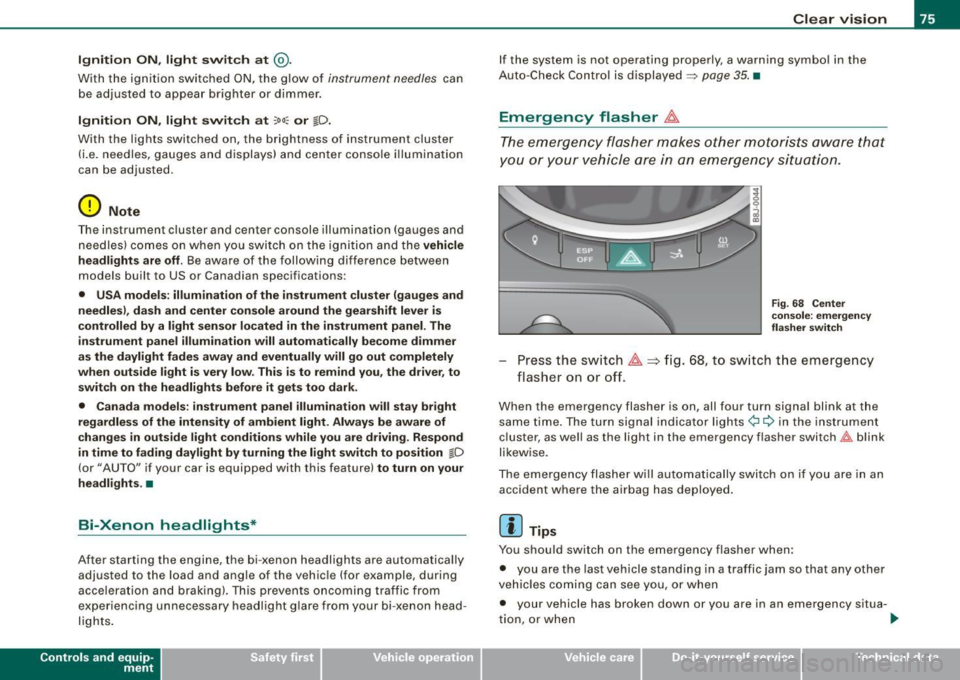
Emergency flasher tfft,,.
T he e mergency flasher m akes other motor ists aware that
y o u or yo ur vehicle are i n an e merge ncy si tuation.
Fig . 68 Center
co nsole : emergency
fla sher sw itch
Press the sw itch ~=:,fig. 68, to s witch t he emergency
flasher on or off.
When the emergency flasher is on, all four turn signal blink at the
same time . The tu rn signal indi cato r lights
¢i Q in the instrument
c luster, as well as the light in the emergency flasher switch
J:&. b link
likewise.
The eme rgency flashe r will automat ically switch on i f you are in an
accident where the airbag has deployed .
[ i ] Tips
You should switch on the emergency flasher when:
• you are the last vehicle standing in a traffic jam so that any other
vehicles coming can see you, or when
• your vehicle has broken down or you are in an emergency s itua -
tion, o r when _,,,
Vehicle care I I irechnical data
Page 89 of 316
Seats and storage
General recommendations
Why is your seat adjustment so important?
The safety belts and the airbag system can only provide
maximum protection if the front seats are correctly
adjusted.
There are various ways of adjusting the front seats to provide safe
and comfortable support for the driver and the front passenger.
Adjust your seat properly so that:
• you can easily and quickly reach all the switches and controls in
the instrument panel
• your body is properly supported thus reducing physical stress
and fatigue
• the safety belts and airbag system can offer maximum protec
tion
~ page 146.
In the following sections, you will see exactly how you can best
adjust your seats.
There are special regulations and instructions for installing a child safety seat on the front passenger's seat. Always heed the informa
tion regarding child safety provided in~
page 168, "Child Safety".
& WARNING
Incorrect seating position of the driver and all other passengers
can result in serious personal injury.
• Always keep your feet on the floor when the vehicle is in motion
- never put your feet on top of the instrument panel, out of the
window or on top of the seat cushion! This applies especially to
the passengers. If your seating position is incorrect you increase
the risk of injury in the case of sudden braking or an accident. If
Controls and equip
ment
Seats and storage
& WARNING (continued)
the airbag inflates and the seating position is incorrect this could
result in personal injury or even death.
• It is important for both the driver and front passenger to keep
a distance of at least 10 inches (25 cml between themselves and
the steering wheel and/or instrument panel. If you're sitting any closer than this, the airbag system cannot protect you properly. In
addition to this, the front seats and head restraints must be
adjusted to your body height so that they can give you maximum
protection.
• Always try to keep as much distance as possible between your
self and the steering wheel or instrument panel.
• Do not adjust the driver's or front passenger's seat while the
vehicle is moving. Your seat may move unexpectedly, causing
sudden loss of vehicle control and personal injury. If you adjust
your seat while the vehicle is moving, you are out of position. •
Driver's seat
The correct seat position is important for safe and relaxed
driving.
We recommend that you adjust the driver's seat in the
following manner:
- Adjust the seat in fore and aft direction so that you can
easily push the pedals to the floor while keeping your
knee slightly bent:::>
& in "Why is your seat adjustment
so important?".
Adjust the seatback so that when you sit with your back against the seatback, you can still grasp the top of the
steering wheel. _..
I • •
Page 91 of 316
Applies to vehicles : wit h m anua l seat a djustment
Adjust ing the m anu al se ats
Position, angle and shape of the manual seats can be
adjusted to provide safe and comfortable seating.
Reed and heed all WARNINGS=:> & before you adjust your
seat.
Moving the front seats forward or backward
- Lift the lever (D =:> page 88, fig. 80 and slide the seat to
the desired position.
- Release the lever and then move the seat further until
you feel and hear it engage.
Adjusting the seat height
- Pull
the lever 0 up and pump it to raise the seat.
-Push the lever down and pump it to lower the seat.
Adjusting the seatback angle
-Lean forward to take your weight off the seatback.
- Turn the hand wheel© in the direction you want the
seatback to tilt .
& WARNING
• Never adjust the driver's or front passenger's seat while the
vehicle is moving. If you do this while the vehicle is moving, you
will be out of position . Always adjust the driver's or front
passenger's seat when the vehicle is not moving.
• Be careful when adjusting the seat height. Check to see that no
one is in the way, or serious injury could result!
Controls and equip
ment
Seats and storage
& WARNING (continued)
• To reduce the risk of injury in the case of sudden braking or
accident, front passengers must never ride in a moving vehicle
with the seatback reclined . Safety belts and the airbag system
only offer maximum protection when the seatback is upright and
the safety belts are properly positioned on the body. The more the
seatback is reclined, the greater the risk of personal injury from an
incorrect seating position and improperly positioned safety
belts! •
Power seats
Applies to ve hicles: w ith power sea ts
Adjustment switches
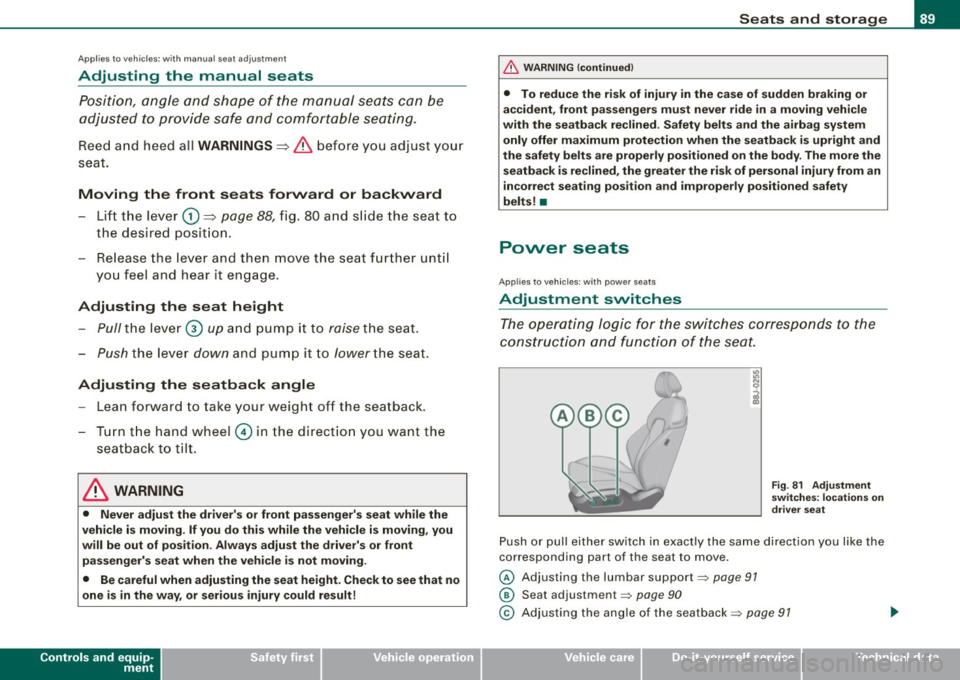
The operating logic for the switches corresponds to the
construction and function of the seat.
Fig. 81 Adjustment
switches: locations on
driver seat
Push or pull either switch in exactly the same direction you like the
corresponding part of the seat to move.
@ Adjusting the lumbar support~ page 91
@ Seat adjustm ent ~ page 90
© Adjusting the angle of the seatback ~ page 91 ..,_
I • •
Page 93 of 316
Applies to vehic les: with power seats
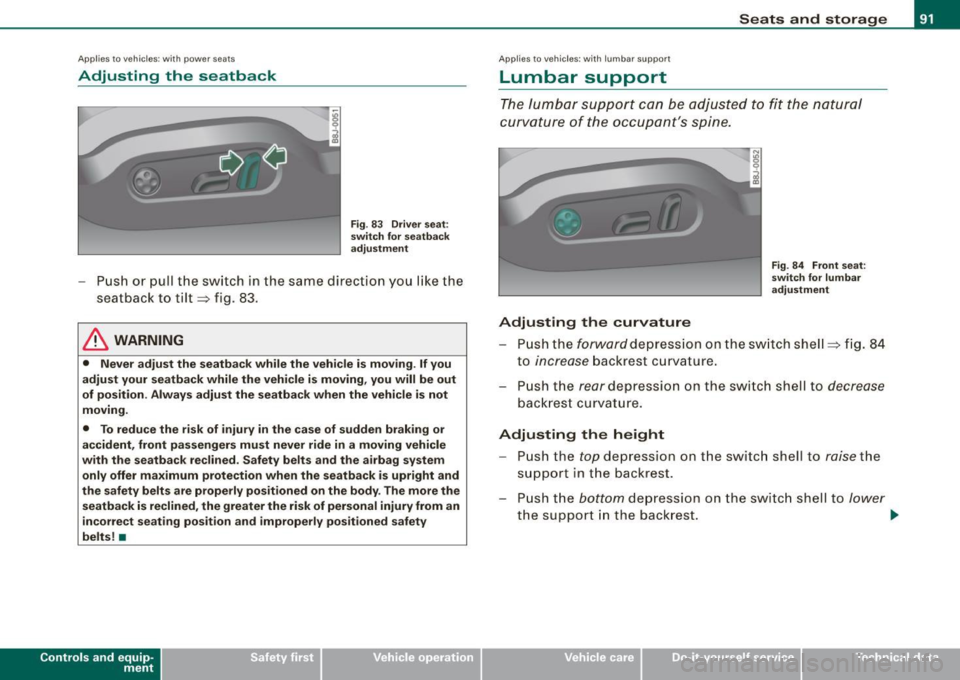
Adjusting the seatback
Fig . 83 Driver seat:
switch for seatback
adjustment
- Push or pull the switch in the same d irection you like the
seatback to ti It => fig. 83 .
& WARNING
• Never adjust the seatback while the vehicle is moving . If you
adjust your seatback while the vehicle is moving, you will be out
of position . Always adjust the seatback when the vehicle is not
moving.
• To reduce the risk of injury in the case of sudden braking or
accident, front passengers must never ride in a moving vehicle
with the seatback reclined. Safety belts and the airbag system
only offer maximum protection when the seatback is upright and
the safety belts are properly positioned on the body . The more the
seatback is reclined, the greater the risk of personal injury from an
incorrect seating position and improperly positioned safety
belts! •
Con tro ls and eq uip
ment
Seats and storage
A pp lies to vehicles: with lumba r suppo rt
Lumbar support
The lumbar support can be adjusted to fit the natural
curvature of the occupant's spine .
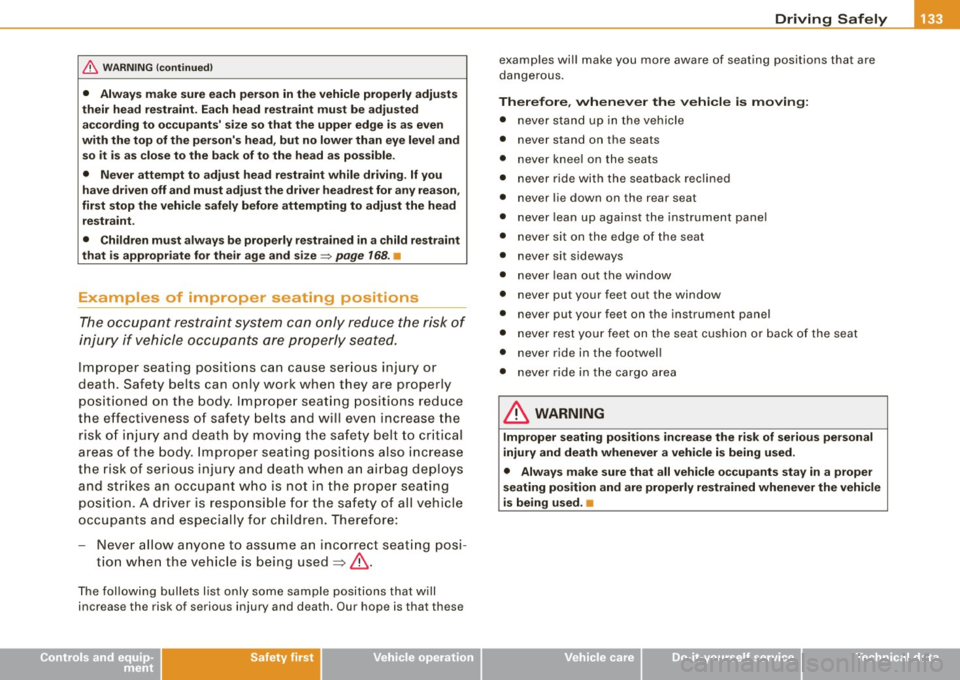
Adjusting the curvature
Fig. 84 Front seat:
switch for lumbar
adjustment
Push the forward depression on the switch shell=> fig. 84
to
increase backrest curvature.
Push the
rear depression on the switch shell to decrease
backrest curvature.
Adjusting the height
Push the top depression on the sw itch s he ll t o raise the
support in the backrest .
Push the
bottom depressio n on the switch shell to lower
the support in the backrest . ~
Vehicle care I I irechnical data
Page 135 of 316
Driving Safely -
----------------
& WARNING (continued)
• Always make sure each person in the vehicle properly adjusts
their head restraint. Each head restraint must be adjusted
according to occupants' size so that the upper edge is as even
with the top of the person's head, but no lower than eye level and so it is as close to the back of to the head as possible .
• Never attempt to adjust head restraint while driving.
If you
have driven off and must adjust the driver headrest for any reason,
first stop the vehicle safely before attempting to adjust the head
restraint.
• Children must always be properly restrained in a child restraint
that is appropriate for their age and size~
page 168. •
Examples of improper seating positions
The occupant restraint system can only reduce the risk of
injury if vehicle occupants are properly seated.
Improper seating positions can cause serious injury or
death. Safety belts can only work when they are properly
positioned on the body. Improper seating positions reduce
the effectiveness of safety belts and will even increase the
risk of injury and death by moving the safety belt to critical
areas of the body. Improper seating positions also increase
the risk of serious injury and death when an airbag deploys
and strikes an occupant who is not in the proper seating
position. A driver is responsible for the safety of all vehicle
occupants and especially for children. Therefore:
- Never allow anyone to assume an incorrect seating posi
tion when the vehicle is being used::::;,
&-
The following bullets list only some sample positions that will
increase the risk of serious injury and death . Our hope is that these
Controls and equip
ment Safety first Vehicle operation
examples will make you more aware of seating positions that are
dangerous.
Therefore, whenever the
vehicle is moving:
• never stand up in the vehicle
• never stand on the seats
• never kneel on the seats
• never ride with the seatback reclined
• never lie down on the rear seat
• never lean up against the instrument panel
• never sit on the edge of the seat
• never sit sideways
• never lean out the window
• never put your feet out the window
• never put your feet on the instrument panel
• never rest your feet on the seat cushion or back of the seat
• never ride in the footwell
• never ride in the cargo area
& WARNING
Improper seating positions increase the risk of serious personal
injury and death whenever a vehicle is being used.
• Always make sure that all vehicle occupants stay in a proper
seating position and are properly restrained whenever the vehicle
is being used. •
Vehicle care Do-it-yourself service Technical data
Page 141 of 316
Because the occupants in th is vehicle are not using safety belts
~ page 138, fig. 122, they will keep moving at the same speed the
vehicle was moving just before the crash, un til some thing stops
them -here, the wall ~ page 138 , fig . 123.
The same principles apply to people sitting in a vehicle that is involved in a frontal collision. Even at city speeds of 20 to 30 mph
(30 to 50 km/h) , the forces acting on the body can reach one ton
(2,000 lbs, or 1,000 kg) or more . At higher speeds , th ese forces are
even greater.
People who do not use safety bel ts are also not attached to their
vehicle. In a frontal collision they will also keep moving forward at
the speed their vehicle was travelling just before the crash . Of
course, the laws of physics don't just apply to frontal collisions, they
determine what happens in all kinds of accidents and collisions. •
What happens to occupants not wearing
safety belts?
In crashes unbelted occupants cannot stop themselves
from flying forward and being injured or killed. Always
wear your safety belts!
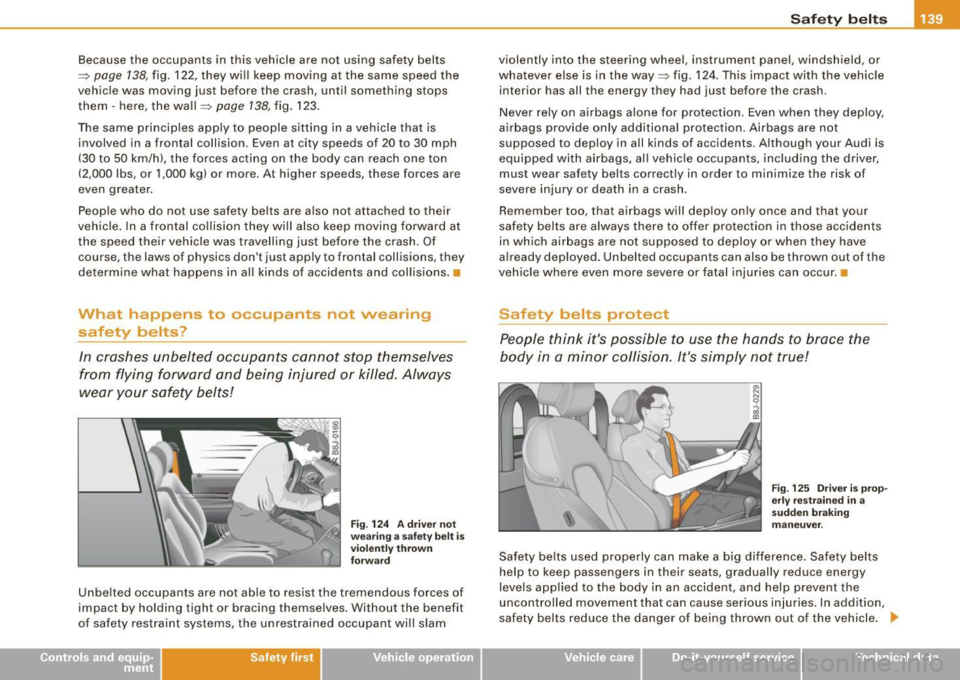
Fig . 124 A driver not
wearing a safety belt is
violently thrown
forward
Unbelted occupants are not able to resist the tremendous forces of
impact by holding tight or bracing themselves . Without the benefit
of safety restraint systems, the unrestrained occupant will slam
Safety first
Safety belts
violently into the steering wheel, instrument panel, windshield, or
whatever else is in the way ~ fig. 124 . This impact with the vehicle
interior has all the energy they had just before the crash.
Never rely on airbags alone for protection. Even when they deploy,
airbags provide only additional protection. Airbags are not
supposed to deploy in all kinds o f accidents. Although your Audi is
equipped with airbags, all vehicle occupants, including the driver,
must wear safety belts correctly in order to minimi ze the risk of
severe injury or death in a crash.
Remember too , that airbags will deploy only once and that your
safety belts are always there to offer protection in those accidents
in which airbags are not supposed to deploy or when they have
already deployed. Unbelted occupants can also be thrown out of the
vehicle where even more severe or fatal injuries can occur. •
Safety belts protect
People think it's possible to use the hands to brace the
body in a minor collision. It's simply not true!
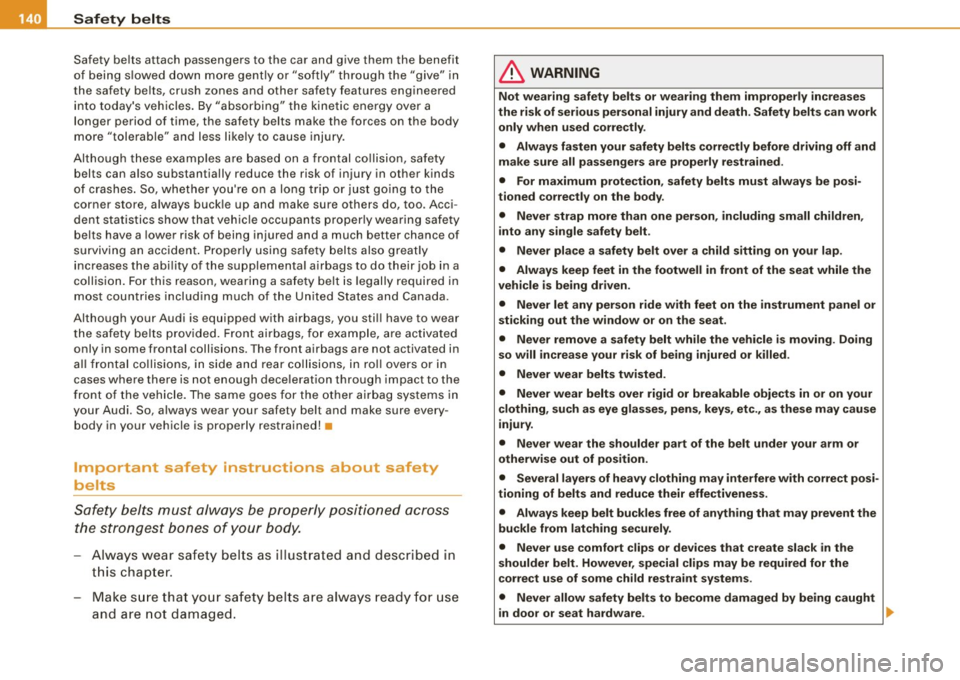
Fig. 125 Driver is prop·
erly restrained in a
sudden braking
maneuver .
Safety belts used properly can make a big difference. Safety belts
help to keep passengers in their seats, gradually reduce energy
levels applied to the body in an accident, and help prevent the
uncontrolled movement that can cause serious injuries. In addition ,
safety belts reduce the danger of being thrown out of the vehicle. .,.
Vehicle care
I I Technical data
Page 142 of 316
• ....__S_ a_ fe_ t _y=-- b_ e_ lt_s ________________________________________________ _
Safety belts attach passengers to the car and give them the benefit
of being slowed down more gent ly o r "softly" through the "give" in
the safety belts, crush zones and other safety features engineered
into today's vehicles . By "absorbing" the kinetic ene rgy over
a
longer period of time, the safety belts make the forces on the body
more "tolerable" and less likely to cause injury.
Although these examp les are based on a frontal co llision, sa fety
belts can a lso substantially reduce the risk of injury in other kinds
of crashes . So, whether you're on a long trip or just go ing to the
corner store, always buckle up and make sure others do, too. Acci
dent statistics show that vehic le occupants properly wea ring safety
belts have a lower risk of being injured and a much better chance of
surviv ing an accident . Properly using safety belts also great ly
increases the abi lity of the supplementa l airbags to do their job in a
collision. For this reason, wearing a safety belt is legally required in
most countries includ ing much of the United States and Canada.
Although your Audi is equipped with airbags, you sti ll have to wear
t he safety be lts prov ided. Fron t ai rbags, for example, are act iva ted
only in some frontal coll isions. The front airbags are not activated in
a ll frontal co llisions, in side and rear c ollisions, in rol l overs or i n
cases where there is not enough dece leration through impact to the
fron t of the vehicle . The same goes for the ot her airbag sys te m s in
your Audi . So, a lways wear your safety belt and make sure every
body in your vehicle is prope rly restrained! •
Important safety instructions about safety
belts
Safety belts must always be properly positioned a cross
the s trongest bones o f your b ody.
- Always w ear saf ety belts as i llus trat ed and d escrib ed in
th is cha pter .
- M ake sure that your safety b elt s ar e always read y for use
and a re not d am ag ed.
& WARNING
Not wearing safety belts or wearing them improperly increases
the risk of serious personal injury and death . Safety belts can work
only when used co rrectly .
• Alway s fa sten your safety belt s corre ctly before driving off and
make sure all pa ssengers are properly restrained .
• For maximum protection , safety belts mu st always be posi
tioned correctly on the body .
• Never strap more than one person , including sm all children ,
into any single safety belt .
• Never pla ce a safety belt ove r a child sitting on your lap .
• Always keep feet in the footwell in front of the seat while the
v ehicle is being dri ven .
• Never let any person ride with feet on the instrument panel or
s ticking out the window or on the seat .
• Never remove a safety belt while the vehicle i s moving. Doing
so will incre ase your risk of being i njured o r killed.
• Never wear belt s twi sted .
• Never wear belts over rigid or breakable objects in or on your
clothing , such a s eye glasses , pens , key s, etc ., as the se may cau se
i njury .
• Never wear the shoulder part of the belt under your arm or
otherwise out of position .
• Several layer s of heavy clothing may interfere with correct po si
tioning of belts and reduce their effe ctiveness .
• Alway s keep belt bu ckles free of anyth ing th at may prevent the
buckle from latching securely.
• Never use comfort clips or devices that create slack in the
s houlder belt . H owever , special clips may be required for the
c orre ct use of some child re straint system s.
• Never allow safety belt s to become damaged by being caught
in door or seat ha rdware . .,_
Page 149 of 316
________________________________________________ A_ i_ r _b _a_, g:::.,_ s..., y'- s_ t_ e_ m ___ !II
repair costs or even the lack of vehicle damage is not necessari ly an
indication of whether an airbag should inflate or not.
It is not possible to define a range of vehicle speeds that will cover
every possible kind and ang le of impact that wil l always trigger the
airbags, since the circumstances wil l vary considerab ly between
one collision and another. Important factors include, for example,
the nature (hard or so ft) of the object which the car hits, the angle
of impact, vehicle speed, etc. The front airbags wi ll also not inflate
in side or rear co llisions, or in roll -overs .
Al way s rem ember : Airbags wi ll deploy only once, and on ly in certain
kinds of coll isions . Your safety belts are always there to offer protec
tion in those situat ions in wh ich airbags are not supposed to deploy,
or when they have already deployed; for example, when your vehic le
strikes or is struck by another a fter the first coll ision.
T his is just one of the reasons why an airbag is a supplementary
restraint and is not a substitute for a sa fety be lt. The airbag system
works most effectively when used with the safety be lts. Therefore ,
a lways prope rly wea r your safety belt s =>
page 137 .
& WARNING
Sitting too clo se to the steering wheel or in strument panel will
de crease the effect ivene ss of the airbags and will incr ease the risk
of personal injury in a collision.
• Never sit closer than 10 in ches (25 cm) to the steering wheel or
in strument panel.
• If you c annot sit more than 10 in ches (25 cm ) from the steering
wheel , inve stiga te whether adaptive equipment may be available
to held you reach the pedal s and in crease your se ating dist ance
from the steering wheel.
• If you are unrestra ined , leaning forward , sittin g side ways or out
of position in any way , your risk of injury i s much higher .
• You will also receive serious injur ies and could even be killed if
you are up again st the airba g or too clo se to it when it infl ates -
ev en with an Advanced Airbag .
Controls and equip ment Safety first
Vehicle operation
& WAR N IN G ( continued )
• To reduce the ri sk of injury when an airbag inflate s, alw ays
wear safety belt s prope rly~ page 141 , "S afet y belt s".
• If children are not properly re strained , they may be severely
injured or killed whe n an airbag inflates .
• Never let children ride unrestrained or improperly restrained in
the vehi cle . Adju st the front seats properly .
• Alway s sit a s far a s po ssible from the steering wheel or the
instrument panel~ page 1 30, "Proper occup ant se ati ng po si
tions ".
• Alwa ys sit upright with yo ur b ack again st the ba ckrest of your
s eat.
• Never place your feet on the instrument p anel or on the seat .
Alway s keep both feet on the floor in front of the seat to help
prevent serious injurie s to the leg s and hips if the airbag infl ate s.
& WARNING
Airbags that have deployed in a crash must be repla ced.
• U se on ly original equipment airbags app roved by Audi and
installed by a trained technici an who has the n eces sary tool s and
diagno sti c equipment to properly repl ace an y airb ag i n your
vehicle and assure sy stem effectivenes s in a crash .
• Ne ver permit salvaged or re cy cled airb ag s to be in stalled in
your vehicle . •
Child restraints on the front seat -some
important things to know
- Be sure to read the important info rmation a nd head the
WARNINGS for important details about c hildren and
Advanced Airbags~ page
168 . .-,
Vehicle care Do-it-yourself service Technical data
Page 150 of 316
___ A_ ir_ b_ a-g _ s_y _s_ t_ e_ m _________________________________________________ _
The airbag on the passenger side makes the front seat a potentially
dangerous place for a child to ride. The front seat is not the safest place for a child in a forward-facing child safety seat . It can be a very
dangerous place for an infant or a child in a rearward-facing seat.
The Advanced Airbag System in your vehicle has been certified to comply with the Requirements of United States Federal Motor
Vehicle Safety Standard 208 as applicable at the time your vehicle
was manufactured.
The Standard requires the front airbag on the passenger side to be
turned off ("suppressed") if a child up to about one year of age restrained in one of the rear -facing or forward -facing infant
restraints listed in Federal Motor Vehicle Safety Standard 208 with
which the Advanced Airbag System in your vehicle was certified has
been installed on the front passenger seat. For a listing of the child
restraints that were used to certify compliance with the US Safety
Standard =>
page 170.
The PASSENGER AIR BAG OFF light in the instrument panel tells you
when the front Advanced Airbag on the passenger side has been
turned off by the electronic control unit.
Each time you turn on the ignition, the
PASSENGER AIR BAG OFF
light will come on for a few seconds and:
• will stay on if the front passenger seat is not occupied,
• will stay on if there is a small child or child restraint on the front
passenger seat,
• will go off if the front passenger seat is occupied by an adult as
registered by the weight -sensing mat=>
page 157, "Monitoring the
Advanced Airbag System".
The
PASSENGER AIR BAG OFF light comes on when the control unit
detects a total weight on the front passenger seat that requires the
front airbag to be turned off.
If the total weight on the front passenger seat is more than that of
a typical 1 year-old child but less than the weight of a small adult,
the front airbag on the passenger side can deploy (the
PASSENGER
AIR BAG OFF
light does not come onl. If the PASSENGER AIR BAG OFF
light does not come on, the front airbag on the passenger side
has not been turned off by the electronic control unit and can
deploy if the control unit senses an impact that meets the condi
tions stored in its memory.
For example, the airbag may deploy if:
• a small child that is heavier than a typical 1 year-old child is on
the front passenger seat (regardless of whether the child is in one
of the child safety seats listed =>
page 170), or
• a child who has outgrown child restraints is on the front
passenger seat .
If the front passenger airbag is turned off, the
PASSENGER AIR BAG
OFF
light comes on in the instrument cluster and stays on .
The front airbag on the passenger side may
not deploy (the
PASSENGER AIR BAG OFF light does not illuminate and stay litl even
if a small adult or teenager, or a passenger who is not sitting upright
with their back against a non-reclined backrest with their feet on the
vehicle floor in front of the seat is on the front passenger seat
=> page 130, "Proper seating position for the driver".
If the front passenger airbag deploys , the Federal Standard requires
the airbag to meet the "low risk" deployment criteria to reduce the
risk of injury through interaction with the airbag. "Low risk" deploy
ment occurs in those crashes that take place at lower decelerations
as defined in the electronic control unit=>
page 157, "PASSENGER
AIR BAG OFF light".
Always remember, a child safety seat or infant carrier installed on
the front seat may be struck and knocked out of position by the rapidly inflating passenger's airbag in a frontal collision. The airbag
could greatly reduce the effectiveness of the child restraint and
even seriously injure the child during inflation.
For this reason, and because the back seat is the safest place for
children -when properly restrained according to their age and size
- we strongly recommend that children always sit in the back seat
=>
page 168, "Child Safety" . .,