service AUDI TT ROADSTER 2008 Owner's Manual
[x] Cancel search | Manufacturer: AUDI, Model Year: 2008, Model line: TT ROADSTER, Model: AUDI TT ROADSTER 2008Pages: 316, PDF Size: 70.1 MB
Page 137 of 316
Driving Safely ---------------=------------'-
& WARNING (continued)
• Never place or install floor mats or other floor coverings in the
vehicle that cannot be properly secured in place to prevent them
from slipping and interfering with the pedals or the ability to
control the vehicle .
• Never place or install floor mats or other floor coverings on top
of already installed floor mats. Additional floor mats and other
coverings will reduce the size of the pedal area and interfere with
the pedals.
• Always properly reinstall and secure floor mats that have been
taken out for cleaning.
• Always make sure that objects cannot fall into the driver foot
well while the vehicle is moving. Objects can become trapped
under the brake pedal and accelerator pedal causing a loss of
vehicle control . •
Stovving luggage
Loading the luggage compartment
All luggage and other objects must be properly stowed
and secured in the luggage compartment.
Loose items in the luggage compartment can shift
suddenly, changing vehicle handling characteristics. Loose items can also increase the risk of serious personal injury in
a sudden vehicle maneuver or in a collision.
- Distribute the load evenly in the lugg age compartment.
- Always place and properly secure heavy items in the
luggage compartment as far forward as possible.
Controls and equip
ment Safety first
Vehicle operation
& WARNING
Improperly stored luggage or other items can fly through the
vehicle causing serious personal injury in the event of hard braking or an accident. To help reduce the risk of serious personal injury:
• Always put objects, for example, luggage or other heavy items
in the luggage compartment .
• Always secure objects in the luggage compartment using the
tie-down eyelets and suitable straps.
& WARNING
Heavy loads will influence the way your vehicle handles. To help
reduce the risk of a loss of control leading to serious personal
injury :
• Always keep in mind when transporting heavy objects, that a
change in the center of gravity can also cause changes in vehicle
handling:
-Always distribute the load as evenly as possible.
- Place heavy objects as far forward in the luggage compart-
ment as possible.
• Never exceed the Gross Axle Weight Rating or the Gross
Vehicle Weight Rating specified on the safety compliance sticker on the left door jamb . Exceeding permissible weight standards
can cause the vehicle to slide and handle differently.
• Please observe information on safe driving=:>
page 128.
& WARNING
To help prevent poisonous exhaust gas from being drawn into the
vehicle, always keep the rear lid closed while driving .
• Never transport objects larger than those fitting completely
into the luggage area because the rear lid cannot be fully closed.
9J),
Vehicle care Do-it-yourself service Technical data
Page 139 of 316
Safety belts -----------------=-------
Safety belts
General notes
Always wear safety belts!
Wearing safety belts correctly saves lives!
This chapter explains why safety belts are necessary, how
they work and how to adjust and wear them correctly.
- Read all the information that follows and heed all of the
instruct ions and WARNINGS.
& WARNING
Not wearing safety belts or wearing them improperly increases
the risk of serious personal injury and death.
• Safety belts are the single most effective means available to
reduce the risk of serious injury and death in automobile acci
dents . For your protection and that of your passengers , always
wear the safety belts properly when the vehicle is moving.
• Pregnant women, injured, or physically impaired persons must
also use safety belts . Like all vehicle occupants, they are more
likely to be seriously injured if they do not wear safety belts . The
best way to protect a fetus is to protect the mother -throughout
the entire pregnancy. •
Number of seats
Your Audi TI Roadster has two seating positions. Each seating posi
tion has a safety belt.
Controls and equip ment Safety first
Vehicle operation
& WARNING
Not wearing safety belts or wearing them improperly increases
the risk of serious personal injury and death .
• Never strap more than one person, including small children,
into any belt. It is especially dangerous to place a safety belt over
a child sitting on your lap.
• Never let more people ride in the vehicle than there are safety
belts available.
• Be sure everyone riding in the vehicle is properly restrained
with a separate safety belt or child restraint. •
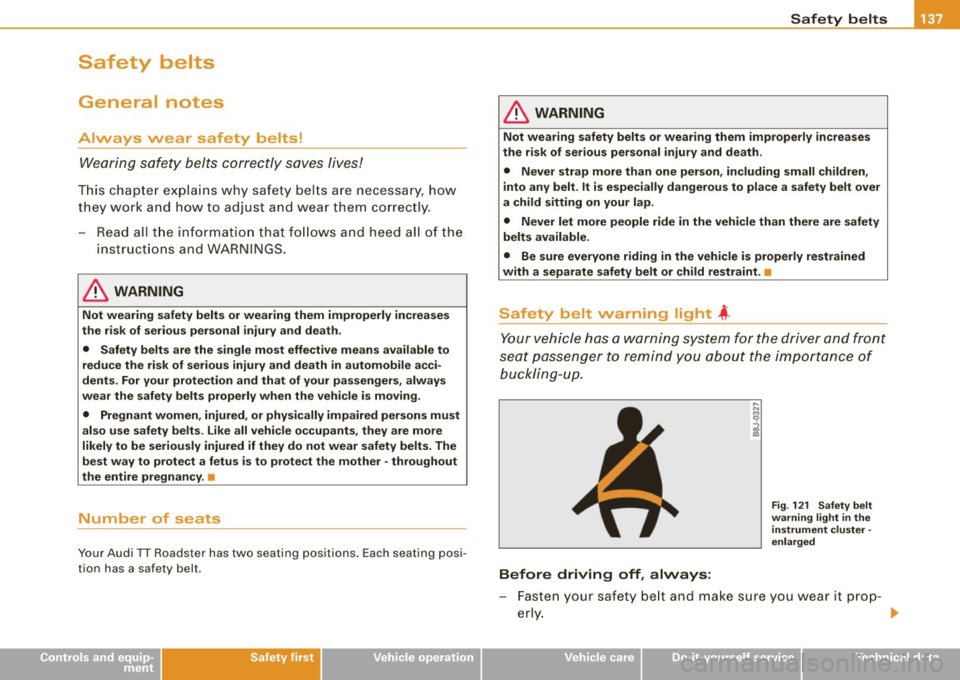
Safety belt warning light .4
Your vehicle has a warning system for the driver and front
seat passenger to remind you about the importance of
buck/ i ng-u p.
Before driving off, always:
Fig . 121 Safety belt
warning light in the
instrument cluster -
enlarged
- Fasten your safety belt and make sure you wear it prop-
erly.
1J,-
Vehicle care Do-it-yourself service Technical data
Page 146 of 316
......... _s_ a_ fe_ ty=-- b_ e _ lt_s ________________________________________________ _
Improperly worn safety belts
Incorrectly positioned safety belts can cause severe inju
ries.
Wearing safety belts improperly can cause serious injury or
death. Safety belts can only work when they are correctly positioned on the body. Improper seating positions reduce
the effectiveness of safety belts and will even increase the
risk of injury and death by moving the safety belt to critical
areas of the body. Improper seating positions also increase
the risk of serious injury and death when an airbag deploys
and strikes an occupant who is not in the correct seating
position. A driver is responsible for the safety of all vehicle
occupants and especially for children. Therefore:
- Never permit anyone to assume an incorrect sitting posi
tion in the vehicle while traveling~&.
& WARNING
Improperly worn safety belts increase the risk of serious personal
injury and death whenever a vehicle is being used.
• Always make sure that all vehicle occupants are correctly
restrained and stay in a correct seating position whenever the
vehicle is being used.
• Always read and heed all WARNINGS and other important infor
mation =>
page 140. •
Safety belt tensioners
How safety belt pretensioners work
In front and side collisions above a particular severity,
safety belts in use are tensioned automatically.
The safety belts are equipped with safety belt pretensioners . The
system is activated by sensors in front and side collisions of great
severity . This tightens the belt and takes up belt slack=>&. in
"Service and disposal of safety belt pretensioner". Taking up the
slack helps to reduce forward occupant movement during a colli
sion.
[ i] Tips
The safety belt pretensioner can only be activated once.
• In minor frontal and side collisions, in rear-end collisions, in a
rollover and in accidents involving very little impact force, the safety
belt pretensioner are not activated.
• When the safety belt pretensioner is activated, a fine dust is
released. This is normal and is not caused by a fire in the vehicle.
• The relevant safety requirements must be observed when the
vehicle or components of the system are scrapped . A qualified deal
ership is familiar with these regulations and will be pleased to pass
on the information to you.
• Be sure to observe all safety, environmental and other regula
tions if the vehicle or individual parts of the system, particularly the
safety belt or airbag, are to be disposed. We recommend you have
your authorized Audi dealer perform this service for you. •
Page 147 of 316
_________________________________________________ S_ a_f _e _t .:..y _ b_ e_lt_ s __ llll
Service and disposal of safety belt
pretension er
The safety belt pretensioners are parts of the safety belts on your
Audi. Installing, remov ing, servic ing or repair ing of belt preten
sioners can damage the safety be lt system and prevent it from
working correctly in a coll ision.
T here are some important things you have to know to make sure
that the effectiveness of the system will not be impaired and that
discarded components do not cause injury or po llute the environ
ment .
& WARNING
Improper car e, servicing and repair proc edure s can incr ease the
ri sk of p ers onal injury and d eat h by pre venting a safety b elt
pret ensioner from activating whe n ne eded o r activating it un ex
p ec tedly :
• The belt preten sioner sy stem can be activated only once. If belt
p reten sion ers ha ve been activated , the syste m mu st be repl aced.
• Never repair , adju st, or chan ge any parts o f the safet y belt
s y stem .
• Safety belt sy stem s includin g safety belt preten sion ers cannot
be r epaired . Spe cial pro cedure s are requ ired for r emoval , in sta lla
tion and di spo sal of t his sys tem .
• For an y wor k on the safet y be lt sy stem , we strongl y rec om
mend that you see your authori zed Audi de aler or qua lifi ed techni
cian w ho has an Aud i appro ved rep air m anu al, t ra ining a nd spe cial
equipment n ece ssa ry.
W For the sake of the environm ent
Undeployed airbag modu les and pretensioners might be c lassified
as Perchlorate Material -special handling may apply, see
www .dtsc .ca .gov/hazardouswaste/perchlorate. When the vehicle or
Controls and equip ment Safety first Vehicle operation parts of the restraint system including airbag modules safety belts
with pretensioners are scrapped, a ll applicable laws and regu la
tions must be observed. Your authorized Audi dealer is familiar with
these requirements and we recommend that you have your dea ler
perform this service for you. •
Vehicle care Do-it-yourself service Technical data
Page 149 of 316
________________________________________________ A_ i_ r _b _a_, g:::.,_ s..., y'- s_ t_ e_ m ___ !II
repair costs or even the lack of vehicle damage is not necessari ly an
indication of whether an airbag should inflate or not.
It is not possible to define a range of vehicle speeds that will cover
every possible kind and ang le of impact that wil l always trigger the
airbags, since the circumstances wil l vary considerab ly between
one collision and another. Important factors include, for example,
the nature (hard or so ft) of the object which the car hits, the angle
of impact, vehicle speed, etc. The front airbags wi ll also not inflate
in side or rear co llisions, or in roll -overs .
Al way s rem ember : Airbags wi ll deploy only once, and on ly in certain
kinds of coll isions . Your safety belts are always there to offer protec
tion in those situat ions in wh ich airbags are not supposed to deploy,
or when they have already deployed; for example, when your vehic le
strikes or is struck by another a fter the first coll ision.
T his is just one of the reasons why an airbag is a supplementary
restraint and is not a substitute for a sa fety be lt. The airbag system
works most effectively when used with the safety be lts. Therefore ,
a lways prope rly wea r your safety belt s =>
page 137 .
& WARNING
Sitting too clo se to the steering wheel or in strument panel will
de crease the effect ivene ss of the airbags and will incr ease the risk
of personal injury in a collision.
• Never sit closer than 10 in ches (25 cm) to the steering wheel or
in strument panel.
• If you c annot sit more than 10 in ches (25 cm ) from the steering
wheel , inve stiga te whether adaptive equipment may be available
to held you reach the pedal s and in crease your se ating dist ance
from the steering wheel.
• If you are unrestra ined , leaning forward , sittin g side ways or out
of position in any way , your risk of injury i s much higher .
• You will also receive serious injur ies and could even be killed if
you are up again st the airba g or too clo se to it when it infl ates -
ev en with an Advanced Airbag .
Controls and equip ment Safety first
Vehicle operation
& WAR N IN G ( continued )
• To reduce the ri sk of injury when an airbag inflate s, alw ays
wear safety belt s prope rly~ page 141 , "S afet y belt s".
• If children are not properly re strained , they may be severely
injured or killed whe n an airbag inflates .
• Never let children ride unrestrained or improperly restrained in
the vehi cle . Adju st the front seats properly .
• Alway s sit a s far a s po ssible from the steering wheel or the
instrument panel~ page 1 30, "Proper occup ant se ati ng po si
tions ".
• Alwa ys sit upright with yo ur b ack again st the ba ckrest of your
s eat.
• Never place your feet on the instrument p anel or on the seat .
Alway s keep both feet on the floor in front of the seat to help
prevent serious injurie s to the leg s and hips if the airbag infl ate s.
& WARNING
Airbags that have deployed in a crash must be repla ced.
• U se on ly original equipment airbags app roved by Audi and
installed by a trained technici an who has the n eces sary tool s and
diagno sti c equipment to properly repl ace an y airb ag i n your
vehicle and assure sy stem effectivenes s in a crash .
• Ne ver permit salvaged or re cy cled airb ag s to be in stalled in
your vehicle . •
Child restraints on the front seat -some
important things to know
- Be sure to read the important info rmation a nd head the
WARNINGS for important details about c hildren and
Advanced Airbags~ page
168 . .-,
Vehicle care Do-it-yourself service Technical data
Page 151 of 316
__________________________________________________ A_ i_ r _b _a...; g::- s_ y=--- s_t _e _m __ lllll
& WARNING
A child in a rearward-facing child safety seat installed on the front
passenger seat will be seriously injured and can be killed if the
front airbag inflates -even with an Advanced Airbag System .
• The inflating airbag will hit the child safety seat or infant
carrier with great force and will smash the child safety seat and
child against the backrest, door or roof. • If you must install a rearward facing child safety seat on the
front passenger seat because of exceptional circumstances and
the PASSENGER AIR BAG OFF light does not come on and stay on, immediately install the rear -facing child safety seat in a rear
seating position and have the airbag system inspected by your
Audi dealer .
• Forward-facing child safety seats installed on the front
passenger's seat may interfere with the deployment of the airbag
and cause serious personal injury to the child.
& WARNING
If , in exceptional circumstances, you must install a forward-facing
child restraint on the front passenger's seat:
• Always make sure the forward-facing seat has been designed
and certified by its manufacturer for use on a front seat with a
passenger front and side airbag .
• Never put the forward -facing child restraint up against or very
near the instrument panel.
• Always move the passenger seat into its rearmost position in
the seat's fore and aft adjustment range, as far away from the
airbag as possible before installing the forward -facing child
restraint. The backrest must be adjusted to an upright position .
• Make sure that the PASSENGER AIR BAG OFF light comes on
and stays on all the time whenever the ignition is switched on .
Controls and equip ment Safety first
Vehicle operation
& WARNING
To reduce the risk of serious injury , make sure that the PASSENGER
AIR BAG OFF light will be displayed whenever a child restraint is installed on the front passenger seat and the ignition is switched
on .
• If the PASSENGER AIR BAG OFF light does not stay on , perform
the checks described=>
page 157, "Monitoring the Advanced
Airbag System ".
• Take the child restraint off the front passenger seat and install
it properly at one of the rear seat positions if the PASSENGER AIR
BAG OFF light does not stay on.
• Have the airbag system inspected by your Audi dealer immedi
ately. • Always carefully follow instructions from child restraint manu
facturers when installing child restraints .
& WARNING
If, in exceptional circumstances, you must install a forward or
rearward-facing child restraint on the front passenger's seat :
• Improper installation of child restraints can reduce their effec
tiveness or even prevent them from providing any protection.
• An improperly installed child restraint can interfere with the
airbag as it deploys and seriously injure or even kill the child -
even with an Advanced Airbag System .
• Always carefully follow the manufacturer's instructions
provided with the child safety seat or carrier .
• Never place additional items on the seat that can increase the
total weight registered by the weight -sensing mat and can cause
injury in a crash . •
Vehicle care Do-it-yourself service Technical data
Page 153 of 316
Airbag syst em -----------------=~-
& WARN ING (co ntinued)
is he avier tha n the t ypi ca l o ne -yea r old child i s on the front
p asse nger seat and the othe r con dition s for airba g deploym ent
a re met .
• Accident stat istic s have shown that children are gen era lly safer
i n th e rea r seat ar ea th an in the front se ating posit ion .
• For its ow n sa fet y, a c hild should always ride pr operly
re str ai ned f or it s a ge a nd si ze . •
Advanced front airbag system
Your vehicle is equipped with a front Advanced Airbag System in
compliance with United States Federal Motor Vehicle Safety Stan
dard 208 as applicab le at the time your vehicle was manufactured.
Th e front Advanced Airbag System supplements the safety belts to
provide additional protection for the driver's and front passenger 's
heads and upper bodies in frontal crashes. The airbags inflate only
in frontal impacts when the vehicle deceleration is high enough .
The front Advanced Airbag System for the front seat occupants is not a substitute for your safety be lts. Rather, it is part of the overa ll
occupant restraint system in your vehicle. A lways remember that
the airbag syste m can only help to protect you, if you a re sitting
upright, wearing your safety be lt and wearing it proper ly. This is why
you and your passengers must a lways be proper ly restrained, not
just because the law requires you to be .
The Advanced Airbag System in your vehicle has been certified to meet the " low risk" requirements for 3 and 6 year-old children on the
passenger side and very small adults on the driver side . The low risk
deployment cr iteria are intended to help reduce the risk of injury
through interaction with the front airbag that can occur, for
examp le, by being too c lose to the steering wheel and instrument
panel when the airbag inflates .
Controls and equip
ment Safety first Vehicle operation
I
n addition, the system has been certified to comply with the
"suppression" requirements of the Safe ty Standard, to turn off the
front airbag for infants 12 months old and younger who are restrained on the front passenger seat in child restraints that are
listed in the Standard=>
page 170, "Child restraints and Advanced
Airbags" .
"Suppression" requires the front airbag on the passenger side to be
turned off if:
• a child up to about one year of age is restrained on the front
passenger seat in one of the rear-facing or forward-facing infant
res traints listed in Federal Motor Vehicle Safety Standard 208 with
wh ich the Advanced Airbag System in your vehicle was certified. For
a listing of the child rest raints that were used to certify your
vehic le's compliance with the US Safety Standard=>
page 170,
• weight less than a threshold leve l stored in the cont rol unit is
detected on the front passenger seat.
When a person is detected on the front passenger seat, weighing more than the total weight of a child that is about 1 year old
restrained in one of the rear-facing or forward -facing infant
restraints (lis ted in Federal Motor Vehicle Safety Standard 208 with
which the Advanced Airbag System in your vehicle was certified),
the front airbag on the passenger side may or may not deploy .
The
PA SS EN GER AIR BA G OFF light comes on when the e lectronic
control unit detects a total weight on the front passenger seat that
requires the front airbag to be turned off. If the
PAS SEN GER AIR BAG
OFF
light does not come on, the front airbag on the passenger side
has no t been turned off by the con trol un it and can deploy if the
control unit senses an impact that meets the conditions stored in its
memory .
If the total weight on the front passenger seat is more than that of
a typical 1 year -o ld, but less than the weight of a small adult, the
front a irbag on the passenger side may dep loy (the
PA SS ENGER AIR
BAG OFF
light does not come onl.
For e xample , the airb ag may deplo y if:
Vehicle care Do-it-yourself service Technical data
Page 155 of 316
Airbag syst em -----------------=~-
& WARN ING (co ntinued)
• Make s ure th at the PA SSENGER AIR BAG OFF light come s on
a nd sta y s o n all the tim e whene ver the ign ition i s sw itched on . •
Advanced Airbag System components
The front passenger seat in your vehicle has a lot of very important
parts of the Advanced Airbag System in it. These parts inc lude the
weight -sensing mat, sensors, wiring, brackets, and more. The func
tion of the system in the front passenger seat is checked by the e lec
tronic contro l unit when the igni tion is on. The control unit monitors
the Advanced Airbag System and turns the airbag indicator light on
when a malfunction in the system components is detected . The
function of the airbag indicator light is described in greater detail
below. Because the front passenger seat contains important parts
of the Advanced Airbag System, you must take care to prevent it
from being damaged. Damage to the seat may prevent the
Advanced Airbag for the front passenger seat from doing its job in a crash.
T he front A dvance d Airb ag Syst em con sis ts of th e
following:
• Crash sensors in the front of the vehicle that measure vehicle
acceleration/dece leration to prov ide information to the Advanced
Airbag System about the severity of the crash .
• An electronic control unit, with integrated crash sensors for front
and side impacts. The control unit "decides" whether to fire the
front airbags based on the information received from the crash sensors. The contro l unit a lso "decides" whether the safety belt
pretensioners should be activated .
• A dual -stage Advanced Airbag with gas generator for the driver
inside the steering wheel hub .
• A dual -stage Advanced Airbag and gas generator inside the
instrument pane l for the front passenger .
Controls and equip
ment Safety first Vehicle operation
•
A weight -sensing mat under the upholstery padding of the front
passenger sea t cushion that measures the total weight on the seat .
The information registered is sent continuously to the e lectronic
control unit to regula te dep loyment of the front Advanced Airbag on
the passenger side.
• An airbag monitoring syste m and indica tor l ight in the instru
ment cluster=>
page 157.
• The PASSENGER AIR BAG OFF light comes on and stays on in the
center of the instrument panel=>
page 157, fig. 133 and tells you
when the front Advanced Airbag on the passenger side has been
turned off .
• A sensor be low the safety belt latch for the front seat passenger
to measure the tension on the safety belt . The tension on the safety
belt and the weight registered by the weight -se nsing mat help the
control unit "decide" whether the front airbag for the front
passenger sea t should be turned off o r not =>
page 147, "Child
restraints on the front seat -some important things to know" .
• A sensor in the safety belt latch for the dr iver and for the front
seat passenger that senses whether that safety be lt is latched or not
and t ransmits this information to the electronic control unit.
& WARNING
Damage to the front pa ssenger seat can prevent the front airbag
fr om worki ng properly .
• Improper repair or di sa ssembly of the front pa ssenger and
dri ver seat will prevent th e Adv an ced Airbag Sy stem from func
tioning properly.
• Rep air s to the front p assenger seat must b e perfor med by qu al
ified and properly tra ined work shop per sonnel .
• Never remo ve the fro nt pa ssenger or dr iver se at from the
v ehi cle.
• Nev er remove th e uphol stery from the fron t pass eng er seat.
• Never disas semble or r emove p arts from the seat or di sconne ct
wires from it . ..
Vehicle care Do-it-yourself service Technical data
Page 161 of 316
__________________________________________________ A_ i_ r _b _a...; g::- s_ y=--- s_t _e _m __ lffl!III
under the upho lstery of the seat have been removed from th e front
p assenge r sea t,
• a safety belt extender has not been left in the safety be lt latch for
the fr ont pass enge r se at .
I n addition to the PASSENGER AIR BAG OFF l ight in the center of the
instrument pane l, the message PASSENGER AIR BAG OFF or
PASSENGER AIR BAG ON will br iefly appear in the instrument c luster
display . Thi s is to inform the drive r of the current front passenger
a ir b ag status .•
Important safety instructions on monitoring
the Advanced Airbag System
& WARNING
An airbag system that is not functioning prope rly cannot prov ide
supplemental protection in a frontal crash.
• If the airbag ind icator light comes on , it means that there may
be something wrong with the Advanced Airbag System . It is
possible that the airbag will inflate when it is not supposed to , or
will not inflate when it should.
• Have the airbag system inspected immediately by your Audi
dealer.
& WARNING
If the front airbag inflates , a child without a child restraint, in a
rearward-facing child safety se at or in a forward-facing child
restraint that has not been properly installed will be seriously
injured and can be killed.
• Even though your vehicle is equipped with an Advanced Airbag
System , make certain that all ch ildren , especially 12 years and
younger, always ride on the back seat properly restrained for their age and size .
Controls and equip ment Safety first
Vehicle operation
& WARNING (continued )
• If you must in stall a rearward-facing child safety seat on the
front passenger seat because of exceptional circumstances and
the PASSENGER AIR BAG OFF light does not appear and stay on ,
immediately install the rear -facing child safety seat in a rear
seating posit ion and have the airbag system inspected by your
Audi dealer .
• A tight tether or other strap on a rearward-fa cing child restraint
attached to the front passenger seat can put too much pressure
on the weight-sensing mat in the seat and reg ister more weight
than is actually on the seat. The heavier weight registered can make the system work as though an adult were on the seat and
deploy the Advanced Airbag when it must be suppressed causing
serious or even fatal injury to the child .
• If, in exceptional circumstances, you must in stall a forward
fac ing child restra int on the front passenger seat , always move the
seat into its rearmost position in the seat's fore and aft adjust
ment range , as far away from the airbag as possible. The backrest
must be adjusted to an upright position . Make sure that the
PASSENGER AIR BAG OFF light comes on and stays on all the time
whenever the ignition is switched on .
& WARNING
• If the PASSENGER AIR BAG OFF light does not go out when an
adult is sitting on the front passenger seat after taking the steps
described above, have the airbag system inspected by your Audi
dealer before transporting anyone on the front passenger seat .
[ i ] Tips
I f the wei ght -sens ing mat in the front passenger seat detects an
empty seat, t he fron t airbag o n the pa ssenge r sid e wil l be tu rne d
o ff , and PASSENGER AIR BAG OFF will stay on .•
Vehicle care Do-it-yourself service Technical data
Page 162 of 316
___ A_ ir_ b_ a-g _ s_y _s_ t_ e_ m _________________________________________________ _
Repair, care and disposal of the airbags
Parts of the airbag system are installed at many different places on
your Audi. Ins tal li n g, r em ovin g, s erv ic ing o r re pairi ng a part in an
area of the veh icle can damage a part of an a irbag system and
prev ent th at system from working pr oper ly in a c ollisio n.
There are some important things you have to know to make sure
that the effect ive ness of the system will not be impai red and that
discarded co mpone nts do not cause inju ry or po llute t he env iro n
ment .
& WARNING
Improper care , servicing and repair procedures can increase the
r isk of personal injury and death by preventing an airbag from
deploying when needed or deploying an airbag unexpectedly:
• Never cover , obstruct , or change the steering wheel horn pad
or airbag cover or the instrument panel or modify them in any way.
• Never attach any objects such as cup holders or telephone
mountings to the surfaces covering the airbag units.
• For cle aning the horn pad or instrument panel , use only a soft ,
dry cloth or one moi stened with plain water. Solvents or cleaners
could damage the airbag cover or change the stiffness or strength
of the material so that the airbag cannot deploy and protect prop
erly .
• Never repair , adjust , or change any parts of the airbag system.
• All work on the steering wheel , instrument panel, front seats or
electrical system (including the installation of audio equipment ,
cellular telephones and CB radios, etc .} must be performed by a
qualified technician who has the training and spec ial equipment
ne cessary .
• For any work on the airbag system , we strongly recommend
that you see your authorized Audi dealer or qualified workshop .
• Never modify the front bumper or parts of the vehicle body.
& WARNING (continued)
• Always make sure that the side airbag can inflate without inter
ference :
- Never install seat covers or replacement upholstery over the
front seatbacks that have not been specifically approved by
Audi .
- Never use addit ional seat cushions that cover the areas
where the side airbags inflate.
- Damage to the original seat covers or to the seam in the area
of the side airbag module must always be repaired immedi
ately by an authorized Audi dealer .
• The airbag system can be activated only once . After an airbag
has inflated, it must be replaced by an authorized Audi dealer or
qualified technician who has the technical information , training
and special equipment necessary.
• The airbag sy stem can be deployed only once . After an airbag
has been deployed , it must be replaced with new replacement
parts designed and approved especially for your Audi model
version. Replacement of complete airbag systems or airbag
components must be performed by qualified workshops only .
Make sure th at any airbag service action is entered in your Audi
Maintenance
& Warranty booklet under AIRBAG REPLACEMENT
RECORD .•
Other things that can affect Advanced Airbag
performance
Changing the vehic le 's suspension system can change the way that
th e A dva nced Ai rbag Sys te m p erform s in a c ras h. F or example,
using tire -rim combinations not approved by Audi, lowering the
ve hicle, c hanging the stiff ness of th e sus pensi on, in clud ing the
springs, suspens ion struts, shock absorbers etc . can chang e the
forces that a re measured by the airbag sensor s and sent to the e lec -
tronic control unit. Some suspension changes ca n, for example, .,_