steering wheel AUDI TT ROADSTER 2008 Owner's Manual
[x] Cancel search | Manufacturer: AUDI, Model Year: 2008, Model line: TT ROADSTER, Model: AUDI TT ROADSTER 2008Pages: 316, PDF Size: 70.1 MB
Page 171 of 316
_____________________________________________ C_ h _ il_d _S_ a _ fe_t.....: y'----""
& WARNING
If , in e xceptional circum sta n ce s, y ou mu st in stall a forward -fa cing
c hild re straint on the front pa ssenger' s seat:
• Always m ake sure the forw ard-f acing se at has b een de signed
and cert ified by it s manufa cturer for use on a front seat with a
p ass eng er fro nt and side airbag .
• Alwa ys follow the manufacturer' s instruc tion s provided with
the child s afet y seat or carrier .
• Alway s move the p assenger sea t into it s rearmo st po sition in
the seat's fore and aft adjustme nt r ange , as far a way from the
airbag as po ssible before in stalling the child restraint. The ba ck
rest must be adju sted to an upr ight p osition .
• Alway s m ake sure th at the PASSEN GER AIR BA G OFF l ight
c ome s on and stay s on all the time wheneve r the ignition is
s witched on. •
Advanced front airbag system and children
Your vehicle is equipped with a dual-stage front "Advanced Airbag
System" in comp liance with United States Federal Motor Vehicle
Safety Standard (F MVSS) 208 as applicab le at the t ime your vehic le
was manufactured .
The Advanced Airbag sys tem in yo ur vehicle has been cer tified to
meet the "low -risk" requirements for 3 and 6 year -old children on
the passenger side and small adults on the d river side. The low risk
deployment criteria are intended to reduce the risk of injury through
interaction with the airbag that can occur, for examp le, by being too
close to the steering wheel and instrument pane l when the airbag
inflates . In addition, the system has been certified to comp ly with
the "suppression" requirements of the Safety Standa rd, to turn off
the front airbag for infants up to 12 months who are restrained on
the front passenger sea t in child restraints that are listed in the
Standard .
Controls and equip
ment Safety first Vehicle operation
Even though your vehicle is equipped with an Advanced Airbag
system, a child should always ride in theseat pr operly restrained for
its age and size. The airbag on the passenger side makes the front
seat a potentially dangerous place for a child to ride. The front seat
is not the safest place for a child in a forward -facing child safety
seat . It can be a very dangerous p lace for an infant or a larger child
in a rearward -facing seat. •
Advanced Airbags and the weight -sensing
mat in the front seat
The Advanced A irbag System in your vehicle detects the presence
of an infan t or child in a chi ld rest rain t on the front passenger seat
using the weight -sensing mat in the seat cushion and the sensor
below the safety belt latch on the front passenger seat that
measures the tension on the sa fety belt.
The weight -sensing mat measures total weight of the child and the
child safety seat and a chi ld blanke t on the front passenger seat . The
weight on the front passenger seat is related to the design of the
child res tra int a nd i ts "footprin t", the size and shape o f the b ottom
of the child restraint as it sits on the seat . T he weight of a child
restra in t and its " footprint" va ry for different kinds of ch ild
restraints and for the different models of the same kind of chi ld
restraint offered by child restraint manufacturers .
The weight ranges for the ind ividual types, makes and models of
child restraints that the NHTSA has specified in the Safety Standard
t ogether with the weight ranges of typical infan ts and typica l 1 year
old chi ld have been stored in the control unit of the Advanced
Airbag Sys tem. When a child res traint is being used on the front
passenger seat with a typical 1 year-old chi ld, the Advanced Airbag
System compares the weight measured by the we ight sensing ma t
with the information stored in the e lectronic control unit.
The electronic contro l unit also registers the tension on the front
passenger safe ty bel t. The tension on the safety be lt for the front
passenger seat will be different for an adult who is properly using •
Vehicle care Do-it-yourself service Technical data
Page 187 of 316
the vehicle begins to skid, ESP brakes the appropriate wheel automatical ly .
The vehicle is stabilized again by the forces acting on the wheel during braking. With an oversteering vehicle (tendency for the rear
end to skid out of the curve), the brake application is mainly at the
front wheel on the outside of the curve, with an understeering
vehicle (tendency to run wide in the curve) at the rear wheel on the
inside of the curve or additionally at the other wheels as needed .
This brake application is accompanied by noises.
ESP works in conjunction with ABS=:>
page 189. If there is ma lfunc
tion in the ABS, ESP is also inoperative .
Activa ting
The ESP is automatica lly activated when the engine is started, and
it performs a self-test. As soon as the test is completed, the system
is in normal operating mode . With ASR deactivated, or with ESP/ASR
deactivated, pressing the button=>
page 184, fig. 142 returns the
system to normal operation.
D eac tiva ting
ESP should norma lly be activated at all times because this ensures
optimum vehicle stability . Only in certain exceptional cases it does
make sense to deactivate Anti -Slip Regulation (ASR) or the Elec
tronic Stability Program !ESP) by pressing the button =:>
page 184,
fig. 142. Both deactivation stages can only be activated from normal
mode.
Dea cti vat ing ASR
Tap the switch . Deactivation is indicated by s low flashing of the ESP
lamp in the instrument c luster. In certain situations (e.g. driving
with snow chains, in deep snow or on loose ground, or when rocking the car free), it may be necessary to deactivate ASR. Deacti
vation is effective only up to a speed of about 45 mph (70 km/h). At higher speeds, ASR is switched on again automatical ly in front
whee l drive vehicles, deactivation is possible only up to about 30
mph (50 km/h). With a ll -whee l drive vehicles, ASR is active above
Controls and equip
ment Safety first Vehicle operation
In
te llig ent tec hn olo gy
about 45 mph (70 km/h) and deactivated automatical ly below this
speed.
D eac tiva tin g ES P/ASR
Press the button for more than 3 seconds . Deactivation is indicated
by the ESP lamp in the instrument c luster staying on permanently .
This deactivates the E lectronic Stabi lity Program (ESP) in addition to
ASR . No Electronic Stability System operation and no Anti-Slip
Regu lation is availab le across the entire speed range; ASR and ESP
are activated only when the brakes are used for the duration of the
braking action and remain active until a stab le vehicle condition has
been reached. There is no driving situation which requires ESP to be
deactivated, so this should only be done if the driver's skill and the
traff ic situation permit .
& WARNING
• The limi ts of ph ysics ca nnot be suspe nd ed by E SP. E ven in vehi
cles w ith ESP, you should always adapt your dr iving to road and
tr affi c co ndition s. Thi s is part icul ar ly tr ue on a s lippe ry and wet
road . Do not be te mpt ed b y th e incre as ed safet y prov ided t o ta ke
ri sks - dang er of an accident !
• Plea se note that when ASR or ESP /ASR i s deactivated , the drive
w heel s can spin on icy and slipper y ro ad s and the vehi cle can
break away - da nger of skiddin g!
Ii ] Tip s
In the event of a defect in the rear spoiler system or in Audi
magnetic ride, it can happen that ASR and ASR/ESP cannot be deac
tivated, or they are activated automatica lly in the deactivated
state. •
Vehicle care Do-it-yourself service Technical data
Page 192 of 316
--~ln~t~ e~ l~ li ~g ~e~ n~ t~ te ~ c~h ~n ~ o~ l'..!: o ~g~ yL ________________________________________ _
(ABS control range). In order for ABS to be ab le to operate optima lly
in th is range, you m ust keep the brake pe dal depressed -do not
"pump the brakes" .
Brake ass istant
T he brake power assist unit increases the pressure that you
ge nera te wi th the brake pedal. I t wo rks only whe n the e ngine is
running .
Automatic full braking
This function al lows fu ll braking in spite of high brake pedal forces
(e .g. whe n the b rakes are seve rely s tresse d beca use the veh ic le is
ful ly loaded). The driver notices this function through a reduction of
pedal force a nd i ncrease d pe dal trave l. W hen the brake peda l is
released, fu ll braking assist switches off again automatically .
If there is an ABS fail ure , the brake assistant and automatic fu ll
brak in g ass ist are not ava ilable.
& WARNING
• ABS cannot suspend the la ws of physics . You should keep this
in mind in particular on an icy or wet road . If ABS control of braking
intervenes , you should adjust your speed immediately to road and
traffic condit ions. Do not be tempted by the increased safety
provided to t ake risks -danger of an accident.
• Please keep in mind that the risk of an accident is increased by
dri ving too fast, pa rticularly in bends and on icy or wet roads , and
by driving too close to the vehicle ahead . The increased risk of an
accident cannot be reduced by the brake as sistant - danger of an
accident .
[ i ] Tips
If a ma lfunction occurs in the ABS, this is signa lled by an indicator
lig ht, see
=> page 20. •
Electro-mechanical power assist
-----
The e lec tro -m ec han ical pow er as sis t h el ps th e dri ver
w he n steering.
T he degree of power assist is electronically matched to vehic le
sp eed .
Th e power steering system ass ists the driver so that he can steer the
ve hicle wi th re duced phy sica l eff ort .
P ower steer ing w ill not wo rk if the engine is o ff. As a result, the
steering wheel wi ll be hard to turn.
& WARNING
If the system develops a problem, you must seek qualified profes
sional assistance .
0 Note
If there is an electronic ma lfunction , servotronic will still funct ion
l ike a conventional power stee ring system, providing a constant
steer in g suppo rt fo rce t hat is no lon ge r proportionate to t he veh icle
speed . This is most noticeable when turning the steering wheel at
lo w spe eds (fo r examp le w hen park ing), -mo re effor t will be
required than usual.
• B e awa re of the d iffer ent than usua l ste ering response and
adjust your steering force accordingly.
• H ave the problem chec ked and set ri ght by an authorized Audi
dea ler as soon as possible .
• I f a steering ma lfunct ion occurs, this is signaled with the~ or.
@ in d ica to r ligh ts and a war ning tone, see . ._
Page 193 of 316
![AUDI TT ROADSTER 2008 Owners Manual [ i ] Tips
• If the pow er st eering sy stem sho uld fa il, or if the e ng ine is not
running (for examp le , whi le being towed), you will stil l be able to
st eer the ve hicl](/img/6/57671/w960_57671-192.png "AUDI TT ROADSTER 2008 Owners Manual [ i ] Tips
• If the pow er st eering sy stem sho uld fa il, or if the e ng ine is not
running (for examp le , whi le being towed), you will stil l be able to
st eer the ve hicl")
[ i ] Tips
• If the pow er st eering sy stem sho uld fa il, or if the e ng ine is not
running (for examp le , whi le being towed), you will stil l be able to
st eer the ve hicle . How eve r, more e ffort w ill be required to do so.
• I f the powe r steering system is not f unctioning pr ope rly, contact
your authorized Audi dea ler immediate ly.
Ap plies to vehicles : wit h A ll Wheel Driv e
Driving w ith your quattro®
With All Wheel Drive, all four w heels ar e dri ven.
General information
With All W hee l Dr ive, power is d is tr ibute d to all fou r whee ls . T his
happens automat ica lly depending on your driving style and the
r oad cond itio ns at the time. See also =>
page 186, "E lec tronic diffe r
entia l lock ( EDU" .
Winter tires
When driving in the winter, your vehic le with All Wheel Drive has an
advantage, even wi th regula r t ir es . In winter road conditions it may
be advisable to mount winter tires (or all -season tires) for improved
driveabi lit y an d braking : these tires m ust be mounted on
all four
wheels .
See also=> page 254 , "Win ter t ires" .
Snow chains
Where tire cha ins are mandatory on certain roads, this normally
a lso a pplies t o vehic le s wi th Al l Wheel Drive =>
page 255, "Sn ow
chains".
Replacing wheels /tires
Vehicles with A ll Wheel Drive must always have tires of the same
s iz e. Also av oid t ires w it h d iff eren t tr ead dep ths. For details see
page=>
page 249, " New tires and replacing tires and whee ls " .
Controls and equip
ment Safety first Vehicle operation
Intelligent technology
Off
-Road driving?
Your Audi d oes not have en ough gr ound clea rance to be use d as a n
off -road vehicle. It is therefore best to avoid roug h tracks and
u neven terrain as much as possible. A lso refer to=>
page 194.
& WARNING
Always adjust your driving to road and traffic conditions. Do not
let the extra safety afforded by All Wheel Drive tempt you into
taking extra risks .
• Although the All Wheel Drive is very effective , always
remember that braking capacity is limited by tire traction. You
should therefore not drive at e xcessive speeds on icy or slippery
road surfaces.
• On wet road su rfaces , be careful not to dr ive too fast because
the front wheels could begin to slide on top of the water (aqua
planing ).
If this should occur , you will have no warning from a
sudden increase in engine speed as with a front -wheel drive
vehicle . Always d rive at speeds which are suited to the road condi
tions. -risk of cra sh. •
Vehicle care Do-it-yourself service Technical data
Page 241 of 316
________________________________________________ T_ i _r_e _s_ a_n_ d_ w_ h_ e_e _ l_s __ l'III
•
& W ARNING (continu ed )
crashes and serious personal in jur ies . Have worn or da maged t ires
replaced immediately .
• Tires age even if they are not being u sed and can fail suddenly ,
especially at high speeds. T ires that are more than 6 years old can
only be used in an emergency and then w ith special care and at
low speed.
Glossary of tire and loading terminology
Accessory weight
means the co mbined we ig ht ( in excess o f those sta nda rd items
which may be rep laced) of automatic transmission, power steering,
power brakes, power w indows, powe r seats, rad io, a nd heater, to
the extent that these items are avai lab le as factory-installed equip
m ent (w hether insta lled or not).
Aspect ratio means t he ratio o f th e height to t he w idt h of the tire in perce nt.
N umbers of 55 or lower indicate a low sidewa ll for improved
steer ing respo nse and b ette r overall ha ndl ing on dry pave ment.
Bead
means the part of the tire that is made of stee l wires, wrapped or
reinforced by ply cords and that is shaped to fit the rim.
Bead separation
means a breakdow n of the bond be tween co mponents i n the bead.
Cord
m eans the strands fo rmi ng the plies in the ti re.
& W ARNING (continued )
• Never mount used tires on your vehicle if you are not sure of
their "previous history. " Old used t ire s may ha ve been damaged
even though the damage cannot be seen that can lead to sudden
tire failure and lo ss of vehicle control.
• If you noti ce unusual vibration or if the vehicle pulls to one side
when driving , always stop as soon as it is safe to do so and check
the wheels and tires for damage . •
Cold tire inflation pressure
mea ns t he ti re pressure reco mm ended by the ve hicle ma nufacturer
for a tire of a designated size that has not been d riven for more tha n
a cou ple o f miles (k ilometers) at low speeds in t he t hre e ho ur per iod
before the tire pressure is measured or ad justed .
Curb weight
means the weight of a moto r vehic le with standard equipment
i nc lud ing the max imu m capac ity o f fue l, o il, and coola nt, a ir c ond i
tioning and additiona l weight of optional equipment.
Extra load tire
means a tire designed to ope rate at higher loads and at higher infla
tion pressures than the corresponding standard tire. Extra load tires
my be identified as "XL", "xi", "EX TRA LOAD", or "RF" on the side
wa ll.
Gross Axle Weight Rating ("GAWR ")
means the load -carrying capacity of a sing le ax le system, measured
at the ti re -ground interfaces.
Gross Vehicle Weight Rating ("GVWR "l
mea ns the ma ximum tot al l oade d weigh t of the vehicle.
Vehicle care
I t •
Page 250 of 316
___ T_ i_ r_e _s_ a_ n_ d_ w_ h_ e_ e _ ls _________________________________________________ _
Check the tire sidewall (=> page 249,
fig. 164) to determine the designated
load rating for a specific ti re. •
Tire service life
The service life of tires depends on a lot of different things
including proper installation and balancing, correct tire
pressure and driving style.
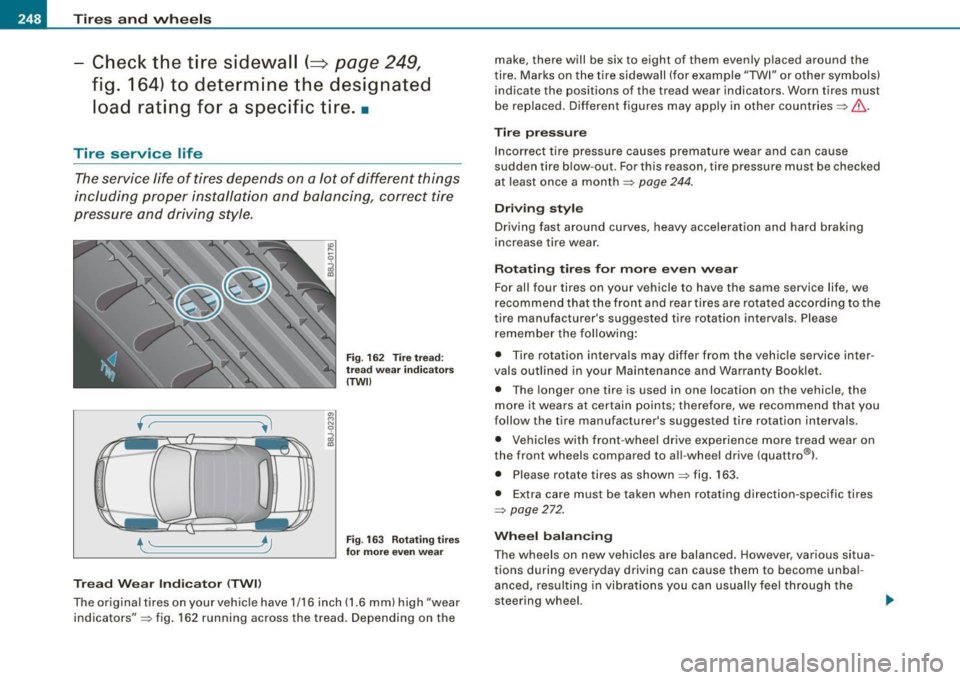
Tread Wear Indicator (TWll
"' M
J
Fig. 162 Tir e tread:
tre ad we ar indi cator s
(TWll
Fig . 163 Rotating tires
for more even wear
The original tires on your veh icle have 1/16 inch (1.6 mm) high "wear
indicators" => fig . 162 running across the tread. Depending on the make, there will be six to eight of them evenly p
laced around the
t ire. Marks on the tire sidewall (for example "TWI" or other symbols)
indicate the positions of the tread wear indicators. Worn tires must
be rep laced. Different figures may apply in other countries =>& .
Tire p ressure
Incorrect tire pressure causes premature wear and can cause
sudden tire blow-out . Forth is reason, tire pressure must be checked
at least once a month
==> page 244.
Driving style
Driving fast around curves, heavy acceleration and hard braking
increase tire wear.
Rotating tires for more even wear
For all four tires on your vehicle to have the same service life, we
recommend that the front and rear tires are rotated according to the
tire manufacturer 's suggested tire rotation intervals. Please
remember the following:
• Tire rotation interva ls may differ from the vehicle service inter
vals outlined in your Maintenance and Warranty Booklet .
• The longer one tire is used in one location on the vehicle, the
more it wears at certain points; therefore, we recommend that you
follow the tire manufacturer's suggested tire rotation intervals.
• Vehicles with front-wheel drive experience more tread wear on
the front wheels compared to a ll-wheel drive (quattro®l .
• Please rotate tires as shown ;;:;:, fig. 163.
• Extra care must be taken when rotating direction -specific tires
==> page 272.
Wheel balancing
The wheels on new vehicles are balanced. However, various situa
tions during everyday driving can cause them to become unbal
anced, resulting in vibrations you can usual ly feel through the
steering wheel. ...
Page 251 of 316
__________________________________________________ T_ ir_e _ s_ a_ n _ d_ w_ h_ e_ e_ls _ ____. 111111
Unbalanced wheels must be rebalanced to avoid excessive wear on
steering, suspension and tires. A wheel must also be rebalanced
when a new tire is installed.
Incorrect wheel alignment
Incorr ect wheel alignment can cause excessive tire wear, impairing
the safety of the vehicle. If tires show excessive wear, have the
wheel alignment checked by an authorized Audi dealer or qualified
workshop.
All Wheel Drive
Vehicles with quattro ® must always have tires of the same size,
construction and tread type. For details see
=> page 191.
& WARNING
Sudden tire failure can lead to loss of control, a crash and serious
personal injury!
• Never drive a vehicle when the tread on any tire is worn down
to the wear indicators .
• Worn tires are a safety hazard, they do not grip well on wet
roads and increase your risk of "hydroplaning" and loss of control .
• Always keep chemicals that can cause tire damage, such as
grease, oil, gasoline and brake fluid away from tires .
• Tires age even if they are not being used and can fail suddenly,
especially at high speeds . Tires that are more than 6 years old can
only be used in an emergency and then with special care and at
lower speeds.
• Never mount used tires on your vehicle if you are not sure of
their "previous history ." Old used tires may have been damaged
even though the damage cannot be seen that can lead to sudden
tire failure and loss of vehicle control. •
New tires and replacing tires and wheels
New tires and wheels have to be broken in.
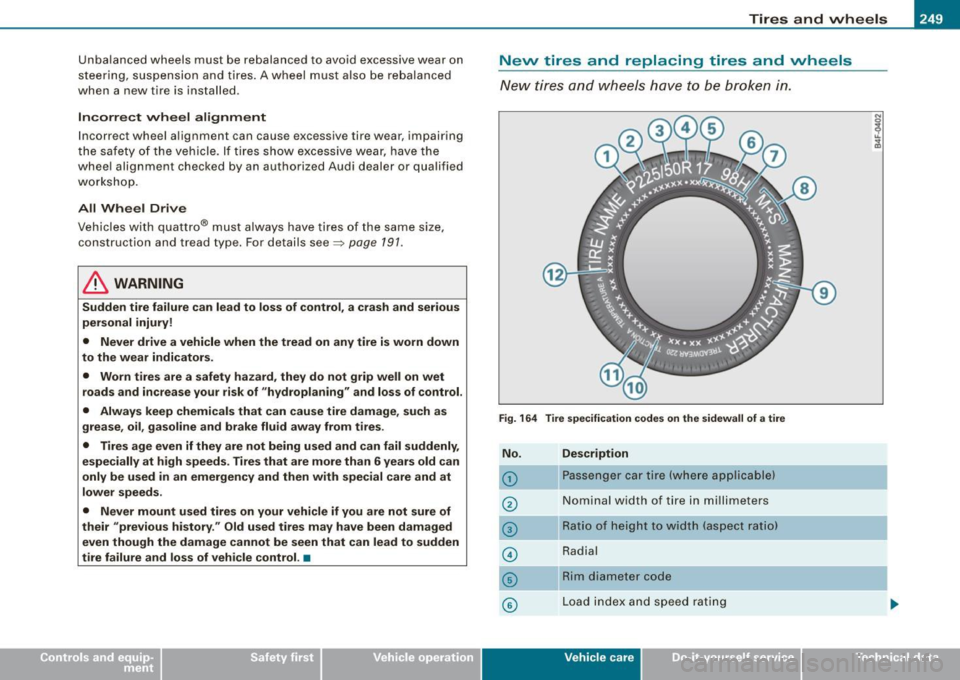
Fig. 164 Tire specification codes on the sidewall of a tire
No.
©
0
©
©
©
©
Description
Passenger car tire (where app licable)
Nominal width of tire in mi llimeters
Ratio of height to width (aspect ratio)
Radial
ii Rim diameter code
Load index and speed rating
Vehic le care
I I irechnical data
Page 260 of 316
-Tires and wheels
---------------------------------------------
& WARNING
Improper use of run-flat tires can cause vehicle damage that can
lead to loss of vehicle control, a crash and serious personal injury.
• Run-flat tires can only be used with special rims.
• Run -flat tires must always be monitored with a properly
programmed Tire Pressure Monitoring System.
• Always inspect a tire that has lost air to make sure it is safe to
drive with the tire in the run-flat mode .
• Never drive with run-flat tires that have been damaged in a
collision.
• Never drive with run-flat tires if heat build-up causes the tire to
give off smoke.
• Never drive with run-flat tires if the vehicle shakes or vibrates
severely.
• Never drive with a run-flat tire that develops sidewall cracks or
other damage while in use.
0 Note
Run -flat tires have special characteristics and requirements, that are
very different from conventional tires . Run-flat tires require special
rims for run -flat use and cannot be used on conventional wheel
rims .
[ i] Tips
• If you are not able to continue driving with run-flat tires, please
seek professional assistance.
• Please contact your authorized Audi dealer or Audi of America,
Inc. if you have questions about tires and rims. •
Applie s t o vehic le s: wi th Run -flat tires
Driving with run-flat tires
Handling characteristics change when tire pressure is
low.
Driving on tires with low tire pressure changes the way a
vehicle handles, particularl y when cornering and braking.
The handling characteristics of run-flat tires do not seem to
change a lot even when driving on low pressure or in the
run -flat mode . Nevertheless you must still take special
precautions when operating a vehicle on run-flat tires when
tire pressure is low o r the tire(s) is flat:
- The Electronic Stabilization Program (ESP) must be
switched on.
- Never drive faster than 50 mph (80 km/h)~ &.
- Plan ahead when driving and anticipate what you will
have to do considering traffic and road conditions up
ahead.
- Accelerate carefully.
- Avo id unnecessary and sudden steering and braking
maneuvers .
- Reduce your speed in plenty of time before intersections,
curves and other places where you may have to react
quickly.
P lease see:=:, page 257, "When it is not possible to continue driving,
even with run-flat tires?" ..,_
Page 302 of 316
___ A---" lp_h_ a_b_ e_ t_ i_ c _ a_ l_ in_d_ e_x ______________________________________________ _
A
A/C operation
Climate control
ABS 102
See Anti -Lock Brake System . . . . . . . . 189
Accessories . . . . . . . . . . . . . . . . . . . . . . . . 296
Acoustic park assist rear .. .... .. ... ... ....... .... .. .
Acoustic parking system
Adaptive Light 109
109
defective . . . . . . . . . . . . . . . . . . . . . . . . 36
Adaptive light . . . . . . . . . . . . . . . . . . . . . . . 72
Adding Engine coolant ... .... ........... 228
Engine oil ....................... 225
Windshield washer fluid . . . . . . . . . . 236
Additiona l accessories .. ...... ...... . 296
Additives Engine oi l ....................... 225
Adjustable steering column .......... 105
Adjusting front seats ... .. .... .... .... 87
Adjusting steering column ...... .. ... 105
Adjusting the seats ...... .... ........ 89
Advanced Airbag System Children ........................ 169
Components .. .................. 153
Front airbags ......... .... ...... . 151
How the components work together 154
Monitoring . . . . . . . . . . . . . . . . . . . . . . 157
Weight -sensing mat .. .. .. .... .... 169 Air distribution
Climate control
Air recirculation mode Climate control ...... .... ... .. .. .
Air vents Climate control
Airbag 101
102
102
Warning/indicator lights ..... ...... 19
Airbag system . . . . . . . . . . . . . . . . . . 146, 165
Care ... ........... .... .... ...... 160
Child restraints ............ .... .. 170
Components (front airbags) .. ... ... 153
Danger of fitting a child safety seat on the front passenger seat . . . . . . . . . . . . 147
Disposal . . . . . . . . . . . . . . . . . . . . . . . . 160
Front airbags ................. ... 150
How do the front aiirbags work? . . . . 155
How many airbags does my vehicle have?
153
Important safety instructions on the knee airbag system .......... ....... . 163
Important things to know ......... 146
Indicator light .. ..... ....... ..... 157
Knee a irbags .. ...... ......... ... 161
Monitoring . . . . . . . . . . . . . . . . . . . . . . 157
PASSENGER AIR BAG OFF light ... .. 157 Alternator
See Generator . . . . . . . . . . . . . . . . . . . . 19
Anti -freeze
See Engine coolant system ...... .. 227
Anti-glare inside day-night mirror ...... 82
Anti-Lock Brake System .............. 189
Anti -lo ck brake system
Warning/indicator lights . ...... .... . 20
Anti-Slip Regulation System (ASR) How the system works . . . . . . . . . . . . 186
Anti-theft systems Anti-Theft Alarm System ........... 56
Electronic immobilizer ............. 49
Ashtray .............. ........... .... 94
ASR How the Anti-Slip Regu lation System
works ......................... 186
Asterisk What does it mean when something is
marked with an asterisk? ... .... .... 6
Audi magnetic ride .... .... ..... .. 17, 112
Description .... .... .... ...... .... 112
Indicator light .... .... ............ 17
Audi Service Repair Manuals and Literature .
294
Repairs .. .... ....... ...... .... .. 160 Auto Safety Hotline . .... .... .... ..... 136
Side airbags . ........ ....... ..... 164 Auto-Check Contro l ................... 29
When must the system be inspected? . . . Automatic transmission ............ 31
157 Auto-Check -Control
All Wheel Drive . . . . . . . . . . . . . . . . . . . . . 191
Alloy wheels . . . . . . . . . . . . . . . . . . . . . . . 207 Manual
transmission
Automatic belt retractor 31
141
air conditioning All-wheel drive Automatic car wash
Temperature .. ............ ... ... 100 Winter tires ..................... 254 See Washing .................. .. 201
Page 303 of 316
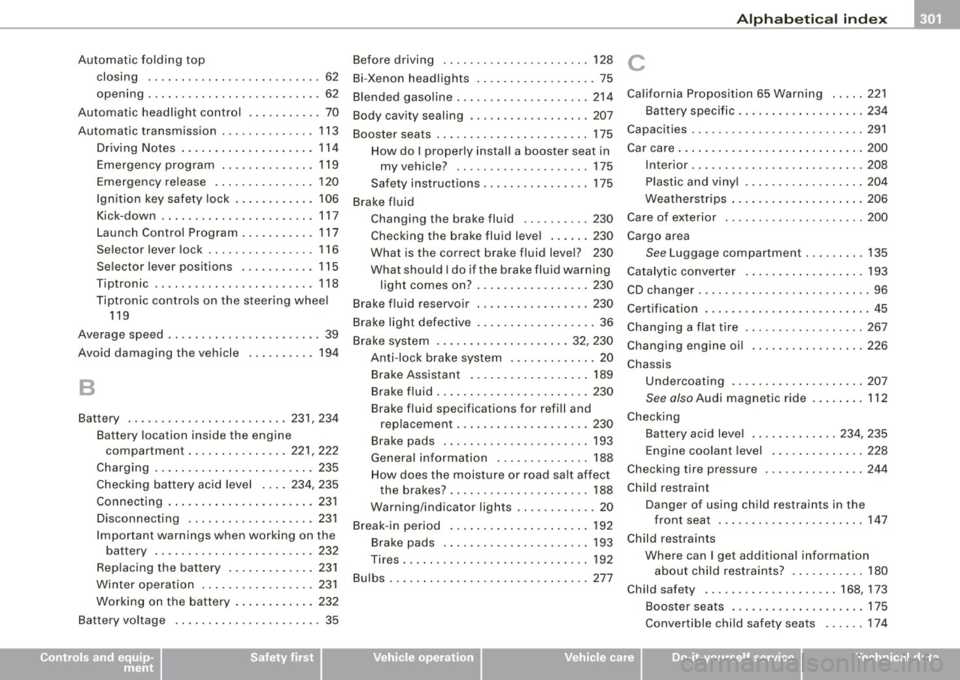
______________________________________________ A_ l.:.. p _h_ a_ b_e _t_ic _ a _ l _in _ d_e _ x __ _
Automatic folding top
closing .. .... .... ....... ..... ... . 62
opening ... ... ... .... .... ... .... .. 62
Automatic headlight control .. ......... 70
Automatic transmission .. .... .... .... 113
Driving Notes ......... .... .. ..... 114
Emergency program .... ...... .... 119
Emergency release . . . . . . . . . . . . . . . 120
Ignition key safety lock . ...... ..... 106
Kick -down .. ... .. .... .... ...... .. 117
Launch Control Program ........... 117
Selector lever lock ........ .... .... 116
Selector lever positions .... ..... .. 115
Tiptronic ... .. .... .... ... .... .... 118
Tiptronic controls on the steering wheel
119
Average speed ... ... ..... ... .... .... . 39
Avoid damaging the vehicle ..... .... . 194
B
Battery .. ... .... .... .... ..... .. 231, 234
Battery location inside the engine
compartment . ...... .... .... 221, 222
Charging ........................ 235
Checking battery acid level .. .. 234, 235
Connecting ...................... 231
Disconnecting .... .... .... ...... . 231
Important warnings when working on the
battery ........................ 232
Replacing the battery .. .......... . 231
Winter operation ................. 231
Working on the battery ... .... .... . 232
Battery voltage . .... .... .... ... .... .. 35
Controls and equip
ment Safety first
Before
driving . .... . .. ... ... ........ 128
Bi -Xenon headlights .................. 75
Blended gasoline . ... .... .... .... .... 214
Body cavity sealing ...... ...... ... .. . 207
Booster seats .. ...... .... .... .... ... 175
How do I properly install a booster seat in
my vehicle? . .......... .... ... .. 175
Safety instructions . .... .... ... .... 175
Brake fluid Changing the brake fluid .. ........ 230
Checking the brake fluid level ...... 230
What is the correct brake fluid level? 230
What should I do if the brake fluid warning
light comes on? ... .. .... .... .... 230
Brake fluid reservoir . ...... ...... .... 230
Brake light defective ........ .... .... .. 36
Brake system ... ... .. .... ........ 32, 230
Anti-lock brake system .. ....... .... 20
Brake Assistant ........ ... .. .... . 189
Brake fluid ................... .... 230
Brake f luid specifications for refill and
replacement .... ...... ...... .... 230
Brake pads ... ... .... .... .... .... 193
General information .............. 188
How does the moisture or road sa lt affect
the brakes? ..... ...... ...... .... 188
Warning/indicator lights .. ...... .... 20
Break -in period ...... ...... ... .. .... 192
Brake pads ...................... 193
Tires .. .... .... ... .... .... .... ... 192
Bulbs .... ... .... .. . .. .............. 277
C
California Proposition 65 Warning . .... 221
Battery specific .... ... .... .... .... 234
Capacities ... .... ........ ... .... .... 291
Car care ... .... ... .. .... .... .... .... 200
Interior ..... .... .. .... ........... 208
Plastic and vinyl .................. 204
Weatherstrips ..... .... ...... ..... 206
Care of exterior .. .... ....... ........ 200
Cargo area
See Luggage compartment . ... .... . 135
Catalytic converter ...... .... .... .... 193
CD changer ..... .... .... .... .... ..... 96
Certification ...... ... .... ...... ...... 45
Changing a flat tire ... .... .... ....... 267
Changing engine oil ............. .... 226
Chassis Undercoating .... ..... ... .... .... 207
See also Audi magnetic ride .... .... 112
Check ing
Battery acid level ......... ... . 234, 235
Engine coolant level .............. 228
Checking tire pressure . ... .... .... ... 244
Child restraint
Danger of using child restraints in the front seat .... ... .... .... .... ... 147
Child restraints Where can I get additional information
about chi ld restraints? ... ........ 180
Child safety ...... .... ... .... ... 168, 173
Booster seats .... .... .... .... ... . 175
Convertible child safety seats ... ... 174
Vehicle operation Vehicle care Do-it-yourself service Technical data